
The complete guide to the Germany digital nomad visa and freelance alternatives

SwappaHome Editorial Team
Home Exchange & Slow Travel Editorial
Key Takeaways Navigating the path to working remotely in Europe's largest economy requires understanding specific legal frameworks, as no universal nomad…
Key Takeaways
Navigating the path to working remotely in Europe's largest economy requires understanding specific legal frameworks, as no universal nomad permit exists. Successful applicants combine diligent preparation with a deep understanding of local compliance.
- Germany lacks a single, dedicated digital nomad entry permit for non-EU travelers.
- The Freiberufler visa serves as the primary pathway for independent local income generation.
- Official residential registration, known as Anmeldung, is mandatory for all residency applications.
- Applicants must demonstrate genuine economic interest or client demand within the German borders.
- Sustaining long-term residency requires strict adherence to local tax and social security obligations.
Understanding the reality of the Germany digital nomad visa
Many professionals dream of living in Europe, but the regulatory landscape is far more complex than simple marketing suggests. While remote work is increasingly common, national immigration laws often lag behind, leaving gaps that require careful negotiation. It is a common misconception that a single, golden ticket exists for location-independent workers to move freely into the country and operate as they would back home.
Dispelling the myth of a dedicated digital nomad entry permit
If you search for a germany digital nomad visa, you will quickly find that no such official program currently exists in the country's immigration code. The government has prioritized stability and local workforce integration over broad, temporary entry for nomadic workers. Those who enter on short-term Schengen stays often find themselves unable to transition into long-term residency without exiting and applying through specific channels from abroad.
The legal reality of the German freelance visa (Freiberufler)
The most viable path for many is the Freiberufler visa, which is designed for liberal professions like writers, educators, and software engineers. This status requires you to operate as a self-employed individual who generates income through independent intellectual labor rather than commercial trade. It is a rigorous process that demands proof that you are not merely a digital guest, but someone building professional roots locally.
Comparing self-employment visas with temporary tourism rules
Visitors from many countries may enter visa-free for tourism, but these rules strictly prohibit any form of gainful activity. If you want to work, even for a foreign client, you must secure a formal residency permit. Mistaking a tourist-accessible entry window for a remote work period is a frequent and costly mistake that can lead to being barred from the country or rejected for future residency.
How German residency laws categorize remote workers
German law divides foreign workers into specific buckets, generally favoring those who contribute to the local economy. Remote workers often struggle here, as the authorities expect tax revenue and professional integration that exceeds what a traditional digital nomad provides. Resources like [5c06] highlight how important it is to distinguish between your status as a traveler and your status as a taxable resident.
Eligibility and application requirements for remote workers
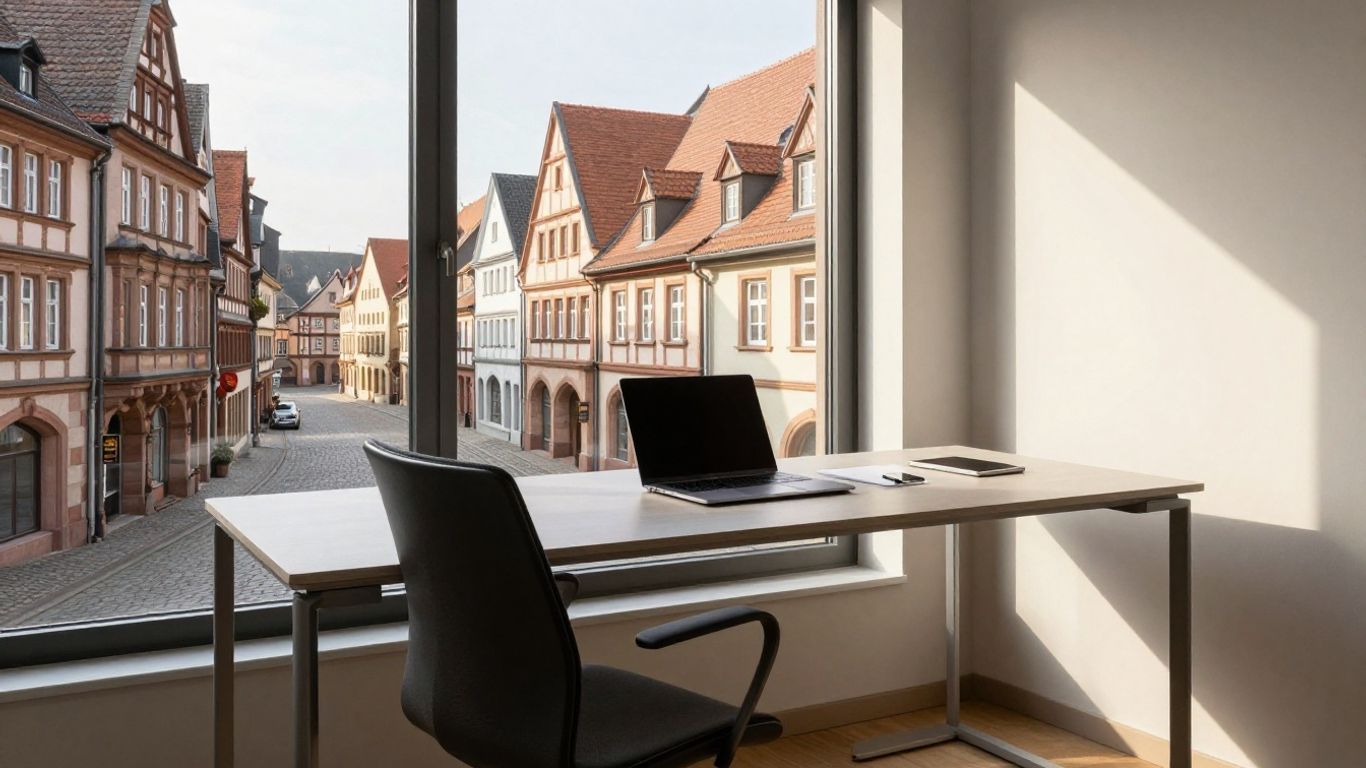 Professional workspace with German architectural view
Qualifying for a freelance visa means proving that your work has direct relevance to the local marketplace. It is not enough to show that you have a remote income; you must demonstrate how your services are needed and who in the local economy will be purchasing them. This transition from 'nomad' to 'freelance practitioner' defines your success.
Defining the difference between liberal professions and commercial businesses
Liberal professions are defined by their independence and specialized knowledge compared to a commercial trade, which might involve buying and selling goods. To qualify as a freelancer, you must remain distinct from an entrepreneur who creates a company with employees and significant physical infrastructure. Understanding this nuance changes how your application is reviewed at the local office.
Documenting professional qualifications and portfolio evidence
Your portfolio is the most critical piece of evidence during the review process. You need to present work that proves not only your skill, but also your ability to thrive independently in the local environment. When gathering these materials, consider the following checklist to ensure you meet the local standard of professionalism:
- Valid proof of degree and certification for your specific field.
- A signed letter of intent from at least one German-based client.
- A detailed personal curriculum vitae covering recent professional history.
- Professional references translated by a certified German translator.
Proving a demand for your services within the German economy
The authorities want to know exactly who will use your services, and why they should choose you over a local professional. You might need to provide a revenue forecast or preliminary service agreements that suggest you will be active within the local business ecosystem.
Meeting the mandatory health insurance and financial stability criteria
Financial stability, or "Lebensunterhaltssicherung," is calculated based on rent, insurance premiums, and living costs at the local poverty-prevention standard. You must provide a plan that includes:
| Item | Requirement for Approval |
|---|---|
| Proof of Funds | Bank statement for three previous months |
| Health Coverage | Must be a recognized German or international plan |
| Income Projection | Contracts or estimates covering current expenses |
Failure to provide precise numbers for these categories will often result in an immediate pause or rejection of your initial residency petition.
Navigating German bureaucracy for your residency permit
Bureaucracy in this country is famously paper-driven and process-obsessed, requiring patience and extreme attention to detail. Appointments at the local Ausländerbehörde are the final gatekeepers for your residency aspirations. Ensuring you arrive with every requested document in physical form is non-negotiable for approval.
Preparing for your appointment at the local Ausländerbehörde
Every appointment requires a specific set of forms, usually provided by the local municipality. You must also have your passport, recent biometric photos, and proof of residence ready to present to the officer on the day of your interview.
Compiling your comprehensive business plan for approval
Your business plan should read as a roadmap rather than a sales pitch. It must articulate your target market, the way you intend to pay taxes, and how you will scale your income to meet the thresholds for renewal. This document often serves as the deciding factor in whether you are granted a long-term permit or a brief, one-year trial.
Managing tax residency and local tax office registration
Once you arrive, you must register with the Finanzamt to receive your tax ID number. You are essentially a local business owner once this occurs, and you must maintain impeccable records of your income and VAT if applicable. Utilizing advice from [6ec6] regarding your planning workflows can help you stay ahead of these administrative deadlines.
The essential importance of obtaining an official home address (Anmeldung)
Anmeldung is the foundational act of becoming a resident. It permits you to access banking, health insurance, and administrative services. If you require assistance finding a location to call home, platforms like [b223] offer resources for finding reliable spaces, though you must ensure your registered address is permanent enough to receive government correspondence.
Living in Germany as a remote professional
 Co-working cafe scene in a historic German building
Living in a place like Berlin or Munich demands that you lean into the local rhythm rather than trying to replicate the life you left behind. Establishing a daily routine in a city where Sunday is a day of rest requires a shift in how you schedule your remote tasks. Finding the right balance will dictate the quality of your stay over the long term.
Finding suitable short-term housing during your visa transition
When you first arrive, short-term rentals can be a challenge. You will need to prioritize landlords who are willing to provide a "Wohnungsgeberbestätigung," which is the official certificate required for registration. Many remote professionals use [SwappaHome] to identify local hosts who understand the needs of working residents and can offer the necessary documentation support.
Leveraging local co-working spaces for reliable fiber internet
Co-working desks are more than just workspaces; they are primary social hubs. In major cities, you will find high-speed fiber internet and quiet areas for calls that may be difficult to manage in older residential buildings. These spaces are often the best place to build the professional network needed to fulfill your residency requirements.
Integrating into the professional community in major tech hubs
Industry events and local meetups in cities like Berlin create opportunities for professional growth. By being active in these spaces, you increase your visibility and potential client base. Engagement is not just about social pleasure but about building the local reputation that the authorities look for upon renewal.
Adapting your work schedule to the local German cultural rhythm
The cultural norm in Germany emphasizes clear boundaries between work and personal time. You will likely find that early morning meetings and late-evening bursts are less compatible with the local lifestyle than a consistent, daytime professional schedule. Respecting this rhythm shows respect for the community and aids your transition.
Alternative residency pathways for location independent workers
Not every remote professional fits the mold of a freelancer. Depending on your experience and industry, other visas may provide more stability or a clearer route to long-term residency. Evaluating these pathways involves looking at your career goals versus the requirements set by the state.
Utilizing the Jobseeker Visa for initial scout trips
The Jobseeker Visa allows you to spend a limited time in Germany searching for formal employment. It effectively lets you scout the landscape to see if the local market supports your talents before committing to a long-term freelance business.
Pursuing a skilled worker visa through local German employment
Securing a contract with a local firm is often the path of least resistance. You might look into the EU Blue Card if your skills are in high demand and your compensation meets the specific government benchmarks. This provides the most stable form of residency and can simplify the process of bringing family along as well.
Exploring EU Blue Card opportunities for specialized remote roles
For those working in specialized software development or research, the Blue Card is a powerful tool. It standardizes the residency process across the EU and is viewed very favorably by the authorities. It represents a commitment to the region that is often recognized when you later apply for permanent settlement.
Transitioning from a freelance visa to permanent residence
Moving from a provisional visa to permanent residency takes years of tax records, pension payments, and language proficiency. It is a marathon, not a sprint. You are measured on your consistency and your integration into society over a multi-year period.
Essential strategies for a successful visa application
Navigating the path requires you to make sound decisions even when the bureaucratic climate feels overwhelming. As discussed in [2159], we must optimize for long-term clarity rather than short-term convenience. Always have a plan for when things proceed more slowly than your calendar anticipates.
Why using a certified German translator for documents matters
Official offices require documents in the original language or an official translation. Submitting documents without proper certification is a frequent reason for delays and confusion. Investing in a professional translator ensures your intentions and qualifications are clearly understood by the reviewing officer.
Avoiding common errors that lead to immediate application rejection
Common pitfalls include insufficient bank statements, missing proof of German insurance, or failing to register your residence immediately upon arrival. Always keep a checklist of your requirements and review it before every appointment to avoid missing the smallest detail.
Handling bureaucratic delays while remaining in good standing
It is common to wait weeks or months for an appointment. During this time, keep your documents organized and your status updated. Always remain in the country legally while your application is pending by following the guidelines given to you at your initial registration.
Engaging international tax counsel to remain fully compliant with German law
If you have income from multiple sources or international clients, local tax regulations can be daunting. As noted by [49e6], compliance is essential to avoid permanent establishment risks that can lead to heavy penalties and the revocation of your residence permit. Consulting with a local tax expert is a fundamental step for any serious remote worker.
Conclusion
Securing your place as a remote professional in Germany involves meticulous planning, legal diligence, and a willingness to integrate into a society with structured professional expectations. While no easy shortcut exists, the pathways available allow dedicated individuals to build a legitimate life and career across the country. Success comes to those who engage with the system properly, ensure total regulatory compliance, and consistently demonstrate their value to the local economy.
Frequently Asked Questions
Can I bypass the freelance visa with a tourist visa?
No, tourist visas are strictly for travel and do not confer the right to work or engage in freelance business, regardless of where your client is based.
Is the freelance visa renewable?
Yes, the freelance visa can be renewed as long as you continue to show profitability, pay your taxes, and maintain social security contributions.
Do I need to speak German to get a visa?
While not always explicitly required for every specialist permit, proficiency in German significantly aids your navigation of local bureaucracy and improves your standing during application reviews.
Can I work for a foreign employer full-time?
Freelance visas are typically for independent contractors and freelancers. Working directly as an employee for a foreign entity without a German contract can trigger complex compliance and permanent establishment issues.
How long does the visa processing take?
Processing times vary significantly based on your local office, but you should expect to wait anywhere from several weeks to a few months for your appointment and administrative approval.
What happens if my visa expires before renewal?
If your application for extension is submitted correctly and on time, you are often granted a temporary stay status while your case is processed, but you must remain in close contact with the authorities.
Does my degree have to be recognized in Germany?
Yes, for many professional and skilled worker visas, having your foreign education credentials formally recognized by the relevant German authorities is a critical first step in the eligibility process.

Published by
SwappaHome
SwappaHome Editorial Team
Home Exchange & Slow Travel Editorial
The SwappaHome Editorial Team brings together travel research, home-exchange community insights, and platform data to produce practical guides for first-time and experienced home swappers. Every article cites real platforms, current market rates, and verifiable city-level facts so readers can make informed decisions without guessing.
Ready to try home swapping?
Join SwappaHome and start traveling by exchanging homes. Get 7 free credits when you sign up!