
Travel visa for United States: A practical guide to requirements, application, and entry

SwappaHome Editorial Team
Home Exchange & Slow Travel Editorial
Key Takeaways A successful U.S. visit starts with choosing the correct travel authorization and preparing evidence that matches your purpose. Rules can change,…
Key Takeaways
A successful U.S. visit starts with choosing the correct travel authorization and preparing evidence that matches your purpose. Rules can change, so confirm current details with official sources before submitting an application.
- A B-1/B-2 visa is generally used for qualifying business, tourism, and medical visits.
- Some eligible travelers may use the Visa Waiver Program with an approved ESTA.
- Your passport, itinerary, finances, employment, and travel history should tell a consistent story.
- A visa permits travel to a U.S. port of entry but does not guarantee admission.
- Follow the authorized stay recorded by U.S. Customs and Border Protection.
Choose the right travel authorization for your trip
The first decision is not which interview date to choose, but whether you need a visa at all. Your nationality, reason for travel, intended length of stay, and personal history all matter. A travel visa for united states is not a single document or category, so avoid relying on another traveler’s experience.
When a B-1 or B-2 visitor visa applies
The B-1 category is generally associated with temporary business activities, while B-2 is used for tourism, visiting family or friends, and certain medical travel. Some applicants may qualify for a combined B-1/B-2 visitor visa. The planned activities must remain consistent with visitor status; employment or long-term study usually requires a different category.
How the Visa Waiver Program and ESTA work
The Visa Waiver Program allows eligible citizens of designated countries to travel for tourism or business for up to 90 days without a visa, provided they meet the program’s conditions. Travelers generally need an approved Electronic System for Travel Authorization, or ESTA, before boarding. Eligibility is individual, and an ESTA application does not remove the need to answer border questions honestly.
The distinction between common options is easier to see side by side:
| Authorization | Typical use | Maximum period commonly associated | Main decision point |
|---|---|---|---|
| B-1 visitor visa | Temporary business travel | Determined at entry | Whether the business purpose qualifies |
| B-2 visitor visa | Tourism, visits, or medical travel | Determined at entry | Whether the visit is genuinely temporary |
| B-1/B-2 visa | Qualifying business and tourism | Determined at entry | Whether each planned activity fits visitor rules |
| ESTA under the VWP | Eligible tourism or business travel | Up to 90 days | Nationality and VWP eligibility |
These labels are a starting point, not a promise of approval or admission. Check the current rules for your passport and circumstances before booking a nonrefundable trip.
When travelers need a different visa category
A visitor visa is usually not the right route for paid employment, degree study, immigration, or a permanent move. Transit, journalism, crew work, exchange programs, and some investment or treaty activities can also involve separate classifications. Describe the real purpose of the trip rather than choosing the category that seems easiest.
How nationality, purpose, and trip length affect eligibility
Nationality can determine whether the Visa Waiver Program is available, while purpose determines whether a visitor category fits. Trip length is also relevant: a long or open-ended stay may prompt closer questions about temporary intent, even when the stated purpose is tourism. Dual nationals should check which passport must be used and whether travel history affects eligibility.
Check the requirements before you apply
Preparation is mostly an exercise in consistency. The application, supporting documents, interview answers, and proposed itinerary should describe the same short-term visit without unexplained gaps. Start with official instructions for the consulate handling your case; a general U.S. entry requirements guide can help frame the questions to verify.
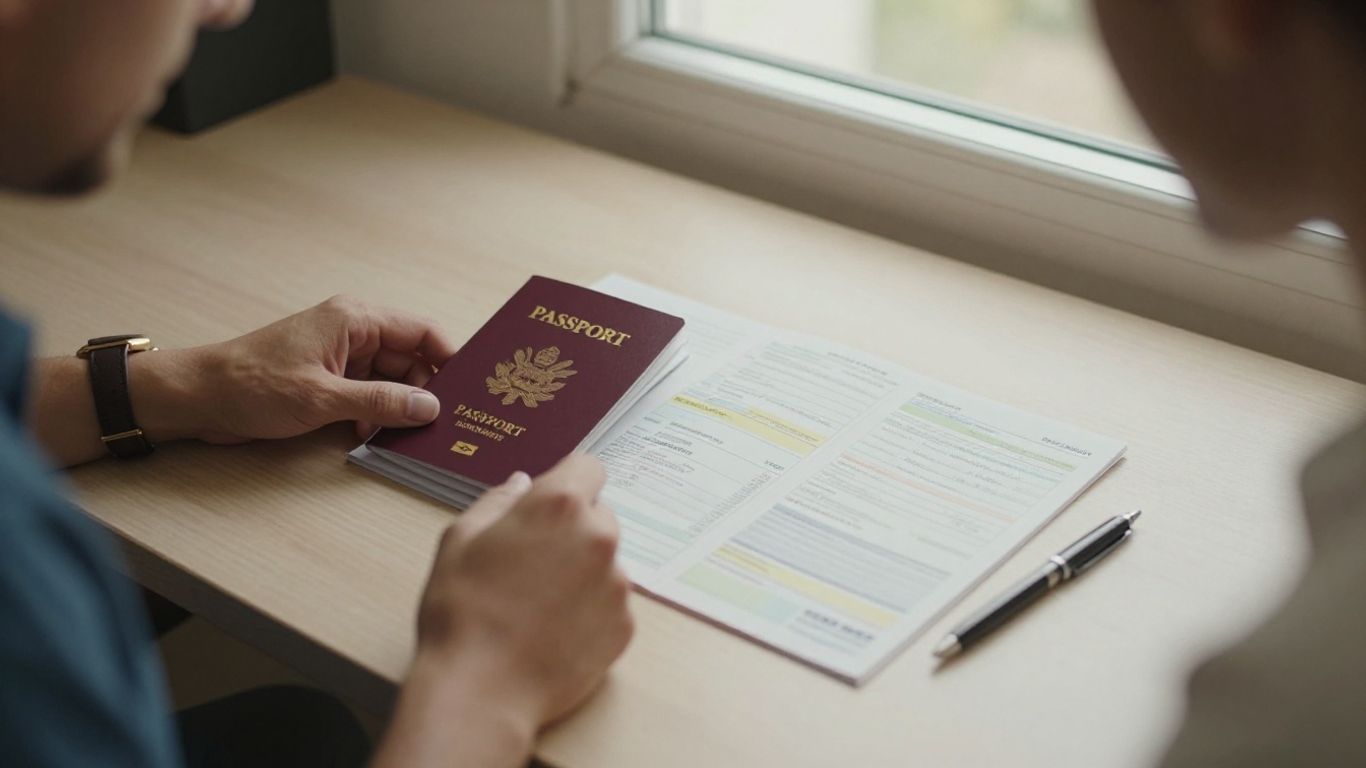 Traveler organizing passport and visa documents
Passport validity and blank-page expectations
Use a passport that is valid for the planned travel and check whether the United States or any transit country applies additional validity rules. Make sure it is undamaged and has room for required stamps or other processing. If you hold more than one nationality, review the document rules carefully before completing forms or making reservations.
Proof of travel purpose and planned itinerary
You do not need to create an elaborate trip narrative, but you should be able to explain where you intend to go, why you are going, how long you expect to stay, and who will pay. A realistic outline of cities, accommodation, and activities is more useful than a folder of generic reservations. Do not purchase expensive, nonrefundable arrangements solely to make an application look stronger.
Evidence of funds, employment, and ties to your home country
Consular officers may consider how you will finance the visit and what connects you to your country of residence. Relevant evidence can include income records, employment details, enrollment, family responsibilities, property obligations, or an established business, depending on your situation. Clear, credible evidence is better than a large stack of documents that you cannot explain.
Health, criminal, and previous immigration considerations
Answer questions about prior refusals, overstays, arrests, or immigration violations accurately. Some medical or criminal circumstances can affect eligibility, and hiding a difficult fact can create a separate problem. If your history is complicated, obtain qualified immigration advice rather than guessing at an answer on the form.
Complete the U.S. visitor visa application
The application process has several linked stages, and an error at one stage can create trouble at the next. Use the instructions for the embassy or consulate where you will apply, since payment methods, appointment systems, and local procedures vary. Keep copies of everything you submit.
Filling out Form DS-160 accurately
Complete Form DS-160 with your current personal, employment, travel, and contact information. Review dates, passport numbers, social media or travel-history fields when requested, and previous U.S. visits before submitting. Save the confirmation page and make sure the information matches what you plan to say at the interview.
Paying the application fee and creating a profile
After submitting the form, follow the local instructions for paying the application fee and creating or updating the appointment profile. The fee is generally nonrefundable, even when a visa is refused, so check the amount and payment process before proceeding. Use an email address and phone number you can reliably access throughout the process.
Scheduling a biometrics appointment and interview
Many applicants must provide fingerprints or other biometric information and attend an in-person interview. The order and location of these steps depend on the post and its appointment system. Select the correct visa category, bring the DS-160 confirmation, and allow time for security screening and document checks.
Preparing a clear and consistent application
Read the completed form from the officer’s perspective: does it show a temporary trip with a plausible budget and a clear reason to return? Correct mistakes through the permitted process instead of quietly submitting conflicting information. A practical U.S. visa application guide can be useful for reviewing the basic sequence, but the consulate’s instructions control your case.
Prepare for the visa interview
An interview is usually brief, so preparation should focus on accuracy rather than rehearsing a speech. Bring documents that support your circumstances, but expect the conversation itself to matter. Calm, direct answers are easier to understand than long explanations that introduce details not asked for.
Documents to bring to the appointment
Bring your passport, appointment information, DS-160 confirmation, fee receipt if required locally, and any photographs or other items specified by the post. Supporting evidence should relate to your purpose, finances, employment, and ties. Organize it so you can find a document quickly, without assuming the officer will review every page.
Common questions consular officers ask
Questions often concern the purpose of the visit, intended dates, destination, companions, employment, funding, and previous international travel. The officer may also ask about relatives in the United States or earlier applications. Answer the question asked, and say so if you do not know an exact date rather than inventing one.
How to explain your travel plans concisely
A useful answer usually covers the destination, purpose, duration, funding, and reason you will return home. For example, explain that you are taking a defined vacation during approved leave, identify the cities you expect to visit, and describe your work or study commitments afterward. Keep the wording natural and avoid presenting a memorized paragraph.
Mistakes that can weaken an otherwise eligible application
Inconsistencies between the DS-160 and interview are a common avoidable problem. Other risks include concealing a previous refusal, overstating income, presenting an implausible itinerary, or treating invitation letters as proof that a visa must be issued. A refusal is not made less likely by adding irrelevant paperwork at the last minute.
Understand processing, decisions, and refusals
Processing times vary by location, season, workload, and the details of an individual case. Some applications are decided soon after the interview, while others require additional review. Do not make fixed travel commitments until you understand the uncertainty around passport return.
Typical timelines and administrative processing
Check the relevant embassy or consulate for current appointment and processing estimates. Administrative processing can extend the timeline after an interview, and the officer may request more information. Estimates are not guarantees, so keep contact details current and respond through the channel specified by the post.
How passport return and visa issuance work
If approved, the consulate generally keeps the passport for visa printing and returns it through the local delivery or collection system. Check the visa details when you receive it, including name spelling, passport number, visa type, and expiration date. If the application is refused, follow the written instructions provided rather than assuming the passport process means approval.
What a refusal under Section 214(b) means
Section 214(b) generally concerns the applicant’s failure to establish eligibility for the requested nonimmigrant classification or sufficient temporary intent. It is not necessarily a permanent ban, but there is no ordinary appeal of that decision. The written explanation and your own circumstances should guide what you do next.
When and how to reapply after a denial
Reapply only when you can present materially different circumstances or useful new information. A new application requires a new form, fee, and interview process, and it does not guarantee a different result. Review what changed—employment, finances, purpose, family situation, or documentation—and answer the earlier concerns honestly.
Plan your arrival in the United States
Receiving a visa is a major step, but it is not the final entry decision. Carry your passport and relevant travel information, and be ready to explain the visit at the port of entry. Good planning also means leaving room for routine questions and possible changes to your itinerary.
What a visa allows and what it does not guarantee
A visa allows you to travel to a U.S. port of entry and request admission in the classification shown on it. It does not guarantee admission, a particular length of stay, or permission to perform activities outside that classification. Airline and border officials may still verify that your documents and plans are consistent.
The role of U.S. Customs and Border Protection
U.S. Customs and Border Protection officers decide whether to admit you when you arrive. They may ask about your purpose, accommodation, return plans, funds, and the items you are bringing. Answer truthfully and keep essential information accessible rather than buried in checked luggage.
How the authorized stay is determined
The authorized period is determined at entry and recorded by the government, rather than simply being the visa’s expiration date. Check your admission record after arrival and note the date by which you must leave. A visa can remain valid for future travel even when the authorized stay for one visit is much shorter.
Accommodation is worth arranging with the same care as flights. Travelers who prefer a home-based stay can explore solo U.S. home exchanges, where the listed experience involves staying in real homes rather than hotels and may prioritize Wi-Fi and apartments. That choice does not change immigration requirements, but it can make an itinerary more concrete.
Extending a stay or changing status after entry
If circumstances require more time, act before the authorized stay expires and follow the appropriate federal process. An extension or change of status is not automatic, and filing late can create serious consequences. Do not begin work or study based only on a pending request unless the applicable rules clearly allow it.
For travelers comparing accommodation costs, SwappaHome describes home exchange as a credit-based arrangement in which members can stay in real homes and learn how the exchange process works. Its materials also describe safety features and guidance for planning a stay. Immigration status remains a separate matter.
SwappaHome also describes a system in which one credit equals one night, with no bidding or price surges. Those details may help a traveler estimate lodging plans, but they should never be treated as evidence for a visa application or as a substitute for checking entry rules.
Conclusion
A strong U.S. visitor visa application begins with the right category, continues with accurate evidence and candid interview answers, and ends with careful attention to the admission record. Verify current instructions before applying, keep your plans realistic, and remember that permission to travel is different from permission to enter or remain.
Frequently Asked Questions
Do I need a visa to visit the United States?
It depends on your nationality, travel purpose, length of stay, and personal circumstances. Some eligible travelers may use the Visa Waiver Program with an approved ESTA, while others need a visitor visa or a different category.
How long can I stay in the United States on a visitor visa?
The authorized stay is determined when you seek admission at a U.S. port of entry. Check your admission record after arrival rather than relying only on the visa expiration date.
Is an invitation letter required for a U.S. visitor visa?
An invitation letter is not automatically required for every visitor visa application. If someone invites you, explain the relationship and trip details honestly, but the letter does not guarantee approval.
Can I work in the United States on a B-1 or B-2 visa?
Visitor classifications do not generally authorize ordinary employment in the United States. If the planned activity involves paid work, review the visa categories and rules that apply before traveling.
What should I do if my visa application is refused?
Read the refusal information and identify whether your circumstances or evidence have materially changed. A new application requires a new process and does not guarantee approval.
Can I enter the United States after my visa expires?
A visa generally must be valid when you seek admission, subject to the rules that apply to your situation. It is also necessary to meet all other entry requirements and receive admission from the border officer.
Can I extend my stay after entering the United States?
You may be able to request an extension in some circumstances, but you must follow the applicable process and act before your authorized stay expires. A request is not automatically approved.

Published by
SwappaHome
SwappaHome Editorial Team
Home Exchange & Slow Travel Editorial
The SwappaHome Editorial Team brings together travel research, home-exchange community insights, and platform data to produce practical guides for first-time and experienced home swappers. Every article cites real platforms, current market rates, and verifiable city-level facts so readers can make informed decisions without guessing.
Ready to try home swapping?
Join SwappaHome and start traveling by exchanging homes. Get 7 free credits when you sign up!