
Environmental Impact of Tourism and How to Travel Lighter

SwappaHome Editorial Team
Home Exchange & Slow Travel Editorial
Tourism generated about 5.2 gigatonnes of CO2-equivalent emissions in 2019, equal to 8.8% of global greenhouse gas emissions, according to a major assessment…
Tourism generated about 5.2 gigatonnes of CO2-equivalent emissions in 2019, equal to 8.8% of global greenhouse gas emissions, according to a major assessment published in Nature. Flights are part of that story, but they aren't the whole story. Every trip also draws on water, electricity, food systems, land, waste services, and local infrastructure.
That wider view changes how we think about responsible travel. A destination can face water shortages while visitors enjoy long showers, swimming pools, irrigated gardens, and freshly laundered towels. A small island can welcome travelers while struggling to process packaging, wastewater, and food waste. A historic city can preserve its culture yet experience pressure from crowded transport, short stays, and accommodation demand.
The environmental impact of tourism isn't a reason to stop discovering the world. It is a reason to understand the system behind each journey and choose where your decisions can make the greatest difference. This guide looks at the major pressures, explains why they vary between trips, and shows how choices such as traveling less frequently, staying longer, and using existing homes through exchange can reduce the burden on destinations.
Table of Contents
- Introduction Why Tourism Footprint Matters Now
- Understanding What Environmental Impact of Tourism Really Means
- Key Environmental Pressures From Carbon to Waste and Water
- How Impacts Differ by Transport Accommodation and Destination
- Proven Strategies to Reduce Tourism Environmental Footprint
- Practical Guide to Sustainable Travel and Hosting With SwappaHome
- Travel Lighter and Make Your Next Trip Count
Introduction Why Tourism Footprint Matters Now
Tourism's climate impact grew by 3.5% per year from 2009 to 2019, more than twice as quickly as overall global emissions, according to the 2024 tourism emissions assessment. Transport produces roughly 75% of tourism's carbon footprint, while aviation contributes about 40%, making flights an important focus. Yet the footprint does not end at the airport.
A trip also activates a destination's water, energy, food, housing, transport, sewage, and waste systems. Travelers use hot water, electricity, meals, goods, and excursions. They may stay in a hotel or an existing home, but either choice draws on services shared with local residents. A sudden rise in demand can require destinations to pump more water, import more food, expand roads, or send additional rubbish to disposal sites already under pressure.
The global issue has a local face
The wider system appears in ordinary travel experiences. On a dry island, residents may be asked to restrict water use while hotels maintain pools and irrigated outdoor areas. In a busy coastal town, waste crews may empty bins constantly during high season and still struggle with litter. In a mountain community, traffic and construction can grow faster than ecosystems recover.
The pressures vary by place and by trip. A temperate city with reliable public transport and established water services faces different problems from a resort in a water-stressed region. A long-haul flight followed by a resort stay creates a different footprint from rail travel followed by several weeks in an existing home.
The central idea: A lighter trip reduces pressure across transport, accommodation, consumption, and destination infrastructure rather than relying on one perfect product.
Home exchange connects this principle to accommodation. Reusing an existing home can avoid some of the additional demand associated with hotel capacity, including purpose-built rooms, shared facilities, constant laundry, and service operations. It does not make travel impact-free, since guests still use water, energy, food, transport, and waste services. It can, however, shift part of the stay from adding dedicated tourist infrastructure to using homes that already exist.
The guide examines climate emissions, energy, water, waste, and land and biodiversity, then compares choices available to travelers, hosts, businesses, and policymakers.
Understanding What Environmental Impact of Tourism Really Means
A trip can carry a much larger footprint than the luggage you bring. Transport starts the journey, then accommodation, food, activities, shopping, and destination infrastructure add further demand. The traveler sees a room, a meal, or a road. Behind each one sits a network of energy, materials, water, workers, and waste services.
Direct impacts come from resources you use personally. Running an air conditioner, taking a shower, charging a laptop, or boarding a plane creates immediate demand. Indirect impacts occur earlier in the supply chain. Electricity may come from a power plant, food may require irrigation and refrigeration, and building materials may be extracted, manufactured, and transported before you arrive.
A hotel stay therefore affects much more than the room itself. The property needs energy for heating, cooling, lighting, kitchens, lifts, laundry, pools, and maintenance. It also requires furniture, cleaning products, food deliveries, replacement linens, wastewater treatment, and waste collection. One overnight booking activates many connected services.
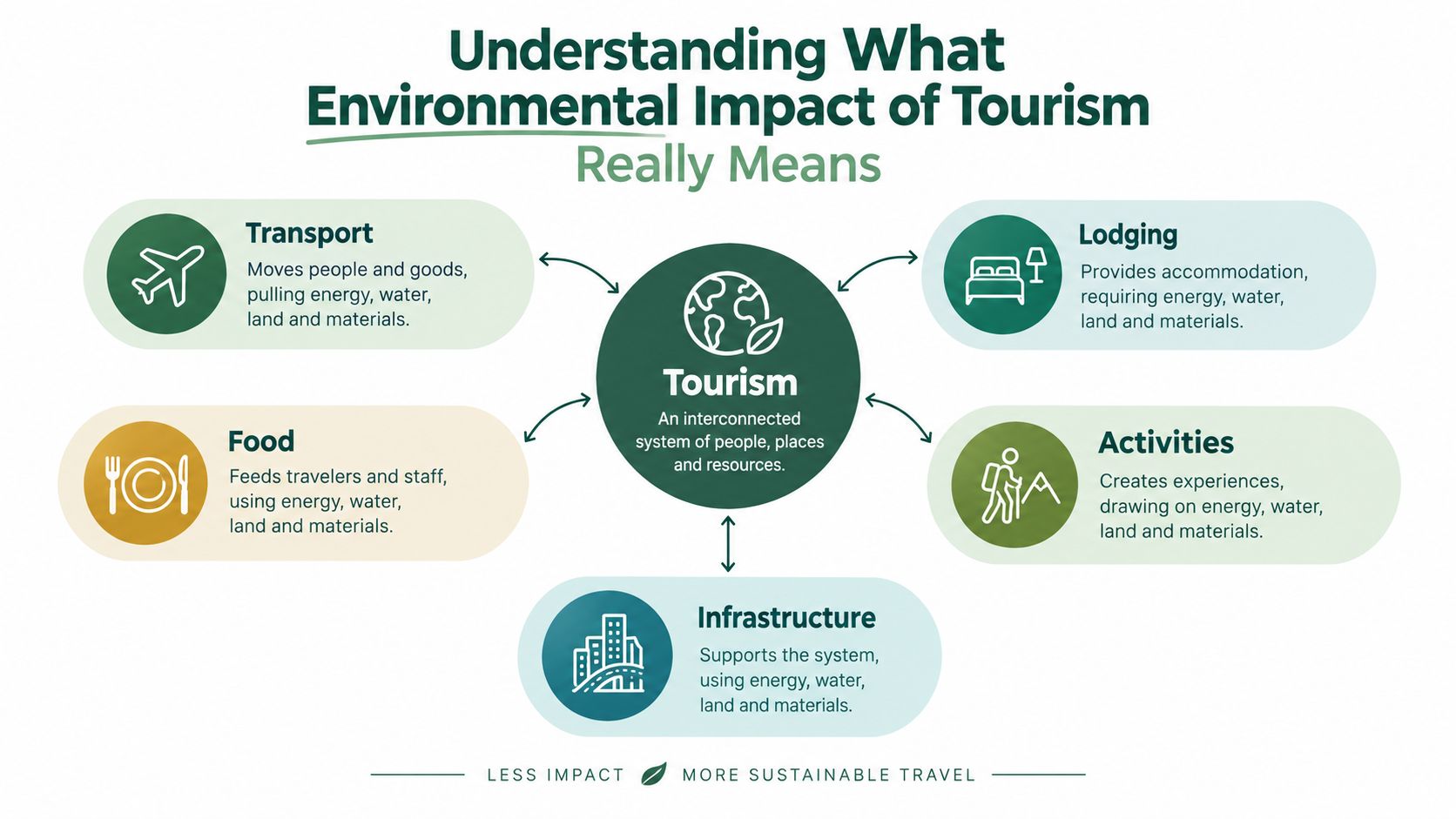 A diagram illustrating how tourism impacts the environment through transport, food, lodging, activities, and infrastructure sectors.
Why tourism is structurally intensive
Tourism joins long-distance mobility with temporary consumption. People usually consume services near home, while tourism moves them elsewhere and asks the destination to recreate familiar services for a limited stay. That arrangement can require energy-intensive transport, new buildings, expanded utilities, and steady deliveries.
Tourism's emissions intensity was 20% higher than the global economy average in 2013, according to tourism emissions research. The figure describes the sector as a whole, not every traveler or destination. It points to a system shaped by movement, built facilities, energy use, and consumption.
Ask four practical questions:
- How far am I traveling? Distance and transport mode shape the first layer of impact.
- What am I using there? Accommodation, food, water, energy, and activities create additional demand.
- What must the destination provide? Roads, airports, treatment plants, shops, and energy infrastructure support the visit.
- What already exists? Reusing homes, choosing established transport, and supporting local services can reduce extra construction and supply-chain demand.
Home exchange makes the last question practical. Staying in an existing home can reduce some demand associated with hotel capacity, shared facilities, constant laundry, and daily service operations. It does not remove travel's effects. Guests still use water, energy, food, transport, and waste services, but the stay can rely more on accommodation that already exists.
For a plain-language introduction, SwappaHome's guide to what sustainable travel means and why it matters explains how to identify travel pressures and reduce avoidable ones.
Key Environmental Pressures From Carbon to Waste and Water
Tourism produced about 5.2 gigatonnes of CO2-equivalent in 2019, equal to 8.8% of global greenhouse gas emissions, according to a published assessment. That figure covers a whole system, not the footprint of one traveler. Flights are visible, but the full picture also includes hotel buildings, food supply chains, water treatment, waste collection, land conversion, and the energy used at each stage.
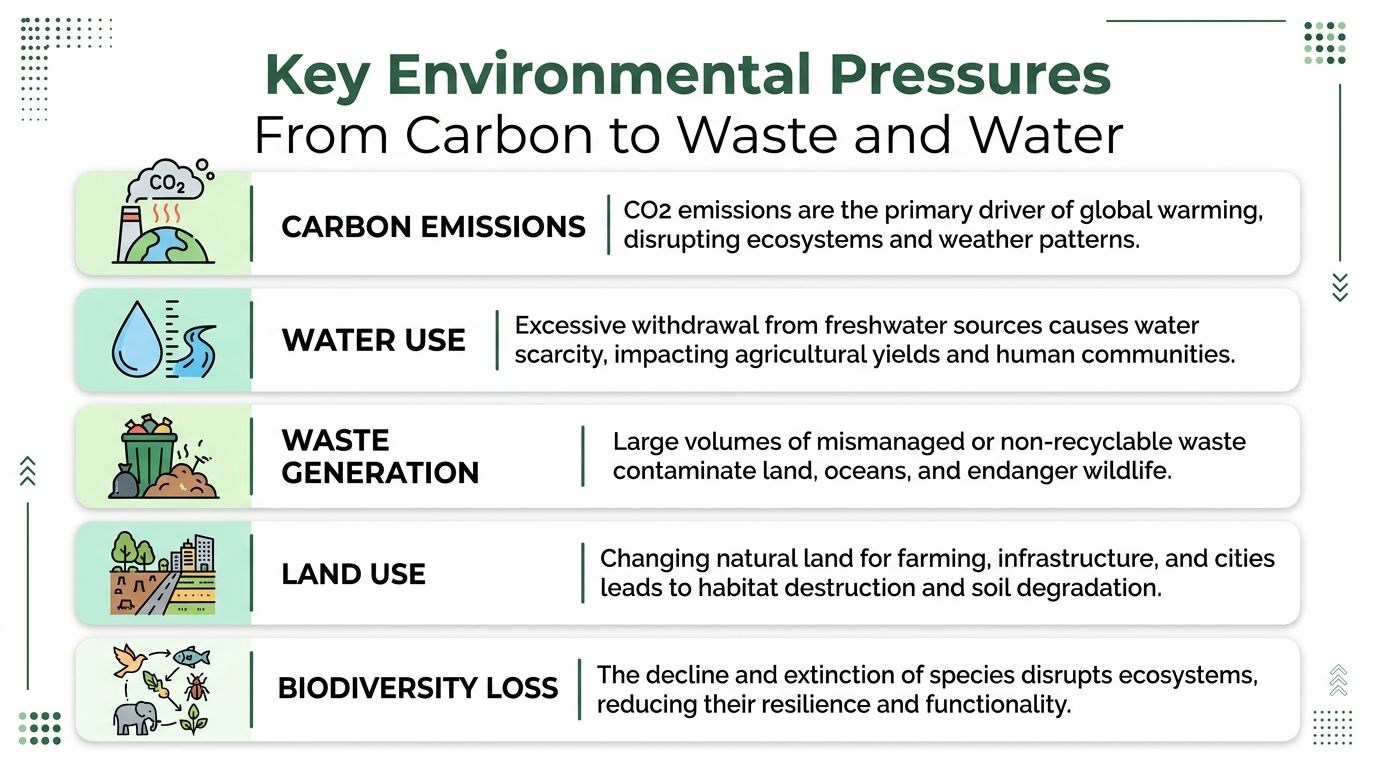 An infographic titled Key Environmental Pressures, illustrating five major issues: carbon emissions, water use, waste, land use, and biodiversity loss.
Carbon and energy
Transport creates the largest share of tourism emissions. One synthesis estimates that transportation produces about 75% of tourism-related CO2 emissions, with air transport contributing roughly 50% of sector emissions and accommodation about 22%, as reported in this review of tourism emissions.
The exact proportions change with the accounting method, yet the practical lesson stays similar. A flight can be the largest single pressure in a trip, while the place where a traveler sleeps still affects energy demand through heating, cooling, lighting, hot water, laundry, and building design. Staying in an existing home through exchange can avoid some demand for new hotel capacity and daily hospitality operations. It does not erase the energy used during the stay.
Water consumption
Tourism uses between 3.5% and 5.8% of global water consumption, according to a UN-linked tourism water management source. Around 80% of that use is indirect, meaning the footprint includes growing food, generating energy, and moving supplies, not only water flowing from a guest-room tap.
Direct use can also be high. Tourists may consume up to 300 liters per day, rising to 880 liters per day in luxury tourism, and generate around 180 liters of wastewater per day. Rainfall, pipes, gardens, pools, food choices, and accommodation practices all change the result. A home exchange can help by using an existing household rather than adding another hotel room with extensive landscaping, laundry, and shared facilities, while guests still need to conserve water locally.
Waste and wastewater
A travel day can leave behind food packaging, bottled drinks, toiletries, takeaway containers, souvenirs, and food scraps. Hotels add cleaning products, discarded supplies, laundry waste, and kitchen waste. If collection, sorting, composting, and treatment cannot keep pace, rubbish may reach landfills, waterways, beaches, or open areas.
Tourist waste averages 1.6 kilograms per person per day, about twice the global average, according to a World Economic Forum and GSTC report cited by WTTC's environmental research. The report projects 205 million tonnes annually by 2034 if trip growth continues. A reusable bottle helps, but it cannot replace local waste infrastructure. Home exchange may reduce some service-related waste, especially daily linen changes and hotel consumables, although visitors remain responsible for sorting and reducing what they buy.
Land and biodiversity
Tourism also requires land for airports, roads, resorts, restaurants, second homes, attractions, and utilities. Construction can fragment habitats, change coastlines, increase erosion, and reduce space for wildlife. Visitors add pressure through damaged trails, noise, anchoring, wildlife encounters, and demand for goods produced in sensitive areas.
These effects accumulate across a destination. One path or room may appear harmless, yet many projects and visitors can alter drainage, vegetation, water availability, and animal behavior.
A UNEP and UNWTO scenario projects that by 2050, tourism could raise energy use by 154%, greenhouse gas emissions by 131%, water consumption by 152%, and solid waste disposal by 251%. Those projections show why using existing homes, local infrastructure, and lower-waste routines matters alongside transport choices.
How Impacts Differ by Transport Accommodation and Destination
A journey's footprint depends less on the label “holiday” than on the choices inside it. A short rail trip to an established city, followed by a home stay and local meals, places different demands on systems than a long-haul flight, a large resort, and daily private transfers.
Transport usually deserves the first decision because it can dominate the trip's emissions. Rail, coach travel, shared transfers, walking, and cycling can reduce reliance on high-emission movement where practical. Direct routes may also avoid unnecessary connections, while staying longer can make the impact of a major journey more worthwhile per day of the visit.
Accommodation changes the second layer. A property with efficient energy systems, renewable electricity, water-saving equipment, and credible waste management can reduce operational pressure. A hotel may also offer professional systems that an individual home lacks, but it requires ongoing services such as room cleaning, linen replacement, food operations, and shared facilities. An existing home used through exchange avoids creating demand for a new hospitality building, although it still consumes energy and water during a stay.
Destination context matters just as much. In a water-stressed island, a shower, garden, pool, and meal may compete with limited supplies. In a temperate city with strong public transport and established utilities, the same stay may create less pressure on water and mobility. Peak-season travel can also concentrate demand, while off-season or secondary destinations may distribute it more evenly, provided local communities benefit and services remain appropriate.
A practical comparison
| Travel Choice | Carbon Intensity | Water and Waste Pressure | Lower Impact Alternative |
|---|---|---|---|
| Long-haul flight and short stay | High, because aviation can dominate the journey's emissions | Concentrated demand during a brief visit | Fly less often, stay longer, and choose rail or coach where feasible |
| Short-haul flight and resort stay | High transport demand plus energy-intensive accommodation | Pools, landscaping, laundry, food service, and packaging can increase pressure | Choose a reachable destination and an existing home or efficient accommodation |
| Rail journey and city hotel | Lower transport pressure than an equivalent flight, with accommodation still contributing | Depends on hotel systems and city infrastructure | Use public transport and select accommodation with clear resource policies |
| Rail or coach journey and home exchange | Lower transport pressure where routes are practical, with an existing property used for lodging | Household water and energy use still matter | Conserve resources, shop locally, and stay long enough to reduce rushed travel |
| Peak-season resort trip | Demand is concentrated in a sensitive period | Can strain water, waste, roads, and local services | Travel in a less crowded period or select a destination with suitable capacity |
No accommodation type is automatically impact-free. The useful comparison asks which option reduces new construction, energy demand, water use, waste, and unnecessary movement for this particular destination and journey.
Proven Strategies to Reduce Tourism Environmental Footprint
Tourism's footprint is shaped by more than a traveler's choices. It includes transport, accommodation, food, water systems, waste services, buildings, and the supply chains that keep destinations operating. Responsibility therefore sits at three levels: public policy sets boundaries, businesses control operations, and travelers influence demand. A weakness at one level cannot be fully corrected by another.
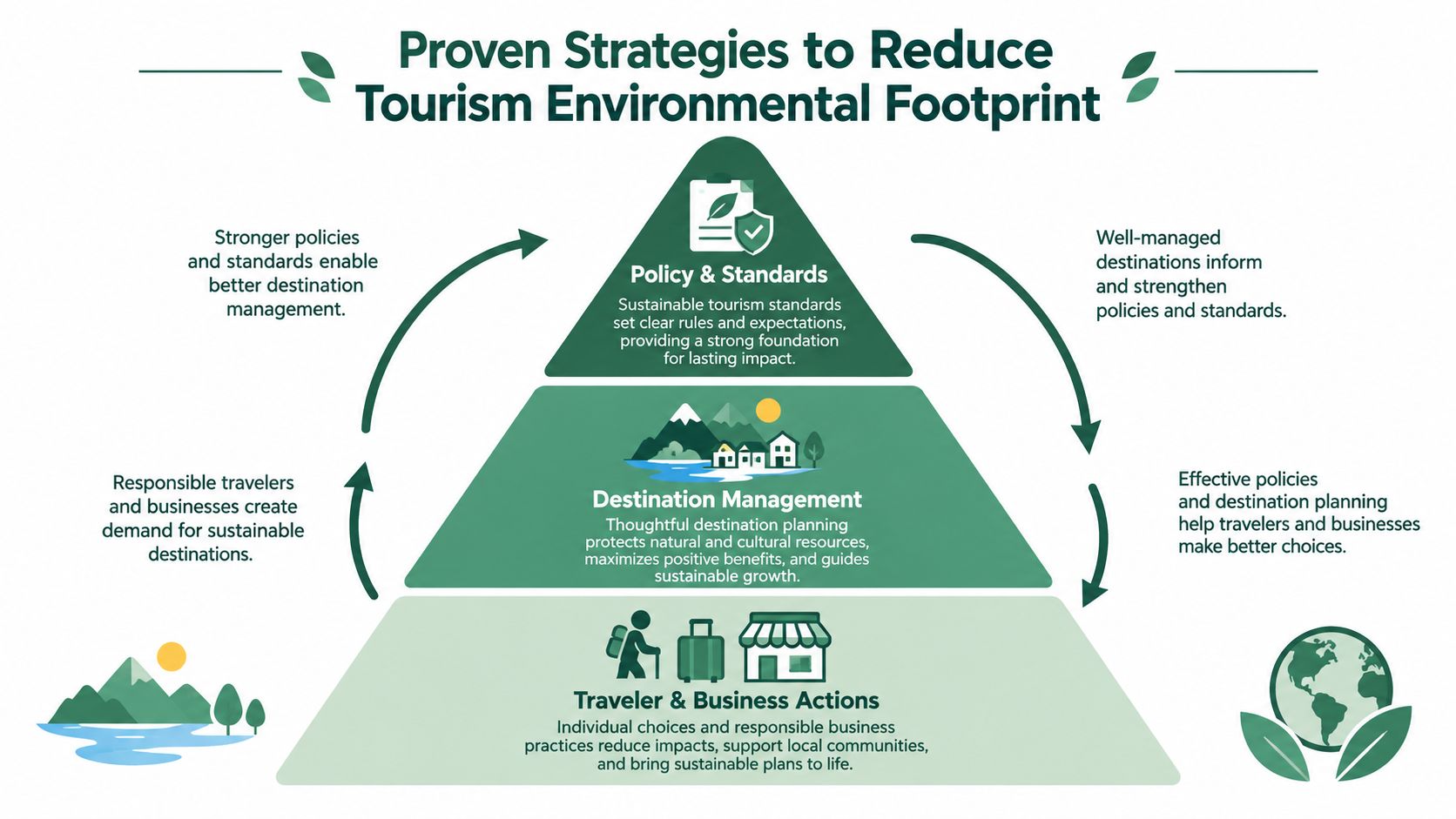 A pyramid diagram showing three levels of strategies to reduce the environmental footprint of tourism.
Policy creates the conditions
Destination authorities can limit development in sensitive areas, protect habitats, manage water withdrawals, improve public transport, and require clear sustainability standards. They can also spread visitors across suitable places and seasons, rather than treating every destination as able to absorb unlimited demand.
Travelers can reinforce these priorities by looking for evidence instead of trusting vague “green” language. Information about sustainable tourism in Slovenia shows how destination planning, local participation, and environmental protection can work together.
Businesses control operations and supply chains
Hotels, airlines, restaurants, tour operators, and property owners influence emissions through equipment, electricity, building design, purchasing, food systems, and waste contracts. The supply chain matters because much of tourism's footprint is created before a guest arrives. A traveler may reuse a towel, while suppliers and property managers determine how that towel was washed, how the building is powered, and how food reaches the destination.
That is why reducing demand for new construction and intensive hotel operations can complement changes in guest behavior. An existing home still consumes energy and water, but it may avoid some additional accommodation capacity and the services required to run it continuously.
Travelers can reduce demand at the source
The most useful personal choices connect the whole journey:
- Fly less frequently: Combine purposes, take fewer long-distance trips, and use rail or other practical alternatives where available.
- Stay longer: One longer visit can replace several rushed breaks and reduce repeated transport demand.
- Use existing homes: Home exchange makes use of residential space rather than automatically adding demand for new hotel rooms.
- Choose local systems: Walk, use public transport, eat locally sourced food, and support businesses rooted in the community.
- Ask better questions: Before booking, check how a property handles water, wastewater, energy, food, and waste.
Home exchange is not impact-free. The journey still matters, and an occupied home still uses resources. Its value lies in addressing the hidden accommodation and supply-chain footprint alongside transport decisions. SwappaHome's guide to slow travel and home swapping explains how longer, more local stays can support a less rushed form of tourism.
Practical Guide to Sustainable Travel and Hosting With SwappaHome
Sustainable travel works best when it becomes a set of decisions made before departure, during the stay, and after guests leave. The same principle applies to hosting. A well-prepared home can help visitors conserve resources instead of guessing how local systems work.
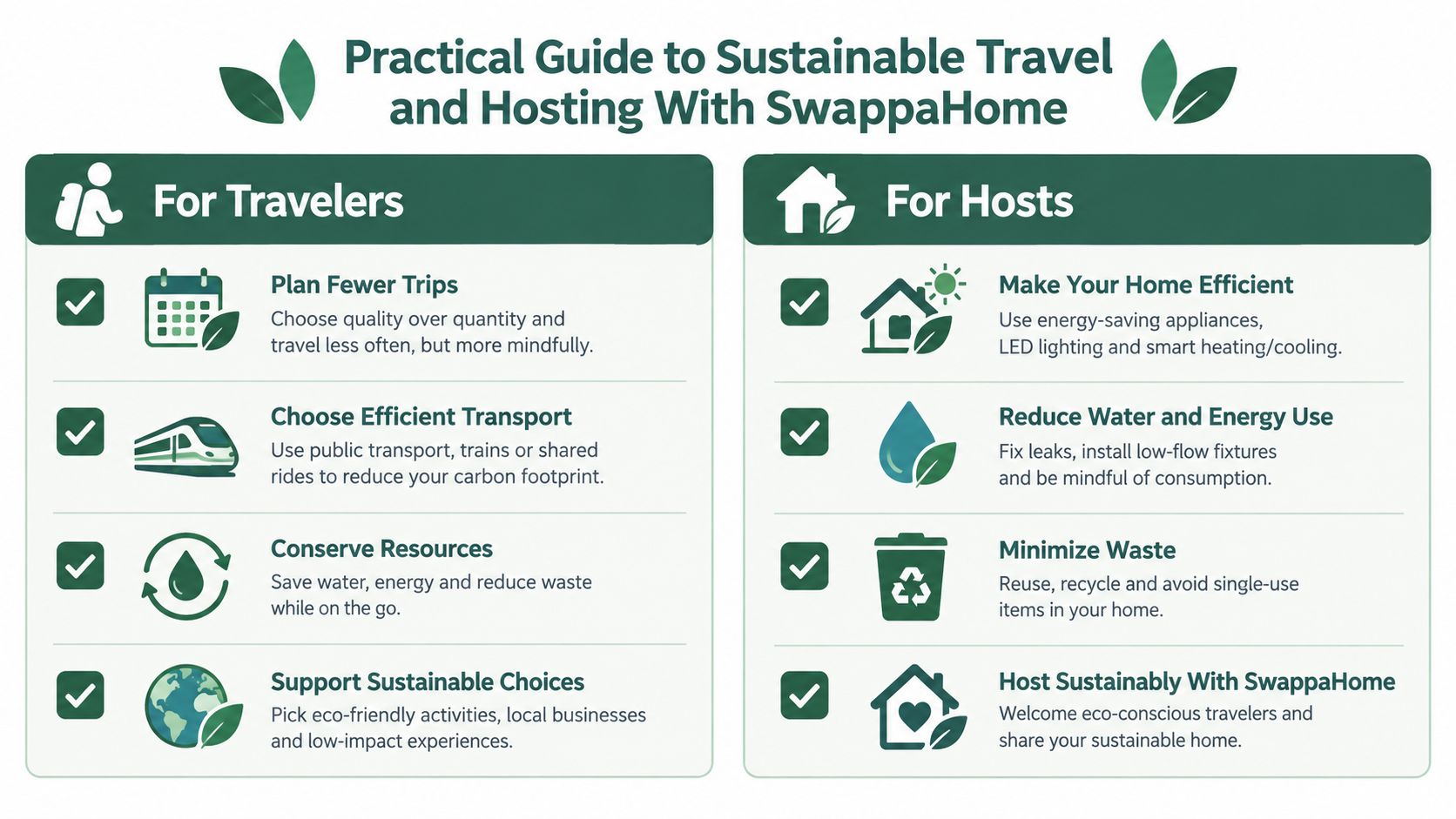 An infographic titled Practical Guide to Sustainable Travel and Hosting With SwappaHome showing tips for travelers and hosts.
For travelers
Start with the route. Choose rail, coach, shared transport, walking, or cycling when they fit the destination and your needs. If flying is necessary, consider whether one longer stay can replace several short breaks, then pack lightly to make transfers and public transport easier.
At the accommodation, treat the home as you would your own:
- Use only the water you need: Take shorter showers, report leaks, and avoid running taps while brushing your teeth.
- Manage energy deliberately: Turn off lights, heating, cooling, and appliances when you leave a room. Keep doors and windows closed when air conditioning is operating.
- Reduce disposable packaging: Carry a refillable bottle and shopping bag where local water and hygiene conditions make refilling appropriate.
- Shop and eat locally: Choose neighborhood markets, independent restaurants, and seasonal food, while avoiding unnecessary packaging.
- Respect local limits: Follow trail rules, wildlife guidance, recycling instructions, and restrictions designed to protect fragile places.
A home exchange can make these habits feel natural because you have a kitchen, storage, and a neighborhood base rather than a room designed around daily hotel service. SwappaHome uses verified homes, community reviews, and a credit system, with one credit earned per hosted night and redeemed for stays, according to the platform's stated model. Members can use entire homes while contributing to a network based on existing residential space. For more context, read SwappaHome's guidance on the environmental impact of sustainable travel through home exchange.
For hosts
Hosts can make low-impact behavior easy for guests. Leave clear instructions for heating and cooling, explain local recycling rules, identify refill points, and note any water restrictions. Provide durable kitchen equipment, reusable shopping bags, and sensible waste separation where the local system supports it.
Before welcoming guests, check for dripping taps, inefficient lighting, unnecessary standby power, and poor insulation. Set realistic expectations about gardens, pools, laundry, and air conditioning. If your home is available for longer stays, make that clear so guests can plan a slower visit instead of a series of short bookings.
A thoughtful welcome guide can include:
- Resource notes: Explain the home's water and energy controls in plain language.
- Waste directions: Show guests what can be recycled, composted, or placed in general waste.
- Local choices: Recommend public transport, nearby shops, refill stations, and locally owned services.
- Departure steps: Ask guests to switch off systems, secure food, and leave waste according to local instructions.
These small preparations don't eliminate impact, but they prevent avoidable consumption and help visitors behave like temporary residents rather than hotel guests.
Travel Lighter and Make Your Next Trip Count
The environmental impact of tourism is large, but it isn't fixed at one universal level. Transport often creates the biggest climate burden, while water, waste, energy, land, and supply chains determine how heavily a destination carries each visit. The most useful response combines fewer unnecessary flights, longer stays, careful resource use, and accommodation that reuses what already exists.
Home exchange fits that approach because it changes the lodging model from nightly commercial occupancy to shared use of existing homes. It can give travelers a kitchen, local neighborhood, and space for a longer stay, while allowing homeowners to turn unused nights into travel opportunities. That doesn't make a trip impact-free, but it can reduce pressure associated with new hospitality construction and intensive hotel operations.
Travelers who want more practical ideas for lower-impact packing and destination habits can also explore eco-friendly travel with Madeira Remote. The best choices are the ones you can repeat without guilt or perfectionism: plan thoughtfully, stay longer, use fewer resources, and support places in ways that help residents live well.
Your next step can be concrete. Decide which journey you can simplify, choose an existing home for the stay, and share clear sustainability guidance if you host. Then build a travel pattern that feels enjoyable, local, and lighter on the places making your trip possible.
SwappaHome lets verified members exchange entire-home stays through a credit system, with homes in neighborhoods rather than conventional hotel rooms. Visit SwappaHome to list your home, earn credits for hosting, and plan a longer, more resource-conscious trip in a real local setting.

Published by
SwappaHome
SwappaHome Editorial Team
Home Exchange & Slow Travel Editorial
The SwappaHome Editorial Team brings together travel research, home-exchange community insights, and platform data to produce practical guides for first-time and experienced home swappers. Every article cites real platforms, current market rates, and verifiable city-level facts so readers can make informed decisions without guessing.
Ready to try home swapping?
Join SwappaHome and start traveling by exchanging homes. Get 7 free credits when you sign up!