
Travelling games PC: The ultimate guide to virtual road trips, exploration, and adventure

SwappaHome Editorial Team
Home Exchange & Slow Travel Editorial
Key Takeaways Travelling games PC players enjoy most tend to make movement feel meaningful, whether that means crossing a country, following a story, or simply…
Key Takeaways
Travelling games PC players enjoy most tend to make movement feel meaningful, whether that means crossing a country, following a story, or simply wandering through a quiet landscape.
- Choose open worlds for freedom and guided journeys for stronger pacing.
- Driving and transport games turn distance, planning, and scenery into the main event.
- Walking and narrative games offer shorter, more focused forms of virtual travel.
- Match the game’s pace, controls, and hardware demands to your habits.
- Mods, accessibility settings, and careful graphics tweaks can improve long journeys.
What makes a great travelling game on PC
A good travelling game gives movement a purpose beyond reaching the next objective. It might reward curiosity, create a convincing sense of place, or let a long stretch of road become relaxing rather than empty. The best choices in the travelling games PC category understand that the journey itself can be the point.
Open-world freedom versus guided journeys
Open-world games let players set their own direction, pause for distractions, and build a personal route through the world. That freedom is ideal when you enjoy detours, scenic overlooks, and the occasional discovery that was not marked on a map. Guided journeys take a different approach, using a tighter sequence of locations and events to keep the trip moving with purpose.
Neither structure is automatically better. A large map can feel tiring when every destination looks interchangeable, while a linear trip can feel restrictive if it never gives you room to look around. Think about whether you want to make travel decisions yourself or be carried along by a carefully shaped itinerary.
The role of discovery, scenery, and atmosphere
Scenery matters because travelling games ask players to spend time looking at the world. A changing sky, a distant mountain range, or a small roadside building can give a route personality even when little is happening mechanically. Sound design matters just as much: tires on wet pavement, wind through trees, and distant city noise can make a virtual place feel inhabited.
Discovery should also have texture. Finding a note, a view, or an unusual landmark is more satisfying when it suggests something about the world rather than merely adding another collectible. For ideas about how games can inspire real-world curiosity, this discussion of games that spark wanderlust offers a useful travel-minded perspective.
Travel speed, pacing, and downtime
Some games make travel brisk and practical, while others linger on the quiet parts. Fast travel is useful when the destination matters most, but it can remove the small surprises that make a route memorable. Slow travel works when the game gives you reasons to observe, listen, plan, or settle into a rhythm.
The right pace depends on your available time. A thirty-minute session may suit a compact walking story or a short drive, while a long-haul simulator can reward an evening set aside for one uninterrupted route. A comfortable pace is often more valuable than a huge map.
Story-driven trips versus pure exploration
Story-driven travel gives every stop emotional or narrative weight. You may be following a character, uncovering a mystery, or seeing a relationship change as the journey continues. These games are often easier to recommend to players who want a clear sense of progress.
Pure exploration is looser. It asks you to decide what matters, and its strongest moments may come from an accidental turn rather than a scripted reveal. Before choosing, ask whether you want the game to tell you why a place matters or let you decide that for yourself.
The main types of travelling games PC players can enjoy
The phrase travelling games PC covers several very different experiences. One player may want realistic freight routes, another may prefer a quiet forest walk, and someone else may want a playable travel memoir. Sorting games by the kind of movement they offer makes it easier to find the right mood.
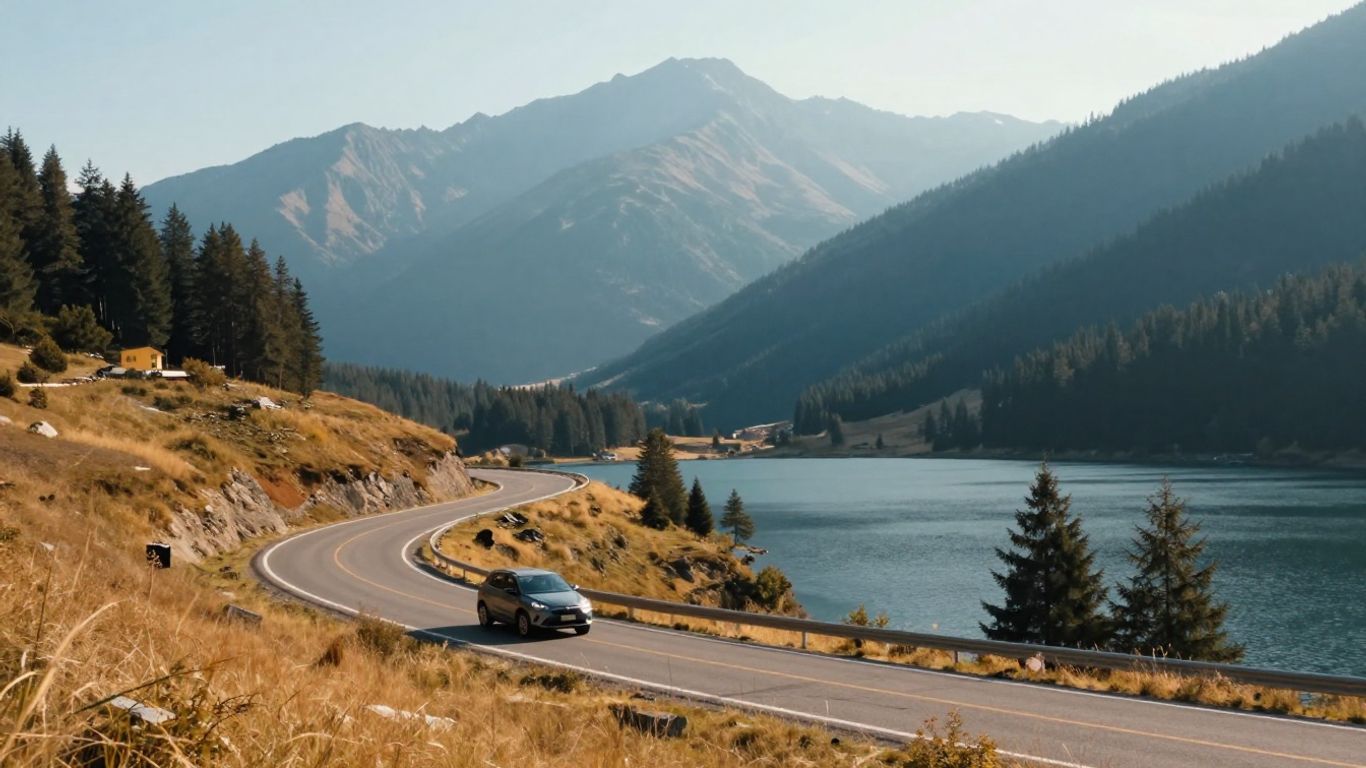 Sunlit road winding through mountains
Road trip and driving adventures
Road-trip games make the vehicle part of the story. Fuel, repairs, navigation, weather, and changing roads can all shape the trip, but the vehicle does not always need to behave realistically. Some games use driving as a framework for comedy, friendship, danger, or improvisation.
The strongest examples make stops feel worthwhile. A roadside diner, an awkward repair, or a sudden change in terrain can break up the miles and give the route a sense of character. They are especially good for players who enjoy movement with a light layer of decision-making.
Walking, hiking, and scenic exploration games
Walking games remove the vehicle and put attention on the landscape itself. Their pleasure comes from noticing paths, reading the environment, and moving at a pace that allows atmosphere to settle. They can be peaceful, unsettling, or deeply reflective without needing combat or complex systems.
These experiences are often approachable on modest hardware and easy to play in shorter sessions. They also suit players who want the feeling of going somewhere without managing fuel, traffic, or a detailed control scheme.
Train, flight, and transport simulators
Transport simulators focus on procedure. You may need to follow a timetable, manage a route, handle a vehicle correctly, or make practical decisions about cargo and distance. The satisfaction comes from learning the system and seeing a carefully planned journey unfold.
They can be more demanding than a conventional adventure game, particularly when controls and interfaces are detailed. Still, that structure creates a special kind of calm. Once the routine becomes familiar, a trip can feel almost meditative.
Narrative travel experiences and interactive journeys
Narrative travel games treat movement as a way to explore identity, memory, culture, or personal change. They may use dialogue, illustrated scenes, written choices, or a small number of carefully designed locations. The journey is less about mastering a vehicle and more about understanding the people taking it.
Wanderlust: Travel Stories is a clear example of this approach, presenting playable novels inspired by real-life travel memoirs and allowing choices to shape the narrative. It is a good fit for readers who enjoy reflective storytelling and travel writing as much as conventional game mechanics.
The best travelling games PC players should consider
There is no single best travel game because the appeal of a journey changes from player to player. Some of the following titles focus on personal stories, while others make logistics, distance, or planetary scale their central pleasure. Together, they show how broad the genre can be.
Wanderlust: Travel Stories for culture and personal storytelling
Wanderlust: Travel Stories is built around a collection of playable novels inspired by real-life travel memoirs. Its journeys use different characters and perspectives, with player choices shaping the direction of each narrative. The emphasis is on reflection, place, and personal experience rather than fast action.
It suits players who want a thoughtful evening of interactive reading. Locations such as Rapa Nui, Bangkok, and the Serengeti give the stories geographical variety, while the choice-based structure keeps the experience active rather than purely passive.
American Truck Simulator for long-distance road travel
American Truck Simulator is aimed at players who enjoy driving long routes and settling into the rhythm of professional haulage. Its appeal comes from the combination of distance, road scenery, vehicle handling, and the gradual sense of building a trucking career.
It is not a quick tour through every landmark. The pleasure lies in ordinary travel: choosing a load, staying alert on the highway, and watching the landscape change over time. A wheel can deepen the feeling, but keyboard or controller play can also work for a more relaxed setup.
Euro Truck Simulator 2 for European routes and logistics
Euro Truck Simulator 2 offers another long-distance driving experience, this time centered on European routes and logistics. It rewards patience, route awareness, and the ability to make a routine delivery feel like a small personal expedition.
The map’s variety gives repeated journeys a sense of progression. A familiar business, road, or vehicle can gradually become part of your own travel history, which is why the game works well for players who prefer ongoing simulation to a tightly finished campaign.
Firewatch and What Remains of Edith Finch for compact exploratory journeys
Firewatch and What Remains of Edith Finch demonstrate how a travelling game can be intimate rather than enormous. Both use exploration to guide the player through a focused experience, pairing movement with atmosphere, observation, and narrative discovery.
They are strong choices when you want a complete journey without committing to dozens of hours. Firewatch leans into wilderness and conversation, while What Remains of Edith Finch moves through a more unusual collection of spaces and stories. Neither needs a huge map to make travel feel significant.
No Man’s Sky for large-scale planetary exploration
No Man’s Sky is the expansive option on this list, built around planetary exploration across a very large science-fiction setting. Its appeal is the feeling of arriving somewhere unfamiliar and deciding what deserves your attention.
The scale can be exciting, but it also asks for patience. Players who enjoy cataloging, gathering, flying, and making their own goals will find more to do than players seeking a tightly directed story. It is best approached as a continuing expedition rather than a short sightseeing tour.
How to choose a travelling game for your play style
Choosing among travelling games PC players can buy is less about ratings than about mood and routine. A game that feels wonderfully absorbing to one person may feel slow or overly technical to another. Start with the way you actually play, then narrow the list by setting, controls, and complexity.
Picking games by preferred pace and session length
Your available play time should influence the choice. Short, guided journeys are easier to enjoy when you have only a little time, whereas simulation games often become more satisfying after you have settled into a longer session. Open-world exploration sits between the two, offering small discoveries without requiring a fixed endpoint.
A simple comparison can make the decision clearer:
| Preferred experience | A suitable game type | What to expect |
|---|---|---|
| Brief and focused | Narrative exploration | Clear scenes and steady story progress |
| Calm and unhurried | Walking or scenic exploration | Atmosphere, observation, and gentle pacing |
| Long and procedural | Transport simulation | Routes, controls, planning, and routine |
| Self-directed | Open-world exploration | Detours, personal goals, and discovery |
The table is not a rulebook, but it helps separate the fantasy of a game from the way it actually fits into your week. Read descriptions with session length in mind, not just map size or total content.
Comparing realistic simulation with relaxing escapism
Simulation asks you to respect systems. You may need to learn controls, follow rules, and accept that progress takes time. That can be deeply relaxing when you enjoy routine, but it may feel like work if you want to switch off immediately.
Escapist travel games usually simplify the practical details. They let you focus on scenery, characters, or a feeling of place without turning every journey into a checklist of procedures. Neither style is more authentic; they simply offer different kinds of satisfaction.
Choosing solo, multiplayer, or shared-screen experiences
Most travel-focused games are naturally suited to solo play because their strongest rewards are personal: a view you noticed, a route you chose, or a story beat that stayed with you. Multiplayer can add conversation and shared planning, especially when the game supports cooperative travel or flexible exploration.
Shared-screen play is less common, so check the store page carefully rather than assuming that local cooperation is available. If you are choosing a game for a group, prioritize its actual control options and social rhythm over the promise of a large world.
Matching hardware requirements to your PC
A quiet walking game may run comfortably on an older computer, while a large simulation or visually dense open world can demand more memory, graphics power, and storage. Check the minimum and recommended requirements, but also look at recent user feedback for performance issues on hardware close to yours.
Resolution and frame rate affect scenic games more than many players expect. A stable image is usually preferable to maximum detail, particularly during long drives or walks where visual comfort matters. Leave room for updates and mods if you expect the game to grow over time.
How to get more from travelling games on PC
Travel games reward a little preparation, but too much optimization can drain the spontaneity from them. The goal is to make the journey comfortable while keeping enough uncertainty for the world to surprise you. Small adjustments to controls, visuals, and route planning often have the biggest effect.
Building an immersive driving or simulation setup
A comfortable chair, sensible camera settings, and a dependable control layout can make a long route feel far more natural. A steering wheel is appealing for dedicated driving simulations, but it is not necessary for everyone. Even a controller with carefully adjusted sensitivity can reduce fatigue.
Keep the setup practical. Good audio, a stable desk, and easy access to pause or navigation controls matter more than adding equipment you will rarely use. The best arrangement is one that makes returning to the game feel inviting.
Using graphics settings to improve scenery and performance
Start by protecting frame-rate stability, then add visual detail gradually. Lowering shadows, reflections, or distant object quality can help when a game stutters, while reducing motion blur may make long sessions more comfortable. Brightness and field of view are worth adjusting for both atmosphere and visibility.
Take a short test drive or walk after each meaningful change. A setting that improves a screenshot may make movement less smooth, and a modest compromise can preserve the landscape without overworking your PC. Scenic games are about the view, but a steady view is the priority.
Finding maps, mods, accessibility options, and community content
Community resources can extend a journey or make it easier to follow your preferred route. Before installing anything, check compatibility, version dates, and whether the change affects saved games. Accessibility options deserve the same attention as visual upgrades because subtitles, remapping, color adjustments, and pace controls can transform comfort.
Useful resources usually fall into a few practical groups:
- Route maps for players who enjoy planning destinations.
- Control presets for wheels, controllers, and alternative input devices.
- Visual or audio adjustments that improve comfort.
- Community scenarios that add variety to familiar journeys.
Use one change at a time when possible. That makes it easier to identify what helped and keeps troubleshooting from becoming its own unwanted adventure.
Planning in-game routes without removing the sense of discovery
A route is most enjoyable when it gives you a direction without dictating every minute. Mark a broad destination, choose one or two optional stops, and leave room for an unplanned turn. This approach works particularly well in open worlds and driving simulations.
You can also create personal themes: follow coastlines, seek mountain roads, visit small settlements, or travel only at dawn. These self-imposed ideas provide shape without turning exploration into a task list. The map should support curiosity, not replace it.
Where to find new travelling games for PC
Finding a travel game often requires reading past the genre label. Store tags may group a calm walking experience with a demanding simulator simply because both involve movement. Trailers, screenshots, reviews, and control information reveal more about the actual feel of a journey.
Browsing Steam categories, tags, and user reviews
Steam tags are useful for building a shortlist, especially when combined with terms such as exploration, walking simulator, driving, simulation, atmospheric, or narrative. User reviews can then clarify whether the game is slow, demanding, repetitive, or unexpectedly relaxing.
Read recent reviews and look for comments about the specific experience you want. A player praising a game’s depth may be describing complexity you would rather avoid, while a complaint about repetition could signal the steady routine another player is seeking.
Using trailers and gameplay footage to judge the experience
A trailer can communicate setting, but gameplay footage reveals the rhythm. Watch for how often the player is moving, waiting, reading, managing systems, or following objectives. Ten minutes of unedited play is often more informative than a polished montage.
Pay attention to camera movement and interface density too. A beautiful landscape may be less appealing if the camera makes you uncomfortable, and a promising simulator may feel inaccessible if its menus dominate the screen.
Checking controller, keyboard, and wheel support
Control support should be part of the first check, not an afterthought. Keyboard and mouse work well for many exploration games, controllers can make walking and driving feel smoother, and wheels are valuable when a simulator is designed around detailed vehicle control.
Look for remapping, sensitivity controls, vibration options, and input prompts. If you rely on a particular device or accessibility setup, community discussions may reveal practical details that the formal store description leaves out.
Comparing price, editions, and seasonal discounts
Travel games vary from short, inexpensive narrative experiences to long-running simulations with optional expansions. Compare the base edition with bundles and check what is actually included before buying. A low headline price is less useful if the content you want sits behind several additions.
Seasonal sales can make it easier to experiment across several styles. If you are unsure whether you prefer a road trip, walking story, or transport simulator, buying one shorter experience first may be wiser than committing to the largest available package.
Conclusion
The best travelling games PC players can find do not all look alike: some ask you to manage a delivery, some invite you to walk through a strange landscape, and others turn a personal story into a journey. Choose the pace and level of control that fit your life, then give the world enough time to make the trip memorable.
Frequently Asked Questions
What are travelling games on PC?
Travelling games on PC are games where movement through a world, route, landscape, or series of destinations is a central part of the experience. They can include driving adventures, walking exploration, transport simulations, and narrative journeys.
Are travel games always open-world?
No. Some are open-world, but many use compact locations or guided routes. A focused game can create a strong sense of travel by carefully shaping scenery, pacing, and story without offering a huge map.
Which travel games are good for short sessions?
Narrative adventures, walking games, and compact exploration titles often work well for short sessions because they provide clear scenes and manageable progress. Some simulation games can also be played briefly, although their rhythm may improve during longer sessions.
Do I need a steering wheel for driving games?
No. Many driving games support a keyboard or controller. A wheel can add immersion and precision in some simulations, but the best choice depends on your budget, available space, and how seriously you want to approach vehicle control.
Can travel games be relaxing?
Yes. Games with gentle pacing, scenic environments, light objectives, or predictable routines can be relaxing. Difficulty, camera movement, sound, and the amount of required concentration all affect whether a particular game feels restful.
Are travel games suitable for children?
Some are, but suitability varies by age rating, themes, controls, and reading requirements. Check the store description and rating, then consider whether the child prefers exploration, storytelling, or structured simulation.
How can I improve performance in scenic PC games?
Use a stable frame rate as your starting point, then adjust resolution, shadows, reflections, view distance, and motion effects. Update drivers when appropriate, close unnecessary applications, and test changes during actual gameplay rather than relying only on menus.

Published by
SwappaHome
SwappaHome Editorial Team
Home Exchange & Slow Travel Editorial
The SwappaHome Editorial Team brings together travel research, home-exchange community insights, and platform data to produce practical guides for first-time and experienced home swappers. Every article cites real platforms, current market rates, and verifiable city-level facts so readers can make informed decisions without guessing.
Ready to try home swapping?
Join SwappaHome and start traveling by exchanging homes. Get 7 free credits when you sign up!