
Trip to Italy: How to Plan the Perfect Italian Vacation

SwappaHome Editorial Team
Home Exchange & Slow Travel Editorial
Key Takeaways A memorable trip to Italy usually comes from choosing less, allowing more time, and leaving room for ordinary moments. Plan around your interests…
Key Takeaways
A memorable trip to Italy usually comes from choosing less, allowing more time, and leaving room for ordinary moments. Plan around your interests first, then let transport, budget, and the season shape the details.
- Choose regions that match your interests and available time.
- Build an itinerary with breathing room between destinations.
- Budget for transport, meals, admissions, and seasonal changes.
- Pick accommodations based on location as much as style.
- Reserve major sights early while keeping some plans flexible.
Set your trip to Italy goals and priorities
Italy can be an art holiday, a food journey, a coastal escape, or a slow exploration of small towns. Those possibilities are exciting, but they can also pull your planning in different directions. Start by naming the experiences you most want, then make destination choices that support them. A focused plan will feel richer than a rushed attempt to see everything.
Choose the best regions for your travel style
Rome and Florence suit travelers drawn to history and art, while the northern lakes and Dolomites offer scenery and outdoor activities. Tuscany works well for vineyards, hill towns, and a slower pace; Sicily brings archaeological sites, beaches, and a distinct culinary identity. Coastal areas reward travelers who are happy to build a trip around swimming, ferries, and scenic walks.
If local neighborhoods and everyday rhythms appeal to you, consider a home exchange rather than limiting yourself to hotel districts. SwappaHome describes curated homes in Italy within walking distance of neighborhood trattorias, markets, and courtyards, with a credit system designed for fair and flexible exchanges. That kind of base can make a city feel less like a collection of attractions and more like somewhere you briefly live.
Decide how many days to spend in Italy
For a first visit, seven to ten nights can support one major city plus a second region without constant packing. Around two weeks allows a classic north-to-central route or a city-and-coast combination, while three weeks makes space for Sicily, Sardinia, or several countryside stops. Count travel days honestly: a transfer between cities often consumes much of a morning or afternoon.
Give each destination a minimum stay that reflects what you want to do there. Two nights may be enough for a small stopover, but large cities deserve three or four nights so you can see major sights without turning every day into a race.
Balance famous landmarks with local experiences
The Colosseum, Vatican Museums, Uffizi Gallery, and St. Mark’s Basilica can be central to a first visit, and they are worth planning carefully. Pair one major sight with a market, neighborhood walk, unhurried lunch, or small museum rather than stacking famous attractions from morning to night. A well-rounded Italy itinerary can move from Rome and the Bay of Naples to Florence and Tuscany, but the same principle works on a smaller scale.
The best local experiences often need little staging. Sit in a piazza after dinner, shop for breakfast near your apartment, or take a regional train to a town that was not the headline destination. These pauses are not wasted time; they are often what gives the trip its texture.
Match your itinerary to the season
Spring and fall are often comfortable for walking, with a useful balance of milder weather and manageable crowds. Summer brings long days and lively coastal towns, but it can mean intense heat and higher demand. Winter is quieter in many cities and can suit travelers who care more about museums, food, and atmosphere than beach weather.
Season should influence more than clothing. It affects opening hours, ferry schedules, countryside activities, and accommodation prices, so check those details before committing to a route. For a broader seasonal perspective, see this Italy travel season guide while comparing your preferred regions.
Build an itinerary that fits your schedule
A good Italian route has a clear shape rather than a long string of pins on a map. Group nearby places, use rail connections where they save time, and protect a few unscheduled hours. Your arrival and departure airports can also change the most efficient order. Think in terms of neighborhoods and travel days, not just the number of sights you can list.
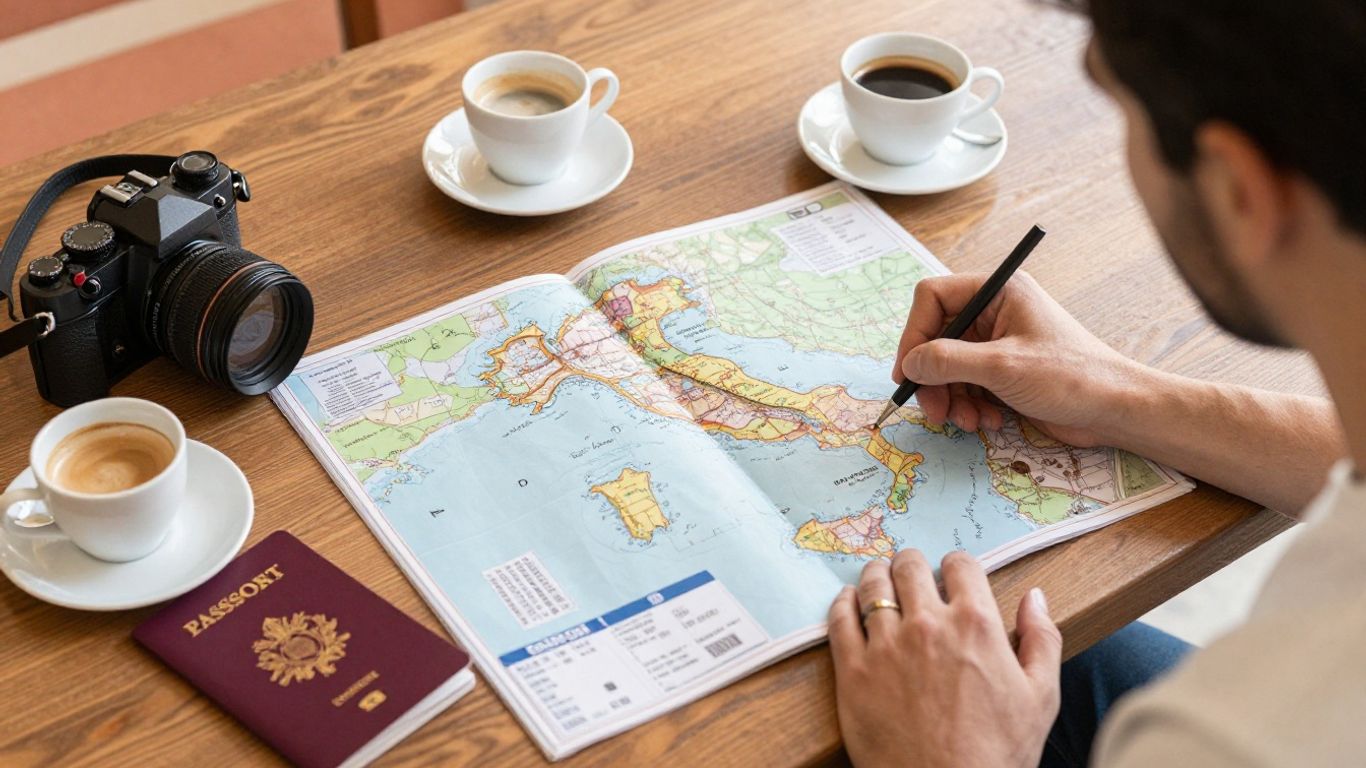 A couple studying an Italy map beside luggage
Plan a first-time trip to Italy
First-time visitors often do well with Rome, Florence, and Venice, provided they have at least nine or ten nights. Rome supplies ancient history and monumental art, Florence concentrates Renaissance treasures in a walkable center, and Venice offers a completely different urban experience. If you have fewer days, choose two rather than squeezing in all three.
Build the route around arrival logistics. Spending the first nights in the city where you land can reduce fatigue, while ending near a convenient airport or fast rail connection makes departure day calmer. Include one deliberately easy day after a long flight.
Combine Rome, Florence, and Venice
These cities connect naturally by high-speed train, making a northbound or southbound route practical. A common rhythm is four nights in Rome, three in Florence, and three in Venice, though art lovers may want more time in Florence and travelers focused on ancient sites may extend Rome. Book the most time-sensitive museums and landmarks before filling the rest of the calendar.
Avoid treating the train ride as a sightseeing day. Check out, reach the station, travel, find the next lodging, and settle in before dinner; the changeover usually takes longer than the journey itself. A little slack also helps when a museum visit or meal runs over.
Explore the Amalfi Coast, Tuscany, or Sicily
The Amalfi Coast is best approached as a focused coastal stay, with ferries and buses often more useful than a car in busy months. Tuscany suits a base-and-day-trip pattern, especially if you want wineries, hill towns, and long lunches. Sicily deserves generous time because its cities, archaeological areas, and landscapes are spread across a large island.
Choose one of these additions based on your trip’s central mood. A coast stop adds scenery and swimming, Tuscany adds countryside and food, and Sicily adds regional depth. Trying to include all three usually turns the vacation into a sequence of departures.
Avoid packing too many destinations into one trip
Every move carries hidden costs: packing, checking out, finding the station, navigating a new neighborhood, and resetting your plans. As a rule, keep at least two nights in a place and reserve three or more for major cities. Day trips can provide variety without creating another lodging change.
Before booking, write down the door-to-door time for each transfer, not only the train or flight duration. If the route still looks pleasant after adding station walks and check-in, it is probably workable. If not, remove a stop now rather than sacrificing time once you arrive.
A useful final check is to ask what you would keep if one day disappeared. The answer reveals the trip’s real priorities and gives you a sensible cut when the schedule becomes too full.
Create a realistic Italy travel budget
Italy can fit several travel styles, but a budget works only when it reflects the way you actually travel. A low nightly rate may be offset by long transfers, while a central room can save money on taxis and time. Set a daily range, then keep a separate reserve for major admissions and unexpected changes. Build in breathing room before you start comparing individual bookings.
Estimate flights, accommodations, and transportation
Start with the large, relatively fixed expenses: international flights, intercity transport, lodging, and airport transfers. Then estimate how many nights you will spend in each type of place, since Rome, Venice, and the Amalfi Coast may price differently from smaller inland towns. Include luggage fees, seat reservations, parking, tolls, and local transit when they apply.
Accommodation is often the largest variable after airfare. A home exchange can change that calculation: SwappaHome’s Italy budget guide describes swapping homes through credits and points to local living, markets, and affordable trattorias. Treat any accommodation approach as part of the whole route, including its location and the transport it may save.
Compare budget, mid-range, and luxury travel styles
A budget trip might use simple rooms, public transport, bakeries, markets, and free walking routes. Mid-range travel usually blends comfortable hotels or apartments with selected tours and sit-down meals. Luxury planning may add private transfers, higher-end lodging, and dedicated guides, but the value depends on how much convenience and personalization matter to you.
The following framework helps you compare the shape of each style before assigning exact numbers:
| Travel style | Accommodation approach | Transportation pattern | Daily planning focus |
|---|---|---|---|
| Budget | Simple rooms or exchanges | Regional trains and buses | Markets, free sights, local meals |
| Mid-range | Comfortable hotels or rentals | Rail plus occasional taxis | A mix of paid and free activities |
| Luxury | Premium hotels or villas | Private transfers and reserved services | Convenience, access, and flexibility |
These categories are starting points, not rules. You can spend modestly on lodging and splurge on a food tour, or choose a beautiful room while relying on trains. Decide which moments deserve the money before cutting small pleasures across every day.
Plan for food, attractions, and activities
Food costs are easier to control when you vary the rhythm. Have a pastry and coffee breakfast, make lunch the substantial meal, and leave room for a market picnic or aperitivo on some evenings. Admission fees also add up quickly in museum-heavy cities, so identify the handful of experiences you would regret missing.
Keep a short list of free or low-cost options for each stop: churches with notable art, public gardens, neighborhood walks, viewpoints, and markets. That flexibility lets you say yes to an unexpected meal or concert without feeling that the budget has failed.
Account for seasonal price differences
Prices tend to rise around major holidays, summer coastal demand, and large local events. Shoulder-season travel can make central lodging and popular attractions easier to manage, while winter may offer savings outside ski and holiday areas. Always compare the total trip cost, since a cheaper room far from transit can create daily taxi expenses.
If your dates are fixed, book the least flexible pieces first and keep a cancellation buffer where possible. If your dates are flexible, compare whole weeks rather than isolated nights; shifting a trip by a few days can change both accommodation and transport costs.
Choose where to stay in Italy
Where you sleep shapes the pace of the entire vacation. A central address may cost more but reduce early-morning transfers, while a residential neighborhood can offer better space and a more ordinary daily rhythm. Match the base to your plans instead of assuming the most famous district is always best. Read recent access details carefully, especially in historic centers with restricted vehicle traffic.
 Sunlit Italian apartment balcony overlooking rooftops
Compare hotels, vacation rentals, and agriturismos
Hotels simplify short stays with front desks, daily housekeeping, and predictable check-in. Vacation rentals can provide kitchens, laundry, and more room for families or longer visits, while agriturismos place you near farms, vineyards, or rural landscapes. Each works best for a different trip rhythm, so compare the practical details rather than the photographs alone.
For food-focused travel, a kitchen and a nearby market can be as valuable as an elaborate breakfast room. SwappaHome’s food and culture exchanges describe curated Italian homes with kitchens and access to neighborhood markets, making that format worth considering when everyday meals are part of the experience. Confirm what is included, how arrival works, and how far the home is from your planned activities.
Select convenient neighborhoods in major cities
In Rome, choose an area with a comfortable evening atmosphere and practical links to the sights you care about; Trastevere and Testaccio offer different feels from the historic center. In Florence, staying within or just beyond the central walking zone can make early museum reservations easier. In Venice, consider how close you are to a vaporetto stop and how much luggage you must carry over bridges.
Neighborhood choice is personal, but the basic test is simple: can you reach breakfast, transit, and dinner without making every outing an expedition? A local residential area may be ideal if you enjoy markets and slower mornings, while a central base suits a short, attraction-heavy visit.
Decide when a countryside stay makes sense
The countryside is rewarding when you have enough time to slow down. It can be a poor fit for a two-night city break if reaching the property requires multiple connections or a car. For three or more nights, however, a rural base can create space for long meals, vineyard visits, walks, and day trips to nearby towns.
Look at the map in relation to your actual plans. A beautiful farmhouse is less useful if every museum, restaurant, and station requires a long drive. Build in an arrival afternoon and avoid scheduling a major activity immediately after check-in.
Consider location, amenities, and access to transit
Check the nearest station, bus stop, ferry pier, grocery store, and pharmacy before booking. Ask whether the property has an elevator, air conditioning, heating, reliable Wi-Fi, luggage storage, and a quiet sleeping arrangement. In older buildings, stairs and uneven streets can be part of the experience, but they should not be surprises.
A convenient location also protects your energy. You may return briefly during the day, walk home after dinner, or change plans when the weather shifts. Those small conveniences often matter more than an extra decorative feature.
Navigate Italy by train, car, and public transportation
Italy’s transport mix makes a varied itinerary possible, but each mode suits a different landscape. Trains are efficient between major cities, cars help in rural areas, and ferries can be the simplest way along some coasts. Check the route as a whole rather than choosing transport one leg at a time. Stations, transfer times, and luggage all affect the experience.
Use high-speed trains between major cities
High-speed trains are particularly useful for links such as Rome–Florence, Florence–Venice, and Rome–Naples. They connect city centers and can be faster and less stressful than flying once airport transfers are included. Compare departure times, station locations, and fare conditions before choosing the cheapest ticket.
Reserve seats when your dates are firm, especially during busy periods. Keep the booking accessible on your phone, arrive with enough time to find the platform, and check the train number rather than relying only on the destination name.
Decide whether to rent a car
A car makes sense for parts of Tuscany, Sicily, Puglia, Sardinia, and other rural areas where villages are scattered. It is usually less helpful in Rome, Florence, Venice, or the Amalfi Coast, where traffic, parking, narrow streets, and restricted driving zones can complicate a short stay. Consider renting only for the portion of the trip that truly needs one.
Before driving, confirm insurance, license requirements, toll arrangements, fuel policy, and parking at each accommodation. Never assume a historic-center address is reachable by car. Ask the property how guests should approach it without entering a restricted zone.
Understand regional trains, buses, and ferries
Regional trains are valuable for day trips and smaller cities, though they may stop more frequently and require more timetable attention. Buses fill gaps where rail lines do not, particularly in hilly areas and along some coastlines. Ferries can be both transport and a scenic part of a coastal route, but schedules may change with weather or season.
Download or save the relevant schedules before leaving reliable Wi-Fi. For a day trip, note the last return option and a backup route. A little preparation prevents a beautiful outing from ending with an expensive, improvised transfer.
Handle tickets, reservations, and transportation strikes
Keep a simple record of confirmation numbers, departure times, and cancellation rules. Some tickets need validation while others are tied to a specific departure, so read the instructions before boarding. For buses and ferries, know where tickets are sold and whether reservations are required.
Transport strikes can affect plans, but they do not always cancel every service. Check official operator updates close to travel, ask your accommodation for practical local advice, and avoid scheduling a flight immediately after a long intercity transfer. A flexible final day is one of the least expensive forms of travel insurance.
Prepare for a smooth Italian vacation
The practical details are small, yet they determine how relaxed the trip feels. Pack for walking, prepare your arrival plan, and reserve only the experiences that genuinely need advance access. Leave room for changing weather and spontaneous invitations. A short checklist completed before departure can save hours of confusion later.
Pack for Italy’s weather, dress codes, and walking
Comfortable shoes matter more than an ambitious wardrobe because historic centers often involve stone streets, stairs, and long walks. Bring light layers, a compact rain shell, and clothing that covers shoulders and knees for churches where dress codes apply. In summer, sun protection and a refillable water bottle are especially useful.
Pack lighter than you think you need. A manageable bag makes train platforms, bridges, stairs, and hotel changes far easier, particularly in cities where vehicles cannot reach the front door.
Learn essential Italian travel phrases
A few Italian words make everyday interactions warmer and more efficient. Practice buongiorno, buonasera, per favore, grazie, scusi, dov’è, and il conto before leaving. Learn how to ask whether someone speaks English, but begin politely in Italian rather than assuming it.
Pronunciation does not need to be perfect. A genuine attempt, followed by patience and a smile, is usually more useful than memorizing a long script. Save addresses and key phrases offline for moments when your connection is unreliable.
Reserve popular attractions and restaurants
Book major museums, archaeological sites, and timed-entry landmarks as soon as your route is stable. Restaurants with limited seating may also require advance planning, especially for weekends and high season. Do not fill every hour, though; reserve the anchors and leave space around them.
A reservation should support the day rather than control it. Group nearby sights together, allow time for lunch and security lines, and keep one or two alternatives in mind in case weather or fatigue changes your plans.
Understand tipping, tourist taxes, and local customs
Service practices vary by setting, and a modest tip for especially good service is generally more appropriate than automatically adding a large percentage. Check the bill, since some restaurants include a service or cover charge. Tourist taxes are often collected separately by accommodations, so include them in your booking notes.
Observe how locals behave in churches, markets, cafés, and public transport. Dress respectfully at religious sites, keep voices low in residential buildings, and avoid blocking narrow streets while taking photographs. Courtesy travels well.
Protect your documents, health, and valuables
Keep digital and paper copies of passports, insurance details, prescriptions, and important reservations in separate places. Carry only what you need for the day, use a secure bag in crowded areas, and store emergency contacts offline. If you take regular medication, bring enough for delays and keep it in its original packaging.
Check your health coverage and understand how to get assistance before departure. Share your route with someone at home, but do not publish every accommodation detail publicly. These precautions are simple, discreet, and worthwhile.
Conclusion
Planning a trip to Italy is less about finding a flawless schedule than creating one that leaves room for the country to surprise you. Choose a route you can enjoy at walking pace, spend deliberately on the experiences that matter, and let a few unplanned hours become part of the itinerary.
Frequently Asked Questions
How many days are enough for a trip to Italy?
Seven to ten nights can work for two major destinations, while two weeks gives you more room for three cities or a city-and-region combination. Longer trips make rural areas, Sicily, or multiple coastal stops more comfortable.
What is the best time to visit Italy?
Spring and fall often offer pleasant sightseeing weather and fewer crowds than summer. Summer suits beach and festival trips, while winter can be appealing for quieter city visits, depending on the region.
Should I visit Rome, Florence, and Venice on one trip?
Yes, if you have roughly nine or ten nights and are comfortable with three city stays. With less time, choose two cities so travel days do not overwhelm the experience.
Is Italy expensive to visit?
Italy can suit different budgets. Lodging, season, location, transportation choices, and restaurant habits make the biggest difference, so compare the full daily cost rather than accommodation alone.
Do I need a car in Italy?
Not usually for major cities, which are often better connected by rail and public transportation. A car becomes more useful in rural Tuscany, parts of southern Italy, and islands where villages are spread out.
How far in advance should I book Italian attractions?
Reserve timed-entry museums, famous archaeological sites, and especially popular restaurants once your dates are firm. Leave unstructured time around those bookings instead of scheduling every hour.
What should I pack for Italy?
Bring comfortable walking shoes, adaptable layers, weather protection, and respectful clothing for churches. A lighter bag is helpful on trains, stairs, bridges, and streets where vehicles cannot reach accommodations.

Published by
SwappaHome
SwappaHome Editorial Team
Home Exchange & Slow Travel Editorial
The SwappaHome Editorial Team brings together travel research, home-exchange community insights, and platform data to produce practical guides for first-time and experienced home swappers. Every article cites real platforms, current market rates, and verifiable city-level facts so readers can make informed decisions without guessing.
Ready to try home swapping?
Join SwappaHome and start traveling by exchanging homes. Get 7 free credits when you sign up!