7 Home Swap Mistakes to Avoid for a Smooth, Stress-Free Exchange

SwappaHome Editorial Team
Home Exchange & Slow Travel Editorial
I've watched more than a few home swaps go sideways, and it's almost never because someone got unlucky. It's because they skipped something. A background check here, a written agreement there, or...
I've watched more than a few home swaps go sideways, and it's almost never because someone got unlucky. It's because they skipped something. A background check here, a written agreement there, or they just wildly underestimated how much prep goes into handing your house over to a stranger. Those little skips are the number one reason first-time swappers end up stressed instead of relaxed on some beautiful terrace in Portugal.
The good news? Pretty much every one of these mistakes is avoidable once you know what to look for. So let's go through the seven that come up over and over, why people make them, and how to not be that person.
Table of Contents
- What Is Home Swapping, and Why Do These Mistakes Trip Up First-Timers?
- The 7 Most Common Home Swap Mistakes (and How to Fix Them)
- How Much Can Home Swap Mistakes Actually Cost You?
- Home Exchange Tips for Avoiding Home Swap Mistakes Before You Book
- FAQ About Home Swap Mistakes
What Is Home Swapping, and Why Do These Mistakes Trip Up First-Timers?
Home swapping is when two households agree to stay in each other's homes instead of paying for a hotel or a rental. Sometimes at the same time, sometimes one after the other, sometimes through a points system. It's basically reciprocal travel, and it's exploded alongside the whole home-sharing thing. Families love it, retirees love it, and remote workers really love it because you get space, a kitchen, and a neighborhood that feels real instead of a beige box with a tiny coffee maker.
So why do so many people mess it up? Because it looks easy. Browse listings, message someone, agree on dates, done. But underneath that simple surface there's a whole tangle of trust, logistics, and a bit of legal fine print that nobody thinks about until something breaks. When you book a hotel, some corporation handles the insurance and the cleaning and the "who broke the lamp" argument. With a swap, it's just two regular people trying to communicate clearly and not screw it up. And when one side drops the ball, you can end up anywhere from a mildly annoying messy kitchen to a genuinely bad situation involving property damage and zero recourse. Knowing the pattern behind these errors is honestly half the battle.
The 7 Most Common Home Swap Mistakes (and How to Fix Them)
These are the seven that show up in basically every home swap horror story I've ever read, plus how to actually fix each one.
Mistake #1: Skipping Proper Vetting of Your Swap Partner
The single biggest mistake is treating your swap partner like a random match on a listing site instead of someone who's about to have full run of your house. Think about that for a second. Full access. To your home.
So before you agree to anything, verify their identity with a government ID, poke around their social media, read whatever reviews other swappers have left, and get on a video call if you possibly can. A profile with zero reviews and a bio that says something like "love to travel, easygoing" and nothing else? That's a red flag. Take it seriously.
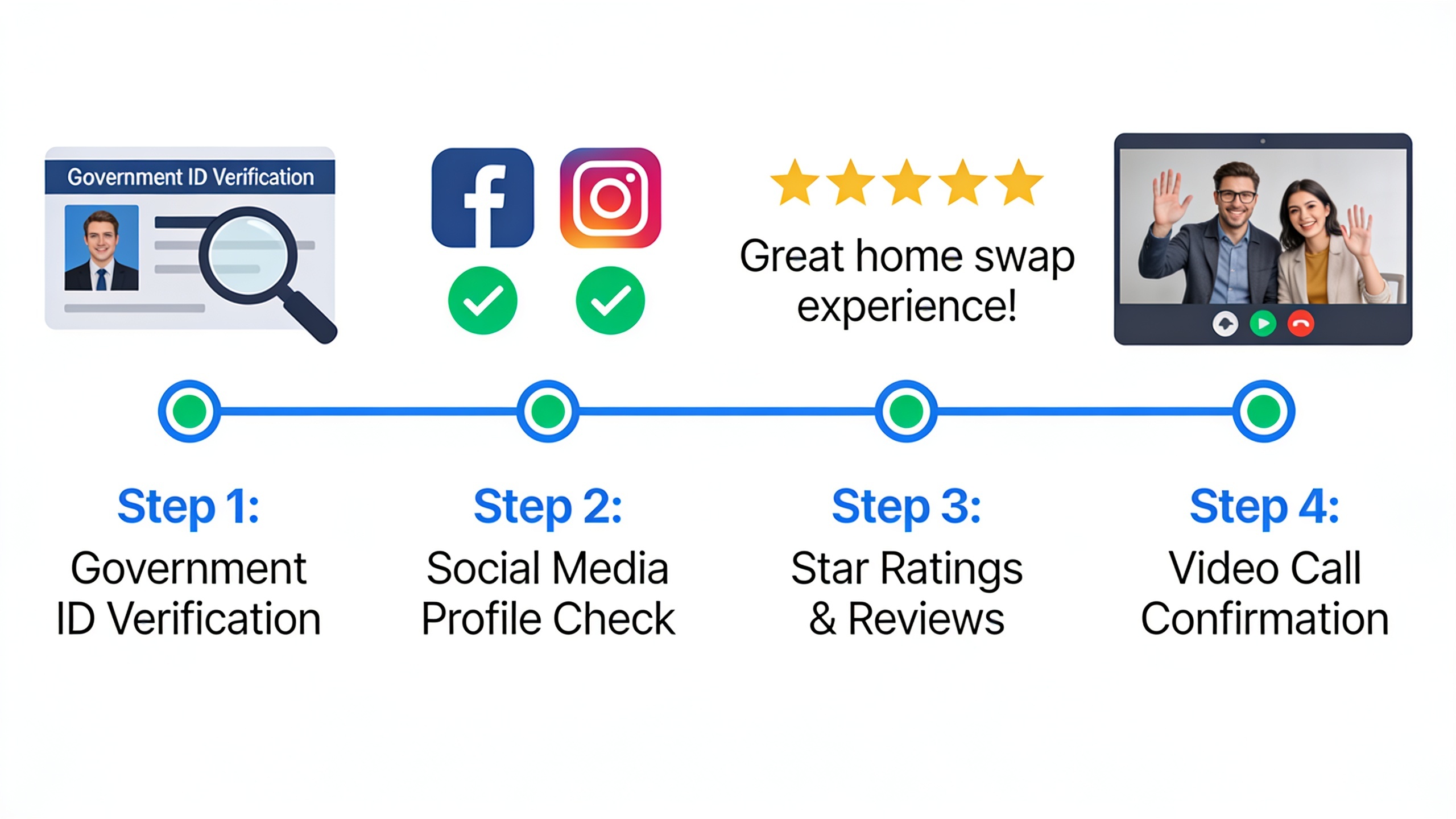 Infographic showing home swap partner vetting steps including ID verification, social media review, ratings check, and video call
And vetting isn't just about trust, it's also about fit. Someone can be perfectly honest and still be a terrible match for your dates, your home type, or your general vibe. If you're not sure how to weigh all that, this guide on how to choose the right home swap partner for your trip breaks down the actual criteria experienced swappers use, from lifestyle habits to communication style to whether your place is even the right size for them.
Mistake #2: Overlooking Insurance and Liability Coverage
A lot of new swappers just assume their homeowner's insurance covers a stranger staying in their place. It usually doesn't. And that assumption can get expensive.
Here's the problem. Standard homeowner's or renter's policies are written around you living there. They may flat-out exclude damage caused by someone who isn't family, and almost no swap agreement bothers to spell out who pays when a pipe bursts or a guest scratches a car in your driveway. So you're left holding the bill and the argument.
Call your insurance provider before you finalize anything and ask, point blank, whether your policy covers a reciprocal home stay. If it doesn't, look into a supplemental policy or a specific home-exchange endorsement. While you're at it, write a simple liability clause into your agreement sorting out who's responsible for accidental damage versus normal wear and tear. For the full rundown on what to check and how to actually protect yourself, this piece on how to handle insurance and liability in home swapping is about the most useful thing I've found on the subject.
Mistake #3: Leaving Agreements Vague or Unwritten
A cheerful "sounds good, see you in June!" is not an agreement. It's a misunderstanding waiting to happen. Get it in writing.
This is maybe the most preventable mistake on the whole list, because all it takes is a shared document. At a minimum, spell out:
- Exact check-in and check-out dates and times
- Who covers utilities, internet, and any subscriptions used during the stay
- Pet, plant, and mail-handling duties
- What happens if someone needs to cancel or reschedule
- Emergency contacts for both households, plus a trusted local contact
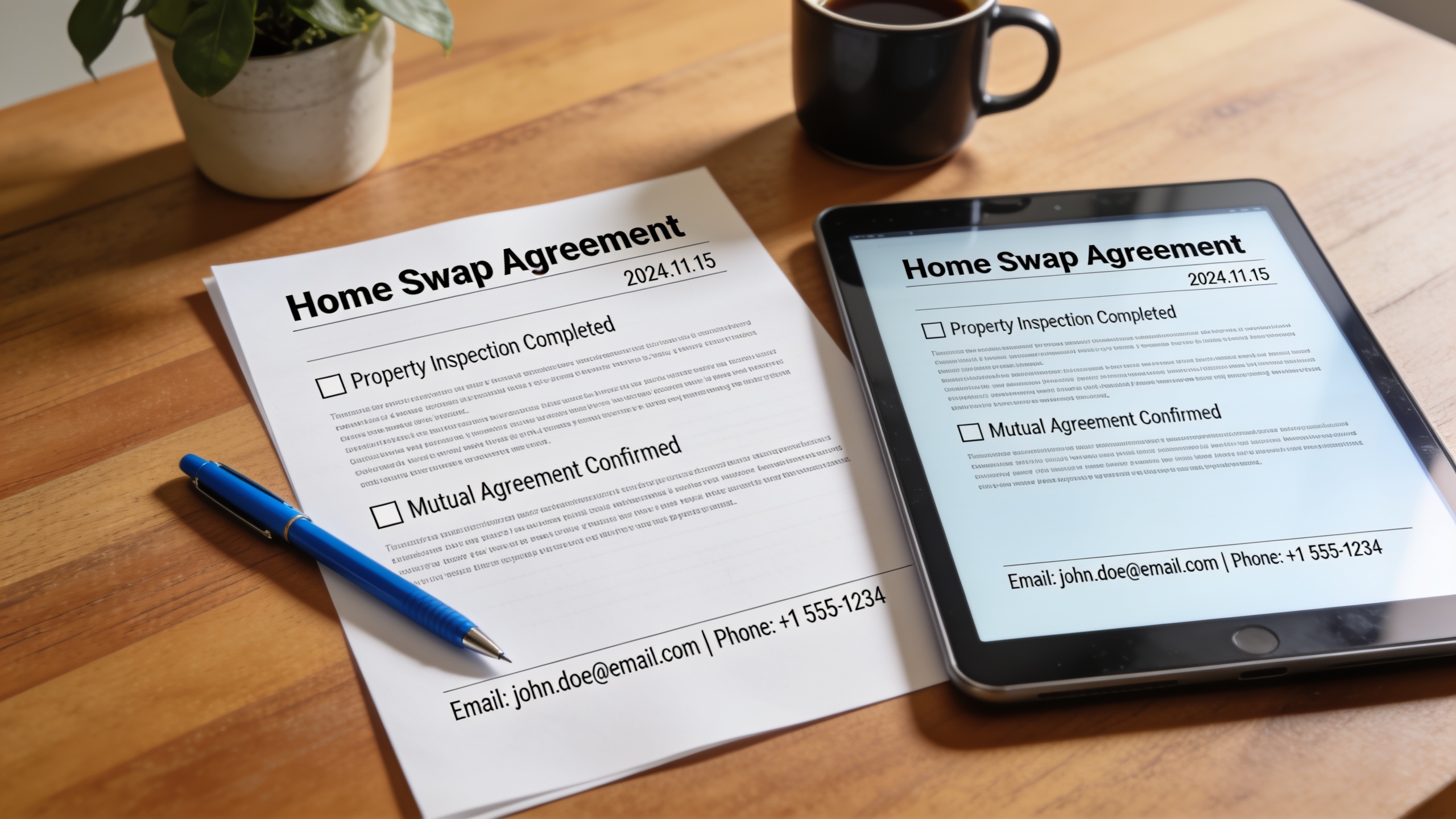 A printed home swap agreement document and digital tablet showing a completed home exchange contract with key details
I know, when you're excited about a trip, drafting a document feels like homework. But this is exactly what turns a home swap from a leap of faith into something calm and manageable. Skip it and you're just hoping everyone remembers the same conversation the same way. They won't.
Mistake #4: Failing to Prepare Your Home Properly
Guests notice everything. The dusty blinds, that one mystery key that doesn't open anything, the fridge full of science experiments nobody cleaned out. A badly prepped home is one of the fastest ways to sour a swap, especially if you're hoping to exchange with the same people again or you need a good review.
And preparation goes way beyond a quick vacuum. Walk through your own place like you're seeing it for the first time. Label the thermostat and the weird appliance controls. Leave a printed welcome guide with the Wi-Fi password and the trash pickup days. Clear out some closet and fridge space so your guests aren't living out of a suitcase. Lock away valuables and sensitive documents. And if your house has quirks, and every house does, write them down. The water heater that only works if you jiggle it. The gate that needs a code. All of it. Oh, and this is a good moment to circle back to Mistake #2 and make sure your insurance is actually sorted before anyone shows up, because a spotless home still needs a safety net behind it.
Mistake #5: Setting Unrealistic Expectations About Location and Amenities
Photos lie. Not always on purpose, but a listing written by someone who adores their home tends to skip the annoying stuff. The noisy street. The fourth-floor walk-up with no elevator. The "10-minute walk to the beach" that turns into a sweaty 30 with a beach bag over your shoulder.
Arriving to find the reality doesn't match the pitch is one of the more soul-crushing mistakes on this list, precisely because it happens after you've flown across the world and unpacked. There's no undo button.
So ask specific questions before you confirm. How loud is it at night? Is there decent AC or heating for the season you're visiting? How far is the nearest grocery store, and can you walk to it? And if you're swapping internationally, do your own homework instead of trusting your partner's description. Someone planning a swap in Japan, for instance, would do well to dig into a detailed resource like E2Japan, which catalogs thousands of landmarks, hotels, and practical stuff like designated smoking areas that no home listing is going to mention. Same idea in reverse: if your swap partner has no clue about your own city's housing quirks, a platform like Vivienda Lista that helps people size up homes and neighborhoods can be a handy reference for setting honest mutual expectations. Because "walkable" and "quiet neighborhood" mean very different things to different people.
Mistake #6: Poor Communication Before and During the Swap
Silence kills a good swap. New users tend to think that once the dates are locked, they can go quiet until the trip. Wrong instinct.
The best exchanges have a steady drumbeat of check-ins. A message a week out confirming everything's still on. A quick text on arrival day. And a reliable way to reach each other mid-stay when something inevitably comes up, like a broken appliance or a recycling system that seems designed by a committee of sadists.
Sort out early which channel you'll use and roughly how fast you each reply, and pay extra attention to time zones. Digital nomads bouncing between back-to-back swaps in different countries really need to nail this, because a communication gap across eight time zones is a lot harder to untangle than one across town. My rule of thumb: over-communicate. Especially in the 48 hours on either side of a changeover. Nobody has ever complained about too many helpful texts.
Mistake #7: Ignoring Local Customs and Practical Logistics
The last one is underestimating how much local knowledge shapes a smooth stay, both for you and for the folks staying in your place. Trash and recycling rules swing wildly from city to city and country to country. Some neighborhoods enforce strict quiet hours or parking permits. And cultural norms around noise, guests, or taking your shoes off indoors can absolutely catch a newcomer off guard.
Before you swap, brief your partner on anything specific to your home, the parking permits, the HOA rules, the quiet hours, and ask them for the same. If you're a nomad juggling finances or subscriptions across borders during a long swap, it's also worth keeping an eye on the practical money side of things. Even something like tracking currency and crypto market moves through a resource like Cryptocoinsjournal can matter when you're managing international payments while you're on the road for months. None of these gaps ruins a trip on its own. But they pile up fast if you ignore them.
How Much Can Home Swap Mistakes Actually Cost You?
These mistakes hit you in three places: money (from damage disputes nobody agreed to sort out), time (from the endless back-and-forth of miscommunication), and reputation (a bad review on a swap platform tanks your future matches). Exact dollar figures bounce around case by case, but the risk pattern is consistent enough to lay out plainly.
| Mistake | Primary Risk | Relative Cost to Fix Afterward | Prevention Effort Required |
|---|---|---|---|
| Skipping partner vetting | Property damage, scams, no-shows | High — often unrecoverable | Low (video calls, ID checks, reviews) |
| No insurance/liability clarity | Out-of-pocket repair costs | High — potentially thousands | Medium (one call to insurer) |
| Vague or unwritten agreements | Disputes over dates, responsibilities | Medium — time-consuming to resolve | Low (a shared document) |
| Poor home preparation | Bad reviews, guest complaints | Low-Medium — reputational | Medium (a few hours of prep) |
| Unrealistic expectations | Trip disappointment, early departure | Medium — lost vacation time | Low (ask detailed questions upfront) |
| Communication breakdowns | Confusion during stay, delayed fixes | Medium — stress and lost time | Low (set expectations early) |
| Ignoring local customs/logistics | Fines, HOA complaints, awkward disputes | Low-Medium — situational | Low (a short local-rules brief) |
Notice the pattern here. The two mistakes with the highest potential cost, skipping vetting and ignoring insurance, are also the ones that take the least effort to prevent. That gap is exactly why they trip up so many people. The fix is easy, which somehow makes it easier to skip when you're excited and just want to lock in your dates already.
Home Exchange Tips for Avoiding Home Swap Mistakes Before You Book
Honestly, every good home exchange tip boils down to one thing: slow down before you confirm. Almost every mistake on this list is born from rushing to grab a date without doing the groundwork.
So build yourself a checklist and run every single potential swap through it, no matter how gorgeous the listing photos are. Identity verification, a written agreement, an insurance confirmation, and a documented walk-through of house rules on both sides. Same process every time, even after you've done a handful of great swaps. Especially then, actually. Complacency after a few good experiences is exactly when people let their guard down and step right back into a mistake they thought they'd already outgrown.
It's also worth thinking hard about how you present your own place. An honest, detailed listing with clear photos and accurate amenity descriptions and real neighborhood info pulls in more serious, compatible partners and cuts your odds of a mismatch down the road. And if you keep a travel blog to document your swaps, which is more and more common among nomads building a bit of a personal brand, a tool like RobinRank can handle the tedious SEO side of publishing so you spend your time on the stuff that actually matters, like vetting partners and planning the trip.
Last thing: build in a buffer. Nail down the final details at least a week before you travel, keep both a printed and a digital copy of your agreement, and have a plan B ready, a nearby hotel or short-term rental, in case a swap collapses at the worst moment. Experienced swappers never fully eliminate risk. They just quietly shrink it, by treating every exchange with the same care they'd want from whoever's about to be sleeping in their bed.
FAQ About Home Swap Mistakes
What's the mistake first-timers make most? Two, really: skipping identity verification on their partner, and never getting the agreement details in writing. Both are dead simple to avoid, but people breeze past them because the whole thing feels so casual, way more casual than booking a hotel.
Do I actually need special insurance for a home swap? Often, yes. Standard homeowner's or renter's policies are usually built around the policyholder living there, and they may not cover damage from a reciprocal guest at all. Call your insurance provider before any swap to confirm what you've got, and grab a supplemental policy if there's a gap.
How can I tell if a potential swap partner is trustworthy? Look for a complete profile with verified ID, reviews from past exchanges, and someone who's happy to hop on a video call before confirming dates. No review history at all, or a weird reluctance to verify their identity, are both perfectly good reasons to slow down or look elsewhere.
What should go in a home swap agreement? Exact check-in and check-out dates, who's covering utilities and subscriptions, pet and plant duties, cancellation terms, and emergency contacts for both households. Get it in writing, even a bare-bones shared doc, and you'll head off most mid-swap arguments before they start.
Is home swapping really cheaper than a hotel or rental? It can be, big time, since no nightly rate changes hands at all. That's the whole draw for budget travelers, families, and retirees. But the real savings depend on how much effort you put in upfront, because cleaning up a mistake after the fact can eat right into whatever you saved.
Here's what I keep coming back to: home swapping rewards preparation way more than luck. The people who get the most out of it aren't the ones with the fanciest homes to dangle. They're the ones who vet carefully, communicate like adults, and treat every agreement like it matters, because it does. Keep this list somewhere handy next time you're browsing listings, and you'll be in great shape to turn your next exchange into the kind of trip that has you itching to do it all over again.

Published by
SwappaHome
SwappaHome Editorial Team
Home Exchange & Slow Travel Editorial
The SwappaHome Editorial Team brings together travel research, home-exchange community insights, and platform data to produce practical guides for first-time and experienced home swappers. Every article cites real platforms, current market rates, and verifiable city-level facts so readers can make informed decisions without guessing.
Ready to try home swapping?
Join SwappaHome and start traveling by exchanging homes. Get 7 free credits when you sign up!