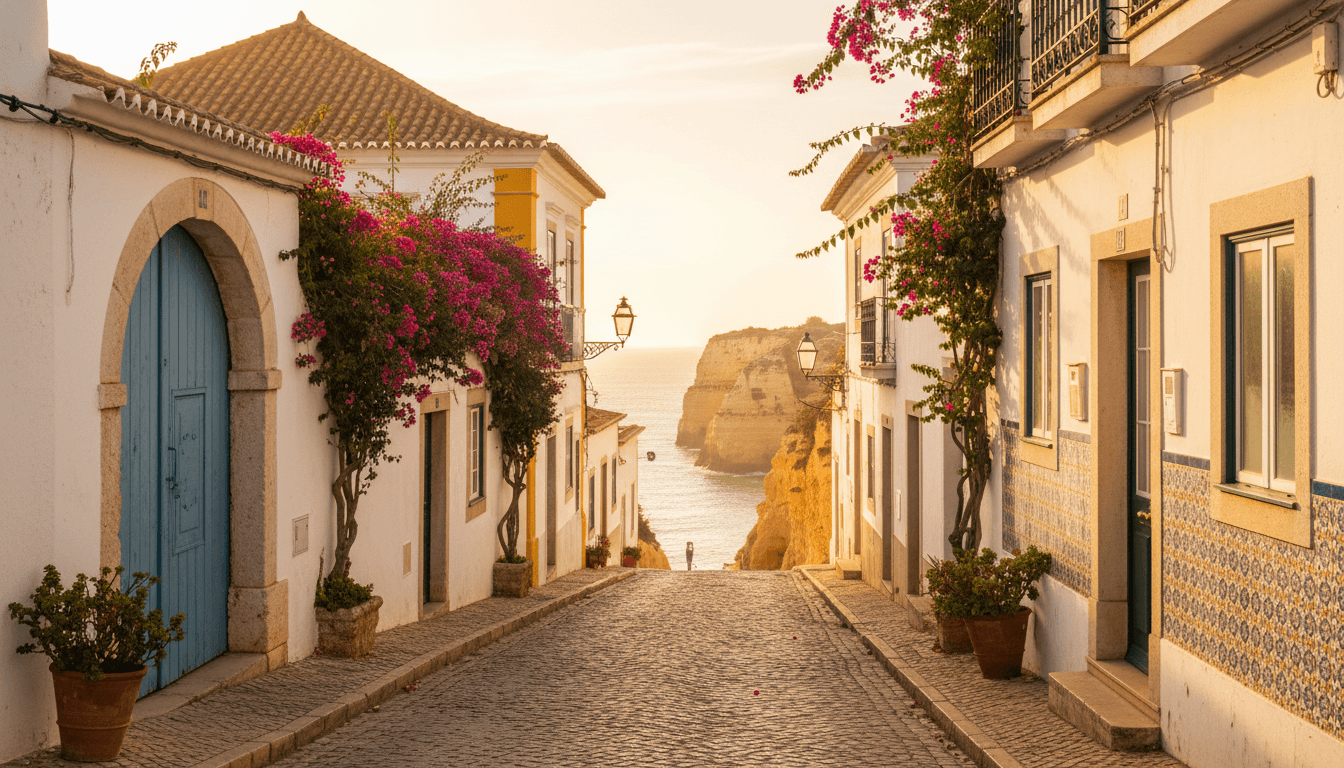
Algarve Bucket List: 27 Unforgettable Experiences for Your Home Swap Adventure

SwappaHome Editorial Team
Home Exchange & Slow Travel Editorial
Discover the ultimate Algarve bucket list for home swappers—from secret beaches to local food markets, cliff hikes to wine tastings in this stunning Portuguese region.
The morning I woke up in a whitewashed villa in Lagos, I made the mistake of checking my phone before coffee. My friend Sarah had texted: "How's the hotel?" I laughed out loud. Hotel? I was staying in a three-bedroom house with a lemon tree in the garden, a kitchen stocked with local olive oil, and a neighbor named João who'd already dropped off fresh figs. This is what building an Algarve bucket list looks like when you're doing a home swap instead of the typical tourist route.
I'd been wanting to explore Portugal's southern coast for years, but the Algarve's reputation as a package-holiday destination had always made me hesitant. Would it be all-inclusive resorts and fish-and-chips shops catering to British tourists? What I discovered during my three-week home exchange was something entirely different—a region of dramatic coastlines, genuine hospitality, and experiences that never made it into the glossy brochures.
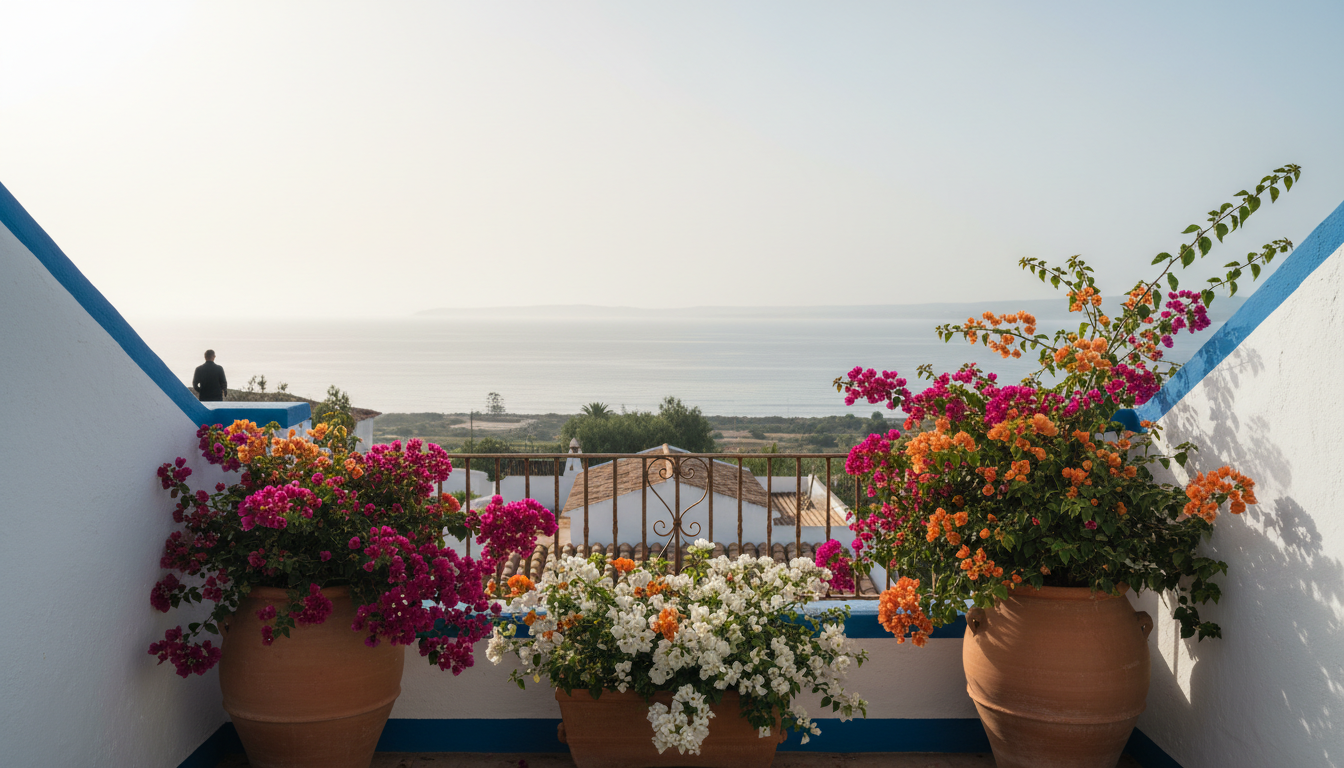 early morning view from a traditional Algarvian villa terrace, white walls with blue trim, terracott
Why the Algarve Deserves a Spot on Your Bucket List
Here's what surprised me most about the Algarve: it's actually two completely different regions pretending to be one. The southern coast—the part everyone knows—has those iconic limestone cliffs, sea caves, and golden beaches that flood Instagram every summer. But venture inland or to the western coast, and you'll find cork oak forests, medieval villages where time genuinely seems slower, and surf breaks that rival anything in California.
The Algarve bucket list I'm sharing isn't the one you'll find in most travel guides. I spent three weeks living like a local, shopping at the same markets, learning which bakeries open earliest, figuring out which beaches the Portuguese families actually go to (spoiler: not the ones with the biggest parking lots). Home swapping gave me something hotels never could—context. My host left notes about her favorite spots, her neighbor's restaurant, the hiking trail that isn't on Google Maps.
And honestly? The Algarve is perfect for home exchange. The region has a strong expat community alongside locals, which means plenty of SwappaHome members with properties ranging from modern apartments in Faro to restored farmhouses in the Monchique mountains. When you're staying in someone's actual home, you inherit their local knowledge. That's worth more than any guidebook.
Coastal Experiences That Should Top Your Algarve Bucket List
Kayaking to Benagil Cave (But Not the Way Everyone Else Does)
You've seen the photos—that massive sea cave with the hole in the ceiling, sunlight streaming onto a hidden beach. Benagil Cave is genuinely spectacular, but here's what nobody tells you: the boat tours that leave from Benagil Beach are chaotic, crowded, and give you about ten minutes inside the cave while jostling with fifty other tourists.
Rent a kayak from Praia da Marinha instead (about €15-20 for two hours, roughly $16-22 USD) and paddle the 2.5 kilometers yourself. Go early—I mean 8 AM early—and you might have the cave nearly to yourself. The paddle takes about 40 minutes each way, and you'll pass a dozen smaller caves and rock formations that the tour boats skip entirely. Just check the tide charts; you can only enter Benagil at low to mid tide.
I went on a Tuesday morning in late September and shared the cave with exactly two other kayakers. We floated there for half an hour, watching the light change as the sun rose higher. No rushing, no crowds, no guide telling us to move along.
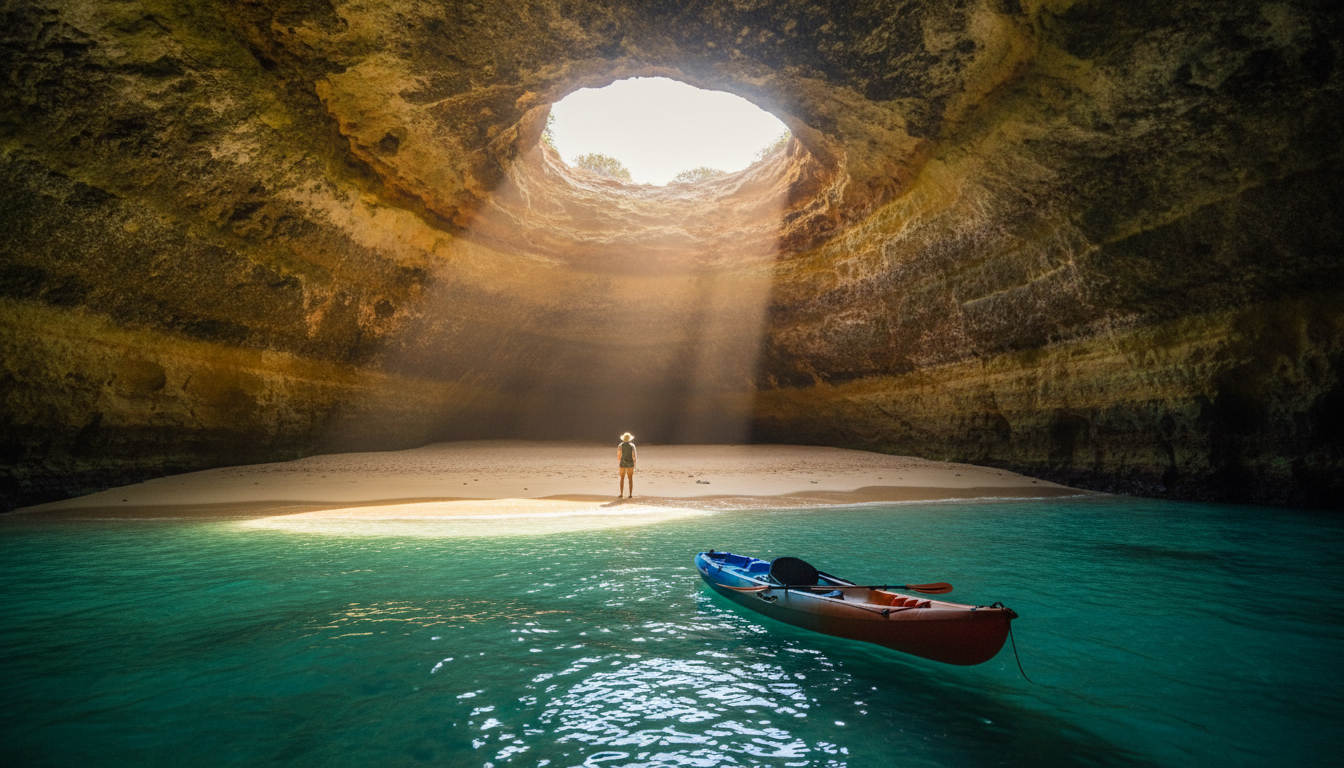 interior of Benagil Cave at golden hour, sunlight streaming through the circular opening in the ceil
The Seven Hanging Valleys Trail (Sete Vales Suspensos)
This 12-kilometer clifftop walk between Praia da Marinha and Praia de Vale Centeanes is, without exaggeration, one of the most spectacular coastal hikes I've ever done. And I've done a lot of them.
The trail winds past rock arches, hidden coves, and those distinctive Algarvian cliffs that look like they're made of honeycomb. You'll pass the famous "heart" rock formation at Praia da Marinha, the double arch at Praia de Albandeira, and viewpoints that made me stop so many times my Apple Watch gave up on calculating my pace.
Practical stuff: start early (before 9 AM in summer), bring at least 2 liters of water per person, and wear proper hiking shoes—the limestone gets slippery. There's no shade for most of the route. The trail is well-marked with wooden posts, but download the offline map anyway. I took a wrong turn near Benagil and ended up adding an extra kilometer.
You can do it as a one-way hike and take an Uber back (around €15/$16), or do the full out-and-back if you're feeling ambitious.
Secret Beaches Worth the Scramble
The Algarve has over 150 beaches, and most tourists only see about five of them. Here are the ones my host circled on a paper map she left in the kitchen:
Praia da Mesquita is technically part of the Marinha beach complex, but it requires a slightly sketchy scramble down a cliff path. The reward? A tiny cove that feels private even in August. The water is that impossible shade of turquoise that you think must be Photoshopped until you're standing in it.
Praia do Carvalho you access through a hand-carved tunnel in the cliff. Yes, really. Someone (legend says a fisherman, but who knows) spent years carving a passage through the rock. The beach itself is small but dramatic, surrounded by towering cliffs.
Praia da Bordeira sits on the western coast—completely different vibe. This is a massive, windswept beach popular with surfers, backed by dunes and a river estuary. It feels wild in a way the southern beaches don't. Perfect for a sunset walk when you want space to think.
Algarve Bucket List Experiences Beyond the Beach
The Saturday Market in Loulé
Skip the tourist markets in Albufeira. The Loulé market, held every Saturday in a stunning Moorish-style building, is where actual Algarvians do their shopping. I spent three consecutive Saturdays here and never got bored.
The ground floor is all produce—mountains of citrus, tomatoes that smell like tomatoes should, bunches of herbs, wheels of local cheese. Upstairs, you'll find everything from handmade ceramics to cork products (the Algarve is cork country) to antiques of questionable provenance. There's a section selling live chickens if you're really committing to the local experience.
Get there by 9 AM if you want the best selection. By noon, the good stuff is gone and the vendors are packing up. Budget around €30-40 ($33-44 USD) for a week's worth of incredible produce, plus whatever catches your eye in the craft section.
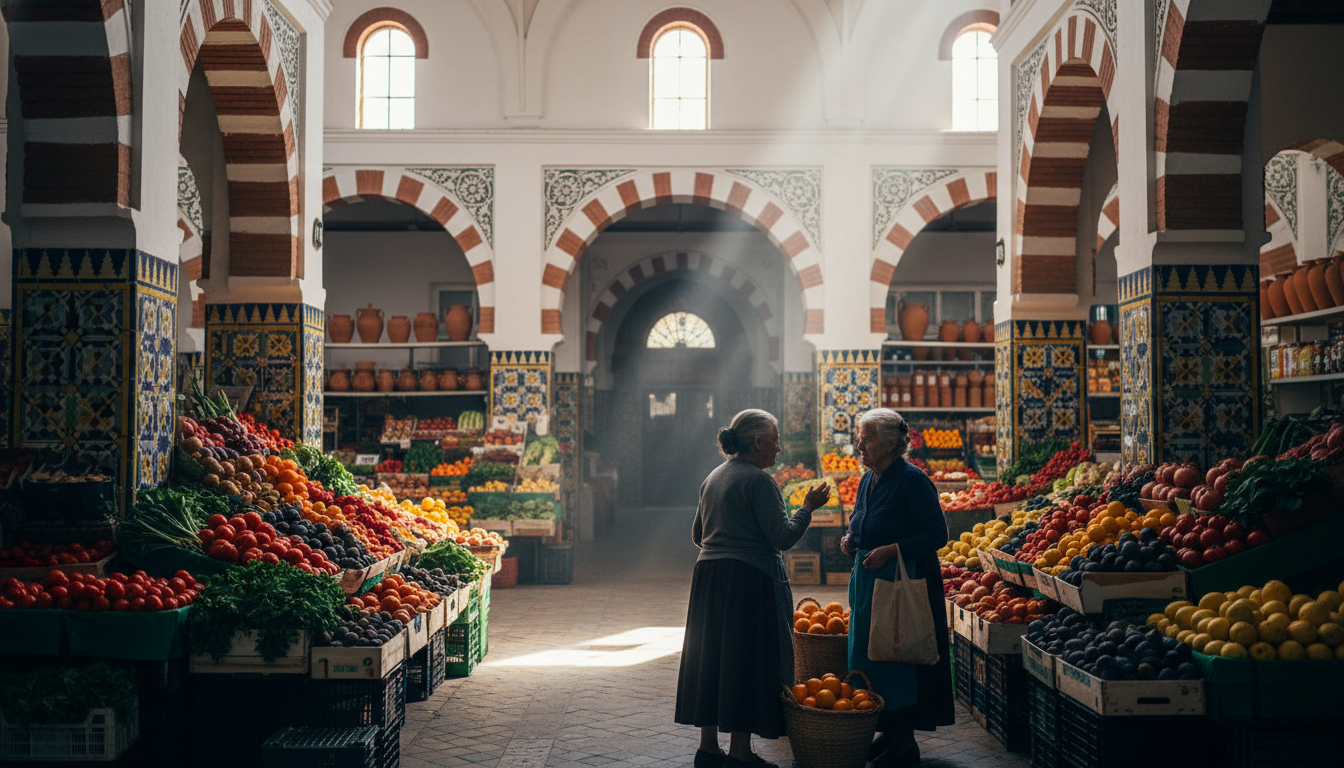 interior of Loul market hall, ornate Moorish arches and tilework, stalls overflowing with colorful p
Wine Tasting in the Algarve (Yes, Really)
I know, I know—Portugal is famous for Porto and the Douro Valley, not the Algarve. But the region's wine scene has exploded in the last decade, and the wines are genuinely excellent. The hot, dry climate produces bold reds and increasingly interesting whites.
Quinta dos Vales near Lagoa is the most visitor-friendly option, with tours and tastings starting around €15 ($16 USD). They're known for their art installations as much as their wine—the estate is dotted with giant sculptures. Quinta do Francês is smaller and more intimate, run by a French-Portuguese couple who'll walk you through their organic vineyards. Book ahead; they only do a few tastings per week.
The local grape to know is Negra Mole for reds—it's been grown here for centuries and produces wines that are fruity but not jammy, perfect with the local grilled fish.
Silves: The Algarve's Forgotten Capital
Before Faro became the regional capital, Silves was the center of power in the Algarve—first under the Moors, then the Portuguese. The massive red sandstone castle still dominates the town, and walking its walls gives you views across orange groves to the distant sea.
But Silves isn't just about history. The town has a great food scene, with restaurants serving traditional Algarvian cuisine that's harder to find on the coast. Try Café Inglês for lunch on their terrace overlooking the castle, or Marisqueira Rui for seafood that locals have been eating for generations.
The drive from the coast takes about 30 minutes and feels like entering a different country. The landscape shifts from beach tourism to agriculture, the air smells like orange blossoms (in spring) or dry grass (in summer), and the pace slows down noticeably.
Food Experiences for Your Algarve Bucket List
Cataplana: The Dish You Need to Eat
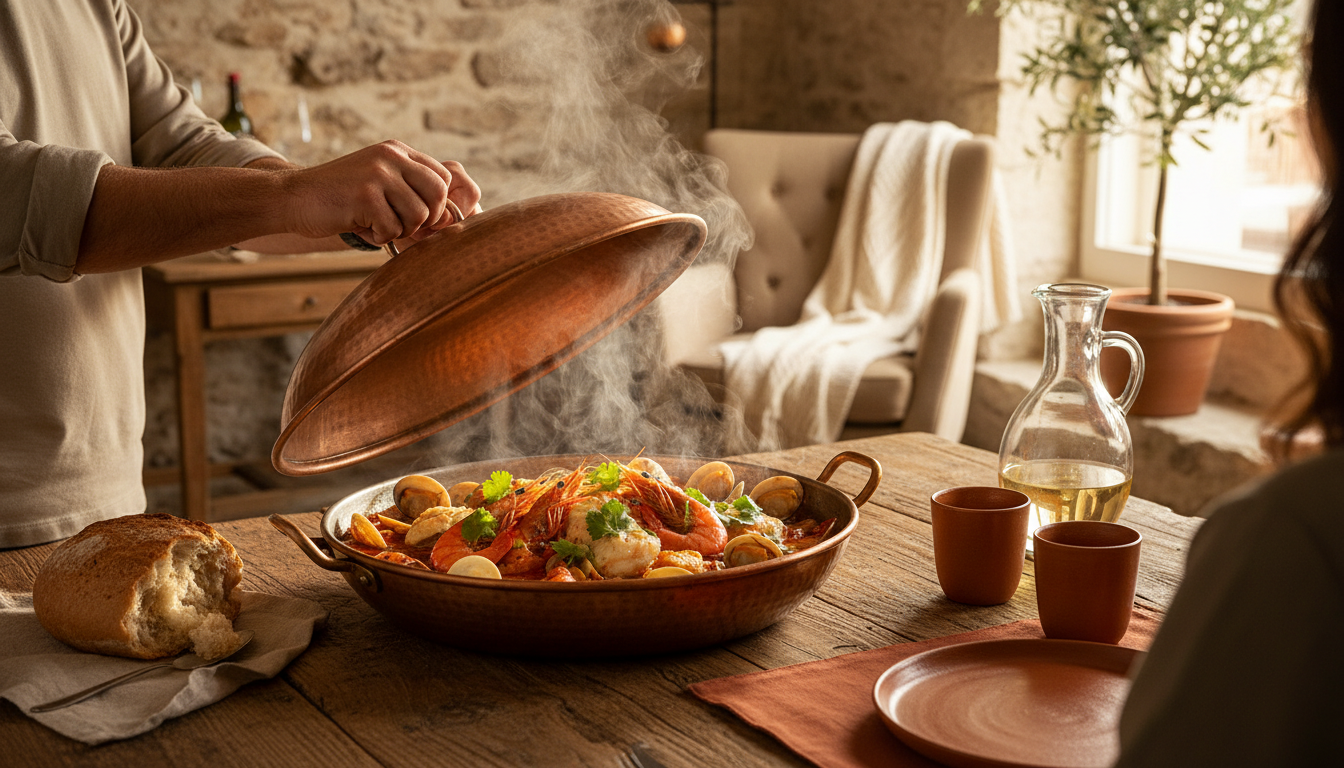
Cataplana is to the Algarve what paella is to Valencia—the signature dish, cooked in a distinctive copper pot that looks like a clam shell. The traditional version combines seafood (clams, prawns, fish) with chouriço sausage, tomatoes, onions, and white wine. The pot seals everything together, and when it's opened at your table, the steam and aroma are theatrical.
The best cataplana I had was at O Chambre in Portimão—a no-frills place where fishermen eat lunch. The cataplana for two costs around €35 ($38 USD) and could honestly feed three. They bring it with crusty bread for soaking up the broth, and you'll want every drop.
One thing to know: cataplana is almost always made for a minimum of two people and usually requires advance ordering. Call the restaurant when you make your reservation and ask them to prepare it.
 traditional copper cataplana pot being opened at a rustic restaurant table, steam rising, revealing
The Art of Percebes (Gooseneck Barnacles)
If you want to eat like a true Algarvian, you need to try percebes—gooseneck barnacles that look frankly prehistoric and taste like the concentrated essence of the ocean. They're harvested by hand from wave-battered rocks, which is why they're expensive (around €60-80 per kilo, roughly $65-87 USD).
You eat them by pinching the leathery tube, pulling out the tender meat inside, and slurping it down. It's messy, primal, and absolutely delicious. Most seafood restaurants on the coast serve them, but they're best at places near the fishing ports—try the restaurants around Sagres or Olhão.
Fair warning: some people hate percebes. The texture is unusual, and the flavor is intensely marine. But if you love oysters and sea urchin, you'll probably love these.
Dom Rodrigo and Other Almond Sweets
The Algarve is almond country—the trees bloom white and pink in January and February, covering the hillsides like snow. The local sweets reflect this, with a tradition of marzipan-like confections that date back to the Moorish period.
Dom Rodrigo is the most famous: threads of egg yolk and sugar wrapped around an almond paste center, shaped into a little dome. It's intensely sweet and absolutely should be eaten with strong coffee. You'll find them in pastelarias throughout the region, but the best come from Pastelaria Algarve in Faro.
Other sweets to try: morgado (almond cake), queijinhos de figo (fig and almond "cheeses"), and the ubiquitous almond tarts that every café serves.
Adventure Activities for Your Algarve Bucket List
Surfing the West Coast
The Algarve's western coast—the Costa Vicentina—is a world apart from the sheltered southern beaches. Here, Atlantic swells roll in with force, creating consistent surf that draws wave riders from across Europe.
Arrifana is the most popular spot, with a crescent-shaped beach that works well for intermediate surfers. Surf schools here charge around €40-50 ($44-55 USD) for a two-hour group lesson including equipment. Amado Beach is better for beginners, with a gentler break and several schools offering lessons. Praia do Castelejo is for experienced surfers only—powerful waves and rocky outcrops make it challenging but rewarding.
Even if you don't surf, the west coast is worth visiting for the dramatic scenery. The cliffs here are darker, more rugged than the south, and the sunsets are absolutely ridiculous.
Dolphin Watching from Lagos
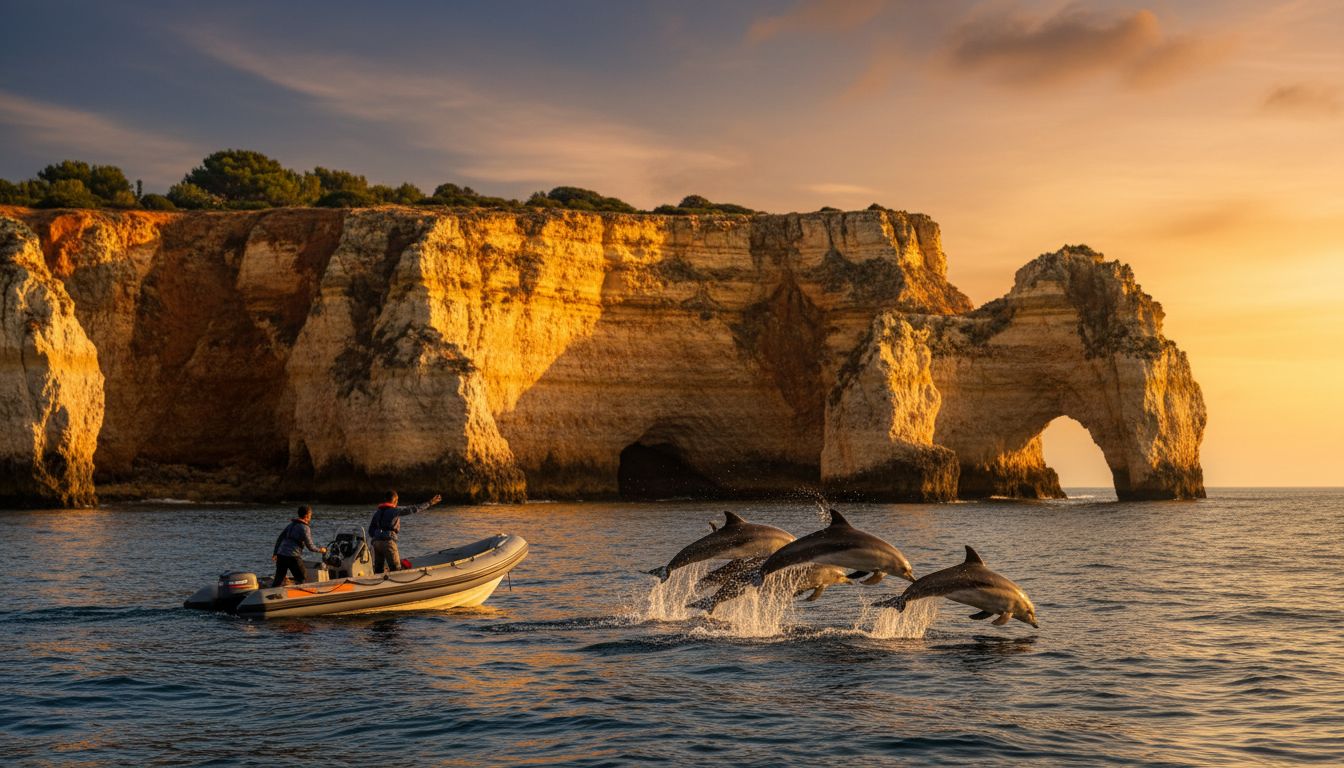
The waters off the Algarve are home to several dolphin species, and boat trips to see them are genuinely worthwhile—not just tourist traps. Common dolphins are the most frequently spotted, traveling in pods of up to several hundred.
I went with Days of Adventure out of Lagos, a small operation that uses a rigid inflatable boat and limits groups to 12 people. The trip costs around €50 ($55 USD) for two hours, and they have a pretty good success rate—we saw three separate pods, including mothers with calves.
The boats also pass the famous Ponta da Piedade rock formations, which are spectacular from the water. If you're prone to seasickness, take medication beforehand; the Atlantic can be choppy.
 pod of common dolphins breaking the surface alongside a small boat, the dramatic golden cliffs of Po
Hiking in the Monchique Mountains
The Algarve isn't all coast. The Serra de Monchique rises to nearly 900 meters in the interior, covered in cork oak, eucalyptus, and chestnut forests. The temperature up here is noticeably cooler than the coast—a relief in summer.
The hike to Fóia, the highest point in the Algarve, can be done from the spa town of Caldas de Monchique. It's about 10 kilometers round trip, moderately strenuous, with views on clear days that stretch to both the southern and western coasts.
The town of Monchique itself is worth exploring—narrow streets, traditional architecture, and restaurants serving mountain specialties like wild boar and honey-roasted chicken. Restaurante A Charrete does an excellent frango piri-piri (spicy grilled chicken) that locals drive up from the coast for.
Cultural Experiences to Add to Your Algarve Bucket List
Faro's Old Town (Without the Crowds)
Faro is the Algarve's capital, but most tourists only see the airport. That's a mistake. The old town, enclosed by medieval walls, is a genuine delight—cobblestone streets, baroque churches, orange trees, and almost no tourist shops.
The Sé Cathedral is worth the €3 ($3.30 USD) entrance fee for the views from the bell tower alone. The bone chapel at Igreja do Carmo is smaller than the famous one in Évora but equally striking—walls lined with the skulls and bones of over 1,000 monks.
But my favorite Faro experience was simply wandering the old town in the early evening, when the day-trippers have left and the locals come out. There's a small square near the cathedral where old men play cards, and a café that serves the best galão (Portuguese latte) I found in the region.
The Ria Formosa Natural Park
This lagoon system stretches for 60 kilometers along the coast east of Faro, a maze of channels, salt marshes, and barrier islands that's home to an incredible diversity of birdlife. It's also stunningly beautiful, especially in the golden light of late afternoon.
You can explore by boat (tours leave from Faro and Olhão), kayak, or on foot along the marked trails. I took a small boat to Ilha Deserta (Desert Island), a long sandbar with nothing but dunes, beach, and a single restaurant. We had lunch there—grilled fish caught that morning—and spent the afternoon swimming in water so clear I could see my feet in chest-deep water.
The park is also famous for its oysters, cultivated in the nutrient-rich waters. Several restaurants in Olhão serve them fresh from the lagoon, around €12-15 ($13-16 USD) per dozen.
The Fishing Village of Ferragudo
On the eastern bank of the Arade River, directly across from the tourist bustle of Portimão, Ferragudo feels like the Algarve of forty years ago. Whitewashed houses climb a hillside, fishing boats bob in the harbor, and the pace of life is determined by the tides.
There's no major attractions here—just a small castle, a pretty church, a handful of excellent restaurants, and one of the best small beaches in the region. That's exactly the point. This is a place for slow mornings, long lunches, and watching the sunset from the harbor wall.
Sueste restaurant, right on the beach, serves some of the best grilled fish in the Algarve. They'll show you the day's catch and cook whatever you choose. Budget around €25-30 ($27-33 USD) per person for a feast.
Making the Most of Your Algarve Home Swap
Staying in a local's home changes everything about how you experience the Algarve. You're not in a tourist zone; you're in a neighborhood. You shop at the same supermarket, nod to the same neighbors, develop a routine that feels less like vacation and more like a temporary life.
My host in Lagos had left a folder of recommendations—her handwriting, her opinions, her favorite spots. That folder was more valuable than any guidebook. She'd noted which beach bars had the best sunset views, which restaurants were overpriced, where to get bread on Sunday mornings when most bakeries were closed.
SwappaHome has a solid selection of properties throughout the Algarve. I've seen everything from modern apartments in Faro's marina to traditional quintas (farmhouses) in the hills above Loulé. The credit system means you can stay for weeks without the cost becoming prohibitive—one credit per night, regardless of the property. For a region that rewards slow travel, that's perfect.
Practical Tips for Your Algarve Bucket List Trip
The best time to visit depends on what you want. Summer (June-August) is hot, crowded, and expensive, but the water is warmest and the days are longest. I prefer shoulder season—late September through October, or April through May. The weather is still excellent, the beaches are quieter, and prices drop significantly.
You'll want a car. Public transport exists but is limited, and many of the best experiences—the hidden beaches, the mountain villages, the west coast—require driving. Rental cars are reasonable, around €25-35 ($27-38 USD) per day in shoulder season.
Learn a few words of Portuguese. English is widely spoken in tourist areas, but making an effort in smaller towns and traditional restaurants goes a long way. "Obrigado/Obrigada" (thank you) and "Bom dia" (good morning) are essential.
Bring reef-safe sunscreen and a good hat. The Algarvian sun is fierce, especially on the water. I got the worst sunburn of my life kayaking to Benagil because I forgot to reapply.
Frequently Asked Questions
What is the best time to visit the Algarve for a bucket list trip?
The ideal time for an Algarve bucket list experience is late April through May or September through October. You'll enjoy warm weather (20-25°C/68-77°F), fewer crowds than summer, lower accommodation costs, and comfortable conditions for hiking and outdoor activities. Water temperatures are still pleasant for swimming in early autumn.
How many days do you need to complete an Algarve bucket list?
To experience the highlights of an Algarve bucket list—including coastal hikes, hidden beaches, food experiences, and cultural sites—plan for at least 10-14 days. This allows time for the Seven Hanging Valleys trail, west coast exploration, wine tasting, and the slower-paced experiences that make the region special. Home swapping makes extended stays affordable.
Is the Algarve expensive for travelers?
The Algarve offers excellent value compared to other Western European coastal destinations. Expect to spend €50-80 ($55-87 USD) per day on food and activities, excluding accommodation. Restaurant meals range from €10-25 ($11-27 USD), and many bucket list experiences like beach visits and hiking are free. Home swapping eliminates accommodation costs entirely.
Can you do the Algarve without a car?
While possible, exploring the Algarve bucket list without a car is limiting. Public buses connect major towns but miss hidden beaches, mountain villages, and the west coast. Renting a car (€25-35/$27-38 USD daily) gives you freedom to discover the region's best experiences. Some travelers use a combination of buses for towns and day-trip tours for remote spots.
What is the most unique experience on an Algarve bucket list?
Kayaking to Benagil Cave at sunrise stands out as the most unique Algarve bucket list experience. Unlike crowded boat tours, paddling yourself through sea caves and arriving at the famous cave with only a few other kayakers feels genuinely special. The combination of physical adventure and natural beauty is unmatched elsewhere in the region.
I'm already planning my next Algarve trip. There's a home swap listing I've been eyeing in Tavira—an old town house with a rooftop terrace and, according to the host, the best pastel de nata in the eastern Algarve just around the corner. Some bucket lists, it turns out, need multiple visits to complete. I'm okay with that.

Published by
SwappaHome
SwappaHome Editorial Team
Home Exchange & Slow Travel Editorial
The SwappaHome Editorial Team brings together travel research, home-exchange community insights, and platform data to produce practical guides for first-time and experienced home swappers. Every article cites real platforms, current market rates, and verifiable city-level facts so readers can make informed decisions without guessing.
Ready to try home swapping?
Join SwappaHome and start traveling by exchanging homes. Get 7 free credits when you sign up!
Related articles
Bachelor and Bachelorette Parties in Singapore: The Complete Home Swap Group Guide for 2026
Planning a bachelor or bachelorette party in Singapore? Discover how home swapping lets groups of 6-12 stay together in luxury condos, saving thousands while partying in Marina Bay.
Cycling in Lisbon: 7 Home Swap Bike Tour Itineraries for Every Rider
Discover the best cycling routes in Lisbon with these home swap bike tour itineraries—from waterfront paths to hilltop adventures, all starting from your borrowed home.
Graduation Trip to Barcelona: How Home Swapping Gives New Graduates the Ultimate Celebration
Planning a graduation trip to Barcelona? Discover how home swapping lets new graduates explore Spain's most vibrant city without the hostel crowds or hotel costs.