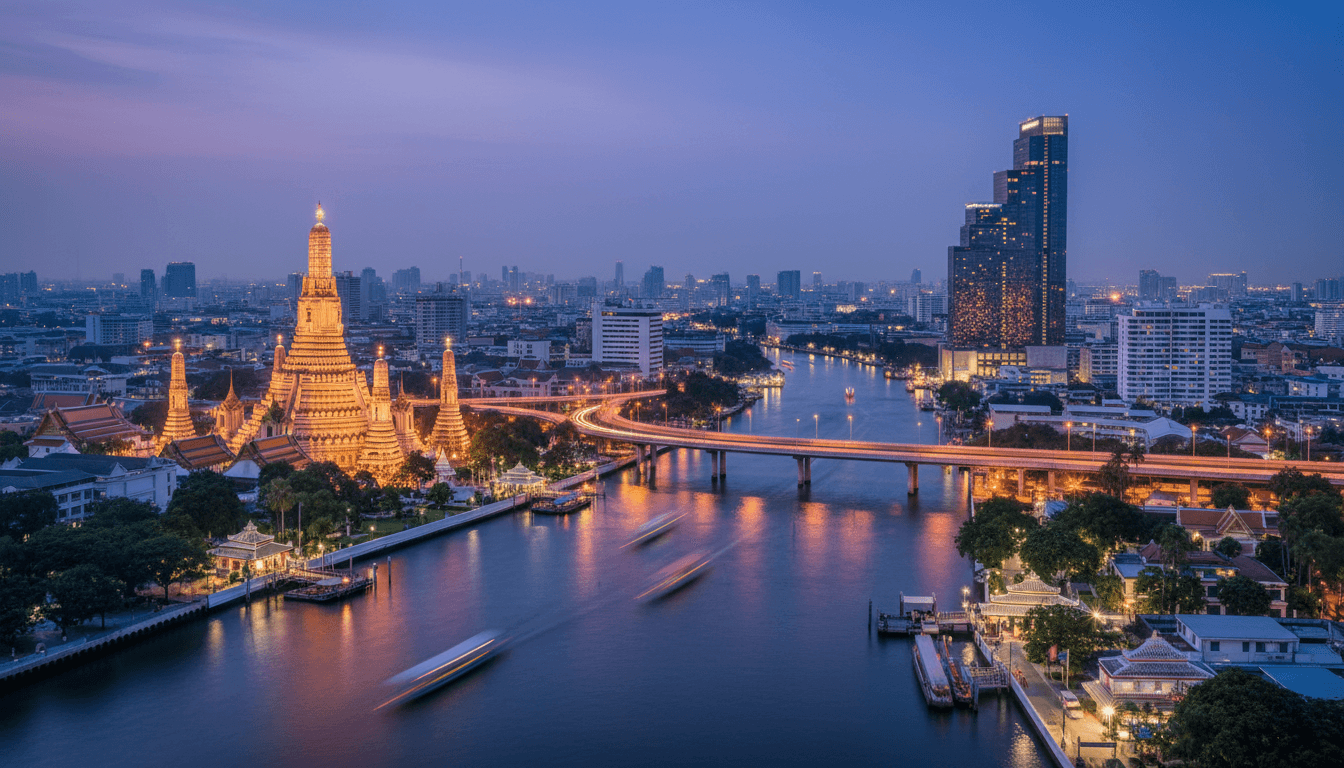
Bangkok for Remote Workers: Finding Home Exchanges with Perfect Workspaces

SwappaHome Editorial Team
Home Exchange & Slow Travel Editorial
Discover how to find Bangkok home exchanges with dedicated workspaces, fast WiFi, and the perfect balance of productivity and pad thai.
I was three weeks into my Bangkok home exchange when I realized I'd accidentally found the holy grail of remote work setups. The apartment belonged to a Thai architect who'd converted half her living room into a workspace with a standing desk, ring light, and—this still makes me emotional—a Herman Miller chair. Outside my window, the BTS Skytrain hummed past every few minutes, and I could smell the som tam being pounded at the street cart below. My Zoom calls had never looked better, and my back had never felt better.
Bangkok for remote workers isn't just a budget play anymore, though the economics remain absurd (we'll get to that). It's become one of Southeast Asia's most sophisticated digital nomad destinations, with infrastructure that rivals Singapore at a fraction of the cost. But here's what most guides won't tell you: the real unlock isn't finding a coworking space—it's finding a Bangkok home exchange with a workspace that actually works.
Why Bangkok Home Exchange Beats Hotels and Rentals for Remote Work
I've done the hotel thing in Bangkok. I've done the Airbnb thing. I've even done the "just work from cafés" thing, which sounds romantic until you're on your fourth iced coffee and your laptop is about to die because every outlet is taken by someone's phone.
Home exchanges changed everything. When you're staying in someone's actual home—especially a fellow remote worker's home—you inherit their setup. Their WiFi router that they've already optimized for video calls. Their desk that's positioned to avoid the afternoon sun glare. Their blackout curtains for when you need to take a 6 AM call with London.
The financial math is almost embarrassing. A decent hotel with reliable WiFi and workspace in central Bangkok runs $80-150/night. A serviced apartment with similar amenities? $1,500-3,000/month. A home exchange? One credit per night on SwappaHome, which you've earned by hosting travelers in your own place. I spent six weeks in Bangkok last year for essentially the cost of utilities and food.
But it's not just about money. It's about the quality of the space.
Best Bangkok Neighborhoods for Remote Worker Home Exchanges
Not all Bangkok neighborhoods are created equal for remote work. I've tried most of them, and I have opinions.
Ari: The Sweet Spot
Ari is where I'd live if I moved to Bangkok permanently, and it's where I actively seek home exchanges. This neighborhood along the BTS Sukhumvit line has the highest concentration of young Thai professionals, which means the apartments here are designed for actual living and working—not just crashing between temple visits.
The cafés are serious about coffee. Roots is legendary, but I'm partial to Ceresia for its cold brew. The restaurants serve food you'd actually want to eat daily, not just tourist-friendly versions of Thai classics. And the residential buildings tend to be newer, with better soundproofing and faster internet infrastructure.
Home exchanges in Ari typically feature dedicated desk spaces, fiber internet (100+ Mbps is standard), and that crucial Bangkok amenity—serious air conditioning. Expect condos in the 40-60 sqm range, often with small balconies perfect for morning coffee.
Thonglor/Ekkamai: For Those Who Need Space
If you're traveling with a partner or need a proper home office setup (not just a desk in the corner), Thonglor and Ekkamai deliver. This is Bangkok's upscale expat zone, and the apartments are larger—we're talking 80-120 sqm with separate rooms.
I did a three-week exchange in a Thonglor townhouse last year that had an entire floor converted to a home office. The owner was a UX designer who'd installed acoustic panels, a green screen wall, and professional lighting. My podcast recordings from that trip still sound better than anything I've done since.
The tradeoff? Thonglor is pricier for eating out (though still cheap by Western standards—figure $8-15 for a nice meal versus $3-5 in Ari), and it can feel a bit... sanitized. Less street food chaos, more boutique restaurants. Depends what you're after.
Silom/Sathorn: The Business District Option
Here's a counterintuitive pick: Bangkok's central business district. Most digital nomads skip it because it feels "corporate," but that's exactly why the home exchanges here are gold.
The condos in Silom and Sathorn were built for Thai executives who work long hours. They prioritized soundproofing (crucial when you're 30 floors up and the wind howls), backup power systems (Bangkok does get outages), and building amenities like meeting rooms and business centers.
I once had a call with a client while using the rooftop meeting room of my Sathorn exchange—glass walls, city views, professional setup. They asked if I'd rented an office. Nope, just borrowed my host's building amenities.
Rattanakosin (Old City): The Creative Retreat
This one's for a specific type of remote worker—the writer, the designer, the person whose work benefits from inspiration over optimization. The old city around the Grand Palace and Khao San Road has been quietly gentrifying, with heritage shophouses converted into stunning live-work spaces.
The WiFi situation is more variable here (always confirm speeds before confirming an exchange), but what you lose in reliability, you gain in atmosphere. I wrote an entire chapter of my book in a 100-year-old teak house near Wat Pho, working at a desk that overlooked a temple garden. Not great for Zoom calls. Incredible for deep work.
What to Look for in a Bangkok Home Exchange Workspace
After dozens of exchanges optimized for remote work, I've developed a checklist. Not all of these are dealbreakers, but the more boxes you tick, the better your productivity.
Internet Speed and Reliability
Thailand has excellent internet infrastructure—better than most Western countries, honestly. But "excellent" at the national level doesn't mean your specific exchange has it.
Always ask for a speed test screenshot. You want minimum 50 Mbps download for comfortable video calls, but most Bangkok condos now have 100-200 Mbps fiber. Upload speed matters too if you're doing any content creation—look for at least 30 Mbps up.
More importantly: ask about reliability. Does the building lose power during storms? Is there a backup system? I once lost an entire afternoon of work because the building's internet went down and my host hadn't mentioned their WiFi was actually a mobile hotspot.
The Actual Workspace Setup
Photos lie. Or rather, photos taken by non-remote-workers don't capture what matters.
When I message potential hosts, I ask specific questions: Is there a dedicated desk or just a dining table? What's the chair situation? Is there natural light at the desk, and if so, which direction does it face? (West-facing desks in Bangkok become unusable after 2 PM without blackout curtains.) Are there enough outlets near the workspace?
The best exchanges I've found are with hosts who also work remotely. They get it. They've already solved the problems.
Air Conditioning Zones
This sounds minor until you've tried to work in Bangkok heat. The city averages 32°C (90°F) year-round with humidity that makes your laptop sweat.
Ideal setup: a workspace in an air-conditioned room with its own unit, so you can keep it cool without freezing the entire apartment. Many Thai condos have this—separate AC units for bedroom, living room, and sometimes a study area.
Ask your host about their electricity costs too. Running AC 24/7 in Bangkok can add $100-200/month to the bill. Most exchanges include utilities, but it's polite to be mindful.
Backup Options
Even the best home exchange setup has bad days. The AC breaks. The building does maintenance. Your neighbor decides to renovate.
I always identify backup workspaces within walking distance before I arrive. Bangkok has an incredible coworking scene—spaces like HUBBA, Glowfish, and The Hive offer day passes ($15-25) when you need an escape. Many cafés have reliable WiFi and are laptop-friendly, though etiquette says you should buy something every couple hours.
How to Find Bangkok Home Exchanges with Great Workspaces
Alright, let's get practical. Here's my actual process for finding remote-work-optimized exchanges in Bangkok.
Search Strategy on SwappaHome
When I'm browsing listings, I don't just search "Bangkok." I search specific neighborhoods (Ari, Thonglor, Silom) because hosts who list their neighborhood know their area—they're more likely to be locals or long-term expats with established setups.
In the listing descriptions, I look for keywords: "work from home," "home office," "remote work," "fast WiFi," "dedicated workspace." Hosts who mention these understand what we need.
Photos matter, but not in the obvious way. I look for a visible desk in the background, a router (sounds weird, but it shows they care about internet), and evidence of actual living—books, plants, personal items. Sterile, staged photos often mean the space is optimized for short stays, not working.
The Pre-Exchange Conversation
Once I've identified potential matches, I send a detailed message. Not a generic "I'd love to stay at your place!" but something like:
"Hi! I'm a travel writer who works remotely, usually 4-6 hours per day. I noticed your apartment has what looks like a dedicated desk area—could you tell me more about the workspace setup? I'm particularly interested in internet speed (I do video calls twice weekly), chair comfort (I have back issues), and whether there's AC in the work area. I'd be happy to share more about my place in San Francisco if you're interested in a future exchange!"
This does two things: it shows I'm serious about the practical details, and it signals that I'm the type of guest who will respect their space because I understand what goes into creating a good work environment.
Timing Your Bangkok Exchange
Bangkok is a year-round destination, but some periods are better for remote workers.
November through February is the "cool" season (still warm by most standards, but humidity drops significantly). This is peak tourist season, so more locals travel—meaning more exchange opportunities. It's also when your AC bill will be lowest.
March through May is brutally hot. I've done it, but you'll be running AC constantly, and the heat saps your energy even indoors. Avoid if possible.
June through October is rainy season. Sounds bad, but here's the secret: the rain usually comes in short, intense bursts in the afternoon. Mornings are often clear, and the rain breaks the heat. Plus, fewer tourists means your host is more likely to be home and available for an exchange.
Living the Bangkok Remote Worker Life
Let me paint you a picture of what a typical workday looks like during a Bangkok home exchange.
Morning Routine
I wake up around 7 AM—early by Bangkok standards, but it's the best time to work. The city is relatively quiet, the temperature is as cool as it gets, and if you're syncing with US time zones, you can catch the end of the American workday.
Breakfast is usually from the street. There's a vendor near every Bangkok condo selling joke (rice porridge) for 35 baht ($1) or pa tong ko (Thai donuts) with condensed milk for 20 baht ($0.60). I grab something, bring it back to my exchange apartment, and eat at my desk while checking emails.
My most focused work happens between 8-11 AM. The apartment is cool, the WiFi is fast, and I haven't yet been tempted by the city outside my window.
Midday Break
Around noon, I force myself to leave. This is crucial for mental health and for actually experiencing Bangkok. I'll walk to a nearby café (Ari has dozens, Thonglor has hundreds), have a proper lunch, maybe do some lighter work—emails, planning, reading.
Thai lunch specials are absurdly good. A plate of khao man gai (Hainanese chicken rice) runs 50-60 baht ($1.50-1.75). Pad krapao with a fried egg on top? 60-80 baht ($1.75-2.25). You can eat like royalty for $5-7 per day if you stick to local spots.
Afternoon Productivity
I return to the apartment around 2 PM, when the heat peaks. This is when I'm grateful for a proper workspace—good AC, comfortable chair, no pressure to buy another coffee.
Afternoons are for calls (if I have them) and creative work. The energy shifts; Bangkok outside is sluggish in the heat, and there's something meditative about working while the city naps.
Evening Exploration
Work ends around 6 PM. The sun sets, the temperature drops slightly, and Bangkok comes alive. Night markets open, rooftop bars fill up, and the street food vendors hit their stride.
This is when home exchange really shines over hotels. I'm not in a tourist zone—I'm in a neighborhood. I know the som tam lady who sets up at the corner of my soi. I have a regular table at the little Isaan restaurant down the street. The 7-Eleven staff recognize me (Thailand's 7-Elevens are an experience unto themselves—surprisingly good food, excellent coffee, and AC that could freeze meat).
Practical Tips for Your Bangkok Remote Work Exchange
Let me rapid-fire some things I wish I'd known earlier.
Money Stuff
Bangkok is cash-heavy, but that's changing. Most restaurants and shops now accept PromptPay (Thailand's QR payment system), and you can link it to your bank app. Grab (the Southeast Asian Uber) works with international cards. ATMs charge 220 baht ($6.30) per withdrawal—brutal—so get a debit card that reimburses foreign ATM fees (Charles Schwab, Wise, etc.).
Budget roughly $1,000-1,500/month for a comfortable remote worker lifestyle, not including your exchange (which costs credits, not cash). That covers food, transport, occasional coworking days, social activities, and incidentals.
Health and Wellness
Bangkok has world-class medical care at developing-world prices. A doctor's visit at a private hospital runs $30-50. Pharmacies sell most medications over the counter. Get travel insurance anyway—I use SafetyWing, which is designed for nomads—but know that you're not in a medical desert.
For fitness: many condo buildings have gyms. Bangkok also has excellent yoga studios (Yoga Elements in Thonglor is my favorite) and Muay Thai gyms if you want to try something new. A single Muay Thai class runs about 500-800 baht ($14-23).
Getting Around
The BTS Skytrain and MRT subway cover most areas you'd want to live. A single ride is 16-59 baht ($0.45-1.70) depending on distance. Get a Rabbit card (like an Oyster card) to avoid buying tickets each time.
For areas not on the train, Grab is your friend. A 20-minute ride rarely exceeds 150 baht ($4.30). Motorbike taxis are faster and cheaper but require a certain comfort with chaos.
Don't rent a car. Just don't. Bangkok traffic is legendary for bad reasons.
The Visa Situation
Most Western passports get 30 days visa-free on arrival (extended to 60 days as of recent changes—verify before you go). For longer stays, the 60-day tourist visa (apply at a Thai embassy before arrival) can be extended once in-country for another 30 days.
Thailand also introduced the Long-Term Resident (LTR) visa for remote workers, but it has high income requirements ($80,000/year). For most of us, visa runs to neighboring countries (Malaysia, Cambodia, Laos) every 60-90 days are the reality. It's annoying but manageable, and honestly? A weekend in Kuala Lumpur or Siem Reap isn't the worst interruption.
Making Your Exchange Work Long-Term
If you fall in love with Bangkok (likely) and want to extend your stay (also likely), here's how to think about it.
SwappaHome's credit system means you're not locked into reciprocal exchanges. Host travelers at your home base, bank credits, use them in Bangkok. I've built up enough credits over the years that I can spend 2-3 months in Southeast Asia annually without ever paying for accommodation.
The key is being a great guest. Leave the apartment cleaner than you found it. Replace anything you use up. Write a detailed, honest review. Send your host a small gift from your home city. The home exchange community is small enough that reputation matters—be someone hosts want to recommend to their friends.
Frequently Asked Questions
Is Bangkok safe for remote workers doing home exchanges?
Bangkok is remarkably safe for a city of 10+ million people. Violent crime against foreigners is rare, and most issues are petty theft in tourist areas—which you'll avoid by staying in residential neighborhoods through home exchange. Use common sense: lock doors, don't flash expensive electronics on the street, and you'll be fine. The bigger "danger" is falling in love with the city and not wanting to leave.
How fast is internet in Bangkok apartments?
Most Bangkok condos have fiber internet with speeds of 100-300 Mbps download and 30-100 Mbps upload—faster than many Western cities. Always ask your exchange host for a recent speed test before confirming. True Fiber and AIS Fibre are the main providers, both reliable. Mobile data (4G/5G) is also excellent and cheap ($15-20/month unlimited) as a backup.
What's the best neighborhood in Bangkok for remote workers?
Ari offers the best balance of livability, workspace-friendly apartments, and authentic Bangkok experience. Thonglor/Ekkamai suits those needing larger spaces or traveling with partners. Silom/Sathorn works for business-focused workers who want professional amenities. Each has strong home exchange options—choose based on your work style and what you want from your off-hours.
How much does it cost to live in Bangkok as a remote worker?
Excluding accommodation (covered by home exchange credits), budget $1,000-1,500/month for comfortable living. This includes food ($150-300), transport ($50-100), coworking day passes ($50-100), social activities ($100-200), health/wellness ($50-100), and miscellaneous ($100-200). You can go lower by cooking more and skipping coworking, or higher if you want regular massages and rooftop bars.
Do I need a special visa to work remotely from Bangkok?
Technically, working on a tourist visa is a gray area, but Thailand doesn't actively enforce this for remote workers serving foreign clients. Most digital nomads use the 60-day tourist visa (extendable to 90 days) and do visa runs to neighboring countries. Thailand's new LTR visa offers legal remote work status but requires $80,000/year income. For stays under 3 months, the tourist visa approach is standard practice.
Bangkok has a way of getting under your skin. The chaos, the food, the warmth of the people, the absurd value for money—it all adds up to something special. And when you experience it from a real home, with a real workspace, in a real neighborhood? It stops being a destination and starts feeling like a life.
My architect host and I still message occasionally. She's used credits to stay at my place in San Francisco twice now, and she always leaves my desk setup better than she found it. That's the thing about home exchange—you're not just swapping spaces. You're joining a community of people who understand that the best way to experience a place is to actually live there.
See you in Bangkok. I'll be the one at the som tam cart, laptop bag over my shoulder, trying to explain to the vendor that yes, I really do want it Thai-spicy.

Published by
SwappaHome
SwappaHome Editorial Team
Home Exchange & Slow Travel Editorial
The SwappaHome Editorial Team brings together travel research, home-exchange community insights, and platform data to produce practical guides for first-time and experienced home swappers. Every article cites real platforms, current market rates, and verifiable city-level facts so readers can make informed decisions without guessing.
Ready to try home swapping?
Join SwappaHome and start traveling by exchanging homes. Get 7 free credits when you sign up!
Related articles
Bachelor and Bachelorette Parties in Singapore: The Complete Home Swap Group Guide for 2026
Planning a bachelor or bachelorette party in Singapore? Discover how home swapping lets groups of 6-12 stay together in luxury condos, saving thousands while partying in Marina Bay.
Cycling in Lisbon: 7 Home Swap Bike Tour Itineraries for Every Rider
Discover the best cycling routes in Lisbon with these home swap bike tour itineraries—from waterfront paths to hilltop adventures, all starting from your borrowed home.

Graduation Trip to Barcelona: How Home Swapping Gives New Graduates the Ultimate Celebration
Planning a graduation trip to Barcelona? Discover how home swapping lets new graduates explore Spain's most vibrant city without the hostel crowds or hotel costs.