Cairo Home Exchange Essentials: Your Complete Guide to Utilities, WiFi, and Daily Life

SwappaHome Editorial Team
Home Exchange & Slow Travel Editorial
Everything you need to know about utilities, WiFi, and daily essentials for your Cairo home exchange—from navigating power outages to finding the best SIM cards.
The electricity cut out at 2 AM on my third night in Zamalek.
I found myself standing on a balcony overlooking the Nile, watching the city's lights flicker back on neighborhood by neighborhood like a slow-motion wave. My host had warned me about this. "Summer brownouts," she'd written in her house manual. "The AC units strain the grid." She'd left me a flashlight by the bed and a portable phone charger on the kitchen counter.
That kind of preparation—that's what makes a Cairo home exchange essentials guide actually useful versus the generic "pack sunscreen" advice you'll find elsewhere.
I've done three home exchanges in Cairo over the past four years, staying in everything from a modern apartment in New Cairo to a crumbling-but-gorgeous flat in Downtown with 14-foot ceilings and windows that hadn't been updated since Nasser was in power. Each stay taught me something new about navigating daily life in this chaotic, beautiful, utterly overwhelming city.
So here's everything I wish someone had told me before my first swap—the practical stuff that makes the difference between surviving and actually thriving.
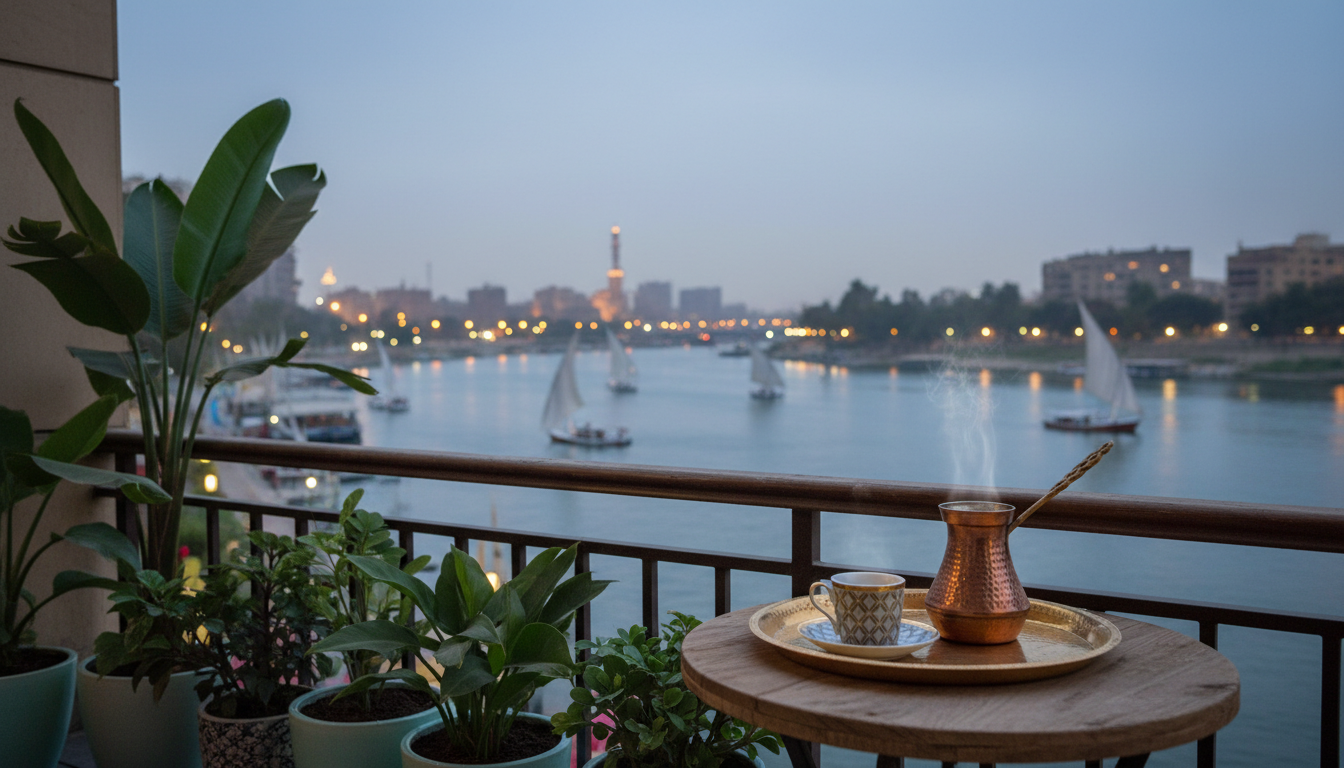 View from a Zamalek apartment balcony at dusk, showing the Nile River with feluccas sailing past, ci
Understanding Cairo's Electrical System for Home Exchange
Let's start with the thing that'll affect literally every aspect of your stay: electricity.
Cairo runs on 220V at 50Hz. If you're coming from North America, you'll need more than just a plug adapter—you'll need a voltage converter for any electronics that aren't dual-voltage. Check the tiny print on your laptop charger and phone charger; most modern ones say "100-240V" and you're fine with just an adapter. But that hair dryer or electric razor from Target? Leave it home or prepare to watch it emit a sad puff of smoke.
The outlets are the European two-pin round type (Type C), though some newer buildings have the three-pin grounded version (Type F). I always travel with a universal adapter that handles both, plus a small power strip so I can charge multiple devices from one outlet. Your host's home will likely have a mix of outlet types depending on when the building was wired and whether anyone's done updates since.
Now, about those power outages. They're not constant, but they happen—especially during summer months when air conditioning pushes the grid to its limits. Most outages last anywhere from a few minutes to a couple of hours. Higher-end buildings in Zamalek, Maadi, and New Cairo often have backup generators that kick in automatically. Ask your host about this before you arrive.
If there's no generator, here's your survival kit: a good flashlight or headlamp (your phone flashlight drains battery fast), a portable power bank with at least 20,000mAh, a battery-powered fan if you're visiting in summer—trust me on this—and offline downloads of maps, entertainment, and any work documents you need.
One thing that surprised me: the power company has actually improved significantly over the past few years. Scheduled outages are now announced in advance, and your host might be able to tell you the typical patterns for their neighborhood.
WiFi and Internet: What to Expect in Your Cairo Home Exchange
Here's where things get interesting.
Cairo's internet infrastructure is... let's call it "developing with enthusiasm." The good news: most home exchange properties will have WiFi. The reality check: speeds and reliability vary wildly depending on the neighborhood, the building's wiring, and which internet service provider your host uses.
The main ISPs are WE (formerly Telecom Egypt), Vodafone, Orange, and Etisalat. WE tends to have the most widespread coverage since they own the actual infrastructure, but Vodafone and Orange often offer faster speeds in areas where they've invested in upgrades. Typical home internet speeds range from 30 Mbps to 100 Mbps on paper, though real-world performance during peak evening hours—roughly 8 PM to midnight—can drop significantly.
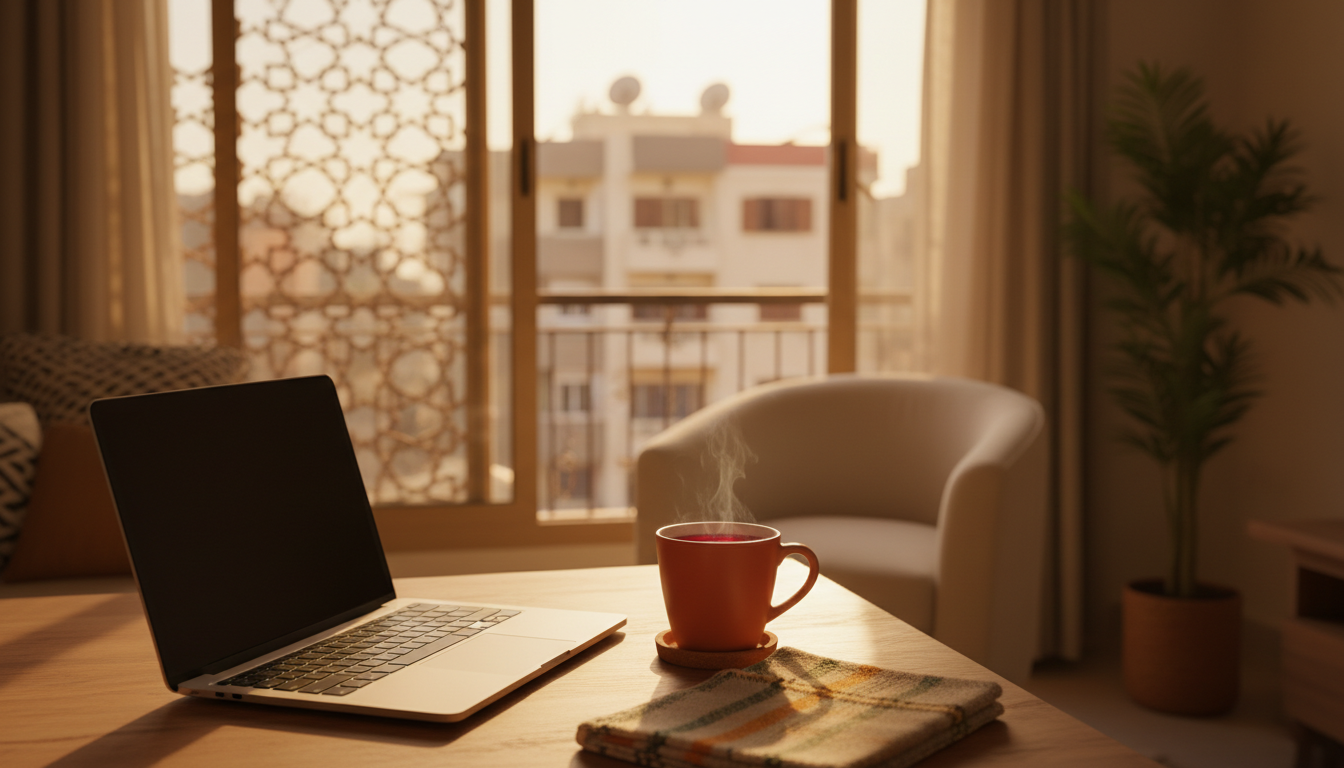 Cozy home office setup in a Cairo apartment with laptop on wooden desk, traditional mashrabiya scree
For remote workers—and I know many of you are doing the digital nomad thing—here's my honest assessment: Cairo is workable but requires backup plans. I always get a local SIM card with a generous data package as my failsafe. If the home WiFi goes down or slows to a crawl during an important video call, I can hotspot from my phone.
Speaking of which.
Getting a Cairo SIM Card: The Essential First Step
This should be one of your first errands after arriving.
Egyptian SIM cards are cheap, easy to get, and will make your life immeasurably easier. You can purchase them at the airport—there are kiosks for all major carriers right after customs—or at any of the countless phone shops throughout the city. You'll need your passport for registration (mandatory, they'll make a copy), and the process takes about 15-20 minutes including activation.
Vodafone tends to have the best coverage in my experience. Their tourist packages start around 300 EGP ($6) for 15GB valid for 30 days. For heavier users, 600 EGP ($12) gets you 50GB. Orange offers competitive packages and sometimes better deals, with 20GB packages around 350 EGP ($7). Etisalat is solid in newer developments like New Cairo and Sheikh Zayed but can be spottier in older neighborhoods.
My recommendation: Vodafone for most visitors, unless your host specifically tells you another carrier works better in their building. Some older structures have thick walls that affect signal strength differently for each carrier.
Pro tip: download the carrier's app before your SIM runs out of data. You can recharge packages through the app using a credit card, which saves you the hassle of finding a recharge shop when you're running low.
Water: What's Safe and What's Not
Let's address the elephant in the room.
Tap water in Cairo is technically treated and "safe" by local standards, but I don't drink it, and neither should you. The treatment process is adequate, but the pipe infrastructure is old, and contamination can occur between the treatment plant and your tap. Even most Cairenes drink bottled or filtered water.
Your home exchange host will likely have one of three setups. Large water dispensers—the 19-liter jugs you see in offices—are common in Egyptian homes. Delivery services like Nestle Pure Life, Aquafina, or local brand Baraka will bring new jugs and collect empties. Your host should leave you instructions for ordering more; it's usually done via phone call or WhatsApp, and a jug costs around 25-35 EGP ($0.50-0.70).
Under-sink filtration systems are increasingly popular in newer apartments. If your host has one, they'll tell you which tap dispenses filtered water—usually a separate small faucet next to the main one.
Bottled water from the grocery store works fine for shorter stays. A 1.5-liter bottle costs about 8-15 EGP ($0.15-0.30) depending on brand.
For brushing teeth, I use tap water and have never had issues. But if you have a sensitive stomach, stick with bottled for everything. Showering with tap water is completely fine—you're not going to absorb anything harmful through your skin.
 Egyptian kitchen counter showing a large blue water dispenser jug, traditional brass coffee pot dall
Gas and Cooking in Your Cairo Home Exchange
Most Egyptian kitchens use gas stoves connected to large gas canisters (called "anabib" locally) rather than piped natural gas, though newer buildings in developments like New Cairo and Maadi are increasingly connected to the gas grid.
If your host's kitchen uses canisters, they should show you—or explain in their house manual—how the system works. The canisters sit in a cabinet or closet, connected to the stove via a rubber hose. You'll turn on the canister valve, then light the stove burners. It sounds more complicated than it is. You'll get the hang of it in one try.
Running out of gas mid-cooking is a rite of passage for anyone living in Cairo.
If it happens, don't panic. Gas delivery is ubiquitous and fast. You can call the number your host left you (there's usually a regular delivery guy for each neighborhood), ask the bawab to arrange it, or flag down one of the gas trucks that drive through neighborhoods honking—you'll learn to recognize the sound. A full canister costs around 100-150 EGP ($2-3) including delivery, and the delivery person will swap your empty for a full one.
One safety note: always make sure the canister valve is fully closed when you're done cooking. Gas leaks are rare but not unheard of, and you'll smell it immediately if there's a problem.
The Bawab: Your Secret Weapon for Daily Life
I need to dedicate a whole section to this because it's one of the most useful aspects of Cairo living that tourists never hear about.
Almost every apartment building in Cairo has a bawab—a building doorman/caretaker who lives on-site, usually in a small room on the ground floor. The bawab is not just a security guard. They're a fixer, a messenger, a package receiver, and often the person who knows everything about how the building works.
Building a good relationship with your bawab will make your home exchange infinitely smoother.
Here's what a bawab can help with: receiving deliveries when you're out, calling repair people if something breaks, arranging gas canister delivery, explaining garbage collection schedules, recommending local services like laundry or pharmacy, and generally keeping an eye on things.
The etiquette: greet them warmly every time you pass. "Sabah el kheir" in the morning, "Masa el kheir" in the evening. A small tip is customary and appreciated—around 50-100 EGP ($1-2) per week of your stay is appropriate, given directly with a smile. This isn't obligatory, but it's the cultural norm and will ensure you get excellent help whenever you need it.
Your host should introduce you (or leave a note introducing you) to the bawab before your arrival. If they haven't, just introduce yourself on day one.
 Friendly Egyptian bawab in traditional galabeya sitting on a chair outside an old Downtown Cairo apa
Grocery Shopping and Food Essentials
You'll find everything you need in Cairo. Knowing where to look saves time and frustration.
Supermarkets for packaged goods and imports: Carrefour (multiple locations, the biggest is in City Centre Mall), Seoudi, Metro Market, and Gourmet Egypt (pricier but excellent selection of imported items). These are your go-to for breakfast cereals, pasta, canned goods, cleaning supplies, and toiletries.
Local markets for produce: Every neighborhood has its own souk or street market. The produce is fresher and cheaper than supermarkets, but it requires some Arabic or confident pointing. Prices are usually posted, but it's acceptable to ask "bekam?" (how much?) before buying. Zamalek has a great Friday morning market on 26th of July Street. Maadi's Road 9 has excellent fruit and vegetable vendors.
Bakeries are everywhere and the bread is incredible. A stack of fresh baladi bread—the round, pocket-style Egyptian bread—costs almost nothing. Like 5 EGP for more than you can eat. Find your nearest "forn" and become a regular.
Pharmacies (called "saydaliya") are on every other corner, open late, and sell most medications without prescription. Panadol, Imodium, antihistamines, basic antibiotics—all available over the counter. Prices are extremely reasonable.
One Cairo-specific tip: many small shops and vendors don't have change for large bills. Try to keep a stash of smaller notes—10s, 20s, 50s—for daily purchases. Breaking a 200 EGP note at a corner shop can be genuinely difficult.
Navigating Cairo's Neighborhoods: Where Utilities Vary
The infrastructure quality in Cairo varies dramatically by neighborhood, and this directly affects your home exchange experience.
Zamalek is my personal favorite. It's an island neighborhood—relatively quiet, tree-lined streets, excellent restaurants. Infrastructure is aging but generally reliable. WiFi tends to be decent, and many buildings have generators. The downside? It can feel removed from "real" Cairo.
Maadi is leafy, expat-heavy, feels almost suburban. Infrastructure is good, especially in Maadi Degla and Maadi Sarayat. Newer buildings, more reliable utilities. Great for families. The downside: it's far from central Cairo attractions.
New Cairo/Fifth Settlement has modern developments with the newest infrastructure. Reliable electricity, fast internet, piped gas. Honestly, it feels like a different country from Downtown. The downside: soulless, car-dependent, far from everything historic.
Downtown Cairo has crumbling colonial architecture and incredible energy. Walking distance to the Egyptian Museum and Islamic Cairo. But the infrastructure is the oldest and least reliable. Frequent power issues in summer, variable internet. It's noisy, polluted, chaotic—and you'll feel like you're actually IN Cairo.
Garden City is quiet, the embassy district, beautiful old villas and apartments. Infrastructure similar to Zamalek—aging but functional. Limited restaurant and shopping options though.
 Aerial view of Zamalek island at golden hour, showing the contrast between green tree-lined streets
Climate Control: Surviving Cairo's Weather
Cairo has three seasons: hot, very hot, and actually-pleasant.
October to April is prime time. Days are warm (20-25°C/68-77°F), nights are cool (10-15°C/50-59°F). You might actually need a light jacket in December and January evenings. Air conditioning isn't necessary, and you might even use heating occasionally in winter months. Electricity bills—and strain on the grid—are lowest.
May and September are transition months. Getting hot but not unbearable. AC is nice to have but not essential if you have good fans and cross-ventilation.
June to August is survival mode. Temperatures regularly hit 35-40°C (95-104°F), sometimes higher. Air conditioning isn't optional—it's a necessity. This is when power outages are most common because everyone's AC is running constantly. If your home exchange doesn't have functioning AC during these months, reconsider the swap.
A note on AC units: Egyptian homes typically have split units—the kind with an indoor unit mounted on the wall and an outdoor compressor—rather than central air. Each room might have its own unit with its own remote. Your host should explain which units work and how to operate them. Some older units are... temperamental. Ask about this before confirming your swap.
Dust is the other climate factor nobody warns you about.
Cairo is dusty. Really dusty. Khamaseen winds in spring (March-May) can bring actual sandstorms. Keep windows closed during dust events, and don't be surprised if you need to wipe down surfaces more often than at home.
Laundry: Options for Your Extended Stay
Most Cairo apartments have washing machines, but dryers are rare—clothes dry fast on a balcony line in Cairo's dry climate. Your host should show you how their machine works; many are European brands with cycle options in Arabic or symbols.
If your host doesn't have a washing machine, or if you prefer to outsource, laundry services are everywhere and cheap. Most neighborhoods have a "makwagi" (ironing man) who also does washing. Typical prices: around 50-100 EGP ($1-2) per kilo for wash-dry-fold service, returned within 24-48 hours. Ask your bawab for the nearest one.
Dry cleaning is also readily available and affordable. A shirt costs around 30-50 EGP ($0.60-1), a suit 100-150 EGP ($2-3).
Laundry detergent is available at any supermarket. Persil, Tide, and local brand Rabso are all common. If you have sensitive skin, bring your preferred detergent from home—specialty options are harder to find.
Transportation Essentials You'll Use Daily
While not strictly a "utility," transportation is an essential daily need that works differently than you might expect.
Uber and Careem (the regional equivalent) work great in Cairo. This will probably be your primary transport mode. Rides are cheap—a 20-minute trip might cost 50-80 EGP ($1-1.60). Both apps work with international credit cards. I prefer Careem slightly because the drivers seem more familiar with Cairo's neighborhoods.
The Metro is excellent for certain routes, especially the line connecting Maadi to Downtown to Giza. It's cheap (starting at 8 EGP), air-conditioned, and avoids traffic. The first two cars are women-only during rush hours.
Taxis still exist but are more hassle than ride-sharing apps. If you do take one, negotiate the price before getting in or insist on the meter ("el adad").
Your host might have specific transportation tips for their neighborhood—some areas are better served by certain apps or have metro stations nearby.
Emergency Contacts and Safety Essentials
Before you arrive, save these numbers in your phone: Police (122), Ambulance (123), Fire (180), and Tourist Police (126—English-speaking operators, helpful for foreigners).
Your country's embassy contact should also be saved. The US Embassy is in Garden City; UK Embassy in the same area; Canadian Embassy in Zamalek.
Ask your host for the building's bawab phone number, a reliable local contact in case of emergency, the nearest hospital or clinic, and their own contact information for urgent questions.
Cairo is generally safe for tourists, but use common sense. Don't flash expensive electronics, be aware of your surroundings in crowded areas, and keep copies of important documents separate from the originals.
Setting Up for Success: A Pre-Arrival Checklist
Two weeks before your Cairo home exchange, confirm these details with your host:
WiFi network name and password. How the AC/heating works. Water situation—dispenser delivery number, filter location, whatever applies. Gas setup if applicable. Bawab introduction and contact. Any scheduled power outages or building maintenance. Garbage collection days and procedures. Nearest supermarket, pharmacy, and ATM. Recommended SIM card carrier for their area. And any quirks about the apartment—that one outlet that doesn't work, the window that sticks, whatever.
A good host will have most of this in a house manual. If they don't, ask. It's better to seem overly prepared than to arrive and have no idea how to turn on the hot water.
Making Your Cairo Home Exchange Feel Like Home
After all this practical information, here's what I really want you to know.
Cairo is one of the most rewarding cities I've ever done a home exchange in. Yes, the infrastructure can be challenging. Yes, you'll probably experience a power outage or a confusing moment with the gas stove. But you'll also wake up to the sound of the call to prayer echoing across the city, drink the best coffee of your life at a tiny ahwa around the corner, and discover what it actually feels like to live—not just visit—one of the world's oldest continuously inhabited cities.
The practical stuff matters because it frees you up to have those experiences.
When you're not stressed about whether your laptop will charge or where to find drinking water, you can actually sink into the rhythm of Cairo life. You can spend an afternoon getting lost in Khan el-Khalili, then come home to your borrowed apartment and cook dinner with vegetables from the local souk, and it feels... normal. That's the magic of home exchange.
SwappaHome has some great Cairo listings—I've browsed them myself for my next potential swap. The platform's credit system means you don't need to find a Cairene who wants to visit your exact city; you can host someone from anywhere, bank those credits, and use them for your Egypt adventure. It removes so much friction from the planning process.
My last Cairo swap ended with me sitting on exactly that kind of rooftop, drinking hibiscus tea and watching the sun set behind the pyramids—actual pyramids!—while my host's cat demanded attention. The electricity was working, the WiFi was strong enough to video call my mom and show her the view, and I had cold water in the fridge and a full gas canister for making dinner later.
All the practical stuff, sorted. All that was left was to be present in one of the most extraordinary places on earth.
That's what I want for your Cairo home exchange too.
Frequently Asked Questions
Is the WiFi reliable enough for remote work during a Cairo home exchange?
It depends on where you're staying. Speeds typically range from 30-100 Mbps, but they can dip during peak evening hours. My advice? Always have a backup. Get a local SIM card with a data package—around 300-600 EGP ($6-12) for 15-50GB—so you can hotspot during outages. Newer areas like New Cairo tend to be more reliable than Downtown.
How much do utilities cost during a home exchange in Cairo?
As a home exchange guest, you typically won't pay utilities directly—they're included in the swap arrangement. But for reference: electricity runs 300-800 EGP ($6-16) monthly depending on AC usage, water 50-100 EGP ($1-2), internet 200-400 EGP ($4-8), and gas canisters 100-150 EGP ($2-3) each, lasting 4-6 weeks.
What voltage adapters do I need for Cairo home exchange?
Cairo uses 220V/50Hz with European-style two-pin round plugs (Type C/F). If you're coming from North America, you'll need both a plug adapter AND a voltage converter for non-dual-voltage electronics. Check your phone and laptop chargers for "100-240V"—if you see that, you only need the adapter.
Can I drink tap water in Cairo during my home exchange stay?
Nope. Don't do it. Most homes have large water dispenser jugs (delivered for 25-35 EGP), under-sink filtration systems, or you can grab bottled water at any supermarket for 8-15 EGP per 1.5L. Tap water is fine for showering and brushing teeth though.
What should I do during a power outage at my Cairo home exchange?
Don't panic—they usually last minutes to a couple hours, mostly in summer. Keep a flashlight, a 20,000mAh power bank, and offline downloads ready. Many buildings in Zamalek, Maadi, and New Cairo have backup generators. Ask your host about their building's setup before you arrive so you know what to expect.

Published by
SwappaHome
SwappaHome Editorial Team
Home Exchange & Slow Travel Editorial
The SwappaHome Editorial Team brings together travel research, home-exchange community insights, and platform data to produce practical guides for first-time and experienced home swappers. Every article cites real platforms, current market rates, and verifiable city-level facts so readers can make informed decisions without guessing.
Ready to try home swapping?
Join SwappaHome and start traveling by exchanging homes. Get 7 free credits when you sign up!
Related articles
Bachelor and Bachelorette Parties in Singapore: The Complete Home Swap Group Guide for 2026
Planning a bachelor or bachelorette party in Singapore? Discover how home swapping lets groups of 6-12 stay together in luxury condos, saving thousands while partying in Marina Bay.

Cycling in Lisbon: 7 Home Swap Bike Tour Itineraries for Every Rider
Discover the best cycling routes in Lisbon with these home swap bike tour itineraries—from waterfront paths to hilltop adventures, all starting from your borrowed home.

Graduation Trip to Barcelona: How Home Swapping Gives New Graduates the Ultimate Celebration
Planning a graduation trip to Barcelona? Discover how home swapping lets new graduates explore Spain's most vibrant city without the hostel crowds or hotel costs.