
Home Exchange Membership: Is It Worth It?

SwappaHome Editorial Team
Home Exchange & Slow Travel Editorial
You're probably looking at a familiar travel problem. A hotel room works for a night or two, but once you add kids, remote work, a longer stay, or the simple…
You're probably looking at a familiar travel problem. A hotel room works for a night or two, but once you add kids, remote work, a longer stay, or the simple desire to cook breakfast without balancing a plate on a desk, that room starts to feel cramped and expensive in all the wrong ways.
That's where a home exchange membership starts to make sense. Instead of paying nightly for commercial lodging, you join a network of homeowners who open their homes to one another. The basic trade is simple. You share access to your place, and in return you stay in someone else's. What confuses many first-time readers is that modern home swapping usually isn't a casual handshake arrangement anymore. It runs through a structured membership model with verification, reviews, and platform rules.
The category has been around far longer than many people realize. HomeExchange traces the roots of organized swapping to paper catalogs in the 1950s, says its U.S. community was born in 1992, and notes that by 2018 the original HomeExchange and GuesttoGuest had combined into one global company. The company says it had more than 250,000 members in 155 countries by 2026, up from 200,000 members at the end of 2024 (HomeExchange about page). That matters because it shows home swapping isn't a novelty anymore. It's a travel model with enough scale to be useful.
Table of Contents
- The Reality of Modern Home Swapping
- How Credit Systems Replaced Reciprocal Matching
- Calculating the True Cost and ROI of Membership
- Trust and Safety in a Verified Community
- Who Benefits Most from Home Exchange Networks
- Your Step-by-Step Guide to Joining and Hosting
- Common Questions About Home Exchange Memberships
The Reality of Modern Home Swapping
A family of four planning ten nights in Lisbon usually runs into the same arithmetic. Two hotel rooms can solve the sleeping problem but raise the lodging bill fast. A short-term rental adds space, but every stay starts from zero, with a new booking fee, a new cleaning fee, and no return value once the trip ends. A home exchange membership works on a different model. You pay for entry to a network, then use that access for one stay or many.
That difference matters because home swapping is no longer just two families trading keys for the same week.
For years, the old version of home exchange depended on a perfect match. You wanted their home, they wanted yours, and both trips had to line up on the calendar. In practice, that worked a bit like trying to barter vacations. The idea sounded charming. The coordination often did not. School schedules, flight prices, and uneven travel seasons could stop an otherwise good match.
Modern memberships reduced some of that friction by turning home exchange into a structured system rather than a one-off arrangement between strangers. You join, build a profile, verify who you are, list your home, and follow platform rules that make expectations clearer on both sides. The value is less about buying one discounted trip and more about getting repeated access to homes that fit real life. A kitchen for a two-week stay. Laundry for a family trip. A desk and reliable internet for remote work.
What a membership is actually buying
A membership usually does not function like a hotel booking site where you pay night by night. It works more like a club fee that gives you entry to an inventory of homes and a set of rules for using them.
In practical terms, that usually includes:
- Access to the network so you can browse listings and contact hosts
- A home and traveler profile that helps other members judge fit, timing, and house rules
- Verification and review tools that add accountability
- An exchange framework that reduces the need to pay standard lodging rates each time you travel
A simple comparison helps here. A hotel sells one stay at a time. A home exchange membership sells repeat access.
That is why the break-even question matters so much. If a membership costs about what one modest hotel night might cost in a major city, the math can work quickly for a household that takes longer trips or needs more space. If you only travel once a year for a quick weekend and prefer standardized service, the value can be weaker. The membership model rewards frequency, flexibility, and homes that are attractive enough to other members to generate exchange opportunities.
Why homeowners kept using it
The growth of large exchange networks suggests members are not treating this as a novelty. HomeExchange reported 150,000 members across 145 countries in early 2024, then 200,000 active members worldwide by December 2024, alongside a 35% rise in one year, 102% growth over two years, and more than 408,000 exchanges in 2024, which it said was 43% more than in 2023 and roughly one exchange every two minutes (UPI coverage of HomeExchange growth).
Those figures point to a practical truth. People stay when the system is usable more than once.
That repeat use is the part many curious homeowners miss at first. The appeal is not only lower lodging cost. It is the shift from booking anonymous space to trading access within a community where profiles, reviews, and platform rules make longer stays feel more workable.
How Credit Systems Replaced Reciprocal Matching
Traditional home swapping had one giant flaw. Two households had to want each other's homes, in the right place, for the same dates, under roughly equal expectations. That's like trying to trade houses the way two children trade baseball cards, except both families also need matching school holidays and matching travel plans.
Modern platforms reduced that friction by separating hosting from traveling. Instead of needing a direct swap, you host one member and earn credits. Later, you spend those credits on a different stay somewhere else. That turns swapping from a coincidence into a usable system.
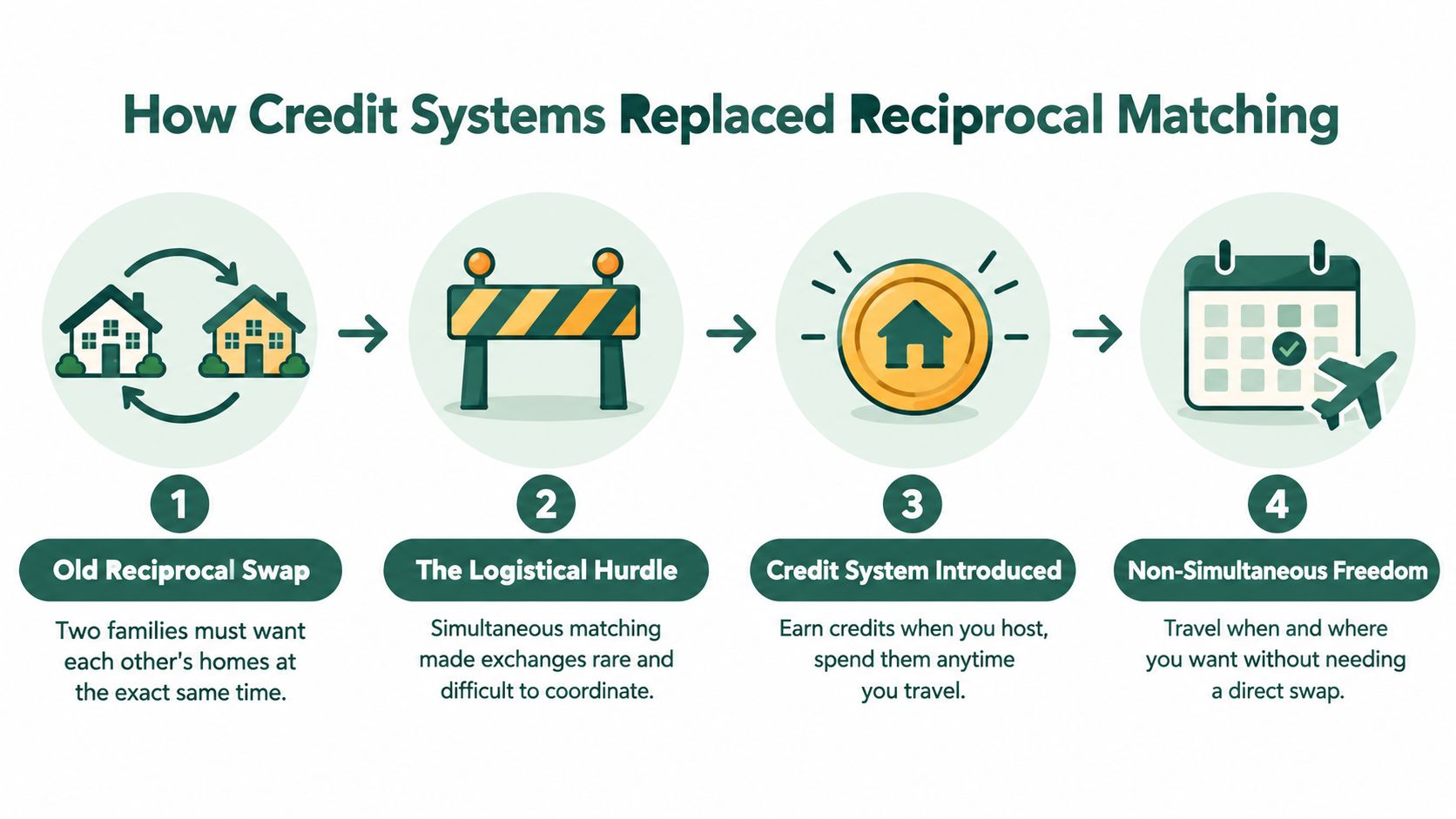 A diagram illustrating the four steps of how credit-based home exchange systems replaced older reciprocal swapping methods.
Why the old model felt harder than it sounded
Under reciprocal matching, a homeowner in Seattle might want Paris in June. The Paris family might love Seattle, but only in October. Even if both homes are a good fit, the timing breaks the deal.
That old setup still works for some people. Retirees with flexible calendars can sometimes arrange elegant direct swaps. Families tied to school breaks often can't. Remote workers may want one month in a city where nobody happens to want their home that same month. The logistics become the bottleneck.
Here's the mechanical difference:
| Exchange style | What has to line up | Main friction |
|---|---|---|
| Reciprocal swap | Two homes, same or coordinated dates, mutual interest | Timing and destination must match |
| Credit-based exchange | One host earns credits, one guest redeems credits later | You still need availability, but not a direct trade |
Credits work like travel currency
A credit system behaves more like airline miles than a barter deal. You create value for the network by hosting. The platform records that value as credits. Then you use those credits later when you travel.
That solves several common problems at once:
- Families can host during one school holiday and travel during another.
- Digital nomads can build credits gradually, then redeem them for longer stays.
- Retirees can travel off-season without waiting for a mirror-image swap partner.
- City homeowners can host high-demand stays and use those credits elsewhere later.
One practical explanation of this model appears in SwappaHome's guide on how the credit system works in home exchange.
Practical rule: If your first question is “But what if nobody wants my home exactly when I want theirs?” you're already describing the problem that credit systems were built to solve.
A short visual overview helps if the mechanics still feel abstract.
Why flexibility matters more than novelty
The strongest argument for credit-based exchange isn't that it feels modern. It's that it removes a scheduling choke point. That change makes home exchange membership useful for ordinary travel planning rather than only for rare, perfectly matched swaps.
It also aligns with how people travel now. Many households don't take one long annual holiday and nothing else. They mix weekend visits, family trips, remote-work weeks, and seasonal breaks. A flexible credit model fits that pattern better than strict one-to-one trading.
Calculating the True Cost and ROI of Membership
A homeowner pays an annual membership, hosts one long weekend, earns enough credits for a four-night family trip, and skips booking two hotel rooms. That is the kind of math that decides whether home exchange pays off.
The useful question is not “Is the fee cheap?” It is “What lodging cost does this membership replace, and how often will I use it?”
Start with the comparison that matches your real trip
Home exchange rarely competes with the rock-bottom hotel rate on a booking site. It usually replaces the stay you would book if you wanted enough room to live normally for a few days.
For a solo traveler on a quick work trip, that might be a standard hotel room. For a family of four, it is often something closer to:
- two hotel rooms,
- a hotel suite,
- or a short-term rental with a kitchen and laundry.
That difference matters because an exchanged home usually covers more than sleeping space. It covers the everyday functions that push trip costs up, such as cooking breakfast, washing clothes, and spreading out without paying for a second room.
| Expense Category | Standard Hotel | Home Exchange |
|---|---|---|
| Sleeping space | Usually one room or multiple booked rooms | Entire home or apartment |
| Kitchen access | Rare or limited | Common |
| Laundry | Paid service or shared facility | Often in-home |
| Marginal cost of an extra night | Another nightly charge | Often tied to credits rather than a cash night rate |
| Access model | Pay per stay | Annual membership plus exchange participation |
The break-even math homeowners should actually do
A membership works more like a warehouse club fee than a pay-per-night booking. You pay for access first, then the value depends on how much you use it.
Use a simple three-part check:
- Estimate your likely use. One week-long trip can justify membership for some households. For others, the value comes from several shorter stays across the year.
- Estimate your hosting capacity. If you are unlikely to host, check whether the platform gives enough flexibility to earn or use credits in other ways. If you are happy to host once or twice, the numbers often improve quickly.
- Compare against your real alternative. Use the accommodation you would book, not the cheapest bed you can find online.
A rough example makes this easier to see. Suppose your annual membership is $220. If your usual family trip would require two hotel rooms at $180 each for three nights, your lodging cost is about $1,080 before taxes and parking. Even if a home exchange stay uses credits you earned by hosting, the membership fee is still only a small share of that avoided lodging bill.
Now flip the example. If you take one two-night city break each year and would happily stay in a basic $120 hotel room, your comparison cost is about $240. In that case, membership may still appeal for space or local feel, but the financial case is thinner.
Why credit-based exchange changes the ROI calculation
Older one-to-one swaps created a hidden cost that did not show up on the invoice. Time. You might spend hours finding a household that wanted your home, in your season, for the same length of stay.
Credit systems change that equation. They turn your hosting value into travel value you can use later. That shift does not remove all effort, but it often cuts the friction that made traditional swapping feel like solving a scheduling puzzle.
So the return is not only about nightly rates. It is also about whether the membership gives you trips you can use.
A practical way to judge value
Ask yourself three plain questions:
- Would I normally pay extra for space, a kitchen, or multiple bedrooms?
- Can I host at least occasionally without too much disruption?
- Will I take enough trips to spread the membership fee across more than one stay?
Households that answer yes to two or three of those usually see the strongest return. Households that want hotel-style service, never want guests, or travel very rarely often will not.
If you want a worked example with trip scenarios, family-size comparisons, and sample lodging math, this breakdown of home exchange savings with real numbers is a useful next step.
If your travel pattern looks like “one bed, one night, lowest price wins,” membership can be a weak fit. If your pattern looks like “family trip, more space, fewer add-on costs,” the math often changes fast.
Trust and Safety in a Verified Community
Most hesitation comes down to one thought. “I understand the savings, but I'm not sure I want strangers in my home.”
That concern is reasonable. A good home exchange membership doesn't remove risk from human behavior. It reduces risk by adding identity checks, listing standards, reviews, and support processes that informal swapping never had.
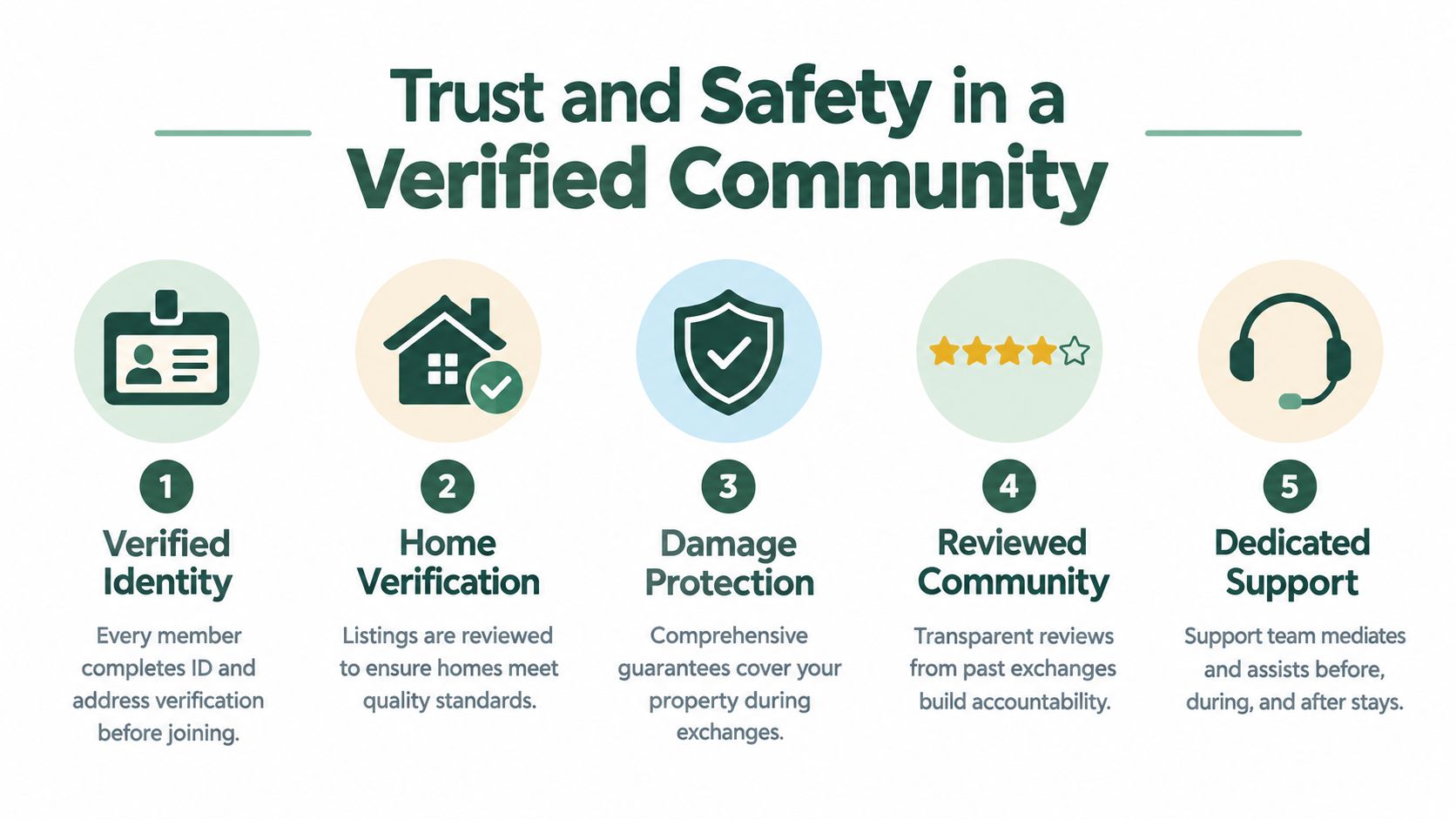 An infographic detailing five key steps to ensure trust and safety within a verified home exchange community.
Why trust improves after real exchanges
A large University of Bergamo study of 46,000 members found that about 80% had already completed at least two exchanges, 76.8% reported being very satisfied, and nearly three out of four respondents had been members for over a year (University of Bergamo home exchange study). The practical reading is straightforward. Trust tends to deepen with successful use, not before it.
That's important because home exchange communities run on accumulated reputation. Each completed stay tells future hosts and guests whether someone communicates well, respects house rules, and leaves the place in good condition.
What careful hosts do before saying yes
A sensible host usually checks four things before approving a stay:
- Profile completeness so the guest doesn't feel anonymous
- Communication quality because message tone often reveals how organized someone is
- Household fit including children, pets, stairs, parking, and sleeping layout
- Review history when available, especially for longer stays
Platforms also vary in how they implement verification and support. If you want a platform-specific overview, SwappaHome outlines its process on the SwappaHome trust and safety page.
You're not looking for a perfect stranger. You're looking for a verifiable member whose behavior is legible before the exchange begins.
The remaining risks people should say out loud
Home swapping still isn't frictionless. The questions are usually practical ones:
- Property wear. Can you accept normal use of your kitchen, sofa, towels, and everyday items?
- Guest behavior. Are your house rules clear enough to prevent avoidable misunderstandings?
- Lifestyle mismatch. Does your home suit the guest's needs, and does their home suit yours?
- Dispute tolerance. If something small goes wrong, are you comfortable resolving it calmly?
Those aren't reasons to avoid home exchange. They're reasons to approach it like an experienced host rather than an anxious first-timer.
Who Benefits Most from Home Exchange Networks
Some travelers get obvious value from a home exchange membership. Others won't enjoy it, even if the math works.
 A happy family packing cardboard boxes together in their bright and spacious living room while moving house.
The people who usually get the most value
Families tend to be strong candidates because they need exactly what exchanged homes often provide: bedrooms, kitchens, laundry, toys, outdoor space, and a layout that supports real life instead of just sleeping.
Remote workers and long-stay travelers also benefit because they need homes that function during the day, not just at night. A dining table, stable neighborhood rhythm, and room to spread out matter a lot more on day ten than day two.
There's also a market signal that mainstream adoption is spreading, even if suitability still varies by household. Reporting on recent exchange activity notes that Spanish summer exchanges rose 29.4% year over year to nearly 40,000, and Canadian membership grew more than 30% in a year, while also pointing out that many articles still skip the harder questions about disputes, household readiness, and who's a poor fit (report on growth and unresolved practical concerns).
Who may be happier in hotels
Home exchange usually isn't ideal for:
- Service-first travelers who want daily housekeeping, room service, and a staffed front desk
- Highly private homeowners who dislike anyone using their kitchen, bed, or personal space
- Very short-trip travelers who prioritize speed over setup and don't want to prepare a home for guests
- Rule-averse guests who don't enjoy reading house manuals or respecting individualized home routines
A home exchange membership works best when you value space, flexibility, and local living more than standardized service.
Your Step-by-Step Guide to Joining and Hosting
A first exchange often fails before anyone arrives. The listing leaves out a steep staircase, the guest assumes there is air conditioning, or the host accepts dates without noticing the trip is only worth a small credit gain after cleaning and prep. Joining well means reducing those small points of friction early.
Treat the setup like writing a clear rental brief for one careful household. You are helping another member answer two questions: Would this home fit my trip, and is this exchange worth it for both of us?
Build a listing that answers the key questions
Good listings show daily life, not just attractive corners. Photos should help a guest understand how the home works from breakfast to bedtime. Include the kitchen, each sleeping area, the bathroom, any workspace, the entrance, and anything that changes comfort or convenience.
The written description does the filtering. If you mention the awkward parts early, you waste less time on poor matches and get better requests from people who are comfortable with the trade-offs.
A useful listing usually covers:
- Layout first. How many people fit comfortably, and where does each person sleep?
- Daily-use features. Washer, cooking basics, internet speed, desk, elevator, parking, outdoor space.
- Possible deal-breakers. Stairs, street noise, pets in the home, shared entry, no air conditioning, limited child safety.
- Neighborhood rhythm. Walkable shops, car-dependent suburb, late-night city noise, beach access, transit options.
One practical test helps. If a guest read only your listing and not your messages, could they still picture a normal day in the home?
Set up your home for low-stress hosting
Hosting gets easier when every repeat question has one clear answer. A short house guide saves far more time than a long message thread.
Prepare the home in layers. First, remove or lock away anything private or hard to replace. Next, make the home easy to use for a tired traveler who arrives late and does not know your routines. Then check the exchange math. If you spend on fresh linens, extra cleaning, supplies, or a key handoff service, compare that cost with the value of the credits or reciprocal stay you expect back.
A solid host setup includes:
- A locked storage area for valuables, personal files, medications, and sentimental items
- A house guide with Wi-Fi, trash rules, heating or cooling instructions, appliance notes, parking, and emergency contacts
- Clear kitchen rules so guests know what is available to use and what is set aside
- Arrival basics such as clean bedding, towels, soap, toilet paper, and open drawer or closet space
Aim for a home that is easy to understand, clean, and functional. That standard is high enough.
If you want one example of a credit-based platform workflow, SwappaHome operates as a members-only exchange network where verified homeowners list a home, host to earn credits, and later redeem those credits for stays in other members' homes.
Learn the guest side before sending your first request
Credit systems changed one big piece of old-style swapping. You no longer need a perfect date match with another household that wants your home at the same time. But you still need fit. Credits remove one bottleneck. They do not remove the need for trust, timing, and clear communication.
That is why first requests matter so much. A weak request feels like a form letter. A strong one shows the host that you read the listing, understand the home, and know whether you are proposing a direct exchange or a credit stay.
Include five basics:
- who is traveling,
- your dates or date flexibility,
- whether you want a direct exchange or credits,
- why the home fits your trip,
- any special factors such as children, pets, or work-from-home needs.
Start with an easy first stay. Pick a home with detailed photos, a house style you understand, and a host whose replies are clear and timely.
Small habits that make exchanges run more smoothly
The best exchange experiences often come from ordinary courtesies that remove friction. Leave one shelf in the fridge open. Label the stove if one burner switch is temperamental. Say plainly which pantry items guests may use.
Guests should match that clarity. Message early if arrival changes. Follow the house guide. Leave the home clean enough that the host is not using a day off to reset the space.
Those habits sound small. In practice, they are what turn a membership from an interesting idea into a repeatable, worthwhile way to travel.
Common Questions About Home Exchange Memberships
The sticking points are rarely about the idea of swapping. They're about the “what if” details.
What if the home isn't as clean as a hotel
It probably won't feel like a hotel. That's not automatically a problem. You're staying in a real home, and the standard should be clean, functional, and accurately represented, not sterile and identical.
If you need polished hospitality standards, hotels may still suit you better. If you value comfort and authenticity, a well-prepared exchanged home often feels better by the second day than a polished room ever did.
What about pets, plants, and everyday responsibilities
These arrangements can work well if discussed in advance. Some hosts welcome guests with pets. Others may ask a guest to feed a cat, water plants, or bring in mail. The key is explicit agreement before confirming the stay.
First-timers often get tripped up. They assume “home exchange” means all homes follow one standard script. They don't. Every household has its own rhythm.
What if someone cancels
Platform rules matter more than travel optimism. Read the cancellation and support process before you commit, especially for peak dates or longer stays. A serious membership platform should have a defined path for mediation, rebooking help, or other support when plans unravel.
Do you need a perfect home to participate
No. You need an honest listing and a livable home that suits the right guest. Some travelers want a design-forward city apartment. Others want a kid-friendly family house with a garden and parking. “Worth exchanging” doesn't mean luxurious. It means useful, welcoming, and accurately presented.
The wrong assumption is that home exchange only works for magazine-ready homes. The better rule is this. Ordinary homes in useful locations often make the most practical stays.
Is a home exchange membership worth it
If you want a neat answer, here it is. A home exchange membership is worth it when you will use the network, feel comfortable hosting, and prefer living space over standardized service. It's less compelling if you want friction-free booking with no household responsibilities on either side.
For many homeowners, the biggest mental shift isn't financial. It's operational. Once you stop asking, “Would I swap homes with one exact family on one exact week?” and start asking, “Would I join a verified system that turns my unused nights into future travel?” the model becomes much easier to evaluate.
If the credit-based approach sounds like the version of home swapping that would fit your life, SwappaHome offers a members-only exchange community built around verified homeowners, flexible credits, and whole-home stays rather than nightly booking fees. You can explore how it works and see whether the model suits your travel habits by visiting SwappaHome.

Published by
SwappaHome
SwappaHome Editorial Team
Home Exchange & Slow Travel Editorial
The SwappaHome Editorial Team brings together travel research, home-exchange community insights, and platform data to produce practical guides for first-time and experienced home swappers. Every article cites real platforms, current market rates, and verifiable city-level facts so readers can make informed decisions without guessing.
Ready to try home swapping?
Join SwappaHome and start traveling by exchanging homes. Get 7 free credits when you sign up!