
Home Swapping in Hanoi: Is Vietnam's Capital Worth It for Exchangers?

SwappaHome Editorial Team
Home Exchange & Slow Travel Editorial
Discover if home swapping in Hanoi is right for you. Insider tips on neighborhoods, what to expect from local hosts, and honest pros and cons from 7 years of exchanges.
The motorbike nearly clipped my elbow as I stepped out of a narrow alleyway in Hanoi's Old Quarter. I remember thinking: this is either going to be the most chaotic home swap of my life, or the most unforgettable.
Spoiler—it was both.
Home swapping in Hanoi isn't for everyone, and I'm going to be completely honest with you about that. After spending three separate stints in Vietnam's capital through home exchanges, I've got strong opinions about whether this city works for the swap lifestyle. The short answer? It absolutely can. But you need to know what you're getting into.
 Early morning street scene in Hanois Old Quarter with vendors carrying traditional shoulder poles, s
Here's the thing about Hanoi that nobody tells you before your first visit: it operates on a completely different rhythm than anywhere else I've swapped. The city wakes up at 5 AM with tai chi in the parks and doesn't really quiet down until midnight. There's no "off" switch. For home exchangers, this creates both incredible opportunities and genuine challenges.
Why Hanoi Home Swapping Is Different From Typical Exchanges
Most of my home swaps have been in Europe, North America, or Australia—places where the home exchange concept is well-established and hosts generally know the drill. Hanoi threw me a curveball.
The home swap community here is smaller but growing fast. When I first looked into exchanges back in 2019, there were maybe a dozen listings on SwappaHome. Now? I'm seeing closer to 80-100 active properties, ranging from tiny Old Quarter apartments to sprawling villas in the expat-heavy Tay Ho district.
What makes Hanoi home swapping unique is the host demographic. Unlike Paris or Barcelona where you're often swapping with locals who travel frequently, many Hanoi listings come from expats—English teachers, digital nomads, NGO workers, and retirees who've made Vietnam home. This actually works in your favor as a first-time Vietnam swapper because communication tends to be smoother and expectations align more closely with Western norms.
But here's where it gets interesting.
I've also swapped with Vietnamese families, and those experiences were profoundly different—in the best possible way. My second Hanoi swap was with a family in the Hoan Kiem district. The grandmother left me handwritten notes (translated by her grandson) about which street vendors had the best banh mi and what time the water puppet theater started. She'd stocked the fridge with fresh fruit and left her bicycle for me to use. That kind of hospitality? You can't buy it at a hotel.
Best Neighborhoods for Home Exchange in Hanoi
Location in Hanoi matters more than almost any city I've visited. Let me break down where you'll find the most swap opportunities.
Old Quarter (Phố Cổ): Chaos and Character
The Old Quarter is Hanoi's beating heart—36 ancient streets, each historically dedicated to a specific trade. It's loud, cramped, overwhelming, and absolutely magnetic.
 Interior of a renovated tube house apartment in Hanois Old Quarter with exposed brick walls, narrow
Home swaps here tend to be in "tube houses"—those impossibly narrow buildings that stretch back from the street like railroad cars. My Old Quarter swap was 3 meters wide and 20 meters deep, with a tiny internal courtyard that let in just enough light. The bedroom was on the third floor, up stairs so steep they were basically a ladder.
Was it convenient? Honestly, not really. Was it an experience I'll never forget? Absolutely.
Expect to pay around 1 credit per night on SwappaHome (that's the standard rate for all exchanges), but know that equivalent hotel rooms in the Old Quarter run $60-120 USD per night for anything decent. The savings add up fast when you're staying for weeks.
The pros? You're walking distance to everything historic. Street food is literally outside your door—pho for $1.50, anyone? And the immersion is unmatched. The cons? Noise. I mean, serious noise. Motorbikes, vendors, karaoke until 11 PM. Space is limited, and parking is nonexistent if you rent a motorbike.
Tay Ho (West Lake): The Expat Haven
If the Old Quarter sounds like too much, Tay Ho might be your speed. This district wraps around West Lake, Hanoi's largest, and has a distinctly different vibe—tree-lined streets, lakeside cafes, yoga studios, and international restaurants.
Most of the expat-owned listings on SwappaHome are in Tay Ho. You'll find modern apartments with actual elevators, Western kitchens, and—this was a revelation after my Old Quarter experience—relative quiet.
 Sunset view over West Lake in Hanoi from a high-rise apartment balcony, with the golden Tran Quoc Pa
I did a two-week swap in Tay Ho last year, in a 12th-floor apartment with a view that made me gasp every morning. The host was an Australian English teacher who'd been in Hanoi for six years. Her place had a full kitchen, fast wifi, and a gym in the building. It felt almost too easy.
The trade-off? Tay Ho is about 7 kilometers from the Old Quarter. You'll need to grab a Grab (Vietnam's Uber equivalent) or rent a motorbike to see the main sights. Rides cost about $2-4 USD each way.
Ba Dinh: History and Diplomacy
Ba Dinh is where you'll find Ho Chi Minh's Mausoleum, the Presidential Palace, and most of the embassies. It's quieter than the Old Quarter, more local than Tay Ho, and has some genuinely lovely French colonial architecture.
Home swap options here are fewer but tend to be spacious—often in old French villas that have been divided into apartments. If you can snag one, you're in for a treat. I toured a friend's swap in Ba Dinh that had 4-meter ceilings, original tile floors, and a garden courtyard. She paid the same 1 credit per night as I did for my cramped tube house.
Hoan Kiem: The Sweet Spot
Hoan Kiem district surrounds the iconic lake of the same name and sits right between the Old Quarter's chaos and the more residential areas. It's walkable, central, and has that perfect balance of authentic and accessible.
This is where I'd recommend first-time Hanoi swappers focus their search. You get the Old Quarter experience without being in the thick of it. The lake itself becomes your living room—morning joggers, evening strollers, weekend pedestrian zones where the streets close to traffic.
What to Expect From Hanoi Home Swap Hosts
Hanoi hosts tend to fall into two categories, and managing your expectations based on which you're dealing with will make or break your experience.
Expat hosts generally communicate in ways that feel familiar. They'll send you detailed instructions, probably have a house manual, and understand concepts like "quiet hours" and "please don't rearrange my furniture." Their homes often have Western amenities—ovens, dryers, comfortable mattresses.
Vietnamese hosts may communicate differently. Don't mistake brevity for coldness—it's often just a language barrier or cultural difference. What they might lack in detailed instructions, they often make up for in personal touches. I've had hosts leave me SIM cards, arrange airport pickups through their cousins, and insist on giving me a walking tour of the neighborhood before they left.
One thing I've noticed across the board: Hanoi hosts are incredibly generous with their local knowledge. Every single one has given me restaurant recommendations that turned out to be perfect. Trust their suggestions over TripAdvisor—seriously.
The Honest Downsides of Home Swapping in Hanoi
I promised you honesty, so here it is.
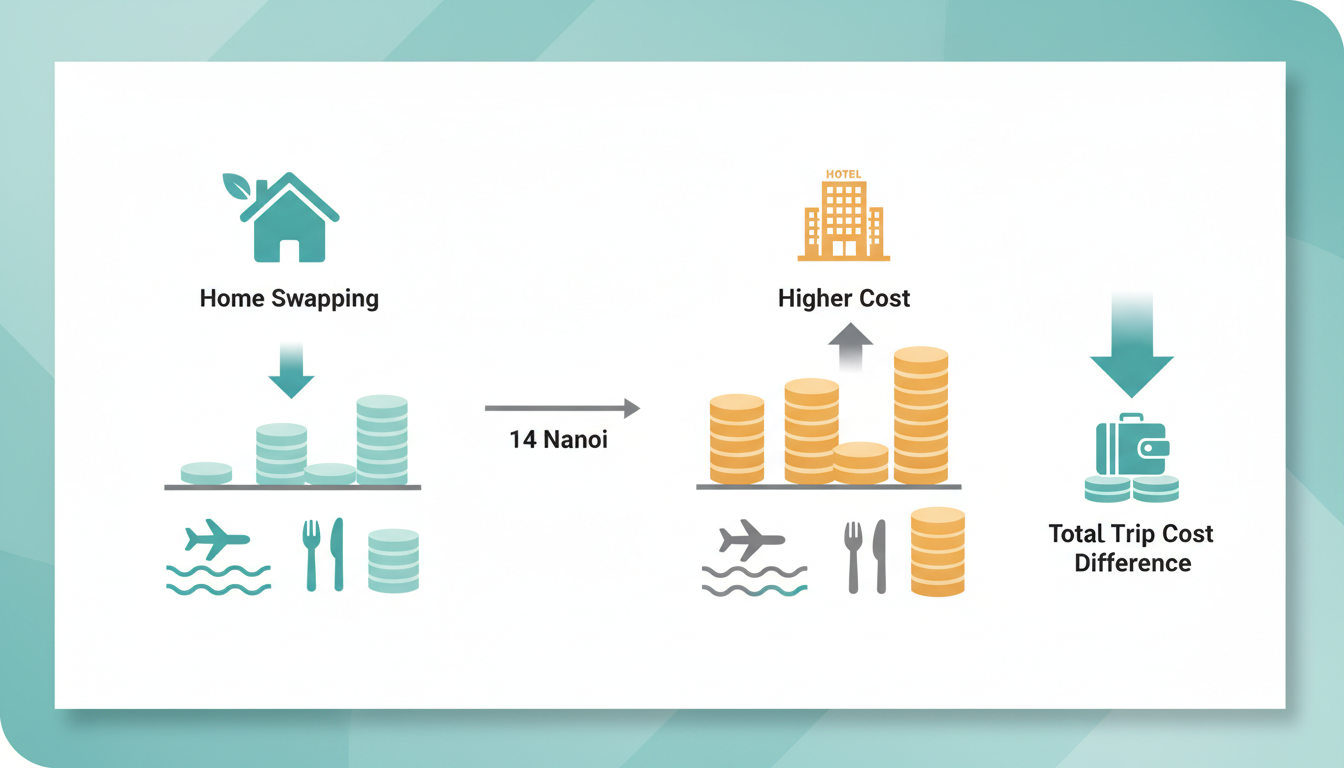 Comparison infographic showing Hanoi home swap costs vs hotel costs over a 14-night stay, breaking d
The Language Barrier Is Real
English is less widely spoken in Hanoi than in tourist-heavy destinations like Bangkok or Bali. If you're staying in a Vietnamese-owned home, you might encounter neighbors, building staff, or local vendors who speak little to no English. This isn't a dealbreaker—Google Translate and hand gestures go far—but it adds a layer of complexity.
Infrastructure Can Be... Unpredictable
Power outages happen. Water pressure varies wildly. Internet can be spotty in older buildings. Air conditioning units in some older apartments sound like jet engines. These aren't daily occurrences, but they're more common than in Western cities.
During my Old Quarter swap, the power went out for six hours on a 38°C day. I survived (barely) by sitting in a cafe and drinking iced coffee. The host apologized profusely, but honestly? It's just part of Hanoi life.
The Climate Factor
Hanoi has four distinct seasons, and two of them are rough for home swappers.
Summer runs from May through August—brutally hot and humid. If your swap doesn't have good air conditioning, you'll be miserable. Temperatures hit 35-40°C with 80%+ humidity. Winter, from December through February, is surprisingly cold and damp. Most Hanoi apartments don't have central heating. My February swap had me sleeping in three layers because the host's space heater couldn't keep up with the drafts.
The best months for Hanoi home swapping? September through November and March through April. Mild temperatures, lower humidity, and the city at its most pleasant.
Fewer Swap Options Than Major European Cities
Let's be real: Hanoi isn't Barcelona or Paris when it comes to home exchange inventory. You might not find your perfect neighborhood or exact dates. Flexibility is key. I've had to adjust my Hanoi travel dates by a week or two to match available swaps, which isn't always possible for everyone.
Why Hanoi Home Swapping Is Worth It Anyway
Despite everything I just said, I keep coming back. Here's why.
 Morning scene of a home exchanger eating pho at a tiny plastic stool on a Hanoi sidewalk, surrounded
The Value Is Unbeatable
Hanoi is already one of the world's best-value destinations. Add home swapping to the equation, and your money stretches absurdly far. During my last three-week stay, my total expenses—food, transport, activities, everything except flights—came to about $600 USD. That's less than a week in most European capitals.
With SwappaHome's credit system, you're using the same 1 credit per night you'd spend anywhere else, but you're getting it in a city where that credit goes incredibly far in terms of local purchasing power.
The Cultural Immersion Is Deeper
Staying in a Hanoi home—especially in a local neighborhood rather than a tourist zone—gives you access to a side of the city that hotel guests never see. You'll learn the rhythm of your street. You'll recognize the woman who sells banh cuon from her cart every morning. The coffee shop owner will start making your drink when he sees you coming.
This isn't just nice-to-have. It fundamentally changes how you experience a place.
The Food Situation
I need to talk about the food because it's honestly a major reason to choose Hanoi for a home swap.
Unlike many destinations where having a kitchen saves you money but limits your culinary experience, Hanoi's street food culture means you'll eat better AND cheaper by going out. A bowl of pho costs 35,000-50,000 VND ($1.50-2 USD). Banh mi sandwiches are 20,000-30,000 VND (under $1.50). Bun cha—the grilled pork noodle dish Obama ate with Anthony Bourdain—runs about 50,000 VND.
Your swap kitchen becomes useful for morning coffee and late-night snacks, but you'll probably eat most meals out. And that's exactly how it should be.
Practical Tips for Your Hanoi Home Swap
After three successful Hanoi exchanges, here's what I wish I'd known from the start.
Before You Book
Check the building's elevator situation—many Hanoi apartments are in walk-ups, and if you have heavy luggage or mobility concerns, you'll want to confirm this upfront. Ask about air conditioning and heating. Don't assume. Ask specifically what climate control exists and how well it works. Clarify the wifi situation too, because speed varies enormously. If you're working remotely, ask for a speed test screenshot.
And discuss motorbike access. Many hosts will let you use their motorbike, which is genuinely life-changing for getting around. But you need an international driving permit and nerves of steel.
During Your Stay
Get a Vietnamese SIM card immediately—Viettel or Mobifone, available at the airport for about $10 USD with plenty of data. You'll need it for Grab, Google Maps, and translation apps.
Learn basic Vietnamese phrases. "Xin chào" (hello), "Cảm ơn" (thank you), and "Bao nhiêu?" (how much?) will get you surprisingly far.
Embrace the early mornings. Hanoi is magical at 6 AM. The heat hasn't hit, the streets are calmer, and the best food vendors are just setting up.
Keep small bills handy. Many local vendors don't have change for large notes. 10,000 and 20,000 VND bills are your friends.
Building Trust With Your Host
Since SwappaHome connects members directly without handling disputes or damages, the relationship you build with your host matters more than usual. I always send a detailed introduction message with photos and my SwappaHome profile link. I video call before confirming if possible—it builds trust both ways. I ask specific questions about the neighborhood and their home, and I offer to share my own home's listing so they can see I'm a real person with a real place. I also get my own travel insurance that covers accommodation issues (this is on you, not the platform).
The review system on SwappaHome helps build accountability, but personal connection is what really makes exchanges work smoothly.
Is Hanoi Home Swapping Right for You?
After everything I've shared, here's my honest assessment.
Hanoi home swapping is perfect if you want deep cultural immersion over tourist convenience, if you're flexible with dates and neighborhood preferences, if you can handle some chaos and unpredictability. It works best if you travel slowly—two weeks minimum to really settle in—and if you're comfortable with basic self-sufficiency in a foreign city.
It might not be ideal if you need everything to be predictable and comfortable, if you only have a few days (hotels are easier for short stays), if you require specific accessibility accommodations, or if you're visiting during extreme weather months without flexibility.
For me, Hanoi has become one of my favorite home swap destinations precisely because it's challenging. The city doesn't hand you anything easily, but what you earn through patience and openness is extraordinary.
That motorbike that nearly clipped me on my first day? By week two, I was weaving through traffic on my host's scooter like I'd been doing it for years, stopping at her favorite pho spot at 6:30 AM, nodding at the same faces I saw every morning. That's the magic of home swapping in a city like Hanoi—you don't visit it, you live it, even if just for a few weeks.
If you're on the fence, I'd say this: start browsing SwappaHome listings for Hanoi. Look at what's available, read the descriptions, check out the neighborhoods on Google Maps. You might find a tube house in the Old Quarter that speaks to your adventurous side, or a modern Tay Ho apartment that offers the perfect balance of comfort and exploration.
Either way, Hanoi is waiting. And trust me—it's worth the leap.
Frequently Asked Questions
Is home swapping in Hanoi safe for solo travelers?
Home swapping in Hanoi is generally safe for solo travelers, especially in expat-heavy areas like Tay Ho. The SwappaHome verification and review system helps build trust between members. I recommend video calling hosts beforehand, choosing verified listings, and getting your own travel insurance for extra peace of mind. Hanoi itself is considered safe for tourists, with low violent crime rates.
How much money can I save home swapping in Hanoi versus hotels?
Over a two-week stay, home swapping in Hanoi can save you $800-1,500 USD compared to mid-range hotels. Decent hotels in central Hanoi cost $60-120 per night, while SwappaHome exchanges cost 1 credit per night regardless of location. Combined with Hanoi's already low cost of living ($20-30/day for food and transport), your total trip costs drop dramatically.
What's the best time of year for Hanoi home exchanges?
The best months for home swapping in Hanoi are September through November and March through April. These periods offer mild temperatures (20-28°C), lower humidity, and comfortable conditions for exploring. Avoid summer months (May-August) unless your swap has excellent air conditioning, and be prepared for damp cold in winter (December-February).
Do I need to speak Vietnamese for a Hanoi home swap?
You don't need to speak Vietnamese for a successful Hanoi home swap, but basic phrases help enormously. Many hosts—especially expats—communicate in English. Google Translate works well for signs and menus. Learning "xin chào" (hello), "cảm ơn" (thank you), and "bao nhiêu" (how much) will make daily interactions smoother, and locals genuinely appreciate the effort.
Are there enough home swap listings available in Hanoi?
Hanoi's home swap inventory is smaller than major European cities but growing steadily, with 80-100 active listings on SwappaHome across various neighborhoods. Flexibility with dates and location increases your chances of finding a match. Book 2-3 months ahead for peak season (October-November, March-April) to secure the best options in popular areas like Hoan Kiem or Tay Ho.

Published by
SwappaHome
SwappaHome Editorial Team
Home Exchange & Slow Travel Editorial
The SwappaHome Editorial Team brings together travel research, home-exchange community insights, and platform data to produce practical guides for first-time and experienced home swappers. Every article cites real platforms, current market rates, and verifiable city-level facts so readers can make informed decisions without guessing.
Ready to try home swapping?
Join SwappaHome and start traveling by exchanging homes. Get 7 free credits when you sign up!
Related articles
How to Extend or Modify a Home Swap Mid-Stay: The Complete Flexibility Guide
Need to extend your home swap or change dates mid-trip? Here's exactly how to negotiate changes, handle credits, and keep both parties happy.

How to Visit Bali for Free with Home Exchange: The Complete 2026 Guide
Skip the $150/night villas. Home exchange in Bali lets you stay in Ubud rice field houses and Seminyak beach pads for zero accommodation cost. Here's exactly how.
How to Vet Home Swap Guests: 12 Red Flags Every Host Should Know
Learn how to vet home swap guests before handing over your keys. Spot the 12 red flags experienced hosts watch for—and protect your home with confidence.