
Home Swap in Hanoi: The Ultimate Packing List and Preparation Guide for 2024

SwappaHome Editorial Team
Home Exchange & Slow Travel Editorial
Planning a home swap in Hanoi? Here's everything you need to pack and prepare—from monsoon-proof essentials to cultural must-knows that guidebooks skip.
The motorbike nearly clipped my elbow as I stepped onto Hàng Bông Street, my overstuffed suitcase wobbling behind me like a drunk friend. That was my first home swap in Hanoi three years ago, and I'd packed completely wrong—heavy winter sweaters (it was February, I assumed cold), zero rain gear, and somehow three pairs of heels that never left the closet of my host's charming Old Quarter apartment.
I learned fast. Hanoi doesn't care about your packing assumptions.
If you're preparing for a home swap in Hanoi, you're about to experience one of Southeast Asia's most intoxicating cities—a place where thousand-year-old temples share streets with bubble tea shops, where the coffee is strong enough to fuel a rocket, and where the weather will absolutely humble you if you're not ready. This guide is everything I wish someone had handed me before that first trip, refined through two more Hanoi swaps and countless conversations with fellow home exchangers who've made this city their temporary home.
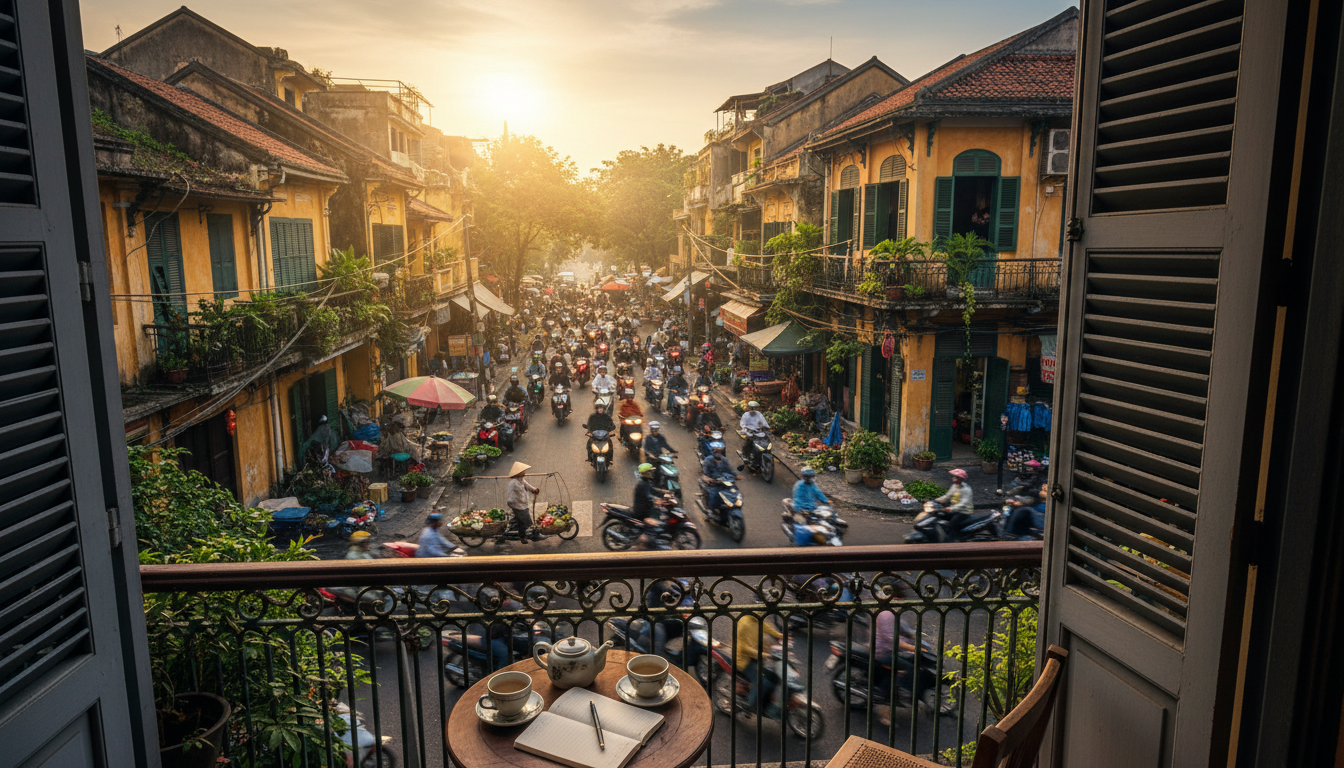 Early morning view from a French colonial-era apartment balcony in Hanois Old Quarter, showing motor
Why Packing for a Hanoi Home Swap Is Different
So here's the thing about preparing for Hanoi that nobody tells you: it's not like packing for Bangkok or Ho Chi Minh City. Those cities are predictably tropical. Hanoi? Hanoi has seasons. Real ones. And they'll mess with your suitcase strategy if you're not paying attention.
Northern Vietnam sits in a subtropical zone. December through February can drop to 10°C (50°F) with a damp chill that seeps into your bones. March through April is spring perfection—mild, occasional drizzle, flowers everywhere. May to September? Prepare for heat, humidity, and monsoon rains that arrive like clockwork every afternoon.
When you're doing a home exchange rather than a hotel stay, your packing philosophy shifts too. You'll have a washing machine (most Hanoi apartments do), a full kitchen, and actual closet space. You can pack lighter knowing you'll do laundry. But you also need to think about what your host might not provide—and trust me, the things you assume will be there often aren't.
Essential Clothing for Your Hanoi Home Exchange
What to Pack for Cool Season (November–February)
I made the rookie mistake of checking Hanoi's average temperature for February (around 17°C/63°F) and thinking, "Oh, that's mild." What the numbers don't tell you is that Vietnamese buildings rarely have central heating. Your swap home will likely have air conditioning that can switch to heat mode, but it's not the same as a properly insulated Western apartment.
Pack layers. Lots of them.
A lightweight down jacket became my best friend during my February swap in the Hoàn Kiếm district. Something you can compress into nothing when the afternoon sun breaks through but throw on immediately when evening hits. Bring a couple of merino wool base layers—they regulate temperature, don't smell after multiple wears, and take up almost no space.
For bottoms, I'd suggest two pairs of comfortable pants that can handle both walking and sitting cross-legged on tiny plastic stools at street food stalls (this is non-negotiable in Hanoi). Jeans work but take forever to dry if they get wet. I've converted to those travel pants that look normal but have stretch and quick-dry fabric—Prana and Kühl make good ones.
And don't forget a scarf. Not for fashion (though Vietnamese women rock the scarf game), but because you'll want something to wrap around your face on a motorbike taxi when the wind cuts through.
Warm Season Packing (March–October)
This is when Hanoi transforms into a steam room. By May, you're looking at 30°C+ (86°F+) with humidity that makes your phone screen fog up when you step outside.
Cotton is your enemy here. It absorbs sweat, clings to your body, and takes ages to dry. Pack linen, bamboo fabric, or moisture-wicking synthetics instead. I basically live in loose linen pants and flowy tops during Hanoi summers.
Real talk: bring clothes you don't mind getting stained. Hanoi street food is incredible but messy—phở broth splashes, bún chả grease drips, and cà phê sữa đá (iced milk coffee) has a way of ending up on white shirts. I pack one or two "nice" outfits for temple visits or dinners out, but my daily uniform is stuff I wouldn't cry over ruining.
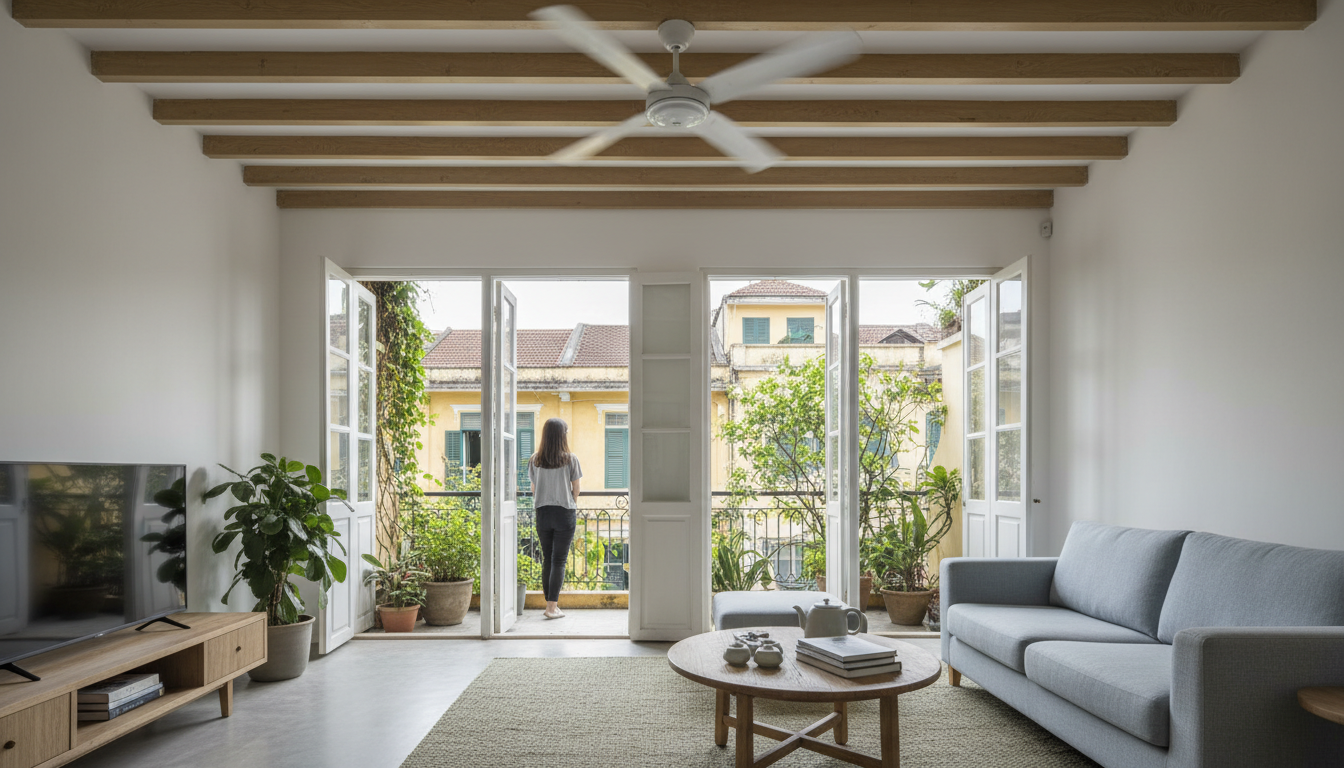 Interior of a bright, airy Hanoi apartment with high ceilings, a ceiling fan spinning lazily, and a
The Hanoi Weather-Proof Essentials You Can't Skip
Rain in Hanoi isn't like rain anywhere else I've experienced. During monsoon season, it doesn't drizzle—it dumps. The sky opens up around 3 or 4 PM most days, transforms the streets into rivers for about an hour, then stops like nothing happened.
A compact travel umbrella is fine for light rain, but for monsoon season, you want a proper rain poncho—the kind that covers your backpack too. You can buy cheap ones everywhere in Hanoi (about 30,000–50,000 VND, roughly $1.20–$2 USD), but they tear easily. Bring a decent one from home or budget to buy a better quality one at a local outdoor shop.
Waterproof shoes matter more than you'd think. I used to pack sandals for Southeast Asia and call it done. But Hanoi's sidewalks flood, the puddles hide potholes, and you'll want closed-toe shoes for the cooler months anyway. I now travel with one pair of waterproof walking shoes (Allbirds Mizzles or similar), one pair of comfortable sandals with good grip (Chacos or Tevas—not fashion slides), and flip-flops for inside the apartment.
That last one matters because many Vietnamese homes have a shoes-off policy. Your swap host will likely have house slippers available, but bringing your own flip-flops means you're not sharing footwear with strangers.
Tech and Gadgets for Your Hanoi Home Swap
Vietnam uses Type A, C, and F electrical outlets. If you're coming from the US, your plugs will work in most outlets without an adapter. Coming from the UK, Australia, or Europe? Bring a universal adapter.
But here's what actually matters for a home exchange: your host's apartment will have WiFi, but the router might be in a weird spot or the password might be taped to the bottom of a decorative cat statue (true story from my Ba Đình district swap). Screenshot or write down all the tech details your host sends you before you arrive.
Power banks are essential. Not because Hanoi lacks electricity, but because you'll spend entire days wandering—getting lost in the Old Quarter's 36 streets, stopping for egg coffee at Café Giảng, watching the sunset at West Lake—and your phone will die from all the photos and Google Maps checking. I carry a 20,000mAh power bank and it usually lasts three days of heavy use.
Get a SIM card immediately upon arrival. Viettel, Vinaphone, and Mobifone all have tourist SIMs available at the airport for around 200,000–300,000 VND ($8–$12 USD) for 30 days of data. The data is unlimited on most plans, and you'll need it because while Hanoi has WiFi in most cafés, it's often slow or requires a Vietnamese phone number to log in.
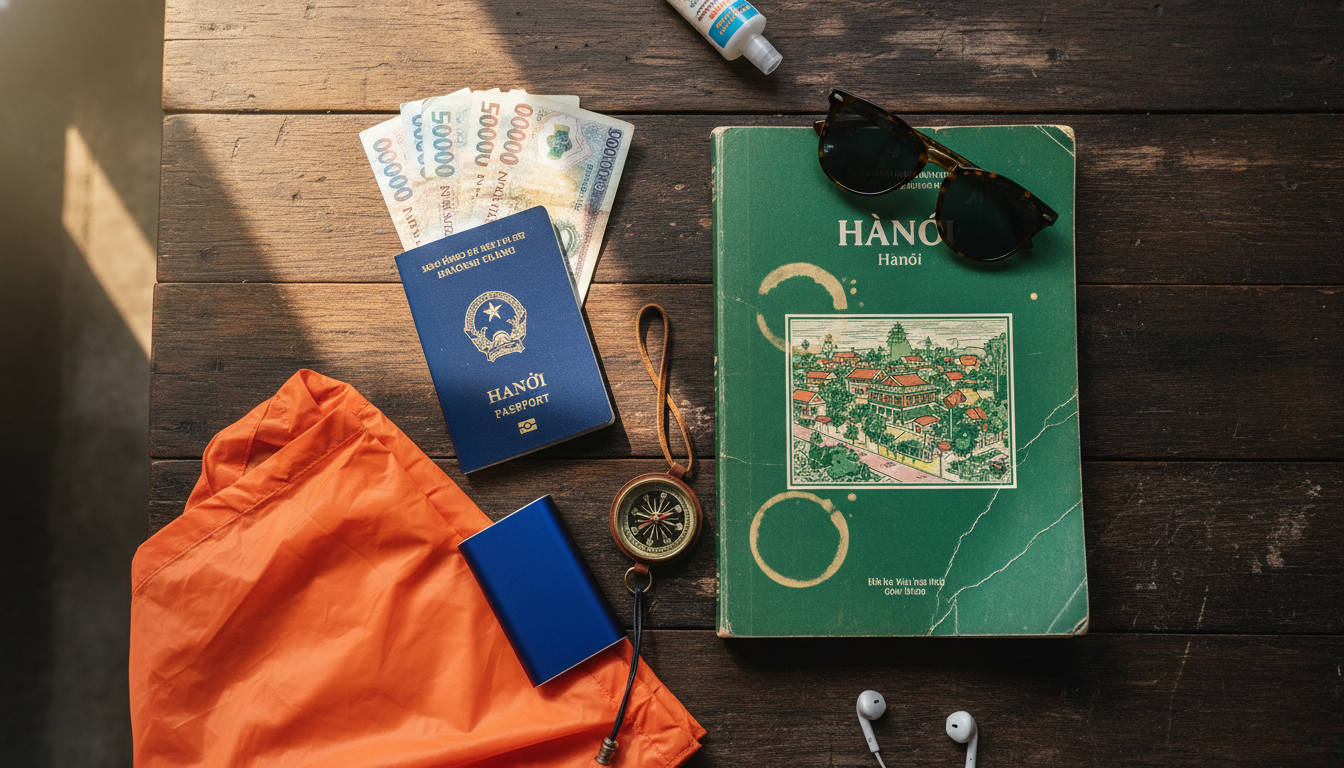 Flat lay of travel essentials on a wooden tablepassport, Vietnamese dong bills, a small power bank,
Health and Safety Items to Pack for Hanoi
Let me be honest with you: Hanoi will probably mess with your stomach at some point. Not because the food is unsafe—street food in Vietnam is generally very fresh because of high turnover—but because your gut isn't used to new bacteria, different oils, and the sheer variety of ingredients you'll encounter.
Pack a small pharmacy. Imodium or equivalent (you won't want to hunt for a pharmacy when you need it), activated charcoal tablets (my secret weapon for food adventures), electrolyte packets (dehydration from heat or stomach issues is real), basic pain relievers, antihistamines (mosquitoes love foreign blood), and any prescription medications you take plus copies of prescriptions.
Mosquito repellent with DEET is worth packing, especially for evenings by the lakes or if you're visiting during wet season. Hanoi isn't a high malaria risk area, but dengue fever exists, and mosquito bites are annoying regardless.
Sunscreen is weirdly hard to find in the right formulations in Vietnam—local brands tend to be very whitening-focused. If you have a preferred SPF, bring it. Same with any specific skincare you can't live without. Vietnamese pharmacies are well-stocked but finding exact products can be a treasure hunt.
Preparing Your Home for Guests While You're in Hanoi
This is the part of home swap preparation that people forget about until the last minute. You're not just packing for Hanoi—you're also getting your place ready for whoever's staying in it.
I've developed a pre-swap checklist over my years of home exchanging. Start with the deep clean. Not just surface tidy—actually clean. Under the couch cushions, inside the fridge, the weird corner behind the toilet. Your guests will notice, and more importantly, it affects the review they leave.
Clear out personal items you don't want touched. I have a closet I designate as "Maya's stuff—please don't open" and I communicate this clearly to guests. Most home exchangers are incredibly respectful, but it's easier for everyone if boundaries are obvious.
Stock the basics—toilet paper, dish soap, a few coffee pods or tea bags, salt and pepper. You don't need to provide a full pantry, but arriving to an empty kitchen after a long flight is demoralizing. I always leave a bottle of wine and a handwritten welcome note too—it sets the tone.
Create a house manual. Where's the circuit breaker? How does the finicky shower handle work? What's the WiFi password? Which neighbor has the spare key? Write it all down, print it out, and leave it somewhere obvious. I also include my favorite local restaurants and the nearest grocery store.
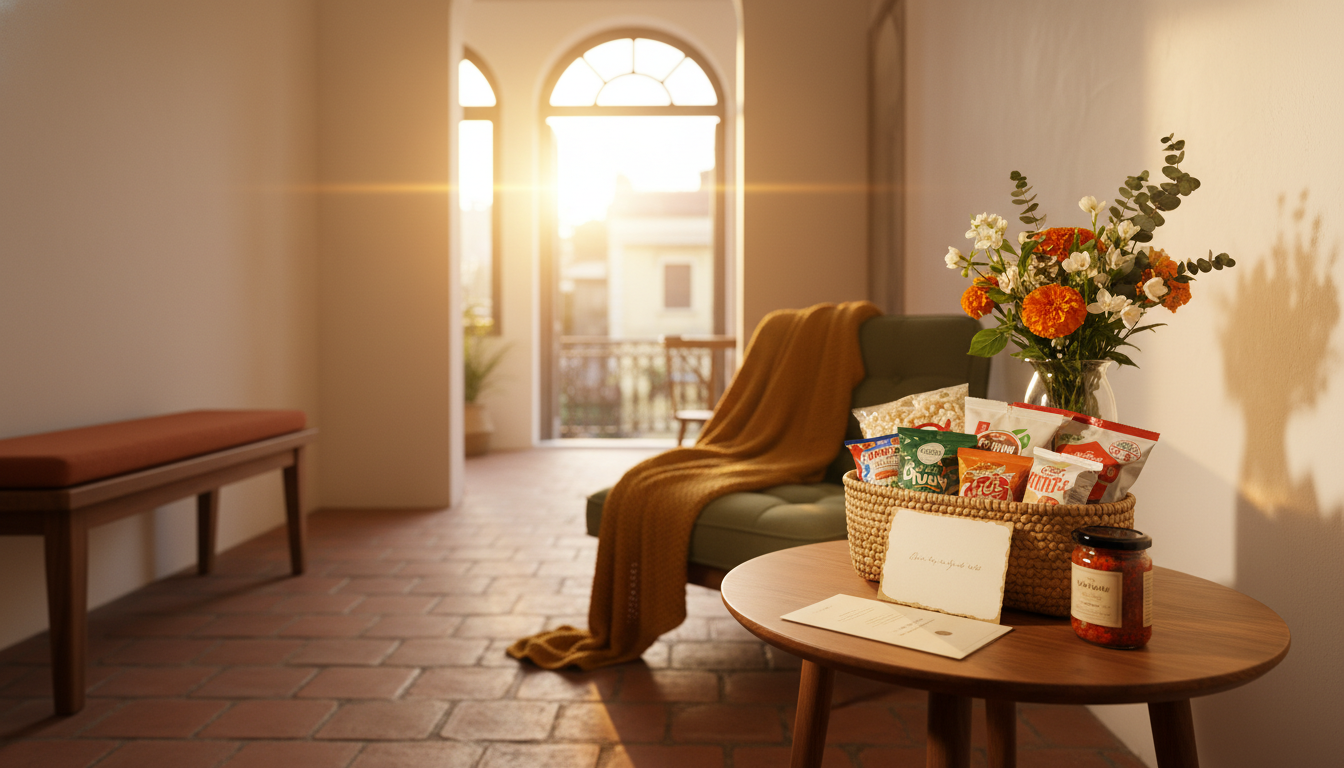 A cozy apartment entryway with a small table holding a welcome basketlocal snacks, a handwritten car
Cultural Preparation: What to Know Before Your Hanoi Home Swap
Packing the right clothes is one thing. Packing the right mindset is another.
Hanoi operates on different social rules than Western cities, and understanding them will make your home exchange experience infinitely smoother.
First, the noise. Hanoi is loud. Motorbikes honking, vendors shouting, karaoke bars blasting until midnight, roosters crowing at 4 AM (yes, in the city center). If you're a light sleeper, pack earplugs. Good ones. I use Mack's silicone earplugs and they've saved my sanity in many a Hanoi apartment.
Second, the concept of personal space is different. Your swap host's neighbors might pop by unannounced. Street vendors might follow you for blocks. People will stare—not rudely, just curiously. It takes adjustment.
Third, learn a few Vietnamese phrases. "Xin chào" (hello), "Cảm ơn" (thank you), and "Bao nhiêu tiền?" (how much?) will get you surprisingly far. Vietnamese is tonal and tricky, but locals genuinely appreciate the effort. I use the Ling app for quick practice.
Fourth—and this is important for home swapping specifically—understand that Vietnamese hospitality is intense. Your host might leave you gifts, might have friends check on you, might message you constantly to make sure you're okay. This isn't intrusive; it's caring. Respond graciously.
Documents and Money: The Practical Prep
Vietnam requires a visa for most nationalities. US, UK, and EU citizens can get e-visas online (around $25 USD) valid for 90 days. Apply at least a week before travel—the system is usually fast but occasionally glitches.
Bring physical copies of your passport (plus two photocopies stored separately), visa approval letter or e-visa confirmation, travel insurance documents, your home exchange booking confirmation, and emergency contact information.
Cash is king in Hanoi. While credit cards work at malls and fancy restaurants, street food vendors, local markets, and most small shops are cash-only. ATMs are everywhere and dispense Vietnamese dong. I typically withdraw 2–3 million VND at a time (about $80–$120 USD) to minimize fees.
And tell your bank you're traveling. Nothing ruins a trip faster than a frozen card because your bank flagged "suspicious activity" in Vietnam.
What NOT to Pack for Hanoi
I've made every overpacking mistake possible, so let me save you the suitcase space.
Leave the formal wear. Unless you have specific business meetings, you won't need blazers, ties, or cocktail dresses. Hanoi is casual. Nice restaurants might expect closed-toe shoes and long pants, but that's about it.
Skip the travel towel—your swap home will have towels. Every apartment I've stayed in through home exchange has provided them. Travel towels are for hostels and camping.
Don't bring too many books. Hanoi has incredible secondhand bookshops in the Old Quarter where you can buy, read, and trade paperbacks. I brought five books on my first trip and came home with different five.
Forget the fancy toiletries. Vietnamese pharmacies and convenience stores stock everything—shampoo, conditioner, razors, toothpaste. Buy there and leave it behind when you go.
Resist the "just in case" items. That formal dress just in case there's a gala. The hiking boots just in case you do a trek. The snorkel gear just in case you visit Ha Long Bay. If it's "just in case," leave it. You can buy or rent almost anything in Hanoi for cheap.
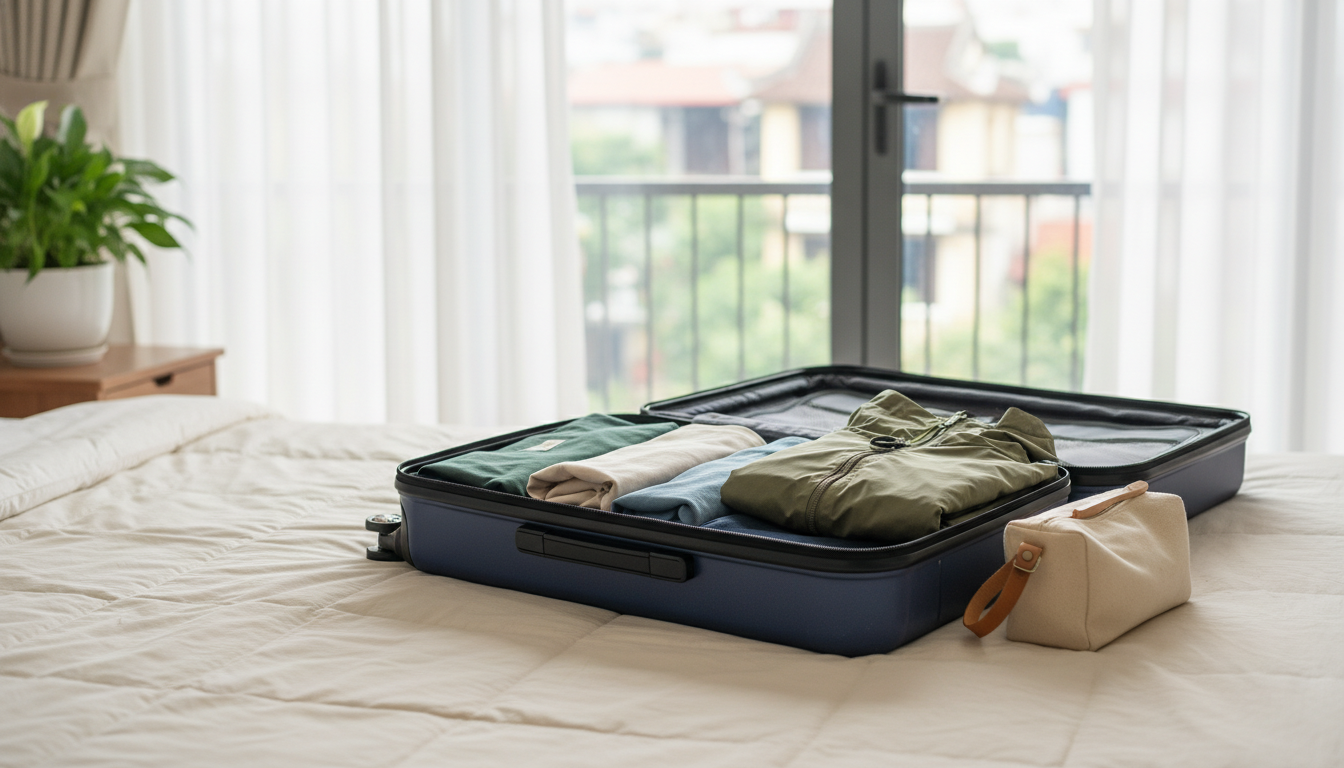 A minimalist packing scenea small carry-on suitcase open on a bed, with neatly rolled clothes, a rai
Setting Up Your Home Exchange Communication
Before you leave for Hanoi, establish clear communication with your swap partner. The messaging system on your home exchange platform works great for this, but I also exchange WhatsApp numbers for real-time questions.
Confirm exact arrival time and key handoff method (lockbox code? Neighbor? Meeting in person?), emergency contacts (your host's friend or family member in Hanoi), any quirks about the apartment ("The hot water takes 30 seconds to kick in"), neighborhood orientation (nearest metro station, best phở shop, pharmacy location), and checkout expectations (cleaning? Laundry? Where to leave keys?).
I also ask for restaurant recommendations. Not the tourist spots—the places your host actually eats. My best meals in Hanoi have come from these insider tips. One swap host sent me to a bún chả place in a random alley near Đống Đa that changed my life. No English menu, plastic stools, absolute perfection for 45,000 VND ($1.80 USD).
The Week Before Your Hanoi Home Swap: Final Checklist
Seven days out, I go into preparation overdrive.
Day 7: Final visa check. Is it approved? Printed? Saved to phone?
Day 6: Notify bank and credit card companies of travel dates.
Day 5: Download offline maps of Hanoi on Google Maps. Download a translation app (Google Translate works offline if you pre-download Vietnamese).
Day 4: Final communication with swap host. Confirm all arrival details.
Day 3: Start packing. Lay everything out first, then edit ruthlessly.
Day 2: Prepare your home for guests. Clean, stock basics, print house manual.
Day 1: Final pack. Weigh luggage. Charge all devices. Get excited.
Day 0: Go to Hanoi. Have the adventure of a lifetime.
Making the Most of Your Hanoi Home Exchange
Here's what I've learned after multiple home swaps in Hanoi: the magic isn't in the tourist sites (though definitely see the Temple of Literature and wander around Hoàn Kiếm Lake). The magic is in living there, even briefly.
Wake up early and join the tai chi practitioners by the lake. Buy vegetables at the wet market on your street and cook dinner in your swap apartment. Learn which café the neighborhood regulars go to and become one of them. Chat with the elderly man who sits outside his shop every evening.
This is what home exchange gives you that hotels never can—a neighborhood, a routine, a glimpse of actual life.
When you're packing for Hanoi, you're not just packing for a trip. You're packing for a temporary life. Pack light enough to be flexible, prepared enough to be comfortable, and open enough to let the city surprise you.
Because it will. Hanoi always does.
I'm already planning my next swap there—a three-week stay in a Tây Hồ apartment with a rooftop terrace overlooking West Lake. If you're looking for your own Hanoi home exchange, there's a growing community of Vietnamese hosts offering everything from Old Quarter studios to spacious family homes in the expat-friendly areas. Start browsing, reach out to hosts, and begin your own Hanoi story.
Just pack better than I did that first time. Your elbows will thank you.
Frequently Asked Questions
What should I pack for a home swap in Hanoi during monsoon season?
For monsoon season (May–September), pack lightweight, quick-dry clothing, a quality rain poncho that covers your bag, waterproof shoes, and a compact umbrella. Expect daily afternoon downpours lasting 1–2 hours. Avoid cotton fabrics that stay wet and pack moisture-wicking materials instead. A waterproof phone pouch is also worth bringing for about $10 USD.
How much money should I bring for a Hanoi home exchange trip?
Budget around $30–50 USD per day for food, transport, and activities in Hanoi. Street food meals cost $1.50–3 USD, café drinks $1–2 USD, and Grab motorbike rides average $1–3 USD across the city. Withdraw Vietnamese dong from ATMs as needed—most charge 20,000–50,000 VND ($0.80–$2 USD) per transaction. Carry cash since many local vendors don't accept cards.
Is it safe to do a home swap in Hanoi?
Hanoi is generally very safe for home exchange travelers. Violent crime against tourists is rare, though petty theft like phone snatching can occur. Home exchange communities use review systems that build accountability between members. Always communicate clearly with your swap partner, get your own travel insurance for peace of mind, and use common sense with valuables.
What electrical adapters do I need for Hanoi?
Vietnam uses Type A, C, and F outlets with 220V electricity. US travelers' two-prong plugs usually fit without adapters. UK, Australian, and some European travelers need a universal adapter. Bring a surge protector for expensive electronics since power fluctuations occasionally happen during storms. Most apartments have multiple outlets, but a small power strip helps.
Do I need to speak Vietnamese for a home swap in Hanoi?
You don't need to speak Vietnamese, but learning basic phrases significantly improves your experience. "Xin chào" (hello), "Cảm ơn" (thank you), and "Bao nhiêu?" (how much?) help with daily interactions. Download Google Translate with Vietnamese offline before arrival. Younger Vietnamese in tourist areas often speak some English, but neighborhood shops and markets may require pointing and patience.

Published by
SwappaHome
SwappaHome Editorial Team
Home Exchange & Slow Travel Editorial
The SwappaHome Editorial Team brings together travel research, home-exchange community insights, and platform data to produce practical guides for first-time and experienced home swappers. Every article cites real platforms, current market rates, and verifiable city-level facts so readers can make informed decisions without guessing.
Ready to try home swapping?
Join SwappaHome and start traveling by exchanging homes. Get 7 free credits when you sign up!
Related articles
How to Extend or Modify a Home Swap Mid-Stay: The Complete Flexibility Guide
Need to extend your home swap or change dates mid-trip? Here's exactly how to negotiate changes, handle credits, and keep both parties happy.

How to Visit Bali for Free with Home Exchange: The Complete 2026 Guide
Skip the $150/night villas. Home exchange in Bali lets you stay in Ubud rice field houses and Seminyak beach pads for zero accommodation cost. Here's exactly how.
How to Vet Home Swap Guests: 12 Red Flags Every Host Should Know
Learn how to vet home swap guests before handing over your keys. Spot the 12 red flags experienced hosts watch for—and protect your home with confidence.