
Home Swapping in Paris: How to Live the City Like a Local

SwappaHome Editorial Team
Home Exchange & Slow Travel Editorial
Discover how home swapping transforms your Paris experience from tourist to temporary Parisian, with insider tips on neighborhoods and daily life.
Home Swapping in Paris: How to Live the City Like a Local
Picture this: It's 7:30 in the morning, and you're padding across worn wooden floors in your slippers, coffee cup in hand, to throw open the tall windows of your Parisian apartment. Below, the boulangerie on the corner is already buzzing with locals grabbing their morning baguettes. The smell of fresh bread drifts up to your third-floor perch, mixing with the aroma of your café au lait. There's no hotel breakfast buffet waiting for you, no tourist crowds forming outside. Just you, this apartment that belongs to a Parisian family currently enjoying your home across the ocean, and an entire city waiting to be discovered at your own pace.
This is what home swapping in Paris actually feels like. And once you've experienced it, those generic hotel rooms with their miniature toiletries and continental breakfast spreads will never quite satisfy you again.
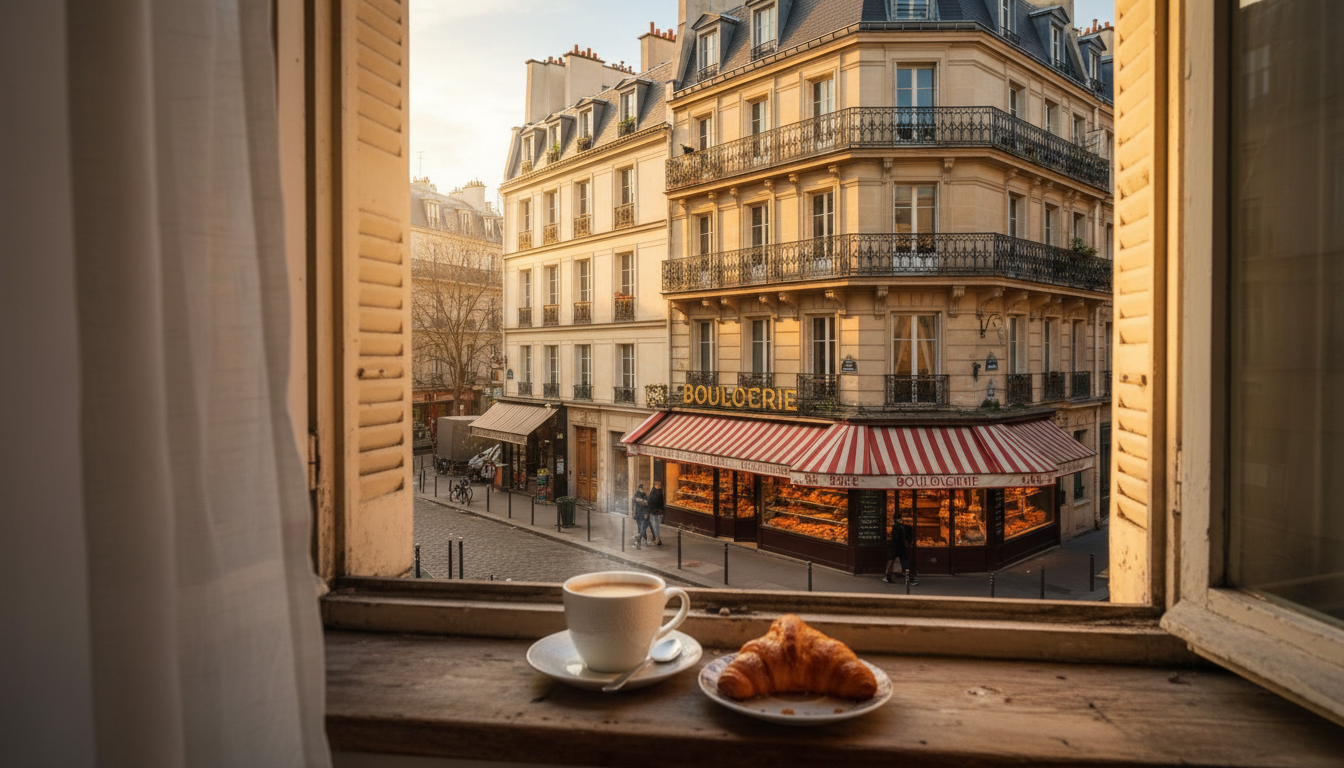 Morning view from a Parisian apartment window showing typical Haussmann buildings, with coffee cup o
Why Paris Hits Different When You Have a Home Base
There's a particular kind of magic that happens when you stop being a visitor and start being a temporary resident. Paris, perhaps more than any other city in the world, rewards this shift in perspective. The French have a phrase for it: flâner—the art of wandering without purpose, of letting the city reveal itself to you. But here's the thing about flânerie: it's nearly impossible to practice when you're operating from a hotel, constantly aware of checkout times and the pressure to maximize every expensive minute.
When you're staying in someone's actual home—a real apartment in a real neighborhood where real Parisians live—the entire rhythm of your trip changes. Suddenly, you have a local cheese shop where the owner starts to recognize you. You discover that the best croissants aren't at the famous patisserie with the hour-long line, but at the unassuming place two streets from your borrowed front door. You learn which café has the perfect morning light for reading, and which park bench catches the afternoon sun just right.
I remember speaking with a traveler who'd done both—the luxury hotel experience and the home swap experience—in Paris. "The hotel was beautiful," she told me, "but I felt like I was watching Paris through glass. When I stayed in that apartment in the Marais, I felt like I was actually in the movie."
That's the difference. Hotels give you a place to sleep. Home swapping gives you a life to borrow.
Finding Your Perfect Parisian Neighborhood
Paris is really twenty small villages masquerading as one city. Each arrondissement has its own personality, its own rhythm, its own secrets. Choosing where to swap isn't just about location—it's about deciding what kind of Parisian you want to be for a week or two.
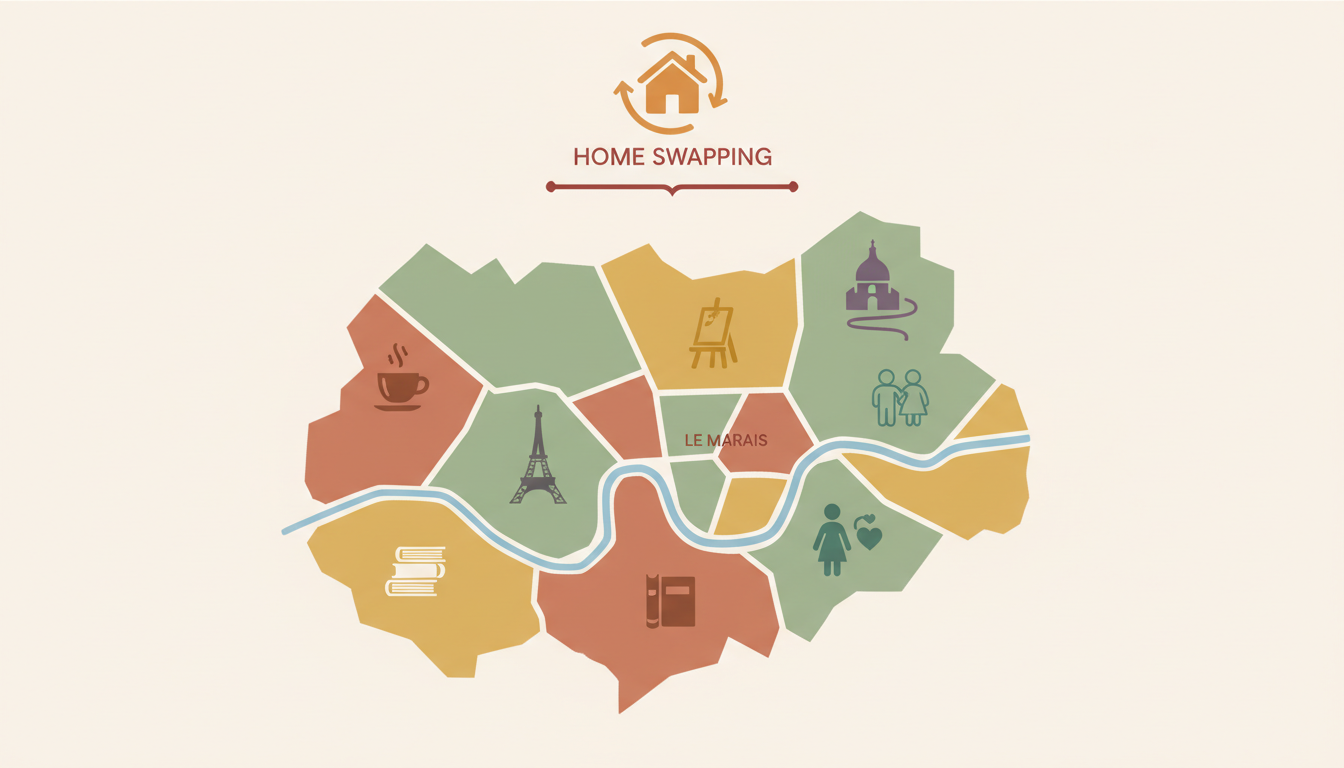 Illustrated map of Paris showing different arrondissements with small icons representing each neighb
The Marais: For the Culture Seekers
The 3rd and 4th arrondissements make up the Marais, and swapping here means waking up surrounded by history that practically seeps through the walls. These apartments tend to be in buildings that have stood for centuries, with spiral staircases that groan with character and windows that look out onto cobblestone streets. The neighborhood is a delicious jumble of Jewish delis, cutting-edge galleries, LGBTQ+ bars, and some of the best falafel you'll find outside the Middle East.
The trade-off? Space is at a premium here. You might find yourself in a charming studio where the kitchen is more of a suggestion than a room. But when your living room window frames a view of Place des Vosges, somehow the square footage stops mattering.
Saint-Germain-des-Prés: For the Literary Romantics
If you've ever fantasized about following in the footsteps of Hemingway, Fitzgerald, and Simone de Beauvoir, the 6th arrondissement is your spiritual home. Saint-Germain is where intellectual Paris lives and breathes, all bookshops and jazz clubs and cafés where philosophers once debated existence over espresso.
Home swaps here often come with built-in bookshelves stuffed with French literature and tiny balconies perfect for pretending you're writing the next great novel. The neighborhood is undeniably expensive—both to visit and to live in—which makes finding a swap here feel like winning some kind of cosmic lottery. You're not just getting accommodation; you're getting access to a Paris that most tourists only glimpse through restaurant windows.
Belleville and Ménilmontant: For the Adventurous Souls
Now, let's talk about the Paris that doesn't make it onto most postcards. The 19th and 20th arrondissements—neighborhoods like Belleville and Ménilmontant—are where young Parisians actually live, where artists have their studios, where the best Chinese food and North African cuisine exist side by side with natural wine bars and underground music venues.
Swapping in these areas means trading Eiffel Tower views for authenticity. Your morning coffee might come from a roaster who speaks three languages and none of them are English. The street art is better than most museum exhibitions. And the rent your swap partners pay? Probably half what someone in the 6th shells out for a closet-sized studio.
This is where I'd point anyone who's already "done" Paris and thinks they know the city. You don't. Not until you've wandered the streets of Belleville at dusk, watching the city lights flicker on from Parc de Belleville, realizing that the real Paris has been hiding in plain sight all along.
The 11th: For the Food Obsessed
If your ideal vacation involves eating your way through a city, the 11th arrondissement should be at the top of your swap wishlist. This neighborhood has quietly become the epicenter of Paris's modern food scene—all the young chefs who trained in Michelin-starred kitchens are opening their own places here, serving innovative food in casual settings at prices that won't require a second mortgage.
The apartment you swap might sit above a wine bar that doesn't even have a sign outside. The cheese shop around the corner might be run by a former software engineer who quit tech to pursue his passion for aged Comté. This is Paris at its most deliciously unpretentious.
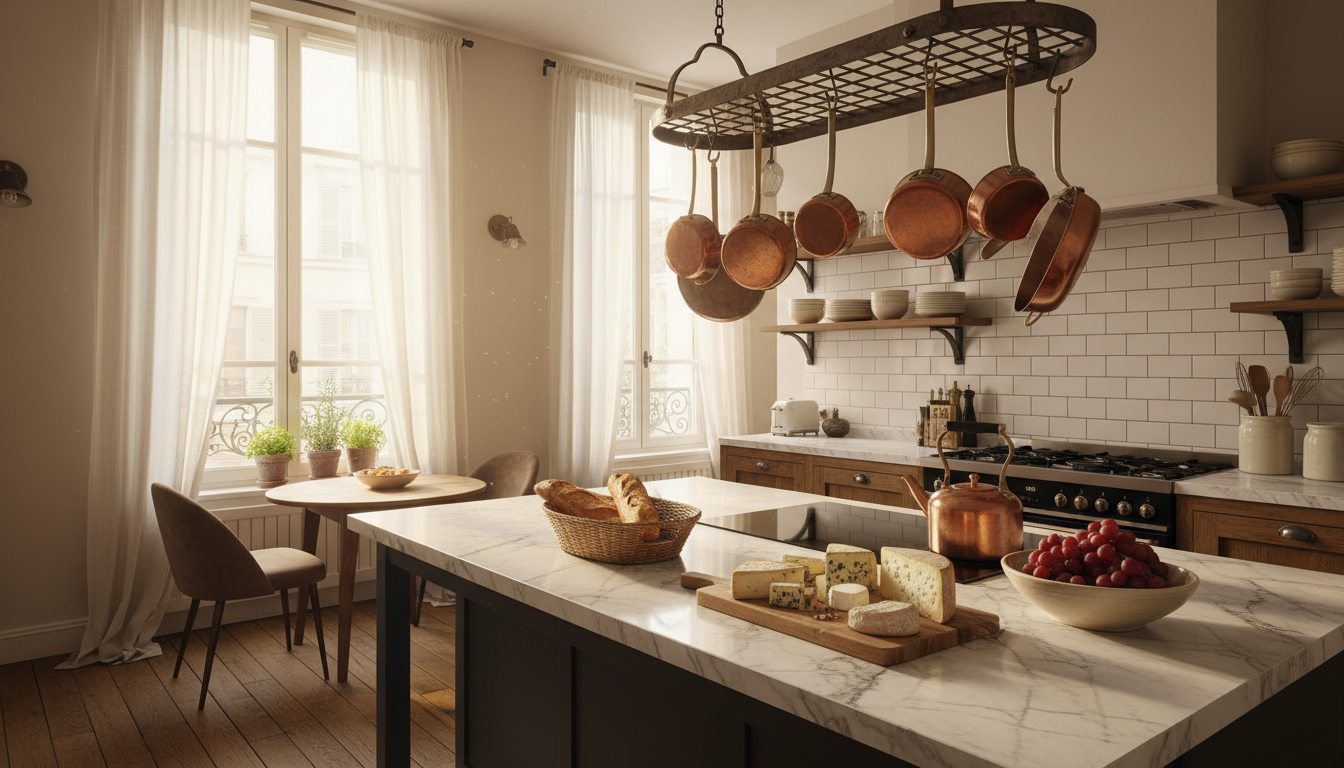 Cozy Parisian apartment kitchen with marble countertops, copper pots hanging, fresh baguette and che
The Art of Living in Someone Else's Parisian Life
Here's something nobody tells you about home swapping: the best part isn't the free accommodation. It's the intimacy of stepping into someone else's daily existence. When you stay in a Parisian's apartment, you inherit their neighborhood, their routines, their little black book of local favorites.
Most swap partners leave notes—sometimes extensive ones—about their neighborhood. Where to get the best bread (and what time it comes out of the oven, because this matters enormously). Which butcher to trust for your Sunday roast chicken. The café where the owner will eventually warm up to you if you keep coming back and always say "bonjour" first.
These notes are worth more than any guidebook. They're curated by someone who actually lives this life, not someone who parachuted in for a week to write about it.
But beyond the practical tips, there's something profound about cooking dinner in someone else's kitchen, using their pots and pans, sitting at their table. You start to understand how Parisians actually live—not the fantasy version, but the real one. The tiny refrigerators that require daily shopping. The way everything closes on Sundays and many places on Mondays too. The unspoken rules about noise after 10 PM. The particular pleasure of a small space made beautiful through careful curation rather than square footage.
Practical Magic: Making Your Paris Swap Work
Let's get into the logistics, because even the most romantic Parisian adventure requires some planning.
Timing Your Swap
Paris empties out in August. This is both a blessing and a curse for home swappers. The blessing: Parisians are desperate to escape the heat, which means more homes available for swapping. The curse: many local shops and restaurants close for their annual vacations, so you might find your favorite neighborhood boulangerie shuttered for three weeks.
Spring and fall are the sweet spots—April through June and September through October. The weather is gentle, the city is alive, and your swap partners are likely heading somewhere warm while you enjoy their perfectly located apartment.
Winter has its own appeal. Paris in December, with the holiday lights and the smell of roasted chestnuts, is genuinely magical. January and February are quieter, colder, but there's something romantic about holing up in a cozy apartment while rain patters against the windows.
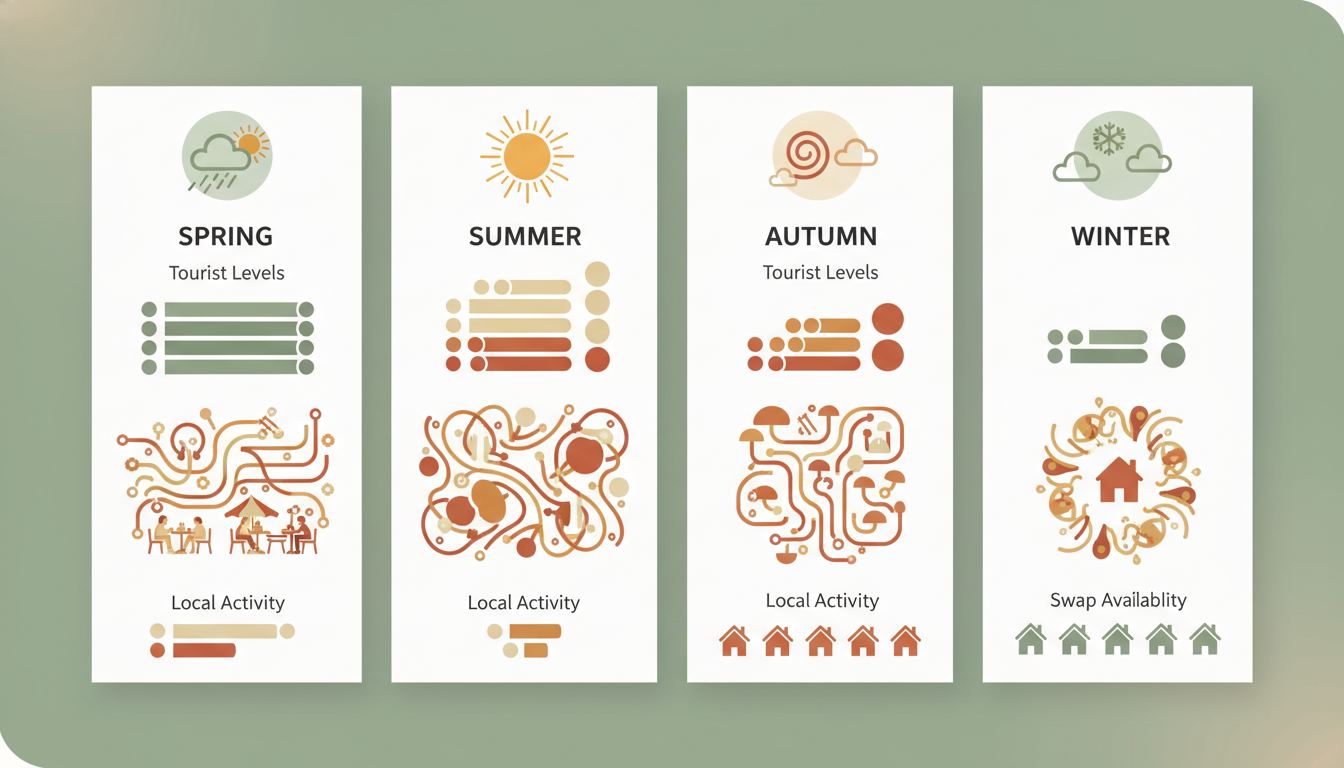 Comparison infographic showing Paris seasons for home swapping - weather, tourist levels, local acti
What to Look for in a Listing
When browsing potential swaps, think beyond the photos (though yes, those matter too). Consider the floor level—Parisian buildings often lack elevators, and that charming fifth-floor walk-up becomes less charming when you're hauling groceries up a spiral staircase. Ask about natural light, which can be scarce in interior-facing apartments. Check whether there's outdoor space, even a tiny balcony, because Parisians live for their moments of fresh air.
The neighborhood matters more than the apartment itself. A slightly smaller space in a vibrant quartier will serve you better than a palatial apartment in a sleepy area. Look for proximity to a metro station, but also to daily essentials: a boulangerie, a supermarket, a pharmacy, a café or two.
And here's a pro tip: pay attention to how your potential swap partners describe their home. The ones who write with obvious affection for their neighborhood, who mention the name of their favorite barista or the best bench in the nearby park—those are the swaps that will transform your trip.
Communication is Everything
The best home swaps start with genuine connection. Before you finalize anything, have a real conversation with your swap partners. Video calls are ideal—they let you see the space and get a sense of the people whose home you'll be borrowing.
Ask about the quirks. Every Parisian apartment has them. Maybe the hot water takes three minutes to arrive. Maybe the bedroom window doesn't close all the way. Maybe there's a trick to the front door lock that takes a few tries to master. Knowing these things in advance transforms minor frustrations into charming peculiarities.
Share your own home's quirks too. This exchange of information builds trust and sets the tone for a successful swap.
Living the Daily Rhythm
Once you've arrived and settled into your borrowed Parisian home, resist the urge to immediately tick off tourist attractions. Give yourself at least one full day to simply be in the neighborhood. Walk every street within a five-block radius. Poke your head into every shop. Sit in the local café and watch the world go by.
This reconnaissance mission will pay dividends for the rest of your stay. You'll discover the shortcut to the metro, the park where locals walk their dogs, the wine shop with the owner who loves recommending bottles, the restaurant that's always packed with French families on Sunday lunch.
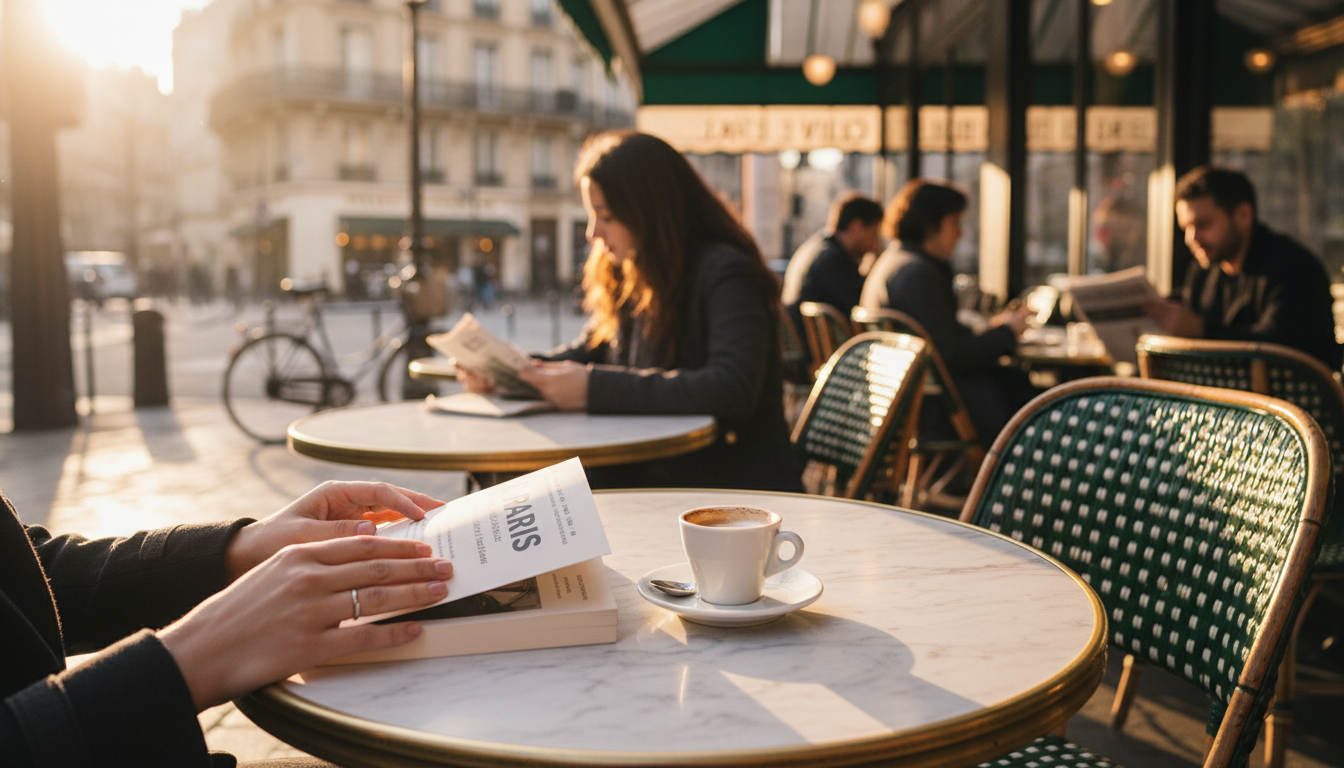 Lifestyle photo of someone reading a book at a typical Parisian caf terrace, small espresso cup on m
Morning Rituals
Paris wakes up slowly, and your mornings should too. The boulangeries open early—usually by 7 AM—and there's genuine pleasure in being among the first customers, when the croissants are still warm and the baguettes are crackling fresh. Buy what you need for breakfast and maybe a little extra for later. The French don't snack much, but they do believe in proper meals.
Take your breakfast back to the apartment or find a bench in a nearby square. This is your time to ease into the day, to flip through a French magazine even if you don't understand most of it, to watch the neighborhood come alive.
The Market Days
Every Parisian neighborhood has market days, and these are non-negotiable for anyone trying to live like a local. The markets are where you'll find the best produce, the most interesting cheeses, the freshest fish. They're also where you'll practice your French (even just "bonjour" and "merci" and "c'est combien?"), where you'll observe how Parisians shop, where you'll discover ingredients you've never seen before.
Ask your swap partners which market they prefer and when it runs. Some are daily, some are twice a week, some are Sunday-only affairs. Plan your cooking around market days, and you'll eat better than you would at most restaurants.
The Art of Doing Nothing
Here's permission you didn't know you needed: it's okay to spend an entire afternoon doing absolutely nothing productive. Sit in a park. Read a book. Watch the light change on the buildings across the street. Take a three-hour lunch. Nap.
This isn't wasting your vacation. This is living your vacation. The Parisians whose apartment you're borrowing? This is how they spend their weekends. The city will still be there tomorrow. The Louvre isn't going anywhere. But this particular afternoon, with this particular quality of light, in this particular borrowed life—that's fleeting. Savor it.
Beyond the Tourist Trail
When you do venture out to explore, your home base gives you a superpower: you can go against the grain. Visit the Louvre on a Wednesday evening when it's open late and the crowds thin out. See the Eiffel Tower at midnight, when it sparkles on the hour and the tourists have mostly retreated to their hotels. Explore Père Lachaise cemetery on a rainy Tuesday morning, when you might have entire sections to yourself.
But also—and this is crucial—give yourself permission to skip the famous stuff entirely. Some of the best days in Paris involve no monuments whatsoever. A morning spent browsing the bouquinistes along the Seine. An afternoon in the Jardin du Luxembourg, watching children sail toy boats in the fountain. An evening wandering the Canal Saint-Martin, stopping for wine at a bar that spills onto the cobblestones.
The advantage of having an apartment is that you can always come back. You don't have to cram everything into one exhausting day because you're paying by the night. You can take the city in small doses, retreating to your borrowed home when you need to recharge, venturing out again when the mood strikes.
The Swap Economy: How It Actually Works
Let's talk about the practical side of making this happen. Home swapping platforms like SwappaHome operate on a beautifully simple principle: you earn credits when someone stays in your home, and you spend those credits to stay in someone else's. One night hosted equals one night away.
This system elegantly solves the timing problem that plagues traditional home exchanges. You don't need to find a Parisian family who wants to visit your city at the exact same time you want to visit theirs. Instead, you might host a family from Berlin in March, bank those credits, and use them for your Paris adventure in October. The flexibility is revolutionary.
For Paris specifically, this matters because Parisian apartments are in high demand. The credit system means you're not competing with everyone who wants a free place to stay—you're part of a community of people who've all contributed to the ecosystem. Your hosting earns you the right to be hosted, and that reciprocity creates trust and quality throughout the network.
Coming Home Changed
There's a particular kind of melancholy that hits when a home swap ends. You've spent a week or two building a life in someone else's space, learning the rhythms of their neighborhood, becoming a regular at their local café. And then suddenly it's over. You strip the beds, wash the dishes, take out the trash, and close the door on a life that was briefly, beautifully yours.
But here's what you take with you: a different relationship with Paris. Not the Paris of postcards and tourist brochures, but a real place where real people live real lives. You'll remember the smell of your morning boulangerie, the sound of the courtyard fountain, the particular creak of the third stair. You'll have inside jokes with a city that most visitors only ever see from the outside.
And maybe, just maybe, you'll have made friends with your swap partners. People who trusted you with their home, whose home you trusted in return. There's something profound about that exchange—more meaningful than any hotel transaction could ever be.
Your Paris Awaits
Somewhere in Paris right now, there's an apartment waiting for you. Maybe it's a sun-drenched studio in the Marais with a view of ancient rooftops. Maybe it's a family flat in the 11th with a kitchen that begs to be cooked in. Maybe it's a writer's garret in Saint-Germain where the ghosts of literary giants seem to linger in the corners.
The beauty of home swapping is that you're not just finding accommodation—you're finding a doorway into a different way of experiencing a city. You're trading the tourist experience for something richer, deeper, more real.
Paris will always have its monuments and museums, its famous cafés and iconic views. But the Paris that stays with you, the Paris that changes you, is the one you discover when you stop visiting and start, however briefly, living.
Your borrowed Parisian life is out there. All you have to do is swap for it.

Published by
SwappaHome
SwappaHome Editorial Team
Home Exchange & Slow Travel Editorial
The SwappaHome Editorial Team brings together travel research, home-exchange community insights, and platform data to produce practical guides for first-time and experienced home swappers. Every article cites real platforms, current market rates, and verifiable city-level facts so readers can make informed decisions without guessing.
Ready to try home swapping?
Join SwappaHome and start traveling by exchanging homes. Get 7 free credits when you sign up!
Related articles

Bachelor and Bachelorette Parties in Singapore: The Complete Home Swap Group Guide for 2026
Planning a bachelor or bachelorette party in Singapore? Discover how home swapping lets groups of 6-12 stay together in luxury condos, saving thousands while partying in Marina Bay.

Cycling in Lisbon: 7 Home Swap Bike Tour Itineraries for Every Rider
Discover the best cycling routes in Lisbon with these home swap bike tour itineraries—from waterfront paths to hilltop adventures, all starting from your borrowed home.

Graduation Trip to Barcelona: How Home Swapping Gives New Graduates the Ultimate Celebration
Planning a graduation trip to Barcelona? Discover how home swapping lets new graduates explore Spain's most vibrant city without the hostel crowds or hotel costs.