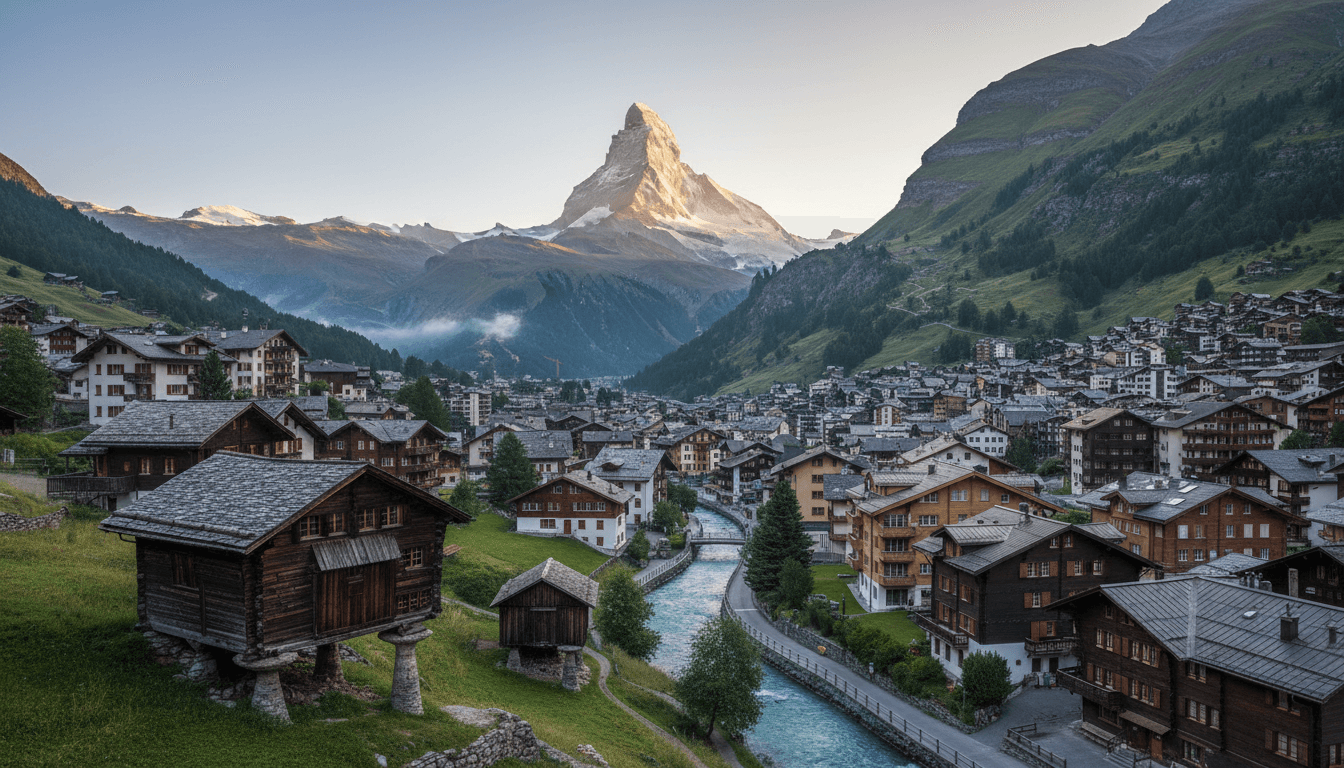
Best Home Swaps in Zermatt for Working Professionals: Your Guide to Remote Work with a Matterhorn View

SwappaHome Editorial Team
Home Exchange & Slow Travel Editorial
Discover the best home swaps in Zermatt for remote workers—fast WiFi, stunning alpine views, and neighborhoods perfect for balancing work and ski slopes.
I looked up from my laptop and the Matterhorn had turned pink. Three days into a deadline crunch, cold coffee abandoned hours ago, and honestly? I couldn't have cared less about the caffeine. That moment—working from a home swap in Zermatt—completely rewired how I think about mixing work and travel.
Finding the best home swaps in Zermatt for working professionals isn't just about scoring a pretty view (though, let's be honest, that helps). It's about WiFi that won't bail on you mid-quarterly review. A proper desk instead of hunching over some coffee table. A neighborhood where grabbing lunch doesn't require a 45-minute snow trek.
Three separate work-focused swaps in Zermatt over four years. I've learned exactly what separates a productive remote work paradise from a frustrating "vacation" where you fall behind on everything.
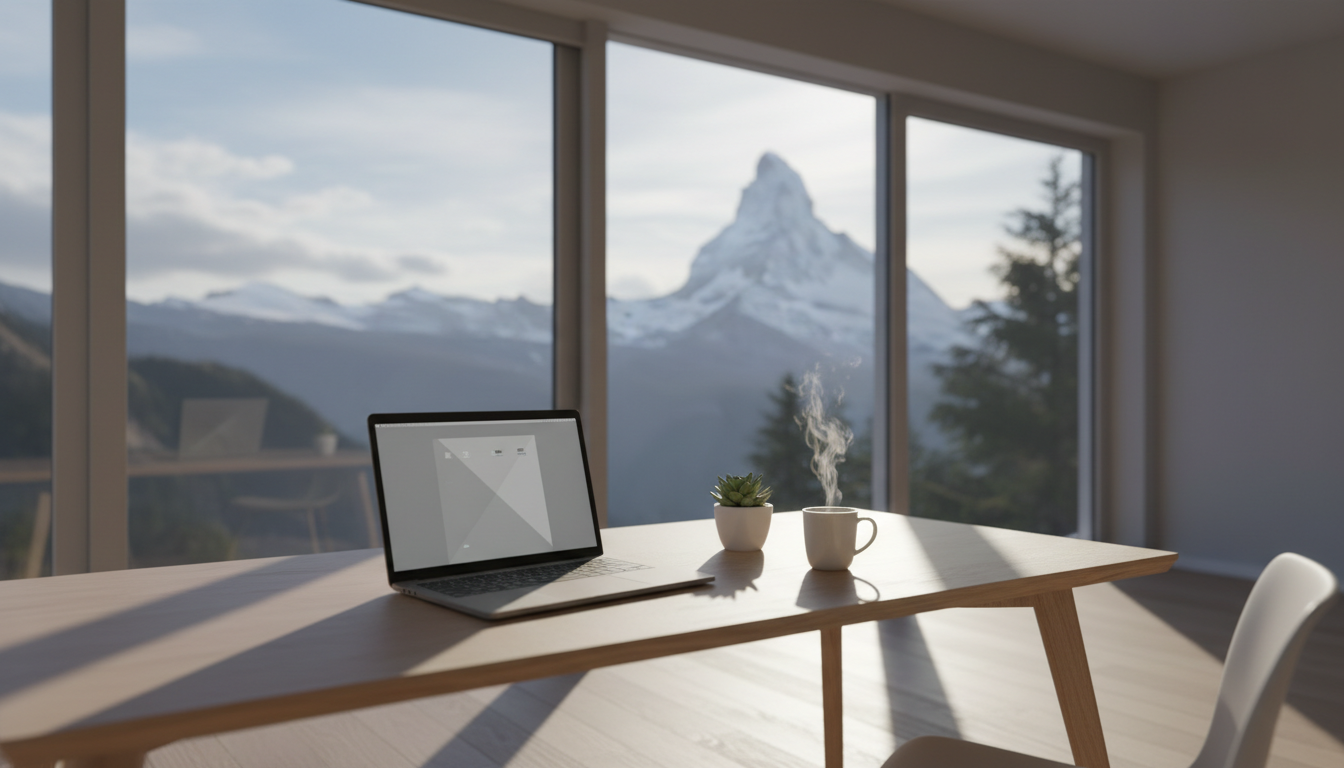 Morning light streaming through floor-to-ceiling windows onto a minimalist wooden desk, laptop open
Why Zermatt Actually Works for Remote Professionals
Here's something most travel articles won't tell you: Zermatt has surprisingly excellent internet infrastructure. The town invested heavily in fiber optic connections over the past decade because—get this—the ski resorts and hotels demanded it. All those wealthy guests streaming Netflix in their chalets meant the whole village got upgraded connectivity.
I consistently get 80-150 Mbps download speeds in Zermatt home swaps. That's better than my apartment in San Francisco. Embarrassing but true.
The car-free policy matters more than you'd think, too. No traffic noise during conference calls. No honking interrupting your focus time. Just the occasional clatter of horse-drawn carriages and the hum of electric taxis. It creates this almost surreal quiet that's perfect for deep work.
And the time zone thing? If you work with US-based teams, Zermatt puts you 6-9 hours ahead. Your mornings are completely free. I'd ski from 8 AM until noon, then work from 1 PM until 9 PM, catching the US East Coast morning and West Coast lunch meetings. Sounds exhausting written out, but it actually felt balanced.
The altitude does take adjustment though. At 1,600 meters (about 5,250 feet), you might feel a bit foggy your first couple days. Drink ridiculous amounts of water—I'm talking 3-4 liters daily. Your brain will thank you.
Best Neighborhoods for Working Professional Home Swaps
Not all parts of Zermatt work equally well for remote professionals. I learned this the hard way during my first swap when I ended up 20 minutes from the nearest grocery store.
Zermatt Village Center (Dorfzentrum)
Your safest bet if logistics make you nervous. The village center puts you within a 5-minute walk of everything: the Coop grocery store, the post office, the train station, about fifteen restaurants.
Home swaps here tend to be traditional wooden chalets converted into apartments, or newer mixed-use buildings. Expect smaller spaces—maybe 50-70 square meters—but with all the amenities you need. Most have dedicated office nooks or at least a proper dining table you can commandeer.
Swap competition runs fiercer in the center. I'd recommend reaching out to potential hosts 3-4 months in advance, especially for peak seasons.
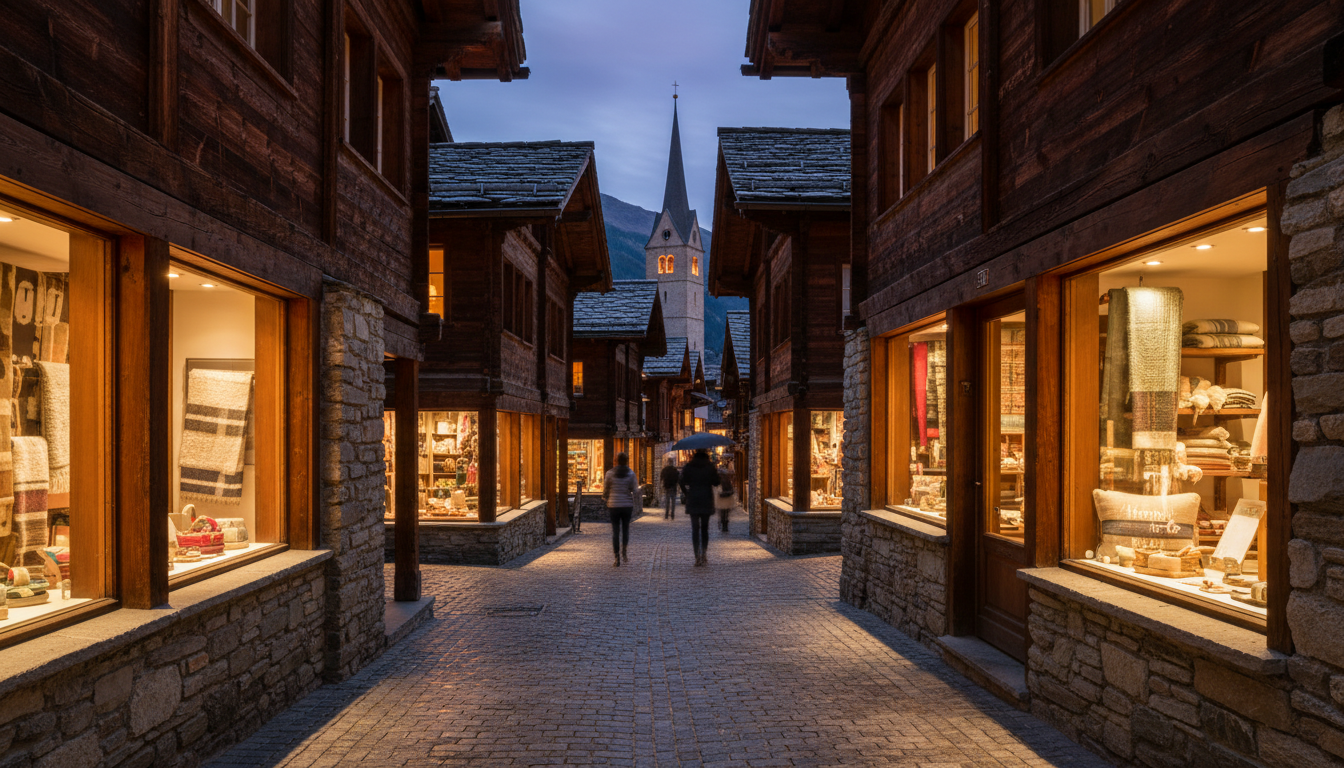 Narrow cobblestone street in Zermatt village center at dusk, warm light glowing from wooden chalet w
Winkelmatten District
My personal favorite for longer work stays. Winkelmatten sits about a 10-minute walk south of the center—far enough to feel residential, close enough that you're not isolated.
The homes here tend to be larger. We're talking proper chalets with multiple bedrooms, often with south-facing balconies that get sun until late afternoon. Several SwappaHome members in this area specifically mention "home office" or "dedicated workspace" in their listings, which tells you they understand the remote work crowd.
I did a three-week swap here in February 2022. The chalet had this small room off the living area that the owners used as a home office—proper ergonomic chair, standing desk option, even a ring light for video calls. They'd clearly thought about what working professionals need.
The walk to the Sunnegga Express gondola takes about 12 minutes from most Winkelmatten properties. That's your gateway to some of the best intermediate skiing in the area—perfect for a lunch break shred.
Steinmatten Area
Slight uphill from the center, Steinmatten offers a nice middle ground. You're elevated enough to get better Matterhorn views from more properties, but still within reasonable walking distance of village amenities.
The trade-off: some streets here get icy in winter, and if you're hauling groceries or your laptop bag, that 15-minute walk can feel longer. Invest in proper boots with aggressive tread. I cannot stress this enough.
Homes in Steinmatten often have garages or storage areas that previous owners have converted into various things—sometimes gyms, sometimes offices. I saw one listing where the owner had built out a fully insulated garden office with its own heating system. Dream setup.
Furi and Zum See (Outskirts)
I'm including these because you'll see listings here, but I'd be cautious for work-focused stays. These areas sit further from the village center, accessible mainly by the Furi gondola or a solid 25-30 minute walk.
The properties are often stunning—larger chalets, more land, incredible isolation. But "isolation" isn't always what a working professional needs. If your WiFi goes down, you're not popping to a café to finish your presentation. If you run out of coffee, that's a whole expedition.
That said, if you have a team that's fully asynchronous and you don't need real-time connectivity, these areas offer the most space and the most dramatic views. Just go in with eyes open.
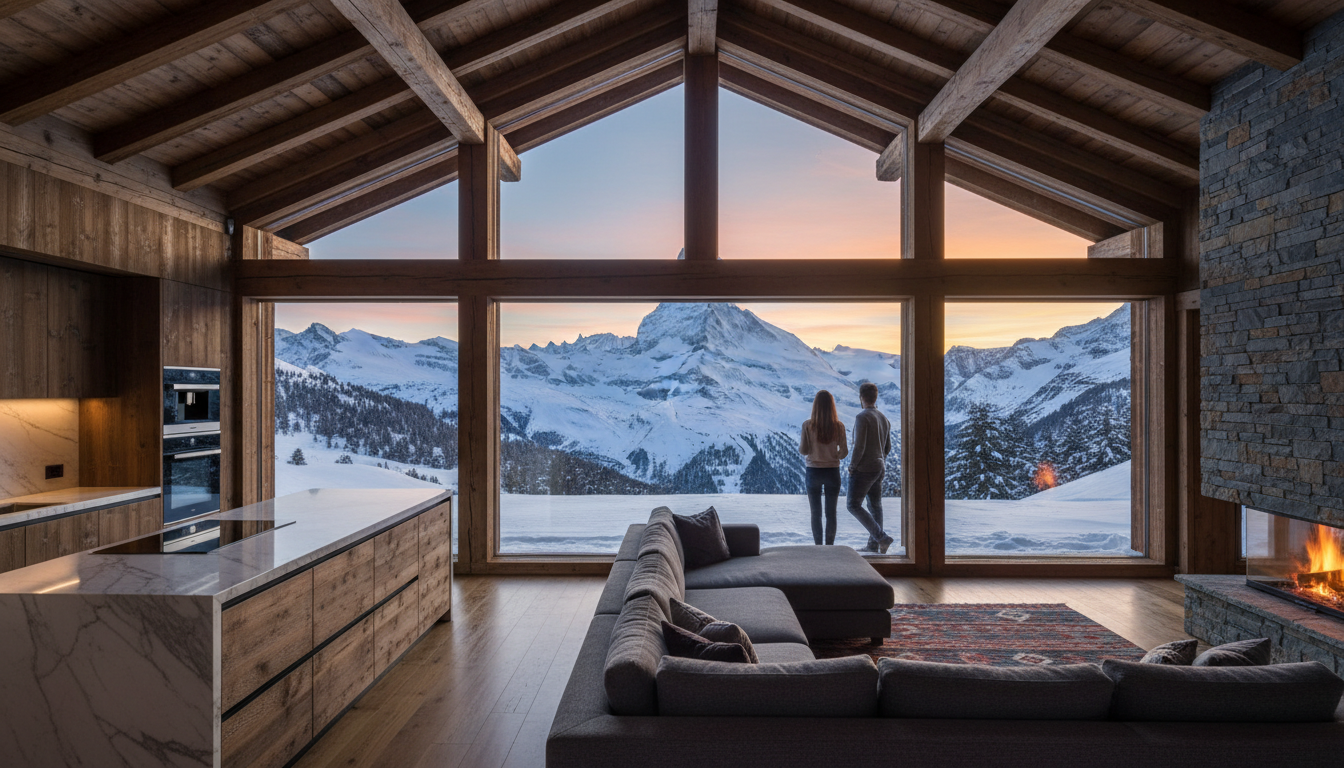 Expansive wooden chalet living room with vaulted ceiling and exposed beams, large sectional sofa fac
What to Actually Look for in a Listing
After three Zermatt swaps and probably fifty listing reviews, I've developed a mental checklist for work-suitable properties.
Internet Specifications
Don't trust "fast WiFi" as a description. Ask specifically: What's the provider? What speed tier? Is it fiber or DSL?
Swisscom fiber is the gold standard in Zermatt. If a host mentions Swisscom with speeds of 100 Mbps or higher, you're set. Some older buildings still have DSL connections that max out around 20-30 Mbps—usable for email and basic video calls, but rough for screen sharing or uploading large files.
I always ask hosts if they'd be willing to run a speed test and share the results. Most are happy to do it. If someone gets defensive about this request? Yellow flag.
Workspace Setup
Look for specific mentions of dedicated desk or office area, ergonomic chair (or at least a proper dining chair, not just a sofa), good lighting near the work area, and proximity to windows—natural light matters for video calls and your mental health.
If a listing shows only living room photos with big squishy couches, message the host directly. Ask: "Where would you recommend I set up for remote work?" Their answer tells you a lot.
Heating and Comfort
Zermatt gets cold. Like, properly cold. Temperatures regularly drop to -10°C (14°F) in January and February. You need to know if the heating is central or room-by-room, how quickly the space warms up, and whether there are drafts near windows.
I once stayed in a gorgeous chalet with original 1960s windows. Beautiful aesthetically, terrible for heat retention. I worked wearing two sweaters and fingerless gloves. Not ideal.
Newer renovations and modern apartments typically have better insulation. If the listing mentions "recently renovated" or "new windows," that's a plus.
Kitchen Functionality
You might think this doesn't matter for work, but hear me out. If you're doing long days of remote work, you need to eat. And eating out for every meal in Zermatt gets expensive fast—we're talking 25-40 CHF ($28-45 USD) for a basic lunch.
A functional kitchen with a proper stove, oven, and refrigerator means you can meal prep on weekends and focus on work during the week. Look for listings that show the kitchen clearly and mention things like a dishwasher (huge time saver) and a coffee machine (non-negotiable for me).
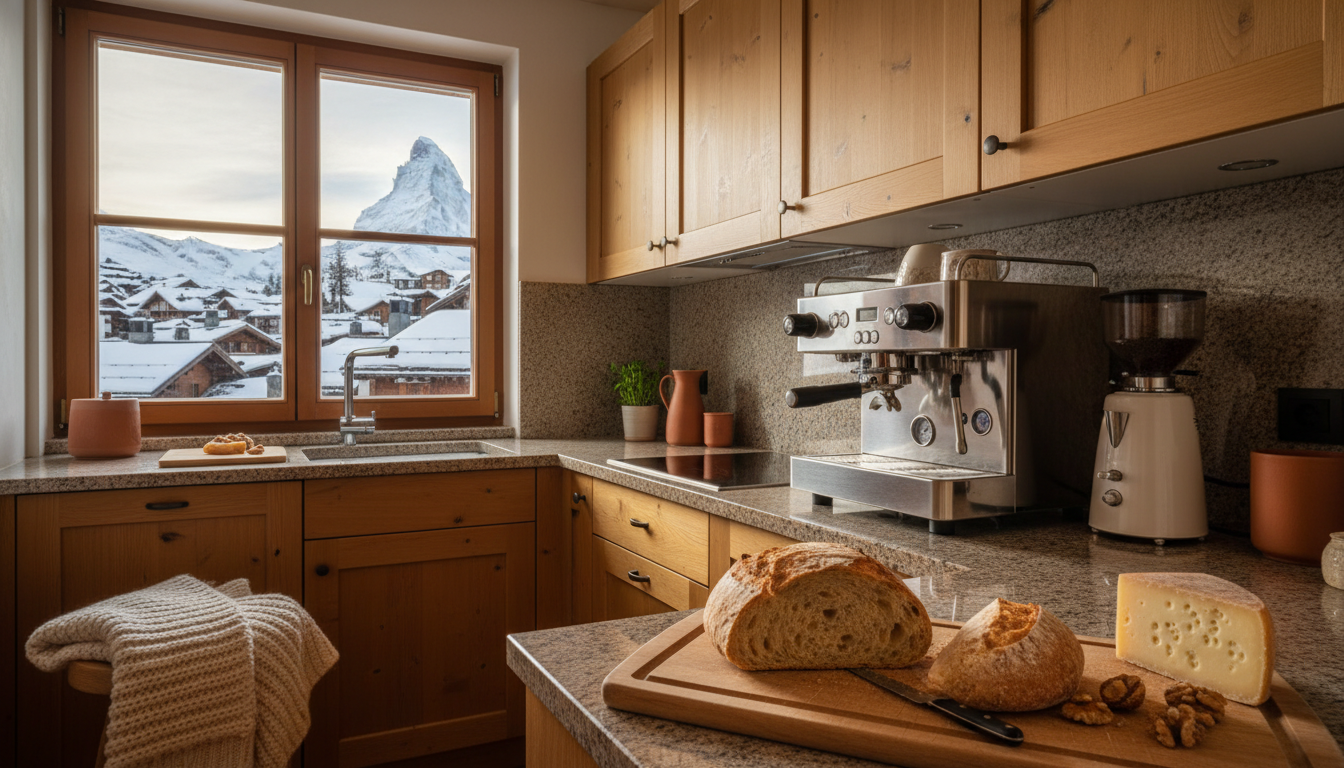 Compact but well-equipped modern kitchen in a Swiss chalet, wooden cabinets, professional espresso m
Finding Zermatt Home Swaps on SwappaHome
Real talk: Zermatt isn't the easiest destination for home exchange. It's a relatively small town (permanent population around 5,700) and many properties are vacation rentals rather than primary residences. But home swaps absolutely exist here, and they're worth pursuing.
Search broader than just "Zermatt." Try "Valais" or "Swiss Alps" as your location filter. Some hosts list their properties under the canton name rather than the specific village. You might also find great options in nearby Täsch (5 minutes by train) where locals who work in Zermatt actually live.
Filter for "suitable for remote work" if that option exists, or search listing descriptions for keywords like "WiFi," "desk," "office," or "workspace."
Look at host profiles carefully. Working professionals tend to swap with other working professionals. If a host's profile mentions their own remote work experience or business travel, they're more likely to understand what you need.
Be flexible on dates. The best Zermatt listings get snapped up quickly for peak ski season (December-March) and summer hiking season (July-August). Shoulder seasons—late April, May, October, November—offer better availability and often better work conditions (fewer tourists, quieter streets).
SwappaHome's credit system works beautifully for Zermatt swaps. You earn 1 credit per night when you host someone at your place, and you spend 1 credit per night when you stay somewhere else. A two-week Zermatt stay costs 14 credits—which you could earn by hosting guests at your home for 14 nights total, spread out however works for you.
New members start with 7 free credits, so you could theoretically do a 10-night Zermatt working trip right off the bat. Not a bad way to test the waters.
Work-Life Balance (The Part Where I Get Preachy)
The whole point of doing a home swap in Zermatt as a working professional is to have a better quality of life while working—not to work constantly in a prettier location.
I've made mistakes here. My first Zermatt swap, I barely left the chalet. I told myself I'd ski "tomorrow" for eight days straight. Don't be me.
Set Hard Boundaries
Before you arrive, decide: What are your work hours? What are your non-negotiable off times?
For me, that meant mornings were sacred. I'd wake up at 7, have breakfast, and be on the slopes by 8:30. First lifts, fresh corduroy, maybe two hours of skiing before the crowds arrived. Then back to the chalet by 11, shower, lunch, and work from noon until 8 PM.
Your schedule will look different based on your team's time zones and your own rhythms. The point is to have a schedule at all.
Use the Environment
Zermatt offers things you can't get at home. Use them.
Morning ski sessions before work (lifts open at 8:30 AM). Lunch walks along the river trail—30 minutes, clears your head. Afternoon coffee breaks at Café du Pont with Matterhorn views. Evening fondue at Chez Vrony after a hard work day (take the gondola up, ski down by headlamp—yes, this is a thing).
The Gornergrat Railway offers sunset viewing trips that return by 6 PM. Perfect for a mid-week mental reset.
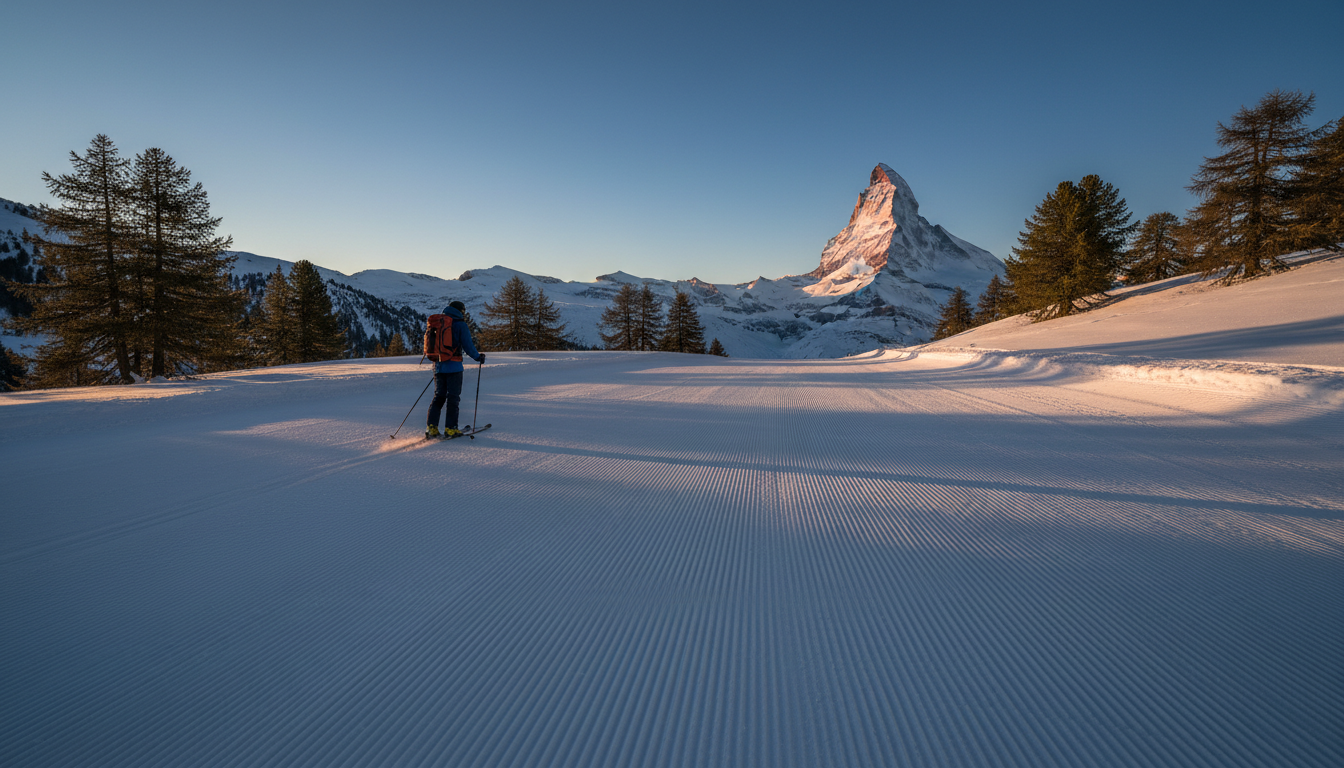 Solo skier on empty groomed run in early morning light, long shadows stretching across pristine snow
Build in Buffer Days
If you're doing a two-week swap, don't schedule calls for your first and last days. Use day one to settle in, figure out the WiFi situation, locate the grocery store, and adjust to the altitude. Use the last day to pack, clean, and decompress before travel.
I'd also recommend keeping at least one midweek day lighter on meetings if possible. That's your powder day, your adventure day, your "I need to remember why I'm here" day.
Practical Tips (The Stuff I Wish I'd Known)
Backup internet matters. Buy a Swiss SIM card with data (Swisscom or Salt) as soon as you arrive. The train station has shops that sell them. If your home WiFi dies during an important call, you can hotspot from your phone. I've done this twice. It saved me twice.
Coworking exists—sort of. There's no dedicated coworking space in Zermatt, but several hotels have lobby areas with WiFi where you can work if you buy a coffee. The Monte Rosa Hotel and Hotel Schweizerhof both have quiet corners that work in a pinch.
Grocery shopping logistics. The Coop in the village center closes at 6:30 PM on weekdays and 5 PM on Saturdays. Closed Sundays. Plan accordingly. The Migros at the train station has slightly longer hours.
Electricity adapters. Switzerland uses Type J plugs, which are slightly different from standard European plugs. Bring a Swiss-specific adapter or a universal one. Most home swap hosts provide adapters, but don't assume.
Altitude affects sleep. You might sleep poorly your first few nights. This is normal. It gets better. Don't schedule anything critical for your first morning.
The train to Täsch. If you need to pick up packages or access services not available in car-free Zermatt, the train to Täsch takes 12 minutes and runs frequently. There's a large parking structure there with package lockers.
The Money Part
I know why you're really here.
A decent hotel room in Zermatt during ski season runs 300-500 CHF ($340-570 USD) per night. A proper apartment rental with workspace amenities? 400-700 CHF ($455-800 USD) per night through traditional booking platforms.
For a two-week working trip, you're looking at 4,200-7,000 CHF ($4,760-7,980 USD) for a hotel, or 5,600-9,800 CHF ($6,370-11,160 USD) for an apartment rental. With a home swap? Zero CHF in accommodation costs.
Yes, zero. Through SwappaHome's credit system, your accommodation cost is essentially the value of hosting guests at your own home—which you might be doing anyway.
You'll still spend money in Zermatt, of course. Budget roughly 200-300 CHF ($230-340 USD) per week for groceries, 400-500 CHF ($455-570 USD) per week for a full ski pass, 50-100 CHF ($57-114 USD) per meal if you dine out occasionally, and 100-150 CHF ($114-170 USD) round trip for the train from Zurich or Geneva.
But eliminating accommodation costs changes the entire equation. Suddenly a two-week Zermatt working trip becomes financially comparable to staying home—except you're staring at the Matterhorn instead of your neighbor's fence.
What to Expect from Your Host
SwappaHome members in Zermatt tend to be a specific type: often Swiss professionals who travel frequently for work themselves, or expats who've settled in the Alps and understand the remote work lifestyle.
Most hosts I've communicated with have been incredibly detailed in their pre-arrival information. Expect to receive WiFi credentials, heating system instructions (Swiss homes often have complex controls), local recommendations, emergency contacts, and quirks about the property ("the bathroom door sticks," "the oven runs hot").
Communicate your needs clearly upfront. Tell your host you're planning to work remotely. Ask about the workspace situation. Inquire about any noise issues—construction nearby? Noisy neighbors? Church bells at 6 AM?
The review system on SwappaHome helps build accountability. Both you and your host review each other after the stay, which encourages everyone to be respectful and communicative. In my experience, home swap hosts are often more attentive than rental property managers because their own reputation is on the line.
One thing to remember: you're staying in someone's actual home. Treat it accordingly. Leave it cleaner than you found it. Don't rearrange furniture. Be mindful of noise. These courtesies matter in the home exchange community.
Best Times of Year
This depends on what you want from your trip.
December-February: Peak ski season. Best snow conditions, most crowded, highest demand for home swaps. Book 4-6 months ahead. Shorter daylight hours (sunset around 5 PM) actually work well for US time zone schedules.
March-April: Late season skiing with longer days. Snow still good at higher elevations. Fewer crowds. Secretly the best time for working professionals—great skiing AND better swap availability.
May-June: Shoulder season. Many lifts closed, town is quiet. Some restaurants close. But if you're primarily working and just want occasional walks, this can be peaceful. Lowest home swap competition.
July-August: Summer hiking season. Different vibe entirely—wildflowers, mountain biking, outdoor dining. Temperatures pleasant (15-25°C / 59-77°F). Good for people who don't ski but want alpine scenery.
September-October: Autumn shoulder season. Crowds thin, fall colors appear, some hiking trails remain open. Another excellent window for working professionals.
November: Basically dead. Most things closed, waiting for ski season. I wouldn't recommend this unless you're specifically seeking isolation.
For first-timers, I'd suggest late March or early September. You get the benefits of the destination without the peak season chaos.
The Real Secret
I want to leave you with something I learned the hard way.
The first time I worked remotely from Zermatt, I treated it like a regular work week that happened to have mountains outside. I sat at my laptop, cranked through tasks, and felt vaguely guilty every time I looked out the window at the peaks I wasn't exploring.
By my third swap, I'd figured it out: integration, not separation.
The mountains aren't a distraction from your work. They're fuel for it. That morning ski session clears your head for the afternoon's strategic thinking. That sunset walk along the river helps you process the difficult conversation you had with your manager. That fondue dinner with the locals you met at the lift line reminds you why you do what you do—to live a life that includes experiences like this.
Zermatt home swaps for working professionals aren't about escaping work. They're about expanding what work can look like. Proving to yourself that productivity doesn't require a gray cubicle. Discovering that your best ideas might come while riding a gondola at 3,000 meters.
If you're considering your first work-focused home swap in Zermatt, stop considering. Start planning. Check SwappaHome for available listings, reach out to hosts, be clear about your needs, and book something.
The Matterhorn will still be there when you look up from your laptop. And trust me—that never gets old.
Frequently Asked Questions
Is home swapping in Zermatt safe for working professionals?
Home swapping in Zermatt is generally very safe. SwappaHome's verification system and review ratings help establish trust between members. The Zermatt community is small and tight-knit, which adds another layer of accountability. I'd recommend getting your own travel and home insurance for additional peace of mind, but in four years of swapping, I've never had a safety issue in Switzerland.
How much can I save with a home swap in Zermatt compared to hotels?
A two-week home swap in Zermatt can save you $4,500-8,000 USD compared to hotel accommodation during ski season. Traditional apartment rentals cost $6,000-11,000 USD for the same period. With SwappaHome's credit system, your accommodation is essentially free—you just exchange hosting at your own home for staying in Zermatt.
What internet speed should I expect in Zermatt home swaps?
Most Zermatt properties with Swisscom fiber connections offer 80-150 Mbps download speeds, which is excellent for video calls, screen sharing, and remote work. Always ask hosts about their specific internet provider and speed before booking. Some older buildings may have slower DSL connections around 20-30 Mbps.
When is the best time for a working professional home swap in Zermatt?
Late March and early September offer the best balance for working professionals. You get good conditions (late-season skiing or early autumn hiking) with fewer crowds and better home swap availability. Peak ski season (December-February) has the best snow but requires booking 4-6 months in advance.
Do I need special equipment for remote work in Zermatt?
Bring a Swiss Type J electrical adapter, a portable laptop stand if you're particular about ergonomics, and purchase a Swiss SIM card with data upon arrival for backup internet. Most home swap hosts provide basic office supplies, but confirm workspace availability before booking. Good headphones are essential for calls in any shared or echoey space.

Published by
SwappaHome
SwappaHome Editorial Team
Home Exchange & Slow Travel Editorial
The SwappaHome Editorial Team brings together travel research, home-exchange community insights, and platform data to produce practical guides for first-time and experienced home swappers. Every article cites real platforms, current market rates, and verifiable city-level facts so readers can make informed decisions without guessing.
Ready to try home swapping?
Join SwappaHome and start traveling by exchanging homes. Get 7 free credits when you sign up!
Related articles

Home Swap in Rome: Where to Find the Best Properties for Your Italian Exchange
Discover where to find the best home swap properties in Rome—from Trastevere's cobblestone charm to Testaccio's local authenticity. Real neighborhoods, real advice.

Home Swap in Bangkok: Where to Find the Best Properties for Free Stays
Discover where to find the best home swap properties in Bangkok—from riverside condos in Charoen Krung to family homes in Ari. Real neighborhoods, real savings.

Home Swap for Beach Lovers: 12 Coastal Destinations Ranked for 2026
Discover the best coastal destinations for home swapping in 2026. From Portugal's Algarve to Australia's Gold Coast, find your perfect beach exchange.