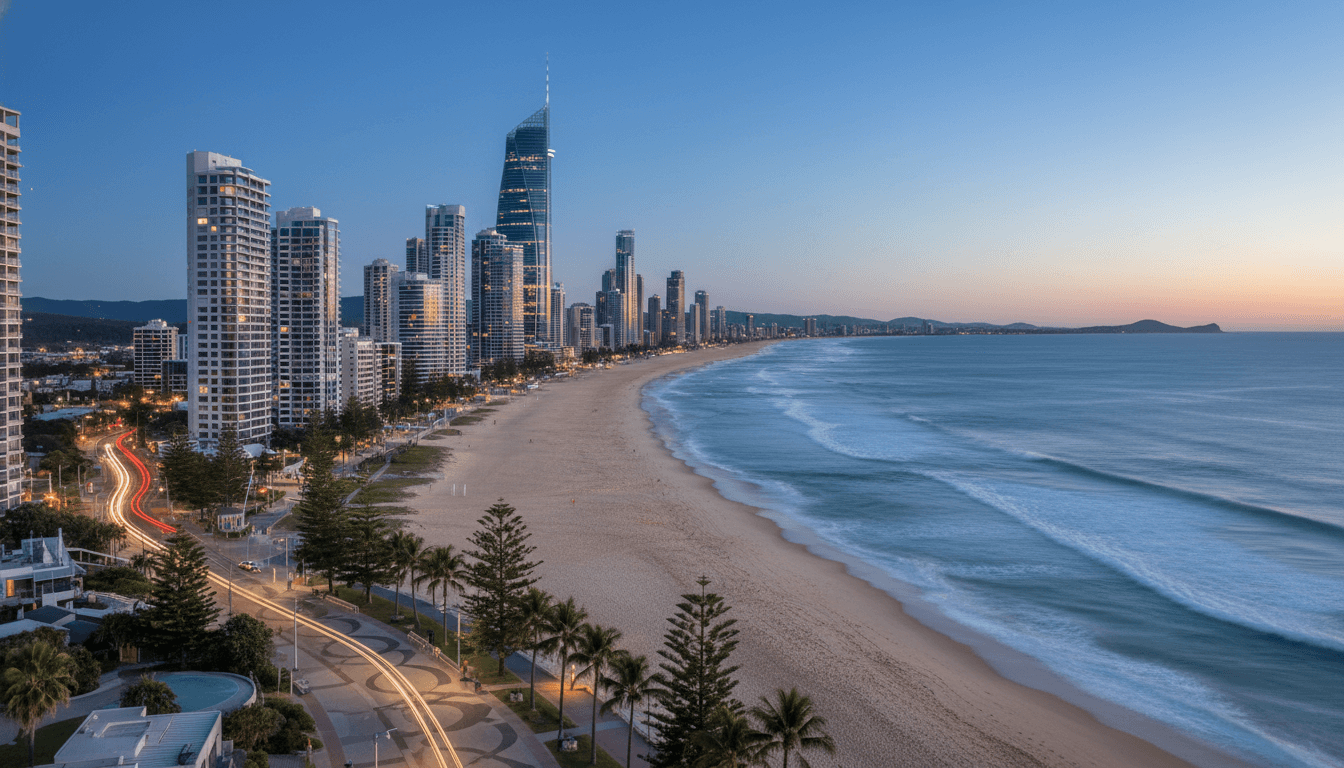
Long-Term Home Exchange in Gold Coast: The Complete Remote Worker's Guide to Living Like a Local
Maya Chen
Travel Writer & Home Exchange Expert
Discover how long-term home exchange in Gold Coast lets remote workers live beachside for months without hotel costs. Real tips from 3 months working poolside.
I looked at the surf forecast before I checked my email that morning. That's when I knew Gold Coast had gotten to me.
Three months into my long-term home exchange, I'd stopped counting days entirely. The barista at my local café had stopped asking my order weeks ago. I knew exactly which break worked with which swell direction, which café had the best flat white, which sunset spot would be crowded versus blissfully empty.
I'd come to Australia's Gold Coast expecting a working holiday—a few months of laptop-on-balcony productivity with some beach time mixed in. What I got was something else entirely. A complete reimagining of what remote work could actually look like.
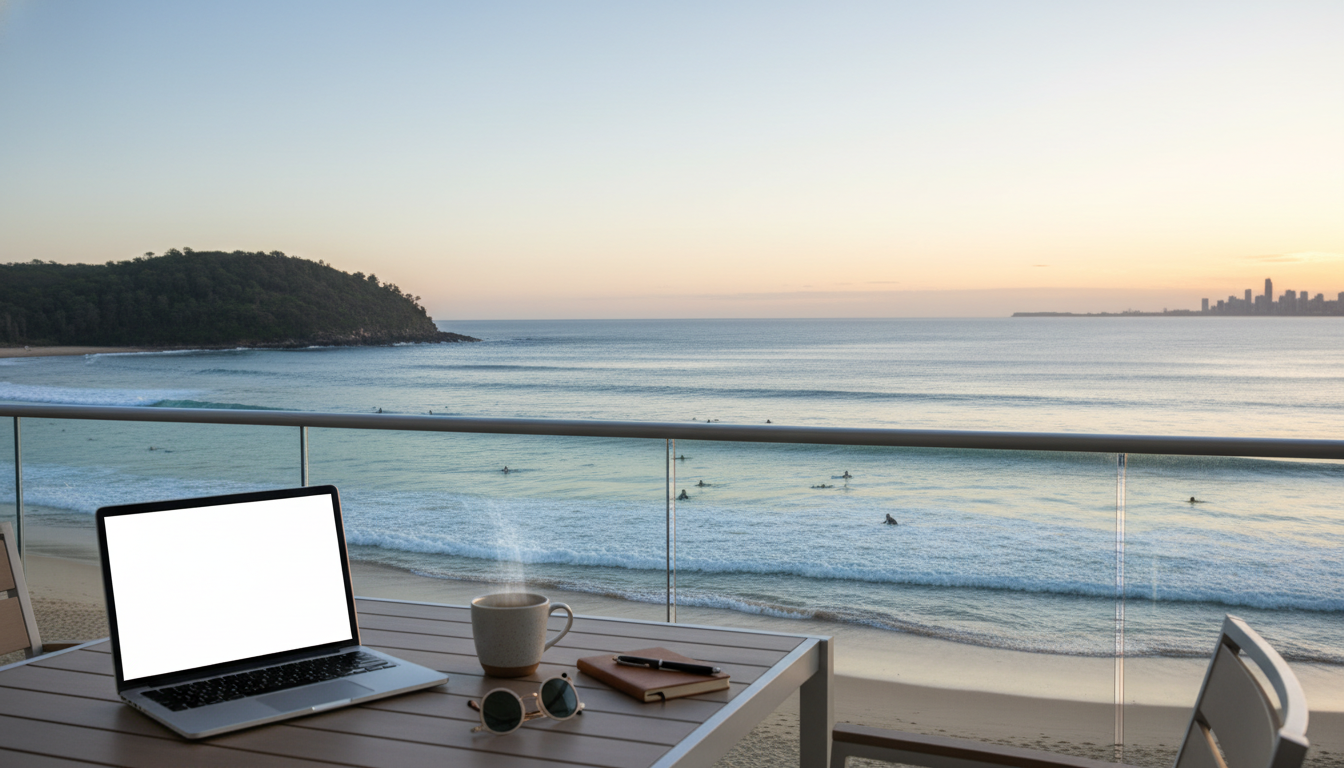 sunrise view from a Burleigh Heads apartment balcony with laptop open on outdoor table, coffee steam
Here's the thing about long-term home exchange in Gold Coast that nobody tells you: it's not just cheaper than hotels or Airbnbs (though it absolutely is—we're talking $0 accommodation versus $150-200 AUD per night). It's that staying in someone's actual home, in an actual neighborhood, for an actual stretch of time transforms you from tourist to temporary local.
And for remote workers? That transformation is everything.
Why Gold Coast Works So Well for Extended Stays
I've done the digital nomad circuit. Lisbon. Bali. Mexico City. The usual suspects. Gold Coast surprised me—and honestly, it shouldn't have, but it did.
The timezone situation is weirdly perfect. Collaborating with US teams means evening calls (morning their time), which frees your entire day. European teams? Early morning syncs, then beach by 9 AM. I found myself more productive here than anywhere else I've worked remotely. Partly because the lifestyle practically forces you into a healthy routine. Hard to stay up doom-scrolling when you know the sunrise is worth waking for.
Then there's the infrastructure. Australia's NBN internet isn't flawless, but in Gold Coast's urban areas, you're typically getting 50-100 Mbps. The home I exchanged into in Mermaid Beach had faster WiFi than my San Francisco apartment. Go figure.
But the real magic? Seventy kilometers of coastline means you're never more than ten minutes from sand. After a frustrating call, I'd walk to the beach, watch the waves for fifteen minutes, come back reset. Try doing that from a WeWork.
Finding Your Gold Coast Neighborhood
Not all suburbs here are created equal—especially for remote workers planning an extended stay. After exploring most of them (perks of having a car and too much curiosity), here's my honest breakdown.
Burleigh Heads: The Sweet Spot
If I had to pick one neighborhood for long-term home exchange in Gold Coast, it's Burleigh. Full stop.
The vibe is village-meets-surf-town. James Street has enough cafés and restaurants to keep you entertained without feeling overwhelming. The headland walk is genuinely spectacular—I did it three times a week as my "commute" reset. And the surf community creates this instant social fabric that's rare for solo remote workers.
Co-working options exist, though I mostly rotated between Commune (around $35 AUD/day for a hot desk) and various cafés that don't mind you camping for a few hours. The Borough on James Street has good WiFi and doesn't give you the stink-eye for nursing a single flat white through a two-hour work session.
Expect homes here to be in high demand on SwappaHome. I'd recommend reaching out to hosts 2-3 months in advance if you're planning a long-term exchange.
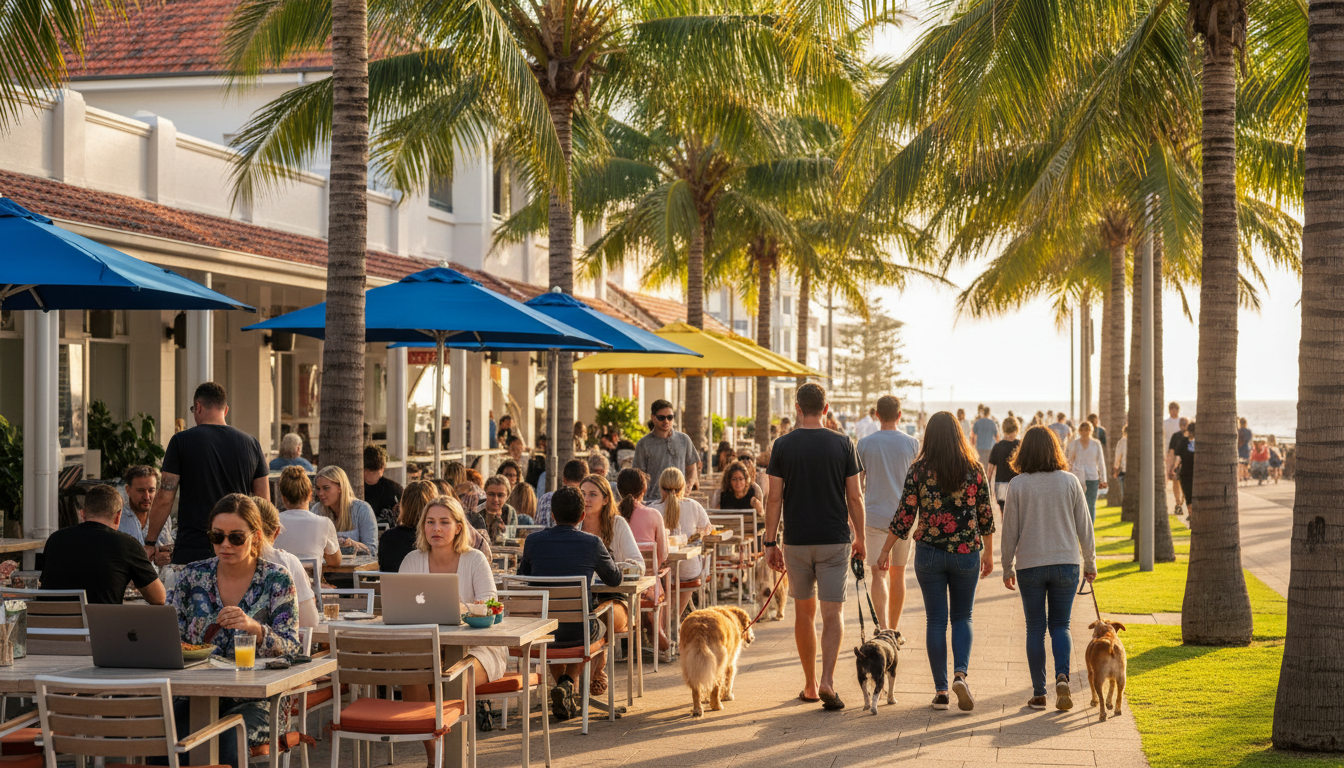 James Street Burleigh Heads on a Saturday morning, locals walking dogs, outdoor caf seating filled w
Mermaid Beach: The Underrated Gem
This is where I actually stayed. I'm almost hesitant to share it because it's so under-the-radar.
Mermaid Beach is residential in the best way. Pacific Fair shopping center is a 5-minute drive (or 15-minute bike ride), giving you access to literally everything you need. But your daily reality is quiet streets, local parks, and a beach that's somehow less crowded than Burleigh despite being equally gorgeous.
The homes here tend to be larger—lots of families live in Mermaid Beach, which means the houses on SwappaHome often have proper home offices, multiple bedrooms (great if your partner or a friend joins for part of your stay), and backyards. The couple I exchanged with had a pool. A pool. I took calls floating on a pool noodle more than once.
Downside: you'll want a car or at least a good bike. It's not as walkable as Burleigh.
Coolangatta: The Budget-Friendly Border Town
Right on the Queensland-New South Wales border, Coolangatta has a different energy. More laid-back, slightly cheaper, and excellent surf (Snapper Rocks is here, which has hosted world championship events).
For remote workers, the appeal is affordability and space. Homes here tend to be larger for the same "credit cost" on SwappaHome—remember, it's always 1 credit per night regardless of the property, so you might as well aim for something spacious.
The Gold Coast Airport is literally in Coolangatta, which is convenient if you're planning weekend trips to Sydney or Melbourne.
Caveat: it's about 30 minutes from the main Gold Coast action. If you want to be in the thick of things, this might feel too quiet. But if you're heads-down on a big project? Perfect.
Broadbeach: The Compromise
Broadbeach sits between Surfers Paradise (avoid for long-term stays—too touristy, too loud) and the southern beaches. It has the convenience of high-rise living with better vibes than Surfers.
The Star Casino area has surprisingly good restaurants. Pacific Fair is walking distance. The light rail runs through here, connecting you to the rest of Gold Coast without a car.
I'd recommend Broadbeach for remote workers who want apartment living with amenities—gyms, pools, concierge. The homes available for exchange here are often modern apartments rather than houses.
Planning Your Long-Term Exchange
Here's where I get practical, because planning a multi-month home exchange requires more strategy than a quick weekend swap.
Start Early—Really Early
For stays of 4+ weeks in Gold Coast, begin your search on SwappaHome at least 3 months ahead. Australian hosts are generally excellent planners, and the good properties get booked.
When I arranged my Gold Coast exchange, I messaged five potential hosts in January for an April-June stay. Three responded within a week, one wasn't available, and one became my eventual host. Give yourself options.
Craft a Compelling Request
Your initial message matters more for long-term exchanges. Hosts are essentially trusting you with their home for months, not days.
What worked for me: I explained exactly why I wanted Gold Coast (genuine interest in surf culture, not just "nice beaches"), shared my remote work schedule (so they knew I'd be home a lot, keeping an eye on things), and offered references from previous long-term exchanges.
I also mentioned that I'd be happy to handle small tasks—watering plants, collecting mail, even meeting their cleaner if they had one scheduled. Long-term exchanges are partnerships.
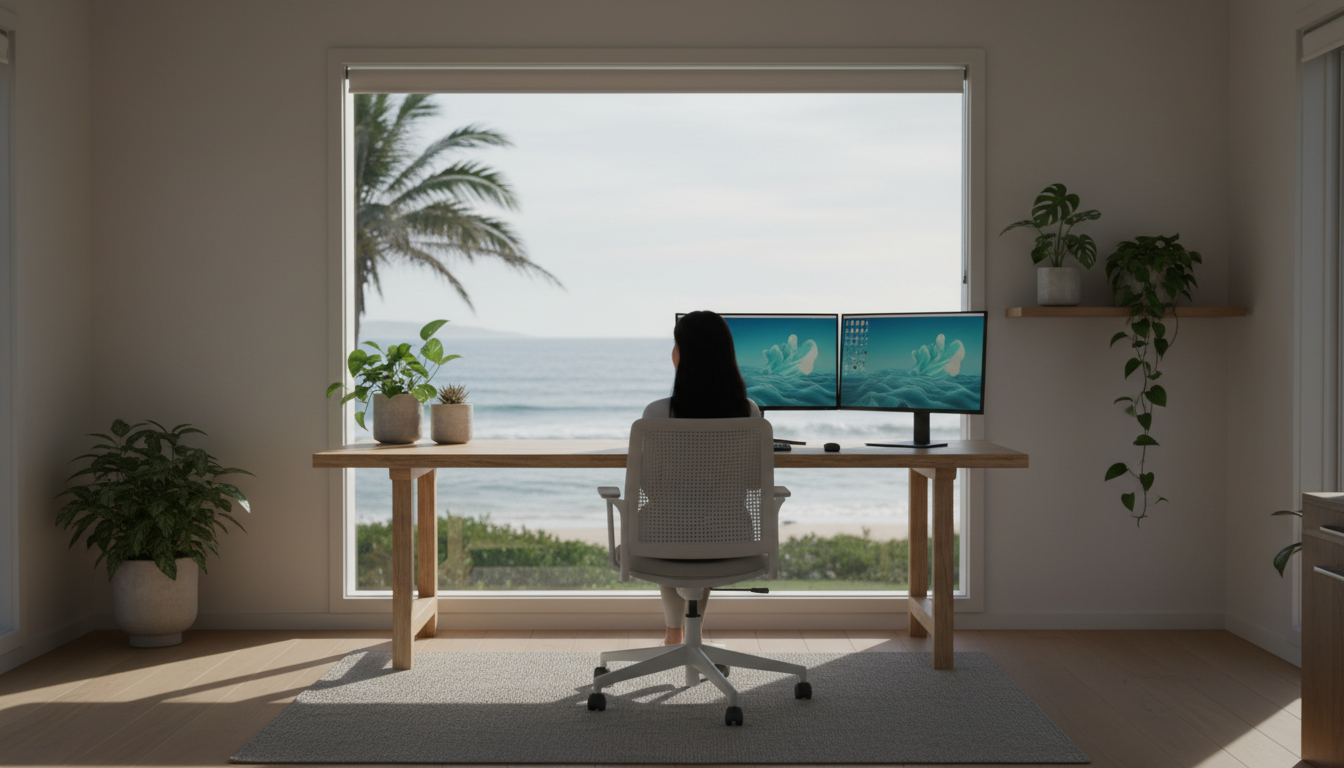 cozy home office setup in an Australian beach house, desk facing window with ocean glimpse, indoor p
The Details That Matter
For a long-term home exchange in Gold Coast, you'll want clarity on a few things before confirming.
Utilities—who pays for electricity, water, internet? In my exchange, we agreed to split any bills over the host's typical monthly average. Ended up being about $180 AUD extra for my entire three-month stay. Negligible.
Car access is huge. Some Gold Coast hosts include their car in the exchange. If it's available, discuss insurance, fuel arrangements, and any restrictions. My hosts left their second car, a beat-up but beloved Subaru Forester. Game-changer for weekend hinterland drives.
Guests—can you have visitors? For how long? I had a friend visit for two weeks in month two. I'd cleared this with my hosts beforehand. No surprises.
Cleaning expectations—professional clean, or just tidy? Sort this out early to avoid awkward conversations later.
The Credit Math
SwappaHome's system is beautifully simple: 1 credit = 1 night, always. No premium for beachfront properties, no discount for inland suburbs.
For a 90-night stay in Gold Coast, you'd spend 90 credits. If you're new to SwappaHome, you start with 10 free credits, meaning you'd need to host guests at your own place (or have hosted previously) to bank the rest.
The strategy I used: I listed my San Francisco apartment aggressively before my trip, hosting multiple short-term guests over several months. By the time I left for Australia, I had 95 credits banked. More than enough.
Real talk: if you don't have a desirable home to offer, long-term exchanges are harder to swing. Gold Coast hosts want to use their credits too, and they're more likely to accept requests from members with appealing properties in interesting locations.
Building Your Remote Work Routine
The first week of any long-term stay is about finding your rhythm. Here's what worked for me.
The Morning Ritual
I'm not a morning person by nature. Gold Coast converted me.
The sunrise over the Pacific is genuinely spectacular, and catching it becomes addictive. My routine: wake at 5:45 AM, walk to the beach (seven minutes from my Mermaid Beach home), watch the sunrise while the surfers paddle out, back home by 6:30 AM for coffee and focused work until 10 AM.
Those early morning hours—before Slack notifications, before emails, before the world wakes up—became my most productive time. I wrote more in those quiet hours than I typically do in entire days back home.
Finding Your Work Spots
Working from your exchange home is great, but variety helps. Here are the spots I rotated through:
For deep focus, the State Library in Southport—free, quiet, excellent WiFi, about 20 minutes north of Burleigh. I'd go here for full-day writing sessions.
For casual work, Paddock Bakery in Miami (yes, there's a Miami in Gold Coast). Excellent pastries, good coffee, relaxed about laptops. The courtyard is lovely.
For calls, home. Always. Australian café acoustics are not conducive to Zoom calls. Trust me on this.
For a change of scenery, HOTA (Home of the Arts) in Bundall has a beautiful gallery and outdoor spaces. I'd take my laptop there occasionally just to think differently.
 interior of Paddock Bakery Miami Gold Coast, rustic wooden tables, industrial lighting, person worki
Managing Time Zones
Gold Coast is GMT+10 (or GMT+11 during daylight saving, October to April). Here's how that translates:
US Pacific (San Francisco, LA)—Gold Coast is 17-18 hours ahead. A 9 AM call in SF is 2-3 AM in Gold Coast. Not ideal. I pushed most US calls to their late afternoon (my early morning).
US Eastern (New York)—14-15 hours ahead. A 5 PM call in NYC is 7-8 AM in Gold Coast. Manageable.
UK/Europe—9-10 hours ahead. A 9 AM London call is 6-7 PM in Gold Coast. Actually perfect—you get your whole day, then end with calls.
Asia—only 1-3 hours difference depending on the country. Seamless.
I blocked my calendar for "no meetings before 6 PM Gold Coast time" and communicated this clearly to my team. Most people respected it.
The Real Costs
Let's talk money, because this is where home exchange really shines.
Accommodation: $0
This is the headline. Three months in Gold Coast, zero accommodation costs. If I'd done this via Airbnb, I'd be looking at $12,000-15,000 USD minimum for a comparable property. Hotels? Don't even want to calculate it.
The only "cost" is the credits spent on SwappaHome, but since I earned those by hosting guests in my own home (which I'd be leaving empty anyway), it's essentially free.
Food and Dining
Gold Coast isn't cheap, but it's not Sydney or Melbourne expensive either.
Groceries run $100-150 AUD per week for one person eating well. Coles and Woolworths are everywhere. For better produce, hit the Carrara Markets on weekends.
Coffee is $4.50-5.50 AUD for a flat white. You'll drink a lot of these. Budget $100-150 AUD monthly if you're a daily café person.
Dining out—a good dinner runs $30-50 AUD per person. Lunch spots are cheaper, $15-25 AUD. I ate out 2-3 times per week and spent around $400 AUD monthly.
Alcohol is expensive in Australia. A six-pack of craft beer is $20-25 AUD. Wine is reasonable if you buy Australian ($15-20 AUD for something decent). Budget accordingly.
My total food spend: roughly $800-900 AUD per month ($520-580 USD at current rates).
Transportation
If your home exchange includes car access, you're golden. Petrol runs about $1.80-2.20 AUD per liter. I spent maybe $150 AUD monthly on fuel.
Without a car, the G:link light rail covers the coastal strip reasonably well. A monthly pass is around $150 AUD. Uber exists but adds up quickly.
Bikes are viable for daily errands. Gold Coast has decent cycling infrastructure, and the weather cooperates most of the year.
The Bottom Line
My three-month Gold Coast cost breakdown:
- Accommodation: $0 (home exchange)
- Food: $2,500 AUD (~$1,650 USD)
- Transport: $450 AUD (~$300 USD)
- Entertainment/misc: $600 AUD (~$400 USD)
- Flights from US: $1,200 USD (booked 4 months ahead)
Total for 3 months: approximately $3,550 USD
Compare that to the $12,000+ I'd have spent on Airbnb alone. Home exchange isn't just convenient—it's financially transformative for long-term stays.
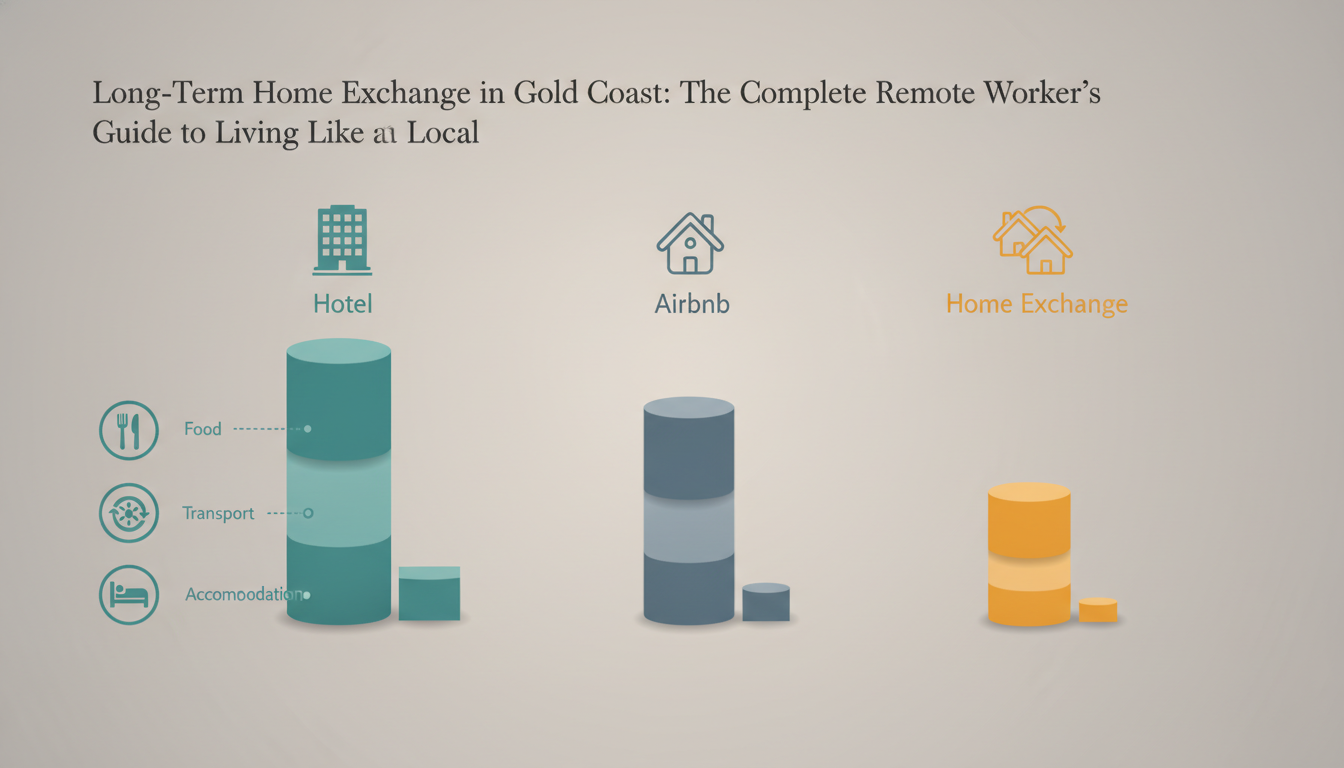 infographic showing cost comparison between 3-month Gold Coast stay via hotel 18,000, Airbnb 12,000,
The Hard Parts (Because There Are Hard Parts)
I'd be lying if I said everything was perfect.
The Homesickness Curve
Around week 6, I hit a wall. The novelty had worn off, I missed my friends, and the time zone difference made spontaneous calls impossible. This is normal.
What helped: scheduling regular video calls with people back home (even if it meant early mornings), joining local activities (I took a surf lesson, badly), and reminding myself that this discomfort was temporary.
By week 8, I'd pushed through. The remaining month was the best part of the trip.
Living in Someone Else's Space
Three months in someone's home means constant small considerations. Where do they keep things? Is it okay to rearrange the living room for better Zoom lighting? Can I use that fancy olive oil?
I over-communicated with my hosts. Sent photos when I moved furniture (and moved it back before leaving). Asked before using anything that seemed special. Treated their home better than I treat my own, frankly.
When Things Break
The dishwasher died in month two. Not my fault—it was old—but suddenly I'm dealing with Australian appliance repair from someone else's home.
I messaged my hosts immediately, sent photos, and asked how they wanted to handle it. They appreciated the transparency and arranged for their usual repair person to come. I let them in, supervised, done.
Key lesson: document everything when you arrive (I take photos of any existing damage), communicate immediately when issues arise, and never try to fix things yourself unless explicitly told to.
The Return to Reality
Leaving was harder than arriving. I'd built routines, found favorite spots, made acquaintances. Packing up felt like dismantling a life.
I gave myself two days of buffer before flying home—one day to clean and restore the house to perfection, one day to say goodbye to my spots. Rushed departures lead to forgotten items and resentful feelings.
Making It Count
Some final thoughts from someone who's done this and would do it again tomorrow.
Embrace the Slow Tourism
You're not here for a week. You don't need to cram everything in. I didn't visit the theme parks (Dreamworld, Movie World, etc.) until month two. I saved the hinterland rainforest drives for rainy days. I let Gold Coast reveal itself slowly.
The best experiences came from repetition. Going to the same beach at the same time, watching the same surfers improve over weeks, noticing how the light changed with the seasons. That's what long-term travel offers that vacations can't.
Build Micro-Communities
Remote work can be isolating. Combat this intentionally.
I joined a casual surf group (terrible surfer, but they were welcoming). I became a regular at two cafés. I chatted with neighbors. By month three, I had people to nod at, wave to, occasionally grab a beer with.
Gold Coast locals are friendly but not pushy. They'll include you if you show up consistently.
Plan Your Exit Strategy
Before you arrive, know when you're leaving and what that looks like. Book your departure flight early (cheaper, and it creates healthy pressure). Arrange your final cleaning. Set expectations with your hosts about handover.
I scheduled a video call with my hosts for my last week to walk through the house together virtually. They could point out anything I'd missed, and we could end on good terms. We're still in touch—they're planning to use their credits to visit San Francisco next year.
Why This Works
I've used other home exchange platforms, but SwappaHome's credit system is particularly suited for extended stays.
The simplicity matters: 1 credit = 1 night, no negotiations, no variable pricing based on season or property type. When you're planning a 90-night stay, knowing exactly what it costs (90 credits) removes so much friction.
The community aspect matters too. Long-term exchanges require trust, and SwappaHome's review system builds that trust visibly. I could see that my Gold Coast hosts had successfully completed a dozen exchanges before mine. They could see my history too. We weren't strangers—we were members of the same community.
If you're considering your first long-term home exchange in Gold Coast, start by building your SwappaHome profile thoroughly. Good photos, detailed description, clear availability. Then start browsing Gold Coast listings, message hosts who appeal to you, and begin the conversation.
The worst that happens? They say no, and you try someone else. The best that happens? You find yourself three months into an Australian adventure, wondering why you ever paid for hotels.
I'm back in San Francisco now, but my Gold Coast exchange changed how I think about travel and work. The two don't have to be separate. With the right setup—reliable internet, a comfortable home base, and the flexibility that home exchange provides—you can build a life anywhere.
Gold Coast is waiting. Your laptop works there too. And somewhere in Burleigh or Mermaid Beach or Coolangatta, there's a home with your name on it.
You just have to ask.
Frequently Asked Questions
How long can you do a home exchange in Gold Coast?
There's no set limit—it depends entirely on your agreement with the host. Most exchanges range from 2-12 weeks, though I've heard of members arranging 6-month stays. The key is clear communication and mutual agreement. On SwappaHome, you'll spend 1 credit per night regardless of duration, so a 90-night stay costs 90 credits.
Is Gold Coast good for remote workers and digital nomads?
Gold Coast is excellent for remote workers due to reliable NBN internet (typically 50-100 Mbps in urban areas), abundant café culture with laptop-friendly spaces, and time zones that work well for European and Asian collaboration. The lifestyle—beaches, outdoor activities, healthy food scene—supports the work-life balance that long-term remote workers need to avoid burnout.
How much does it cost to live in Gold Coast for 3 months?
With long-term home exchange covering accommodation, expect to spend approximately $3,000-4,000 USD total for a 3-month Gold Coast stay. This includes food ($500-600 USD/month), transportation ($100-150 USD/month), and entertainment. Without home exchange, accommodation alone would cost $12,000-18,000 USD for the same period via Airbnb or hotels.
What's the best suburb in Gold Coast for long-term stays?
Burleigh Heads is widely considered the best Gold Coast suburb for long-term home exchange, offering walkable village atmosphere, excellent cafés, surf culture, and community feel. Mermaid Beach suits those wanting quieter residential vibes with larger homes. Coolangatta works for budget-conscious remote workers who don't mind being 30 minutes from central Gold Coast.
Do you need a car for long-term living in Gold Coast?
While Gold Coast's G:link light rail covers the coastal strip, a car significantly improves quality of life for long-term stays—especially for accessing hinterland areas, Carrara Markets, and suburbs away from the tram line. Many home exchange hosts include car access in their listing. If not, budget $150-200 AUD monthly for light rail passes plus occasional rideshares.
40+
Swaps
25
Countries
7
Years
About Maya Chen
Travel Writer & Home Exchange Expert
Maya is a travel writer with over 7 years of experience in the home swapping world. Originally from Vancouver and now based in San Francisco, she has completed more than 40 home exchanges across 25 countries. Her passion for "slow" and authentic travel led her to discover that true luxury lies in living like a local, not a tourist.
Ready to try home swapping?
Join SwappaHome and start traveling by exchanging homes. Get 10 free credits when you sign up!
Related articles

Lyon Home Exchange: Your Complete Guide to France's Hidden Gem for Home Swapping
Discover why Lyon home exchange is booming among savvy travelers. From Croix-Rousse to Presqu'île, find the best neighborhoods and insider tips for your swap.

Zurich Bucket List: 47 Unforgettable Experiences to Enjoy During Your Home Swap
Discover the ultimate Zurich bucket list for home swappers—from secret swimming spots to fondue rituals locals actually do. Save thousands while living like a true Zürcher.
Dublin Home Exchange Utilities Guide: WiFi, Heating & Everything Your Guests Need
Master Dublin home exchange utilities—from dodgy WiFi fixes to heating quirks. Practical tips from 7 years of swapping homes across Ireland.