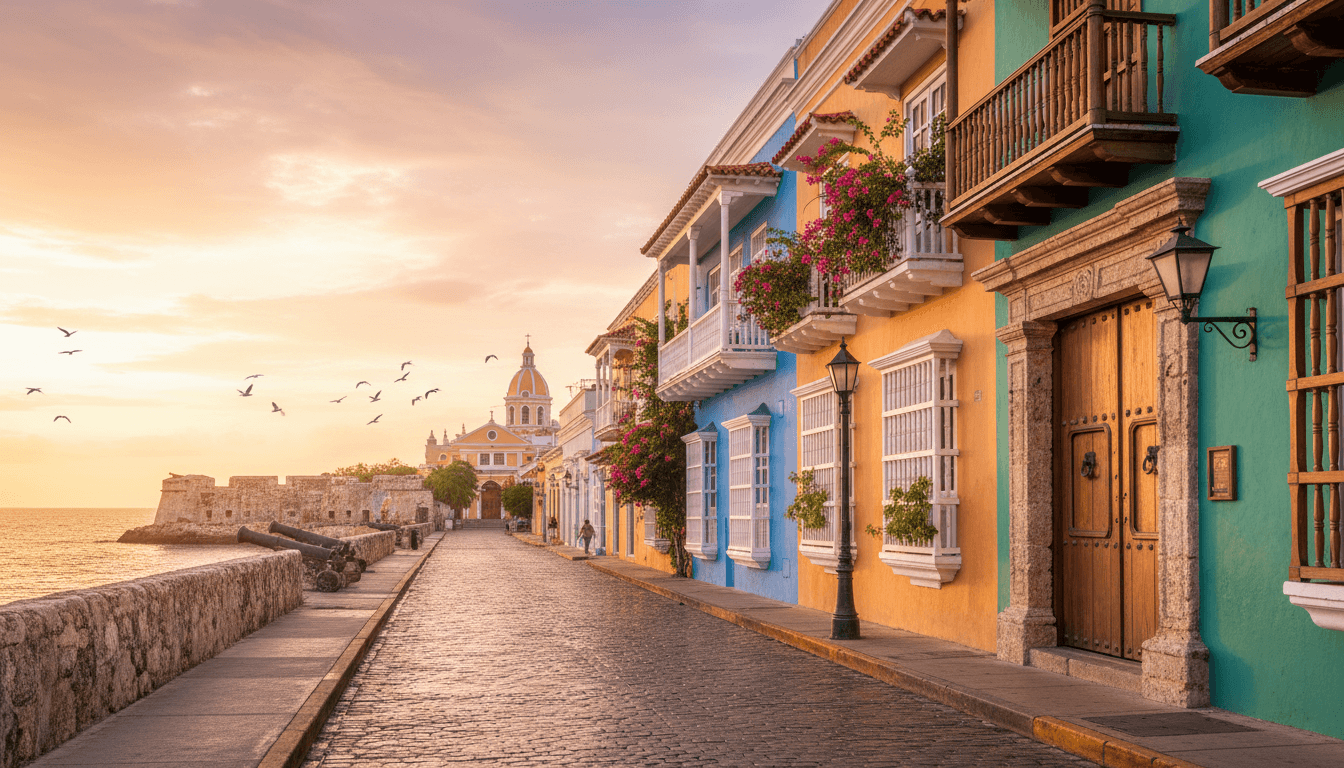
Solo Home Exchange in Cartagena: How I Made Friends and Found Community
Maya Chen
Travel Writer & Home Exchange Expert
Discover how solo home exchange in Cartagena opens doors to authentic friendships, local connections, and a community you'd never find in a hotel.
The woman at the fruit stall didn't speak much English, and my Spanish was—let's be generous—functional. But she remembered me from the day before, when I'd butchered the word for passion fruit so badly she'd laughed until she had to sit down. Now she was waving me over, holding up a mamoncillo and gesturing that I needed to try it. That's the thing about solo home exchange in Cartagena: you stop being a tourist somewhere around day three. You become the gringa who lives in that blue house on Calle del Curato, the one who always buys too many mangoes.
I'd been nervous about this trip. Solo travel is one thing—I've done plenty of it. But solo home exchange in Cartagena felt different. I'd be staying in someone's actual home, in a neighborhood where tourists rarely wandered, without the safety net of a hotel concierge or the anonymity of an Airbnb. What I didn't expect was how quickly that vulnerability would transform into connection.
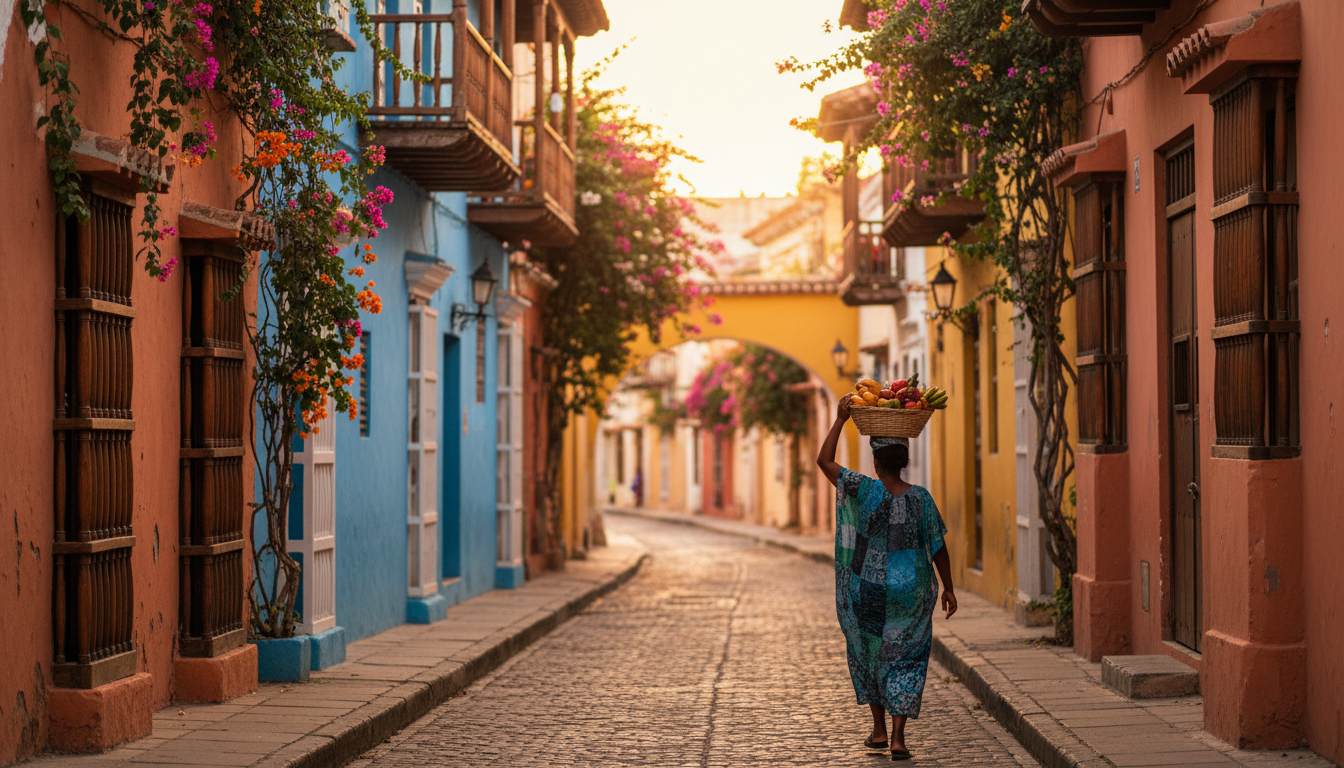 Narrow colonial street in Cartagenas Getseman neighborhood at golden hour, colorful buildings with w
Why Solo Travelers Are Choosing Home Exchange in Cartagena
Here's something I've learned after seven years of swapping homes: the experience is fundamentally different when you're alone. Not worse—different. When you're traveling with a partner or family, you have a built-in social unit. You eat dinner together, you discuss the day's adventures, you have someone to share that "did you see that?" moment with.
Solo home exchange strips that away. And what fills the void is... everything else. The neighborhood. The neighbors. The rhythm of local life that you have no choice but to join.
Cartagena amplifies this tenfold. Colombians are genuinely, almost aggressively friendly—and I don't mean the performative hospitality you sometimes encounter in tourist-heavy destinations, the kind where everyone's nice because they want your money. I mean neighbors who will invite you to their cousin's birthday party after one conversation. Shopkeepers who remember your name. The security guard at the corner who starts saving you a seat at his domino games.
The city runs on connection. Trying to stay isolated here is like trying to stay dry in a swimming pool.
Finding the Right Neighborhood for Solo Home Exchange
Not all of Cartagena offers the same experience. Where you stay matters enormously when you're traveling alone.
Getsemaní: The Sweet Spot
My swap was in Getsemaní, and I'm convinced it's the best neighborhood for solo home exchange in Cartagena. It's local enough to feel authentic but connected enough that you're never far from help if you need it.
The apartment I stayed in belonged to a Colombian-American couple who split their time between Cartagena and Miami. They'd left me a three-page document of their favorite spots—not the tourist recommendations you'd find on TripAdvisor, but the places they actually went. The pharmacy where the owner speaks English. The corner store that sells the best empanadas for 2,000 pesos (about $0.50 USD). The neighbor in apartment 3B who waters their plants and would be checking in on me.
That last detail? That's the magic of home exchange. I wasn't just a guest in a space. I was temporarily part of a community that already existed.
Getsemaní has transformed significantly over the past decade—there's no denying the gentrification—but it still maintains a neighborhood feel that the walled city has largely lost. You'll see kids playing soccer in Plaza de la Trinidad at sunset, old men arguing over chess games, street art telling the neighborhood's history on nearly every corner.
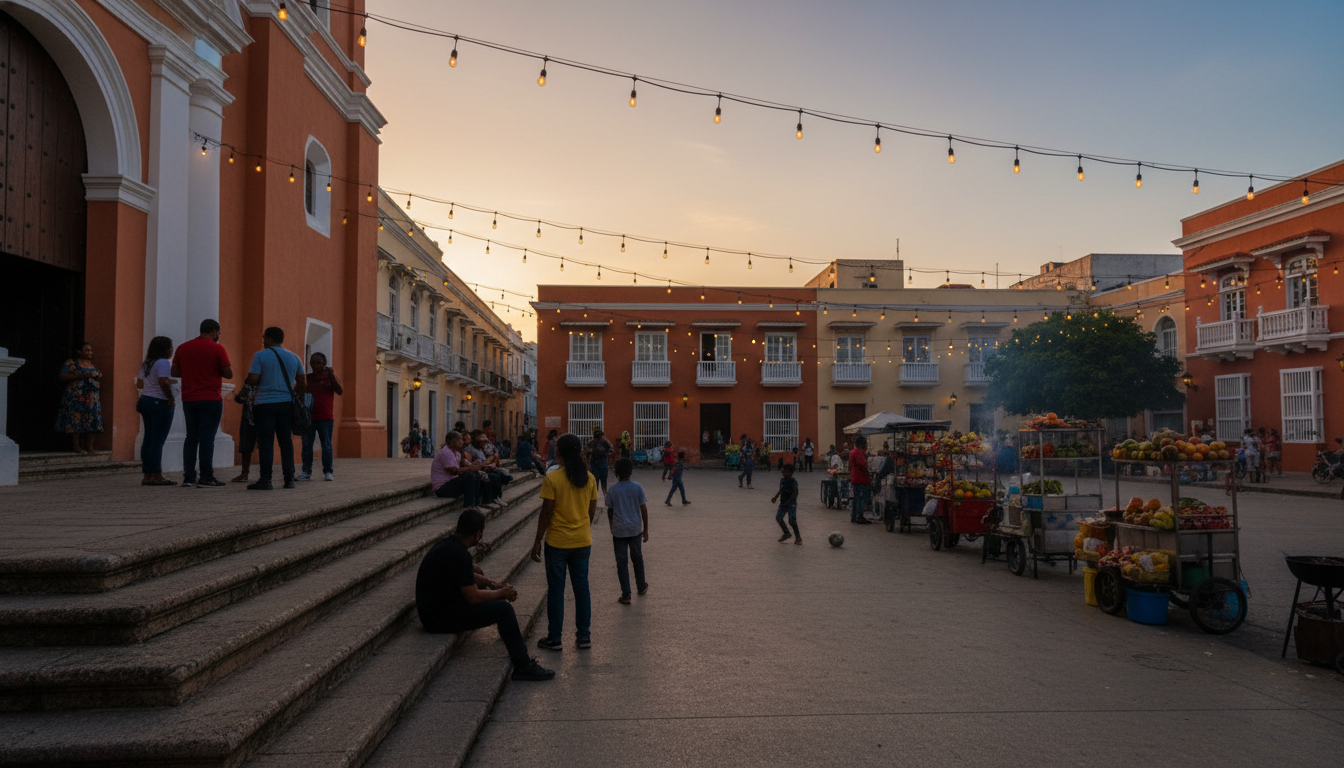 Plaza de la Trinidad in Getseman at dusk, locals sitting on the church steps, children playing, stri
The Walled City: Beautiful but Isolating
I've done home exchanges in Cartagena's Centro Histórico too, and while the architecture is stunning—we're talking UNESCO World Heritage stunning—I found it harder to make genuine connections. The walled city is primarily tourists and the people who serve them. The residents who remain tend to be wealthy, often foreign, and less integrated into the kind of street-level community life that makes Getsemaní special.
If you're set on staying in the walled city, look for properties near the San Diego neighborhood, which has retained more of its residential character. Expect to pay more in credits simply because these homes tend to be larger and more luxurious—though on SwappaHome, it's still just one credit per night regardless of the property's market value.
Bocagrande: Skip It
I'll be direct: Bocagrande is not where you want to do a solo home exchange if you're hoping to meet locals and make friends. It's Cartagena's high-rise beach district, full of chain hotels and vacation condos. The vibe is more Miami than Colombia. You could have the same experience in any coastal city in the world.
The Art of Meeting Locals Through Home Exchange
So you've booked your solo home exchange in Cartagena. You've arrived at your swap home, unpacked your bag, figured out how the shower works (always an adventure). Now what?
This is where solo travel gets interesting—and where home exchange gives you advantages a hotel never could.
Start with Your Host's Network
Before I left for Cartagena, I asked my hosts if they'd be willing to introduce me to anyone. Not in a demanding way—I framed it as "I'd love to meet some of your friends or neighbors if anyone's interested in grabbing coffee with a visiting American."
They connected me with three people: their neighbor María, a retired teacher who'd lived in the building for forty years; their friend Carlos, a chef who ran a small restaurant in Manga; and Valentina, a young architect who'd house-sat for them before and knew the neighborhood well.
Those three introductions shaped my entire trip. María invited me to her church's weekly community lunch (more on that later). Carlos taught me how to make coconut rice in his restaurant kitchen and refused to let me pay for the lesson. Valentina took me to a salsa night that I never would have found on my own—a rooftop in Manga where locals actually danced, not the tourist-trap salsa bars in the walled city where gringos shuffle awkwardly while instructors try to upsell private lessons.
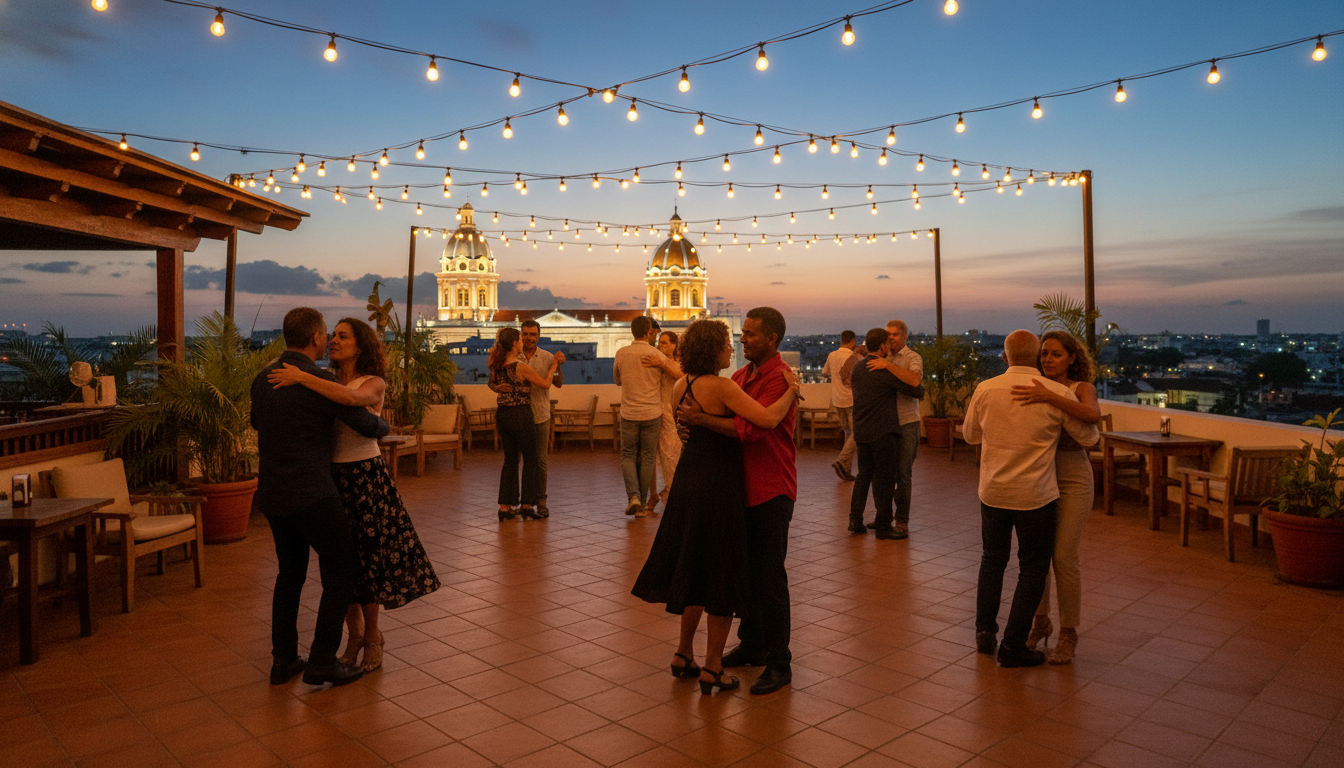 Rooftop salsa dancing in Cartagena at night, fairy lights strung overhead, couples of all ages danci
Become a Regular Somewhere
The single best strategy for making friends as a solo traveler? Pick one or two spots and go back every day.
I chose a small café called Epoca Espresso in Getsemaní for my morning coffee. It's run by a Colombian couple, Andrés and Lucia, who roast their own beans from a farm near Santa Marta. A cortado costs about 8,000 pesos ($2 USD), which is expensive by local standards but reasonable for specialty coffee.
Day one, I was just another customer. Day two, Andrés remembered my order. Day three, Lucia asked where I was staying. Day four, I was sitting at the bar chatting with them between customers, learning about their dream of opening a second location, hearing about their daughter's quinceañera planning. By day seven, they were inviting me to a weekend asado at their apartment.
This doesn't happen when you're staying at a hotel, bouncing between different cafés each morning, eating dinner at a new restaurant every night. The repetition of home exchange—of actually living somewhere—creates space for relationships to develop.
Say Yes to Everything (Within Reason)
I have a rule when I'm doing solo home exchange: for the first week, I say yes to every invitation that doesn't feel unsafe. Neighbor invites me to a birthday party where I won't know anyone? Yes. Café owner suggests I check out a gallery opening? Yes. Random person at the fruit market says I should come to their church's community lunch? Yes—though I'll admit I hesitated on that one.
The church lunch turned out to be one of the highlights of my trip. It was at a small Catholic church in Getsemaní, and about thirty people showed up—mostly older women, a few families, some neighborhood characters. The food was incredible: sancocho (a hearty soup), rice with coconut, fried fish, patacones. I was the only foreigner there, and my presence was treated as a curiosity but not an intrusion.
An elderly woman named Doña Carmen appointed herself my translator and protector for the afternoon. She introduced me to everyone, explained the dishes, told me stories about the neighborhood before the tourists came. When I left, she pressed a small prayer card into my hand and told me to come back next week.
I did.
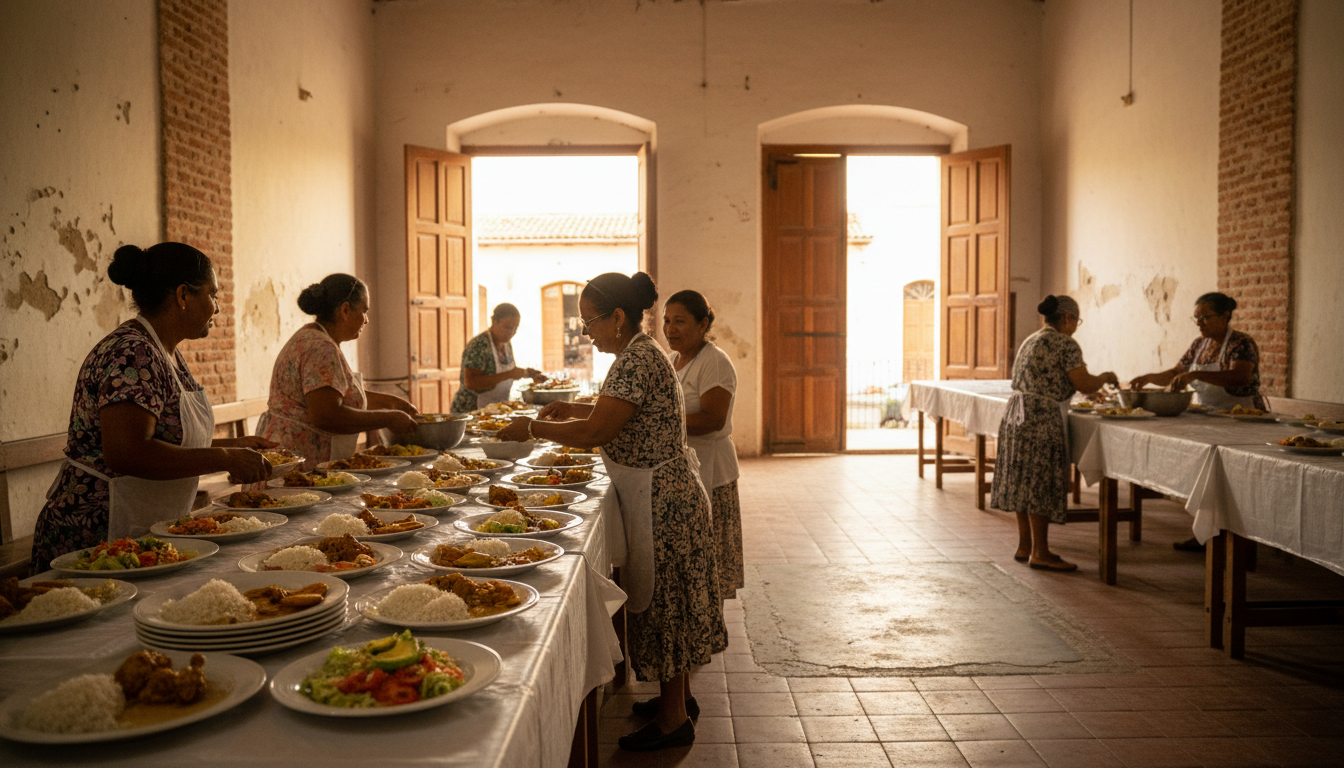 Community lunch at a small church in Getseman, long tables covered in white plastic, plates of tradi
Practical Tips for Solo Home Exchange in Cartagena
Alright, let's get into the logistics. Making friends is wonderful, but you also need to know how to navigate daily life.
Safety Considerations
I won't sugarcoat it: Cartagena has crime, like any major city. But I felt safer there than I do in many American cities, including my own San Francisco. The key is common sense.
Stick to well-lit, populated areas at night. Don't flash expensive jewelry or electronics. Use Uber or InDriver rather than hailing taxis on the street (rides within the city center rarely cost more than 15,000 pesos, about $3.75 USD). Keep your phone in a zippered bag when walking.
Getsemaní has improved dramatically in terms of safety over the past decade, but it's still a neighborhood in transition. The blocks closest to the walled city and Plaza de la Trinidad are fine at any hour. Venture further toward the edges, and you'll want to be more cautious after dark.
One advantage of home exchange: your hosts know the neighborhood. Ask them specifically which streets to avoid and what times. Their advice will be more current and specific than any guidebook.
Language Barrier (Or Lack Thereof)
You can get by in Cartagena with minimal Spanish, especially in tourist areas. But if you're doing a home exchange in a residential neighborhood and hoping to make local friends, even basic Spanish will transform your experience.
I'm not fluent—far from it—but I can hold a simple conversation, and that was enough. People appreciate the effort. They'll slow down, use simpler words, help you find the right phrase. The fruit vendor who laughed at my pronunciation? She became one of my favorite daily interactions precisely because of that linguistic stumbling.
If your Spanish is truly nonexistent, consider taking a few lessons before you go. Or sign up for a week of classes in Cartagena itself—there are several schools in Getsemaní that cater to travelers, and the social aspect of group classes is another way to meet people.
Managing the Heat
Cartagena is hot. Not "oh, it's a bit warm" hot. We're talking 85-95°F (29-35°C) with humidity that makes you feel like you're breathing through a wet towel.
This affects everything about daily life, including your social calendar. Locals structure their days around the heat: activity in the morning, rest during the hottest afternoon hours, then everything comes alive again after 4 or 5 PM. Adopt this rhythm.
Make sure your home exchange has air conditioning in the bedroom at minimum—this is non-negotiable for sleeping. Check with your hosts about the electricity situation; some older buildings have inconsistent power, and you do not want to lose AC at 2 AM.
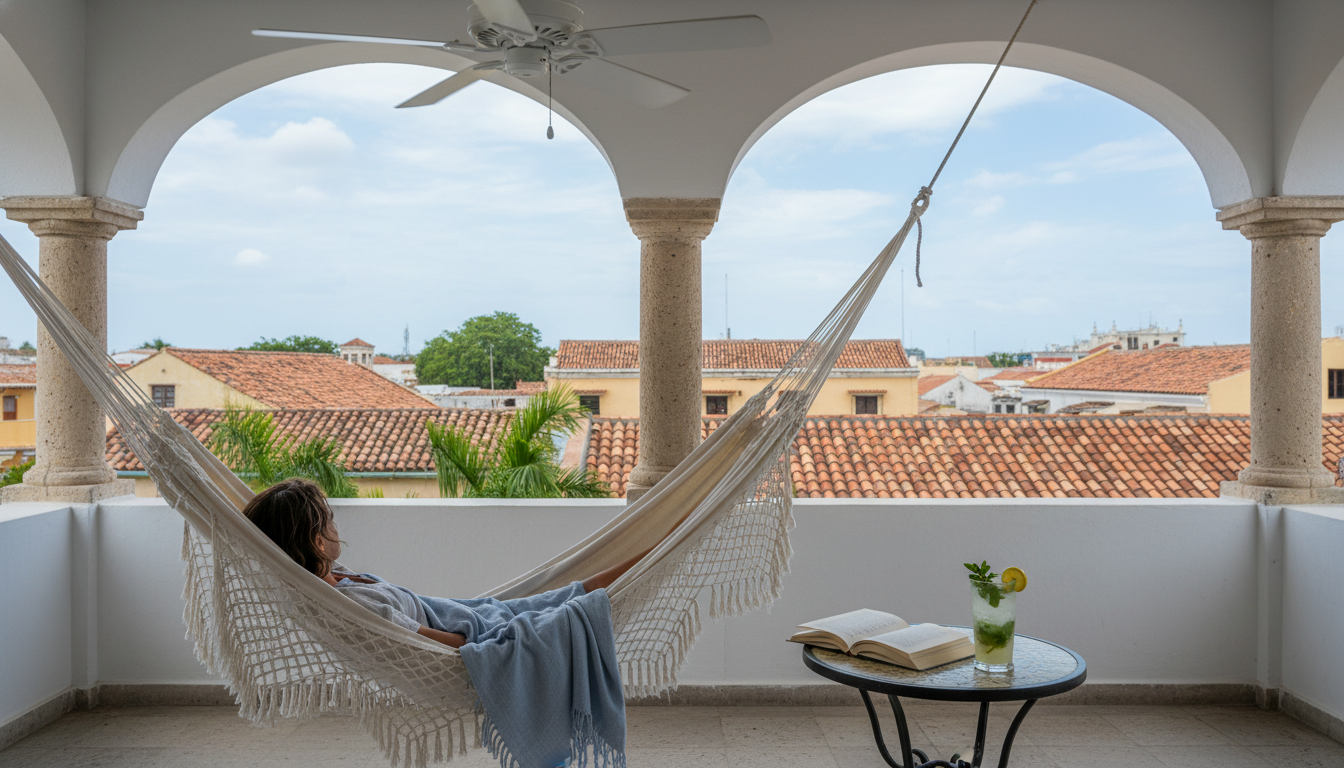 Hammock on a shaded balcony in Cartagena during siesta time, ceiling fan spinning, glimpse of coloni
Costs and Budgeting
One reason solo home exchange in Cartagena is so appealing: it's incredibly affordable once you've eliminated accommodation costs.
Here's what I spent on a typical day: breakfast at home with fruit from the market, coffee, and eggs ran me about 8,000 pesos ($2 USD). Morning coffee at Epoca was another 8,000 pesos. Lunch at a corrientazo restaurant—those set menu places with soup, a main, and a drink—cost 15,000-20,000 pesos ($3.75-5 USD). An afternoon snack of fresh juice and empanadas was maybe 5,000 pesos ($1.25 USD). Dinner at a mid-range restaurant hit 40,000-60,000 pesos ($10-15 USD), and Uber rides added another 15,000-25,000 pesos ($3.75-6.25 USD).
Total: roughly $25-35 USD per day for a comfortable experience. You can spend much less if you cook more meals at home or eat exclusively at local spots. You can spend more if you want cocktails at rooftop bars in the walled city (expect 35,000-50,000 pesos per drink, or $8.75-12.50 USD).
Compare that to hotel costs—a decent hotel in Cartagena runs $80-150 USD per night—and you see why home exchange makes solo travel so much more accessible.
Building Lasting Friendships Beyond Your Trip
Here's something I didn't expect from my solo home exchange in Cartagena: I'm still in touch with people I met there, two years later.
María, the retired teacher from my building, sends me WhatsApp messages on holidays. Carlos invited me back to cook with him anytime—and I'm planning to take him up on it next year. Valentina and I follow each other on Instagram; she visited San Francisco last fall and stayed on my couch.
These aren't the superficial "let's stay in touch!" connections you make with fellow travelers in hostels. These are relationships built on shared meals, repeated interactions, genuine curiosity about each other's lives.
The home exchange framework makes this possible in a way that other forms of travel don't. You're not passing through. You're living there, even if only for a few weeks. You have a home base, a neighborhood, a routine. You become, temporarily, part of a community.
Staying Connected
A few practical tips for maintaining friendships across borders:
WhatsApp is essential—everyone in Colombia uses it, and it's how you'll stay in touch. Exchange numbers with people you connect with, and don't be shy about sending a message after you leave. Send photos, too. People love seeing themselves through a visitor's eyes. I sent María a photo I'd taken of her at the church lunch, and she told me it was now framed in her living room.
And follow through on invitations. If you say "you should visit me sometime," mean it. When they do visit, host them generously. The reciprocity of home exchange extends beyond the literal swapping of houses.
What Solo Home Exchange Taught Me About Travel
I've done a lot of solo trips. Backpacking through Southeast Asia in my twenties. Business trips where I tacked on a few days of exploration. Weekend getaways when I needed to clear my head.
Solo home exchange is different. It's slower, more intentional, more demanding in some ways. You can't retreat to the anonymity of a hotel room when you're tired of being "on." You have to engage with the place you're in, the people around you, the rhythms of daily life.
But that engagement is exactly what transforms a trip into an experience. I didn't just visit Cartagena. I lived there, briefly. I had a fruit vendor who knew my name. I had a café where they started making my coffee when they saw me walk in. I had a neighbor who checked on me and a church community that welcomed me to lunch.
That's not something you can buy. It's not something a hotel can offer, no matter how many stars it has. It's the gift of home exchange: the chance to belong somewhere, even temporarily.
Getting Started with Solo Home Exchange in Cartagena
If I've convinced you to try this, here's how to make it happen.
First, get your profile set up on SwappaHome. Be specific about what you're looking for—mention that you're a solo traveler, that you're interested in residential neighborhoods, that you want to connect with locals. The more detail you provide, the better matches you'll find.
Start searching for Cartagena listings a few months before your planned trip. Look for hosts who seem engaged and communicative—their listing descriptions and response times will tell you a lot. Prioritize hosts who mention their neighborhood, their favorite local spots, their willingness to introduce you to friends.
When you reach out to potential hosts, be personal. Tell them about yourself, why you want to visit Cartagena, what kind of experience you're hoping for. Ask questions about their neighborhood and their community. The best home exchanges start with genuine connection before you ever arrive.
And then? Show up with openness. Say yes to invitations. Become a regular somewhere. Let the city surprise you.
Cartagena is waiting. And honestly? It's really good at making friends.
Frequently Asked Questions
Is solo home exchange in Cartagena safe for women?
Yes, with standard precautions. I traveled solo as a woman and felt safe throughout my stay. Stick to well-populated areas at night, use ride apps instead of street taxis, and trust your instincts. The residential neighborhoods where home exchanges typically occur often feel safer than tourist-heavy areas because neighbors look out for each other.
How many credits do I need for a home exchange in Cartagena?
On SwappaHome, it's always one credit per night regardless of location or property size. A two-week solo home exchange in Cartagena would cost 14 credits. New members start with 10 free credits, so you'd only need to earn 4 more by hosting guests at your own home before your trip.
What's the best time of year for solo home exchange in Cartagena?
December through April offers the driest weather, but also the highest tourist crowds and prices for flights. I prefer the shoulder seasons—late November or early May—when you get decent weather with fewer tourists. Avoid September and October, the rainiest months, unless you don't mind afternoon downpours.
Do I need to speak Spanish for home exchange in Cartagena?
Basic Spanish significantly enhances your experience, especially for making local friends. You can manage with English in tourist areas and with younger Colombians, though. Consider taking Spanish lessons in Cartagena itself—schools in Getsemaní offer affordable group classes that double as social opportunities.
How far in advance should I book a solo home exchange in Cartagena?
Start searching 2-3 months ahead for the best selection, especially during peak season (December-January). Popular neighborhoods like Getsemaní have limited inventory. That said, I've also found last-minute exchanges when plans changed—flexibility increases your options significantly.
40+
Swaps
25
Countries
7
Years
About Maya Chen
Travel Writer & Home Exchange Expert
Maya is a travel writer with over 7 years of experience in the home swapping world. Originally from Vancouver and now based in San Francisco, she has completed more than 40 home exchanges across 25 countries. Her passion for "slow" and authentic travel led her to discover that true luxury lies in living like a local, not a tourist.
Ready to try home swapping?
Join SwappaHome and start traveling by exchanging homes. Get 10 free credits when you sign up!
Related articles
Lyon Home Exchange: Your Complete Guide to France's Hidden Gem for Home Swapping
Discover why Lyon home exchange is booming among savvy travelers. From Croix-Rousse to Presqu'île, find the best neighborhoods and insider tips for your swap.

Zurich Bucket List: 47 Unforgettable Experiences to Enjoy During Your Home Swap
Discover the ultimate Zurich bucket list for home swappers—from secret swimming spots to fondue rituals locals actually do. Save thousands while living like a true Zürcher.
Dublin Home Exchange Utilities Guide: WiFi, Heating & Everything Your Guests Need
Master Dublin home exchange utilities—from dodgy WiFi fixes to heating quirks. Practical tips from 7 years of swapping homes across Ireland.