Solo Home Exchange in Vienna: How to Meet Locals and Make Real Friends

SwappaHome Editorial Team
Home Exchange & Slow Travel Editorial
Discover how solo home exchange in Vienna opens doors to authentic friendships. From Naschmarkt coffee invitations to neighborhood Heurigen, here's how travelers connect.
Solo Home Exchange in Vienna: How to Meet Locals and Make Real Friends
The Stephansplatz bells have just struck nine, and you're standing in a stranger's kitchen in Vienna's 7th district—Neubau, the creative heart of the city—grinding coffee beans from the local rösterei down the street. There's a handwritten note on the counter: "The neighbor Frau Müller waters my plants. She'll probably bring you Apfelstrudel. Don't refuse—she makes the best in the building."
This is what solo home exchange in Vienna actually looks like. Not the polished isolation of a hotel room near the Ringstraße, but genuine immersion into a city where coffee culture runs deeper than the Danube and neighbors still knock on doors with homemade pastries.
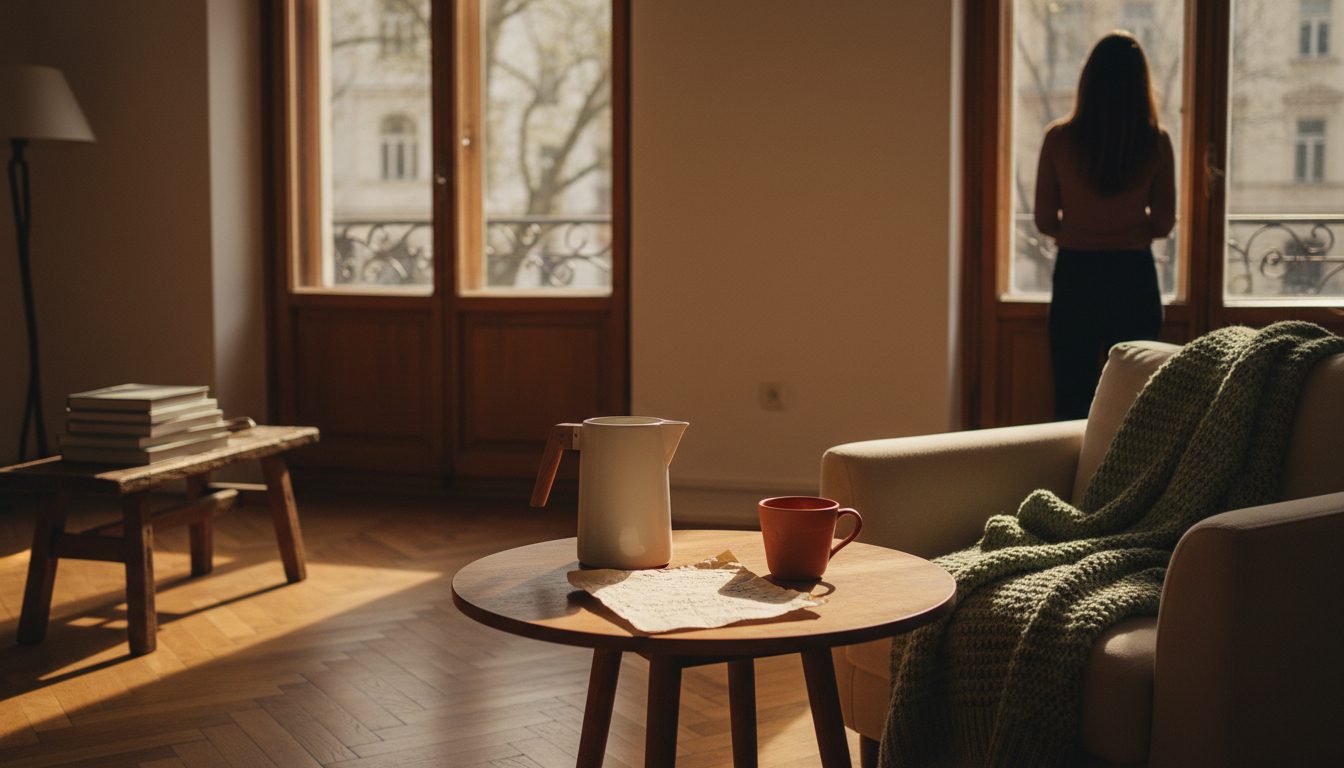 Morning light streaming through tall windows in a classic Viennese Altbau apartment in Neubau, with
Vienna presents a peculiar paradox for solo travelers. Austrians have a reputation for being reserved—kühl, as they say—yet once you're inside someone's home, inside their neighborhood, inside their daily rhythms, that coolness melts into something surprisingly warm. Home exchange doesn't just give you a free place to stay in one of Europe's most expensive capitals. It hands you the keys to a social world that tourists in hotels simply never access.
Why Solo Home Exchange in Vienna Works Differently Than Other Cities
Vienna isn't Paris, where café culture invites strangers to linger and chat. It's not Barcelona, where the streets themselves become living rooms. Vienna's social fabric is woven more privately—in apartment buildings, in Kaffeehäuser where regulars have claimed the same table for decades, in the Heurigen wine taverns of the outer districts where families gather on Sunday afternoons.
This is precisely why solo home exchange here creates opportunities other travel styles can't replicate.
Stay in someone's home and you inherit their ecosystem. The Greißler (corner shop) owner who knows your host by name. The building's Hausmeister who'll chat with you about the weather while you're taking out the recycling—Vienna's recycling system is notoriously complex, and locals love explaining it. The elderly couple in 4B who've lived there since 1962 and remember when the district was still rebuilding from the war.
SwappaHome members consistently report that Vienna home exchanges come with more neighbor introductions than almost any other European city. There's something about Viennese apartment culture—the shared courtyards, the unwritten rules about quiet hours, the communal stairwells—that creates natural touchpoints for connection.
The Viennese Apartment Building as Social Hub
Understanding Viennese housing helps explain why home exchange here is so effective for meeting people. Most of Vienna's residential buildings are Altbau—pre-war structures with high ceilings, creaky parquet floors, and shared inner courtyards called Innenhöfe. These courtyards aren't just architectural features; they're social spaces where children play, neighbors chat, and summer evenings turn into impromptu gatherings.
In a hotel, you're invisible. In a Viennese Altbau, you're part of the building's rhythm.
You'll learn that the woman on the third floor practices piano at 4 PM sharp (perfectly legal under Vienna's noise ordinances). You'll discover that Sunday mornings mean the smell of Semmelknödel wafting through the stairwell. You'll find yourself nodding Grüß Gott to the same faces day after day until nodding becomes conversation.
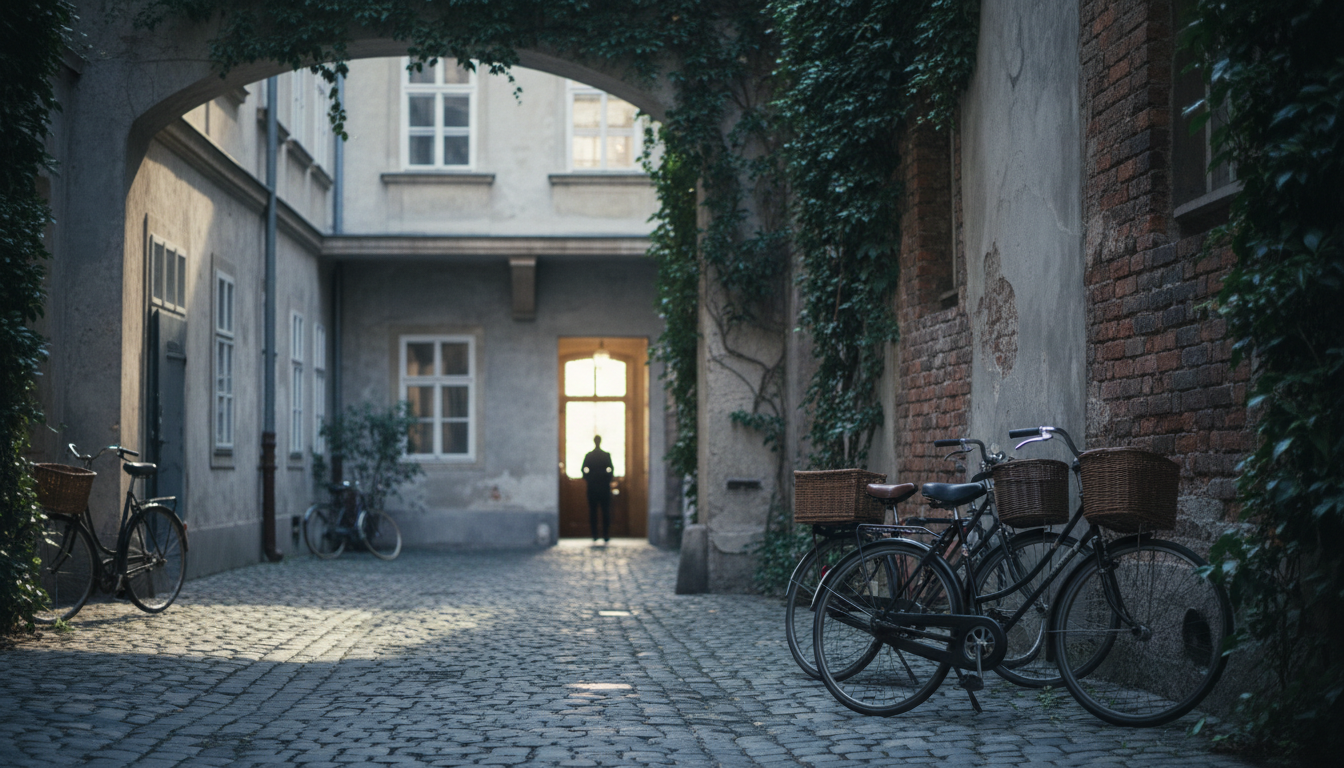 A classic Viennese inner courtyard Innenhof with climbing ivy, bicycles parked against old walls, an
Best Vienna Neighborhoods for Solo Home Exchange and Social Connection
Not all Vienna districts offer the same potential for meeting locals. The 1st district (Innere Stadt) is gorgeous but dominated by tourists and offices—you'll find fewer residential exchanges and even fewer opportunities for neighborhood immersion. Here's where solo home exchangers consistently find the richest social experiences:
Neubau (7th District): Creative Class Meets Coffee Culture
Neubau is Vienna's answer to Brooklyn or Kreuzberg—except it's been gentrifying slowly since the 1990s, so the mix of old and new feels organic rather than jarring. The streets around Burggasse and Neubaugasse are lined with independent cafés, vintage shops, and small galleries where owners actually want to talk.
Home exchanges in Neubau typically run 1 credit per night through SwappaHome's system, same as anywhere else—but what you get for that credit is access to a neighborhood where regulars still matter. The barista at Kaffeefabrik on Favoritenstraße will remember your order by day three. The owner of the wine shop on Zieglergasse will start recommending bottles based on what you bought last time.
Typical hotel rates in this area hover around €150-200 per night for anything halfway decent. A two-week stay would run €2,100-2,800. With home exchange, that's 14 credits—and most SwappaHome members earn credits by hosting guests in their own homes, making the exchange genuinely reciprocal.
Josefstadt (8th District): Vienna's Intellectual Heart
Smaller and quieter than Neubau, Josefstadt is where university professors, theater people, and old Viennese families have lived for generations. The Theater in der Josefstadt, Austria's oldest continuously operating theater, anchors the cultural life here. So does the Café Hummel, a traditional Kaffeehaus where the waiters still wear tuxedos and the regulars still read newspapers on wooden holders.
Solo travelers doing home exchange in Josefstadt often report being invited to Stammtisch—the regular table gatherings that are central to Austrian social life. Your host's friends might meet every Thursday at a certain Beisl (traditional pub), and a well-worded message before your exchange can sometimes score you an invitation.
Leopoldstadt (2nd District): The Neighborhood That Defies Expectations
Once Vienna's Jewish quarter, then working-class, now increasingly hip, Leopoldstadt offers something the western districts don't: the Prater. Not just the famous amusement park with its giant Ferris wheel, but the vast green expanse of the Prater park itself—where Viennese jog, cycle, picnic, and actually talk to strangers in a way they rarely do elsewhere.
Home exchanges near the Karmelitermarkt put you in the center of Leopoldstadt's revival. The market operates Tuesday through Saturday, and by your third visit, the cheese vendor will be offering samples and asking about your travels. This kind of repeated, low-stakes interaction is exactly what builds genuine connection.
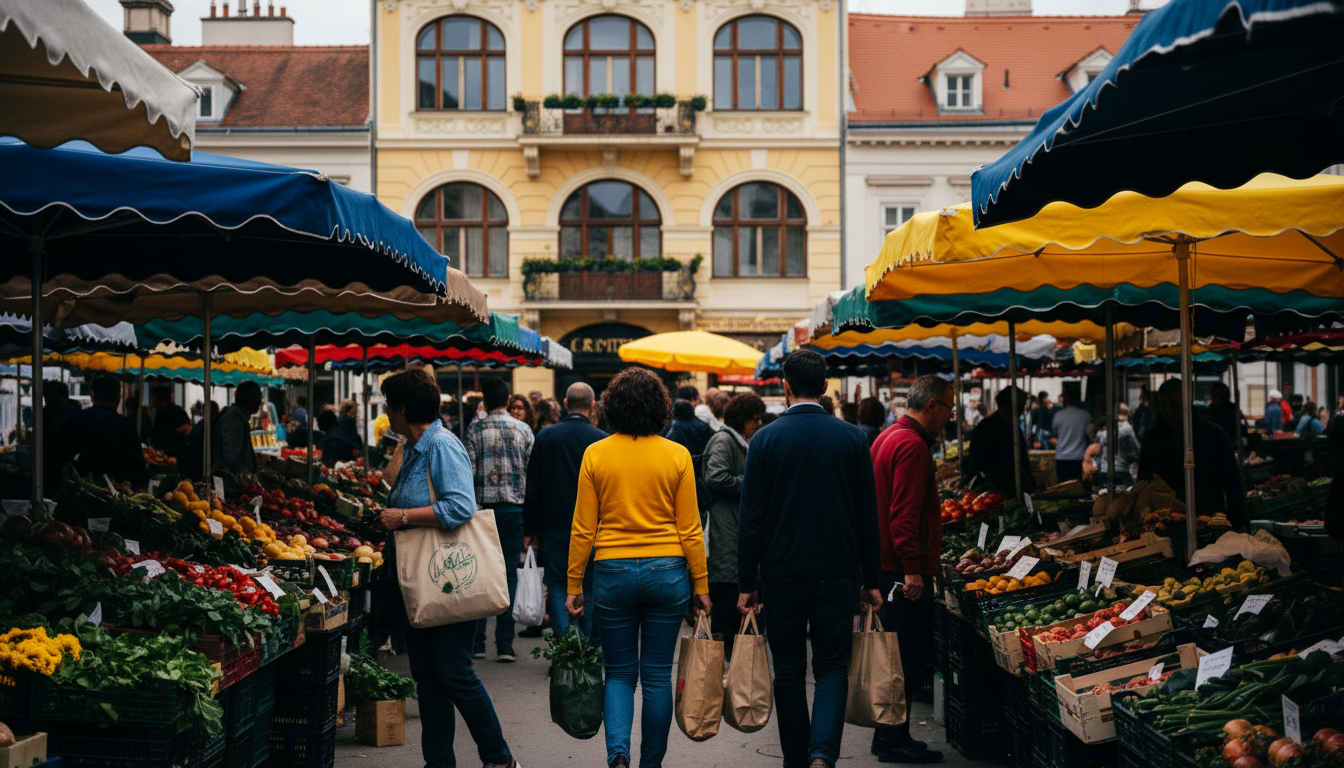 The Karmelitermarkt in Viennas 2nd district on a Saturday morning, with market stalls, locals carryi
How to Actually Meet Viennese Locals During Your Home Exchange
Having a local address is just the beginning. Vienna doesn't hand out friendships easily—you need to know where to find them and how to approach.
The Kaffeehaus Strategy: Becoming a Regular in Days
Vienna's coffee house culture is a UNESCO-recognized intangible cultural heritage, and there's a reason. Kaffeehäuser are designed for lingering—you order a Melange (Vienna's signature coffee), receive a glass of water on the side (always, without asking), and you're entitled to sit for hours. No one will rush you. No one will judge you for being alone.
The trick is choosing the right one.
Tourist-heavy spots like Café Central or Café Sacher won't yield connections. Instead, find the neighborhood Kaffeehaus near your exchange home. In Neubau, that might be Café Jelinek on Otto-Bauer-Gasse—cramped, smoky (Vienna still allows smoking in traditional cafés), and full of regulars who've been coming for decades. In Josefstadt, try Café Hummel or Café Eiles near the Parliament.
Here's the protocol: arrive at the same time each day. Bring a book or newspaper—preferably German, even if you're just looking at pictures. Order the same thing. Sit at the same table if possible. By day three or four, the Ober (waiter) will acknowledge you differently. By day five, he might ask where you're from. By day seven, the person at the next table might comment on your book.
This sounds slow. It is. But it's how Vienna works.
Heurigen: Where Wine Opens Doors
A Heuriger is a wine tavern serving the current year's wine—the word literally means "this year's." They're found in Vienna's outer wine-growing districts: Grinzing (touristy), Nussdorf (better), Stammersdorf (best for meeting locals), and Neustift am Walde (the sweet spot between authentic and accessible).
Solo travelers often feel awkward at Heurigen because they're designed for groups—long communal tables, shared platters of cold cuts and spreads, carafes of wine meant for passing around. But this communal setup is exactly what makes them perfect for meeting people.
Here's what works: go on a weekday evening, not a weekend. Sit at a communal table rather than claiming a small one alone. Order a Viertel (quarter liter) of white wine—Grüner Veltliner or Gemischter Satz are the local specialties—and a small food board. Look approachable. Viennese at Heurigen are more relaxed than Viennese elsewhere; the wine helps, but so does the setting.
The Heuriger Mayer am Pfarrplatz in Heiligenstadt is where Beethoven once lived (there's a plaque), and it strikes a good balance between historic charm and local clientele. A full evening—wine, food, atmosphere—runs around €25-35, a fraction of what you'd spend at a restaurant in the center.
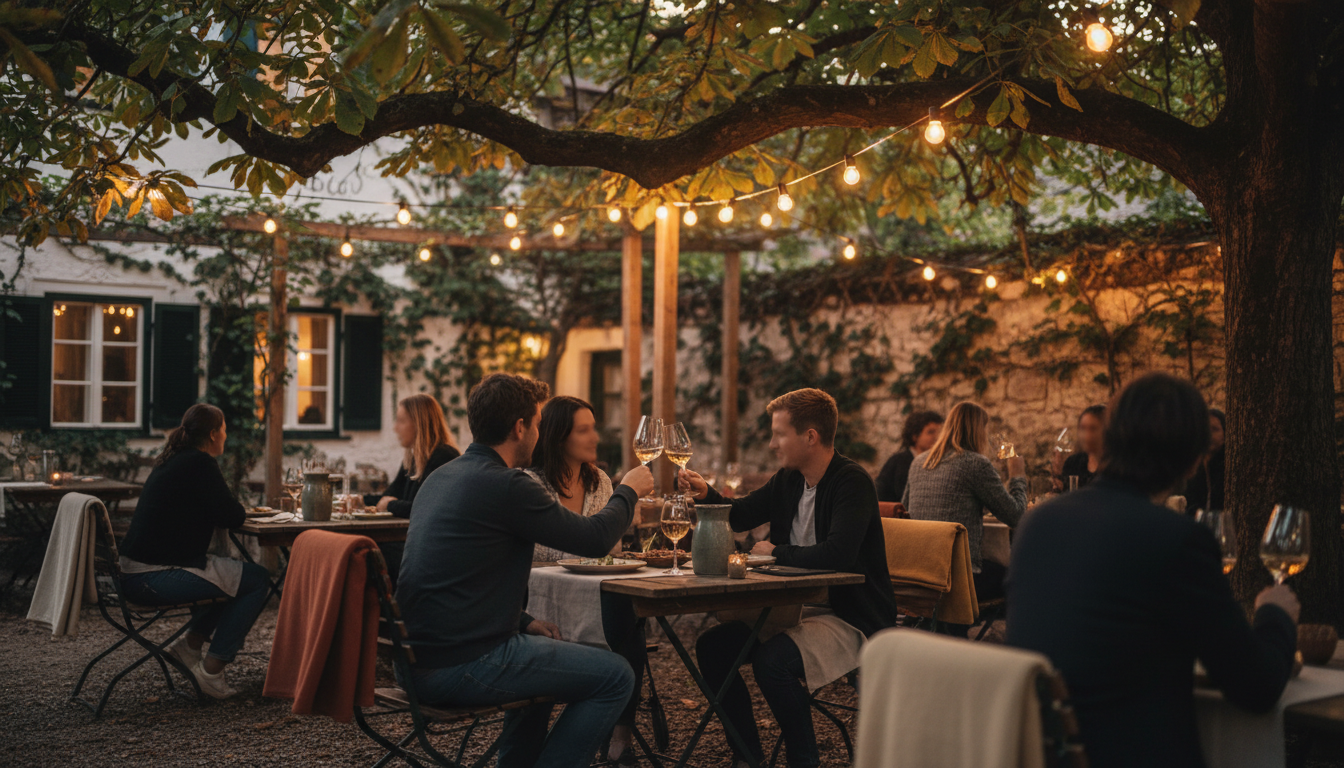 A traditional Heuriger wine tavern in Viennas outskirts at dusk, with outdoor seating under chestnut
The Naschmarkt Approach: Shopping as Social Practice
Vienna's Naschmarkt, stretching along the Wienzeile between the 4th and 6th districts, is the city's most famous market—and therefore its most touristy. But here's what most visitors miss: the market has two faces. The main stretch is for tourists. The stalls at the far end, toward Kettenbrückengasse, are for locals.
As a home exchanger, you have a reason to shop here that tourists don't: you're cooking. You need ingredients. This changes everything.
Vendors at the Naschmarkt respond to people who know what they want. Ask for Kürbiskernöl (Styrian pumpkin seed oil) and they'll tell you which producer is best this season. Ask how to prepare Tafelspitz and they might walk you through the entire recipe. Come back twice, and you're no longer a tourist—you're a customer.
The Saturday flea market at the Naschmarkt's western end is even better for random encounters. Viennese love their antiques and vintage finds, and browsing creates natural conversation opportunities.
Building Real Friendships: From Exchange to Lasting Connection
Meeting people is one thing. Making actual friends—connections that outlast your trip—requires more intention.
Your Host's Network: The Hidden Asset
The most underutilized resource in home exchange is your host themselves. Many SwappaHome members are happy to connect solo travelers with their friends, especially if you ask thoughtfully before arrival.
A message like: "I'm traveling solo and would love to experience Vienna like a local. If any of your friends would be open to grabbing coffee or showing me their favorite spots, I'd be grateful for an introduction" works better than you'd expect. Viennese might be reserved with strangers, but they're generous with friends-of-friends.
Some hosts leave detailed neighborhood guides with personal recommendations: "My friend Thomas runs the bookshop on Josefstädter Straße—tell him I sent you and he'll talk your ear off about Austrian literature." These introductions are gold.
Language: The Effort That Opens Doors
Vienna is not a city where you need German to survive. English is widely spoken, especially in the center. But learning even basic German phrases shifts how locals perceive you.
Grüß Gott (formal hello), Servus (casual hello/goodbye), Bitte (please/you're welcome), Danke schön (thank you very much), Die Rechnung, bitte (the bill, please), and Noch ein Bier, bitte (another beer, please) will get you surprisingly far.
More importantly, attempting German signals respect. Austrians are proud of their language—and specifically their Austrian German, which differs from German German in ways they'll happily explain if you ask. Mispronouncing Wiener Schnitzel correctly (VEE-ner SHNIT-sel) or ordering a Melange properly (may-LAHNZH) marks you as someone who cares.
Classes, Workshops, and Structured Social Opportunities
Solo travelers sometimes need a structured excuse to meet people. Vienna offers several worth considering.
Cooking classes at Wrenkh Cooking School in the 1st district attract a mix of tourists and locals learning Austrian cuisine—Apfelstrudel, Sachertorte, Kaiserschmarrn—and the technical precision required creates genuine bonds among participants.
German language exchanges through Sprachcafé events pair German speakers with learners for casual conversation practice. Check the schedule at Das Café in Josefstadt or Tacheles in Leopoldstadt.
Walking tours with a twist offer perspectives most visitors never encounter. Shades Tours runs experiences led by formerly homeless Viennese—the kind of thoughtful programming that attracts travelers who make good connections.
Running and cycling groups tap into Viennese outdoor culture. The Vienna Hash House Harriers (a social running group) welcomes visitors, and the Prater Lauftreff organizes free weekly runs through the Prater park.
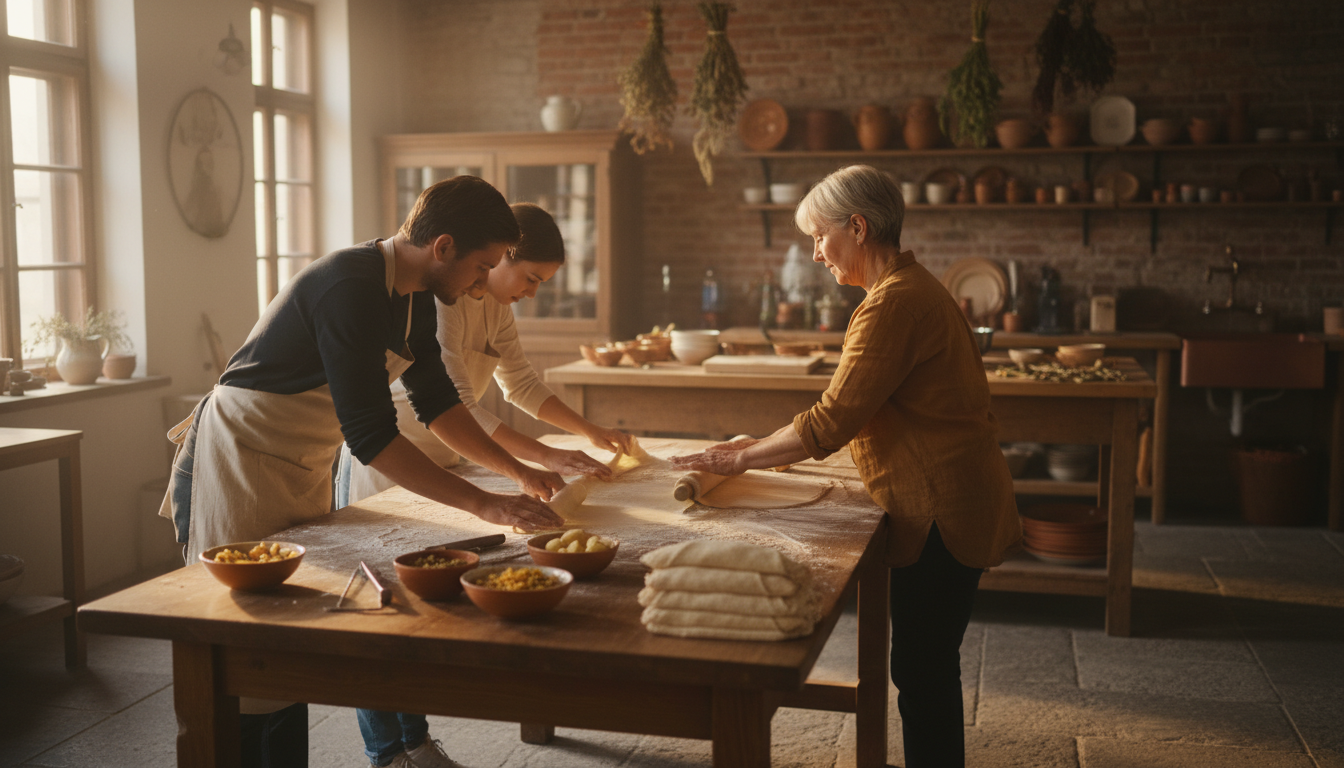 A small group cooking class in a Vienna kitchen, with participants rolling strudel dough on a floure
The Practical Side: Making Solo Home Exchange Work in Vienna
Social opportunities matter, but so does logistics.
Getting Around Without a Car
Vienna's public transport system (Wiener Linien) is exceptional. The U-Bahn (metro) runs five lines covering most of the city. Trams fill the gaps with a romantic, old-world charm. A weekly pass (Wochenkarte) costs €17.10—absurdly cheap for unlimited travel.
More importantly for meeting locals: Viennese actually talk on public transport, at least compared to cities like London or Tokyo. The tram, especially, has a social dimension. Older passengers might comment on your shopping bags or ask if you need directions. These micro-interactions add up.
For reaching Heurigen in the outer districts, the tram lines 38 (to Grinzing) and D (to Nussdorf) are your friends.
Timing Your Vienna Home Exchange for Maximum Social Opportunity
Vienna's social calendar affects your chances of meeting people significantly.
Best months: May-June and September-October. The weather is pleasant, outdoor seating is everywhere, and Viennese are in good moods. The Wiener Festwochen (May-June) brings cultural events that attract engaged locals.
Challenging months: July-August. Many Viennese flee to the countryside or Mediterranean. The city empties out, and your chances of meeting locals drop significantly.
Winter consideration: The Christkindlmarkt season (mid-November through December) is magical but tourist-heavy. January-February is quiet, cold, but excellent for Kaffeehaus culture—locals retreat indoors, and the café becomes even more central to social life.
Ball season: Vienna's famous ball season runs January-February. Scoring tickets to a smaller ball (not the Opernball, which is impossible and insanely expensive) means experiencing Viennese high culture in a way few tourists do.
Safety and Solo Travel Considerations
Vienna consistently ranks among the world's safest cities—the Economist Intelligence Unit has placed it in the top five for years. Solo travelers, including solo women, report feeling comfortable walking at night, using public transport late, and exploring independently.
That said, the usual urban precautions apply. The area around Praterstern can feel sketchy late at night. Pickpockets operate in tourist zones, especially around Stephansplatz and the Naschmarkt. Keep valuables secure, but don't be paranoid.
For home exchange specifically: Vienna's apartment buildings are secure. Most have coded entry systems (Gegensprechanlage), and your host will provide access instructions. If you're staying in an Altbau, you might need an actual key for the main door—don't lose it, as replacements involve the entire building and cost around €100-150.
What the SwappaHome Community Says About Vienna
Feedback from experienced home exchangers reveals consistent patterns about solo stays in Vienna.
The neighbor factor comes up repeatedly. More than in almost any other European city, Vienna home exchanges involve meeting the people next door, upstairs, or down the hall. Hosts often mention neighbors by name in their welcome notes, and those neighbors frequently reach out.
The coffee house revelation is another common theme. Travelers who commit to the Kaffeehaus routine—same place, same time, several days running—report breakthrough moments when regulars begin acknowledging them. It requires patience, but it works.
The Heuriger success stories are particularly striking. Solo travelers who venture to the outer-district wine taverns on weekday evenings consistently report being welcomed at communal tables, drawn into conversations, and sometimes invited to join groups for the evening.
The language effort pays disproportionate dividends. Even basic German attempts—especially Austrian-specific phrases—shift interactions from transactional to personal.
Common Mistakes Solo Travelers Make in Vienna (And How to Avoid Them)
Staying too central: The 1st district is beautiful but socially dead for travelers seeking local connection. Home exchanges in the 2nd through 9th districts offer far richer opportunities.
Rushing the Kaffeehaus: Treating Vienna's cafés like Starbucks—order, drink, leave—misses the entire point. Budget at least 90 minutes per visit. Bring something to do. Let time expand.
Avoiding communal settings: Solo travelers sometimes seek privacy out of self-consciousness. In Vienna, this instinct works against you. Communal tables at Heurigen, shared benches at the Naschmarkt, group tours—these are where connections happen.
Expecting immediate warmth: Viennese reserve isn't coldness; it's simply a different social calibration. Expect politeness on day one, acknowledgment by day three, actual warmth by day seven. Adjust your timeline accordingly.
Ignoring the outer districts: The best Heurigen, the most authentic neighborhoods, the locals who aren't exhausted by tourists—they're in the 17th, 18th, 19th, and 21st districts. A home exchange in Währing or Döbling might seem inconvenient, but it's often socially richer than one in the center.
Making the Most of Your SwappaHome Vienna Exchange
The credit system makes Vienna accessible regardless of your home's location or size. You earn 1 credit per night when hosting guests in your own home—whether that's a studio in Cleveland or a house in Sydney. You spend 1 credit per night when staying anywhere on the platform, including Vienna's most desirable neighborhoods.
New SwappaHome members start with 7 free credits, enough for a full week in Vienna without having hosted anyone yet. That's a €1,000-1,400 value based on typical hotel rates in the neighborhoods mentioned above.
The platform's messaging system lets you connect with potential hosts before committing. For Vienna specifically, it's worth asking:
- "Are there neighbors you'd recommend I introduce myself to?"
- "What's your favorite local Kaffeehaus?"
- "Any friends who might be open to meeting a solo traveler?"
- "Which Heuriger do you recommend for someone on their own?"
These questions signal that you're not just looking for accommodation—you're looking for connection. Hosts who value community will respond enthusiastically.
The Unexpected Gifts of Solo Home Exchange in Vienna
Something happens when you stay in a real home in a city like Vienna. You stop performing tourism and start practicing life. You buy groceries instead of eating every meal out. You learn the recycling schedule (paper on Wednesdays, glass and metal on alternating Fridays). You nod to the same faces in the stairwell until nodding becomes Grüß Gott becomes Wie geht's? becomes an invitation for coffee.
Vienna rewards this kind of slow immersion. The city isn't designed for quick hits of excitement—it's designed for depth, for return visits, for building something over time. A week in a hotel gives you photos of Schönbrunn Palace. A week in a Neubau apartment gives you a favorite bakery, a barista who knows your order, a neighbor who brought you Apfelstrudel, and maybe—if you're lucky and patient—an invitation to someone's Stammtisch.
The friends you make through home exchange are different from friends you make through hostels or tours. They're not fellow travelers passing through. They're people with roots, with routines, with lives you glimpsed from the inside. They're the woman who explained the recycling system. The vendor who taught you about Kürbiskernöl. The regular at the Kaffeehaus who finally asked what you were reading.
These connections don't always last—but sometimes they do. SwappaHome members report staying in touch with Viennese contacts years later, returning for visits, hosting them in turn. The exchange becomes reciprocal in ways that go beyond accommodation.
Vienna is waiting. Not the Vienna of tourist brochures, but the Vienna of inner courtyards and neighborhood cafés and Sunday afternoons at the Heuriger. The keys are there—literally—if you're willing to pick them up.
Frequently Asked Questions
Is solo home exchange in Vienna safe for women traveling alone?
Vienna consistently ranks among the world's safest cities for solo female travelers. The city's public transport runs reliably until midnight (24-hour service on weekends), well-lit streets characterize most residential neighborhoods, and violent crime against tourists is exceptionally rare. Home exchanges in established residential areas like Neubau, Josefstadt, or Leopoldstadt offer the added security of apartment buildings with coded entry systems and attentive neighbors.
How much money can I save with home exchange in Vienna compared to hotels?
Decent hotels in Vienna's desirable neighborhoods typically cost €150-200 per night, with well-located Airbnbs running €100-150. A two-week trip would cost €1,400-2,800 in accommodation alone. With SwappaHome's credit system—where every night costs 1 credit regardless of location—and 7 free starter credits for new members, solo travelers can eliminate accommodation costs entirely while staying in neighborhoods tourists rarely access.
What's the best time of year for a solo home exchange in Vienna?
May-June and September-October offer ideal conditions: pleasant weather, outdoor café seating, and Viennese in sociable moods. Avoid July-August when locals flee the city for vacation. Winter (January-February) is cold but excellent for Kaffeehaus culture—the café becomes even more central to social life when Viennese retreat indoors.
Do I need to speak German to make local friends in Vienna?
No, but learning basic phrases significantly increases your connection opportunities. English is widely spoken, but attempting Grüß Gott, Servus, and simple Austrian German phrases signals respect and often transforms interactions from transactional to personal. Viennese appreciate the effort and frequently respond with patience and warmth.
How do I find home exchange hosts in Vienna who are open to helping solo travelers meet locals?
Use SwappaHome's messaging system to ask potential hosts directly about their neighborhood, favorite local spots, and whether they have friends open to meeting visitors. Questions like "Are there neighbors you'd recommend I introduce myself to?" or "What's your favorite local Kaffeehaus?" signal your interest in genuine connection and help identify hosts who value community over simple accommodation exchange.

Published by
SwappaHome
SwappaHome Editorial Team
Home Exchange & Slow Travel Editorial
The SwappaHome Editorial Team brings together travel research, home-exchange community insights, and platform data to produce practical guides for first-time and experienced home swappers. Every article cites real platforms, current market rates, and verifiable city-level facts so readers can make informed decisions without guessing.
Ready to try home swapping?
Join SwappaHome and start traveling by exchanging homes. Get 7 free credits when you sign up!
Related articles

Bachelor and Bachelorette Parties in Singapore: The Complete Home Swap Group Guide for 2026
Planning a bachelor or bachelorette party in Singapore? Discover how home swapping lets groups of 6-12 stay together in luxury condos, saving thousands while partying in Marina Bay.
Cycling in Lisbon: 7 Home Swap Bike Tour Itineraries for Every Rider
Discover the best cycling routes in Lisbon with these home swap bike tour itineraries—from waterfront paths to hilltop adventures, all starting from your borrowed home.
Graduation Trip to Barcelona: How Home Swapping Gives New Graduates the Ultimate Celebration
Planning a graduation trip to Barcelona? Discover how home swapping lets new graduates explore Spain's most vibrant city without the hostel crowds or hotel costs.