SwappaHome Credits vs Cash: When to Use Which for Smarter Travel

SwappaHome Editorial Team
Home Exchange & Slow Travel Editorial
Should you spend SwappaHome credits or save them? Here's exactly when each strategy maximizes your travel budget—with real scenarios and math.
The Credit Question Every Home Swapper Faces
You're staring at two tabs on your browser. One shows a charming apartment in Lisbon's Alfama district available through SwappaHome—one credit per night for a week-long stay. The other shows a similar place on a vacation rental site for €95 per night. Your credit balance sits at 14. And suddenly, the question hits: should you spend your SwappaHome credits here, or save them for something else and pay cash this time?
This SwappaHome credits vs cash decision trips up even experienced home exchangers. The answer isn't always obvious, and getting it wrong can mean leaving serious value on the table.
 Split-screen showing SwappaHome credit dashboard on one side and a wallet with euros on the other, w
Here's what most people miss: credits and cash aren't interchangeable currencies with a fixed exchange rate. Their relative value shifts dramatically based on where you're going, when you're traveling, how long you're staying, and what alternatives exist. The SwappaHome community has collectively figured out patterns that separate savvy swappers from those who accidentally overpay—or under-leverage their credits.
This breakdown covers exactly when to spend credits, when to hoard them like a dragon guarding gold, and how to think about the whole equation so you're never second-guessing yourself at 2 AM while booking a trip.
Understanding How SwappaHome Credits Actually Work
Before diving into strategy, the mechanics matter. SwappaHome operates on a beautifully simple credit system that eliminates the traditional home-swap coordination nightmare.
The core principle: one credit equals one night. Always. Whether you're hosting someone in a studio apartment in Cleveland or a four-bedroom villa overlooking the Amalfi Coast, you earn exactly one credit per night hosted. Whether you're booking a modest flat in Manchester or a penthouse in Manhattan, you spend exactly one credit per night.
This flat-rate system is intentional. It removes the awkward "is my place worth as much as yours?" negotiation that plagues direct-swap platforms. A retired teacher in Omaha can host travelers, accumulate credits, and spend them on stays that would otherwise cost €300+ per night in peak-season Paris.
New members start with 7 free credits—essentially a free week of accommodation anywhere in the network. After that, the only way to earn more is by hosting guests in your own space.
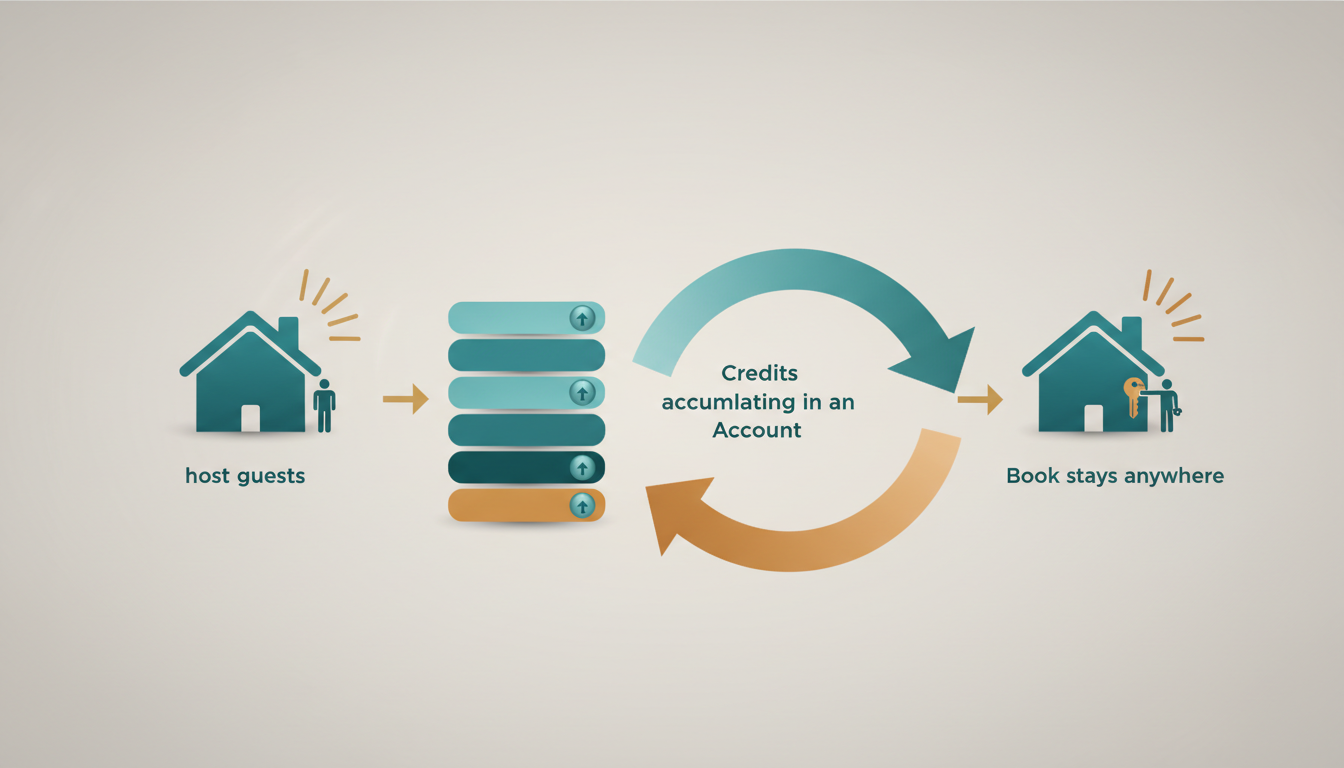 Simple infographic showing the credit flow host guests earn 1 creditnight credits accumulate in acc
No money changes hands between members for the stays themselves. The platform facilitates connections; members handle their own arrangements. This peer-to-peer model means your credits represent real value—nights someone else provided to you, or nights you'll provide to someone else.
Now, with that foundation clear, the strategic question becomes: when does spending a credit make more sense than spending cash?
When SwappaHome Credits Deliver Maximum Value
Credits aren't equally valuable in every situation. They shine brightest under specific conditions—and recognizing these scenarios can multiply your effective savings.
High-Cost Destinations During Peak Season
The math becomes almost comical in expensive cities during their busiest periods. Consider Amsterdam during tulip season (mid-April), when even basic vacation rentals in the Jordaan neighborhood routinely hit €180–250 per night. A week-long stay? That's €1,260–1,750 in cash.
Or take it further: New York City during the December holidays. Decent apartments in Brooklyn—not even Manhattan—average $200–350 per night. A two-week family visit to see the Rockefeller tree and catch some Broadway shows could run $2,800–4,900 on rental platforms.
In these scenarios, each SwappaHome credit you spend effectively "buys" $200+ worth of accommodation. If you earned those credits by hosting in a mid-range market—say, Austin or Denver, where comparable nightly rates run $100–150—you've essentially doubled your money.
Extended Stays (Two Weeks or Longer)
The credit advantage compounds over longer trips. Hotels and traditional rentals often have minimum stays or reduced weekly rates, but they still add up brutally over time. A month in Barcelona? Even with monthly discounts on rental platforms, you're looking at €2,000–3,500.
That same month costs 30 SwappaHome credits. If you hosted 30 nights throughout the year in your own home—maybe a few weekend guests here, a week-long family there—you've essentially earned a free month in Spain.
Community members report this pattern constantly: travelers who host steadily throughout the year, then take extended trips to expensive destinations, effectively living rent-free abroad for months at a time.
Locations Where Quality Rentals Are Scarce
Some destinations have a thin rental market but active home-exchange communities. Smaller towns in Provence, coastal villages in Portugal's Alentejo region, rural Japan—these places might have three mediocre vacation rentals and fifteen lovely homes available through exchange networks.
Credits give you access to inventory that cash literally cannot buy. A family home in a Tuscan hill town, complete with a garden and a neighbor who shares homemade wine, simply doesn't appear on Airbnb. But it might appear on SwappaHome, listed by an Italian family who wants to visit San Francisco next summer.
 Charming stone cottage in a Provenal village with lavender in the foreground, shuttered windows, and
Spontaneous or Flexible Travel
When you're not locked into specific dates, credits become even more powerful. Last-minute availability often exists on SwappaHome because plans change—a host's incoming guest cancelled, or they just listed their place while heading out unexpectedly.
Cash bookings on traditional platforms often surge for last-minute availability (hotels especially). But a SwappaHome credit costs the same whether you book six months out or six days out. Spontaneous travelers who keep a healthy credit balance can pounce on opportunities without paying the "procrastination tax" that hotels love to charge.
When Paying Cash Makes More Sense
Here's where the analysis gets nuanced. Despite the obvious appeal of "free" accommodation, there are genuine scenarios where spending cash—and preserving your credits—is the smarter move.
Budget Destinations Where Cash Goes Far
Not every destination commands premium prices. Southeast Asia, Eastern Europe, parts of Central America, and many African cities offer genuinely affordable accommodation that might make credit spending feel wasteful.
Consider Lisbon's neighbor, Porto. While Lisbon rentals in desirable neighborhoods run €80–120 per night, Porto often comes in at €50–70 for comparable quality. Still worth credits? Maybe. But if you're choosing between Porto (€50/night) and Copenhagen (€180/night), the strategic play might be: pay cash for Porto, save credits for Copenhagen.
The extreme version: destinations like Bali, where beautiful private villas with pools rent for $40–60 per night, or Medellín, Colombia, where stylish apartments in El Poblado run $50–80. Using credits here means you're "spending" a currency worth $150+ elsewhere on something you could buy for $50.
Short Trips (One or Two Nights)
The transaction cost of a home exchange—even a non-reciprocal one through SwappaHome—isn't zero. You're messaging with a host, coordinating key handoff, potentially meeting someone. For a single night, that coordination might not feel worth it compared to booking a straightforward hotel.
Many community members report a mental threshold: stays under three nights feel like more hassle than they're worth for home exchange, while stays of a week or more feel like the sweet spot where the authentic "living like a local" experience really kicks in.
When Your Credit Balance Is Low
This one's psychological but real. If you're sitting on 5 credits and you have a dream trip to Tokyo planned for next year—where a week in Shibuya would otherwise cost $1,400+—maybe don't spend 4 of those credits on a long weekend in Chicago.
Credit preservation matters. The SwappaHome network isn't infinite; availability in your target destination during your target dates isn't guaranteed. Keeping a buffer lets you say "yes" when the perfect opportunity appears.
When You Need Specific Amenities or Guarantees
Home exchanges are wonderful, but they're peer-to-peer arrangements between individuals. SwappaHome facilitates the connection and provides a review system, but the platform doesn't offer insurance, damage coverage, or dispute resolution the way some hotel chains or premium rental platforms do.
If you're traveling for a wedding and absolutely cannot risk any accommodation hiccups, or you need guaranteed wheelchair accessibility, or you require specific amenities for medical reasons—cash bookings through platforms with customer service guarantees might provide peace of mind worth paying for.
 Side-by-side comparison showing a cozy home exchange living room on one side and a standardized hote
The Real Math: Calculating Your Personal Credit Value
Here's a framework that helps make these decisions concrete rather than abstract.
Step 1: Estimate Your "Earning Rate"
What's the cash value of accommodation in your area? If you live in San Francisco and could rent your place for $180/night on a rental platform, each credit you earn by hosting is "worth" roughly $180. If you live in a smaller city where comparable rentals go for $80/night, that's your earning rate.
This isn't exact—you're not actually collecting that cash—but it establishes a baseline.
Step 2: Estimate the "Spending Rate" for Your Trip
What would you pay in cash for the accommodation you're considering? Research actual listings. A week in that Lisbon apartment might run €700 on rental platforms. That's €100/night, or roughly $110/night.
Step 3: Compare the Rates
If your earning rate ($180/night in SF) exceeds the spending rate ($110/night in Lisbon), you're getting less value per credit spent than you "paid" to earn it. Not necessarily a bad deal—$110/night is still $110/night you're not spending—but worth knowing.
If the spending rate ($250/night in Paris) exceeds your earning rate ($180/night in SF), you're effectively multiplying your value. Each credit "buys" more than it "cost."
Step 4: Factor in Opportunity Cost
Could you use those credits somewhere even more valuable later? If you're planning both a weekend in Portland ($120/night) and a week in Reykjavik ($220/night), and you only have enough credits for one, the Reykjavik trip delivers more value per credit.
This framework isn't about being cheap—it's about being strategic. The goal is maximizing total travel experiences, not minimizing any single expense.
Hybrid Strategies: The Best of Both Worlds
Savvy SwappaHome members rarely think in binary terms. The most effective approach often combines credits and cash across a single trip or travel year.
The "Anchor and Explore" Method
Use credits for your primary destination—the expensive city where you'll spend most of your time—and pay cash for shorter side trips to budget-friendly spots.
Example: A two-week Italy trip. Spend 7 credits on a week in Rome (where rentals in Trastevere run €130–180/night). Pay cash for 4 nights in Bologna (€70/night) and 3 nights in a small Umbrian town (€50/night). Total cash outlay: €430. Total credit value captured: €900+.
The "Seasonal Arbitrage" Play
Host during your city's peak season—when demand is highest and you'd theoretically earn the most "value" per credit—and travel during shoulder seasons elsewhere, when your credits buy accommodation that's cheaper anyway.
If you live in Austin, SXSW season (March) is when everyone wants to visit. Host then, earn credits. Spend those credits in September in Barcelona, when the summer crowds have thinned and the weather is still perfect.
 Calendar view showing hosting periods highlighted in one color and travel periods in another, with a
The "Credit Buffer" Philosophy
Maintain a minimum credit balance (many members suggest 7–10 credits) as an "emergency fund" for spontaneous opportunities or dream trips that suddenly become possible. Spend cash freely on routine travel; guard credits for special occasions.
This prevents the regret of "I would have had enough credits for that incredible Kyoto listing if I hadn't used them all on that mediocre Denver trip."
Real Scenarios: How the Community Decides
Abstract frameworks help, but concrete examples clarify. Here's how the credit-vs-cash decision plays out in situations SwappaHome members frequently encounter.
Scenario 1: The Family Reunion
You need to visit your hometown for a week over Thanksgiving. Your parents' house is full. Hotels in the area run $100/night, and there's a nice SwappaHome listing available.
The calculation: $700 in cash vs. 7 credits. If you live in an expensive city and those credits are "worth" $150+ each to earn, you might pay cash here and save credits for a trip where they'd buy $200/night accommodation.
But if you're sitting on 20+ credits and don't have major trips planned, why not use them? The "waste" of spending high-value credits on lower-value accommodation only matters if you have a better use for them.
Scenario 2: The Dream Trip
You've always wanted two weeks in Japan. Tokyo and Kyoto, cherry blossom season. Rentals in decent neighborhoods run $180–250/night. A 14-night trip would cost $2,520–3,500 in cash.
This is exactly what credits are for. If you have 14 credits—or can accumulate them by hosting before the trip—this is a no-brainer. The effective value captured per credit is enormous.
Scenario 3: The Weekend Getaway
You want a quick 3-night escape to a city 4 hours away. Rentals run $90/night. You have 8 credits.
This is where personal preference matters. Some members happily spend 3 credits to avoid a $270 cash outlay. Others think: "I'd rather pay $270 and keep those credits for my Paris trip next year, where they'd effectively be worth $600."
Neither answer is wrong. It depends on your credit balance, upcoming plans, and how much you value cash liquidity versus travel flexibility.
Scenario 4: The Workcation
You're working remotely for a month and want to do it somewhere interesting. Lisbon, maybe, or Mexico City. Rentals with good WiFi run €1,500–2,500/month.
Credits shine here. 30 credits for a month of accommodation that would otherwise cost $1,600–2,700? If you can host enough to earn those credits, you've essentially bought yourself a month abroad for the cost of... being a good host at home.
Building a Credit Strategy for the Long Term
The credit-vs-cash question isn't just about individual trips—it's about how you approach home exchange as an ongoing travel lifestyle.
Host Consistently, Not Just When You Need Credits
The members who get the most value from SwappaHome tend to host regularly throughout the year, not just in a frantic burst before a big trip. Consistent hosting builds your review history (making future guests more likely to request your place), keeps your listing active in search results, and accumulates credits steadily.
Think of it like a savings account. Regular deposits beat scrambling to save right before you need the money.
Track Your Credits Like a Travel Budget
Some members keep a simple spreadsheet: credits earned, credits spent, effective value captured. Over time, patterns emerge. Maybe you discover you're consistently "spending" credits on $80/night destinations when you could be saving them for $200/night ones.
Consider Your Hosting Capacity Realistically
If you can only host 20 nights per year—because of work, family, or personal preference—you can only earn 20 credits per year. That's your annual "travel budget" in credit terms. Spend them wisely.
If you have more flexibility—a second bedroom, a flexible schedule, a home in a desirable location—you might earn 50+ credits annually. That changes the calculus entirely. You can afford to be less precious about individual credit expenditures.
Factor in the Intangibles
Credits and cash aren't the whole equation. Home exchanges offer something hotels and standard rentals don't: a connection to place. You're staying in a real home, often with local recommendations from your host, sometimes with quirky details and personal touches that make the experience memorable.
That value doesn't show up in the math, but it's real. Sometimes the "right" choice is to spend credits even when the pure financial calculation suggests paying cash—because the experience will be richer.
The Bottom Line on Credits vs Cash
The SwappaHome credits vs cash decision ultimately comes down to three questions:
-
What's the cash alternative? High-cost destinations and peak seasons favor credits. Budget destinations and off-seasons might favor cash.
-
What's your credit situation? Flush with credits? Spend freely. Running low with a dream trip ahead? Preserve them.
-
What are your priorities? Pure savings maximization? Use credits where they capture the most value. Flexibility and spontaneity? Keep a buffer and pay cash for routine travel.
There's no universal answer because there's no universal traveler. Someone living in Manhattan with a spare bedroom might earn credits worth $250/night and should spend them strategically on equally expensive destinations. Someone in a small Midwestern city might earn credits worth $70/night—and for them, almost any destination delivers positive value.
The framework matters more than any specific rule. Understand how credits work, estimate your personal earning and spending rates, and make decisions that align with your travel goals.
And when in doubt? The SwappaHome community is full of members who've wrestled with exactly these questions. The collective wisdom suggests: don't overthink it. Credits are meant to be spent. The worst outcome isn't "spending credits inefficiently"—it's hoarding them forever and never taking the trips they could enable.
Frequently Asked Questions
How many SwappaHome credits do new members start with?
New SwappaHome members receive 7 free credits upon joining—essentially one free week of accommodation anywhere in the network. After that, credits are earned exclusively by hosting guests in your own home, at a rate of one credit per night hosted, regardless of your home's size or location.
Can I buy SwappaHome credits with cash instead of hosting?
No, SwappaHome credits cannot be purchased with cash. The only way to earn credits is by hosting other members in your home. This ensures the community remains reciprocal—everyone contributes accommodation to earn the right to receive it. The system prevents a cash-only dynamic that would undermine the exchange principle.
Do SwappaHome credits expire?
Credits on SwappaHome do not expire as long as your membership remains active. You can accumulate credits over time and spend them whenever you're ready to travel. This allows members to host during convenient periods and travel when their schedule permits, even if that's months or years later.
Is one credit always equal to one night, regardless of the property?
Yes, always. Whether you're booking a studio apartment or a five-bedroom house, a rural cottage or a city-center penthouse, the cost is one credit per night. Similarly, hosting earns one credit per night regardless of your property's size or market value. This flat-rate system keeps things simple and eliminates negotiation over relative property values.
When should I definitely use credits instead of paying cash?
Credits deliver maximum value in high-cost destinations during peak seasons—think Paris in spring, New York during the holidays, or Tokyo during cherry blossom season. They're also ideal for extended stays of two weeks or more, where accommodation costs compound significantly. If cash alternatives would cost $150+ per night, credits almost always represent the smarter choice.

Published by
SwappaHome
SwappaHome Editorial Team
Home Exchange & Slow Travel Editorial
The SwappaHome Editorial Team brings together travel research, home-exchange community insights, and platform data to produce practical guides for first-time and experienced home swappers. Every article cites real platforms, current market rates, and verifiable city-level facts so readers can make informed decisions without guessing.
Ready to try home swapping?
Join SwappaHome and start traveling by exchanging homes. Get 7 free credits when you sign up!
Related articles
People Like Us vs SwappaHome: Which Home Exchange Platform Wins in 2026?
Comparing People Like Us vs SwappaHome for home exchange in 2026. Real fee breakdowns, credit systems, and which platform fits your travel style.

Home Swapping vs House Sitting: Which Free Accommodation Option Is Right for You?
Confused about home swapping vs house sitting? After 7 years of both, here's the real difference—and which one saves you more money.
Home Swap vs Hotel: 10 Reasons Why Home Exchange Wins Every Time
Discover why home swap beats hotels for authentic travel. From saving $200+/night to living like a local, here's what 7 years of home exchange taught me.