
Teaching Kids About Travel Through Home Swapping: Raising Little Global Citizens

SwappaHome Editorial Team
Home Exchange & Slow Travel Editorial
Discover how home swapping transforms family travel into powerful learning experiences that teach children about culture, geography, and global citizenship.
Teaching Kids About Travel Through Home Swapping: Raising Little Global Citizens
My daughter was seven when she first understood that not everyone in the world eats dinner at the same time. We were staying in a family's apartment in Barcelona, and she couldn't wrap her head around why the restaurants didn't open until 9 PM. "But that's my bedtime," she protested, genuinely confused. That night, eating tapas at 10 PM while watching Spanish families stroll by with their own children—wide awake and laughing—something clicked for her. The world suddenly became bigger, stranger, and infinitely more interesting.
This is what travel does for children. Not the sanitized, resort-style travel where everything is designed to feel like home with better weather, but real travel—the kind where you navigate unfamiliar grocery stores, sleep in beds that belong to actual families, and discover that your way of doing things is just one way among millions.
Home swapping has quietly revolutionized how families experience the world together. Instead of staying in sterile hotel rooms designed for business travelers, families find themselves in real homes, in real neighborhoods, surrounded by the authentic rhythms of daily life in another place. And for children, this immersion creates learning opportunities that no classroom, textbook, or educational app could ever replicate.
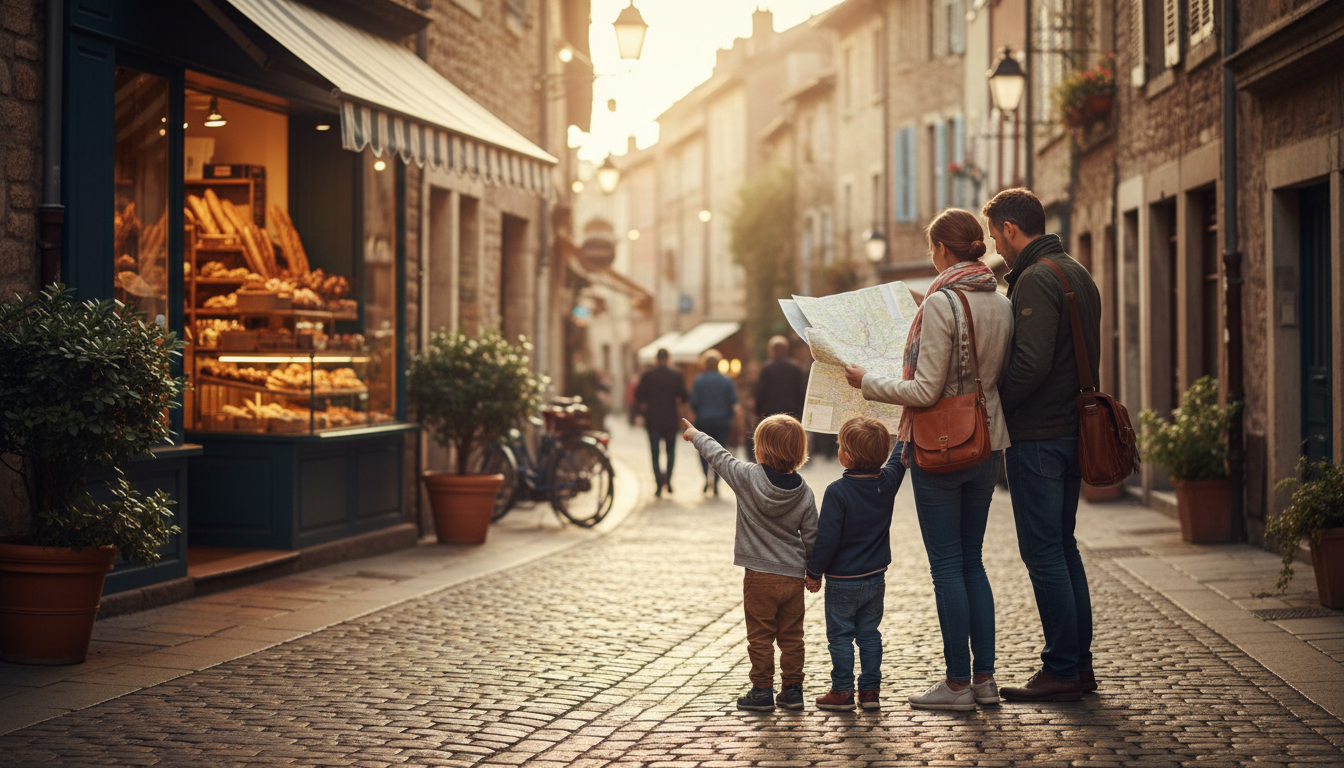 A family with two young children exploring a charming European neighborhood street, the kids pointin
Why Home Swapping Creates Deeper Learning Experiences
There's a fundamental difference between visiting a place and temporarily living in it. Hotels, by design, minimize cultural friction. They offer familiar comforts, predictable routines, and staff who smooth over any confusion. This is lovely for a business trip or a quick getaway, but it creates a bubble that separates travelers from the place they've traveled to see.
Home swapping punctures that bubble entirely.
When your family stays in someone else's home, you're suddenly confronted with how other people actually live. The kitchen is stocked with unfamiliar ingredients. The books on the shelves are in another language. The neighborhood park has different playground equipment than what your kids are used to. Even the light switches work differently.
For children, these small differences become profound teaching moments. They start asking questions—endless questions—about why things are the way they are. Why do the eggs sit on the counter instead of the refrigerator? Why are all the cars so small? Why does everyone hang their laundry outside? Each question opens a door to understanding that human beings have developed countless different solutions to the same basic problems of living.
I remember staying in a family's home in Copenhagen where the children's room had a wall covered in hand-drawn maps. The family had left us a note explaining that their kids loved geography, and they'd drawn maps of every place they'd visited. My son, who was nine at the time and decidedly uninterested in maps, became obsessed with adding to the collection. He spent hours drawing a map of our hometown to leave behind, carefully marking his school, our house, and his favorite pizza place. That wall taught him more about geography and cultural exchange than a year of social studies classes.
The Geography Lesson That Actually Sticks
Let's be honest: most children find geography boring. Memorizing capitals, identifying countries on a map, learning about climate zones—it all feels abstract and disconnected from their lives. But something magical happens when geography becomes personal.
Before a home swap trip, geography transforms from a subject into a treasure hunt. Where exactly are we going? What's near it? What language do people speak there? What's the weather like? Suddenly, your child has a reason to care about where Portugal sits on a map, because in three weeks, they'll be sleeping in a Portuguese family's home and playing with that family's toys.
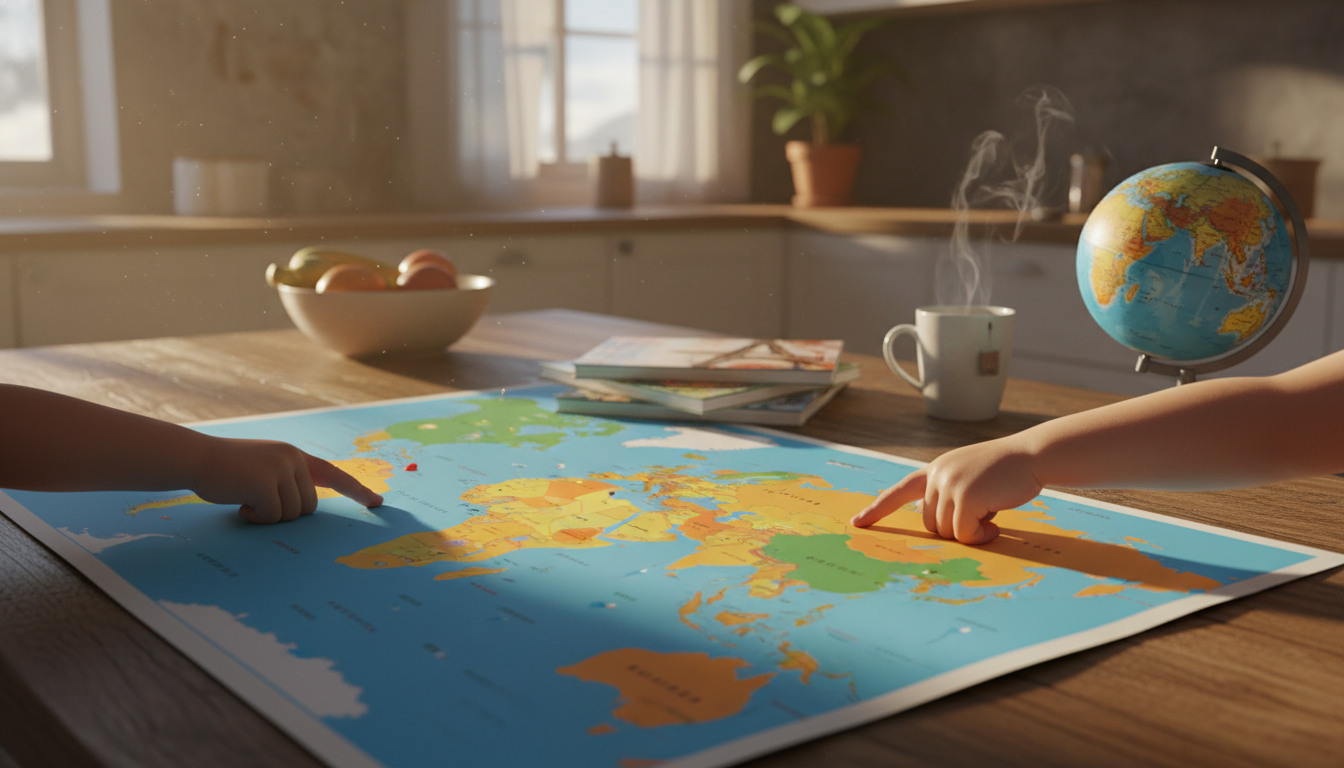 A childs hands pointing at locations on a colorful world map spread across a kitchen table, with tra
The learning doesn't stop once you arrive. Children develop an intuitive understanding of distance, climate, and cultural regions when they experience them firsthand. My daughter learned more about latitude and weather patterns during our summer swap in Stockholm—where the sun barely set—than she ever would have from a textbook. The concept of the midnight sun went from an abstract fact to a lived experience that she still talks about years later.
Home swapping also teaches children about the interconnectedness of places. When you're staying in a real home, you often find evidence of where that family has traveled. Photos on the walls, souvenirs on shelves, guidebooks in the living room. Children start to see that travel isn't just something their family does—it's a human universal, a way that people everywhere connect with the broader world.
Cultural Immersion Without the Pressure
One of the beautiful things about home swapping for families is that it provides cultural immersion at a child-friendly pace. You're not rushing from tourist attraction to tourist attraction, trying to maximize your expensive hotel stay. You're living in a neighborhood, which means you have time to slow down and let children absorb their surroundings naturally.
Mornings might involve walking to a local bakery for breakfast, where your kids learn to point at pastries and attempt a few words in the local language. Afternoons could be spent at a neighborhood playground, where they discover that children everywhere love to swing and slide, even if the games they play are slightly different. Evenings might find you cooking dinner in the family's kitchen, experimenting with local ingredients and discovering new favorite foods.
This slow immersion is developmentally perfect for children. Their brains are wired to learn through observation and participation, not through lectures or guided tours. When they watch local families going about their daily routines, they're absorbing cultural information at a deep level—learning not just facts about a place, but developing genuine empathy and understanding for people who live differently than they do.
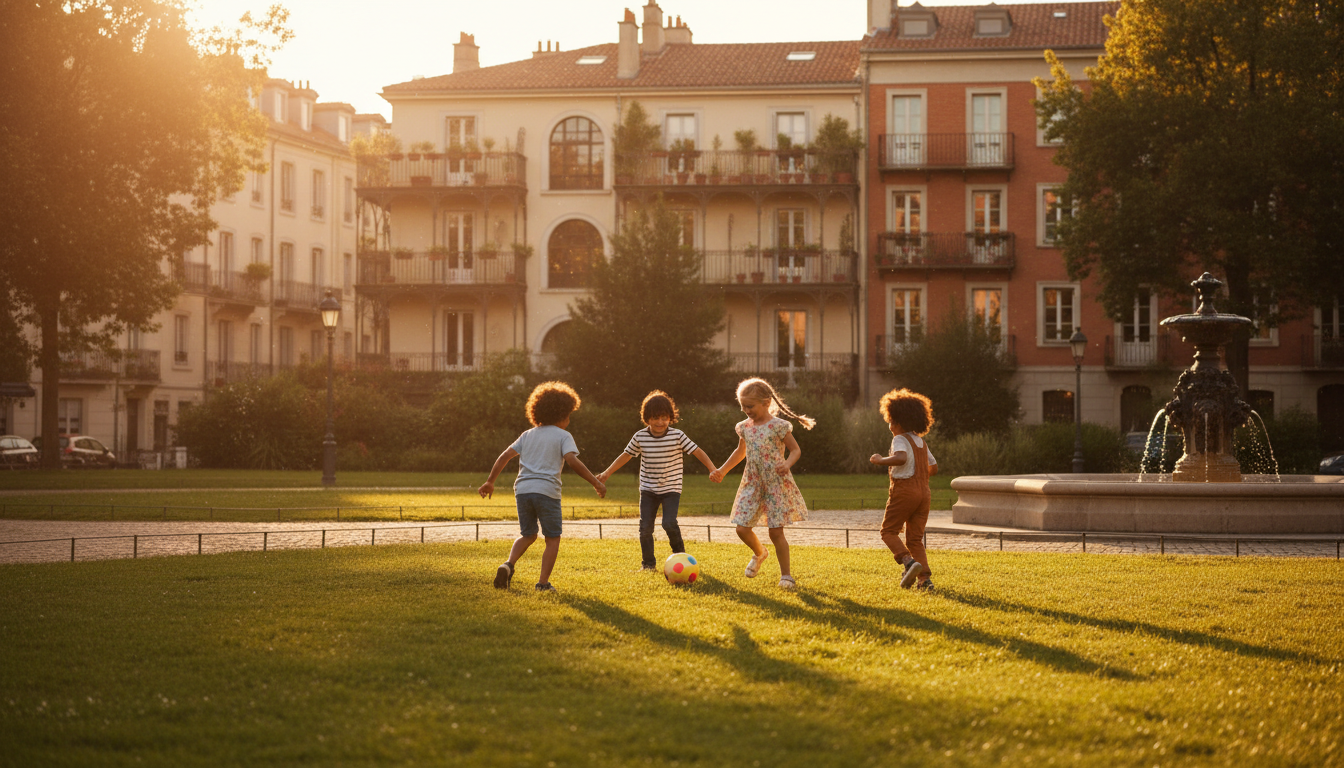 Children of different nationalities playing together in a sunny European park, with apartment buildi
I've watched my children develop remarkable adaptability through home swapping. They've learned to navigate unfamiliar environments, to communicate when they don't share a language, to try foods that initially seemed strange, and to find common ground with children from completely different backgrounds. These skills—flexibility, resilience, open-mindedness—are exactly what they'll need to thrive in our increasingly connected world.
Practical Learning: Life Skills in Action
Beyond the cultural and geographical education, home swapping teaches children practical skills that will serve them throughout their lives. And because these lessons happen organically, in the context of real experiences, they stick in ways that formal instruction rarely achieves.
Consider money and budgeting. Traditional travel often shields children from financial realities—parents pay for hotels and restaurants, and kids have no concept of what things cost. But when you're home swapping and shopping at local markets, children see the family budget in action. They learn to convert currencies, to compare prices, to make choices about how to spend limited resources. My kids became surprisingly savvy about exchange rates after a few trips where they had small allowances to spend on souvenirs.
Then there's the planning process itself. Home swapping requires research, communication, and organization—and children can be involved in every step. They can help search for potential homes, looking at photos and reading descriptions. They can contribute to messages with host families, perhaps writing a few sentences about themselves or their pets. They can help plan what to pack, what activities to prioritize, and how to prepare the family home for incoming guests.
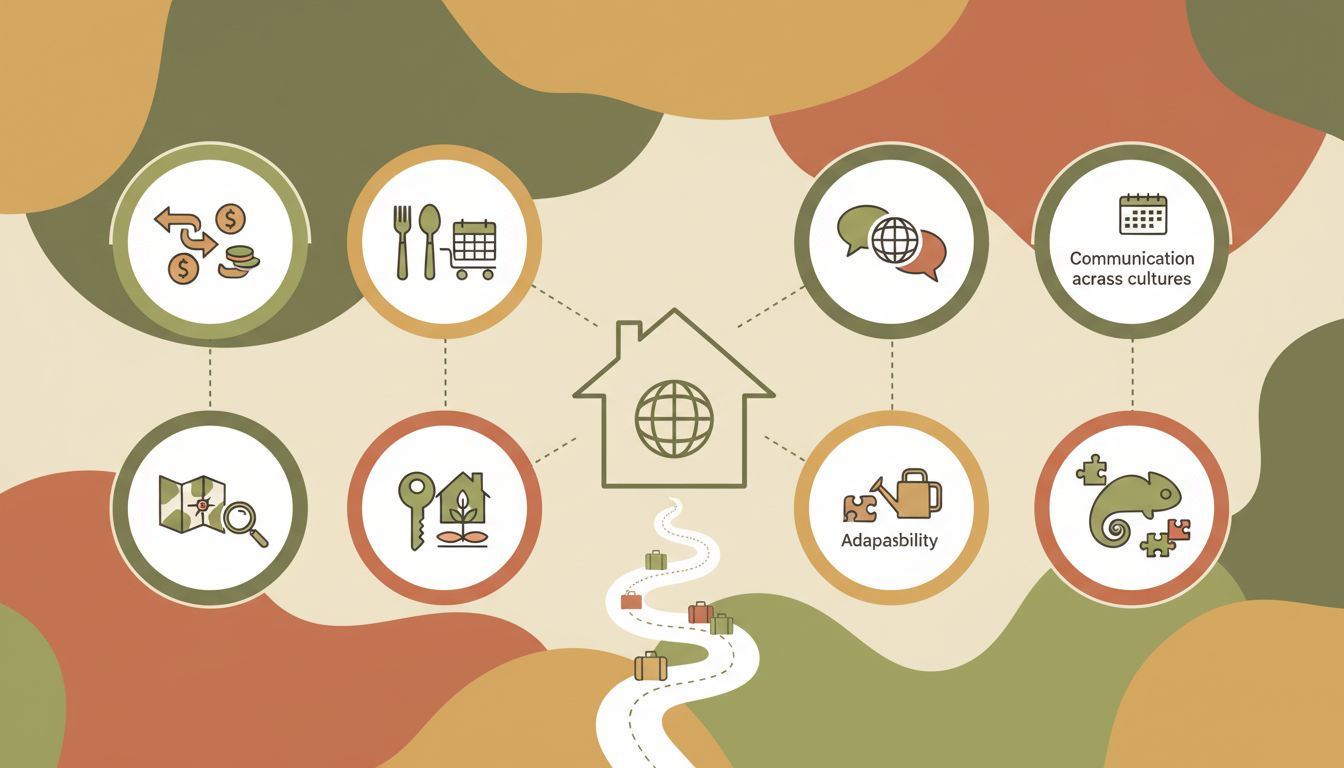 An infographic showing Life Skills Kids Learn Through Home Swapping with illustrated icons for curre
This involvement gives children ownership over the travel experience. They're not passive passengers being dragged from place to place—they're active participants in a family adventure. And that sense of agency makes the entire experience more meaningful and memorable.
The responsibility aspect deserves special mention. When you're staying in someone else's home, you need to treat it with care. Children quickly understand that real people—people with kids just like them—will return to this home. They learn to be respectful of others' belongings, to clean up after themselves, and to leave spaces better than they found them. These lessons in responsibility and consideration transfer directly to how they treat their own home and community.
Building Empathy Across Borders
Perhaps the most profound gift that home swapping gives children is the development of genuine empathy for people from different backgrounds. In an age of increasing polarization and tribalism, raising children who can see the humanity in people unlike themselves feels more important than ever.
When children stay in another family's home, that family becomes real to them in a way that abstract discussions of "other cultures" never achieve. They sleep in beds that other children sleep in. They play with toys that other children love. They see family photos on the walls and imagine the lives of the people in them. This intimacy creates connection.
Many home swapping families leave welcome notes, local recommendations, or small gifts for their guests. When children receive these gestures of hospitality from strangers halfway around the world, they learn something profound about human kindness. They discover that generosity and warmth exist everywhere, that most people want to help others and share what they love about their homes.
The reciprocal nature of home swapping reinforces these lessons beautifully. When your family hosts others in return, children experience the joy of welcoming strangers and sharing their own world. They might leave notes about their favorite local spots, recommend their beloved pizza place, or set out their favorite books for visiting children to enjoy. This reciprocity teaches them that cultural exchange is a two-way street, that they have something valuable to offer as well as something to learn.
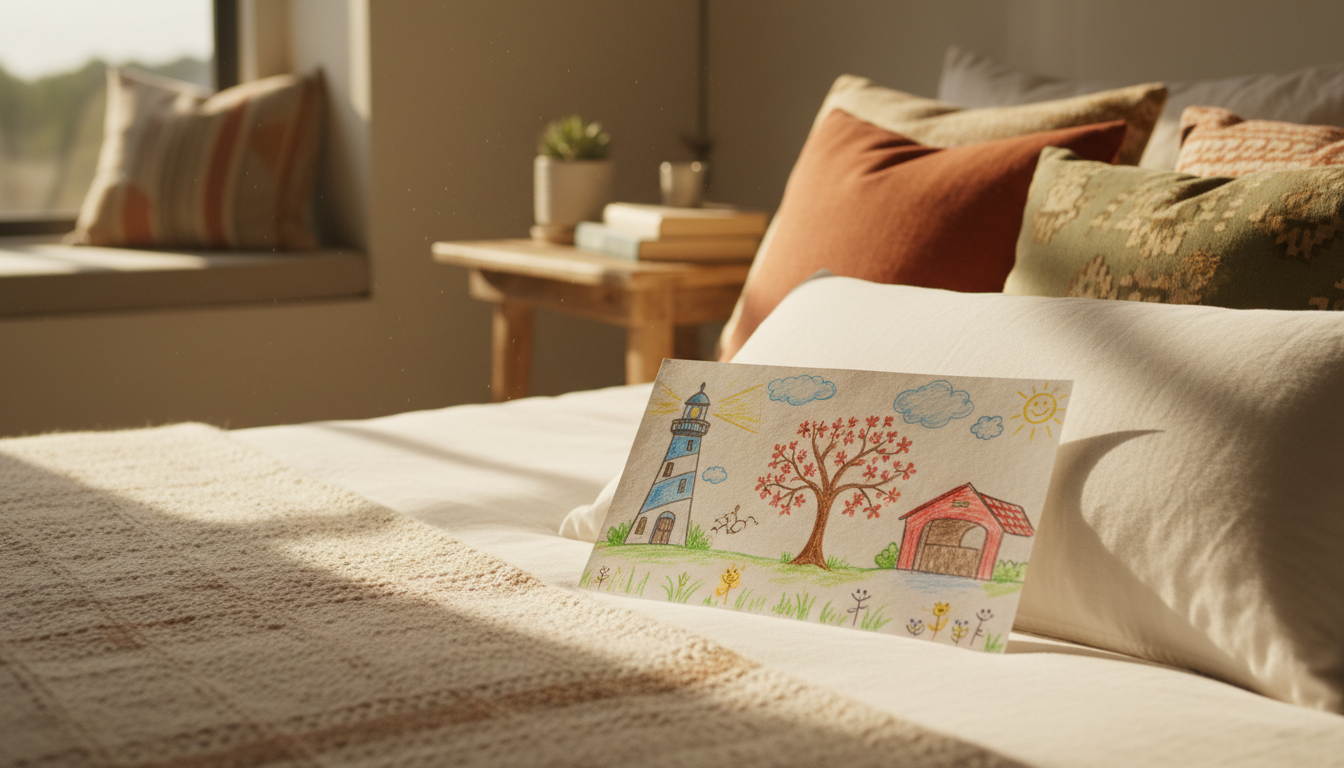 A childs hand-drawn welcome note with colorful illustrations of local landmarks, placed on a pillow
I've seen this empathy development in action countless times. After staying in a family's home in Japan, my daughter became fascinated with Japanese culture and started learning basic Japanese phrases. But more importantly, she started asking questions about what daily life was like for Japanese children her age. What did they eat for lunch? What games did they play? What were their schools like? The family we'd swapped with became a window into an entire way of life, and her curiosity was genuine and respectful.
Making It Work: Age-Appropriate Approaches
Of course, children of different ages will engage with home swapping travel in different ways, and smart parents adjust their approach accordingly.
For toddlers and preschoolers, the focus should be on sensory experiences and simple observations. Young children won't remember the historical significance of where you visited, but they'll remember the taste of fresh croissants from the bakery downstairs, the sound of church bells in the morning, the feel of cobblestones under their feet. At this age, home swapping works beautifully because it provides the comfort and routine that young children need—a real kitchen for preparing familiar foods, a cozy bedroom for naps, a neighborhood to explore at a toddler's pace.
Elementary-aged children are primed for active learning and can be involved in every aspect of the experience. They can help research destinations, learn basic phrases in new languages, keep travel journals, and take photographs to document their adventures. This is the age when children are naturally curious about how things work and why people do things differently—perfect for the kind of comparative cultural learning that home swapping facilitates.
Tweens and teenagers might initially resist family travel (it's not cool to hang out with your parents, after all), but home swapping often wins them over. The independence of staying in a real home—being able to grab breakfast on their own, explore the neighborhood, have some privacy—appeals to their growing need for autonomy. And the authentic cultural experiences feel more sophisticated and interesting than tourist-trap attractions. I've watched sullen teenagers transform into enthusiastic explorers when given the freedom to discover a new place on their own terms.
Creating Lasting Memories and Traditions
The families I know who home swap regularly have developed beautiful traditions around their travels. Some keep a family travel journal, with each member contributing entries and mementos from every trip. Others collect small items from each destination—a tile from Portugal, a wooden spoon from Sweden, a piece of pottery from Mexico—creating a physical reminder of their adventures.
Photography becomes more meaningful when children are actively involved. Instead of posed shots in front of famous landmarks, home swapping families often have albums full of everyday moments: cooking dinner in a Parisian kitchen, playing cards on a rainy afternoon in Ireland, walking to school with local children in Costa Rica. These images capture the texture of daily life in different places, and they become treasured family memories.
Many families also maintain connections with the families they've swapped with, creating a global network of friends. Children exchange letters or video calls with kids they've met through swapping. Some families do repeat swaps, returning to beloved destinations and watching each other's children grow up over the years. These ongoing relationships teach children that the world is full of potential friends, that borders and distances don't have to separate people who care about each other.
The tradition of preparing your own home for guests also becomes meaningful for children. They take pride in making their space welcoming, in sharing their favorite things, in being good hosts even when they're not physically present. This sense of participation in a global community of travelers shapes how they see themselves and their place in the world.
Getting Started: Your Family's First Home Swap
If you're intrigued by the possibility of teaching your children about the world through home swapping, the good news is that getting started is simpler than you might think.
The first step is creating a profile that showcases your home and family. Be honest and detailed—mention that you have children, describe your home accurately, and share what makes your location special. Other families with children will be specifically looking for kid-friendly homes, so highlighting features like a backyard, proximity to parks, or a collection of children's books and games can make your listing more attractive.
Platforms like SwappaHome make the process straightforward by using a credit system: when someone stays at your home, you earn credits that you can use to stay in homes anywhere in the world. This flexibility is particularly valuable for families, as it means you're not locked into simultaneous exchanges and can travel when school schedules and work calendars align.
When searching for your first swap destination, consider what will engage your children. A home near beaches might appeal to water-loving kids, while a city apartment could excite children who dream of urban adventures. Look for homes where other families with children have stayed—reviews often mention kid-friendly features and nearby activities.
Before you go, involve your children in the preparation. Let them help research the destination, learn a few phrases in the local language, and understand what to expect. This preparation builds excitement and helps children feel invested in the adventure.
And when you arrive, resist the urge to over-schedule. The beauty of staying in a real home is that you have time to simply live in a new place. Let your children set some of the pace. Follow their curiosity. Allow for lazy mornings and spontaneous discoveries. The learning will happen naturally when you give it space.
The Gift That Keeps Giving
Looking back on years of home swapping with my children, I'm struck by how profoundly these experiences have shaped who they're becoming. They're curious about the world in a way that feels genuine, not performative. They're comfortable with difference and uncertainty. They understand, in their bones, that their way of life is one beautiful option among countless beautiful options.
These aren't lessons I could have taught them through lectures or books. They're lessons that came from sleeping in other children's beds, eating at other families' tables, and discovering that home can be found in the most unexpected places.
The world is full of families just like yours—parents who want their children to grow up with open minds and open hearts, who believe that travel is one of the greatest educations we can offer. Through home swapping, you can connect with these families, share in each other's lives, and give your children the gift of genuine global citizenship.
It starts with a single trip, a single home, a single moment when your child realizes that the world is bigger and more wonderful than they ever imagined. And from there, the adventure never really ends.

Published by
SwappaHome
SwappaHome Editorial Team
Home Exchange & Slow Travel Editorial
The SwappaHome Editorial Team brings together travel research, home-exchange community insights, and platform data to produce practical guides for first-time and experienced home swappers. Every article cites real platforms, current market rates, and verifiable city-level facts so readers can make informed decisions without guessing.
Ready to try home swapping?
Join SwappaHome and start traveling by exchanging homes. Get 7 free credits when you sign up!
Related articles

Bachelor and Bachelorette Parties in Singapore: The Complete Home Swap Group Guide for 2026
Planning a bachelor or bachelorette party in Singapore? Discover how home swapping lets groups of 6-12 stay together in luxury condos, saving thousands while partying in Marina Bay.
Cycling in Lisbon: 7 Home Swap Bike Tour Itineraries for Every Rider
Discover the best cycling routes in Lisbon with these home swap bike tour itineraries—from waterfront paths to hilltop adventures, all starting from your borrowed home.

Graduation Trip to Barcelona: How Home Swapping Gives New Graduates the Ultimate Celebration
Planning a graduation trip to Barcelona? Discover how home swapping lets new graduates explore Spain's most vibrant city without the hostel crowds or hotel costs.