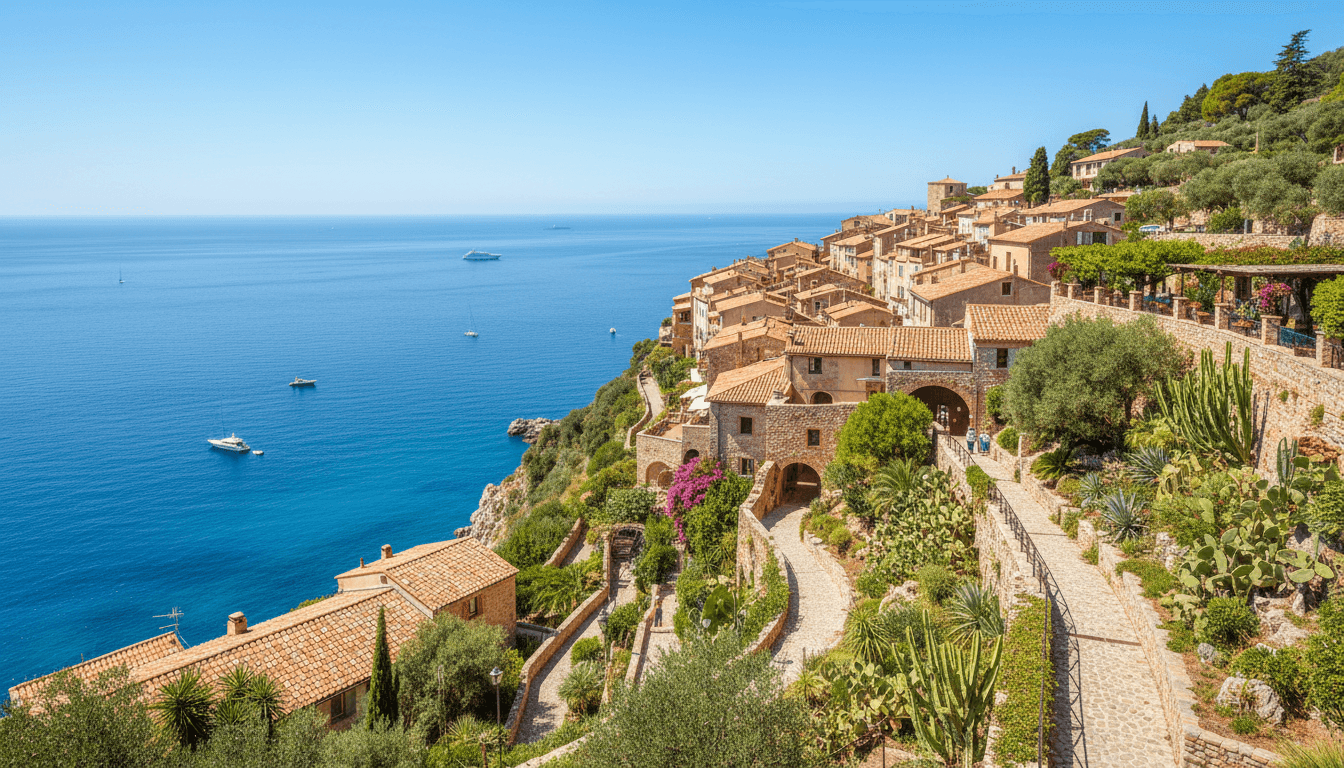
Family-Friendly Home Swapping in French Riviera: The Complete Planning Guide for 2024
Maya Chen
Travel Writer & Home Exchange Expert
Plan the ultimate family-friendly home swap on the French Riviera with insider tips on kid-approved beaches, neighborhoods, and how to find the perfect exchange.
My daughter was four when she first tasted real socca from a vendor in Nice's Cours Saleya market. She burned her tongue because she couldn't wait for it to cool, and honestly? Neither could I. That trip—our first family-friendly home swapping in French Riviera adventure—changed how we travel forever. We stayed in a three-bedroom apartment in Antibes with a washing machine (crucial with kids), a balcony overlooking terracotta rooftops, and neighbors who taught my daughter to say "bonjour" with a proper French accent.
Three years and five Riviera swaps later, I've learned that traveling the Côte d'Azur with children isn't just possible—it's actually better when you're staying in a real home instead of cramming everyone into a hotel room with a minibar you're terrified they'll open.
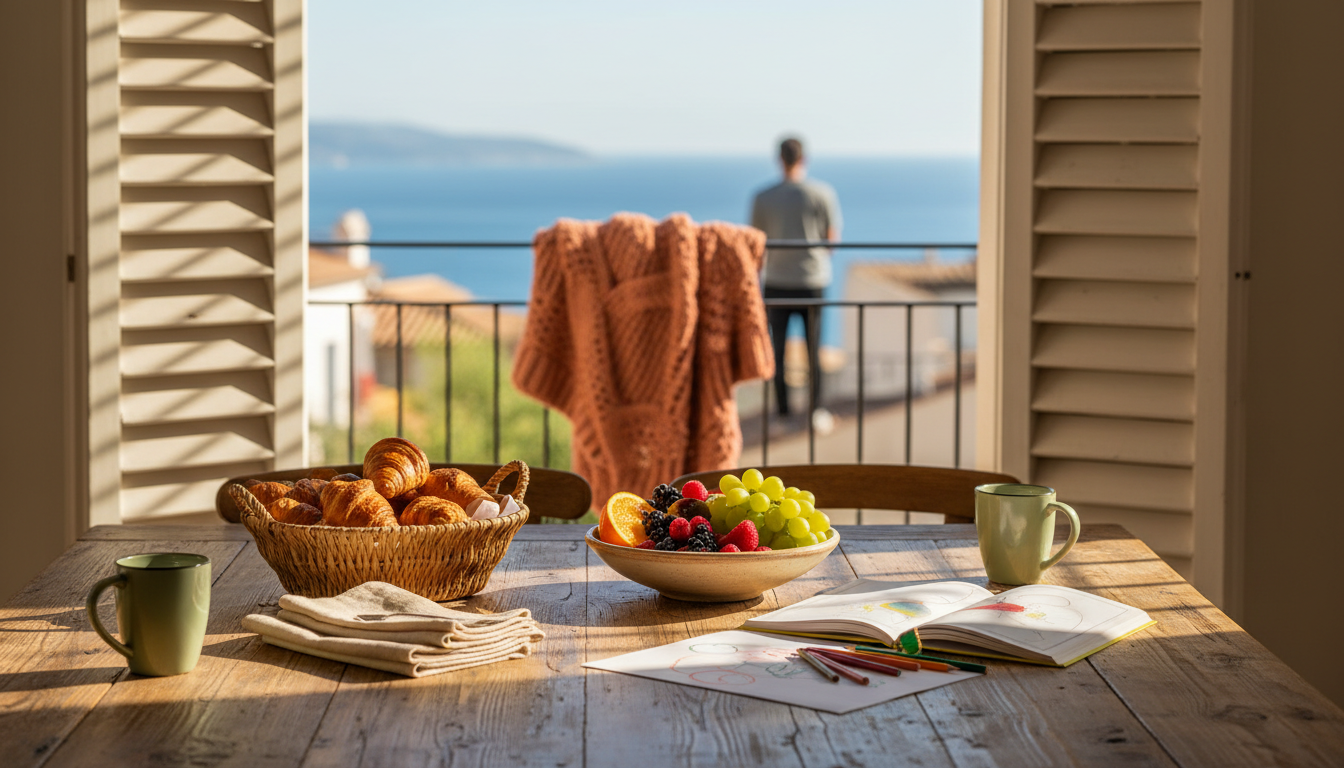 Morning light streaming through shuttered windows onto a breakfast table with croissants, fresh frui
Why Family-Friendly Home Swapping Makes Sense on the French Riviera
Here's what nobody tells you about the French Riviera with kids: it's expensive. Like, genuinely jaw-dropping expensive. A family hotel room in Nice during summer runs €250-400 per night ($270-430 USD). Cannes? Even worse. And those prices get you a room—not a kitchen, not a washing machine, not a space where your toddler can have a meltdown without the entire floor hearing.
Home swapping flips this equation entirely.
Last July, we stayed in a four-bedroom villa in Mougins—the kind of place with a private pool and a garden full of lavender—for exactly zero euros. The family who owned it took our San Francisco apartment for two weeks. Their teenagers wanted to explore California; my kids wanted to splash in a pool without paying €50 per day for hotel sunbed access.
The math is almost absurd when you break it down. Two weeks in a comparable rental property would cost €4,000-6,000 ($4,300-6,500 USD). Two weeks through home exchange? The credits you've already earned by hosting others. That's money you can spend on boat trips to the Îles de Lérins, or that fancy beach club lunch in Saint-Tropez, or just really excellent ice cream every single day.
But honestly, the financial savings aren't even the best part.
The Real Reason Families Choose Home Exchange Over Hotels
Kids need space. Not Instagram-worthy space—functional, messy, lived-in space. They need a kitchen where you can make pasta at 6 PM because someone is hangry and the restaurants don't open until 7:30. They need a couch for afternoon movie time when the sun gets too intense. They need their own bedroom so everyone actually sleeps.
Home swapping gives you all of this, plus something hotels never can: a local's perspective.
The family we swapped with in Antibes left us a binder. Not a generic tourist guide—a handwritten notebook with their favorite beaches (Plage de la Gravette for calm water, Plage du Ponteil for the playground nearby), the bakery with the best pain au chocolat (Maison Brémond on Rue de la République), and crucial intel like "the parking garage on Place de Gaulle is cheaper than the one by the port."
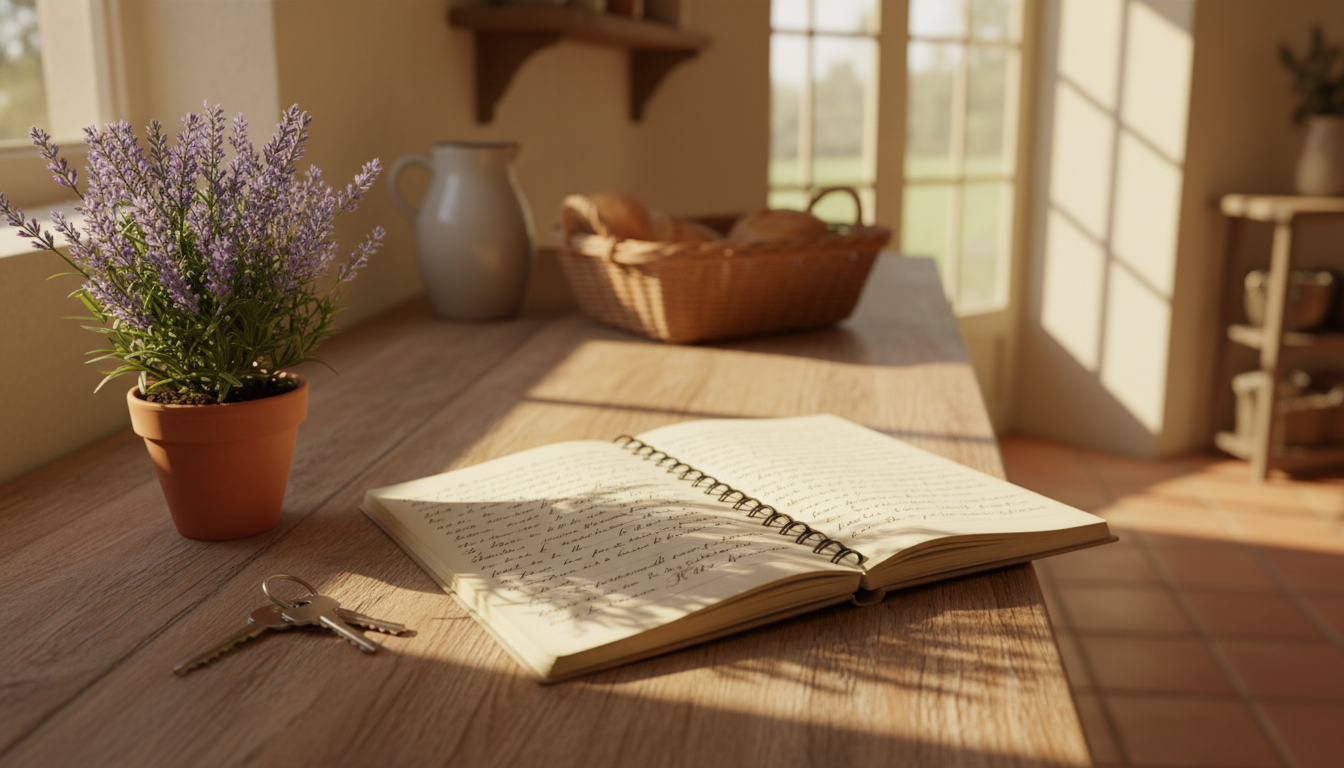 A handwritten notebook open on a kitchen counter next to a set of house keys and a small potted lave
That kind of information transforms a vacation. Instead of wandering around hoping to stumble onto something good, you arrive with insider knowledge. You feel like you belong.
Best Neighborhoods for Family-Friendly Home Swapping on the French Riviera
Not all Riviera towns work equally well when you're traveling with children. Some are gorgeous but impractical. Others are perfect for families but overlooked by most tourists. Here's my honest breakdown after swapping in six different locations.
Antibes: The Sweet Spot for Families
If I had to pick one town for a first family home swap on the Riviera, it's Antibes every time.
The old town is compact and walkable—important when you're pushing a stroller over cobblestones or chasing a six-year-old who's spotted another cat. The beaches are sandy (rare on this coastline), the market is one of the best in the region, and there's an actual playground right by the water at Plage du Ponteil.
Antibes also has the Marineland aquarium complex about 15 minutes away, which saved us on a rainy day. It's not SeaWorld, but it's got dolphins and penguins, and my kids talked about it for months.
Home swap availability here is excellent. Antibes has a strong community of families who travel during school holidays, which means plenty of kid-friendly homes with toys, high chairs, and—crucially—blackout curtains. Most listings offer 2-3 bedrooms, often with balconies or small gardens.
Nice: The Practical Choice
Nice is the easiest base logistically. The airport is right there, the train connections are excellent, and you can reach Monaco, Èze, or Villefranche in under 30 minutes. The Promenade des Anglais is iconic, and the old town (Vieux Nice) has that chaotic, colorful energy that kids seem to love.
The catch? The beaches are rocky, not sandy. Bring water shoes or prepare for complaints. Nice is also a city—busier, noisier, and less "vacation-y" than the smaller towns.
For home swaps, the best family neighborhoods are Cimiez (quieter, with the Matisse Museum and Roman ruins), the Port area (near the beach but more residential), or the western end near the airport (less charming but very practical).
Villefranche-sur-Mer: The Postcard Town
This is the Riviera of your imagination: pastel buildings tumbling down to a sheltered bay, fishing boats bobbing in clear water, a beach where you can actually swim without waves knocking over your toddler.
Villefranche is tiny, which is both its strength and weakness. There's not much to do besides swim, eat, and wander—but with kids, that's often exactly right. The beach (Plage des Marinières) has calm, shallow water and a few restaurants right on the sand.
Home swap availability is limited since it's a small town, so fewer listings exist. But the ones that do tend to be spectacular. I've seen a converted fisherman's house with a roof terrace that made me audibly gasp.
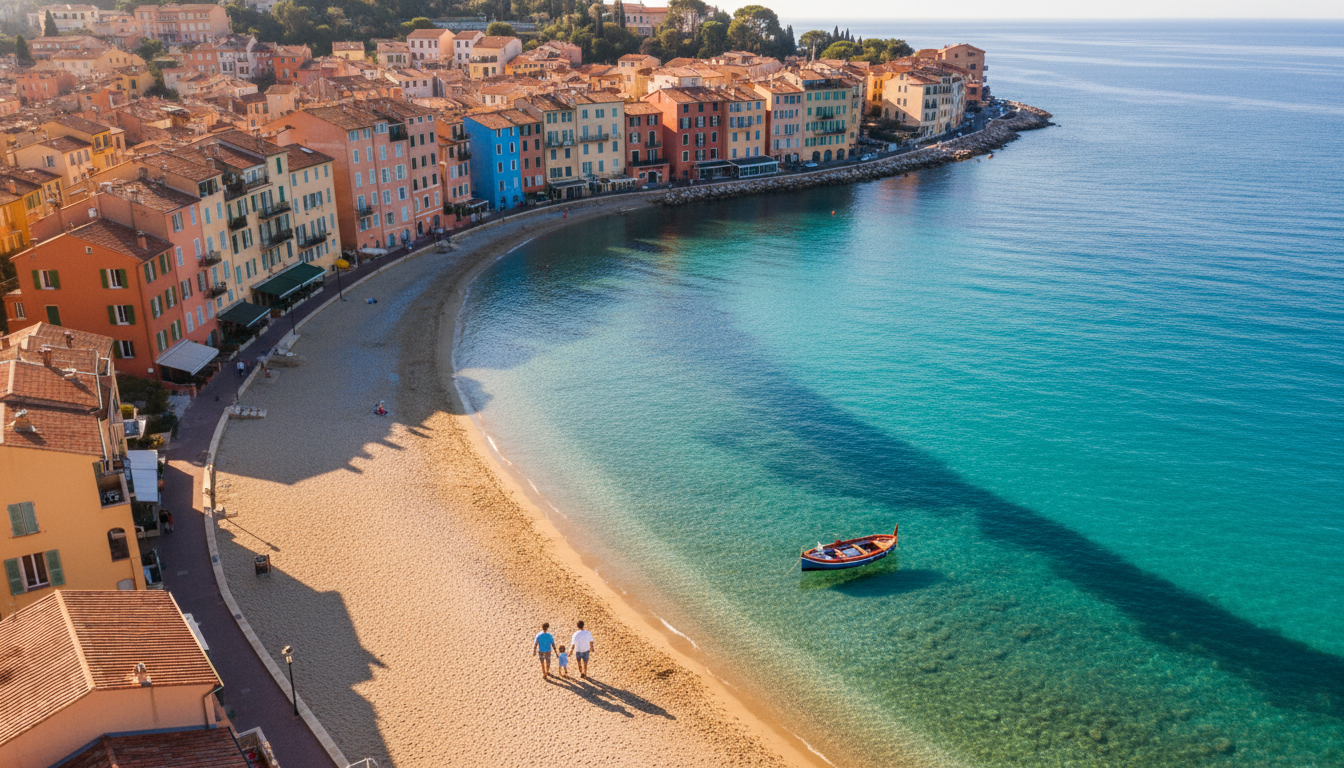 Aerial view of Villefranche-sur-Mers curved bay with colorful buildings, a family visible on the san
Menton: The Underrated Gem
Menton sits right on the Italian border, and it feels different from the rest of the Riviera—quieter, more Italian in flavor, with incredible gardens and a microclimate that makes it even warmer than Nice.
For families, the big draw is the beaches: long, sandy, and significantly less crowded than Cannes or Nice. The old town is steep (lots of stairs), but the waterfront is flat and stroller-friendly.
Menton is also cheaper than the rest of the Riviera. Restaurants, parking, ice cream—everything costs a bit less. If you're doing a longer swap, this matters.
Where to Avoid with Young Kids
I'm going to be honest: Saint-Tropez and Monaco are not great with small children.
Saint-Tropez is gorgeous but logistically annoying—traffic is nightmarish in summer, parking is expensive and distant, and the vibe is more champagne-and-yachts than sandcastles-and-naps. Monaco is fascinating for a day trip (the Oceanographic Museum is excellent), but staying there with kids feels like bringing a toddler to a fancy restaurant for every meal.
Cannes falls somewhere in the middle. The beaches are beautiful but mostly private (€30-50 per person per day for a sunbed), and the town itself is more glamorous than family-oriented. That said, the Îles de Lérins boat trip from Cannes is absolutely worth doing with kids—Île Sainte-Marguerite has forest trails, rocky coves for swimming, and the prison where the Man in the Iron Mask was held.
How to Find the Perfect Family Home Swap on the French Riviera
Finding a home swap is part strategy, part relationship-building. Here's what's worked for me.
Start Early—Really Early
French families book their summer holidays months in advance. If you want a Riviera swap in July or August, start reaching out in January or February. I know that sounds excessive. It's not.
The best family homes get snapped up fast because—surprise—everyone wants a three-bedroom apartment with a pool and a crib already in place.
Write a Compelling Family Profile
Your SwappaHome profile needs to show that you're trustworthy, responsible, and that your kids won't destroy someone's home. Include the ages of your children (helps hosts know what to prepare), your travel style ("we're early risers who spend most of the day out exploring"), what you're looking for ("a home with outdoor space and a washing machine"), and photos of your home AND your family (hosts want to see who's staying).
Be specific about your needs. If you need a crib, say so. If your kid has allergies, mention it. The more information you provide, the easier it is for hosts to say yes.
Look for Families Like Yours
The best swaps happen when both families are at similar life stages. A couple with teenagers probably has a home set up for teenagers—not a baby-proofed space with a high chair. Search for listings that mention kids, toys, or family-friendly features.
On SwappaHome, you can filter by amenities and read through listing descriptions to find homes that explicitly welcome families. Pay attention to the photos: are there kids' books on shelves? A swing set in the garden? These details tell you more than any description.
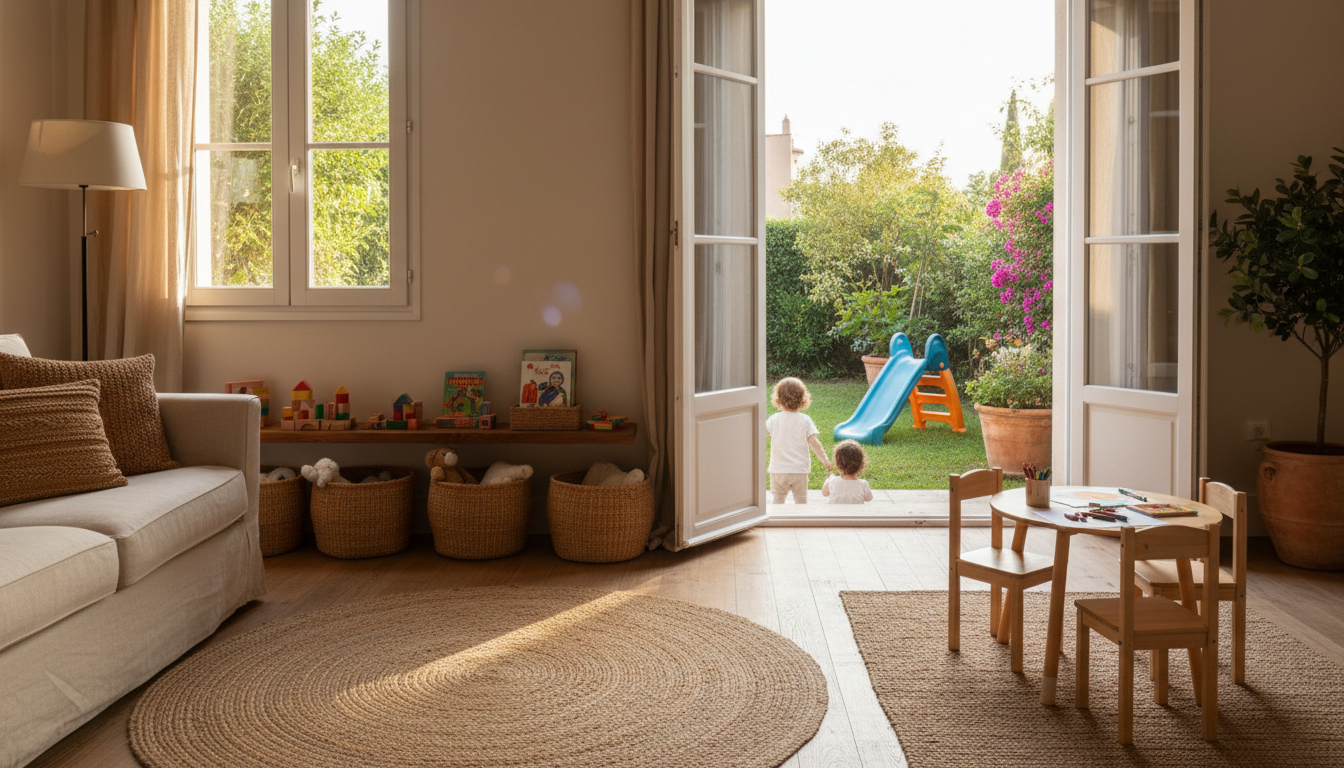 A bright living room with toys neatly stored in baskets, a child-sized table and chairs, and French
The First Message Matters
When you reach out to a potential swap, don't send a generic "we'd love to stay at your place" message. Mention something specific about their home, explain why the Riviera appeals to your family, and offer details about your own home that might interest them.
Something like:
"Hi! We're the Chen family—two adults, two kids (ages 5 and 8). We noticed your apartment in Antibes has a balcony and is near Plage de la Gravette, which looks perfect for our July trip. Our San Francisco home has three bedrooms, a backyard, and we're a 15-minute drive from the Golden Gate Bridge. Would you be interested in discussing a swap?"
Personal, specific, and shows you've actually read their listing.
Practical Planning: What Families Need to Know
Getting There
Nice Côte d'Azur Airport (NCE) is your gateway. Direct flights from major US cities run during summer (United from Newark, Delta from New York and Atlanta, Norwegian from various hubs). Flight time is roughly 9-10 hours.
With kids, I recommend arriving in the morning if possible. The jet lag is brutal either way, but arriving at 10 AM means you can push through to an early bedtime rather than arriving exhausted at midnight.
From Nice airport, you have options. Rental cars are essential if you're staying outside Nice or want to explore—budget €40-70/day ($45-75 USD) for a family-sized vehicle. The coastal TER trains are cheap (€5-15 per adult), scenic, and stop at most Riviera towns, with kids under 4 riding free. Taxis and Uber run €30-50 to central Nice, €50-80 to Antibes or Cannes.
Transportation Once You're There
This is where opinions diverge. Some families swear by renting a car; others find it more hassle than it's worth.
My take: if you're staying in Nice or Antibes, you don't need a car. The train and bus connections are excellent, parking is expensive and stressful, and the coastal roads in summer are clogged with traffic.
But if you want to explore the hilltop villages (Èze, Saint-Paul-de-Vence, Gourdon), visit the lavender fields in the backcountry, or have the flexibility to beach-hop, a car makes life easier. We usually rent one for 3-4 days of a two-week trip, not the whole time.
Food and Dining with Kids
French restaurants are generally welcoming to children, but with caveats. Dinner service starts late (7:30-8 PM at the earliest), portions are adult-sized, and there's rarely a kids' menu outside of tourist traps.
Embrace the long lunch—many restaurants offer better-value set menus at lunch, kids are more alert, and you can do a light dinner at home. Picnic constantly. The markets are incredible—grab cheese, bread, charcuterie, and fruit, and eat on the beach or in a park. Cook at home. This is the whole point of home swapping! The produce at Provençal markets is extraordinary, and even simple pasta with fresh tomatoes tastes better when you're eating it on a terrace overlooking the sea. And find the pizza places. Every town has them, they're usually good, and kids will eat pizza anywhere.
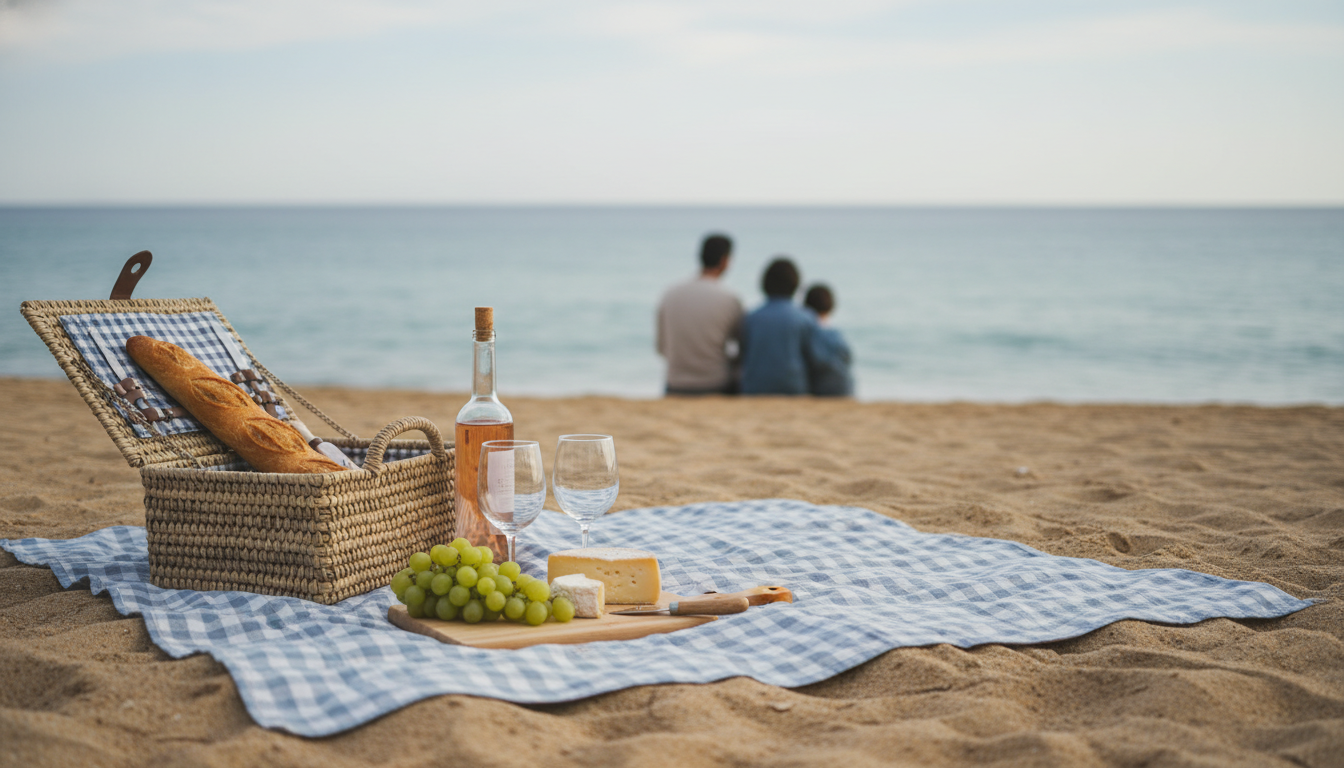 A family picnic spread on a checkered blanket at a beach, with baguette, cheese, grapes, and a bottl
Budget Breakdown (Two Weeks, Family of Four)
Even with free accommodation through home swapping, the Riviera isn't cheap. Here's a realistic breakdown:
Flights from the US to Nice run $800-1,500 per person ($3,200-6,000 total). A week of car rental costs $350-500. Food—mixing restaurants, markets, and cooking—runs $1,200-1,800. Activities and attractions add $300-500. Miscellaneous expenses like parking, beach gear, and ice cream total $200-400.
Total: $5,250-9,200
For comparison, the same trip with hotel accommodation would add $3,800-6,000 for rooms alone. Home swapping cuts your total budget by roughly 40%.
Kid-Approved Activities Beyond the Beach
Yes, the beaches are the main attraction. But you'll want backup plans for cloudy days, restless afternoons, or when everyone has simply had enough sand in their swimsuits.
Marineland (Antibes) offers an aquarium, dolphin shows, and an attached water park—a full-day activity. Tickets run around €42 per adult, €35 per child ($45/$38 USD). Book online to skip lines.
Oceanographic Museum (Monaco) sits in a stunning building on a cliff with an excellent aquarium and rooftop views. More educational than Marineland, better for kids 6+. €18 per adult, €12 per child ($20/$13 USD).
The trains—seriously. French kids are obsessed with the TER trains, and yours will be too. The coastal route between Nice and Monaco goes through tunnels and along cliffs—it's genuinely spectacular. Round trip costs under €10 per adult.
Hilltop villages make for great day trips. Èze has a cactus garden at the top that kids find surprisingly interesting. Saint-Paul-de-Vence has an excellent contemporary art foundation (Maeght) with outdoor sculptures. Gourdon has a medieval castle. All involve walking and stairs, so bring the carrier for little ones.
Boat trips to Île Sainte-Marguerite from Cannes take 15 minutes and cost €15 per adult round trip. Pack a picnic, explore the forest trails, swim in the coves, visit the fort. One of our best Riviera days.
What to Prepare Before Your Family Home Swap
A successful swap requires preparation on both ends. Here's my pre-trip checklist.
Communicate with your hosts about car seat availability (many French families have them; ask if you can use theirs), crib or toddler bed situation, baby-proofing needs like outlet covers and stair gates, pool safety if there's a pool, local emergency numbers and nearest hospital, and a pediatrician recommendation just in case.
Prepare your own home for guests by clearing out a closet and dresser drawers, leaving fresh linens and towels, stocking basic pantry items (coffee, tea, oil, salt), writing your own guide to the neighborhood, and hiding valuables and personal documents.
Pack for the kids: favorite stuffed animal or comfort item, a few books and small toys for downtime, water shoes (essential for rocky beaches), sun protection (French pharmacies have excellent kids' sunscreen if you forget), and any specific medications.
Making the Most of Your Family Home Swap Experience
After five Riviera swaps, here's what I wish I'd known from the start.
Slow down. The temptation is to see everything—Nice, Monaco, Cannes, Saint-Tropez, all the villages. Resist it. With kids, one activity per day is plenty. Leave time for the pool, the beach, the afternoon gelato run. The best memories won't come from checking off attractions.
Embrace the rhythm. French life has a pace. Shops close for lunch. Dinner is late. Sundays are quiet. Instead of fighting it, lean in. Take that long lunch. Let the kids nap while you sit on the balcony with a glass of rosé. This is vacation.
Connect with your hosts. Even if you never meet in person, the relationship matters. Send photos of your kids enjoying their home. Leave a thoughtful gift (we always bring local treats from San Francisco). Write a genuine review. These connections often lead to future swaps or friendships.
Build in flexibility. Things go wrong. Kids get sick. Weather turns. Having a home base with a kitchen and comfortable space means you can roll with it. A rainy day in a hotel room is miserable. A rainy day in an apartment with toys, books, and the ability to make hot chocolate is actually kind of nice.
The French Riviera with kids isn't the Riviera of celebrity yachts and champagne-fueled parties. It's better. It's morning croissants on a sunny terrace, sandy feet at the end of every day, and the particular magic of watching your children fall in love with a place you love too.
Home swapping makes it possible—financially, practically, and in that deeper sense of actually living somewhere instead of just visiting.
If you're ready to try it, SwappaHome is where I'd start. The platform's credit system means you don't need to find a simultaneous swap (always tricky with school schedules), and the community tends to attract families who understand that homes with kids are homes with life.
My daughter still talks about that first socca in Nice. She's seven now, and she's already asking when we're going back.
I'm looking at listings for next summer.
Frequently Asked Questions
Is family-friendly home swapping on the French Riviera safe?
Home swapping is generally very safe, especially through platforms like SwappaHome where members are verified and reviewed by other users. The mutual exchange creates natural accountability—both families have something at stake. For extra peace of mind, consider getting your own travel insurance that covers personal liability and belongings, and communicate thoroughly with your hosts about house rules and emergency contacts.
How much can families save with home swapping versus hotels on the French Riviera?
A family of four can save $3,800-6,000 on a two-week Riviera trip by home swapping instead of booking hotels. Summer hotel rates for family rooms average €250-400 per night ($270-430 USD) in Nice and higher in Cannes. With home exchange, accommodation costs nothing beyond the SwappaHome membership and credits you've earned by hosting others.
What's the best time of year for a family home swap on the French Riviera?
June and September offer the best balance for families: warm weather (75-82°F/24-28°C), swimmable seas, and smaller crowds than July-August. School holiday periods (mid-July to late August) have the most swap availability since French families travel then too, but beaches and attractions are significantly more crowded. May and October work for older kids who don't mind cooler water.
Do I need a car for a family home swap on the French Riviera?
Not necessarily. If you're based in Nice, Antibes, or along the coastal train line, public transportation is excellent and parking is expensive and stressful. A car helps for visiting hilltop villages, accessing beaches outside town centers, and traveling with heavy beach gear. Many families rent a car for just part of their trip rather than the entire stay.
How far in advance should I arrange a family home swap for the French Riviera?
Start searching 4-6 months ahead for summer swaps, especially July and August. The best family-friendly properties—those with multiple bedrooms, outdoor space, and kid amenities—get booked early. For shoulder season (May-June, September), 2-3 months ahead is usually sufficient. Send personalized messages to potential hosts and be flexible on exact dates to increase your chances.
40+
Swaps
25
Countries
7
Years
About Maya Chen
Travel Writer & Home Exchange Expert
Maya is a travel writer with over 7 years of experience in the home swapping world. Originally from Vancouver and now based in San Francisco, she has completed more than 40 home exchanges across 25 countries. Her passion for "slow" and authentic travel led her to discover that true luxury lies in living like a local, not a tourist.
Ready to try home swapping?
Join SwappaHome and start traveling by exchanging homes. Get 10 free credits when you sign up!
Related articles
Lyon Home Exchange: Your Complete Guide to France's Hidden Gem for Home Swapping
Discover why Lyon home exchange is booming among savvy travelers. From Croix-Rousse to Presqu'île, find the best neighborhoods and insider tips for your swap.

Zurich Bucket List: 47 Unforgettable Experiences to Enjoy During Your Home Swap
Discover the ultimate Zurich bucket list for home swappers—from secret swimming spots to fondue rituals locals actually do. Save thousands while living like a true Zürcher.
Dublin Home Exchange Utilities Guide: WiFi, Heating & Everything Your Guests Need
Master Dublin home exchange utilities—from dodgy WiFi fixes to heating quirks. Practical tips from 7 years of swapping homes across Ireland.