
Home Swapping with Babies: The Complete Guide to Stress-Free Family Travel

SwappaHome Editorial Team
Home Exchange & Slow Travel Editorial
Home swapping with babies transforms family travel from stressful to seamless. Real tips from 40+ exchanges with little ones in tow.
My daughter was eleven months old when we did our first home swap with a baby. I remember standing in a stranger's kitchen in Copenhagen at 2 AM, warming a bottle while snow fell outside the window, thinking: this is so much better than any hotel could ever be.
 cozy Scandinavian kitchen at night with warm lighting, a parent warming a bottle at the counter, sno
Home swapping with babies isn't just possible—it's genuinely the smartest way to travel with little ones. I've done it twelve times now across three continents, and I'm convinced it's the secret that separates parents who dread traveling from those who actually enjoy it. The difference? You're not cramming your family into a cramped hotel room. You're borrowing someone's life—their full kitchen, their washing machine, their quiet neighborhood where nobody cares if your baby screams at 6 AM.
But here's what nobody tells you: traveling with a baby through home exchange requires a completely different approach than the swaps you did pre-kids. The spontaneity you once had? Gone. That "we'll figure it out when we get there" attitude? Dangerous.
So let me walk you through everything I've learned—the hard way, mostly—about making home swapping with babies work beautifully.
Why Home Swapping Beats Hotels When You're Traveling with a Baby
I need to be honest about something. Before my daughter was born, I thought parents who complained about hotel travel were being dramatic. Then I spent four nights in a boutique hotel in Barcelona with a seven-month-old, and I understood everything.
The room was gorgeous. It was also 280 square feet of acoustically perfect nightmare.
Every time she cried, I was convinced the entire floor could hear us. We ate room service at weird hours because the restaurant didn't open until 7 PM—and that's her bedtime. The minibar became our pantry. I spent $47 on Pringles and overpriced water. Forty-seven dollars.
Contrast that with our first home swap with a baby—a two-bedroom apartment in Copenhagen's Vesterbro neighborhood. We had a separate room for her to sleep in. A kitchen where I could prep her food at 5 AM without waking anyone. A washing machine that saved us from packing seventeen onesies. A living room where we could actually sit and have wine after she went down.
The math alone makes the case. That Barcelona hotel ran us about $285/night for a room barely big enough to fit her travel crib. The Copenhagen apartment? One SwappaHome credit per night—essentially free. Over our eight-night stay, we saved roughly $2,280. And we had three times the space.
But it's not really about money, is it? It's about sanity. When you're home swapping with a baby, you're not a tourist trying to squeeze a tiny human into adult travel. You're temporarily living somewhere, with all the infrastructure that implies.
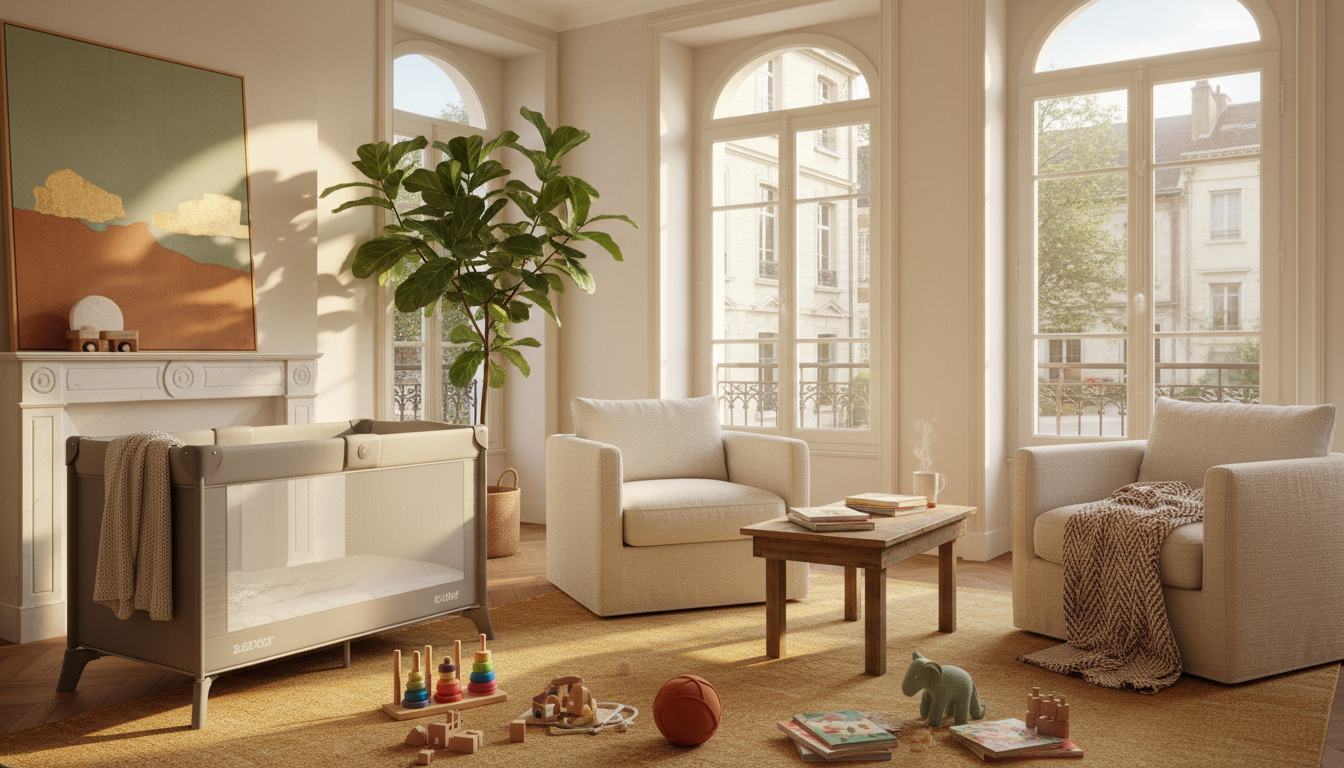 bright, airy living room in a European apartment with a pack-n-play set up in the corner, toys scatt
How to Find Baby-Friendly Home Swaps (The Non-Obvious Stuff)
Here's where most parents mess up: they search for homes that explicitly mention "baby-friendly" or "family-friendly" in the listing. That's fine, but it's limiting. Some of the best swaps I've done with my daughter were with hosts who didn't have kids at all—they just had the right setup.
What actually matters for home swapping with babies:
A separate sleeping space. Non-negotiable for me. Your baby needs somewhere to sleep that isn't three feet from where you're trying to watch Netflix. Look for listings with a second bedroom, a den, even a large walk-in closet—I'm serious, we converted one in Austin and it was perfect. Some hosts will specifically mention a nursery or kids' room, but don't overlook that "home office" that could easily fit a travel crib.
Ground floor or elevator access. I learned this one the hard way in Lisbon. Gorgeous fourth-floor apartment in Alfama. No elevator. Cobblestone streets. Try carrying a sleeping baby, a diaper bag, and groceries up 67 stairs. Once. You'll never make that mistake again.
Walkable neighborhood. Babies need movement. You need coffee. The ideal swap is somewhere you can push a stroller to a café, a park, a grocery store without loading everyone into a car. When I'm searching on SwappaHome, I actually open Google Maps and look for green spaces within a 10-minute walk.
Washer and dryer. Honestly? This might be the most important one. Babies are disgusting. I mean that lovingly. But between blowouts, spit-up, and the mysterious stains that appear from nowhere, you'll do laundry every other day. A listing without laundry facilities is a dealbreaker for me now.
The Questions to Ask Before Booking
Once you find a promising listing, message the host with specific questions. I've developed a standard list over the years: Is there a separate room where we could set up a travel crib? What's the noise situation like—thin walls, loud neighbors, early-morning garbage trucks? Is there a grocery store within walking distance? Any stairs to access the home? Would you be open to us bringing a few baby items to leave for future families? And—this one's important—what's the water heater situation? Nothing worse than running out of hot water mid-bath.
Most hosts are incredibly accommodating once they know you're traveling with a baby. I've had people offer to borrow a crib from friends, leave their high chair out, even stock the fridge with milk and bananas. The home exchange community tends to be generous—you just have to ask.
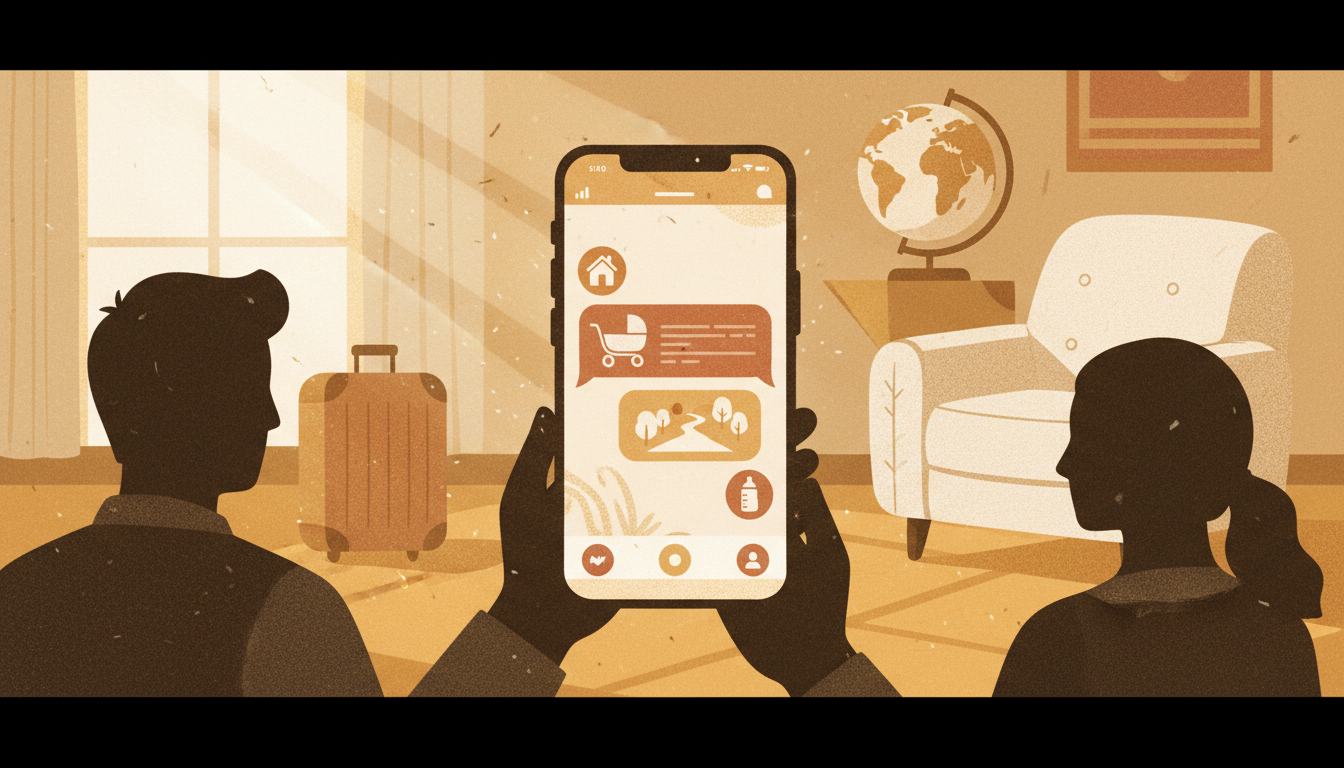 smartphone screen showing a SwappaHome message conversation between two members discussing baby equi
The Baby Gear Dilemma: What to Bring, Borrow, or Buy
This is the question that keeps new parent-travelers up at night. How do you pack for a baby without checking fourteen bags?
After a lot of trial and error, I've landed on a system that works. It's not perfect—nothing with babies is perfect—but it gets us out the door without a moving truck.
Always Bring
Travel crib. I know some people try to borrow cribs or use host-provided ones, but I can't do it. My daughter sleeps in the same Lotus Travel Crib whether we're in Tokyo or Tucson. The consistency helps her sleep, which helps me sleep. It's worth the luggage space. The Lotus weighs 13 pounds and fits in a backpack—not sponsored, just obsessed.
White noise machine. Our Hatch goes everywhere. Different homes have different sounds—creaky floors, street noise, enthusiastic birds at 5 AM. White noise creates a consistent sleep environment no matter where you are.
Car seat. If you'll need one at your destination, bring your own. Renting car seats is expensive—usually $15-20/day—and the quality is questionable. We gate-check ours in a padded travel bag.
Familiar comfort items. Whatever your baby sleeps with—lovey, specific blanket, that one pacifier they'll accept—bring duplicates. I travel with three of my daughter's favorite stuffed elephant because losing it would end the trip.
Borrow or Find at Destination
High chair. Most homes have one, or you can ask your host to borrow one from a neighbor. Worst case, restaurant high chairs exist. This isn't worth packing.
Stroller. This is controversial, but hear me out. If you're doing a longer swap (10+ days), consider buying an inexpensive umbrella stroller at your destination and donating it when you leave. We bought a $45 stroller at a Target in San Diego, used it for two weeks, and left it at a local Buy Nothing group. Saved us the hassle of gate-checking our nice stroller and worrying about damage.
Baby bathtub. Hosts often have these, or you can use the sink for small babies. For older babies, a laundry basket in the regular tub works surprisingly well.
Toys. I bring maybe three small toys from home. The rest? We visit a local thrift store in the first day or two and pick up a few things. Babies don't care if toys are new. We donate everything before we leave.
The Secret Weapon: Baby Gear Rental Services
In major cities, baby gear rental companies are a game-changer for home swapping with babies. BabyQuip operates across the US and parts of Europe. You can have a crib, high chair, toys, and even a jogging stroller delivered to your swap home before you arrive.
Prices vary, but expect to pay around $30-50/day for a full baby setup. For a week-long trip, that's $210-350—still way cheaper than the hotel premium you'd pay for a "family suite."
I've used BabyQuip for swaps in Portland, Chicago, and Miami. The gear is clean, the delivery is reliable, and the peace of mind is worth every penny.
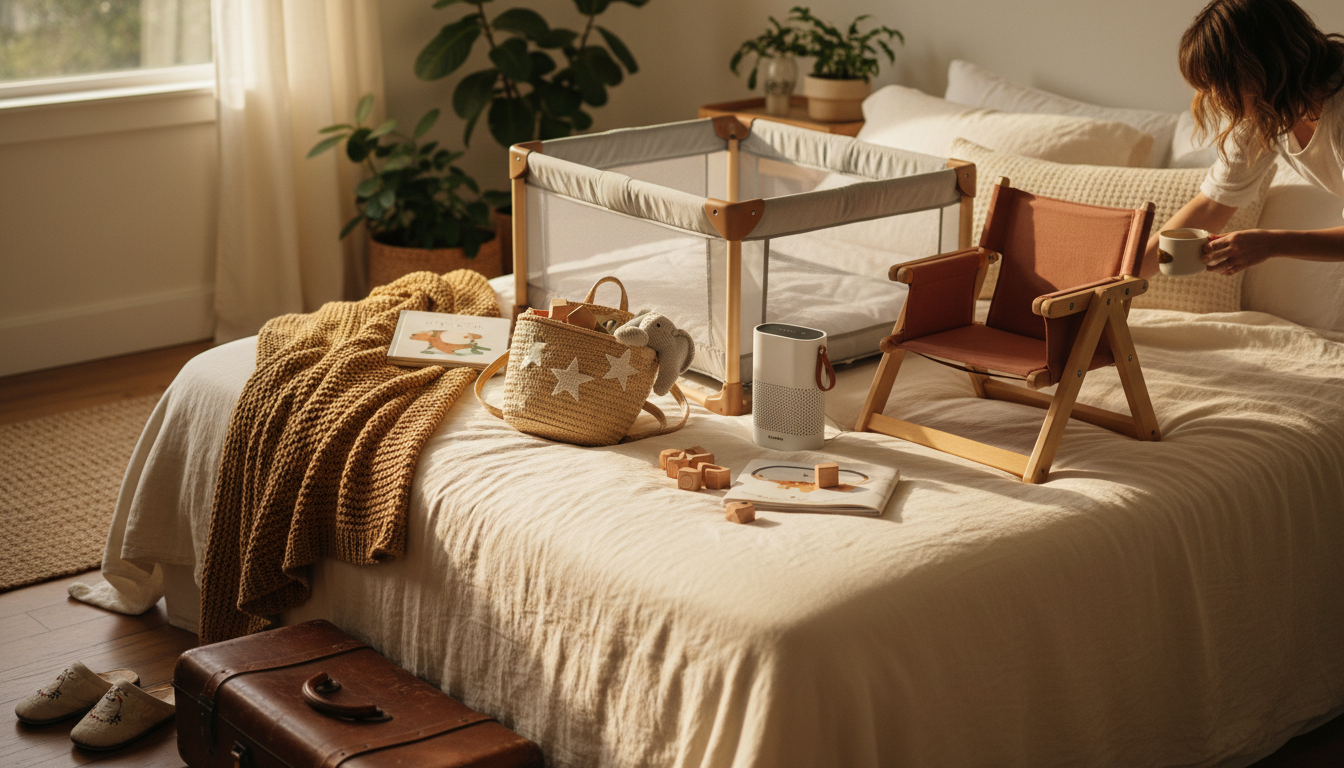 assortment of baby travel gear laid out neatly on a bed - travel crib, white noise machine, portable
Preparing Your Own Home for Baby-Having Guests
Here's the beautiful thing about the SwappaHome community: what goes around comes around. If you make your home welcoming for families with babies, you'll find hosts who do the same for you.
When we started home swapping with our daughter, I completely revamped how we prepare our San Francisco apartment for guests. Now, our listing explicitly mentions that we're a baby-friendly home, and we've hosted dozens of families with little ones.
What we provide: a pack-n-play with fresh sheets, a basic high chair (the IKEA Antilop—$25 and indestructible), outlet covers on all accessible outlets, a small basket of baby toys and books, a few diapers and wipes for emergencies, and a list of nearby playgrounds, family-friendly restaurants, and our pediatrician's number just in case.
The investment was maybe $150 total, and it's made our listing significantly more attractive to the family travel crowd. Plus, it feels good. I remember the relief I felt arriving at a swap in Amsterdam to find a crib already set up. I want to give that feeling to other parents.
Navigating Time Zones and Sleep Schedules (The Real Challenge)
Let's talk about the thing that actually makes traveling with babies hard: jet lag doesn't care about your carefully crafted sleep schedule.
I'm not going to pretend I have this figured out. Every trip is different, every baby is different, and sometimes you just have to survive the first few days. But here's what's worked for us when home swapping with babies across time zones.
For westward travel (easier): Start shifting bedtime later by 15-20 minutes per day, starting a week before you leave. Keep your baby awake on the plane as long as possible, then let them crash. The first morning, get outside in bright sunlight immediately—it helps reset circadian rhythms.
For eastward travel (harder): This one's rough. Babies don't want to go to sleep when their body says it's afternoon. Our strategy: accept that the first 2-3 nights will be chaotic. Don't fight it. If your baby is wide awake at 3 AM, turn on a dim light and do quiet play in the living room—this is where having a separate space matters. Gradually shift wake-up time earlier by 30 minutes per day.
The home swap advantage: When you're in a real home instead of a hotel room, middle-of-the-night wakings are so much more manageable. You can make a snack in the kitchen, sit on a couch, even take a walk around the apartment without disturbing anyone. In a hotel, you're trapped in one room with a wide-awake baby, trying not to turn on lights or make noise.
Our Copenhagen swap happened during a brutal 9-hour time difference from San Francisco. The first two nights, my daughter was up from 2-5 AM like clockwork. But instead of pacing a dark hotel room, I'd bundle her up and we'd sit in the host's cozy living room, looking at the snow, listening to Danish podcasts I didn't understand. It was actually... peaceful? In a sleep-deprived, surreal way.
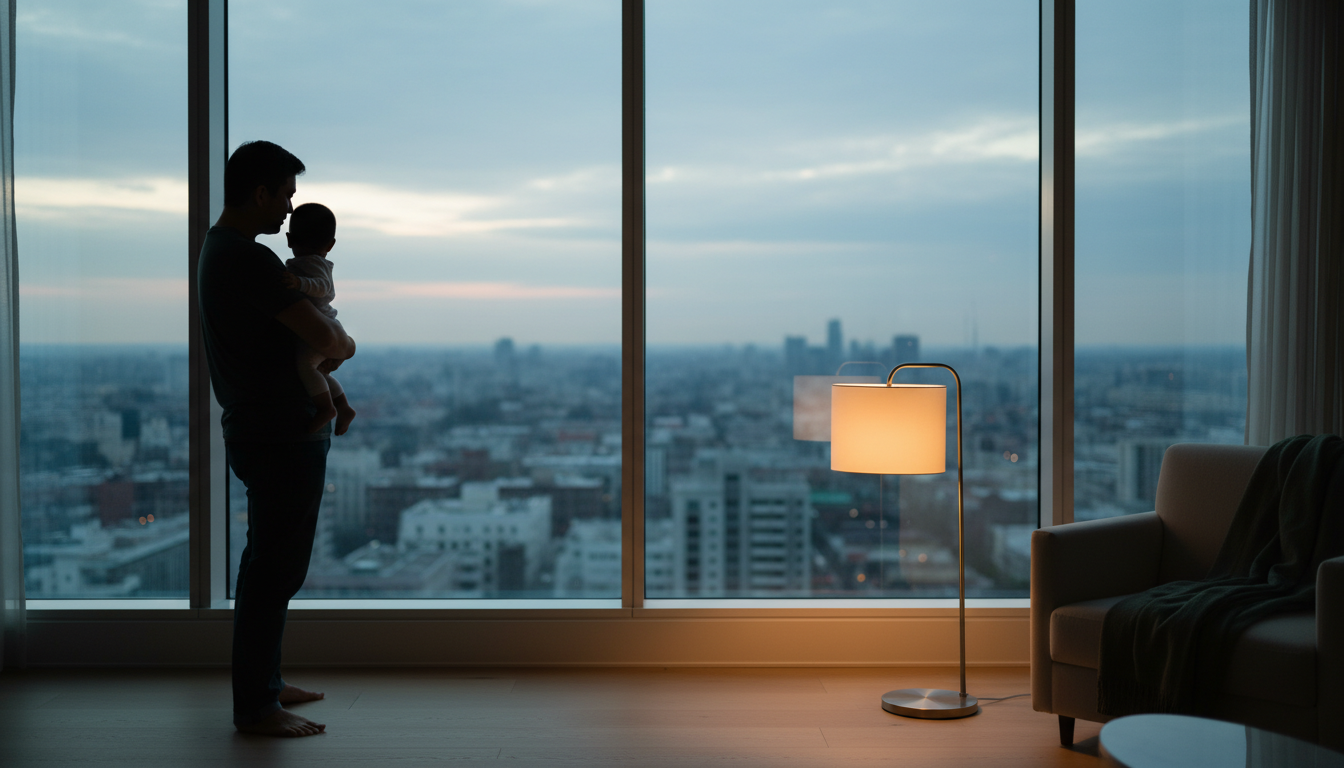 parent and baby silhouetted against a large window at dawn, city skyline visible, warm lamp glowing
Baby-Proofing a Swap Home (Without Being Annoying)
You're staying in someone else's home. You can't install baby gates or move their furniture around dramatically. But you also can't let your newly mobile baby pull a bookshelf onto themselves.
The balance I've found: bring a few portable safety items and do a quick assessment when you arrive.
Portable baby-proofing kit: Outlet covers (the plug-in kind that take 2 seconds to install and remove), a portable baby gate (the pressure-mounted kind that doesn't require drilling), cabinet locks (the magnetic kind that stick on—ask your host first), and corner protectors (the adhesive gel kind that peel off cleanly). This whole kit fits in a gallon Ziploc bag and weighs almost nothing.
First-hour assessment: When you arrive at a new swap, do a walkthrough while your baby is contained—in a carrier, in their travel crib, wherever. Look for dangling cords from blinds or electronics, unstable furniture that could tip, small objects at baby height like decorative items or coins, accessible cleaning supplies or medications, and sharp corners at head height.
I usually spend 15-20 minutes doing a basic baby-proof. Move a few things to higher shelves (take photos first so you can put them back). Install outlet covers. Set up the portable gate if there are stairs. It's not perfect, but it's enough to let you relax.
And please—please—put everything back exactly how you found it before you leave. Take photos when you arrive so you remember where things go.
Feeding Your Baby While Home Swapping Abroad
If you're breastfeeding, you've got the easiest portable food system ever invented. If you're formula feeding or your baby is eating solids, you need a plan.
Formula: Research formula availability at your destination before you go. European formula brands are different from American ones, and your baby might not tolerate a sudden switch. For trips under two weeks, I'd bring enough formula from home. For longer trips, order your usual brand online for delivery to your swap home, or gradually transition to a local brand over several days.
Baby food: Here's where home swapping with babies really shines. You have a kitchen. You can make baby food. A $15 portable blender—I use a NutriBullet knockoff—turns any fruit or vegetable into baby food in seconds. Hit up a local grocery store, buy fresh produce, and blend away. It's cheaper than pouches, healthier, and your baby gets to try local flavors.
Some of my daughter's favorite foods came from swap trips. She went crazy for the avocados in Mexico City, the sweet potatoes in Tokyo, the fresh berries in Stockholm. Exposing her to different cuisines early has made her a remarkably adventurous eater.
Snacks for planes and emergencies: Always overpack snacks. I bring roughly triple what I think we'll need. Puffs, pouches, crackers, dried fruit—whatever your baby will reliably eat. Flight delays happen. Restaurants close unexpectedly. That emergency stash will save you.
Building Your Baby-Friendly Swap Network
After a few successful swaps with my daughter, I started noticing something: we kept connecting with the same types of hosts. Other parents. People who understood the chaos and didn't judge the Cheerios ground into their carpet.
Now I actively cultivate these connections. When we have a great swap with a family, I stay in touch. We've done repeat swaps with a family in Portland three times—they have twins the same age as my daughter, and at this point, the kids have their own little friendship.
On SwappaHome, I look for listings that mention kids or family-friendly features. I read reviews looking for mentions of "traveled with our toddler" or "perfect for families." These hosts get it.
I've also started leaving detailed reviews specifically mentioning how baby-friendly a home was. "The separate nursery was perfect for our 14-month-old" or "The fenced backyard meant our crawler could explore safely." This helps other parents find good swaps, and it signals to hosts that family travelers are a great audience to attract.
When Things Go Wrong (Because They Will)
I'd be lying if I said every home swap with a baby has been smooth. There have been disasters. Let me tell you about Austin.
We arrived at a gorgeous mid-century modern home in the Zilker neighborhood. Photos were stunning. Reviews were glowing. What the listing didn't mention: the home was on a busy street with single-pane windows, and our bedroom shared a wall with the living room.
My daughter, who normally sleeps like a champion, woke up every 45 minutes the first night. Every car that passed, every creak of the old floors, every time we so much as whispered—she was up. By 4 AM, we were all crying.
What did we do? We problem-solved. I ran to Target at 7 AM and bought blackout curtains and extra white noise machines. We moved her travel crib to the walk-in closet—seriously, it worked. We adjusted.
The trip wasn't ruined. We just had to adapt. That's the thing about traveling with babies—flexibility isn't optional, it's survival.
Some practical "when things go wrong" tips: Always have a backup plan. Know where the nearest hotel is, just in case the swap is truly unworkable. We've never had to use this nuclear option, but knowing it exists reduces anxiety. Communicate with your host—if something's not working, reach out. Most hosts want you to have a good experience. They might have suggestions, or they might be able to lend you something that helps. And lower your expectations. Not every day of a trip with a baby will be magical. Some days are just about survival. That's okay. The good days make up for it.
The Long Game: Why This Gets Easier
Here's what I want you to know if you're considering your first home swap with a baby: it gets easier. So much easier.
That first trip to Copenhagen, I was a mess of anxiety. I overpacked. I over-researched. I barely slept the week before we left.
Now, twelve swaps later, I can pack for a two-week trip in an hour. I know exactly what we need and what we can skip. I know how to read a listing for baby-friendliness. I know that the first two days are always hard and then it clicks.
My daughter is two and a half now, and she's become an incredible traveler. She's adaptable. She's curious. She sleeps well in new places because she's done it so many times. Home swapping with babies gave her that gift—the understanding that the world is big and interesting and full of different homes to explore.
And honestly? It gave me something too. It gave me back the identity I was afraid I'd lost when I became a parent—the part of me that loves adventure, loves new places, loves the feeling of waking up somewhere unfamiliar. I just do it differently now. With more snacks. And a travel crib.
Getting Started: Your First Home Swap with Baby
If you're ready to try this, here's my honest advice: start small. Pick a destination within a few hours of home, ideally in the same time zone. Do a 4-5 night swap. See how it goes.
On SwappaHome, you can filter for homes with specific features—look for multiple bedrooms, laundry facilities, and ground-floor access. Read listings carefully. Message hosts with your questions. Be upfront that you're traveling with a baby.
The community is welcoming. Most hosts remember what it was like to travel with little ones, or they're excited to host families. You might be surprised how many doors open once you ask.
And when you're lying in a stranger's living room at 3 AM, baby finally asleep on your chest, looking out at a city you've never seen before—you'll get it. You'll understand why this is worth the extra planning, the portable baby gates, the emergency snack stash.
Because this is how you give your kids the world without losing yourself in the process. One home swap at a time.
Frequently Asked Questions
Is home swapping with a baby safe?
Home swapping with babies is as safe as you make it. The SwappaHome community includes verified members with reviews from previous guests, which builds accountability. Do your due diligence: read reviews carefully, communicate extensively with hosts beforehand, and do a baby-proofing walkthrough when you arrive. Consider getting your own travel insurance for extra peace of mind.
What age is best to start home swapping with a baby?
Most parents find home swapping easiest with babies under 6 months (before mobility) or after 12 months (when sleep patterns stabilize). The 6-12 month window—when babies are mobile but not walking and sleep is unpredictable—is the trickiest. That said, we did our first swap at 11 months and survived. There's no perfect age, just different challenges.
How much money can you save home swapping with a baby versus hotels?
Families typically save $150-400 per night compared to family-friendly hotel rooms. A two-week home swap can save $2,000-5,000 easily. On SwappaHome, you spend one credit per night regardless of location or home size. New members start with 7 free credits, meaning your first 7 nights cost nothing beyond your membership.
What baby gear should I bring on a home swap trip?
Essentials to pack: travel crib, white noise machine, car seat (if driving), and comfort items like a favorite lovey. Leave behind: high chair, baby bathtub, and bulky toys. Consider renting gear through services like BabyQuip ($30-50/day) for items you don't want to transport. Most swap homes have or can borrow basic baby equipment if you ask.
How do I find baby-friendly homes on SwappaHome?
Search for listings mentioning multiple bedrooms, laundry facilities, and family-friendly neighborhoods. Read reviews for mentions of other families who stayed with children. Message hosts directly to ask about separate sleeping spaces, stair access, and willingness to provide baby items. Many hosts without kids still have baby-friendly setups—don't limit yourself to explicitly "family" listings.

Published by
SwappaHome
SwappaHome Editorial Team
Home Exchange & Slow Travel Editorial
The SwappaHome Editorial Team brings together travel research, home-exchange community insights, and platform data to produce practical guides for first-time and experienced home swappers. Every article cites real platforms, current market rates, and verifiable city-level facts so readers can make informed decisions without guessing.
Ready to try home swapping?
Join SwappaHome and start traveling by exchanging homes. Get 7 free credits when you sign up!
Related articles
How to Extend or Modify a Home Swap Mid-Stay: The Complete Flexibility Guide
Need to extend your home swap or change dates mid-trip? Here's exactly how to negotiate changes, handle credits, and keep both parties happy.

How to Visit Bali for Free with Home Exchange: The Complete 2026 Guide
Skip the $150/night villas. Home exchange in Bali lets you stay in Ubud rice field houses and Seminyak beach pads for zero accommodation cost. Here's exactly how.
How to Vet Home Swap Guests: 12 Red Flags Every Host Should Know
Learn how to vet home swap guests before handing over your keys. Spot the 12 red flags experienced hosts watch for—and protect your home with confidence.