
Home Exchange in Provence: Your Complete Guide to Utilities, WiFi, and Essentials

SwappaHome Editorial Team
Home Exchange & Slow Travel Editorial
Everything you need to know about managing utilities, WiFi, and daily essentials during your Provence home exchange—from electricity quirks to finding the best boulangerie.
The electricity cut out on my third night in a stone farmhouse outside Gordes. There I was, standing in pitch darkness, clutching a flashlight I'd thankfully thrown in my suitcase, wondering why on earth I hadn't asked my host about the fuse box before she left for my San Francisco apartment.
That moment—fumbling around an unfamiliar French house at midnight—taught me something important about home exchange in Provence. The practical stuff matters. A lot. Maybe even more than picking the perfect village or timing your trip for lavender season. You can recover from missing peak bloom. But spending three hours trying to figure out how to turn on the hot water heater? That'll test anyone's vacation zen.
I've done five separate home exchanges across Provence now. A converted silkworm farm in the Luberon. A fisherman's cottage in Cassis. A few others in between. And I've learned exactly what you need to know before you show up. This isn't the glamorous stuff travel magazines write about—no sun-dappled vineyards or charming café terraces here. This is the real stuff. The stuff that makes the difference between a dreamy month in the South of France and a frustrating series of Google Translate sessions with utility companies.
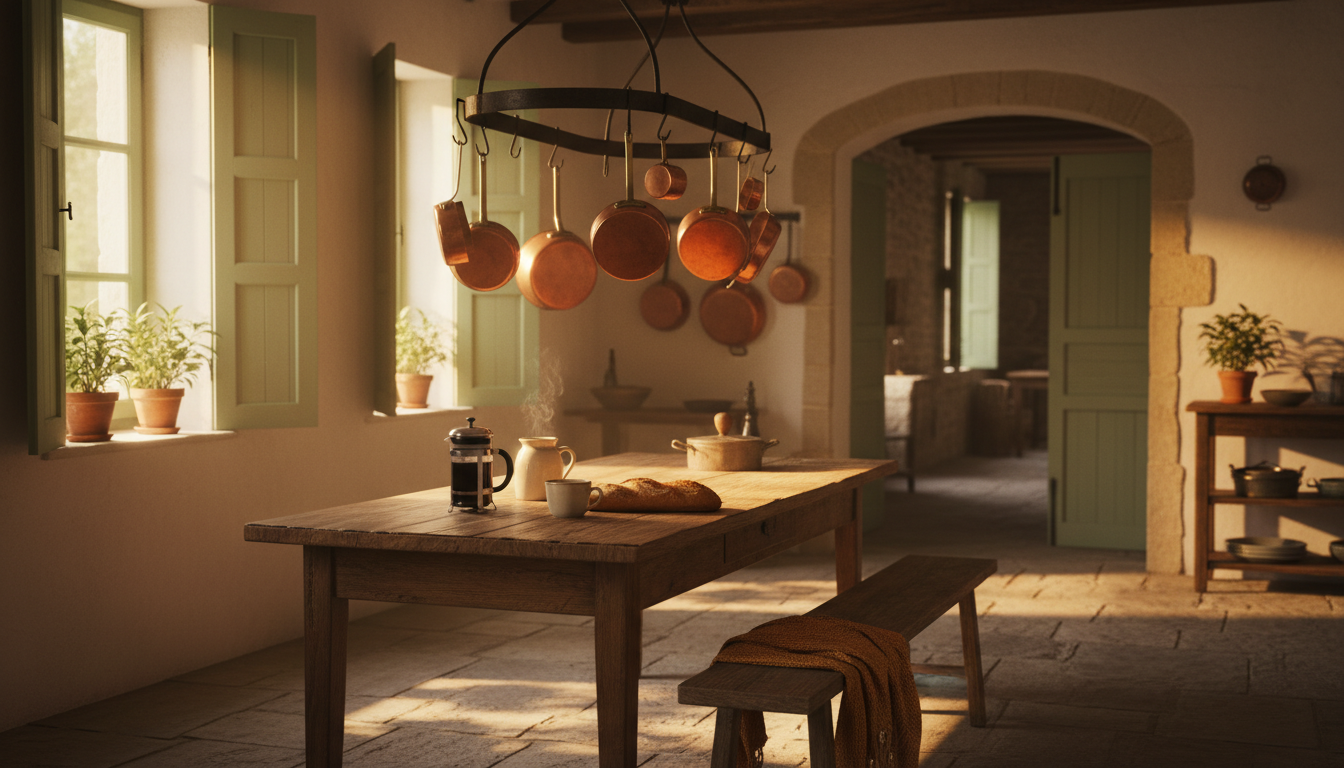 rustic Provenal kitchen with copper pots hanging, morning light streaming through shuttered windows,
Understanding French Utilities Before Your Provence Home Exchange
Here's the thing nobody tells you: French homes run differently than American or British ones. Not worse—just different. And those differences will affect your daily life way more than you'd expect.
Electricity: The 220V Reality
France runs on 220 volts. Your American hairdryer? It will either die dramatically or—worse—work for about thirty seconds before releasing that distinctive burning smell. I learned this the hard way in Aix-en-Provence. Not fun.
What you actually need is a proper voltage converter (not just a plug adapter) for any American appliances you absolutely must bring. Expect to pay around $25-40 USD for a decent one. But honestly? My advice is to leave most electronics at home and use what's in the house. Your host will have a hairdryer. They'll have a coffee maker. They'll have everything you actually need.
The plug adapters themselves are Type E—two round pins with a hole for the grounding pin. Grab a pack of three before you leave. They're about $8 on Amazon, and you'll want them scattered around the house.
One quirk specific to older Provençal homes: many still have those old-fashioned fuse boxes with actual ceramic fuses, not circuit breakers. When I blew that fuse in Gordes, I had to physically replace the fuse itself. Ask your host where spare fuses are kept. Seriously. Write it down.
Water Heaters: The Chauffe-Eau Situation
Most French homes have what's called a chauffe-eau—an electric water heater that's often set to heat water only during off-peak hours. Usually 10:30 PM to 6:30 AM. Brilliant for electricity bills. Confusing if you want a hot shower at 3 PM after a long day exploring the Pont du Gard.
The solution is usually a switch or button that forces the heater to run during peak hours. It might be labeled "marche forcée" (forced operation). Ask your host to show you—or at minimum, have them photograph it and send you the location before you arrive.
Water pressure in Provence varies wildly. Village homes connected to municipal systems usually have decent pressure. Rural farmhouses with their own wells? Sometimes it's a trickle. Not a dealbreaker, but worth asking about if you're someone who needs a powerful shower to feel human in the morning.
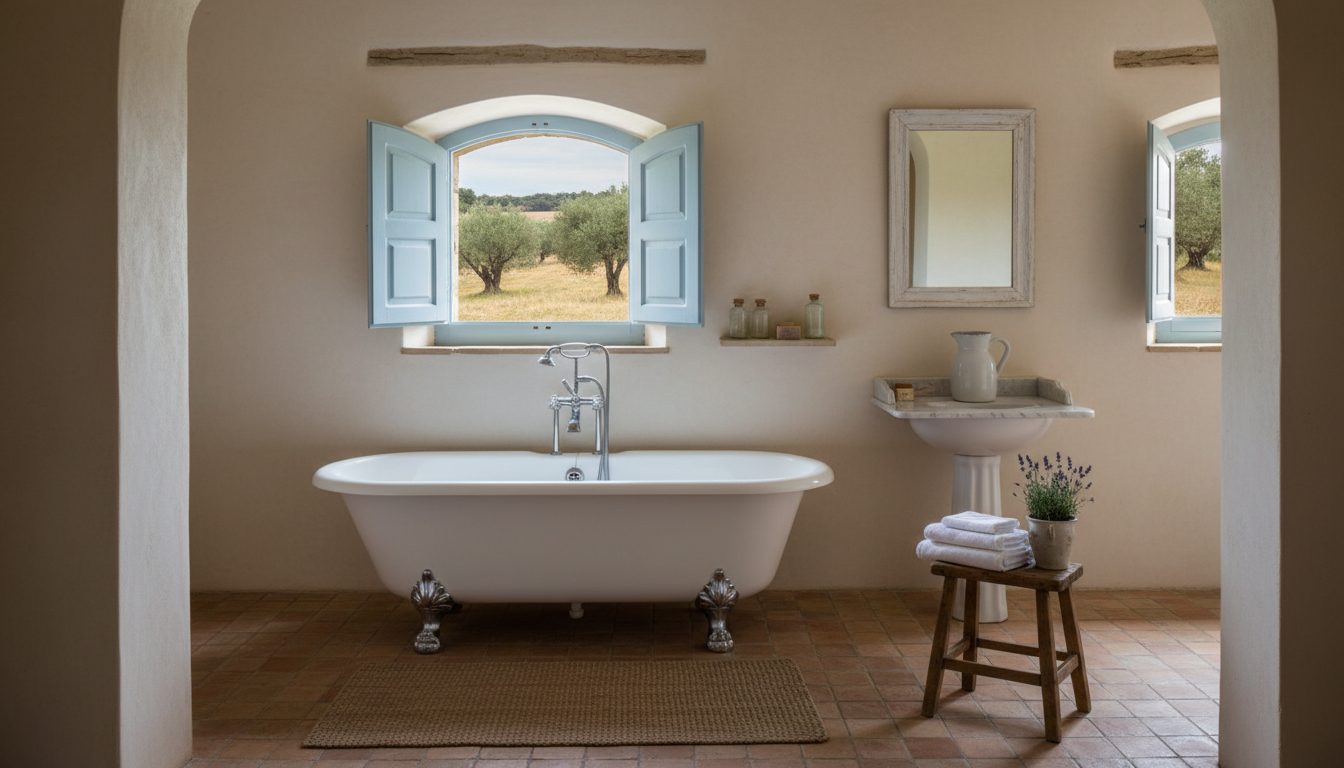 traditional Provenal bathroom with terracotta tiles, clawfoot tub, and small window overlooking oliv
WiFi and Internet Connectivity in Provence
I'll be honest with you—internet in rural Provence can be... character-building. The same thick stone walls that keep houses cool in August also block WiFi signals like they're training for the Olympics.
What to Expect from French Internet
Urban areas like Aix-en-Provence, Avignon, and Marseille generally have solid fiber connections. You'll get speeds comparable to any major city—50-100 Mbps is common, sometimes faster.
But that charming mas (farmhouse) in the hills above Bonnieux? You might be looking at ADSL with speeds around 5-10 Mbps on a good day. Enough for email and basic browsing. Video calls? Possible but potentially frustrating. Streaming Netflix in HD? Maybe not.
Questions to ask your home exchange host about WiFi:
- What's the typical download speed? (Ask them to run a speed test at speedtest.net)
- Is the router in a central location, or will you need to sit in a specific room for good signal?
- What's the WiFi password? (Seems obvious, but I've arrived at 11 PM to find this information nowhere)
- Is there a data cap? (Rare now, but some older contracts still have them)
Mobile Data as Backup
I always buy a French SIM card as backup. Orange, SFR, and Bouygues all offer prepaid options. For about €20-30 ($22-33 USD), you can get a month of decent data. Orange tends to have the best rural coverage in Provence—relevant if you're staying outside major towns.
You can buy SIM cards at any tabac (tobacco shop), supermarket, or the carrier's own stores. Bring your passport; they'll need to register the SIM to your name. The whole process takes about fifteen minutes.
Pro tip: Enable your phone's hotspot feature before you leave home. If the house WiFi fails—and at some point, it probably will—you'll want that backup ready to go.
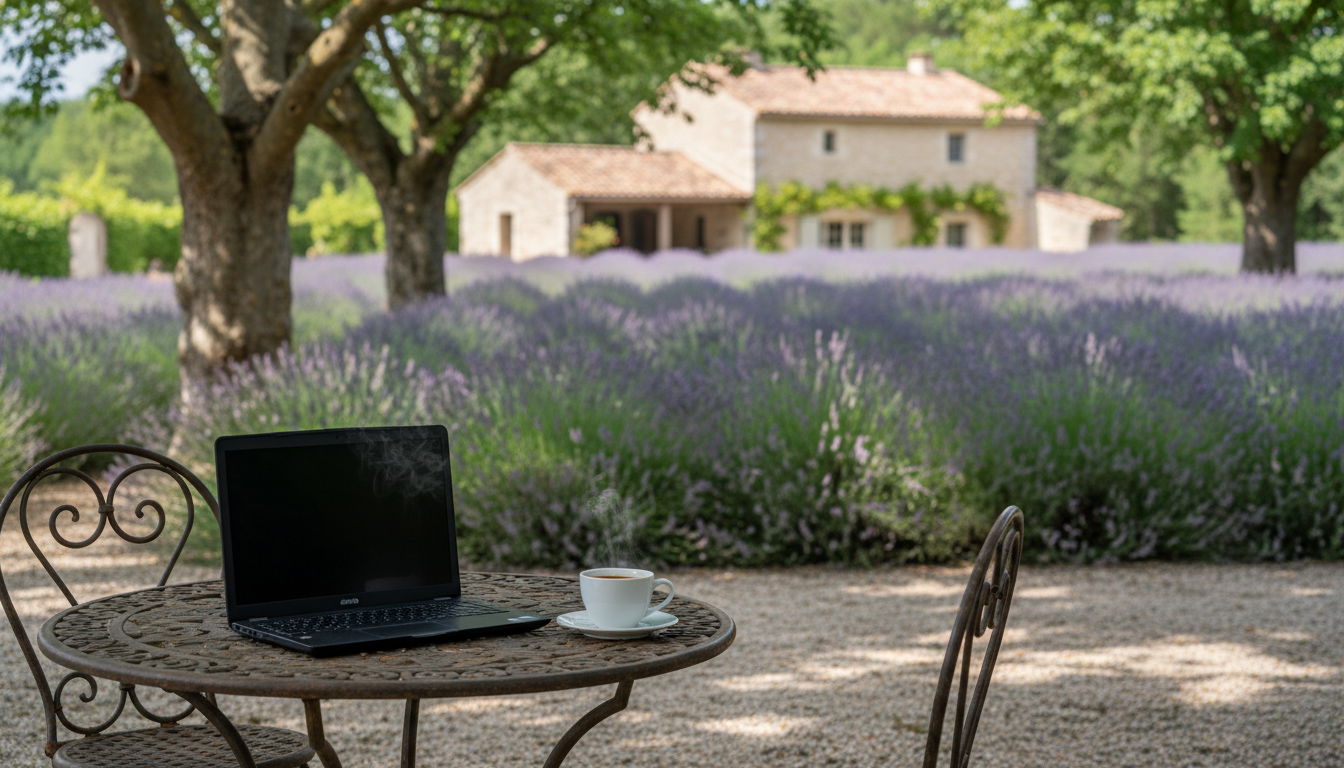 laptop and coffee on wrought-iron table in Provenal garden, lavender bushes in background, dappled s
Essential Groceries and Where to Find Them in Provence
Grocery shopping in Provence is genuinely one of the best parts of being there. But it helps to know the landscape before you arrive hungry and jet-lagged.
Supermarket Options for Home Exchange Guests
The big chains you'll encounter:
Carrefour and Carrefour Market are the most common. Good selection, reasonable prices. The larger "hypermarché" versions outside towns have everything—electronics, clothes, garden furniture, you name it. Smaller "Market" versions in town centers focus on groceries.
Intermarché is slightly cheaper than Carrefour, good for basics. Their house brand ("Top Budget") is genuinely fine for most things.
Super U and Hyper U are my personal favorites for quality-to-price ratio. Their wine selection is surprisingly good, and they stock more local products than the bigger chains.
Monoprix you'll find in larger cities like Aix and Avignon. More upscale, better prepared foods, higher prices. Worth it for their cheese counter though.
Expect to spend roughly €60-80 ($65-88 USD) per person per week on groceries if you're cooking most meals. That drops significantly if you're strategic about markets.
The Market Schedule Matters
Provençal markets aren't just tourist attractions—they're where locals actually shop. And the prices often beat supermarkets for produce, cheese, and meat.
Every town has a market day. Some highlights: Aix-en-Provence has a daily market at Place Richelme for produce, with the big market on Tuesday, Thursday, and Saturday. L'Isle-sur-la-Sorgue does Sunday antiques—famous, crowded, worth it once. Apt on Saturday morning is one of the best in the Luberon. Vaison-la-Romaine on Tuesday in the lower town is fantastic and less touristy. Saint-Rémy-de-Provence on Wednesday morning is very photogenic.
Arrive early. By 11 AM, the best stuff is gone and vendors start packing up. Bring cash—some vendors take cards now, but many don't. And bring your own bags. This is France.
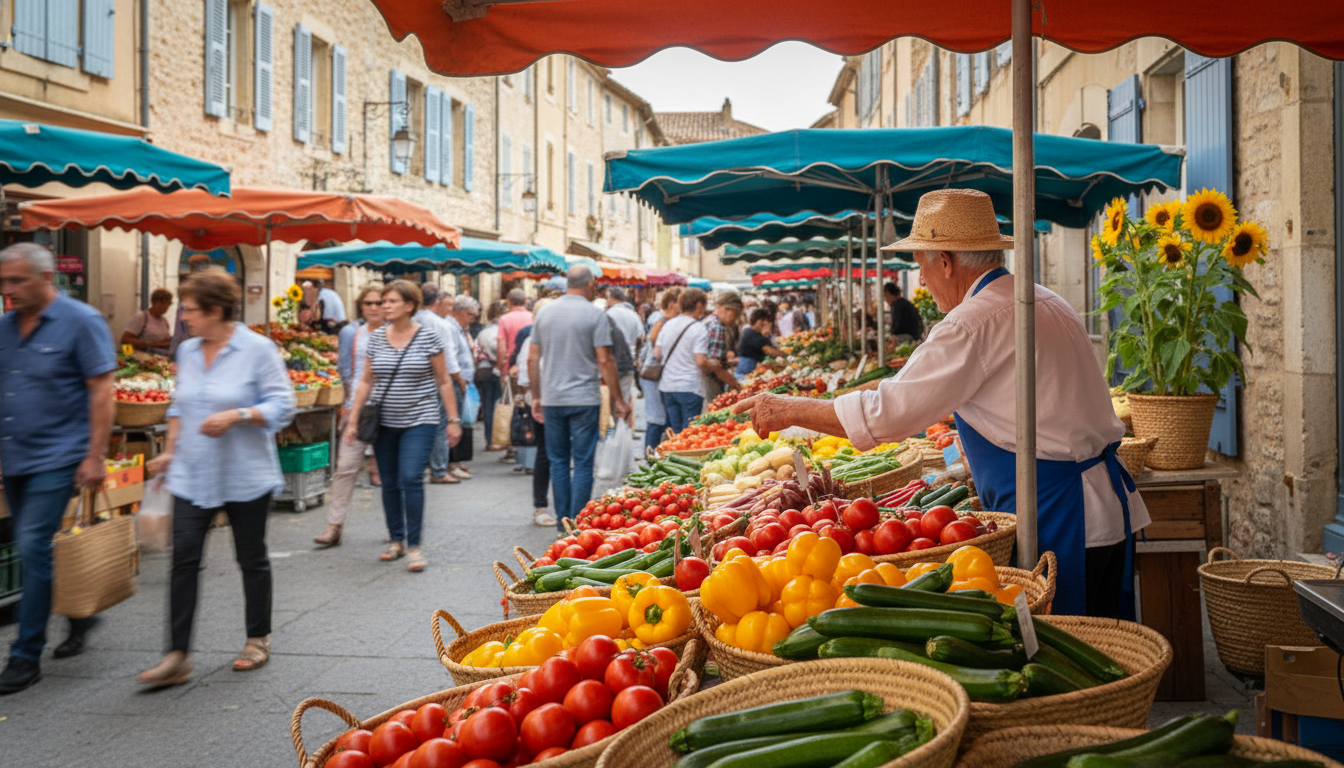 bustling Provenal market scene with colorful vegetable stalls, woven baskets of tomatoes and peppers
Heating and Cooling: Provence's Climate Surprises
People imagine Provence as eternally sunny and warm. And yes, summer is hot—often brutally so. But if you're doing a home exchange during spring or fall, you need to think about heating. Even summer nights in the hills can get surprisingly cool.
Summer Cooling Strategies
Air conditioning is not standard in Provençal homes. Many older houses rely on thick stone walls and strategic shutter use to stay cool. This actually works remarkably well—if you know the system.
The routine goes like this: Close all shutters and windows by 9 AM. Keep the house sealed and dark during the day. Open everything around 8 PM when the temperature drops. This can keep a stone house 15-20 degrees cooler than outside. It feels counterintuitive at first, sitting in the dark on a gorgeous summer day. But trust the system.
If your exchange home does have AC (more common in newer builds or renovated properties), ask about usage. Electricity in France isn't cheap—around €0.18-0.22 per kWh—and running AC constantly can significantly impact your host's utility bill. Most hosts will mention this, but it's polite to ask what's reasonable.
Fans help. If the house doesn't have any, pick one up at Carrefour or Brico Dépôt for €15-30 ($16-33 USD). Your host will probably appreciate you leaving it behind.
Winter and Shoulder Season Heating
Many Provençal homes use electric radiators—straightforward but can be expensive to run. Others have oil-fired central heating (chauffage au fioul) or wood-burning stoves.
If there's a wood stove or fireplace, ask your host: Where's the firewood stored? Is there a specific technique for the flue or damper? Any local sources for buying more wood if needed?
Wood is typically sold by the stère (roughly a cubic meter). Expect to pay €50-80 ($55-88 USD) per stère, delivered. Your host should leave you enough for a reasonable stay, but for longer exchanges, you might need to order more.
The mistral—that famous cold wind that barrels down the Rhône Valley—can make even mild days feel frigid. It's strongest in winter and spring, sometimes blowing for days. When it's howling, you'll want heating regardless of what the thermometer says.
Waste Management and Recycling in Provence
Garbage disposal in French villages is surprisingly specific. Getting it wrong can result in fines or, more commonly, very pointed looks from neighbors.
The Sorting System
France takes recycling seriously. Most areas use a color-coded bin system. Yellow bin or bag is for recyclables—plastic bottles, cans, cardboard, paper. Green bin is for glass only, no caps or lids. Gray or black bin is for everything else (ordures ménagères).
Some villages don't have individual bins. Instead, you'll take sorted waste to communal containers, usually located at the edge of the village or at specific collection points. Ask your host where these are—it's not always obvious.
Collection schedules vary. In my experience, it's usually once or twice a week for regular trash, less frequently for recycling. Your host should leave this information, but if not, check the local mairie (town hall) website or simply ask a neighbor.
The Déchetterie Option
For larger items or anything that doesn't fit the normal system, there's the déchetterie—the municipal waste facility. These are free for residents (your host's address counts) and accept everything from garden waste to old furniture to electronics.
You might need this if you're doing any cleaning or organizing during a longer stay. Just bring a piece of mail addressed to the house as proof of residence.
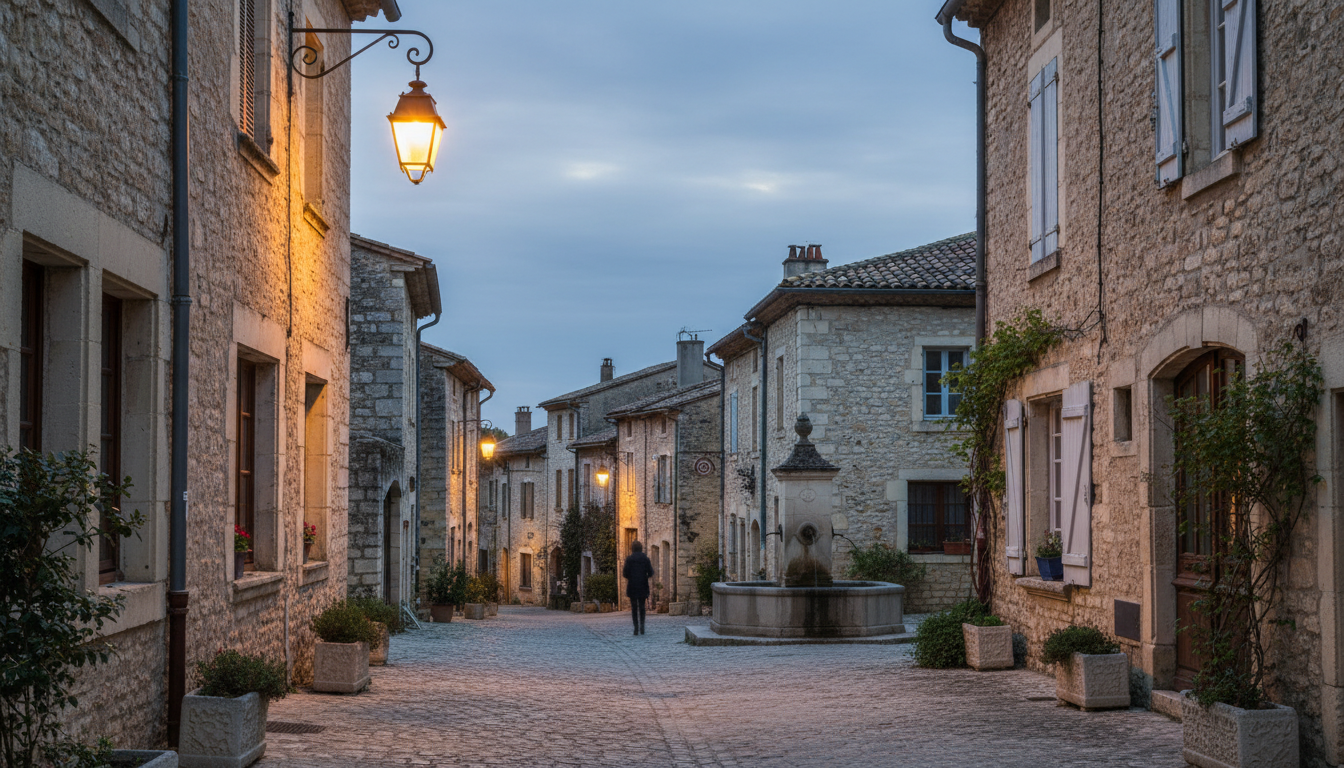 charming Provenal village street at dusk, honey-colored stone buildings, wrought-iron street lamp, s
Transportation Essentials for Your Provence Home Exchange
Unless you're exchanging into a city center apartment in Aix or Avignon, you'll probably need a car. Public transportation exists but is limited, especially in the villages and countryside that make Provence so appealing for home exchanges.
Renting a Car
Major rental agencies operate out of Marseille airport (MRS) and the Avignon TGV station. Expect to pay €30-50 ($33-55 USD) per day for a small car, less for weekly rentals. Book in advance during summer—availability gets tight.
A few France-specific notes:
Manual transmission is standard and significantly cheaper than automatic. If you can't drive stick, book automatic well in advance and expect to pay 30-50% more.
French autoroutes (highways) are toll roads. The A7 from Lyon to Marseille will cost you about €25-30 in tolls each way. Budget for this if you're planning day trips.
Parking in villages can be... creative. Many streets are barely one car wide. If you're staying in a village center, ask your host about parking—there might be a dedicated spot, or they might have tips for where to leave the car.
Getting Around Without a Car
It's possible, but limiting. The TER regional trains connect major towns reasonably well. Aix to Marseille is 35 minutes; Avignon to Arles is 20 minutes. But getting to smaller villages usually requires either a car or a willingness to wait for infrequent buses.
Bikes are increasingly popular, and many home exchange hosts have bicycles available. Electric bikes are particularly useful given Provence's hills. If your host doesn't have bikes, rental shops exist in most tourist towns—expect €15-25 ($16-27 USD) per day for a regular bike, €35-50 ($38-55 USD) for electric.
Communication Essentials: Talking to Your Host and Neighbors
Even if your French is limited, a few phrases go a long way. Your Provence home exchange experience will be smoother if you can handle basic interactions.
Key Phrases for Home Exchange
Bonjour (hello) and au revoir (goodbye) are non-negotiable. Always greet shopkeepers, neighbors, anyone you interact with. Not doing so is considered genuinely rude—I can't stress this enough.
Je fais un échange de maison (I'm doing a home exchange) explains your situation if neighbors seem curious about the stranger in their midst.
Où se trouve...? (Where is...?) followed by pointing at a map or showing an address works for directions.
La connexion internet ne marche pas (The internet isn't working) might come in handy. It certainly has for me.
Staying in Touch with Your Host
SwappaHome's messaging system works well for pre-trip communication, but once you're in the house, you'll want a backup method. Exchange WhatsApp numbers or email addresses before you travel.
Time zones matter if you're from North America. Provence is 9 hours ahead of California, 6 ahead of New York. That 2 PM "quick question" text might wake your host at 11 PM their time. Ask me how I know.
I keep a shared document with my hosts—a simple Google Doc where we can both add notes. Questions that come up, things we've discovered about each other's homes, recommendations. It's more organized than a long text thread and creates a nice record for future exchanges.
The Pre-Arrival Checklist for Provence Home Exchange
Before you leave, confirm these things with your host. I send a message about two weeks before arrival covering all of this:
Arrival logistics: Where are the keys? Is there a code? What time can you arrive? French hosts often expect you after 4 PM, similar to hotel check-in.
Utilities orientation: Where's the fuse box? How does the water heater work? Any quirks with the heating or cooling?
WiFi details: Network name, password, router location, speed expectations.
Waste collection: Which day? Where do bins go? Where are the communal containers if applicable?
Emergency contacts: A neighbor who has a spare key? A local friend who speaks English? The host's mobile number for urgent issues?
House rules: Anything specific about the property? Plants that need watering? A cat that visits from next door?
Most hosts will proactively share this information. But asking shows you're a thoughtful guest—which matters for those post-stay reviews.
What to Bring (and What to Leave Behind)
After multiple Provence home exchanges, here's what I always pack:
A universal power strip—one good adapter plus a power strip means you can charge everything from one outlet. A flashlight or headlamp for those fuse box moments, or just navigating an unfamiliar house at night. Basic first aid supplies because pharmacies (pharmacies) are everywhere and excellent, but having basics saves a trip. Reusable shopping bags, required for markets, useful everywhere. A good French phrasebook or app—Google Translate works offline if you download the French language pack in advance. And comfortable walking shoes because Provençal villages are cobblestoned and hilly. Sandals are fine for beaches, not for exploring Gordes.
What to leave home: Too many electronics, formal clothes (Provence is casual), any expectations of things working exactly like they do at home.
When Things Go Wrong
They will, occasionally. A pipe might leak. The WiFi might die. You might lock yourself out.
First step: Don't panic. Message your host. They know their house and usually have solutions or contacts.
For genuine emergencies: 15 is for medical emergency (SAMU), 17 is for police, 18 is for fire department, and 112 is the European emergency number that works for everything.
For non-emergencies, your host's neighbor is often your best resource. French neighbors tend to know each other and help each other. A friendly Bonjour, je suis l'ami(e) de [host's name] (Hello, I'm [host's name]'s friend) opens doors.
Plumbers, electricians, and other tradespeople can be found through your host or by searching "[profession] + [town name]" online. Expect to pay €50-80 ($55-88 USD) for a basic call-out, more for actual repairs. Keep receipts and discuss with your host how to handle costs.
The practical stuff isn't glamorous. Nobody posts Instagram stories about successfully resetting a circuit breaker or finding the recycling containers. But getting these details right is what transforms a home exchange from stressful to seamless.
That farmhouse outside Gordes where the power went out? I ended up having one of my best evenings in Provence. Candles everywhere, a bottle of local rosé, the kind of quiet you never get in cities. Sometimes the complications become the stories.
If you're considering your first home exchange in Provence, SwappaHome makes the matching part easy. The rest—the utilities, the WiFi, the where-to-buy-milk—that's what this guide is for. Print it out, save it to your phone, whatever works. And when you're sitting on a terrace somewhere in the Luberon, glass of wine in hand, hot water working perfectly, you'll know the preparation was worth it.
Frequently Asked Questions
How reliable is WiFi for remote work during a Provence home exchange?
It really depends on where you're staying. Urban areas like Aix-en-Provence typically offer 50-100 Mbps fiber connections—totally fine for video calls and remote work. Rural farmhouses? You might only get 5-10 Mbps ADSL, which works for email but struggles with video conferencing. Always ask your host to run a speed test before confirming your exchange if you need reliable internet for work.
What voltage adapter do I need for a home exchange in Provence?
France uses 220V electricity with Type E plugs (two round pins plus a grounding hole). If you're coming from the US, you'll need both a plug adapter (around $8 USD) and a voltage converter ($25-40 USD) for any 110V appliances. That said, most home exchange properties include hairdryers, coffee makers, and other essentials—so you may not need to bring electronics at all.
How much should I budget for groceries during a Provence home exchange?
Expect to spend approximately €60-80 ($65-88 USD) per person per week on groceries when cooking most meals at home. Shopping at local markets instead of supermarkets can reduce costs for fresh produce, cheese, and meat. For reference: a baguette costs about €1.20, a bottle of decent local wine runs €5-10, and fresh market vegetables are often cheaper than supermarket equivalents.
Is air conditioning common in Provence home exchange properties?
Not really—it's not standard in traditional Provençal homes, especially older stone buildings. Many rely on thick walls and strategic shutter use to stay cool. You close everything by 9 AM and reopen at dusk. Newer or renovated properties may have AC, but ask your host about expectations for usage, as electricity costs around €0.18-0.22 per kWh in France.
What should I do if something breaks during my Provence home exchange?
Contact your host immediately through your agreed communication channel—WhatsApp, email, or SwappaHome messaging. They typically know local tradespeople and can guide you through solutions. For genuine emergencies, call 112 (European emergency number). Keep receipts for any repair costs and discuss reimbursement with your host. Having a friendly relationship with neighbors also helps—they often have spare keys and local knowledge.

Published by
SwappaHome
SwappaHome Editorial Team
Home Exchange & Slow Travel Editorial
The SwappaHome Editorial Team brings together travel research, home-exchange community insights, and platform data to produce practical guides for first-time and experienced home swappers. Every article cites real platforms, current market rates, and verifiable city-level facts so readers can make informed decisions without guessing.
Ready to try home swapping?
Join SwappaHome and start traveling by exchanging homes. Get 7 free credits when you sign up!
Related articles

Bachelor and Bachelorette Parties in Singapore: The Complete Home Swap Group Guide for 2026
Planning a bachelor or bachelorette party in Singapore? Discover how home swapping lets groups of 6-12 stay together in luxury condos, saving thousands while partying in Marina Bay.

Cycling in Lisbon: 7 Home Swap Bike Tour Itineraries for Every Rider
Discover the best cycling routes in Lisbon with these home swap bike tour itineraries—from waterfront paths to hilltop adventures, all starting from your borrowed home.

Graduation Trip to Barcelona: How Home Swapping Gives New Graduates the Ultimate Celebration
Planning a graduation trip to Barcelona? Discover how home swapping lets new graduates explore Spain's most vibrant city without the hostel crowds or hotel costs.