
Home Swapping with Friends: The Ultimate Guide to Group Travel Accommodation

SwappaHome Editorial Team
Home Exchange & Slow Travel Editorial
Discover how home swapping with friends transforms group travel. Save thousands, stay together, and create unforgettable memories in real homes worldwide.
Last October, I found myself standing in a kitchen in Porto, locked in a surprisingly heated debate with seven of my closest friends about who deserved the bedroom with the azulejo-tiled bathroom. We'd just arrived at this stunning four-bedroom apartment overlooking the Douro River—the kind of place that would've cost us €400+ per night as a vacation rental. But we'd scored it through home swapping, and the only "cost" was hosting travelers at our respective homes back in the States.
That trip completely rewired how I think about group travel.
 group of friends laughing around a large wooden dining table in a Portuguese apartment, morning ligh
Here's the thing about traveling with friends: everyone wants to do it. But the logistics? They usually murder the dream before it even gets off the ground. Someone can't swing the Airbnb split. The hotel demands four separate rooms at $200 a pop. Half the group wants to cook breakfast while the other half refuses to eat cereal in some cramped hotel room with one sad window.
Home swapping with friends solves almost all of these problems—if you know how to do it right.
I've organized five group home swaps over the past three years. Everything from a cozy weekend in Mendocino with three friends to that chaotic-but-magical week in Porto with eight people. I've made mistakes. Learned things the hard way. And now I'm about to save you a lot of headaches.
Why Home Swapping Works Better Than Hotels for Group Travel
Let me paint you a picture of the alternative.
Two years ago, before I'd cracked the group swap code, six of us tried to book a girls' trip to Nashville. The math was brutal. Three hotel rooms at the boutique place everyone wanted? $1,800 for three nights. The "budget" option—some generic chain near the airport—was still $900 total, plus we'd need Ubers everywhere. A vacation rental could've worked, but the decent ones in East Nashville ran $350-400 a night, and inevitably someone couldn't swing their $200 share.
The trip never happened.
Now compare that to what home swapping offers groups.
Space that actually fits everyone. Most home swap listings are real homes—three bedrooms, four bedrooms, sometimes more. You're not cramming into a hotel room with a rollaway cot. Everyone gets a real bed. There's usually a living room where you can actually hang out without perching awkwardly on someone's mattress.
A kitchen that saves you hundreds. This is the sleeper benefit, honestly. In Nashville, we would've spent $50-80 per person daily on restaurant meals. In Porto? We hit the Mercado do Bolhão, bought fresh bread, cheese, olives, and wine for maybe €15 per person, and had these leisurely breakfasts that became the highlight of each day. Over a week, that's easily $300-400 saved per person.
The credit system is group-friendly. On SwappaHome, it's one credit per night, regardless of how many people stay. Whether two friends crash at your place while you're gone or eight of you descend on a villa in Tuscany, the math stays simple. No per-person fees. No "cleaning surcharges" that mysteriously triple for larger groups.
 modern kitchen in a Copenhagen apartment with friends cooking together, someone chopping vegetables
How to Find Group-Friendly Home Swap Properties
Not every home swap listing works for groups. A charming studio in Paris? Perfect for a couple, nightmare for five friends. You need to search strategically.
Filter for Space First, Location Second
I know, I know—everyone wants to be in the "perfect" neighborhood. But when you're traveling with a group, having enough bedrooms and bathrooms matters more than being three blocks from the main square. Trust me on this.
Look for listings that mention multiple bedrooms (obviously), more than one bathroom, a dining table that seats your group size, common areas beyond just the bedrooms, and outdoor space—a terrace or garden is absolute gold for groups.
The Sofa Bed Reality Check
Many listings will say "sleeps 8" but actually have three bedrooms and two sofa beds. This can work—I've done it—but be honest with your group about who's willing to take the pull-out. In my experience, the sofa bed should go to whoever volunteered enthusiastically (rare), lost the card game you played to decide (more common), or stays out latest and won't care anyway (most common).
Read Between the Lines
When a listing says "perfect for families," that usually means kid-friendly setup with toys, high chairs, maybe bunk beds. Great if you're traveling with children. Potentially awkward if your college friends are sleeping in race car beds.
"Quiet neighborhood" often means you'll need to keep noise down—not ideal if your group tends toward late-night kitchen conversations.
"Historic building" sometimes translates to "thin walls and no elevator." Charming, absolutely. But consider whether dragging luggage up four flights of 17th-century stairs is really the vibe you're going for.
 aerial view of a spacious Barcelona apartment with rooftop terrace, showing multiple seating areas,
Coordinating Credits: The Group Home Swap Strategy
Here's where it gets interesting—and where most people give up too soon.
The simplest scenario: one person in your group has enough credits to book the entire stay, and everyone else pays them back somehow. Hosting duties, cash equivalent, eternal gratitude, whatever you agree on.
But there's a more elegant solution I've used twice now, and it's kind of genius.
The Distributed Hosting Model
Say you have four friends planning a week-long trip. That's 7 nights, which means 7 credits needed.
Instead of one person burning all their credits, each friend hosts travelers at their own home before the trip. Friend A hosts for 2 nights in San Francisco and earns 2 credits. Friend B hosts for 2 nights in Austin—another 2 credits. Friend C hosts for 2 nights in Chicago. Friend D hosts for 1 night in Denver.
Now you collectively have 7 credits. One person books the trip (since SwappaHome accounts are individual), and the others transfer their credits or settle up however makes sense for your group.
This approach has a beautiful side effect: everyone in the group experiences hosting before they travel. They understand the dynamic from both sides. They're more respectful guests because they know what it's like to hand over their keys to a stranger.
The New Member Bonus Hack
SwappaHome gives new members 7 free credits to start. If some friends in your group haven't joined yet, that's essentially free accommodation waiting to be claimed.
I'm not saying you should recruit friends purely for their signup bonus. But if they've been curious about home swapping anyway, a group trip is the perfect low-pressure introduction. They get to experience it with people they trust, in a home you've already vetted, without the anxiety of doing it solo for the first time.
Planning the Perfect Group Home Swap Trip
Organization is everything. Groups fall apart when nobody takes charge, but they also implode when one person becomes a dictator. Here's how to find the balance.
Step 1: Establish the Non-Negotiables (Early)
Before anyone starts browsing listings, get these questions answered.
Dates: What's the window? Who has hard conflicts? You need at least a 2-week range to have any flexibility.
Budget for extras: Home swapping is free accommodation, but you'll still spend on flights, food, activities. Make sure everyone's on the same page about the overall trip budget.
Group dynamics: Is this a "do everything together" trip or a "home base for independent exploration" trip? Neither is wrong, but you need alignment.
Sleeping arrangements: Hash this out before you book. Seriously. Nothing kills group vibes faster than arriving somewhere and having an awkward standoff over who gets the master bedroom.
Step 2: Assign Roles
Successful group trips need three roles, I've found.
The Coordinator manages the SwappaHome booking, communicates with the host, handles logistics. This should be someone organized who actually enjoys this stuff—not someone guilted into it.
The Treasurer tracks shared expenses, manages the Splitwise or Venmo situation, keeps everyone honest. Ideally someone who won't be weird about asking for money.
The Activities Lead researches restaurants, books any tours or reservations, creates a shared doc with options. This should be someone who likes planning but won't be offended when the group vetoes their suggestions.
In smaller groups, one person might wear multiple hats. In Porto, I was Coordinator and Activities Lead while my friend Jamie handled money. Worked great.
 flat lay of travel planning materials on a wooden table laptop showing a home listing, printed map o
Step 3: The Booking Conversation
When you message a potential host about a group stay, transparency is your friend.
Don't say: "Hi! I'd like to book your apartment for 7 nights."
Do say: "Hi! I'm Maya, and I'm organizing a trip with 5 friends (all adults, ages 28-35). We're looking for a home base to explore [city]—mostly day trips and dinners out, back by 10-11pm most nights. We're all experienced home swappers and very respectful of spaces. Would your home be a good fit for our group?"
This accomplishes several things. It shows you're thoughtful and communicative. Sets expectations about noise and activity level. Gives the host an easy out if they're not comfortable with groups. And establishes trust before any commitment.
Most hosts appreciate this directness. The ones who don't respond well? Probably weren't a good match anyway.
Making It Work: House Rules for Group Home Swaps
Here's where I get a little preachy, but it's earned: groups can be harder on homes than individuals. More people means more dishes, more bathroom usage, more chances for something to go wrong.
You need internal house rules—not just the host's rules, but your own group agreements.
The Kitchen Protocol
Designate a nightly kitchen cleaner and rotate the duty. The rule: whoever cooks doesn't clean, but someone always cleans before bed. Waking up to a sink full of last night's pasta dishes is a friendship-ender. I've seen it happen.
The Bathroom Schedule
If there are fewer bathrooms than people—and there usually are—establish a morning routine. In Porto, we had two bathrooms for eight people. We split into early risers (6-8am bathroom time) and late risers (8:30-10am). Sounds rigid, but it prevented the "I've been waiting 45 minutes" meltdowns.
The Quiet Hours Agreement
Agree on when the communal spaces go quiet. Maybe it's midnight, maybe it's 1am—depends on your group. But having an explicit agreement prevents the passive-aggressive "some people are trying to sleep!" texts.
The Damage Plan
Talk about this before you go: if something breaks, how do you handle it? My groups agree upfront that any damage costs get split equally, no blame games. This removes the awkwardness if someone accidentally shatters a wine glass or clogs a drain.
One important note: SwappaHome connects members but doesn't provide damage coverage or insurance. If you're worried about liability, consider getting your own travel insurance that covers accommodation issues. Some homeowner's or renter's insurance policies also extend to home exchanges—worth checking before you go.
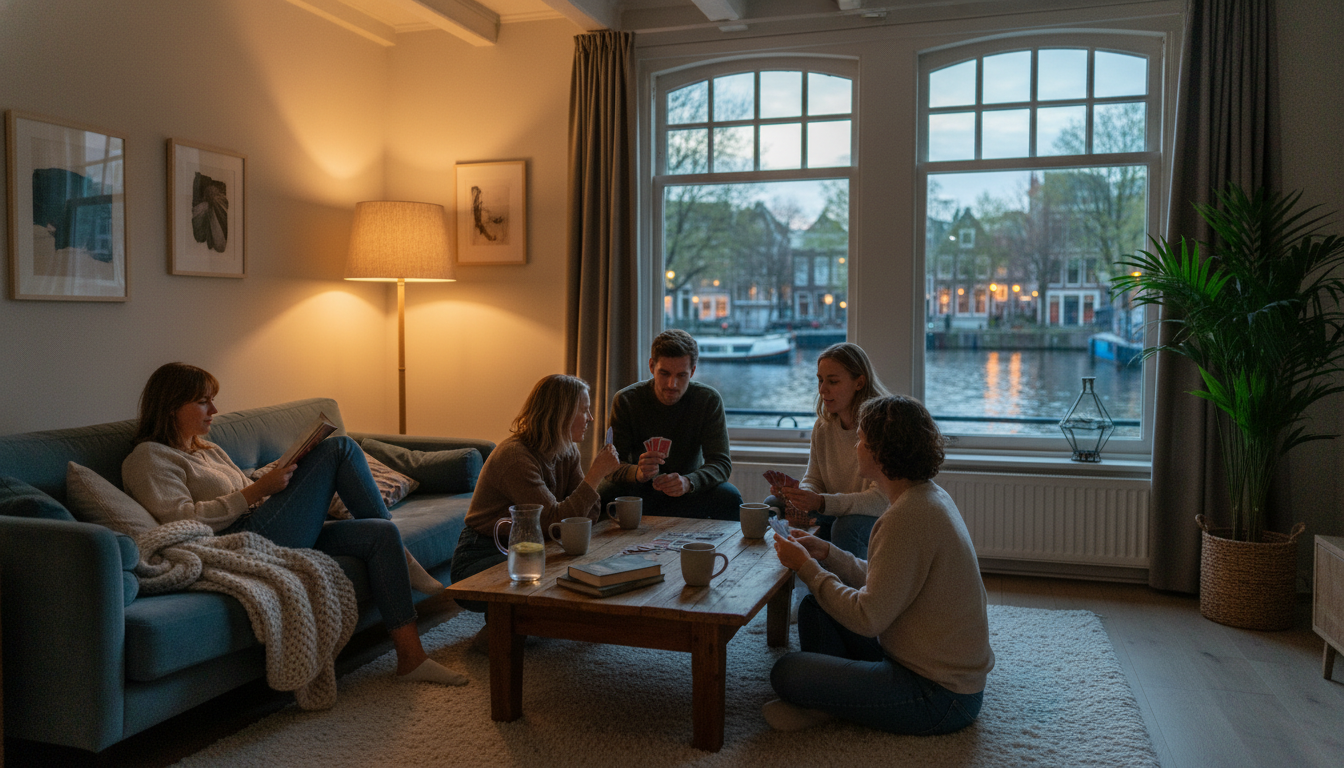 cozy living room scene in a Amsterdam canal house, friends playing cards at a coffee table, one pers
Real Talk: When Group Home Swapping Gets Complicated
I'd be lying if I said every group swap goes smoothly. Here are the challenges I've actually faced—and how to handle them.
The Flaky Friend Problem
Someone commits to the trip, you book based on that headcount, then they back out three weeks before departure.
Prevention: Don't book until everyone has paid their share of any non-refundable costs (flights, mainly). If someone's not willing to buy a plane ticket, they're not committed.
If it happens anyway: Have a conversation about whether the remaining group can absorb the extra space, or if you need to find a replacement traveler. Don't guilt-trip the flaky friend—it doesn't help—but do have clear policies about any shared costs they committed to.
The Mismatch Expectations
You arrive and the home isn't quite what the listing suggested. Maybe "spacious" was generous. Maybe the "garden" is a fire escape with one potted plant.
Prevention: Video chat with hosts before booking group trips. Ask specific questions: "Can the dining table actually seat 6 comfortably?" "How far is the walk to the nearest metro?" "Is there any street noise at night?"
If it happens anyway: Make the best of it. Seriously. I've had trips where the accommodation was disappointing but the group energy made it amazing anyway. Complain for 10 minutes, then move on and focus on the experience.
The Odd Person Out
Someone in the group isn't vibing—they want to do different activities, they're annoyed by the group dynamics, whatever.
Prevention: Be thoughtful about who you invite. A group trip isn't the time to "test" a new friendship or include someone out of obligation.
If it happens anyway: Build in solo time. Having a home base makes this easy—people can opt out of group activities without the weirdness of "going back to their own hotel room." Normalize saying "I'm going to skip the museum and read on the terrace."
The Financial Breakdown: What Group Home Swapping Actually Saves
Let me run real numbers from my Porto trip because I think this makes the value concrete.
The group: 8 people, 6 nights
Hotel alternative: Decent hotels in Porto's Ribeira district run €120-180/night. We would've needed 4 rooms minimum. Conservative estimate: €150 × 4 rooms × 6 nights = €3,600 total (about $3,900 USD), or $487 per person.
Vacation rental alternative: A 4-bedroom apartment in a similar location was listed at €280/night on Airbnb, plus €150 cleaning fee, plus service fees. Total: approximately €1,950 (about $2,100 USD), or $262 per person.
What we actually spent: 6 credits total (earned by hosting before the trip). $0 for accommodation.
We did spend money on groceries—approximately €25 per person for the week. A few dinners out ran €30-40 per person total. Activities added up. But our accommodation—typically the biggest travel expense—was free.
Over the course of that one trip, we collectively saved somewhere between $2,100 and $3,900 compared to traditional options. Split among 8 people, that's $260-490 each that went toward better meals, a day trip to the Douro Valley, and frankly, just staying longer than we would've otherwise.
Best Destinations for Group Home Swaps
Some places are just better suited to group home swapping than others. Based on my experience and what I've seen on SwappaHome, here's where to look.
European Cities with Spacious Apartments
Lisbon and Porto, Portugal: Large apartments are common because Portuguese families historically lived multi-generationally. You'll find tons of 3-4 bedroom listings in central neighborhoods.
Barcelona, Spain: The Eixample district has those gorgeous modernist apartments with high ceilings and multiple bedrooms. Just be mindful of noise regulations—Barcelona takes them seriously.
Amsterdam, Netherlands: Canal houses often have 3-4 floors with multiple bedrooms. The stairs are steep, but worth it for the location and space.
North American Options
Montreal, Canada: An affordable city with beautiful Plateau apartments that fit groups well. Plus, you get that European feel without the transatlantic flight.
Austin, Texas: Lots of family homes in neighborhoods like East Austin and South Congress. Great for groups who want space and a backyard.
San Diego, California: Beach houses and larger homes are common in the swap inventory. Perfect for groups who want a mix of city and coast.
Unexpected Group-Friendly Spots
Slovenia: Ljubljana and Lake Bled have an emerging home swap community with surprisingly spacious properties at lower "demand" than Western European capitals.
Colombia: Medellín and Cartagena have beautiful apartments that fit groups, and the home swap community is growing fast.
Getting Your Friends on Board with Home Swapping
The biggest barrier to group home swapping isn't logistics—it's convincing your friends to try it.
I get it. The concept sounds weird at first. "Wait, strangers stay in your house? And you stay in theirs? And no money changes hands?" It takes some explaining.
Here's my pitch when friends are skeptical:
"Think about it like a trusted community of travelers who've all agreed to take care of each other's homes. Everyone has reviews, so you can see their track record. And the whole system only works if people are respectful—there's no incentive to trash someone's place because you'd get terrible reviews and no one would ever host you again."
Then I show them my SwappaHome profile, with reviews from past swaps. Real testimonials from real people go further than any explanation.
For truly hesitant friends, suggest starting small: a weekend trip somewhere driveable, with a smaller group. Low stakes, easy logistics. Once they experience it, they're usually converts.
Your Group Home Swap Checklist
Before I wrap up, here's the sequence that's worked for my group trips:
2-3 months before: Confirm dates, establish the group, assign roles (Coordinator, Treasurer, Activities Lead)
6-8 weeks before: Start searching SwappaHome for group-friendly listings; shortlist 3-5 options
5-6 weeks before: Message hosts, have video chats, make your booking
4 weeks before: Book flights once accommodation is confirmed
2 weeks before: Create shared docs for itinerary, house rules, emergency contacts
1 week before: Confirm arrival details with host, share door codes/key pickup info with group
During the trip: Designate daily kitchen cleaner, respect quiet hours, communicate openly
After the trip: Leave a thoughtful review, send a thank-you message, start planning the next one
That Porto trip I mentioned at the beginning? It was supposed to be a one-time experiment. "Let's just see if this group home swap thing works."
We're now planning our third annual group swap. Next year: Copenhagen. Eight friends, one apartment, zero accommodation costs, and memories we'll be talking about for decades.
The friends you travel with become closer. The homes you stay in become characters in your stories. And the money you save? It means you can actually say yes to the trip instead of watching it die in a group chat full of "maybe next year."
If you've been thinking about trying home swapping but felt intimidated doing it solo, grab some friends. Make it a group adventure. The logistics are more complex, sure—but the payoff is exponentially better.
I'll see you out there. Probably arguing over who gets the room with the best view.
Frequently Asked Questions
Is home swapping with friends safe for larger groups?
Yes—home swapping with friends is safe when you choose verified hosts with positive reviews. SwappaHome's review system creates accountability, since hosts and guests rate each other and build trust through reputation. For extra peace of mind, consider getting your own travel insurance that covers accommodation. Groups often feel safer than solo travelers anyway because you're looking out for each other.
How many credits do I need for a group home swap?
On SwappaHome, you need one credit per night regardless of group size. A week-long trip for 8 friends costs the same 7 credits as a solo traveler's week. This flat-rate system makes group travel incredibly cost-effective—no per-person fees, no cleaning surcharges that mysteriously increase with headcount.
Can multiple SwappaHome members combine credits for one booking?
While bookings are made through individual accounts, groups can coordinate by having each member host travelers before the trip to earn credits. One person then makes the booking, and the group settles internally however they agree. New members also start with 7 free credits, which can jumpstart your group's credit pool.
What happens if something gets damaged during a group home swap?
SwappaHome connects members but doesn't provide damage coverage or insurance. Groups should discuss damage policies before traveling—many agree to split any costs equally. Consider checking if your homeowner's or renter's insurance covers home exchanges, or purchase travel insurance with accommodation coverage for extra protection.
How do I find homes big enough for group travel on SwappaHome?
Search for listings with 3+ bedrooms and multiple bathrooms. Read descriptions carefully—"sleeps 8" might mean sofa beds rather than proper bedrooms. Message hosts directly to confirm the space works for your group size, and request a video chat for larger groups. European cities like Lisbon, Barcelona, and Amsterdam often have spacious apartments perfect for groups.

Published by
SwappaHome
SwappaHome Editorial Team
Home Exchange & Slow Travel Editorial
The SwappaHome Editorial Team brings together travel research, home-exchange community insights, and platform data to produce practical guides for first-time and experienced home swappers. Every article cites real platforms, current market rates, and verifiable city-level facts so readers can make informed decisions without guessing.
Ready to try home swapping?
Join SwappaHome and start traveling by exchanging homes. Get 7 free credits when you sign up!
Related articles

Bachelor and Bachelorette Parties in Singapore: The Complete Home Swap Group Guide for 2026
Planning a bachelor or bachelorette party in Singapore? Discover how home swapping lets groups of 6-12 stay together in luxury condos, saving thousands while partying in Marina Bay.

Cycling in Lisbon: 7 Home Swap Bike Tour Itineraries for Every Rider
Discover the best cycling routes in Lisbon with these home swap bike tour itineraries—from waterfront paths to hilltop adventures, all starting from your borrowed home.

Graduation Trip to Barcelona: How Home Swapping Gives New Graduates the Ultimate Celebration
Planning a graduation trip to Barcelona? Discover how home swapping lets new graduates explore Spain's most vibrant city without the hostel crowds or hotel costs.