
Honeymoon in New York: Why Home Swapping Beats Luxury Hotels Every Time

SwappaHome Editorial Team
Home Exchange & Slow Travel Editorial
Planning a honeymoon in New York? Skip the $800/night hotels. Home swapping gives you real NYC apartments, neighborhood charm, and savings that fund unforgettable experiences.
Picture waking up in a sun-filled Brooklyn brownstone, the smell of fresh bagels drifting up from the corner deli on Smith Street. Your new spouse is making coffee in a real kitchen—not fumbling with a hotel room's single-cup machine. Through the window, the Manhattan skyline glows pink in the early morning light. This is what a honeymoon in New York actually feels like when you skip the hotel route.
Most couples planning a New York honeymoon immediately jump to the Midtown luxury hotels—the kind with marble lobbies, turndown service, and $45 room-service eggs. There's a certain glamour to that, sure. But here's what the wedding magazines won't tell you: those same couples often return home having spent $6,000-10,000 on accommodation alone, having seen New York through the same tourist-bubble lens as everyone else, and having missed the actual magic of this city entirely.
Home swapping offers something radically different. Instead of a sanitized hotel room that could be anywhere from Dubai to Denver, you get a real New York apartment in a real New York neighborhood. You get a kitchen where you can make midnight grilled cheese after stumbling back from a jazz club in the West Village. You get a local's list of recommendations—the Thai place on the corner that doesn't look like much but will change your life, the park bench with the perfect sunset view, the coffee shop where the barista will remember your order by day three.
And you get all of this essentially free, using credits you've earned by hosting travelers in your own home. That $6,000 you would have spent on a hotel? It becomes dinner at Eleven Madison Park, orchestra seats to a Broadway show, a helicopter tour over the Hudson, a shopping spree in SoHo—and still enough left over to pad your savings account.
Why New York Honeymoons Deserve More Than a Hotel Room
New York isn't a city you experience from a hotel lobby. It's a city of neighborhoods, each with its own personality, its own rhythm, its own secrets. Staying in a hotel—even a beautiful one—puts you in a bubble. You're a tourist, passing through. Staying in someone's actual home plants you in the middle of real New York life.
The difference hits you immediately. In a hotel, you wake up, get dressed, and head out to "do" New York—fighting crowds, following itineraries, checking boxes. In a home swap, you wake up and you're already living New York. You walk to the corner bodega in your pajamas for orange juice. You nod at the neighbor walking their dog. You discover that the best croissant in the city is apparently three blocks away at a bakery with no sign, according to the note your host left on the fridge.
This matters more on a honeymoon than any other trip. This is supposed to be the beginning of your married life together—and what better way to start than by playing house in one of the world's greatest cities? There's something deeply romantic about cooking dinner together in a stranger's kitchen, about falling asleep in a quiet residential neighborhood instead of a buzzing commercial district, about waking up and feeling like you actually live here, even if just for a week.
The SwappaHome community includes hundreds of New York properties, from cozy studios in Harlem to sprawling lofts in Tribeca. Many hosts specifically note that they love welcoming honeymooners—and often leave champagne, chocolate, or restaurant recommendations tailored for couples.
The Real Cost of a New York Honeymoon: Hotels vs. Home Swapping
Let's talk numbers, because this is where the home-swap advantage becomes impossible to ignore.
A "nice" hotel in Manhattan—we're talking a solid four-star, good location, nothing outrageous—runs $400-600 per night. Want something actually special? The kind of place with a view, a spa, the whole honeymoon fantasy? You're looking at $700-1,200 per night. For a week-long honeymoon, that's $4,200-8,400 just for a place to sleep.
Now factor in everything else hotels charge for. Breakfast at a New York hotel averages $35-50 per person—that's $70-100 daily, or $490-700 for the week. Room service dinner? $80-120 for two, easily. Mini-bar? Don't even look at it. Parking if you drove? $75-95 per night at most Manhattan hotels. The "resort fee" that's increasingly common? Another $30-50 nightly.
A week in a mid-range Manhattan hotel, with modest dining and no wild extras, easily tops $7,000. Upgrade to luxury and you're pushing $12,000-15,000.
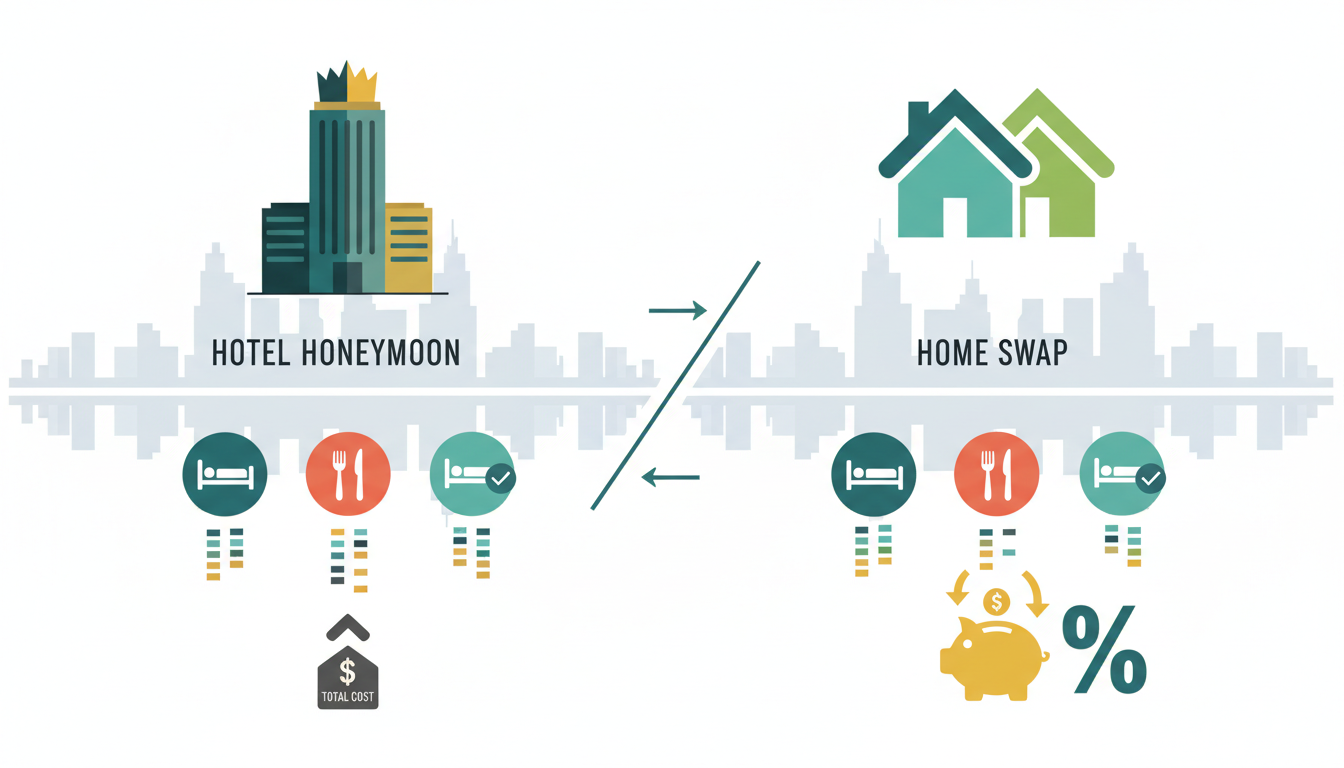 Split-screen infographic comparing hotel honeymoon costs vs home swap costs in New York, showing ite
Home swapping flips this equation entirely. On SwappaHome, every night costs one credit—whether you're staying in a studio apartment or a four-bedroom brownstone. New members start with seven free credits, meaning your first week-long honeymoon accommodation costs nothing but the membership fee. Even if you need to earn credits first by hosting travelers, you're still paying zero dollars for your New York stay.
The kitchen changes everything financially. Making breakfast in your swap apartment costs maybe $15 for two—fresh bagels from Ess-a-Bagel, cream cheese, good coffee, fresh fruit from the Union Square Greenmarket. That's $105 for the week instead of $490-700. Pack a picnic lunch for Central Park: another $50-70 in savings daily. Even if you eat out for every dinner, you've cut your food budget by two-thirds.
Most SwappaHome members report saving 70-90% on their New York trips compared to hotel stays. That's not marketing speak—it's math.
The Best New York Neighborhoods for a Home Swap Honeymoon
Choosing where to stay matters enormously in New York, and home swapping opens neighborhoods that hotels simply don't serve. Here's where the SwappaHome community finds the best honeymoon experiences:
Brooklyn Heights and DUMBO
These neighboring Brooklyn waterfront areas offer what might be the most romantic setting in all of New York. Brooklyn Heights has tree-lined streets of historic brownstones, the famous Promenade with its unobstructed Manhattan views, and a village-like feel that's almost European. DUMBO (Down Under the Manhattan Bridge Overpass) adds cobblestone streets, converted warehouse lofts, and that iconic view of the Manhattan Bridge framing the Empire State Building.
Home swaps here typically feature character you'd never find in a hotel—original fireplaces, exposed brick, rooftop access, gardens. The neighborhood is walkable to Brooklyn Bridge Park, where you can watch sunset over the harbor, then stroll across the Brooklyn Bridge into Manhattan as the city lights up.
Dinner options range from River Café (splurge-worthy, right on the water) to Juliana's Pizza (cash only, worth every penny) to dozens of cozy wine bars and bistros along Henry Street and Montague Street.
West Village and Greenwich Village
If your honeymoon fantasy involves winding streets, hidden jazz clubs, and the feeling of old New York, the Villages deliver. This is where Carrie Bradshaw wandered, where Bob Dylan played his first New York shows, where the Stonewall uprising happened. The streets don't follow a grid—they twist and turn and dead-end into tiny parks and secret gardens.
Home swaps in the Village tend toward the compact (this is Manhattan, after all) but often include details like working fireplaces, original moldings, and access to private gardens. You're walking distance to Washington Square Park, the Comedy Cellar, Blue Note Jazz Club, and some of the city's best restaurants—from the legendary Joe's Pizza to the impossible-to-book Via Carota.
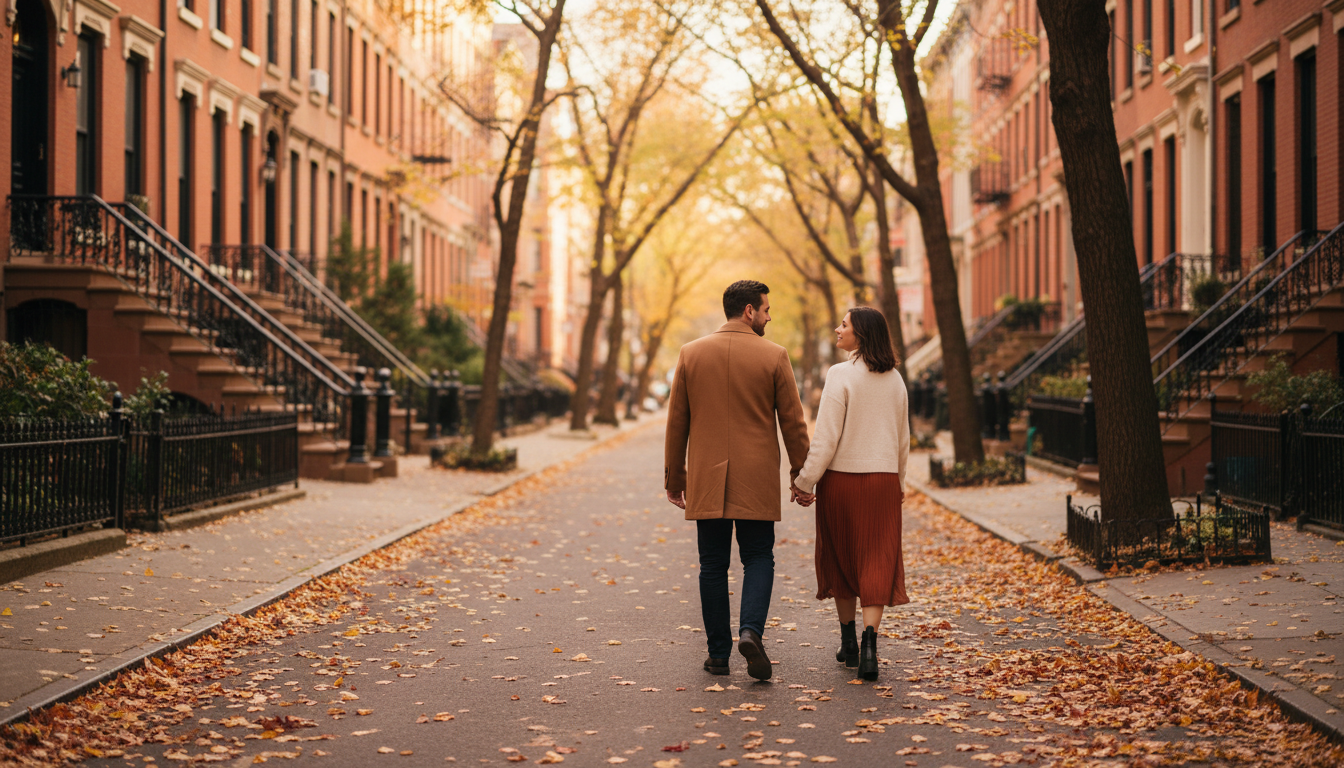 Couple walking hand-in-hand down a tree-lined West Village street at golden hour, brownstones with s
Upper West Side
For couples who want space, quiet, and proximity to Central Park, the Upper West Side offers a more residential honeymoon experience. Pre-war apartments here often feature grand proportions—high ceilings, large windows, formal dining rooms. You're steps from the American Museum of Natural History, Lincoln Center, and the park's most beautiful western sections including Strawberry Fields and the Jacqueline Kennedy Onassis Reservoir.
The neighborhood has an intellectual, cultured vibe—lots of bookshops, classical music, and long-established restaurants like Barney Greengrass (the "Sturgeon King," serving smoked fish since 1908) and Café Luxembourg. Morning runs or walks in Central Park become part of your honeymoon routine.
Williamsburg, Brooklyn
For couples who lean creative, food-obsessed, or nightlife-curious, Williamsburg offers a honeymoon with edge. This is New York's hipster epicenter—but don't let that word fool you. The food scene is genuinely world-class, the waterfront parks are stunning, and the energy is young and alive.
Home swaps here often feature industrial-chic lofts with exposed beams and massive windows. You're near Smorgasburg (the famous weekend food market), rooftop bars with Manhattan views, vintage shops, and some of the city's most innovative restaurants. The L train gets you to Manhattan in minutes.
Harlem
For couples interested in history, music, and genuine neighborhood character, Harlem offers a honeymoon experience unlike anywhere else in New York. The brownstones here are magnificent—many larger and more ornate than their downtown counterparts, at a fraction of the price. You're near the Apollo Theater, Marcus Garvey Park, and legendary soul food spots like Sylvia's and Red Rooster.
Sunday gospel brunch at a Harlem church is a honeymoon memory you'll never forget. The neighborhood is also home to some of the city's best jazz—Minton's Playhouse, where bebop was born, still hosts live music.
How to Find and Book the Perfect New York Honeymoon Swap
Finding a great home swap for your honeymoon requires a bit more intentionality than booking a hotel, but the payoff is worth it. Here's what works:
Start early. New York is one of the most popular home-swap destinations globally, and the best properties—especially in prime neighborhoods—book up months in advance. For a honeymoon, begin your search at least three to four months out, ideally six months if you're targeting a specific neighborhood or traveling during peak season (September-November or December holidays).
Be specific about what matters. SwappaHome lets you filter by neighborhood, amenities, and property type. For a honeymoon, prioritize: a comfortable bed (this seems obvious but matters enormously), natural light (you want to wake up happy), and either outdoor space or proximity to a park. A dishwasher and laundry access are luxuries that make a longer stay much more pleasant.
Read the reviews carefully. The SwappaHome community takes reviews seriously—they're how trust gets built. Look for hosts who've received specific praise for cleanliness, communication, and thoughtful touches. Mentions of "left us wine" or "incredible recommendations" signal hosts who understand hospitality.
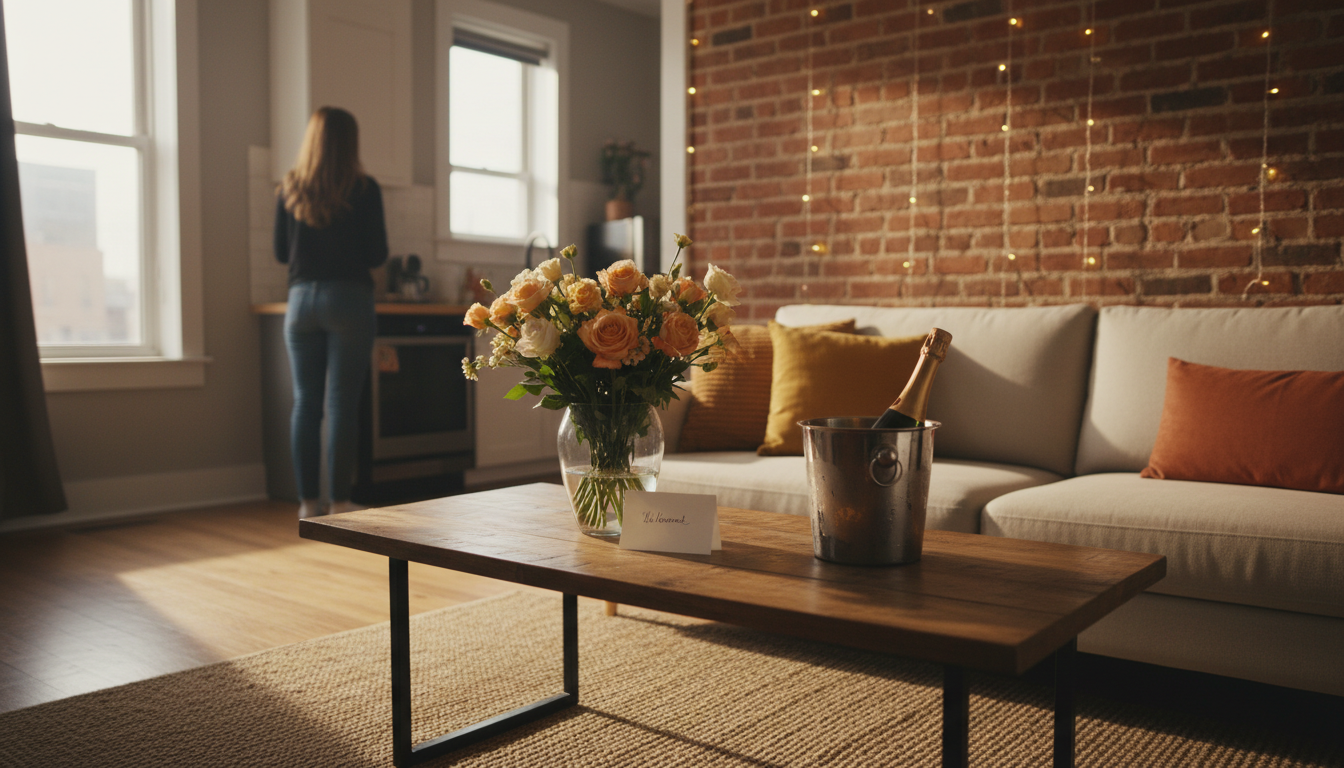 Cozy apartment interior with exposed brick, string lights, fresh flowers on the table, a bottle of c
Message potential hosts personally. A generic booking request gets generic results. Write a real message explaining that you're honeymooning, share a bit about yourselves, and ask any specific questions about the space or neighborhood. Hosts are far more likely to accept requests from people they feel a connection with—and they often go above and beyond for honeymooners.
Consider timing carefully. New York transforms by season. Spring (April-May) brings cherry blossoms in Central Park and pleasant walking weather. Summer (June-August) is hot and humid but offers free outdoor concerts, Shakespeare in the Park, and rooftop bars. Fall (September-November) is arguably the city's most beautiful season—crisp air, changing leaves, fashion week energy. Winter (December-February) means holiday magic, ice skating, and cozy restaurant season, though you'll need serious cold-weather gear.
What New York Home Swap Hosts Typically Provide
A common question from first-time home swappers: what's actually included? The answer varies by host, but New York swap properties typically include:
Fresh linens and towels, changed before your arrival. Most hosts also provide basic toiletries—soap, shampoo, toilet paper—though bringing your favorites is always smart.
Kitchen basics: coffee maker (often with coffee provided), basic cookware, dishes, utensils. Some hosts stock spices, oils, and pantry staples; others keep the kitchen more bare-bones. Always ask in advance if cooking is important to you.
WiFi and streaming services. Nearly universal in New York swaps—most hosts leave their Netflix, Hulu, or other accounts logged in for guests.
Local recommendations. This is where home swapping really shines. Most SwappaHome hosts leave detailed guides—printed, digital, or both—covering everything from the nearest subway entrance to their favorite neighborhood restaurants to which dry cleaner they trust. Some hosts create elaborate welcome books; others prefer a quick phone call to walk you through the essentials.
What's not typically included: daily housekeeping (this isn't a hotel), airport transfers, or concierge services. You're trading those conveniences for space, character, and massive savings.
Making the Most of Your New York Honeymoon Budget
The money you save on accommodation opens up experiences that would otherwise be honeymoon-budget-busters. Here's how savvy couples reallocate those savings:
Splurge on One Unforgettable Dinner
New York has more world-class restaurants than anywhere in America—and the best ones cost accordingly. With hotel savings in your pocket, you can actually afford them.
Eleven Madison Park in the Flatiron District offers a multi-hour tasting menu experience that regularly tops "world's best" lists. Expect $400-500 per person with wine pairings, but this is a once-in-a-lifetime meal. Le Bernardin in Midtown—Eric Ripert's legendary seafood temple—is slightly more accessible at $200-300 per person but no less special.
Or go the opposite direction: book a counter seat at a tiny omakase spot like Sushi Nakazawa or Shuko, where $200-300 per person gets you an intimate, interactive experience.
 Elegant restaurant table set for two with candlelight, Manhattan skyline visible through floor-to-ce
Get Broadway Tickets Worth Having
Orchestra seats to a hit Broadway show run $200-400 each. Most hotel-staying honeymooners settle for rear mezzanine or skip Broadway entirely. With your savings, you can sit in the fifth row of Hamilton, Wicked, or whatever's capturing the city's attention. The difference between seeing a show from row E versus row W is the difference between being inside the experience and watching it from a distance.
Worth noting: The TKTS booth in Times Square offers same-day discounted tickets to many shows, but lines are long and selection is limited. For a honeymoon, book in advance and pay full price for the seats you actually want.
Experience the City from Above
New York helicopter tours—departing from the Downtown Manhattan Heliport—run $200-300 per person for a 15-20 minute flight over the Statue of Liberty, Brooklyn Bridge, and Manhattan skyline. It's touristy, sure, but also genuinely breathtaking. The photos alone are worth it.
Alternatively, book sunset drinks at a rooftop bar with views. The Roof at the Public Hotel, Westlight in Williamsburg, and 230 Fifth all offer skyline panoramas without the helicopter price tag.
Book a Spa Day
New York spas range from neighborhood nail salons to world-class wellness temples. For a honeymoon splurge, consider Aire Ancient Baths in Tribeca—a subterranean thermal bath experience in a restored 1883 textile factory. Couples packages run $300-500 and include access to multiple temperature pools, steam rooms, and optional massage treatments.
The Practical Side: Navigating New York During Your Honeymoon
A few logistics that make New York honeymoons smoother:
Transportation in New York is best handled by subway, walking, and occasional rideshares. Do not rent a car—parking is expensive, traffic is miserable, and you won't need one. Buy an unlimited MetroCard ($33 for 7 days) and use it freely. The subway runs 24/7, though late-night service is less frequent.
From the airports: JFK to Manhattan runs $60-80 by taxi (flat rate) or $11 by AirTrain plus subway. LaGuardia is closer but has no train connection—expect $40-60 by taxi or rideshare. Newark is actually quite convenient to Manhattan via NJ Transit ($15) or taxi ($60-80 plus tolls).
Tipping in New York is expected everywhere: 18-22% at restaurants, $1-2 per drink at bars, $2-5 for hotel bellhops or doormen who help with bags. Your home swap eliminates most tipping situations, which is another quiet savings.
Reservations are essential for popular restaurants—book 2-4 weeks ahead for in-demand spots, or be prepared to eat at off-hours (5:30pm or 9:30pm). Apps like Resy and OpenTable are your friends.
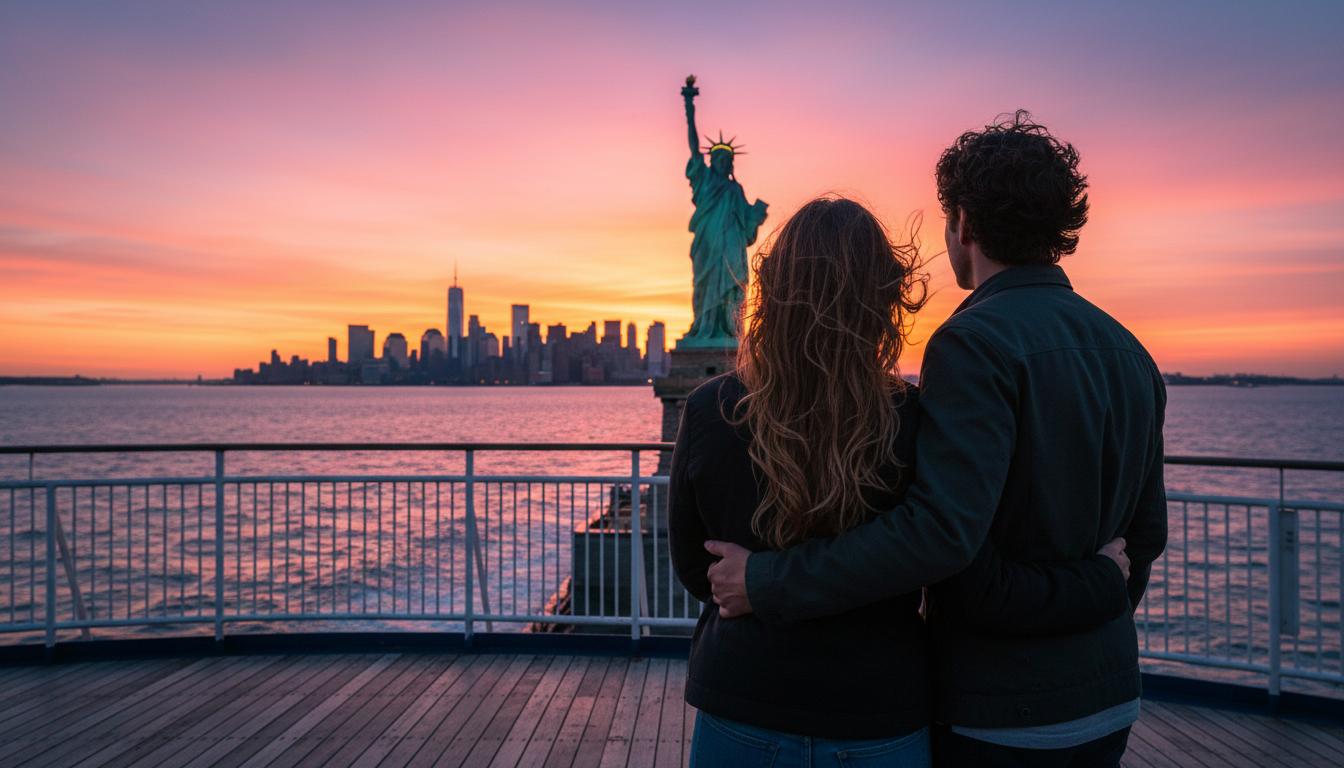 Couple riding the Staten Island Ferry at sunset, Statue of Liberty in the background, wind in their
What Makes Home Swapping Actually Romantic
Here's the thing: there's a case to be made that home swapping is inherently more romantic than hotels—even luxury ones.
Hotels, by design, are transactional. You're a room number, a credit card, a checkout time. The staff is professional and pleasant, but you're one of hundreds of guests cycling through. Everything is standardized, sanitized, predictable. That's the point of hotels: reliability without surprise.
Home swaps are personal. You're staying in someone's actual life—their books on the shelves, their art on the walls, their neighborhood, their coffee mug. There's intimacy in that, a sense of connection to a real person even though you've never met. The host chose to trust you with their home; you chose to trust them with your honeymoon. That mutual vulnerability creates something hotels can't replicate.
And the domestic rituals matter. Making breakfast together, doing dishes side by side, arguing about what to watch on the host's Netflix—these are the mundane intimacies of married life. A honeymoon in a home swap lets you practice them from day one, in a beautiful setting, without the pressure of your actual daily routine.
Many SwappaHome members report that their home swap honeymoons felt more like "real life but better" than the typical honeymoon fantasy. Less performance, more presence. Less Instagram, more actual experience.
When Hotels Might Actually Make Sense
Honesty matters, so here's the truth: home swapping isn't perfect for every couple or every honeymoon.
If you genuinely want to be pampered—daily housekeeping, room service at 2am, someone else making the bed—a hotel delivers that and a home swap doesn't. Some couples want their honeymoon to be a complete break from domestic tasks. That's valid.
If you're uncomfortable with uncertainty, hotels offer predictability that swaps can't match. You know exactly what a Marriott or Hilton will look like. A home swap is always somewhat unknown until you arrive.
If your trip is very short—three nights or less—the setup overhead of a home swap (key exchange, orientation, figuring out the neighborhood) might not be worth it. Hotels are optimized for short stays.
If you need guaranteed amenities—a gym, a pool, a concierge who can get restaurant reservations—hotels are more reliable. Home swaps vary wildly in what they offer.
For most couples planning a week or more in New York, though, the home swap advantages overwhelm these concerns. The savings, the space, the neighborhood immersion, the romance of playing house—it's hard to beat.
A Week-Long New York Honeymoon Itinerary (Home Swap Edition)
Here's how a home swap honeymoon might actually unfold, based on patterns we've seen work well in the SwappaHome community:
Day 1: Arrive, settle into your swap apartment, explore your immediate neighborhood on foot. Find the nearest good coffee shop, grocery store, and restaurant. Have a low-key dinner somewhere casual—you just traveled, you're tired, and you have all week.
Day 2: Central Park day. Walk from the south end (59th Street) up through the Mall, past Bethesda Fountain, around the Lake, to Belvedere Castle. Pack a picnic from a neighborhood deli. End with dinner in the Upper West Side or Upper East Side, depending on which side of the park you finish.
Day 3: Museum day. Pick one major museum—the Met, MoMA, the Guggenheim, the Whitney—and give it real time, not a rushed tour. Have lunch at the museum café. Spend the evening in a different neighborhood than where you're staying.
Day 4: Brooklyn exploration. Brooklyn Bridge walk (go early, before crowds), DUMBO waterfront, Brooklyn Heights Promenade. Lunch at Time Out Market or Juliana's Pizza. Afternoon wandering Prospect Park or the Brooklyn Botanic Garden. Dinner in Williamsburg or your home neighborhood.
Day 5: Splurge day. This is when you use those savings. Spa morning, fancy lunch, Broadway show, late-night cocktails at a rooftop bar.
Day 6: Off-the-beaten-path day. Explore a neighborhood tourists skip—Astoria in Queens for Greek food and beer gardens, the Bronx for the real Little Italy on Arthur Avenue, Staten Island Ferry (free!) for Statue of Liberty views.
Day 7: Slow morning in your apartment. Make breakfast, drink coffee, pack leisurely. One final neighborhood walk, one last meal at a spot you loved. Head to the airport with actual memories, not just photos.
Getting Started with SwappaHome for Your Honeymoon
If home swapping sounds right for your New York honeymoon, here's the practical path forward:
Create your SwappaHome profile and list your own home. Even if you're not ready to host immediately, having a complete listing makes you more credible to potential swap partners. Include good photos, honest descriptions, and details about your neighborhood.
Start earning credits by hosting travelers in your home before your honeymoon. This builds your reputation, gets you comfortable with the swap process, and banks the credits you'll need for New York. Most couples can earn enough credits for a week-long honeymoon by hosting 2-3 short stays over a few months.
Begin searching New York properties 4-6 months before your wedding. Favorite the ones that appeal to you, and reach out to hosts early. Mention that you're honeymooning—hosts often prioritize couples celebrating special occasions.
Ask questions before confirming. How does key exchange work? What's the parking situation if you're driving? Are there any quirks to the apartment (noisy street, tricky shower, temperamental lock)? Good hosts appreciate thorough questions.
Leave a detailed, thoughtful review after your stay. The home swap community runs on trust and reciprocity. Your review helps future travelers and builds your own reputation for future swaps.
Frequently Asked Questions
Is a home swap honeymoon in New York safe?
Home swapping in New York is as safe as the neighborhood you choose and the host you select. SwappaHome's verification system and review ratings help you identify trustworthy hosts. Stick to established neighborhoods, read reviews carefully, and communicate with your host before booking. Most members report feeling safer in residential neighborhoods than in tourist-heavy hotel districts.
How much can we actually save on a New York honeymoon with home swapping?
Most couples save $4,000-8,000 on a week-long New York honeymoon by home swapping instead of staying in hotels. The exact savings depend on what hotel you'd otherwise book, but even compared to mid-range options, the difference is substantial. Add kitchen savings on meals and the total easily reaches $5,000-10,000.
What if something goes wrong during our New York home swap?
Communication is key. Most issues—a broken appliance, a confusing lock, a neighbor complaint—resolve quickly with a message to your host. For your honeymoon, consider purchasing travel insurance that covers accommodation disruptions, and always have a backup plan (a hotel you could book last-minute if absolutely necessary). In practice, serious problems are rare in the SwappaHome community.
When is the best time for a honeymoon home swap in New York?
Fall (September through November) offers the best combination of weather, availability, and atmosphere—crisp days, changing leaves, vibrant cultural calendar. Spring (April-May) is a close second. Summer is hot and crowded; winter is cold but magical if you embrace it. Avoid the weeks between Christmas and New Year's unless you specifically want holiday New York—prices spike and availability drops.
Do we need to swap simultaneously, or can we use credits from previous hosting?
SwappaHome uses a credit system, so you don't need to swap simultaneously. Host travelers in your home before your honeymoon to earn credits, then spend those credits in New York—your hosts might be anywhere in the world. This flexibility is one of home swapping's biggest advantages for honeymoon planning.

Published by
SwappaHome
SwappaHome Editorial Team
Home Exchange & Slow Travel Editorial
The SwappaHome Editorial Team brings together travel research, home-exchange community insights, and platform data to produce practical guides for first-time and experienced home swappers. Every article cites real platforms, current market rates, and verifiable city-level facts so readers can make informed decisions without guessing.
Ready to try home swapping?
Join SwappaHome and start traveling by exchanging homes. Get 7 free credits when you sign up!
Related articles

Bachelor and Bachelorette Parties in Singapore: The Complete Home Swap Group Guide for 2026
Planning a bachelor or bachelorette party in Singapore? Discover how home swapping lets groups of 6-12 stay together in luxury condos, saving thousands while partying in Marina Bay.

Cycling in Lisbon: 7 Home Swap Bike Tour Itineraries for Every Rider
Discover the best cycling routes in Lisbon with these home swap bike tour itineraries—from waterfront paths to hilltop adventures, all starting from your borrowed home.

Graduation Trip to Barcelona: How Home Swapping Gives New Graduates the Ultimate Celebration
Planning a graduation trip to Barcelona? Discover how home swapping lets new graduates explore Spain's most vibrant city without the hostel crowds or hotel costs.