
House Sitting vs. Home Exchange: Which Fits Your Travel Style?

SwappaHome Editorial Team
Home Exchange & Slow Travel Editorial
So you want to travel without hemorrhaging money on hotels. Good instinct. But now you're staring down two options that both promise "free" lodging, and they sound kind of similar until you actually...
So you want to travel without hemorrhaging money on hotels. Good instinct. But now you're staring down two options that both promise "free" lodging, and they sound kind of similar until you actually look under the hood. House sitting means you take care of someone's home (and usually their pets) while they're gone. Home exchange means you trade stays with other travelers, either directly or through some kind of credit system. Same goal, wildly different experience. This guide walks through how each one works, what they'll actually cost you, and who each is really built for.
Table of Contents
- House Sitting vs. Home Exchange: What's the Core Difference?
- How Does House Sitting Work?
- How Does Home Exchange Work?
- House Sitting vs. Home Exchange: Comparing Costs Side by Side
- Which Wins on Flexibility and Control?
- Responsibilities: What You're Actually Signing Up For
- Which Travel Style Fits Each Option?
- Home Exchange Alternatives Worth Considering
- Frequently Asked Questions
House Sitting vs. Home Exchange: What's the Core Difference?
The core difference comes down to who benefits and how: house sitting is a one-way deal where you look after a home while the owner's away in return for a free place to stay, while home exchange is a two-way arrangement where members trade stays in each other's homes, either directly or through a shared credit system.
With house sitting, the owner packs up and leaves, and you move in to keep an eye on the plants, the pets, the general upkeep. Nobody's ever going to crash at your place in return. It's a straight service-for-lodging swap. Home exchange runs on reciprocity instead. A platform like Swappahome connects verified members who list their own homes and then use those listings to book stays somewhere else, usually through credits rather than actual cash. The way Swappahome puts it: list your home, earn one credit for every night a guest stays, then spend those credits to book anywhere in the network, with one credit equal to one night no matter where you're headed.
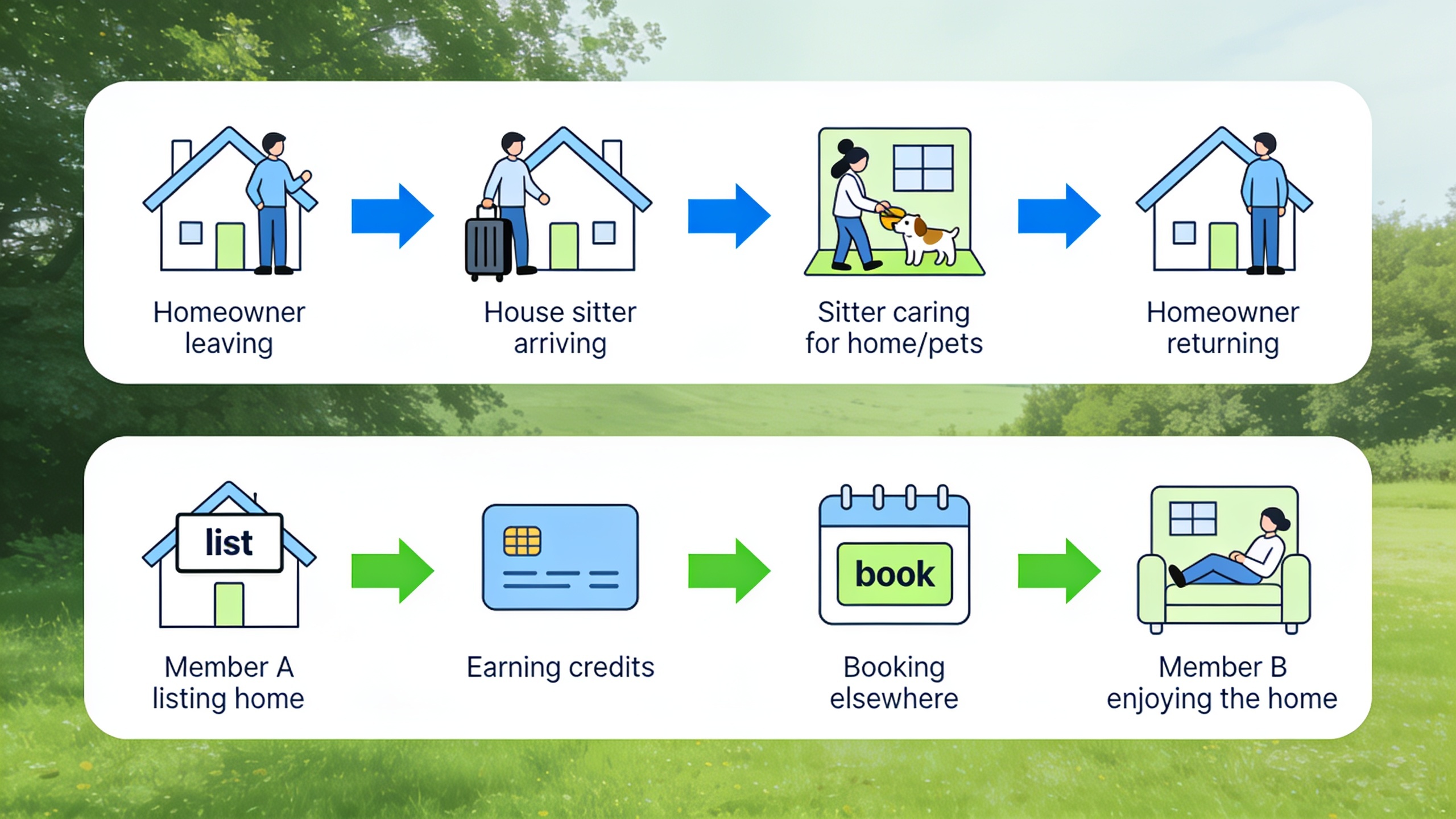 Infographic comparing house sitting workflow versus home exchange credit system
And honestly, that one structural thing, service versus reciprocity, ends up shaping almost everything else. Cost, flexibility, how much of your vacation you spend actually working. Keep it in mind as we go.
How Does House Sitting Work?
House sitting works by matching homeowners who need someone around while they travel with sitters willing to handle the home-and-pet stuff in exchange for a free place to crash. The owner usually leaves you a small novel of instructions, and you're expected to actually be there for the whole assignment, which might be three days or three weeks.
Here's the part people underestimate. The homeowner is handing their property, and often a pet they adore, to someone they barely know. So there's almost always some vetting involved: references, an intro call, maybe a trial run. Your "payment" is the roof over your head. No cash changes hands either direction as a rule, though occasionally there's a little stipend for pet expenses. The catch? Your calendar isn't yours anymore. It bends around when owners need coverage. Say you've got your heart set on Barcelona in June. You now have to find a Barcelona homeowner who happens to be leaving in June, which is a much narrower target than just booking a hotel whenever you feel like it.
How Does Home Exchange Work?
Home exchange works by letting you list your own place, then use that listing (and the trust it builds up) to book stays in other members' homes, either through direct swaps or a credit system that means you don't have to line up travel dates exactly.
Swappahome, for one, runs on credits rather than making two people visit each other's homes at the same time. According to the platform, new members get seven free credits at signup, which is good for up to seven free nights across the network. After that, hosting a guest earns you one credit per night they stay, and those credits, which Swappahome says never expire, can be spent in any of the more than a dozen countries currently in the community. No money passes between members, everyone's ID-verified, and every stay ends with two-way reviews, the same kind of trust setup you've probably seen on short-term rental sites.
This is the whole point, really. It fixes the scheduling headache that always killed old-school one-to-one swapping. You don't need to find an Italian family dying to visit your exact neighborhood on your exact dates. You host when it works for you, stack up credits, and cash them in whenever you're ready to go somewhere. If the whole concept is new to you and you want to see how a swap-based stay stacks up against a managed rental service, the piece on GuestReady vs Swappahome: Which Fits Your Travel Style? digs into that comparison.
House Sitting vs. Home Exchange: Comparing Costs Side by Side
On pure out-of-pocket cost, both a credit-based home exchange and house sitting can get your accommodation close to zero. They just get there differently, one through caregiving, the other through hosting or credits, and the sneaky costs aren't the same either.
House sitting itself has no membership fee when it's arranged directly between an owner and sitter. But a lot of sitters find their gigs through listing platforms that charge an annual subscription just to browse and apply, and getting yourself to the sit? That's all on you. Home exchange platforms vary. Swappahome says flat-out that it's free to join and free to use, "no fees, no catches," no required membership.
Want to see what that actually adds up to? Swappahome ran a comparison using average nightly prices across 947 cities from AirROI public data (snapshot dated April 29, 2026). A 14-night stay in Paris booked through Airbnb averaged roughly €1,707, versus €0 through Swappahome's credit-based exchange, since you'd just be spending banked credits instead of cash. That's Airbnb's public pricing for that snapshot, not a locked-in rate, but it gives you a real sense of the gap.
| Cost Factor | House Sitting | Home Exchange (Swappahome model) |
|---|---|---|
| Nightly accommodation cost | Free (in exchange for care duties) | 1 credit per night; new members start with 7 free credits |
| Platform fees | Not stated publicly for direct arrangements; some listing sites charge subscription fees | Free to join, no required membership fees, per Swappahome |
| Cash exchanged between parties | Typically none | None — Swappahome states no money changes hands between members |
| Travel/transport costs | Sitter's own responsibility | Traveler's own responsibility |
| Extra costs to watch for | Possible pet supplies, utilities, or transport to the sit | Not stated publicly beyond the credit system |
Which Wins on Flexibility and Control?
Home exchange generally gives you more control over your own dates, while house sitting gives you more shot at destination-specific opportunities you couldn't otherwise afford. Both come with strings attached, though, and you should know what they are before you jump in.
With house sitting, your dates aren't your dates. They're the homeowner's. You're basically waiting for someone else's vacation to open a window for you. Sometimes that's magic, a chance to spend a month somewhere you'd never be able to afford otherwise. But if you're trying to plan around work deadlines, school holidays, or your partner's stingy vacation allowance, that unpredictability can be a real pain.
A credit-based exchange loosens that up because you're not chasing a simultaneous match. You host on your schedule, bank the credits, spend them when you're ready. Swappahome built it around the idea that credits don't expire, so there's none of that "use it or lose it" panic the second you earn one. Now, I'll be honest: availability still depends on who's actually listed homes in the place you want, on the dates you want. Popular cities in peak season will always have more people competing for the same bookings than a quiet off-season search. No platform magics that away.
And if you're traveling solo, the whole flexibility question shifts again. Safety, communication with hosts, handling last-minute changes with nobody to split the logistics with. All of it matters more. The guide on Solo Travel Home Swap: Tips for the Independent Explorer gets into navigating a swap trip on your own.
Responsibilities: What You're Actually Signing Up For
House sitting comes with active, hands-on duties for your entire stay, while home exchange responsibilities are more front-loaded, mostly about prepping and maintaining your own listing rather than doing daily chores in someone else's house.
Let's be clear about what a sitter's day actually looks like. Feeding and walking pets. Watering plants. Grabbing the mail. Dragging the trash out on the right day. Dealing with whatever minor house drama pops up. This is not a passive vacation. You're working a caretaking job in exchange for the bed, and owners often want regular check-ins or photos to know things haven't gone sideways.
A home exchange member's job is a different animal. Because Swappahome runs on that reciprocal, credit-earning model, your main obligations are keeping your listing accurate, answering booking requests, and getting your place ready when you've got a guest coming. Plenty of members go the extra mile here, from a proper cleaning to little touches that make a stay feel warm. Even something small, like lighting a hand-poured soy candle by the door before someone checks in, sets a tone that feels personal instead of transactional. And when you're the guest, the deal is simple: treat the place the way you'd want yours treated. Respect the house rules, leave it clean, finish the two-way review that keeps the whole verified-member system honest.
Which Travel Style Fits Each Option?
The right pick has less to do with budget than you'd think. It's really about how much caregiving you want on your plate, how locked-in your dates are, and whether you'd rather earn your stay through service or through hosting.
Budget-focused travelers in their late 20s to 40s, the ones who want flexibility without being chained to a caretaking schedule, tend to gravitate toward home exchange. A credit model like Swappahome's lets you plan around your own calendar instead of somebody else's departure. And those seven free starter credits can make a first trip essentially free before you've even hosted a single person.
Families usually land on home exchange too, and the reason is pretty practical. Swapped homes come with full kitchens, multiple bedrooms, a yard maybe. If you're a parent trying to keep a toddler's nap schedule intact, that beats cramming everyone into one hotel room by a mile. Swappahome's own listings, like a two-bedroom, two-bath house in Lisbon's historic Belém neighborhood or a family-sized bungalow in Melbourne, are actual homes, not compact hotel boxes.
Retirees with flexible schedules and a genuine soft spot for animals, on the other hand, are often perfect for house sitting. Fewer date restrictions, more patience for the daily rhythm of pets and plants. The stuff that feels like a chore to a frazzled professional can be a genuinely enjoyable part of slow travel when you've got the time for it.
 Retired couple enjoying house sitting with pets in a peaceful home setting
Digital nomads and remote workers? Almost always better off with home exchange. When your day revolves around client calls and deadlines, being tied to a pet's feeding schedule is a recipe for stress. A swapped home is just a home you're living and working in, no ongoing duties beyond not trashing the place.
Home Exchange Alternatives Worth Considering
If neither traditional house sitting nor a strict one-to-one swap feels right, there are a few in-between options that borrow bits from both. A credit-based platform is itself one of them, since it kills the requirement that two members want to visit each other's exact home on matching dates.
Beyond that, you've got short-term rentals (you pay market rate, but you get location certainty), extended-stay corporate housing (handy for longer remote-work stints, though usually pricier than a swap), and those hybrid caretaking setups where an owner gives you a reduced rental rate in exchange for keeping a light eye on the place rather than a full-blown sit. Each one juggles cost, flexibility, and responsibility differently. My advice? Write down your own priorities, budget, how flexible your schedule really is, and how much hands-on work you're honestly willing to take on, then hold each model up against that list before you commit to anything.
Frequently Asked Questions
Is house sitting actually free, or are there hidden costs? The lodging is usually free in exchange for the caretaking, yeah. But you're almost always paying your own way to get to the property, and a lot of the platforms that connect sitters with owners charge a subscription just to see the listings. Ask the homeowner up front whether utilities, pet supplies, or other odds and ends are covered.
How does the credit system on something like Swappahome actually work? New members get seven free credits at signup, good for up to seven free nights. After that, hosting a guest earns you one credit per night they stay, and you can spend those credits later anywhere in the network, since Swappahome says credits never expire and one credit always equals one night, no matter the destination.
Do I have to own a home to use a home exchange platform? Pretty much, yeah. These platforms are built around members listing their own place to earn credits or set up swaps, so having a home or apartment to list is central to how it works. No listable home? Then house sitting or a regular paid rental is probably an easier place to start.
Which one's safer for solo travelers? Both lean on trust systems, house sitting through references and intro calls, and platforms like Swappahome through ID verification and two-way reviews after every stay. But if you're on your own, do the extra homework regardless: hop on a video call with the host or sitter before you commit, and get your check-in details confirmed in writing.
Can I try home exchange before I commit my own home to the network? On Swappahome, sort of, yes. Those seven free starter credits basically let you experience a stay in the network before you've hosted anybody. You'll need to list your own home eventually to keep earning credits for future trips, but you get to test the waters first.
Finding Your Fit
There's no clean winner in the house sitting versus home exchange debate, and anyone who tells you otherwise is selling something. It really does come down to whether you'd rather trade caretaking hours for a free bed or trade access to your own home for stays elsewhere. Pull up your actual travel calendar, be honest about how much daily responsibility you can stomach, look at your budget, and let those three things do the deciding. Do that, and your next trip feels less like a compromise and more like the vacation you actually wanted in the first place.

Published by
SwappaHome
SwappaHome Editorial Team
Home Exchange & Slow Travel Editorial
The SwappaHome Editorial Team brings together travel research, home-exchange community insights, and platform data to produce practical guides for first-time and experienced home swappers. Every article cites real platforms, current market rates, and verifiable city-level facts so readers can make informed decisions without guessing.
Ready to try home swapping?
Join SwappaHome and start traveling by exchanging homes. Get 7 free credits when you sign up!