
How to Handle Insurance and Liability in Home Swapping: A Complete Guide

SwappaHome Editorial Team
Home Exchange & Slow Travel Editorial
Trading houses with a family in Lisbon or a couple in Denver sounds like the ultimate vacation hack, and for millions of travelers, it genuinely is. But before you hand over your keys (or your smart...
Trading houses with a family in Lisbon or a couple in Denver sounds like the ultimate vacation hack, and for millions of travelers, it genuinely is. But before you hand over your keys (or your smart lock code), you really need a plan for how insurance and liability are going to work. Skip that step, and one broken pipe, one slip on a wet bathroom floor, or one missing laptop can turn your cheap-and-cheerful getaway into a legal mess that costs you way more than a hotel ever would.
So let me walk you through how to protect yourself, your place, and the people staying in it. None of this is complicated. Most of it is just stuff people forget to do because they're too busy daydreaming about the beach.
Home swapping has blown up over the last few years as people look for something more authentic (and cheaper) than a hotel, and the platforms that run these exchanges have made the logistics almost effortless. But logistics and liability are two very different animals. One is about coordinating dates and keys. The other is about what happens when things go sideways. This piece covers what home swap insurance actually protects, how liability plays out in the real world, what your existing policy will and won't touch, and the concrete stuff you should be doing before, during, and after every swap.
Table of Contents
- What Home Swap Insurance Actually Is
- Who's on the Hook When Things Go Wrong
- Will Your Homeowners Policy Even Cover This?
- What This Costs
- Your Options, Side by Side
- What to Do Before, During, and After
- The Agreement You Shouldn't Skip
- Questions People Actually Ask
What Home Swap Insurance Actually Is
Home swap insurance is really a mix of coverage types (homeowners add-ons, specialized travel insurance, and liability protection) that deal with the specific risks of letting a stranger live in your home while you live in theirs. It matters because your standard policy was written with one household in mind. Your household. Not a reciprocal exchange involving two families, two properties, and potentially two countries' worth of legal exposure.
Think about the weird position you're in for a second. When you swap homes, you're basically a temporary landlord and a temporary tenant at the exact same time, often thousands of miles apart. That double role opens up gaps that an ordinary policy just doesn't see coming.
Say your exchange partner's kid takes a tumble down your stairs and breaks an arm. Who's liable? You, because it's your house? Them, because they're the ones occupying it? Or what if your place floods while you're gone and your guest doesn't clock the problem for two days? Does your insurer pay out, or do they shrug and call the house "unoccupied by the policyholder" and deny the whole thing? These are exactly the questions home swap insurance is built to answer, and it's why the experienced swappers I know treat insurance as a non-negotiable, right up there with the practical prep in How to Prepare Your Home for a Swap: A Complete Checklist. Not an afterthought. A must-do.
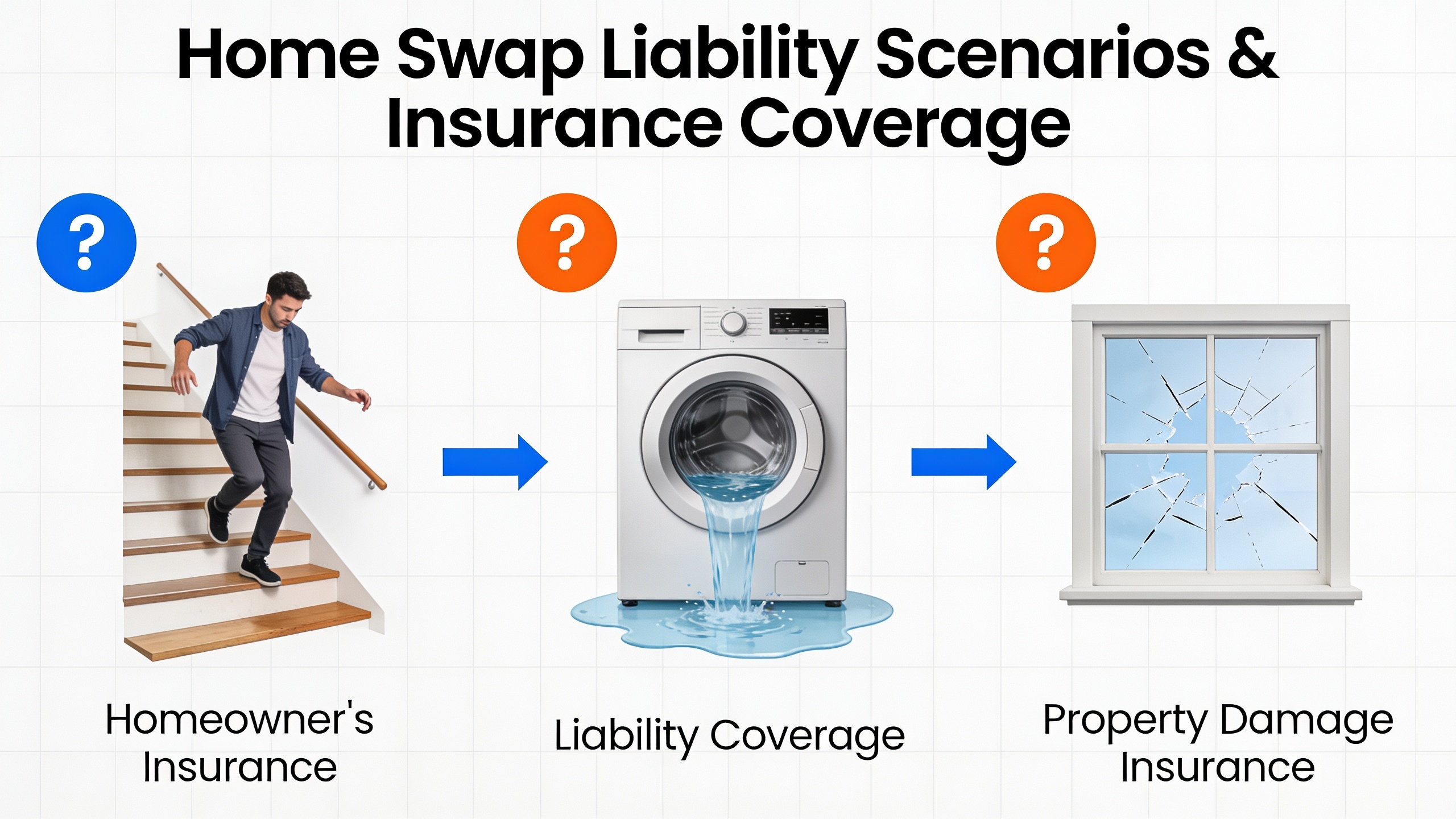 Three common home swap liability scenarios illustrated: guest injury, property damage, and theft, showing the types of incidents home swap insurance covers
Who's on the Hook When Things Go Wrong
Home exchange liability is basically the legal responsibility each side carries for injuries, property damage, or losses during a swap. It usually breaks down into three buckets: someone getting hurt, something getting broken, and stuff going missing.
Let's start with injuries, because honestly this is the one people forget about most. If your guest slips on a wet floor, trips over that rug you've been meaning to secure for months, or burns themselves on your temperamental gas grill, you as the homeowner could be on the hook for negligence. Especially if it was a hazard you knew about and didn't fix or mention. Courts and insurers tend to ask one basic question: did you exercise "reasonable care"? Meaning, did you fix the known problems, leave warnings where you needed to (a note about the water heater that scalds you if you're not careful, that sort of thing), and generally keep the place safe? Most swappers obsess over property damage and completely blank on the fact that a person's actual physical safety is in play. Don't be that person.
Property damage is the one everyone worries about. A small kitchen fire, water damage from a washing machine nobody was watching, a broken window. Here it usually comes down to negligence versus plain bad luck. Was the guest careless, or did something just happen? Either way, somebody's insurance has to cover the repairs, and the whole point of planning ahead is figuring out whose policy applies before the damage happens, not while you're arguing about it afterward.
And then there's theft, which is less common but still worth thinking about. Most swaps run on mutual trust and platform reviews, and the vast majority go fine. But it's smart to lock away or remove anything valuable, sentimental, or fragile rather than just leaving it out and hoping. If you've spent real money on nice pieces, say a set of solid oak dining furniture from a specialist like Oak Castle Furniture, photograph them and note them in your home inventory before anyone shows up. It's good for insurance and it's good for your own peace of mind.
Will Your Homeowners Policy Even Cover This?
Short answer: probably only partway, and some policies won't cover swap-related incidents at all unless you tell your insurer first. This is the single most important thing to check before you agree to anything.
Here's the issue. Most homeowners policies are written around "customary use," which is insurance-speak for "you and your family living in your house." The second you bring in a non-family occupant, even for free, even for a weekend, some insurers treat it as a change in occupancy or a sniff of short-term rental activity. And no, it doesn't matter that no rent changed hands. That reclassification can mess with your liability coverage, and occasionally your dwelling coverage too.
The fix is almost embarrassingly simple, which is exactly why people skip it. Call your agent before the swap and describe what you're actually doing. Then ask them three things directly. Does my liability coverage extend to a non-paying guest occupying my home during a reciprocal exchange? Is there a cap on how many days a year this applies, and does anything change if the swap is international? And would I need a rider, an endorsement, or some kind of "host protection" add-on to close the gaps?
A lot of the big insurers now offer endorsements for home-sharing setups, mostly because Airbnb dragged the whole industry into adapting years ago. But home swapping still lives in a gray zone that not every agent recognizes right away, so be a little pushy and get the answer in writing. Email counts. A verbal "yeah you're probably fine" does not.
Renters, same deal, but with one extra headache: read your lease. Plenty of rental agreements ban subletting or long-term guests without the landlord signing off, and a home swap could technically trip that clause even with zero money involved. Shoot your property manager a quick email before you lock in dates. Better a slightly awkward conversation now than an eviction notice later.
What This Costs
A standalone home swap or liability policy usually runs somewhere between $50 and $250 per exchange, though the real number depends on your home's value, how long the swap is, and whether you're crossing a border. Tacking a liability endorsement onto your existing homeowners policy is often cheaper, sometimes just a small bump in your annual premium, since you're not buying a whole new policy from scratch.
A few things push that price around. A weekend swap costs way less to insure than a six-week winter escape abroad. Higher-value homes, and homes sitting in flood or wildfire zones, carry bigger premiums. A swap with a big family or a bunch of guests bumps up your liability exposure and the cost with it. Cross-border swaps often need travel insurance with a home-liability rider, which tends to cost more thanks to the jurisdictional tangle. And if your current policy already handles most scenarios, you might only need a small add-on rather than the full package.
Now put that against the alternative. A single slip-and-fall lawsuit can rack up tens of thousands in legal fees and settlements before anyone even reaches a judgment. Against that, spending $50 to $250 is basically a rounding error. And as home swapping keeps going mainstream, something I dug into more in How Home Swapping Is Changing the Future of Travel, insurers are slowly building products tailored to exactly this, which should nudge costs down over time.
Your Options, Side by Side
Everyone's got a different risk tolerance, a different home value, a different budget. So before you commit to anything, it helps to see the main options laid out together.
| Protection Option | Typical Cost | What It Covers | Best For |
|---|---|---|---|
| Homeowners policy liability endorsement | $10–$40/year added premium | Guest injury claims, some property damage | Frequent swappers wanting year-round coverage |
| Standalone home swap/exchange insurance | $50–$250 per trip | Injury, damage, sometimes belongings | Occasional or one-time swappers |
| Travel insurance with home-liability rider | $75–$300 per trip (varies by trip cost) | Trip cancellation plus limited home liability | International swappers, long-term exchanges |
| Platform-provided guarantee (varies by service) | Often included or optional add-on | Basic damage protection, dispute mediation | Swappers using a vetted exchange platform |
| No additional coverage, informal agreement only | $0 upfront, high risk cost later | Nothing beyond existing policy limits | Not recommended for most swappers |
That last row isn't really a strategy. I only put it in there to show you what you're actually signing up for if you skip this whole thing. Most seasoned swappers layer at least two of these together, usually a homeowners endorsement for baseline protection plus either a platform guarantee or a standalone policy for the specific trip. Belt and suspenders. It's boring and it works.
What to Do Before, During, and After
The single best way to dodge insurance and liability drama is to document everything, talk to your swap partner like an adult, and treat the exchange with the same seriousness you'd give a formal rental. Even though nobody's paying anybody.
Before
Start with a walkthrough video or a set of photos of every room. Note the existing scuffs and dents, the condition of the appliances, and where the shut-off valves for water and gas are. Then send all of it to your partner so nobody's arguing later about whether that scratch on the floor was already there. This is also your moment to remove or lock away the irreplaceable stuff (jewelry, documents, that one thing you'd never forgive yourself for losing) instead of just trusting the universe.
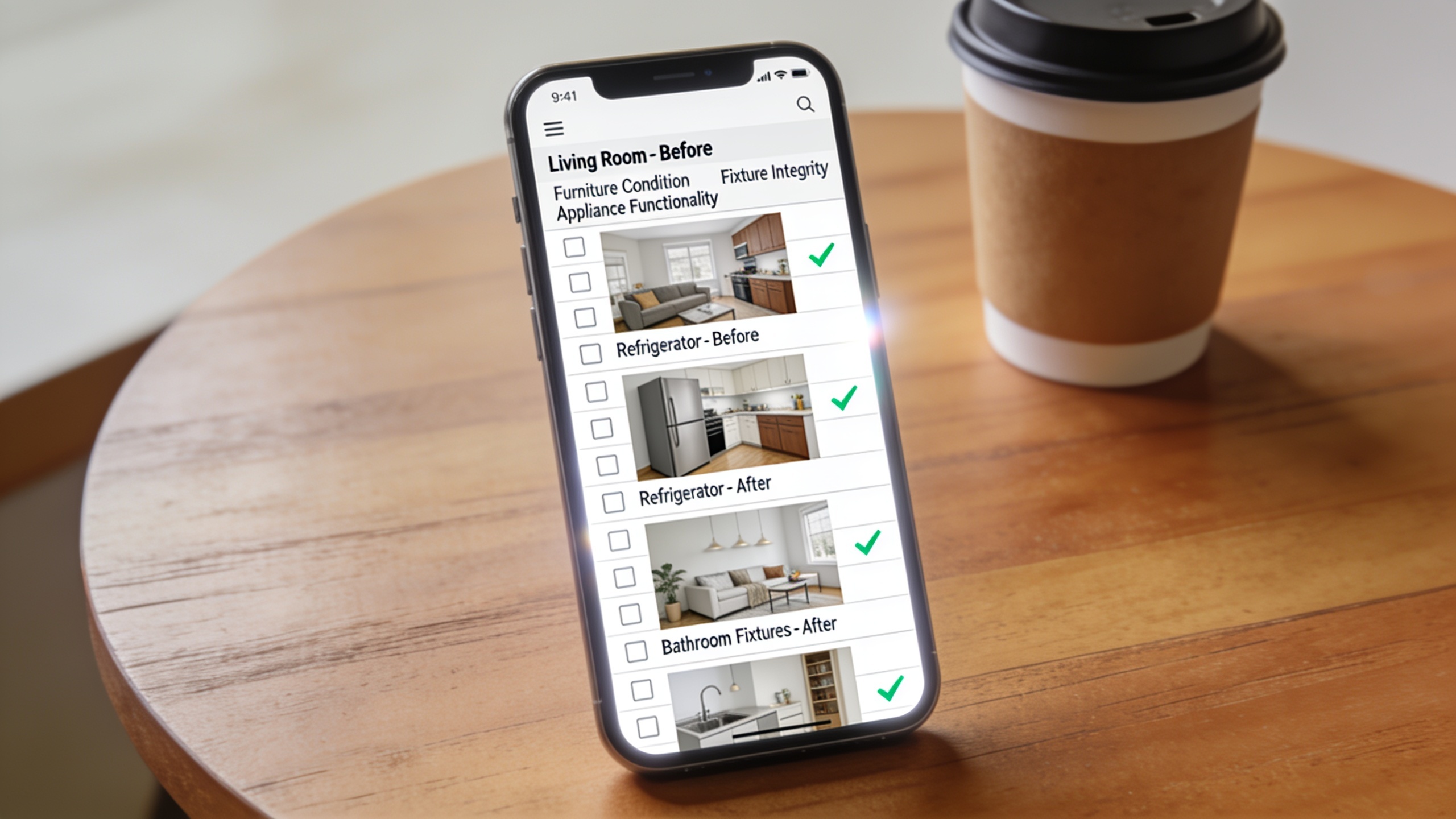 Home documentation checklist on a smartphone showing before photos and inventory notes for a home swap, demonstrating proper pre-swap preparation and insurance documentation
If you're heading somewhere new, local directories are weirdly handy for more than just where to eat. A resource like Bournemouth Info can help incoming guests quickly track down emergency services, local tradespeople, and the practical stuff about the area, which honestly stops a lot of small problems from ballooning into big ones.
Oh, and vet your swap partner the way you'd vet a tenant. Check their reviews, look at their online footprint, get a feel for who they are. There's plenty of good writing out there on how to judge whether an online profile is legit, including guides on sites like Sukhweb, and applying that same healthy skepticism to a prospective partner's history is cheap, easy due diligence. Do it.
During
Keep your conversations inside the platform's messaging system, not just texting each other's personal numbers. Why? Because it creates a timestamped record if things get contentious later. Ask your partner to flag any problems the moment they happen instead of sitting on them until checkout, and give them a clear point of contact for emergencies, whether that's a neighbor, a property manager, or you. If something breaks, a same-day photo and message is worth so much more to an insurer than a fuzzy explanation two weeks after the fact.
After
Do your own walkthrough within 24 hours of getting home and compare it against your original documentation. If something got damaged, file the claim fast, because most policies start their notification clock from the date of the incident, not the day you happened to notice it. And hang onto all your correspondence with your partner as part of the claim. Insurers tend to move faster and treat you better when there's a clean paper trail showing everybody communicated in good faith.
The Agreement You Shouldn't Skip
A home exchange agreement is just a written document, signed by both sides before the swap, that spells out who's responsible for what and what happens if something goes wrong. Even a single page dramatically cuts down on disputes, because it forces both households to agree on the terms up front instead of improvising in the middle of a crisis.
At a bare minimum, cover these:
- Dates and duration, including check-in and check-out times.
- Insurance confirmation from both parties, stating that coverage has been checked and endorsed for the swap period if needed.
- How incidents get reported, with an actual timeframe (say, within 24 hours).
- Who pays for damage above a certain threshold, and whether a deposit or refundable holding fee is involved.
- House rules and emergency contacts, meaning smoking, pets, guest limits, pool and hot tub use, utility shut-offs, and alarm systems, plus who to call locally and how to reach the traveling family.
Most platforms hand you a template for this, and I'd adapt it rather than skip it, even for swaps with friends or family. Maybe especially then. The point isn't to signal distrust. It's to kill ambiguity, so if something weird happens, both of you already know the process instead of negotiating it while you're stressed and cranky.
It's kind of interesting, actually. This whole move toward verified, community-backed trust systems shows up all over the internet in totally different corners. Even in something as unrelated as SEO, platforms like RobinRank lean on verified community exchanges to build credibility, which mirrors exactly why documented agreements and real reviews matter so much in home swapping. Trust works best when it's written down, not just assumed.
Questions People Actually Ask
Does my travel insurance cover home swap liability? Usually not automatically. Standard travel insurance handles trip cancellations, medical emergencies abroad, and lost luggage, but it doesn't cover liability for damage or injury happening back at your home while you're away. You typically need a specific home-liability rider bolted onto a travel policy, or a separate homeowners endorsement, to close that gap.
What if my swap partner wrecks my place and has no insurance? Then you're looking at pursuing reimbursement directly through your signed agreement, or in the worst cases, small claims court. Which is exactly why you confirm both parties' insurance before the swap and put damage responsibility in writing. It's the difference between a clear process and a shouting match.
Can I get sued if a guest gets hurt in my home? Yes. Homeowners can absolutely be held liable for injuries caused by negligence, like a hazard you knew about and never dealt with, even during a totally free exchange. This is precisely the risk that liability coverage, whether through your homeowners policy or a standalone swap product, exists to handle.
Are Airbnb-style host protection programs going to cover me? No. Those host protection programs are built for paid bookings and generally don't extend to reciprocal, no-cost swaps. For exchange-based stays, home swap-specific insurance or a dedicated homeowners endorsement is the more reliable route.
Do I need separate insurance for international swaps? Often, yes. Domestic homeowners policies may have limited or zero applicability once you're both abroad hosting a foreign guest, and liability standards vary from country to country. A travel policy with an international home-liability rider, plus written confirmation from your home insurer about cross-border coverage, is generally the safest bet.
Swapping homes is one of the most rewarding ways to travel. You get a real neighborhood instead of a hotel corridor, a real kitchen instead of a mini-fridge, and often a friendship on the other end of it. But all of that hinges on doing the unglamorous work first: calling your insurer, documenting your place, writing a clear agreement, and taking liability as seriously as you would if actual money were on the table. Get that groundwork sorted, and the rest of the swap gets to be what it's meant to be. An adventure. Not a claim waiting to happen.

Published by
SwappaHome
SwappaHome Editorial Team
Home Exchange & Slow Travel Editorial
The SwappaHome Editorial Team brings together travel research, home-exchange community insights, and platform data to produce practical guides for first-time and experienced home swappers. Every article cites real platforms, current market rates, and verifiable city-level facts so readers can make informed decisions without guessing.
Ready to try home swapping?
Join SwappaHome and start traveling by exchanging homes. Get 7 free credits when you sign up!