
Long-Term Home Exchange in Barcelona: The Complete Remote Worker's Guide to Living Like a Local
Maya Chen
Travel Writer & Home Exchange Expert
Discover how long-term home exchange in Barcelona lets remote workers live affordably in one of Europe's best cities. Neighborhoods, costs, and insider tips.
Three months into my long-term home exchange in Barcelona, it hit me—I'd accidentally built the life I'd been chasing for years.
I was writing from a sunlit apartment in Gràcia. Walking to the same bakery every morning where the owner had started remembering my order (café amb llet, croissant de mantega). Spending weekends hiking Montjuïc instead of doom-scrolling flight deals. My laptop had a permanent view of a small plaza where old men played dominoes.
My rent? Zero euros.
This wasn't a vacation. This was living—the kind that most remote workers dream about but assume requires either a trust fund or a willingness to sleep in hostels forever.
It requires neither.
Long-term home exchange in Barcelona has quietly become one of the best-kept secrets among digital nomads who've burned out on the constant moving, the soulless Airbnbs, the financial hemorrhage of trying to experience Europe on American savings. And Barcelona? It's not just any city. It's a city that actually works for remote work—reliable WiFi, endless co-working cafés, a timezone that overlaps reasonably with both US coasts and European clients, and a quality of life that makes you wonder why you ever thought you needed to "hustle" in a gray cubicle.
But here's the thing: doing it right takes some planning. I learned a few things the hard way so you don't have to.
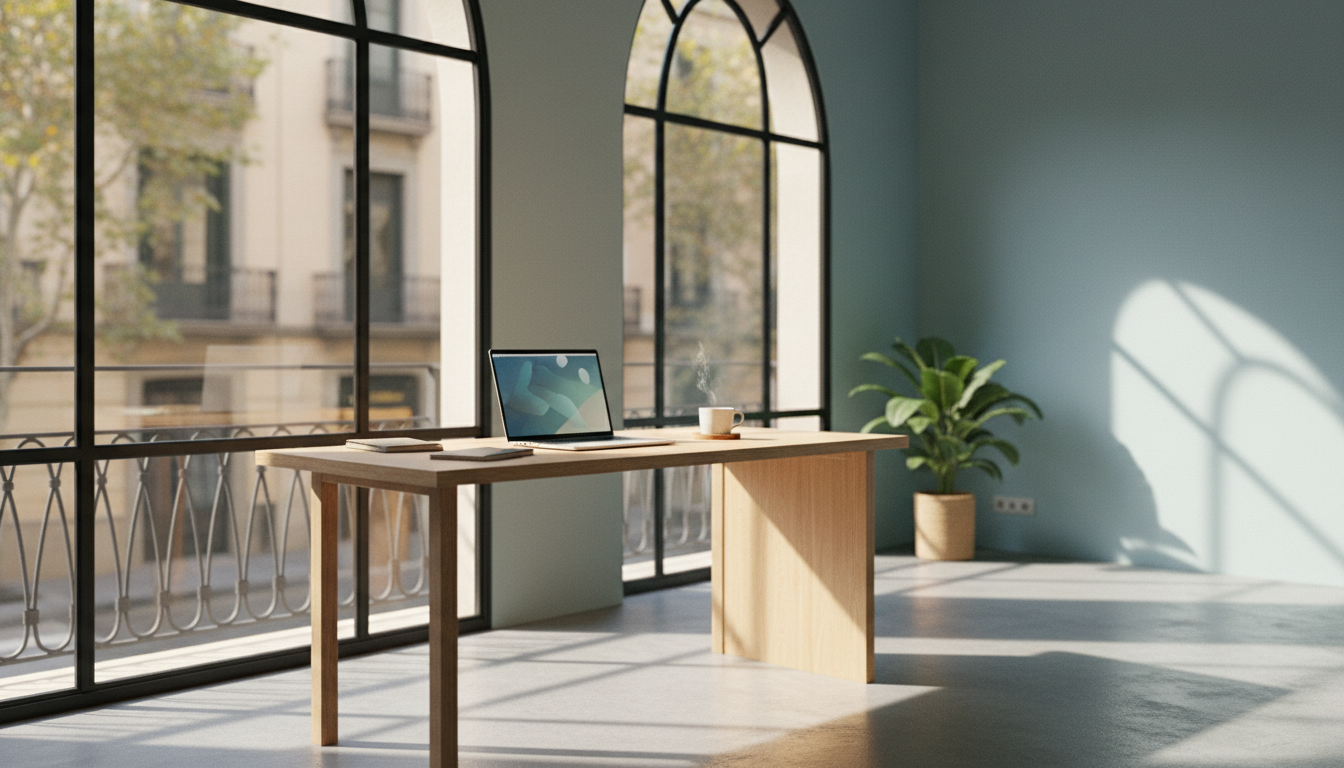 Morning light streaming through tall windows of a modernist Barcelona apartment, laptop open on a wo
Why Barcelona is Perfect for Long-Term Home Exchange
I've done extended stays in Lisbon, Mexico City, and Chiang Mai. All great. But Barcelona hits differently for remote workers—and it's not just the beach (though, okay, it's partly the beach).
The city runs on a rhythm that actually supports working humans. Unlike some European capitals that shut down entirely between 2-5 PM, Barcelona has adapted. Yes, traditional siesta culture exists, but you'll find plenty of cafés and co-working spaces that stay open. The metro runs until midnight on weekdays, 2 AM on Fridays, and 24 hours on Saturdays. Grocery stores have reasonable hours. Pharmacies are everywhere.
Cost of living? Still significantly lower than London, Paris, or Amsterdam—even if it's crept up over the past five years. A proper meal at a neighborhood restaurant runs €12-18 ($13-20 USD). A glass of wine at a terrace bar? €3-4 ($3.25-4.35 USD). Monthly metro pass? €40 ($43 USD). These numbers matter when you're not on a two-week vacation but actually budgeting for months.
And the WiFi situation is legitimately excellent. Spain invested heavily in fiber infrastructure, and most Barcelona apartments have speeds that would make your American ISP weep with shame. I consistently got 300+ Mbps in my Gràcia exchange—faster than my home connection in San Francisco.
But the real reason Barcelona works for long-term home exchange? The housing stock.
Unlike cities dominated by tiny studios, Barcelona has actual apartments. Spacious ones, often with balconies, separate bedrooms, and—crucially for remote workers—dedicated spaces that aren't your bed. The city's famous Eixample grid is filled with gorgeous modernist buildings with high ceilings and natural light. Even the smaller places in older neighborhoods tend to have character. This matters because when you're exchanging homes for months, you need a space that functions as a home, not a hotel room.
How Long-Term Home Exchange Actually Works for Extended Stays
Let me demystify this because I remember being confused when I first started.
On SwappaHome, the system is beautifully simple: you earn 1 credit for every night someone stays at your place, and you spend 1 credit for every night you stay somewhere else. That's it. No complex pricing tiers based on location or apartment size. A night in a Barcelona penthouse costs the same credits as a night in a countryside cottage.
For long-term stays, this math becomes incredibly powerful.
Say you have a one-bedroom apartment in Denver. You list it on SwappaHome and host guests while you're away—maybe a family visiting for a wedding, then a couple exploring Colorado for a week, then a business traveler for a few nights. Over three months, you might host 60-70 nights total. That's 60-70 credits you've banked. Now you can spend those credits on a three-month stay in Barcelona. Your accommodation cost? Zero. You've essentially converted your empty apartment into European living.
The key insight for remote workers: you don't need to do a simultaneous swap. You're not trading houses with one specific person who happens to want your place at the exact same time. The credit system means you can host whenever it works for you, bank those credits, and use them whenever and wherever you want.
I hosted guests in my San Francisco apartment during a busy conference season (easy credits—everyone wants SF during Dreamforce), then used those credits for my Barcelona adventure six months later.
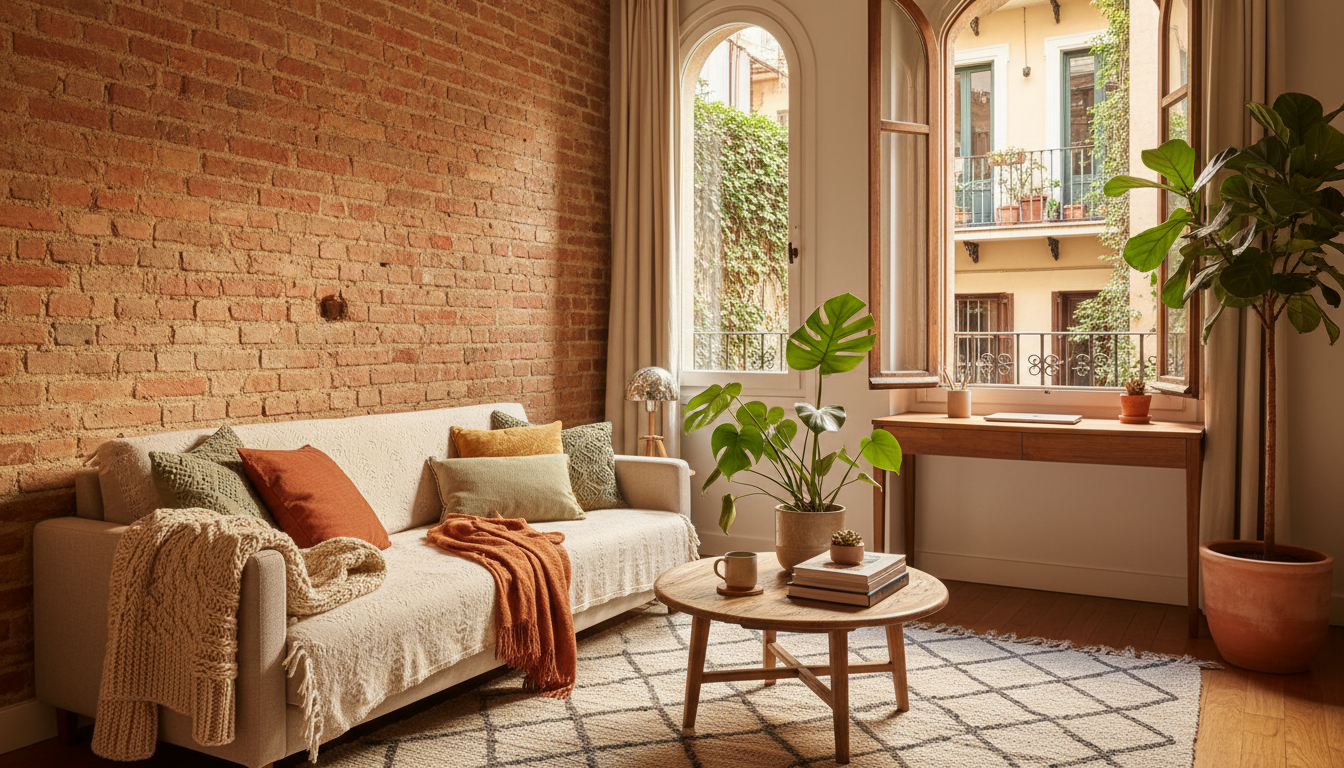 Cozy living room in a Barcelona apartment with exposed brick, comfortable sofa, plants, and a small
Best Barcelona Neighborhoods for Remote Workers on Home Exchange
Not all Barcelona neighborhoods are created equal for the laptop-wielding crowd. After three months of exploration and conversations with dozens of other remote workers, here's my honest breakdown.
Gràcia: The Sweet Spot for Most Remote Workers
This is where I stayed, and I'm biased—but hear me out.
Gràcia was an independent village until Barcelona absorbed it, and it still feels that way. Tight-knit. Slightly bohemian. Full of small plazas where actual neighbors actually know each other.
For remote work, Gràcia offers the perfect density of good cafés without the tourist crush of the Gothic Quarter. Federal Café on Carrer del Parlament became my unofficial office (great WiFi, they don't rush you, excellent flat whites for €3.50/$3.80 USD). La Pepita on Carrer de Còrsega is perfect for lunch breaks—incredible tapas, always packed with locals.
The neighborhood has multiple co-working spaces if you need dedicated desk time. Aticco on Carrer de Vallirana charges around €180/month ($195 USD) for a hot desk with 24/7 access. OneCoWork near Plaça de la Virreina is pricier at €250/month ($270 USD) but has a rooftop terrace that makes video calls feel luxurious.
Gràcia apartments on SwappaHome tend to be in older buildings with character—think wooden beams, interior courtyards, small balconies overlooking the street. They're not the fanciest, but they feel like home.
Eixample: Space and Light for the Productivity-Obsessed
If you need serious space to work, Eixample is your neighborhood.
The famous grid layout means apartments here are larger, with those iconic chamfered corners that let light pour in from multiple directions. Many buildings have rooftop terraces (terrats) that residents share. Eixample Dreta (the right side) is more upscale, closer to Passeig de Gràcia with its designer shops. Eixample Esquerra (left side) is slightly more residential and affordable. I'd recommend Esquerra for long-term stays—still gorgeous architecture, but more neighborhood feel.
The downside: Eixample can feel a bit formal compared to Gràcia or Poble Sec. It's not where you'll stumble into a spontaneous street party. But if your priority is a dedicated home office setup with excellent light and space, this is where you'll find it.
Co-working wise, MOB (Makers of Barcelona) near Plaça de Tetuan is a favorite among creative remote workers—€195/month ($210 USD), strong community events, and a café that actually serves good coffee.
Poble Sec: Underrated and Excellent Value
Tucked between Montjuïc and the Paral·lel avenue, Poble Sec has quietly become one of Barcelona's best neighborhoods for long-term stays.
It's more local than touristy. Packed with incredible tapas bars along Carrer de Blai (the famous "pintxos street"). And significantly more affordable than Gràcia or Eixample. The apartments here are often in older buildings, smaller on average, but the neighborhood's walkability and food scene more than compensate. You're also a 15-minute walk from the beach at Barceloneta and a 10-minute funicular ride to the top of Montjuïc for weekend hikes.
For remote work, Poble Sec has fewer dedicated co-working spaces but plenty of work-friendly cafés. Satan's Coffee Corner on Carrer de l'Arc del Teatre (technically just outside Poble Sec in Raval) is legendary among laptop workers—no WiFi password games, good coffee, and a vibe that says "stay as long as you need."
El Born: Beautiful but Buyer Beware
El Born is gorgeous. Medieval streets, the stunning Santa Maria del Mar church, trendy boutiques, excellent cocktail bars.
It's also extremely touristy, noisy at night, and the apartments available for exchange tend to be smaller and older (not always in the charming way). I'd recommend Born for a shorter stay—maybe your first month while you get oriented—but not for a full three-month stint. The constant tourist foot traffic gets exhausting, and you'll pay more in cafés and restaurants than in other neighborhoods.
That said, if you find a Born apartment on SwappaHome with interior-facing windows (away from the street noise), it could work beautifully. Just do your due diligence.
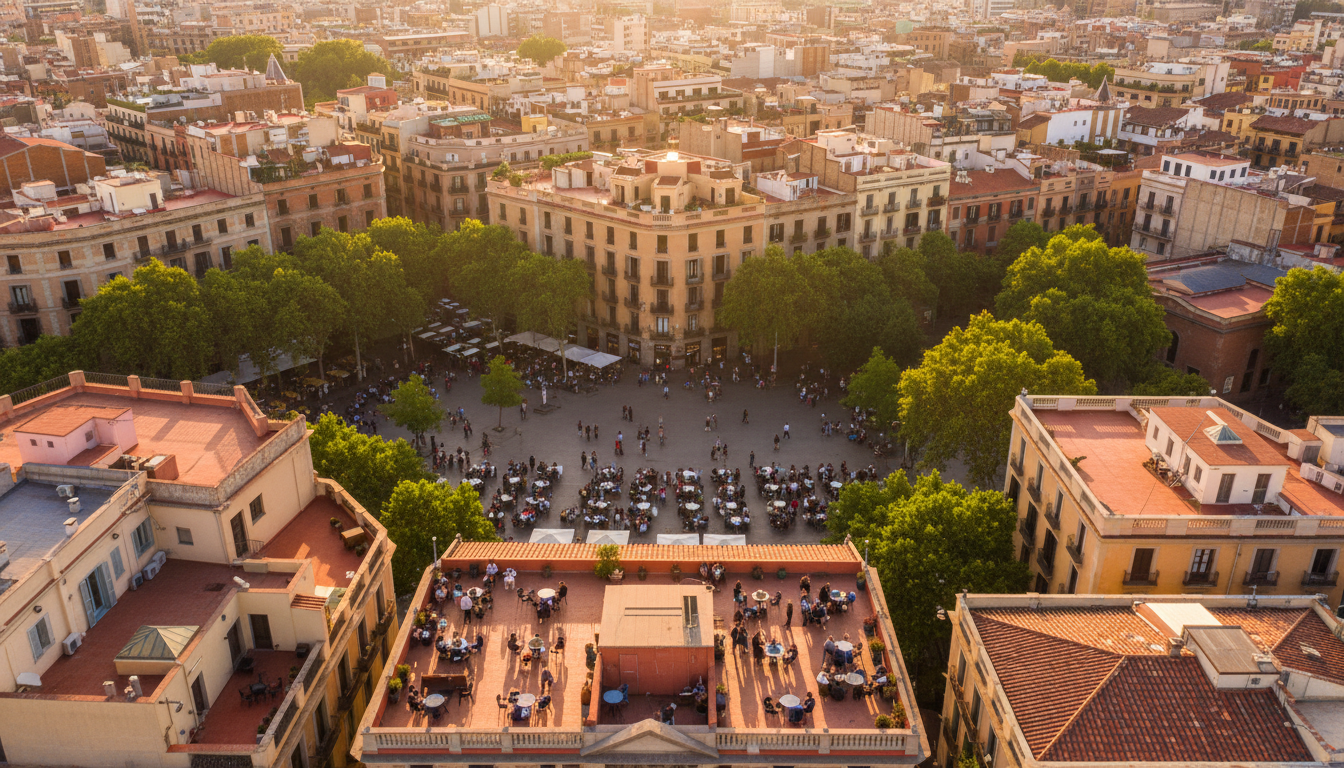 Aerial view of Grcia neighborhood at golden hour, showing the distinctive plaza with outdoor caf sea
Setting Up Your Long-Term Home Exchange in Barcelona: A Step-by-Step Approach
Alright, let's get practical. Here's how I'd approach a three-month Barcelona stay if I were starting from scratch.
Three to Four Months Before: Preparation Phase
First, get your SwappaHome profile dialed in.
This matters more for long-term exchanges because hosts are trusting you with their home for months, not days. Upload high-quality photos of your place—not just the pretty corners, but the functional stuff. Your home office setup. The kitchen. The view from the window where you drink your morning coffee. Write a bio that shows you're a real person who will treat their home with respect.
Start messaging potential hosts in Barcelona early. For long-term stays, you're looking for people who are either doing their own extended travel (sabbatical, remote work elsewhere, visiting family), snowbirds who leave Barcelona during certain seasons, or people with second homes they don't use full-time.
Be upfront about your dates and your work situation. Something like: "I'm a remote writer looking to spend February through April in Barcelona. I work from home most days, so I'd need reliable WiFi. I'm quiet, respectful, and happy to care for plants or pets if needed."
The pet/plant thing isn't a throwaway line. Many long-term exchangers specifically want someone who'll water their plants and feed their cat. This can actually make you more attractive as a guest.
One to Two Months Before: Logistics
Once you've confirmed an exchange, handle the boring stuff.
Visa situation: US citizens can stay in the Schengen Area (which includes Spain) for 90 days within any 180-day period without a visa. If you're planning exactly three months, you're fine. If you want longer, you'll need to either leave the Schengen zone for a while or look into Spain's digital nomad visa (a whole other article, but it exists and it's increasingly accessible).
Health insurance: Your American health insurance probably doesn't cover you abroad, or covers you poorly. Get a policy designed for long-term travelers. I use SafetyWing (around $45/month for basic coverage) but World Nomads and Allianz also have good options. Don't skip this—Spanish healthcare is excellent but not free for non-residents.
Banking: Tell your bank you're traveling. Set up a Wise account (formerly TransferWise) for easy currency conversion—their rates are significantly better than your bank's. Consider getting a credit card with no foreign transaction fees if you don't have one.
Phone situation: Your American plan probably has expensive international roaming. Options include getting a Spanish SIM card when you arrive (Orange and Vodafone have prepaid plans around €15-20/month for data), using an eSIM like Airalo or Holafly, or relying on WiFi and WhatsApp (risky if you need phone calls).
The First Week: Getting Settled
Don't try to be productive immediately.
I made this mistake—opened my laptop on day two, tried to power through jet lag, and produced garbage work for a week.
Instead, spend your first week learning the apartment (where's the fuse box? how does the washing machine work? which grocery store is closest?), walking your neighborhood without a destination, finding your café spots (try at least five before committing to a regular), adjusting to the timezone, and stocking the kitchen with basics.
By week two, you'll be ready to actually work, and you'll have a functional routine instead of chaos.
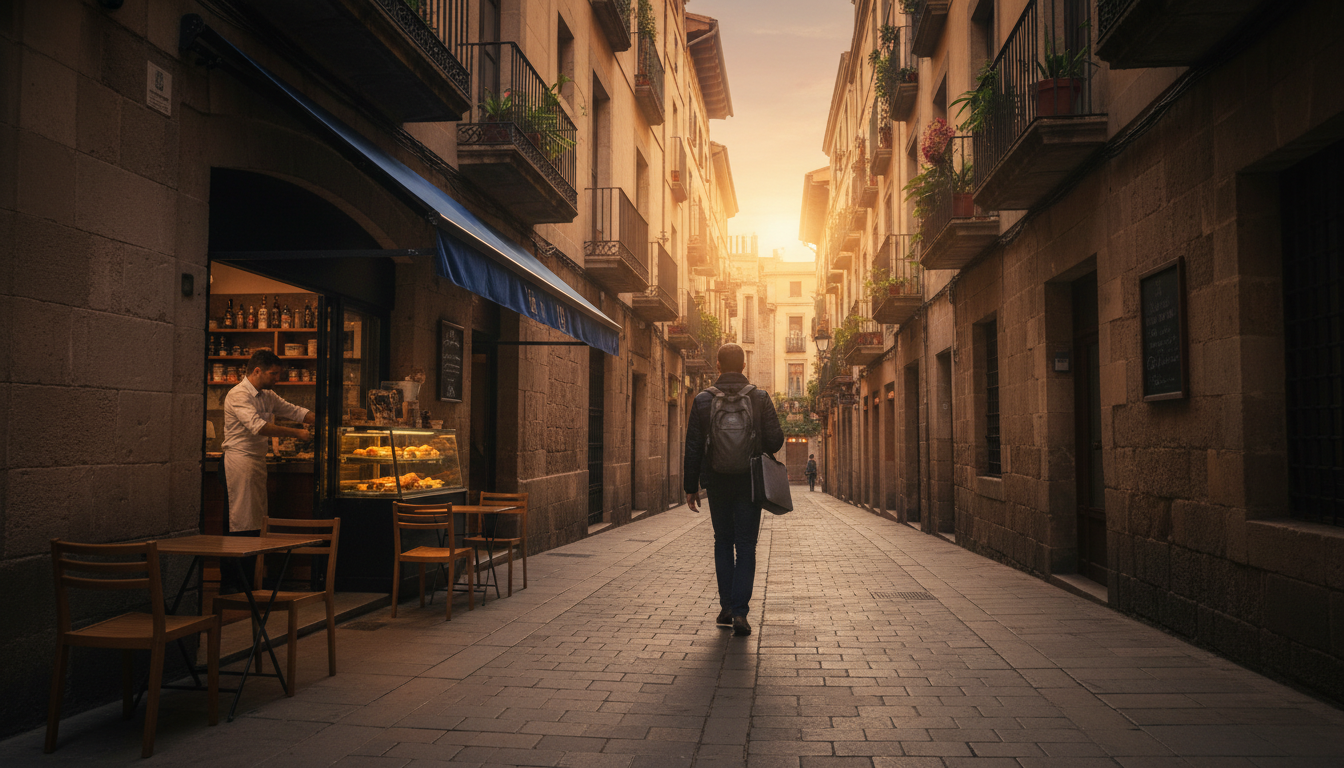 Narrow street in El Born neighborhood with morning light, a person walking with a laptop bag, histor
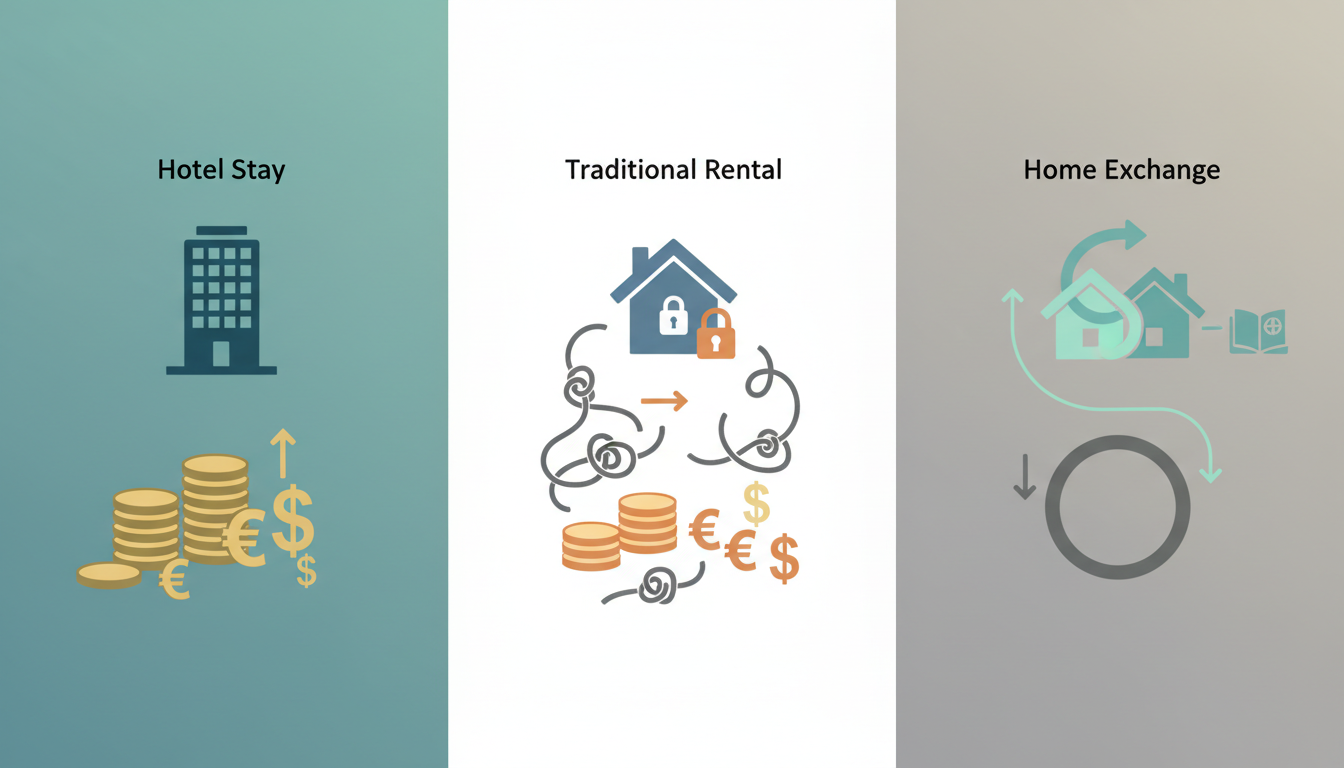
The Real Costs: What Long-Term Home Exchange in Barcelona Actually Saves You
Let me break down real numbers from my three-month stay, because I think the savings are genuinely shocking when you see them side by side.
Traditional rental approach (if you could even find one for 3 months): Short-term furnished rental in Gràcia runs €1,400-1,800/month ($1,520-1,950 USD). Three months puts you at €4,200-5,400 ($4,560-5,860 USD). Add utilities (usually extra) at ~€100/month ($108 USD). Plus a security deposit (often 2 months) of €2,800-3,600 ($3,040-3,900 USD) tied up. Total: roughly $5,000-6,500 USD (not counting deposit).
Airbnb approach: A decent one-bedroom in Gràcia runs €80-120/night ($87-130 USD) minimum. Three months (90 nights) means €7,200-10,800 ($7,800-11,700 USD). Total: roughly $8,000-12,000 USD.
Home exchange approach: SwappaHome membership has a minimal annual fee. Accommodation from credits earned from hosting equals zero cost. Total: essentially $0 for accommodation.
Even accounting for the "cost" of having guests in your home while you're away (which, honestly, often means someone's watering your plants and keeping your place lived-in), the savings are dramatic. We're talking $5,000-12,000 that stays in your pocket over three months.
That's money you can spend on actually experiencing Barcelona—cooking classes, day trips to Costa Brava, that fancy tasting menu at Disfrutar you've been eyeing.
Avoiding the Pitfalls: What I Wish I'd Known
Long-term home exchange isn't all sunshine and sangria. Here's the stuff that tripped me up.
The Loneliness Factor
This surprised me.
I'm an introvert. I like being alone. But by month two, I was craving connection in a way I hadn't anticipated. When you're not in a hostel meeting fellow travelers daily, and you're not in an office with colleagues, and you don't speak the local language fluently, isolation creeps in.
My solutions: I joined a weekly language exchange meetup (Mundo Lingo at various bars, free). Started going to the same gym (DIR has locations everywhere, around €50/month). Found a co-working space with community events, even though I mostly worked from home. Said yes to every social invitation, even when I was tired.
The "It's Not My Home" Awkwardness
Living in someone else's space for months is psychologically weird.
Their art on the walls. Their books on the shelves. Their particular way of organizing the kitchen that makes no sense to you.
I dealt with this by bringing a few personal items (my favorite mug, a small photo, my own pillow), rearranging one small area to feel like "mine" (with permission, and photos to restore it), and accepting that this discomfort is part of the deal—and actually kind of interesting.
The Bureaucracy
Spain loves paperwork.
If you need to do anything official—open a bank account, sign up for a gym, get a phone contract—expect it to take three times longer than it should and require documents you don't have. My advice: don't try to set up anything requiring residency documentation. Stick to prepaid options, tourist-friendly services, and cash when necessary.
The August Problem
If you're planning a summer stay, know that Barcelona empties in August.
Many locals leave for the coast or mountains. Shops close. Your favorite café might be shuttered for three weeks. The tourists multiply while the locals vanish. August can still be great—the beaches are warm, the city has a lazy vibe—but adjust your expectations. September is honestly better for long-term stays: still warm, locals return, and the energy picks back up.
 Comparison infographic showing three columns Hotel Stay showing high costs, Traditional Rental showi
Making It Work: Daily Routines That Actually Stick
After experimenting for three months, here's the routine that finally clicked for me.
Morning (7:30-12:00): Wake up, make coffee in the apartment (Spanish coffee culture is great, but €2 coffees add up). Work during my most focused hours while the apartment is quiet and the light is good. No meetings before 10 AM local time if I can help it—that's 1 AM on the West Coast, 4 AM on the East Coast, so it works out.
Midday (12:00-14:00): Break for a real lunch. Not sad desk lunch. Walk to a nearby restaurant for the menú del día—a multi-course lunch special that most Barcelona restaurants offer for €12-15 ($13-16 USD). This is the best deal in Spanish dining, and it forces you to stop working and eat like a human.
Afternoon (14:00-18:00): More work, but lighter tasks—emails, admin, calls with US clients who are just waking up. Around 16:00, I'd often relocate to a café for a change of scenery.
Evening (18:00 onwards): Laptop closed. This is sacred. Walk, explore, meet friends, cook dinner with market ingredients, sit on the balcony with a glass of cava. Barcelona evenings are too beautiful to waste on screens.
The key insight: Barcelona's natural rhythm (late lunches, late dinners, evening paseos) actually supports remote work beautifully if you lean into it instead of fighting it.
The Community Aspect: Why Home Exchange Feels Different
I want to end on something less practical but equally important.
Home exchange creates a different relationship with a place than renting or hoteling. When you're staying in Maria's apartment in Gràcia, using her coffee maker, sleeping in her guest room, you're not a tourist. You're a temporary neighbor. Maria's friends in the building know you're there. The woman at the fruit stand asks how Maria's trip is going. You're woven into a fabric, however lightly.
This matters for long-term stays. It's the difference between three months of being a visitor and three months of actually living somewhere.
The SwappaHome community reinforces this. You're not a customer; you're a member. The reviews you leave and receive create accountability. The people whose homes you stay in often become genuine connections—I still exchange messages with several hosts from past exchanges, sharing travel tips and life updates.
Is it for everyone? No. If you need hotel-style anonymity, if the idea of someone staying in your space makes you anxious, if you want everything controlled and predictable—home exchange might not be your thing.
But if you're a remote worker dreaming of actually living abroad, not just visiting? If you're tired of the financial drain of traditional accommodation? If you want to experience Barcelona the way Barcelonans do?
Long-term home exchange might just change everything.
I'm writing this from my San Francisco apartment, already planning my next extended exchange (thinking Lisbon in the spring, maybe Buenos Aires in the fall). My Barcelona experience didn't just save me money—it rewired how I think about where and how I can live.
The laptop lifestyle doesn't have to mean constant motion or financial stress. Sometimes it means three months in a sun-drenched apartment, walking to the same bakery, watching the seasons change in a plaza where old men play dominoes.
If that sounds like your kind of life, SwappaHome is genuinely worth exploring. Start building those credits now. Your Barcelona apartment is waiting.
Frequently Asked Questions
Is long-term home exchange in Barcelona legal for remote workers?
Yes, staying in Barcelona through home exchange is completely legal for remote workers. As a US citizen, you can stay in Spain (and the broader Schengen Area) for up to 90 days within any 180-day period without a visa. Home exchange is simply a form of accommodation—no different legally than staying with friends. For stays longer than 90 days, you'd need to explore Spain's digital nomad visa or leave the Schengen zone temporarily.
How much money can I save with long-term home exchange versus renting in Barcelona?
The savings are substantial. A three-month furnished rental in a desirable Barcelona neighborhood like Gràcia costs €4,200-5,400 ($4,560-5,860 USD), while Airbnb runs €7,200-10,800 ($7,800-11,700 USD) for the same period. With home exchange through SwappaHome, your accommodation cost is essentially zero—you earn credits by hosting guests at your home and spend them on your Barcelona stay. That's $5,000-12,000 in potential savings over three months.
What's the best Barcelona neighborhood for remote workers doing home exchange?
Gràcia is the sweet spot for most remote workers. It offers excellent WiFi infrastructure, numerous work-friendly cafés like Federal Café, co-working spaces like Aticco (€180/month), and a genuine neighborhood feel without overwhelming tourist crowds. The apartments available for exchange tend to have character—wooden beams, balconies, good natural light—and the area's plazas provide perfect spots for lunch breaks and evening unwinding.
How far in advance should I plan a long-term home exchange in Barcelona?
Start planning three to four months before your intended arrival. Long-term exchanges require finding hosts who are also traveling for extended periods—sabbaticals, their own remote work adventures, or seasonal relocations. Begin messaging potential hosts on SwappaHome early, being clear about your dates and work-from-home needs. This timeline also gives you adequate time to sort visas (if needed), travel insurance, and banking logistics.
Do I need to speak Spanish for a long-term stay in Barcelona?
Not necessarily, but basic Spanish (or Catalan) dramatically improves your experience. Barcelona is bilingual—Catalan is the regional language, Spanish (Castilian) is widely spoken, and English is common in tourist areas and among younger residents. For daily life in residential neighborhoods, knowing phrases for grocery shopping, café ordering, and friendly greetings makes a real difference. Language exchange meetups like Mundo Lingo are free and help you practice while meeting locals and fellow expats.
40+
Swaps
25
Countries
7
Years
About Maya Chen
Travel Writer & Home Exchange Expert
Maya is a travel writer with over 7 years of experience in the home swapping world. Originally from Vancouver and now based in San Francisco, she has completed more than 40 home exchanges across 25 countries. Her passion for "slow" and authentic travel led her to discover that true luxury lies in living like a local, not a tourist.
Ready to try home swapping?
Join SwappaHome and start traveling by exchanging homes. Get 10 free credits when you sign up!
Related articles
Lyon Home Exchange: Your Complete Guide to France's Hidden Gem for Home Swapping
Discover why Lyon home exchange is booming among savvy travelers. From Croix-Rousse to Presqu'île, find the best neighborhoods and insider tips for your swap.

Zurich Bucket List: 47 Unforgettable Experiences to Enjoy During Your Home Swap
Discover the ultimate Zurich bucket list for home swappers—from secret swimming spots to fondue rituals locals actually do. Save thousands while living like a true Zürcher.
Dublin Home Exchange Utilities Guide: WiFi, Heating & Everything Your Guests Need
Master Dublin home exchange utilities—from dodgy WiFi fixes to heating quirks. Practical tips from 7 years of swapping homes across Ireland.