
Senior-Friendly Home Swap in Hong Kong: Your Complete Guide to Accessible, Comfortable Stays
Maya Chen
Travel Writer & Home Exchange Expert
Discover how to find the perfect senior-friendly home swap in Hong Kong with accessibility features, elevator access, and comfortable neighborhoods for mature travelers.
My mother called me last March with a request that caught me off guard. "Maya, I want to try one of your home swaps. But I need to know—can a 68-year-old woman with a dodgy knee actually do this in Hong Kong?"
That question sent me down a research rabbit hole. And honestly? I discovered that senior-friendly home swap in Hong Kong isn't just possible—it's actually one of the smarter ways for mature travelers to experience this incredible city. The key is knowing exactly what to look for and where to find it.
 Elderly couple enjoying dim sum breakfast on a sunlit apartment balcony overlooking Victoria Harbour
Here's what I've learned from helping my mom plan her trip, talking to dozens of senior home swappers, and my own experiences navigating Hong Kong's unique urban landscape.
Why Senior Travelers Are Choosing Home Swap in Hong Kong Over Hotels
Hong Kong hotels have a reputation problem for older travelers. The rooms are notoriously compact—we're talking 150-200 square feet for a standard room at $180-250 USD per night. After a long flight, the last thing anyone over 60 wants is to squeeze into a bathroom where the shower head practically touches the toilet.
A senior-friendly home swap in Hong Kong changes the equation entirely. You're staying in a real apartment, typically 500-900 square feet, with a proper kitchen, comfortable seating, and—this matters more than you'd think—space to actually unpack your suitcase.
My friend Patricia, who's 71, did her first Hong Kong home swap last autumn. She told me: "I could make my own breakfast instead of navigating hotel buffet chaos at 7 AM. I had a washing machine. I could rest in the afternoon without housekeeping knocking. It felt like living there, not just visiting."
The financial angle is significant too. Two weeks in a Hong Kong hotel runs $2,500-3,500 USD easily. A home swap? You're using credits you've already earned by hosting, which means your accommodation cost is essentially zero. That freed-up budget can go toward hiring a private guide for a day ($150-200 USD) or splurging on that harbor-view dinner at Hutong ($100-150 per person).
Essential Accessibility Features for Senior Home Swappers in Hong Kong
Not every Hong Kong apartment works for mature travelers. The city's older buildings can be challenging—narrow staircases, no elevators, cramped layouts. But newer developments and certain neighborhoods offer genuinely accessible options.
Elevator Access: Non-Negotiable for Most Seniors
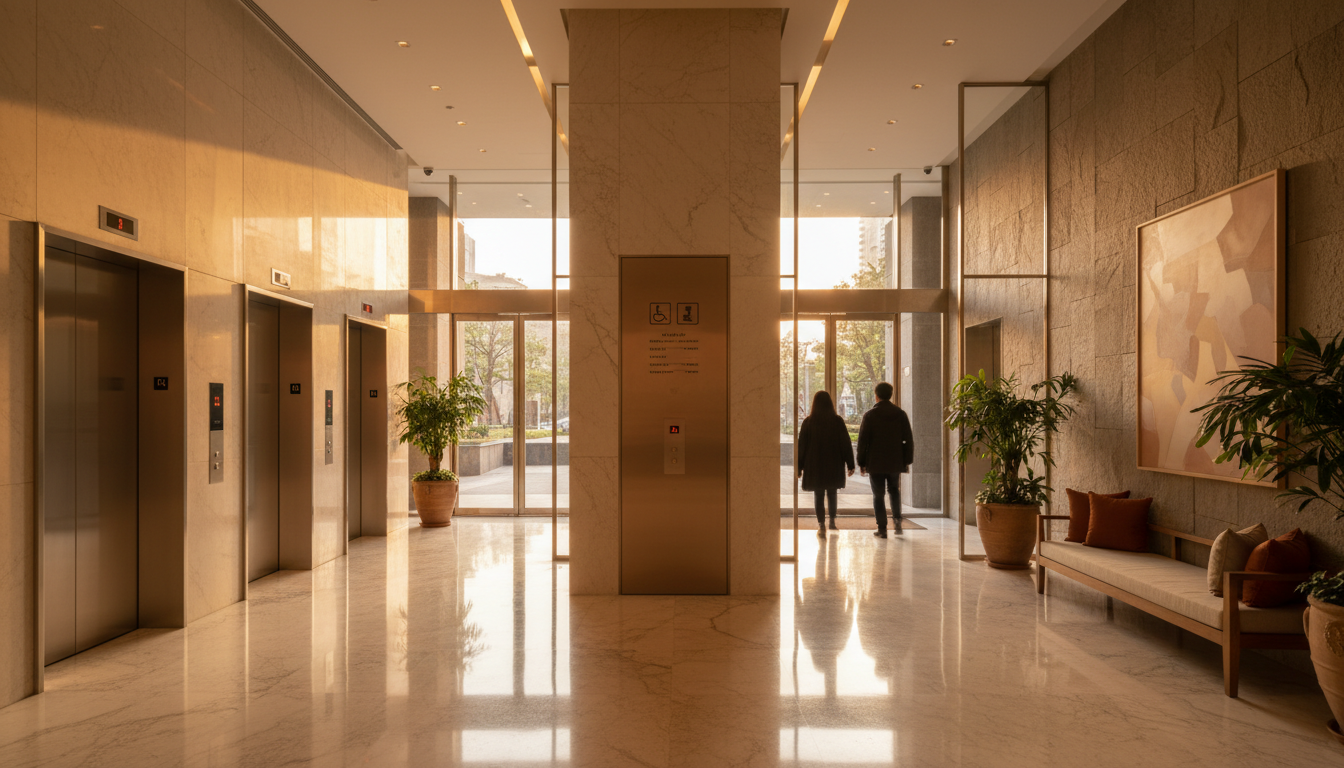
Hong Kong has over 70,000 elevators—one of the highest densities in the world. But here's what listings don't always tell you: some buildings have elevators that don't stop on every floor, or require climbing a half-flight of stairs to reach the lift lobby.
When messaging potential swap partners, ask specifically: Does the elevator go directly to your floor? Are there any stairs between the street entrance and the elevator? Is there a ramp or step-free path from the street?
I've seen listings that say "elevator building" but fail to mention the five steps up to the lobby. For anyone with mobility concerns, those five steps matter.
 Modern Hong Kong apartment building lobby with wide glass doors, smooth marble floors, and clearly m
Bathroom Safety Considerations
This is where I get practical, maybe even a bit blunt. Hong Kong bathrooms in older apartments often have wet-room style designs where the entire floor gets wet during showers, no grab bars, high-sided bathtubs with no shower option, and slippery tile floors.
Newer apartments (built after 2010) typically have better setups—separate shower enclosures, non-slip flooring, and sometimes even built-in seats. When reviewing listings, look closely at bathroom photos. If they only show the sink and mirror, ask for more pictures.
Some hosts have added grab bars or shower stools specifically for senior guests. Don't hesitate to ask—most hosts are happy to accommodate. Through SwappaHome's messaging system, I've seen hosts offer to install temporary grab bars before a senior guest arrives.
Step-Free Living Spaces
Hong Kong apartments sometimes have unexpected level changes—a raised platform for the bedroom, a sunken living room, a step up to the balcony. These design quirks look elegant in photos but can be hazardous for anyone unsteady on their feet.
Ask your potential host: "Are there any steps or level changes inside the apartment?" Simple question. Can prevent a lot of problems.
Best Hong Kong Neighborhoods for Senior-Friendly Home Swaps
Location matters enormously for older travelers. Hong Kong's famous hills, stairs, and crowded sidewalks can turn a simple grocery run into an exhausting expedition. Here's where I'd point my mom—and where I'd look for any senior-friendly home swap in Hong Kong.
Mid-Levels: Convenient but Choose Carefully
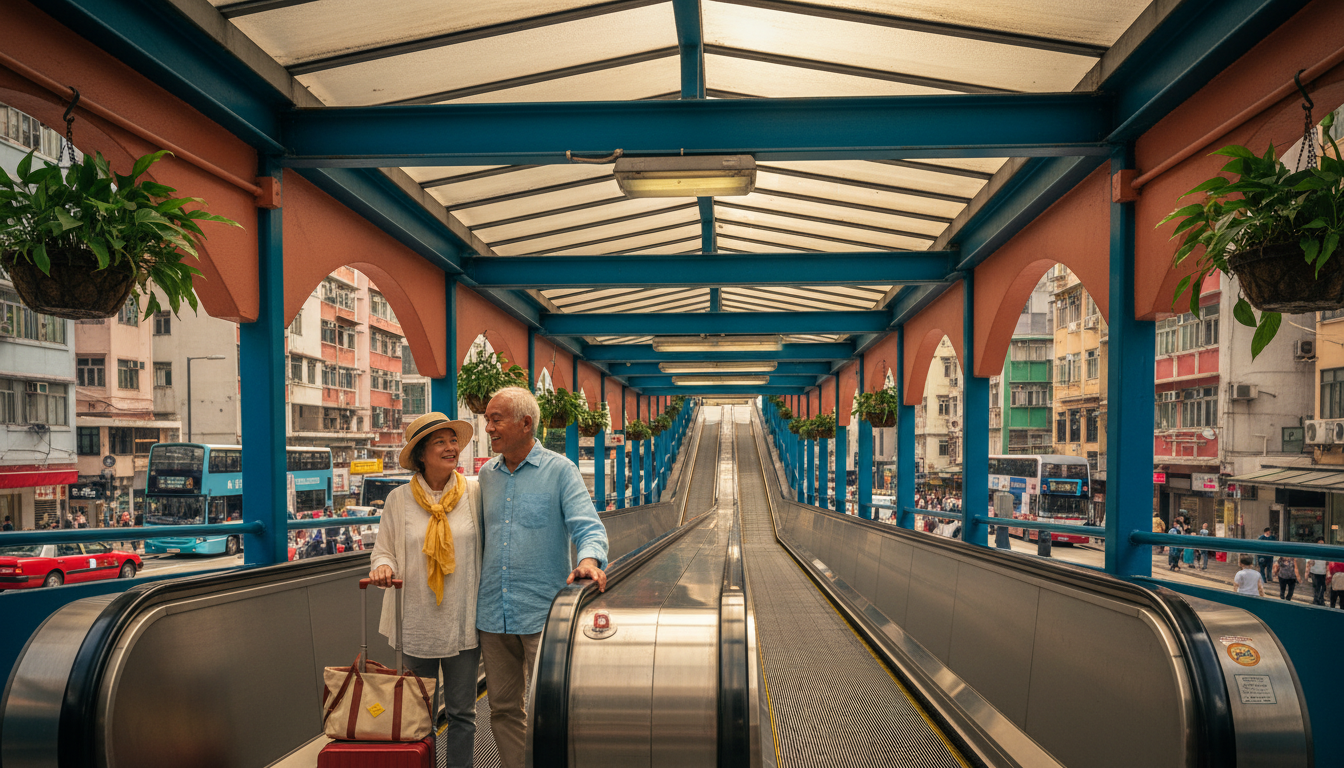
Mid-Levels sounds ideal—it's central, residential, and home to the famous Central-Mid-Levels Escalator system. But here's the catch: while the escalators help with the hills, they only go upward during certain hours (6 AM to midnight, switching direction at 10 AM). If you're coming home after midnight or need to go down during morning hours, you're walking.
The best Mid-Levels apartments for seniors are those within a 2-minute flat walk from the escalator, or those with direct taxi access. Robinson Road and Conduit Road have several modern buildings with excellent accessibility.
Expect to find 2-bedroom apartments in this area, typically 700-900 square feet. The neighborhood has good grocery options—a Wellcome supermarket on Caine Road, several bakeries, and plenty of restaurants with accessible entrances.
 The Central-Mid-Levels Escalator system with covered walkway, showing the long stretch of moving sta
Taikoo Shing: My Top Pick for Senior Travelers
If I could recommend just one neighborhood for a senior-friendly home swap in Hong Kong, it's Taikoo Shing on Hong Kong Island's eastern side.
Why? Everything is connected. The residential towers link directly to a massive shopping mall (Cityplaza) via air-conditioned, step-free walkways. You can go from your apartment to restaurants, supermarkets, a movie theater, and the MTR station without ever going outside or encountering a single stair.
The apartments here were built in the 1980s but are well-maintained, typically 600-800 square feet for a 2-bedroom. The neighborhood is quieter than Central, with wide sidewalks, a waterfront promenade for gentle walks, and a genuine community feel.
My mom ended up staying in Taikoo Shing. She walked to the wet market every morning (flat, covered path), had dim sum at the mall, and took the MTR into Central when she wanted to sightsee. The MTR station has elevators and is about a 5-minute walk from most buildings.
Kowloon Station Area: Modern and Accessible
The developments around Kowloon Station—The Arch, The Harbourside, Sorrento—are some of Hong Kong's newest and most accessible. Built in the 2000s, these towers have excellent elevator access, wide corridors, and modern bathrooms.
The location is convenient: direct Airport Express access (no stairs, no transfers), the Elements Mall with hundreds of shops and restaurants, and flat walking paths along the waterfront.
The downside? These apartments feel less "Hong Kong" and more "international luxury." If your swap partner wants an authentic neighborhood experience, they might prefer somewhere else. But for pure accessibility and comfort, it's hard to beat.
Discovery Bay: Island Escape with Golf Carts
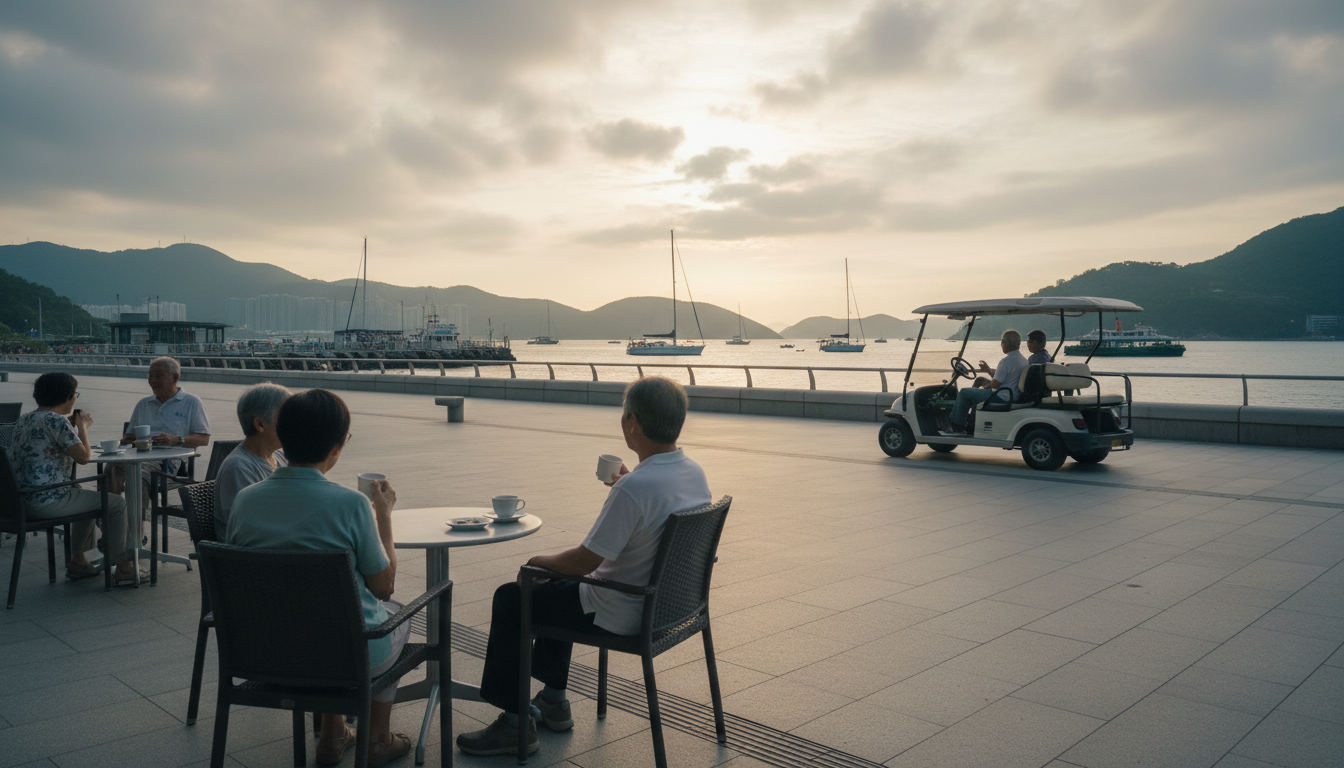
For seniors who want a slower pace, Discovery Bay on Lantau Island offers something unique: no cars. The community uses golf carts and a free shuttle bus system, making it remarkably easy to navigate with mobility issues.
The ferry to Central takes 25 minutes and is fully accessible. The beaches are flat and walkable. The community has a strong expat presence, so English is widely spoken.
The catch: you're somewhat isolated. A spontaneous trip to Kowloon for dinner becomes a 45-minute journey each way. But for seniors who want a peaceful base with occasional city excursions, Discovery Bay works beautifully.
 Discovery Bay waterfront plaza at sunset, showing flat pedestrian walkways, outdoor caf seating with
How to Find and Vet Senior-Friendly Home Swap Listings
Searching for accessible apartments requires more detective work than the average home swap. Here's my process.
Start with the Photos
I look at every single photo in a listing, zooming in on bathroom layout (shower vs. tub, floor type, any visible grab bars), bedroom access (are there steps up to the bed platform?), building entrance (stairs or ramp visible?), and kitchen counter height (can you cook while seated if needed?).
If a listing has only 3-4 photos, message the host and ask for more. Any serious home swapper understands this request.
Ask the Right Questions
Through SwappaHome's messaging, I send a detailed message to potential hosts. Here's a template I've refined:
"Hi [Name], I'm helping plan a trip for a senior traveler (or: I'm a senior traveler myself) and want to make sure your apartment would work for someone with moderate mobility needs. Could you tell me: Is the elevator accessible directly from street level, or are there any stairs to reach it? Does your bathroom have a walk-in shower or a bathtub? Are there any grab bars? Are there any steps or level changes inside the apartment? How far is the nearest grocery store, and is the route flat and accessible? Is there a comfortable chair (not just a sofa) for reading/resting? Thank you so much for taking the time to answer these!"
Most hosts respond thoroughly. If someone seems annoyed by these questions or gives vague answers, that tells you something.
Check the Building Age
Hong Kong buildings constructed after 2000 generally have better accessibility features—wider doorways, more reliable elevators, and bathrooms designed with international standards in mind. Buildings from the 1970s-80s can still work, but require more vetting.
You can often estimate building age from photos (architectural style, fixtures) or simply ask the host.
Read Reviews with Senior Needs in Mind
On SwappaHome, reviews mention specific details about the space. Look for comments about elevator reliability, neighborhood walkability, bed comfort (seniors often need firmer mattresses), noise levels (light sleepers need quiet), and host responsiveness (important if something goes wrong).
Practical Tips for Senior Home Swappers in Hong Kong
Transportation That Works
The MTR (subway) is excellent for seniors—clean, air-conditioned, and most stations have elevators. Download the MTR Mobile app to check elevator status before traveling; occasionally elevators are under maintenance.
Taxis are affordable by Western standards ($3-15 USD for most trips) and abundant. The red taxis serve Hong Kong Island and Kowloon; green taxis serve the New Territories. Most drivers don't speak much English, so have your destination written in Chinese characters (your host can help with this).
Avoid the trams if mobility is a concern—they require climbing steep steps to board.
Healthcare Access
Hong Kong has world-class medical facilities. Private hospitals like Matilda International Hospital and Hong Kong Sanatorium & Hospital have English-speaking staff and are accustomed to treating international visitors.
Travel insurance is essential. Make sure your policy covers pre-existing conditions if applicable. Keep a list of your medications with generic names (brand names differ internationally).
Climate Considerations
Hong Kong's humidity can be challenging for seniors, especially those with respiratory conditions. The best times to visit are October to December (comfortable temperatures around 65-75°F, low humidity, clear skies) and March to April (mild but occasionally foggy).
Avoid June through September unless you love heat and humidity (85-95°F with 80%+ humidity). Air conditioning is everywhere, but the constant in-and-out of AC can be jarring.
 Hong Kong skyline from Victoria Peak on a clear autumn day, with comfortable temperatures evident fr
Food and Dietary Needs
Hong Kong accommodates dietary restrictions better than many Asian cities, but it requires some navigation. For seniors watching sodium intake, traditional Cantonese food can be challenging—soy sauce is in everything.
Useful phrases: "Mo yim" (冇鹽) means no salt. "Siu yau" (少油) means less oil. "Ngo sik jai" (我食齋) means I eat vegetarian.
Most shopping malls have food courts with diverse options, including Western restaurants. The city has excellent Japanese food if you need a break from Chinese cuisine.
Making Your Home Senior-Friendly for Reciprocal Swaps
Home exchange works both ways. If you're hoping to attract senior guests to your home (who might then host you in Hong Kong), consider these improvements:
Grab bars in the bathroom cost $20-50 to install and make a huge difference. A shower stool ($30-40) can be stored in a closet and offered to guests who need it. Good lighting matters—seniors often need brighter light for reading and navigating at night.
In your SwappaHome listing, mention accessibility features explicitly: "Step-free entrance, walk-in shower, firm queen mattress, elevator building." Senior travelers search for these keywords.
What My Mom Actually Experienced
I want to circle back to my mom's trip because it illustrates how this all comes together.
She stayed in a 2-bedroom apartment in Taikoo Shing, hosted by a retired professor who was visiting her daughter in Toronto. The apartment had direct elevator access from the lobby, a walk-in shower with a removable shower head, a comfortable recliner in the living room, a fully stocked kitchen with a rice cooker and kettle, and written instructions for the TV, AC, and washing machine.
My mom spent two weeks there. She took the MTR to Central twice, visited the Big Buddha (accessible via Ngong Ping 360 cable car, which has wheelchair-accessible cabins), and mostly enjoyed slow mornings at the wet market and afternoons reading in the apartment.
Total cost for accommodation: 14 credits, which she'd earned hosting a young couple from Melbourne for two weeks the previous summer.
Her verdict: "I could actually rest when I needed to. In a hotel, I always feel like I should be out doing something. Here, I felt like I was living a life, not performing a vacation."
Getting Started with Your Senior-Friendly Hong Kong Home Swap
If you're new to home swapping, SwappaHome gives you 10 free credits when you sign up—enough for 10 nights in Hong Kong. The platform's verification system and reviews help you find trustworthy hosts, and the messaging system lets you ask all those detailed accessibility questions before committing.
Start by creating your listing with detailed photos and explicit mentions of any accessibility features. Then browse Hong Kong listings, filtering for the neighborhoods I've mentioned. Send thoughtful messages to potential hosts. Be patient—the right match might take a few weeks to find.
Hong Kong isn't the easiest city in the world for senior travelers. The hills are real, the crowds can be overwhelming, and the pace can feel relentless. But with the right apartment in the right neighborhood, it transforms into something manageable—even delightful.
My mom is already planning her return trip. This time, she wants to try Kowloon.
Frequently Asked Questions
Is home swapping in Hong Kong safe for senior travelers?
Home swapping in Hong Kong is generally safe for seniors, especially when using platforms like SwappaHome with verified members and review systems. Hong Kong itself ranks among the world's safest cities. The key is thoroughly vetting apartments for accessibility features and choosing neighborhoods with flat terrain and good public transportation access.
How much can seniors save with home swap versus hotels in Hong Kong?
Seniors can save $2,500-4,000 USD on a two-week Hong Kong trip by home swapping instead of staying in hotels. Mid-range Hong Kong hotels cost $180-280 per night, while home swaps use credits earned by hosting guests. This savings can fund accessible transportation, private tours, or extended stays.
What accessibility features should seniors look for in Hong Kong home swaps?
Seniors should prioritize direct elevator access from street level, walk-in showers with grab bars, step-free interior layouts, and proximity to MTR stations with working elevators. Request detailed bathroom photos and ask hosts specifically about stairs, level changes, and the walking route to nearby amenities.
Which Hong Kong neighborhoods are most accessible for senior home swappers?
Taikoo Shing offers the best accessibility with connected indoor walkways to shopping, dining, and transit. Kowloon Station area has modern, accessible buildings. Discovery Bay provides car-free, flat terrain. Mid-Levels works if you're near the escalator system. Avoid older districts like Sheung Wan or Sham Shui Po with steep hills and stairs.
Do Hong Kong apartments have grab bars and accessible bathrooms?
Most Hong Kong apartments don't have grab bars installed by default, but newer buildings (post-2000) typically have walk-in showers and non-slip flooring. Many hosts will install temporary grab bars or provide shower stools upon request. Always ask potential hosts about bathroom accessibility before confirming your swap.
40+
Swaps
25
Countries
7
Years
About Maya Chen
Travel Writer & Home Exchange Expert
Maya is a travel writer with over 7 years of experience in the home swapping world. Originally from Vancouver and now based in San Francisco, she has completed more than 40 home exchanges across 25 countries. Her passion for "slow" and authentic travel led her to discover that true luxury lies in living like a local, not a tourist.
Ready to try home swapping?
Join SwappaHome and start traveling by exchanging homes. Get 10 free credits when you sign up!
Related articles

Lyon Home Exchange: Your Complete Guide to France's Hidden Gem for Home Swapping
Discover why Lyon home exchange is booming among savvy travelers. From Croix-Rousse to Presqu'île, find the best neighborhoods and insider tips for your swap.

Zurich Bucket List: 47 Unforgettable Experiences to Enjoy During Your Home Swap
Discover the ultimate Zurich bucket list for home swappers—from secret swimming spots to fondue rituals locals actually do. Save thousands while living like a true Zürcher.
Dublin Home Exchange Utilities Guide: WiFi, Heating & Everything Your Guests Need
Master Dublin home exchange utilities—from dodgy WiFi fixes to heating quirks. Practical tips from 7 years of swapping homes across Ireland.