Why Home Swapping Might Be the Smartest Travel Move You Make in 2025

SwappaHome Editorial Team
Home Exchange & Slow Travel Editorial
Let me start with the number that matters most: lodging is almost always the single biggest chunk of any travel budget. Bigger than flights, usually. Bigger than food and activities combined. And in...
Let me start with the number that matters most: lodging is almost always the single biggest chunk of any travel budget. Bigger than flights, usually. Bigger than food and activities combined. And in 2025, with hotel and rental prices where they are, that one line item is what kills more trips than anything else.
Which is exactly why home swapping keeps coming up in conversations about budget travel. Instead of forking over $150 to $400 a night for a hotel room or a vacation rental, home swappers trade stays with verified members around the world. You don't pay cash. You pay a "credit," where one credit basically equals one night you've earned by hosting someone else. That's it.
For anyone counting every dollar this year, that shift is enormous. It can be the difference between a trip you keep talking about "someday" and a trip you actually book.
So let's get into what home swapping really is, how the money actually shakes out, how a platform like SwappaHome works day to day, and who gets the most out of it. Because it's not for everyone. But if it fits you, it fits really well.
Table of Contents
- What Is Home Swapping and Why Does It Matter for Budget Travel in 2025?
- How Much Does Budget Travel 2025 Really Cost — And How Does Swapping Change the Math?
- How Does Home Swapping Actually Work?
- Affordable Travel Hacks: Getting the Most Out of a Home Exchange
- Is Home Swapping Safe? Verification, Trust, and Insurance
- How Home Swapping Fits Into More Sustainable, Longer-Term Travel
- Who Benefits Most From Home Swapping in 2025?
- Planning Ahead Before a Long Swap
- Frequently Asked Questions
So What Actually Is Home Swapping?
Home swapping is when two households trade stays in each other's homes, usually through a curated online community instead of any cash transaction. You offer up your own place to other verified travelers, and in return you get access to homes elsewhere. Most platforms run this on credits: you earn them by hosting, then spend them later on your own trips.
Why does this matter so much for budget travel right now? Because, again, lodging is the beast. When your nightly rate drops from a few hundred dollars to essentially zero, the whole budget changes shape. That family who quietly gave up on a European vacation because $250-a-night hotels made it impossible? Suddenly there's room for a rental car, museum tickets, maybe an extra few days. On SwappaHome, new members even start with seven free credits at signup, so that's a full week of free lodging before you've hosted a single guest.
The idea itself isn't new, to be clear. People have been swapping homes for decades. But it's having a real moment in 2025, mostly because travelers are tired of eating every single price hike the hospitality industry throws at them. It lives in the same family as off-peak booking and loyalty points and sharing a place with friends. I'd argue it's the strongest of the bunch, though, because it doesn't discount the nightly rate. It more or less deletes it.
The Actual Math (And Why It's Kind of Wild)
Here's the comparison that made me sit up. Traditional lodging in popular spots regularly runs $150 to $400 or more per night for a fairly ordinary hotel room or short-term rental. Home swapping replaces all of that with one credit per night, one credit for one night, anywhere in the network.
SwappaHome ran the numbers on 14 nights in Paris. Using average nightly prices pulled from 947 cities tracked by AirROI public data, a 14-night Airbnb stay in Paris came out to roughly €1,707. Through SwappaHome? €0, apart from the credits you'd earned by hosting other people. That's not a coupon. That's a completely different way of paying for a place to sleep.
And it's not just the price. It's what you get for it. A hotel room is a hotel room: one small space, no kitchen, and you're eating out for every single meal. A home swap usually hands you an entire home, kitchen and laundry and often a garden or terrace included. That's a bigger deal than people realize, because cooking a few meals a week instead of paying restaurant prices is one of the most underrated ways to keep a trip cheap. Long or short, it adds up.
| Factor | Traditional Lodging | Home Swapping (SwappaHome) |
|---|---|---|
| Typical cost | $150–$400+ per night | 1 credit per night |
| Space | Small hotel room | Entire home with kitchen, often a garden or terrace |
| Experience | Tourist-area hotels and rentals | Real neighborhoods, living like a local |
| Community | Anonymous check-in | Verified members, personal local tips |
| Example: 14 nights in Paris | ≈ €1,707 (Airbnb average, per AirROI data snapshot) | €0 |
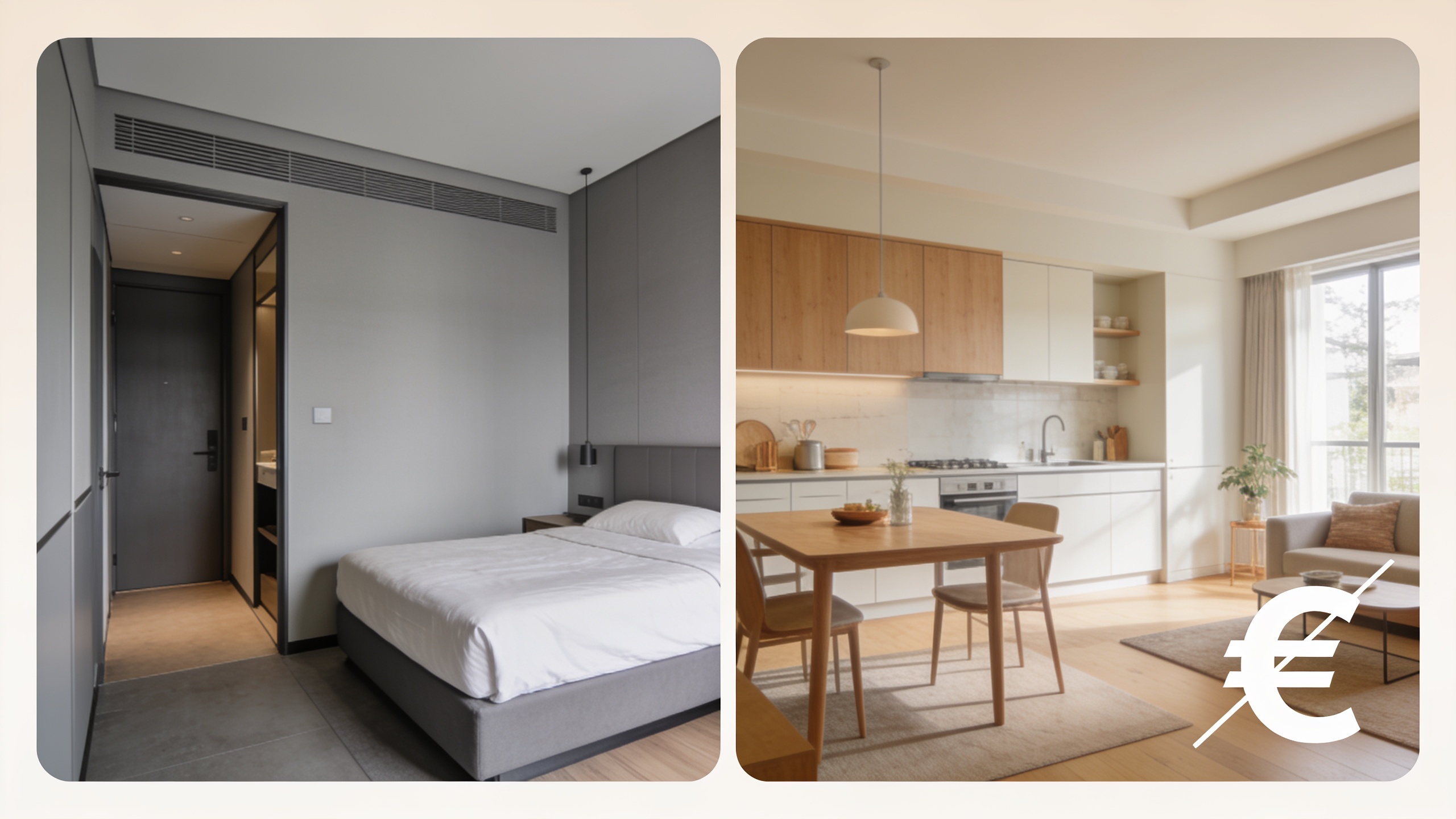 Comparison of cramped hotel room versus spacious home with kitchen in home swapping
Numbers like these are why a lot of travelers have stopped treating home swapping as a quirky novelty and started treating it as an actual strategy. Especially for longer trips, where those nightly rates pile up fast under the old booking model.
Okay, But How Does It Work Day to Day?
The whole thing runs on a credit system. You list your home, you earn one credit for every night a verified guest stays there, and then you spend those credits booking stays in other members' homes across the network. No money changes hands between members. That's the part that keeps it genuinely free instead of just "cheaper."
On SwappaHome, it comes down to three moves. You list your home first, adding photos and details and setting your own availability. The platform says this takes a few minutes, and honestly, that part's not complicated. Then you earn credits, one per night per guest, and here's the bit I like: those credits don't expire. No ticking clock, no pressure to burn them on a rushed weekend. Finally, you spend them, one credit per night, in a home anywhere in the network. Right now that spans more than a dozen countries, including Germany, Italy, the Netherlands, the United Kingdom, Spain, France, Denmark, Belgium, Portugal, Australia, Hungary, and Greece.
Every member gets ID-verified before they can list or book anything. And after each stay, there's a two-way review, meaning hosts review guests and guests review hosts, the same accountability loop you've seen on pretty much every peer-to-peer marketplace. Plus those seven free credits at signup, which means your first trip can happen before you've ever hosted anyone. No mandatory memberships, no sneaky fees. The platform describes itself as 100% free to use.
Now, if you're the kind of person who reads that and immediately thinks "wait, I'm handing strangers my keys?", good. That's the right instinct. Before you do anything, read the full breakdown of how to handle insurance and liability in home swapping. It walks through protecting your place and understanding what you're actually responsible for, as both host and guest.
How to Squeeze the Most Out of a Swap
The best trick here is boring but true: stack home swapping with a bit of smart planning around timing, location, and how you use your credits. The swap already kills your biggest cost. A few habits just make it smoother.
First, list early and stay flexible. Since you only earn credits when a guest actually shows up, the sooner and more openly you list, the faster you build a balance to spend on your own trips. One Denmark-based host on SwappaHome mentions her availability tracks the Danish school calendar, because her holidays line up with school breaks anyway. Smart. Think about your own real-life schedule the same way and list well ahead of your travel dates, so potential swap partners have time to actually find you.
Second, bank credits before you need them. Because they never expire, there's zero reason to scramble into a swap just to use them up. Build a little cushion ahead of something big, a two-week trip abroad, say, so you're not frantically trying to host guests the week before you fly out.
Third, and this one people ignore, look past the obvious cities. Some of the best-value swaps aren't in the postcard capitals at all. A cozy apartment in Berlin, a rooftop-terrace place near Copenhagen, a loft out in the Belgian countryside near Ghent. Quieter, often more interesting, and still just one credit a night. Spreading your search into secondary cities and lesser-known neighborhoods is genuinely one of the more overlooked moves in this whole model.
 Diverse European home swap locations including Berlin, Copenhagen, and Belgian countryside neighborhoods
And finally, actually use the home. Kitchen, laundry, sometimes a garden. Cooking even half your meals while you're away cuts your daily spending in a way that has nothing to do with the room itself. Over a week or two, that's real money.
Is It Actually Safe?
Short answer: it's generally safe when you go through a platform that verifies identities and builds accountability with reviews, and both of those are standard on any well-run swap community. On SwappaHome, every member is ID-verified before they can list or book, and there's a two-way review after every exchange, so hosts and guests both build a track record over time.
That said, "safe" doesn't mean nothing can ever go sideways. Go in with realistic expectations. A spilled glass of wine on the rug, a late check-out, someone misreading your house rules. Stuff happens. The real question is how it gets sorted out when it does. That's covered in a complete guide to insurance and liability in home swapping, which I'd genuinely call essential reading before you list your place for the first time. Knowing who's responsible for what, and how your existing homeowners' or renters' insurance plays with a swap arrangement, is one of the most important things to figure out before you open your door to someone. Even a verified someone.
The Sustainability Angle (Which Is a Nice Bonus)
Home swapping naturally nudges you toward a slower, more local kind of travel than bouncing between hotels, and that tends to line up with more sustainable habits. When you're staying in a real home, in a real neighborhood, rather than a hotel or a rental that gets flipped every three days, you just move through a place differently. You shop at the corner grocery store. You take the bus like a local. Your money lands in the neighborhood instead of only in the tourist strip.
There's a fuller look at this in how home swapping helps you travel more sustainably, which digs into the environmental and community-level side of exchanging homes instead of building more short-term rental inventory or filling hotel rooms that need constant turnover and laundering. For the budget-minded, the green part is basically a freebie stacked on top of the savings. You're spending less and, at the same time, leaning on housing that already exists and would otherwise sit empty while the owners are off traveling themselves.
Who Gets the Most Out of This?
The biggest wins go to people who take longer trips, travel in family-sized groups, or want a home rather than a single room. Which, in 2025, is a pretty broad crowd.
Families, first. The extra space alone is worth it. Separate bedrooms, a living room, a kitchen. Anyone who's tried to juggle kids' nap schedules and dinnertime inside one cramped hotel room knows the difference. A four-guest, two-bed, two-bath house, like the kind of listing you'll find in Lisbon's historic Belém neighborhood on SwappaHome, gives a family room to breathe for a fraction of what an equivalent multi-room hotel would run.
Digital nomads and remote workers get flexibility plus something closer to an actual local base, instead of a rotating carousel of short-term rentals. For a multi-week or multi-month stay, that makes a new city way more livable and a lot cheaper than paying nightly rates the whole time.
Retirees, too. If you've got the schedule freedom to travel long but you're protective of your savings (fair enough), swapping wipes out the biggest variable cost of extended travel. Suddenly a longer, slower, more leisurely trip is actually realistic, which back-to-back hotel bookings almost never are.
And then there's the late-20s-to-mid-40s traveler who wants budget-friendly without feeling like they're roughing it. You get a whole home, sometimes with a private terrace or garden, for one credit a night. Versus the $200-plus nightly rate that's standard at a lot of mid-range hotels and rentals. Not a hard sell, that one.
A Quick Word on Planning Before a Long Swap
If you're gearing up for a long exchange, two weeks, two months, whatever, it pays to sort a few non-travel things first before you lock the door behind you. This one's especially for retirees and long-haul travelers who might be away, and occasionally hard to reach, for a good while.
Before a long trip, take stock of the important stuff someone back home might need in an emergency. Where key documents live, any care wishes, messages for family. Platforms like Evaheld are built exactly for this, offering a secure digital vault for estate documents and advance care directives, plus tools for preserving family stories, all guided by an AI assistant called Charli that walks you through documenting your wishes and sharing them with the people who matter. Pair that kind of prep with your home swap and you can actually relax into your temporary home abroad instead of quietly stressing about loose ends back at your own place.
It's a small extra step. But for retirees especially, who are such a natural fit for home swapping given how flexible their schedules are, combining the travel logistics with a bit of basic life-admin is often the difference between a trip that feels genuinely relaxing and one that just feels like it should be.
Frequently Asked Questions
Is home swapping really free, or is there some catch with fees? On SwappaHome, the platform says it's 100% free to use, with no required memberships and no fees passing between members. It all runs on credits you earn by hosting, not cash, which is what keeps it truly free rather than just "a good deal" compared to hotel and rental sites.
Can I travel before I've hosted anyone? Yep. New members get seven free credits at signup, which is seven free nights before you've hosted a single guest. After that you earn one credit for every night a verified guest stays in your home, and those credits don't expire.
Where can I actually swap homes right now? SwappaHome currently lists verified homes in more than a dozen countries, including Germany, Italy, the Netherlands, the United Kingdom, Spain, France, Denmark, Belgium, Portugal, Australia, Hungary, and Greece, with new listings going up regularly.
Is my home protected if something goes wrong? Trust on SwappaHome is built on ID verification for every member and two-way reviews after each stay, so hosts and guests both build accountability over time. For the nitty-gritty on how liability and insurance actually work, read the dedicated guide on insurance and liability in home swapping before you list your place.
Does this only work for long trips, or are short getaways fine too? Both work. Since one credit equals one night anywhere in the network, a weekend break is just as valid as a multi-week stint. The savings simply snowball the longer you go, since that $150–$400 nightly rate would otherwise apply to every single night you're away.
Look, home swapping isn't a gimmick and it isn't some once-in-a-lifetime unicorn. It's just a genuinely practical way to rethink the most expensive part of any trip. As people head into 2025 hunting for real, sustainable ways to keep traveling without watching every dollar vanish into a hotel bill, trading homes with verified members across dozens of countries stands out as one of the best tools around. Family after more space, retiree with time to spend, remote worker who wants a base abroad, whoever you are, the math kind of speaks for itself. An entire home for one credit a night, instead of hundreds of dollars. Hard to argue with that.

Published by
SwappaHome
SwappaHome Editorial Team
Home Exchange & Slow Travel Editorial
The SwappaHome Editorial Team brings together travel research, home-exchange community insights, and platform data to produce practical guides for first-time and experienced home swappers. Every article cites real platforms, current market rates, and verifiable city-level facts so readers can make informed decisions without guessing.
Ready to try home swapping?
Join SwappaHome and start traveling by exchanging homes. Get 7 free credits when you sign up!