
Work from Hanoi: The Ultimate Home Swapping Guide for Digital Nomads

SwappaHome Editorial Team
Home Exchange & Slow Travel Editorial
Discover how digital nomads can work from Hanoi through home swapping—save thousands while living like a local in Vietnam's electric capital.
The motorbike horn symphony started at 6 AM. I was three days into my first work from Hanoi experience, sitting on a tiny balcony in the Old Quarter, laptop balanced on a plastic stool, drinking the best cà phê sữa đá of my life. Below me, the city was already fully alive—vendors carrying baskets of fresh bánh mì, elderly women doing tai chi in the park across the street, and yes, approximately ten thousand motorbikes weaving through streets that seemed too narrow to hold them all.
I'd found this apartment through a home swap—a 45-square-meter gem with fiber internet and a view of St. Joseph's Cathedral. The owner, a Vietnamese-American architect named Linh, was staying in my San Francisco place while I pretended to be a local in her city. My hotel-dwelling digital nomad friends were paying $60-80/night for sterile rooms with mediocre WiFi. I was paying nothing, living in a real neighborhood, and had a kitchen where I could store my obsessive collection of Vietnamese instant noodles.
That was three years ago. I've since done four more home swaps in Hanoi, each one teaching me something new about how to actually live and work here—without burning through savings or missing the point of being there entirely.
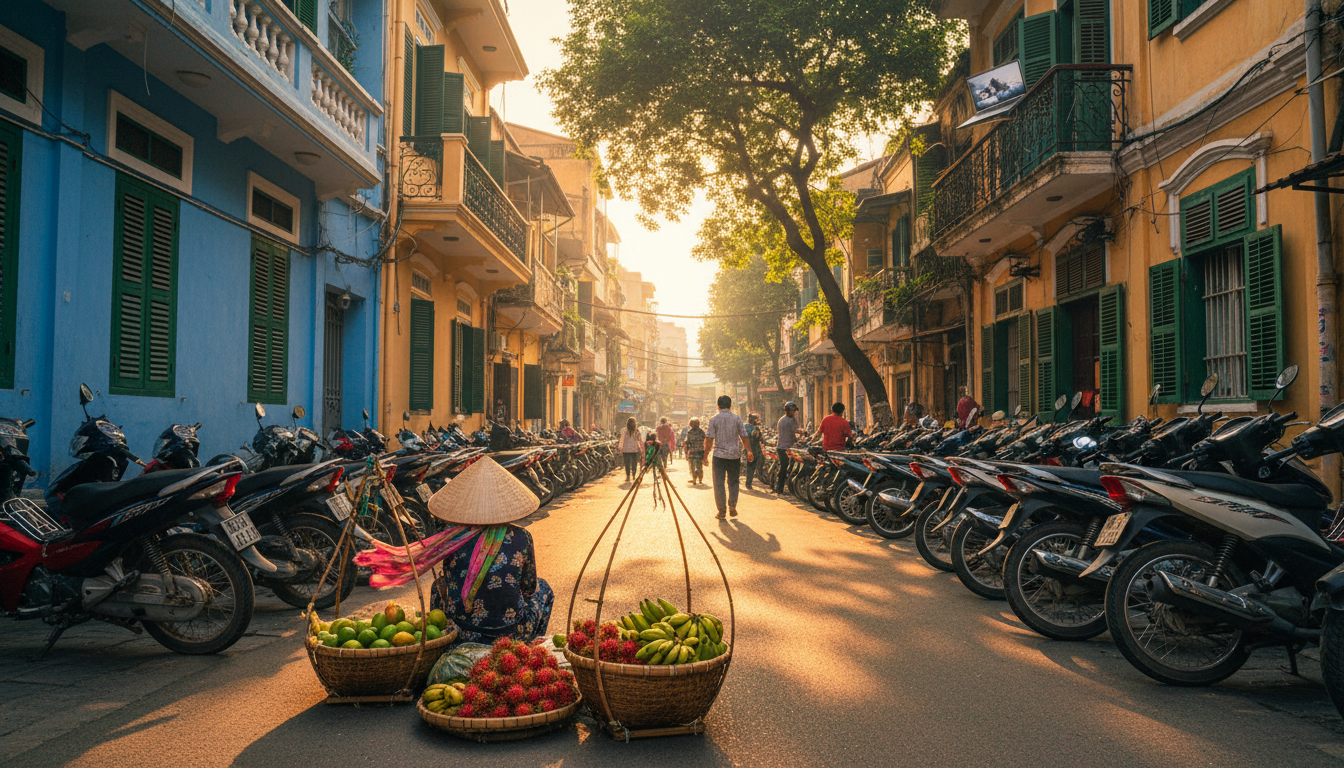 Morning scene on a narrow Old Quarter street in Hanoimotorbikes parked along pastel-colored colonial
Why Home Swapping in Hanoi Makes Sense for Remote Workers
Here's the thing: Hanoi is already one of the most affordable cities for digital nomads in Southeast Asia. You can survive on $1,000/month if you're careful, live comfortably on $1,500, and feel downright luxurious on $2,000. So why bother with home swapping when accommodation is already cheap?
Because "cheap" and "good for working" aren't the same thing.
The budget guesthouses and Airbnbs that populate most nomad guides come with tradeoffs. WiFi that dies mid-video call. No kitchen, meaning you're eating out for every single meal (which adds up, even at $3 per bowl of phở). Locations optimized for tourists, not people who need to actually focus for eight hours.
Home swapping flips everything. You're staying in someone's actual home—the place where they live and, often, work remotely themselves. Reliable internet. A proper desk setup. A kitchen. A neighborhood chosen for livability rather than proximity to tourist attractions.
During my most recent swap in Hanoi's Tây Hồ district, I had a dedicated home office with a 27-inch monitor, an ergonomic chair, and 150 Mbps fiber. The owner was a UX designer who worked from home. She'd already solved every problem I would have faced—the desk faced away from window glare, there was a backup mobile hotspot in the drawer, and she'd left a note about which café downstairs had the best WiFi for when I needed a change of scenery.
That kind of setup would cost you $50-70/night in a serviced apartment. Through SwappaHome's credit system, I spent credits I'd earned hosting travelers in San Francisco. No money changed hands.
Best Neighborhoods in Hanoi for Digital Nomad Home Swaps
Hanoi sprawls, and where you stay dramatically affects your quality of life as a remote worker. After five swaps and countless café-hopping sessions, here's my honest breakdown.
Tây Hồ (West Lake): Best for Focus and Space
This is where I'd recommend most digital nomads land, especially for stays longer than two weeks. The neighborhood wraps around Hanoi's largest lake, and the vibe is noticeably calmer than the city center. You'll find more modern apartments here—many built in the last decade with proper soundproofing and reliable electricity.
Home swaps here typically mean larger apartments (60-100 sqm is common), dedicated workspaces, building gyms, and proximity to the expat-friendly cafés along Xuân Diệu street. The downside? You're 20-30 minutes from the Old Quarter by Grab bike, so you'll miss some of that chaotic energy that makes Hanoi feel like Hanoi.
Average Airbnb cost runs $45-70/night. Home swap cost: 1 credit/night (earned by hosting).
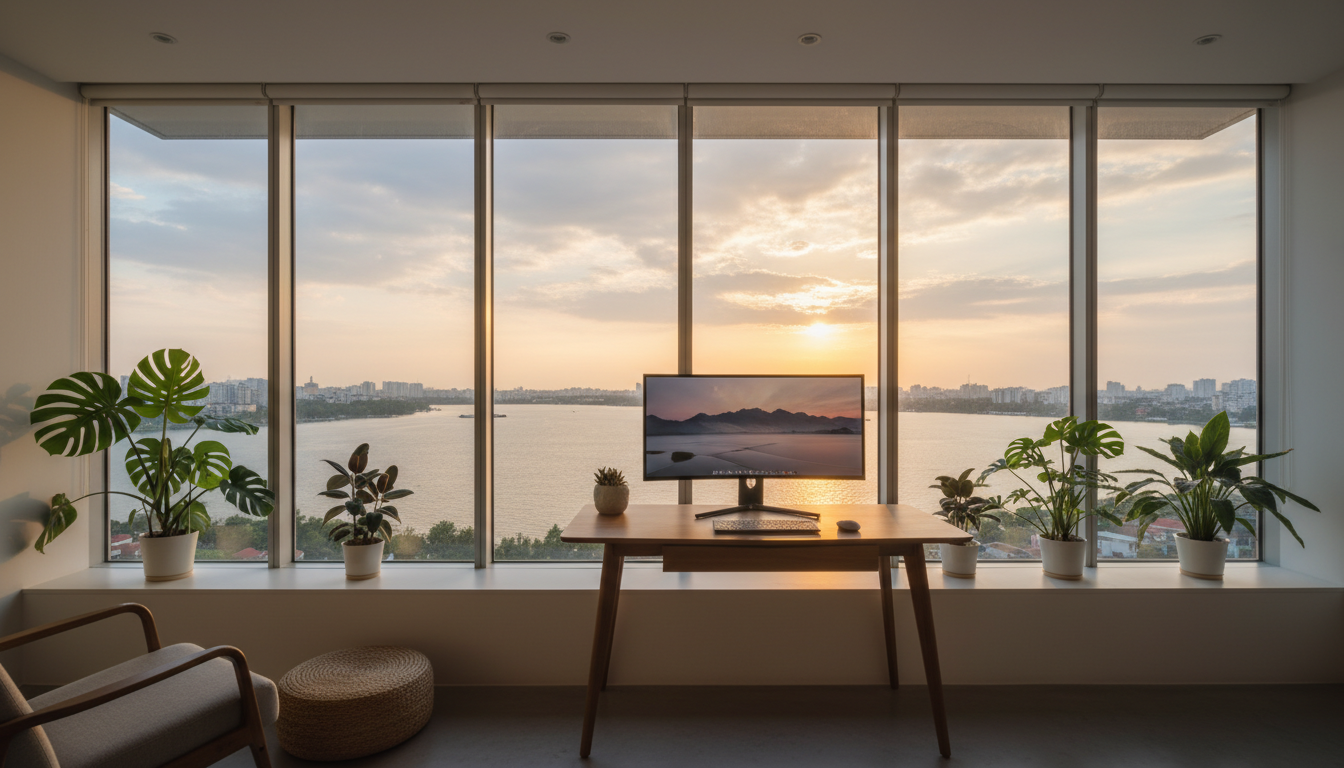 Modern apartment interior in Ty H with floor-to-ceiling windows overlooking West Lake at sunset, a m
Hoàn Kiếm (Old Quarter): Best for Energy and Immersion
The Old Quarter is sensory overload in the best way. Narrow tube houses, streets named after the guilds that once occupied them (Silk Street, Silver Street, Paper Street), and food vendors on literally every corner. It's the Hanoi you've seen in photos.
For remote work? It's complicated.
The buildings are old, WiFi can be inconsistent, and noise is constant. But if you thrive on energy and want to feel the pulse of the city while you work, there's nothing like it. I wrote some of my best travel articles from a third-floor balcony on Hàng Bạc street, fueled by the chaos below.
Home swaps in the Old Quarter tend to be smaller—30-50 sqm tube house apartments—but they come with character you won't find anywhere else. Look for listings that specifically mention "quiet room" or "soundproofed" if you take video calls. Average Airbnb cost is $35-55/night; home swap cost is 1 credit/night.
Ba Đình: Best for Balance
This district doesn't make most tourist guides, which is exactly why I love it for working visits. It's where many Hanoians actually live—tree-lined streets, local markets, and a pace that feels residential rather than performative.
You're close to the Ho Chi Minh Mausoleum and the Temple of Literature, but the neighborhood itself is quiet. Home swaps here often come with Vietnamese families who travel frequently for work, meaning you get authentic local apartments with all the creature comforts.
I did a three-week swap in Ba Đình last year with a university professor. Her apartment had a small balcony garden, a collection of Vietnamese literature I couldn't read but loved looking at, and a neighborhood phở shop where I became a regular. The owner texted me recommendations throughout my stay—where to get my laptop repaired when I spilled coffee on it (Phố Huế, $30), which bánh mì cart was worth the walk. Average Airbnb cost is $30-45/night; home swap cost is 1 credit/night.
Setting Up Your Hanoi Home Swap for Remote Work Success
Here's what I've learned to ask before confirming any work-from-Hanoi home swap.
Internet: The Non-Negotiable
Vietnam has excellent internet infrastructure—better than many Western countries, honestly. But "excellent" at the national level doesn't mean the apartment you're eyeing has it.
Before any swap, I ask for speed test results (a screenshot from fast.com or speedtest.net), the type of connection (fiber vs. DSL—fiber is standard in newer buildings), and backup options (mobile hotspot, café recommendations). Anything above 50 Mbps is plenty for video calls. Most modern Hanoi apartments hit 100-200 Mbps. If someone can't provide a speed test, that's a yellow flag.
Workspace Reality Check
Ask for photos of where you'll actually work. "Desk available" could mean a beautiful dedicated office or a wobbly table in the corner of the bedroom.
I always ask: Is there a desk and chair? (Sounds basic, but I've been burned.) What's the lighting like during the day? Is the workspace separate from the sleeping area? Are there power outlets near the desk?
Noise Assessment
Hanoi is loud. There's no getting around it. But some loud is workable (distant traffic hum) and some isn't (construction next door, karaoke bar below).
I ask what floor the apartment is on (higher generally means quieter), whether there's ongoing construction nearby, if the windows are double-glazed, and what's directly below or above the apartment.
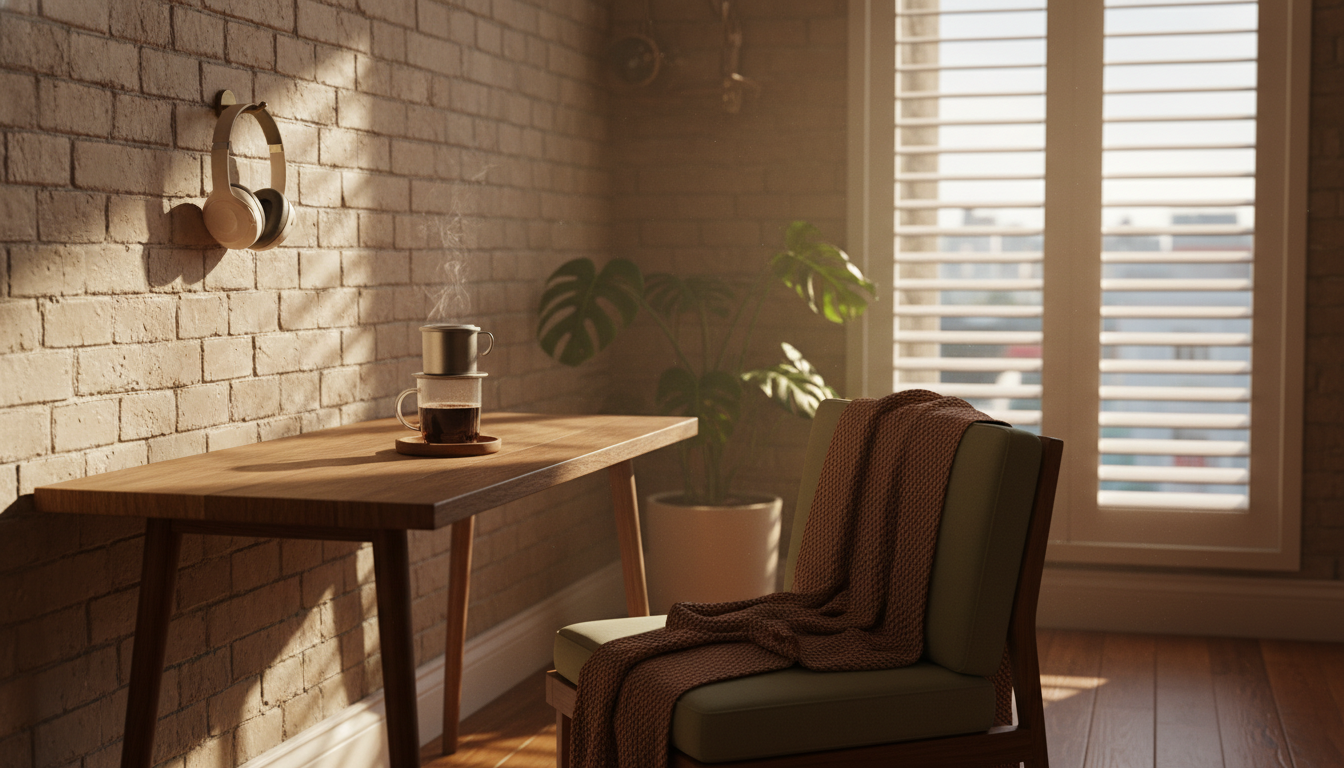 Cozy home office corner in a Hanoi apartmentwooden desk against exposed brick wall, Vietnamese coffe
The Practical Stuff: Visas, Costs, and Timing
Vietnam Visa Situation for Digital Nomads
As of 2024, most nationalities can get a 90-day e-visa for around $25. The process takes 3 business days and is genuinely straightforward—I've done it four times without issues.
For stays longer than 90 days, you'll need to do a visa run (most people pop to Bangkok or Singapore) or work with a local visa agency for extensions. There's no official digital nomad visa yet, though rumors persist that one is coming.
One thing to know: technically, working remotely on a tourist visa exists in a gray area. You're not taking jobs from Vietnamese workers, but you're also not explicitly authorized to work. Most digital nomads operate under don't-ask-don't-tell. I'm not a lawyer, and this isn't legal advice—just describing the reality on the ground.
Monthly Budget Breakdown (Home Swap vs. Traditional)
Let me show you real numbers from my last month in Hanoi.
With Home Swap: Accommodation was $0 (used 30 credits earned from hosting). Food ran about $350 (mix of cooking and eating out). Occasional coworking cost $50. Transport via Grab was $40. SIM card with data, $10. Entertainment and coffee, $80. Total: roughly $530/month.
Without Home Swap (budget Airbnb): Accommodation would be $1,200 (at $40/night). Food jumps to $450 (more eating out without a kitchen). Coworking, transport, SIM, and entertainment stay similar. Total: roughly $1,830/month.
That's $1,300/month in savings. Over a three-month stay, you're looking at nearly $4,000 kept in your pocket—enough for a flight home, a month in another country, or a serious dent in your savings goals.
Best Time to Work from Hanoi
Hanoi has actual seasons, which surprises people expecting uniform Southeast Asian heat.
October through December is my favorite. Warm days (70-80°F), cool evenings, minimal rain. The city feels energized after the summer humidity breaks. January through March gets cool and often drizzly. Temperatures can drop to 50°F, and buildings aren't heated. If your swap has air conditioning with a heat function, you're golden. If not, pack layers. April and May are warming up with occasional rain—pleasant for exploring but humidity starts creeping in. June through September brings the heat, humidity, and dramatic afternoon thunderstorms. Not unworkable—the storms are actually beautiful—but expect to sweat during your commute to the café.
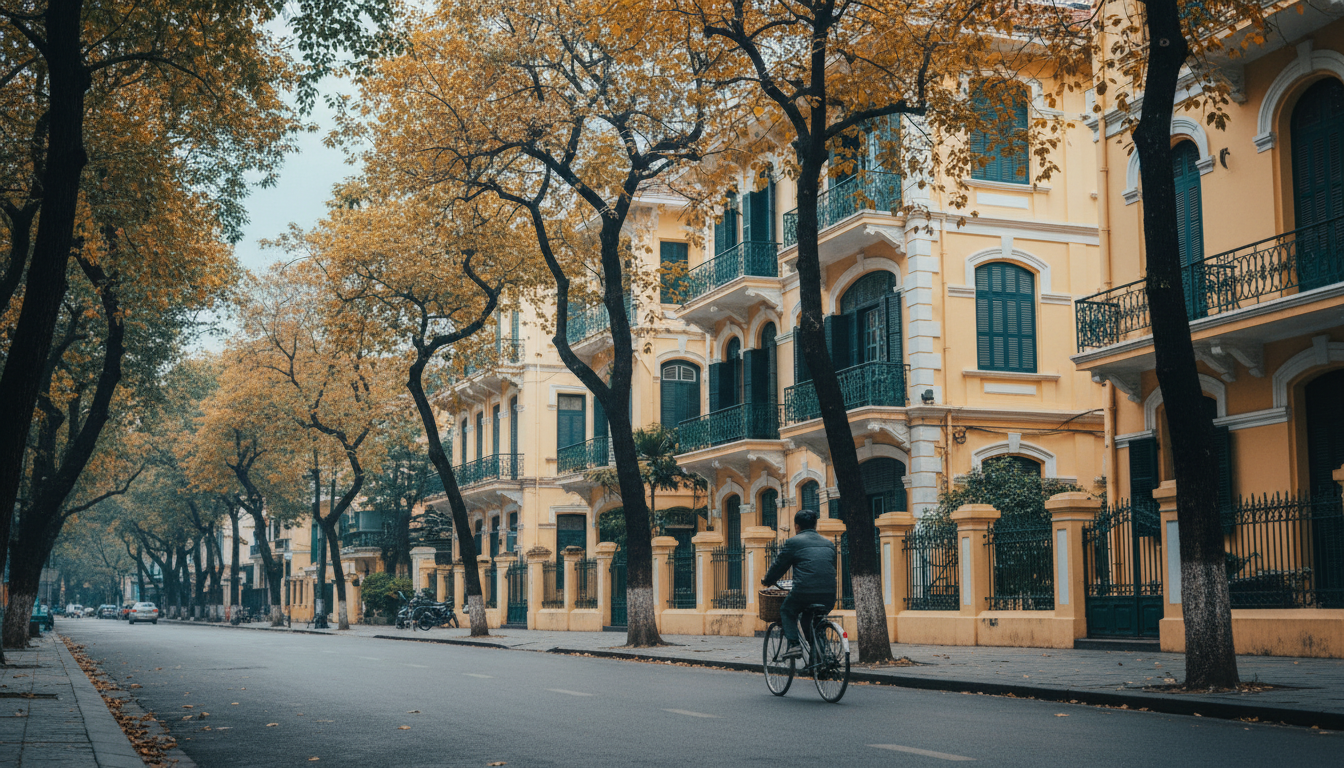 Hanoi street scene in autumngolden leaves on trees lining a quiet Ba nh street, a person on a bicycl
Where to Work When You Need to Leave the Apartment
Even the best home swap setup needs variety. Here are my tested Hanoi workspaces.
The Tranquil Café in Tây Hồ, on Xuân Diệu street, has become my Hanoi office. Fast WiFi, excellent cà phê sữa đá, and a second-floor space that's quiet enough for calls. Around $3-4 for a coffee that lasts you three hours without side-eye from staff.
Hanoi House Café in Hoàn Kiếm is a restored French villa with multiple rooms, each with different vibes. I like the upstairs library area for focused writing. Gets busy on weekends but weekday mornings are productive.
The Workshop, also in Hoàn Kiếm, serves serious coffee (they roast their own) and has a dedicated workspace upstairs. More expensive at $4-5 per drink, but the quality matches the price.
For coworking, Toong (multiple locations) is the WeWork of Hanoi—professional, reliable, $150-200/month or $15/day. Dreamplex in Hoàn Kiếm has a more creative vibe with good events and similar pricing. UP Coworking in Tây Hồ is smaller and friendlier, popular with long-term nomads, running $100-150/month.
Making the Most of Your Hanoi Home Swap
The magic of home swapping isn't just the savings—it's the insider access. When you stay in someone's home, you inherit their neighborhood knowledge.
Before you arrive, ask your swap partner for their favorite local food spots (the places tourists don't find), the best coffee shop within walking distance, any neighborhood quirks (when's trash day, where to get drinking water), and emergency contacts (building manager, reliable taxi driver).
During your stay, document what you discover. I keep a running note of places I find—the phở shop that's only open until 9 AM, the bánh mì cart that appears at 3 PM, the rooftop bar with no sign. Share these with your host when you leave. It's how the home swap community gets better.
Building relationships is where this really pays off. Some of my swap partners have become genuine friends. Linh, whose Old Quarter apartment started my Hanoi obsession, has since stayed at my place twice more. We've met up in both cities, shared travel tips, and she's introduced me to her family when I visited during Tết (Vietnamese New Year).
This isn't transactional tourism. It's building a network of homes around the world, hosted by people who understand the nomad lifestyle because they live it too.
 Two women laughing over ph at a tiny street-side restaurant in Hanoi, plastic stools, steam rising f
Common Concerns About Home Swapping in Hanoi (Addressed Honestly)
"What if something goes wrong with the apartment?"
Real talk: SwappaHome connects you with hosts—it doesn't provide insurance or damage coverage. You're responsible for treating the space well, and your host trusts you to do so. I recommend getting your own travel insurance that covers personal liability (World Nomads and SafetyWing both offer this). In five Hanoi swaps, my worst incident was accidentally breaking a coffee mug, which I replaced for $2 at the local market.
"Is it safe to leave my home with strangers?"
The review system creates accountability. Every swap I've done, both parties have had established profiles with multiple positive reviews. You can also use SwappaHome's verification features to confirm identity. But ultimately, this is a community built on mutual trust. If that makes you uncomfortable, home swapping might not be for you—and that's okay.
"What about the language barrier?"
Younger Vietnamese in Hanoi often speak excellent English, especially in neighborhoods popular with expats. Google Translate's camera feature is genuinely useful for menus and signs. And honestly? Pointing, smiling, and basic politeness get you surprisingly far. I've had entire friendships conducted through translation apps.
"Can I really work effectively from Vietnam?"
Vietnam's timezone (UTC+7) works well for European clients (you're 6-7 hours ahead) and reasonably for US clients (you're 12-15 hours ahead, meaning your morning is their evening). I've managed US-based projects from Hanoi by shifting my schedule—working 4 PM to midnight local time. Not for everyone, but doable.
Getting Started with Your Hanoi Home Swap
If you're new to SwappaHome, here's the path I'd recommend.
Create your profile with detailed photos and descriptions of your home. Be honest about what you're offering—serious remote workers will appreciate knowing about your WiFi speed and workspace.
Start hosting to earn credits. New members get 7 free credits to start, but building up a reserve gives you flexibility. Each night you host earns 1 credit.
Search Hanoi listings and filter for what matters: WiFi speed, workspace, neighborhood. Read reviews carefully—other digital nomads will mention work-related details.
Reach out early. Good Hanoi apartments book up, especially during peak season (October-December). I start conversations 2-3 months before my intended dates.
Do a video call with potential swap partners. You'll get a feel for the space and the person. I've never had a bad swap when I've done this step.
The Bigger Picture
I've worked from a lot of cities. Lisbon, Mexico City, Bali, Barcelona—the usual digital nomad circuit. Hanoi is different.
It doesn't cater to you. It doesn't smooth its edges to make foreigners comfortable. The traffic will terrify you, the noise will overwhelm you, and at some point, you'll get food poisoning from something delicious.
But if you give it time—and home swapping gives you that time, without the financial pressure of expensive accommodation—Hanoi reveals itself as one of the most rewarding places to work remotely. The food alone is worth the trip. The coffee culture rivals any European capital. The cost of living means your freelance income stretches further. And the energy of the place, that constant motion and noise and life, becomes the soundtrack to some of your best work.
My last morning in Hanoi, during my most recent swap, I woke up at 5:30 to catch the sunrise over West Lake. I walked to the same bánh mì cart I'd visited every day for three weeks. The woman running it recognized me, smiled, and handed me my usual without asking. I sat on a plastic stool, ate the best sandwich of my life, and watched the city wake up.
That's not a tourist experience. That's not even a nomad experience, really. That's just... living somewhere. And that's what home swapping makes possible.
Start building your credits on SwappaHome. Hanoi is waiting.
Frequently Asked Questions
Is home swapping in Hanoi safe for digital nomads?
Yes, with normal precautions. SwappaHome's review and verification system helps ensure trustworthy exchanges. I recommend getting personal travel insurance for liability coverage, as the platform doesn't provide damage protection. In five Hanoi swaps, I've never experienced safety issues—the community is built on mutual respect and accountability.
How much can digital nomads save by home swapping in Hanoi?
Expect to save $1,000-1,500 monthly compared to traditional accommodation. A decent Airbnb runs $35-70/night ($1,050-2,100/month), while home swaps cost only the credits you've earned hosting. Over a three-month stay, that's $3,000-4,500 in savings—enough to fund your next destination.
What internet speed should I expect from Hanoi home swaps?
Most modern Hanoi apartments have fiber internet ranging from 50-200 Mbps—plenty for video calls and remote work. Always ask for speed test screenshots before confirming a swap. Newer buildings in Tây Hồ and Ba Đình typically have the most reliable connections.
What's the best neighborhood in Hanoi for remote workers?
Tây Hồ (West Lake) offers the best balance of modern apartments, reliable WiFi, and peaceful working environment. For more cultural immersion, the Old Quarter provides energy and character but can be noisy. Ba Đình is ideal for those wanting authentic local living without tourist crowds.
How long can digital nomads stay in Vietnam?
The e-visa allows 90 days for most nationalities, costing around $25. For longer stays, you'll need visa runs to neighboring countries or local agency extensions. There's no official digital nomad visa yet, though remote workers commonly stay on tourist visas while working for non-Vietnamese clients.

Published by
SwappaHome
SwappaHome Editorial Team
Home Exchange & Slow Travel Editorial
The SwappaHome Editorial Team brings together travel research, home-exchange community insights, and platform data to produce practical guides for first-time and experienced home swappers. Every article cites real platforms, current market rates, and verifiable city-level facts so readers can make informed decisions without guessing.
Ready to try home swapping?
Join SwappaHome and start traveling by exchanging homes. Get 7 free credits when you sign up!
Related articles

Bachelor and Bachelorette Parties in Singapore: The Complete Home Swap Group Guide for 2026
Planning a bachelor or bachelorette party in Singapore? Discover how home swapping lets groups of 6-12 stay together in luxury condos, saving thousands while partying in Marina Bay.

Cycling in Lisbon: 7 Home Swap Bike Tour Itineraries for Every Rider
Discover the best cycling routes in Lisbon with these home swap bike tour itineraries—from waterfront paths to hilltop adventures, all starting from your borrowed home.

Graduation Trip to Barcelona: How Home Swapping Gives New Graduates the Ultimate Celebration
Planning a graduation trip to Barcelona? Discover how home swapping lets new graduates explore Spain's most vibrant city without the hostel crowds or hotel costs.