10 Tips for a Stress-Free First Home Swap Experience

SwappaHome Editorial Team
Home Exchange & Slow Travel Editorial
Handing your house keys to a stranger so you can go sleep in theirs sounds a little unhinged when you say it out loud. And yeah, your first time doing it feels like a leap of faith. But once you...
Handing your house keys to a stranger so you can go sleep in theirs sounds a little unhinged when you say it out loud. And yeah, your first time doing it feels like a leap of faith. But once you understand how the whole thing actually works, it stops feeling like a gamble and starts feeling like the smartest travel hack you've never tried. These tips are here to close that gap. Whether you're a family trying to dodge insane lodging costs, a retiree with all the time in the world, or a remote worker itching for a change of view, this beginner's guide walks through the stuff that actually separates a good swap from a nightmare.
Home swapping used to be a fringe thing. Now it's gone fairly mainstream, mostly because hotels have gotten absurdly expensive and people are hungry for something that feels more local and less sterile. But it's still built on trust, and anything built on trust works best when you've done your homework. So below you'll find ten tips covering everything from vetting your partner to what to throw in your suitcase, plus a comparison table and answers to the questions every first-timer eventually asks.
Table of Contents
- What Is Home Swapping and Why Are Travelers Choosing It?
- How Do You Choose the Right Home Swap Partner?
- What Should Be in a Home Swap Agreement?
- How Do You Prepare Your Home for Guests?
- How Can You Protect Yourself with Insurance and Liability Coverage?
- What Should You Pack and Plan Before You Travel?
- First Home Swap Tips for a Smooth Arrival and Departure
- Common Mistakes First-Time Home Swappers Make
- Frequently Asked Questions
What Is Home Swapping and Why Are Travelers Choosing It?
Home swapping is when two people or families trade their primary homes for a set stretch of time so both can travel without paying for a hotel or vacation rental. No money changes hands for lodging. The "payment" is just reciprocity. You crash in their place, they crash in yours, either at the same time or on whatever schedule you both agree to.
The appeal isn't complicated. Lodging is almost always the biggest chunk of any travel budget, and a swap basically wipes that line item off the page. A 2023 survey by the American Hotel & Lodging Association found average daily hotel rates in the U.S. pushed past $150 a night in a lot of major markets, and that's before you get hit with taxes and fees. Do the math on a two-week trip and you're looking at $2,000 or more just for somewhere to sleep. Swapping sidesteps that completely, which is exactly why families, digital nomads, retirees, and generally anyone who travels a lot keeps circling back to it.
But it's not only about the money. People who swap tend to rave about the "living like a local" part. A real kitchen. A real neighborhood. Sometimes a car. Sometimes a resident cat who decides you're now their favorite person. It's less staged than a hotel and honestly more personal than most short-term rentals. The catch is that it asks more of you upfront in terms of trust and coordination, which is the whole reason a little prep goes such a long way.
How Do You Choose the Right Home Swap Partner?
The right partner is someone whose lifestyle, expectations, and home line up closely enough with yours that neither household feels weird about it. This matters more than pretty much anything else in the process. You are, after all, handing someone the keys to your entire life for a week or two.
Tip 1: Vet Profiles Thoroughly
Look for people with verified identities, detailed profiles, and ideally reviews from past swaps. A profile with three blurry photos and zero history is a much bigger question mark than one with a handful of completed exchanges and happy feedback. Pay attention to how they talk about their home and their neighborhood too. If the profile feels rushed or vague, that usually tells you the person hasn't really thought the logistics through either. And that's a problem waiting to happen.
Tip 2: Match Lifestyles and Household Size
 Comparison of mismatched home swap partners showing lifestyle incompatibility
A retired couple squeezing into a house built for five kids is going to feel the mismatch fast, and so is a family with toddlers trying to survive in some minimalist glass condo with nothing childproofed. Be honest about household size, pets, whether anyone smokes, even how much noise you can tolerate. If you're eyeing an international swap, dig into the local norms too. Travelers heading to Japan, for example, often lean on resources like E2Japan to get a handle on etiquette, accommodation standards, and even where the designated smoking areas are before locking anything in, because cultural expectations over there can be genuinely different from what you're used to.
Honestly, the single best predictor of a good swap is how much you talk before you commit. Video calls, long messages, a shared doc laying out what each side expects. All of that surfaces the mismatches early, while they're still fixable, instead of when you're standing in someone's kitchen realizing this was a mistake.
What Should Be in a Home Swap Agreement?
A home swap agreement is a written document spelling out the dates, house rules, responsibilities, and backup plans for both sides, and you should have one for every single exchange. Even the friend-of-a-friend ones. Especially those, actually. Skipping this is one of the most common ways a first swap goes off the rails.
Tip 3: Put Everything in Writing
Verbal agreements evaporate. People misremember, especially when you're planning across time zones over the course of weeks. A decent agreement covers exact check-in and check-out times, who pays utilities during the stay, pet care, parking, and what happens if someone has to cancel. If the idea of bringing all this up feels awkward or too transactional, the guide on how to negotiate a home swap as a first-timer actually gives you scripts and negotiation tactics that keep things friendly while still protecting both households. Worth a look before your first go.
Tip 4: Set Clear House Rules
Every home has its quirks. Maybe the dishwasher only likes one specific detergent, or the upstairs neighbor loses it over any noise after 10 p.m. Write that stuff down. Appliance instructions, trash and recycling days, the wifi password, and any rooms that are off-limits (a locked office, a stuffed storage closet, whatever). The point isn't to draft some intimidating legal contract that scares people off. It's just to take the guesswork out so nobody's left wondering.
How Do You Prepare Your Home for Guests?
Prepping your home means cleaning it properly, locking away anything valuable, and leaving good instructions so your partner can actually live there without texting you every hour about the thermostat. This protects your stuff and your sanity while you're gone.
Tip 5: Deep Clean and Declutter
A deep clean is more than a quick tidy. Hit the bathrooms, the kitchen appliances, and the bedding hard, because those are the spots guests notice first. Decluttering matters too, and not just for looks. A cleaner, emptier home is way easier for someone unfamiliar with it to move around in. Put away the paperwork, the medications, and anything fragile or sentimental you'd be gutted to lose.
Tip 6: Create a Welcome Binder or Digital Guide
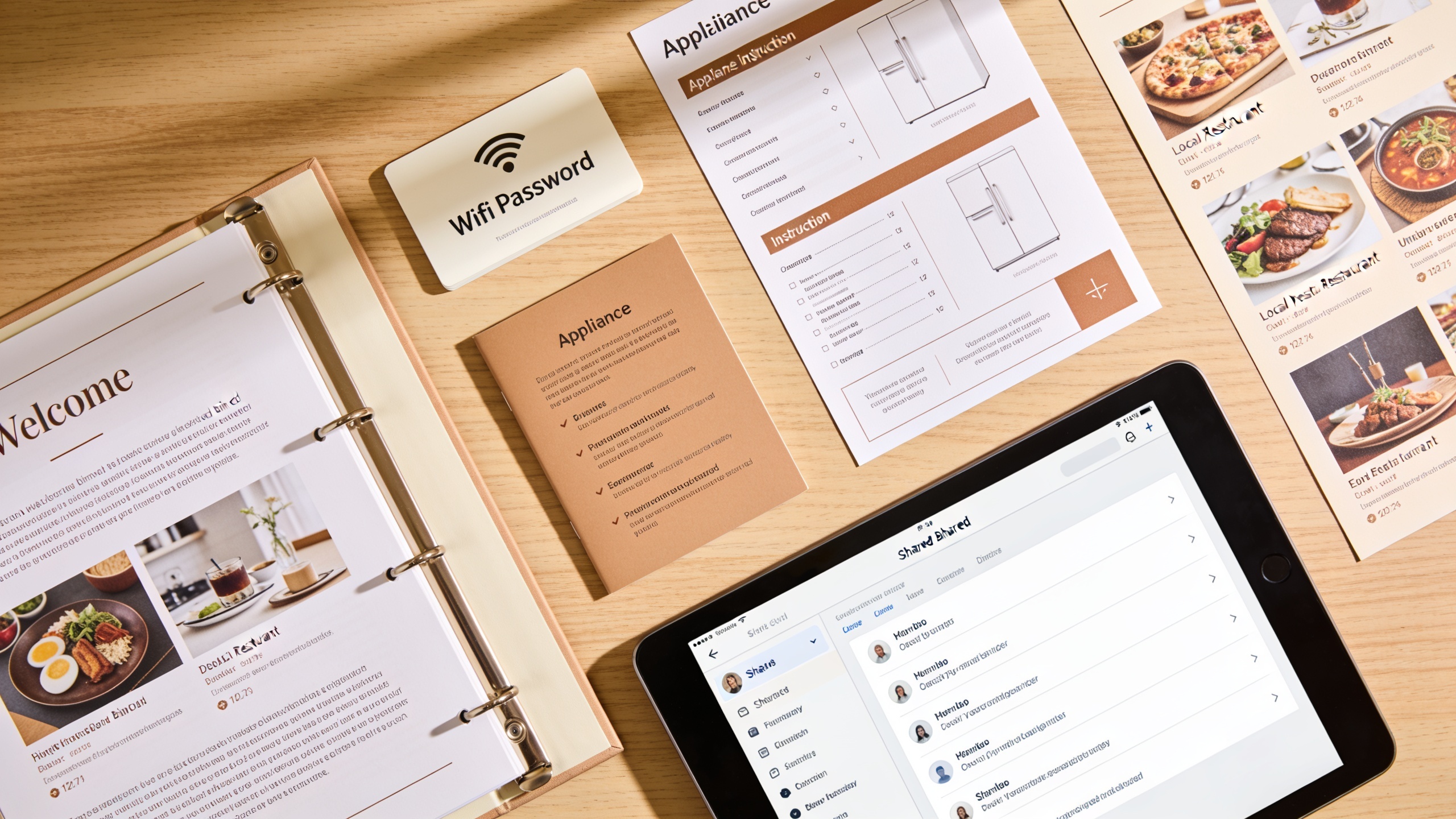 Welcome binder and digital guide materials for home swap guests
Your welcome guide should cover the wifi, appliance quirks, emergency contacts, the nearest grocery store, decent restaurants, trash pickup days, and any of those little things (the temperamental thermostat, the front door that needs a firm shove to actually lock). A lot of swappers do this digitally now with a shared doc or a simple app, which also makes it dead easy to update for the next exchange. And if you're listing your home regularly and want your profile to stand out with sharper descriptions that show up when people search for swaps in your area, some hosts play around with AI writing tools like RobinRank to draft and polish property descriptions faster. It's a small thing, but it can give you a real edge when you're trying to attract the good partners.
How Can You Protect Yourself with Insurance and Liability Coverage?
Insurance and liability coverage protect you financially when something goes sideways during a swap, whether that's property damage, an injury, or a fight over who's responsible for what. This is easily the most overlooked part of a first swap, and it's the one people regret ignoring more than any other.
Tip 7: Confirm Coverage Before You Commit
Standard homeowner's and renter's policies don't always cover a home swap, and a lot of them have specific clauses about non-family occupants staying in your place. So before you finalize anything, call your insurer and just ask them straight: does my policy cover a temporary occupant, and do I need a rider or extra coverage? Some swap platforms offer their own damage protection plans, but read the fine print, because what they actually cover varies wildly. For a full rundown of what to ask, what most standard policies quietly leave out, and how liability usually gets split between partners, the walkthrough on handling insurance and liability in home swapping is genuinely worth reading before you sign. Think of it like travel insurance on a big international trip. You'll probably never need it. But the one time you do, you'll be very glad it's there.
What Should You Pack and Plan Before You Travel?
Packing and planning for a swap goes way beyond stuffing a suitcase. You're heading somewhere with no hotel staff, no concierge, no rental agency on speed dial when something breaks. A bit of extra planning here means a lot fewer surprises once you land.
Tip 8: Pack for Independence, Not Convenience
You'll be handling your own transportation, groceries, and household stuff, so pack the things that make daily life smoother: a portable charger, a universal power adapter, and enough basic toiletries to get you through day one before you've figured out where the local stores are. If long flights and unfamiliar beds tend to leave you stiff (and let's be real, they leave most of us stiff), some travelers keep something like Muscle Mint around as a simple vegan-friendly topical for easing sore muscles. Handy when you're jet-lagged and want to be mobile enough to actually go explore instead of collapsing.
Tip 9: Understand Local Logistics and Payment Norms
Figure out how people actually pay for things where you're going. Cash, card, or in some regions increasingly digital and even crypto options. Most swaps don't involve any direct payment, but getting a feel for the local money landscape makes everyday spending so much less stressful. If you're curious how digital currencies are reshaping cross-border payments and travel spending in general, sites like Cryptocoinsjournal track that stuff, which is legitimately useful if you're a digital nomad juggling finances across a few countries during a longer swap.
Oh, and map out the nearest grocery stores, pharmacies, and public transit before you arrive. Not while you're standing on the sidewalk jet-lagged and confused. A five-minute session with Google Maps before you leave saves an embarrassing amount of stress later.
First Home Swap Tips for a Smooth Arrival and Departure
A smooth arrival and departure comes down to clear timing, a proper handoff of information, and treating the home the way you'd want yours treated. This is the part where all your earlier planning either pays off or completely falls apart.
Tip 10: Communicate Continuously and Leave the Home Better Than You Found It
Stay in touch with your partner throughout the stay, not just at the bookends. A quick message when you arrive to confirm everything's as expected, another mid-stay if anything pops up. It builds trust and stops tiny issues from snowballing into big ones. When it's time to go, do a final clean, replace whatever you used up (the coffee, the basic pantry stuff), and leave a note letting them know their place is ready and waiting. This one habit, leaving things better than you found them, is what turns a one-off swap into a repeat relationship and glowing reviews for your next trip. It's genuinely the whole game.
Common Mistakes First-Time Home Swappers Make
First-timers almost never get burned by the swap concept itself. They get burned by under-communicating, skipping the agreement, and having wildly unrealistic expectations about the property. Here's how the common missteps stack up against the better move, side by side.
| Common Mistake | Why It Causes Problems | Better Approach |
|---|---|---|
| Skipping a written agreement | Leads to disputes over dates, responsibilities, or damage | Draft a clear agreement covering dates, rules, and contingencies |
| Not checking insurance coverage | Leaves both parties financially exposed if something breaks or an accident occurs | Confirm coverage with your insurer before committing |
| Overpromising the home's condition | Creates disappointment and trust issues on arrival | Share honest, recent photos and disclose known quirks |
| Poor communication during the stay | Small issues escalate without a way to resolve them quickly | Maintain light, regular check-ins throughout the exchange |
| Ignoring local research | Leads to wasted time figuring out basics on arrival | Research transit, groceries, and payment norms in advance |
Notice the thread running through all of these? They all come from treating the swap like a transaction instead of a relationship. The exchanges that go smoothly are almost always the ones where both people put in a little extra time upfront on communication and planning. Boring advice, maybe. But it's true.
Frequently Asked Questions
Is home swapping actually safe for first-timers? Generally, yes, as long as you take the standard precautions: verify your partner's identity, read the reviews, put your agreements in writing, and sort out insurance before you commit. The risk profile is roughly the same as other trust-based sharing economy services, and it drops a lot the more due diligence you do. The people who get burned are usually the ones who skipped a step.
Do we both have to swap at the exact same time? Nope. Simultaneous swaps are common but not required. Plenty of people do "non-simultaneous" arrangements where one party stays at a different time, often tracked through a points or credit system on the platform instead of a strict date-for-date trade.
What happens if something breaks during the swap? That depends entirely on your agreement and what your insurance covers. A lot of first-timers just assume damage "won't happen," which is a nice thought until it does. Having a clear picture of liability ahead of time (the guides on insurance and liability in home swapping cover this well) means you already know how a busted appliance or accidental damage gets sorted before it ever becomes a fight.
How far ahead should I start planning? Most experienced swappers say start searching and negotiating at least two to three months before your travel dates, and even earlier for popular destinations or peak season. Finding a compatible partner and hammering out the details just takes time. Rushing it rarely goes well.
Can I swap if I rent instead of own? Yes, but check your lease first and, in most cases, get written permission from your landlord. Some leases flat-out ban subletting or temporary occupants, so you really want to confirm this before you start negotiating with anyone.
Home swapping rewards preparation more than almost any other kind of travel. But it also hands you something hotels and even most vacation rentals just can't: a real, local way to experience a place while your own home gets cared for in return. Start small. Talk often. Treat that first swap as a learning experience. By your second or third one, the whole thing stops feeling like a leap of faith and starts feeling like second nature.

Published by
SwappaHome
SwappaHome Editorial Team
Home Exchange & Slow Travel Editorial
The SwappaHome Editorial Team brings together travel research, home-exchange community insights, and platform data to produce practical guides for first-time and experienced home swappers. Every article cites real platforms, current market rates, and verifiable city-level facts so readers can make informed decisions without guessing.
Ready to try home swapping?
Join SwappaHome and start traveling by exchanging homes. Get 7 free credits when you sign up!