
Home Swap for Business Travel: How to Combine Work and Travel Without the Hotel Bill

SwappaHome Editorial Team
Home Exchange & Slow Travel Editorial
A home swap for business travel means trading stays with another professional (your place for theirs) so you end up with a whole home, kitchen, and a real workspace instead of a shoebox hotel room....
A home swap for business travel means trading stays with another professional (your place for theirs) so you end up with a whole home, kitchen, and a real workspace instead of a shoebox hotel room. And often you pay nothing per night. For consultants, sales reps, and remote employees who basically live out of a carry-on for weeks at a time, this quietly changes everything about how a trip gets planned and paid for. Below I'll walk you through finding a work-friendly exchange, handling the logistics while you're actually on the clock, and staying productive once you land somewhere new.
Table of Contents
- What Is a Home Swap for Business Travel?
- Why More Professionals Are Choosing a Work-Friendly Home Exchange
- How Does Home Swapping Work for a Business Trip?
- How Do You Find a Work-Friendly Home Exchange?
- Managing the Logistics: Trust, Communication, and Timing
- Staying Productive in a Swapped Home
- Home Swap vs. Hotel for Business Travel: A Side-by-Side Look
- Frequently Asked Questions
What Is a Home Swap for Business Travel?
A home swap for business travel is an arrangement where you stay in someone else's home while that person (or another swapper) may stay in yours, either at the same time or on separate dates, instead of booking a hotel or short-term rental. The difference between this and your standard vacation swap is priorities. A business-focused swap cares about reliable internet, a quiet room or a decent desk, and being close to the client office, the conference, or a coworking spot. Not whether there's a hot tub.
The idea itself is old news. Home exchange has been around as a vacation money-saver since at least the mid-20th century. What's new is business travelers latching onto it, and that tracks perfectly with the rise of remote and hybrid work. When most of your job lives on a laptop, the place you're staying can't just have a bed. It needs a desk, a connection that won't die mid-call, and enough quiet that you're not apologizing to a client because a dog is barking two rooms over. Platforms have caught up to this. Some, like swappahome.com, now pitch themselves straight at remote workers instead of vacationers, and they list homes by Wi-Fi speed and workspace setup right alongside the usual bedroom-and-bathroom count.
The exact mechanics shift a bit from platform to platform. But the spine of it is always the same: you list your own home, you browse other people's, and you arrange a stay by swapping space instead of handing over cash every night.
Why More Professionals Are Choosing a Work-Friendly Home Exchange
The pitch is simple. A work-friendly home exchange swaps out a paid hotel room for a whole home (kitchen, living space, somewhere to work) usually at little to no cash cost, and that math gets really appealing once a trip runs a week or longer. A "work-friendly" exchange just means the home was listed and chosen specifically because it supports remote work: fast internet, an actual place to sit and focus, and a host who gets that you might be on video calls all day instead of out taking photos of cathedrals.
Money's the obvious one. On SwappaHome, for example, the whole thing runs on credits instead of nightly cash. The platform puts it at "1 credit per night" to stay in a listed home, versus hotel rates it pegs at "$150–400 per night." And when you scale that up, the gap gets almost silly. SwappaHome's own comparison shows a 14-night stay in Paris booked through Airbnb averaging 1,707 € (based on nightly averages across 947 cities tracked by AirROI public data, snapshot dated April 29, 2026) against 0 € through a home swap. If you travel for work once a year, fine, whatever. If you're doing it five or six times? That compounds fast.
Then there's space. A hotel room is built for sleeping and staring at a TV. A swapped home comes with a kitchen, a living room, sometimes a garden or terrace, which honestly matters more than people expect on a two-week trip. There's a point where you'd rather cook something between calls than eat another restaurant dinner alone. And because these listings belong to real people instead of a faceless front desk, you get a lot more direct back-and-forth before you show up. You're messaging an actual host, so it's easy to nail down exactly what the workspace and connection look like before you commit to anything.
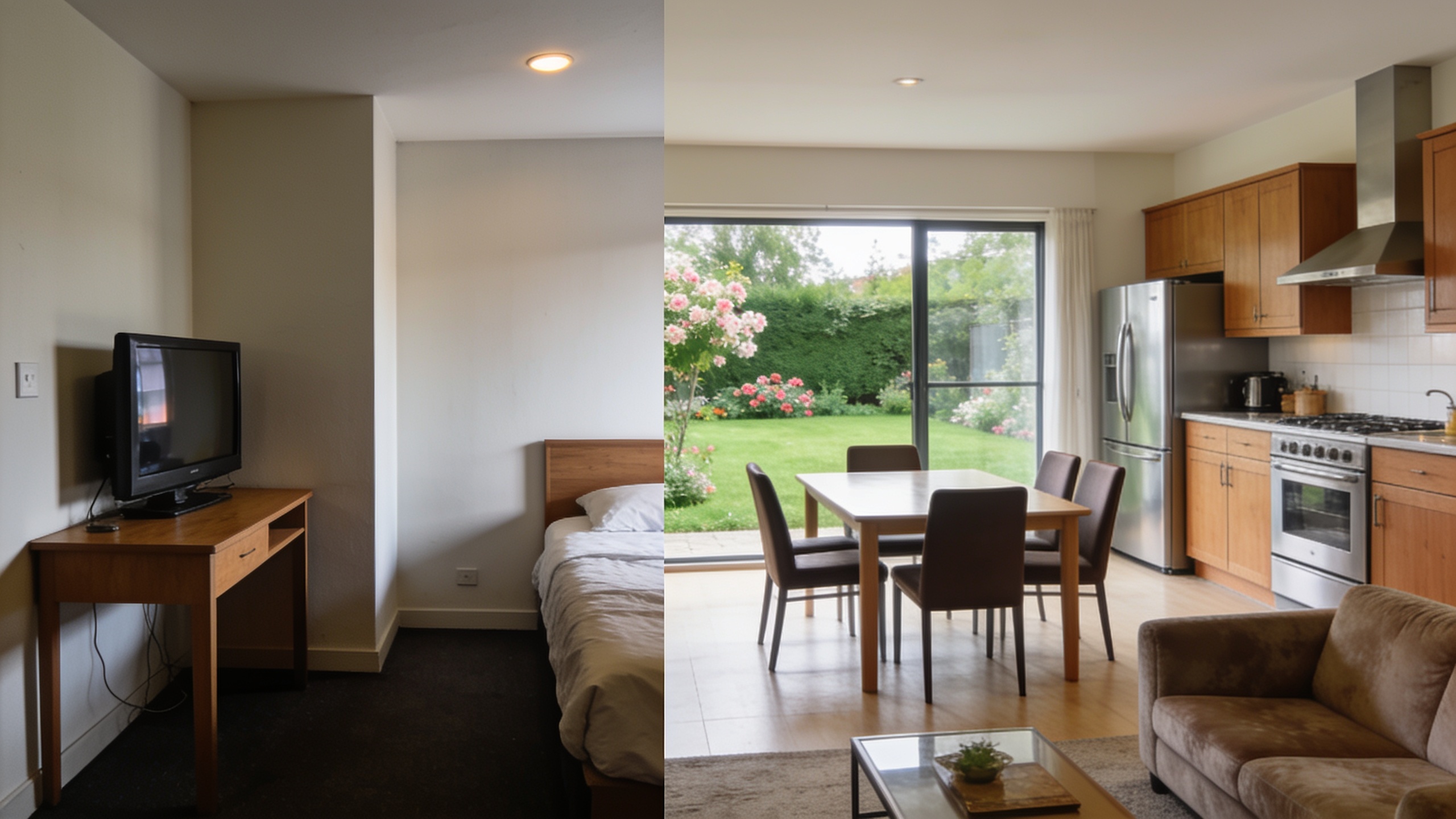 Comparison of cramped hotel room versus spacious home with kitchen and living areas
Digital nomads got here first, unsurprisingly. There's a closer look at how they pull this off in how digital nomads are using home swaps to travel for free, which digs into how remote workers stretch long stays across a bunch of cities on exchange credits instead of cash.
How Does Home Swapping Work for a Business Trip?
Home swapping for a business trip usually follows three steps: list your own home, search and filter for a work-ready place at your destination, and travel using earned or exchanged credit instead of paying nightly. On SwappaHome specifically, it breaks down like this. You list your home with photos, Wi-Fi details, and workspace info. You browse work-ready homes filtered by destination, dates, and work style. Then you stay in the one you matched with, and any credits you don't use roll forward, since the platform says credits "never expire."
One thing worth knowing up front: signup here is tied to a real professional identity, not some throwaway account. SwappaHome asks you to join through LinkedIn, which they treat as a kind of identity check for the community. There's no membership fee listed. Joining and listing a home are described as free, and the site says there's "no money between members," meaning the whole thing runs on credits rather than one traveler paying another.
For a short trip, the big adjustment is timing. You need to start hunting well before you would for a hotel, because matching with a work-ready home in a specific city on specific dates just takes longer than booking a room for next Tuesday. If your trip's built around a single meeting or a quick conference, it might make more sense to swap plus grab a hotel night before or after. But for anything stretching two weeks or more, the kind of engagement consultants and project contractors deal with constantly, the cost advantage becomes hard to ignore. See the Paris number above.
How Do You Find a Work-Friendly Home Exchange?
Finding a work-friendly home exchange comes down to filtering by three things, in this order: verified internet speed, a described workspace, and how close the place is to wherever your work actually happens. Then confirming all of it directly with the host before you book. A pretty kitchen photo tells you nothing about whether your video call will drop halfway through, so a business search has to go deeper than a vacation search.
Wi-Fi and Workspace Essentials
Internet reliability is the single most important filter, full stop. SwappaHome lists connection speeds on individual homes (examples on the platform include 75 Mbps, 100 Mbps, 125 Mbps, and 150 Mbps), so you can actually compare before reaching out instead of crossing your fingers. Rough rule of thumb: anything above roughly 50 Mbps download is plenty for video calls and cloud work for one or two people. But if your job involves hauling around big files, screen sharing, or a couple of people working from the same house, aim high.
Past the numbers, read the listing for language that describes a real place to work. A desk. A quiet room. A dining table that pulls double duty. If a description only gushes about the neighborhood and nearby attractions and never once mentions where you'd sit down and get things done? That's your cue to ask the host directly before committing.
Location and Timezone Considerations
For work travel, location is less about tourism and more about logistics: how far the home sits from the client site, the conference center, or a reliable transit line, and how many time zones you're crossing relative to your usual meeting schedule. A home 20 kilometers outside the city, like the Farum, Denmark listing near Copenhagen featured on SwappaHome, is great if you mostly work remotely and only need the city now and then. It's a headache if you've got daily in-person meetings downtown.
Worth checking who else lives there, too. Some hosts share the property, like one SwappaHome listing describing a "quiet and considerate student" on a separate floor, which changes how much privacy you'll get during work hours. None of this is a dealbreaker on its own. It's just stuff to weigh when your day involves calls, deadlines, and actual focus time, not only evenings and weekends.
Solo business travelers deal with a slightly different set of worries than families or couples swapping together. Personal safety, single-occupancy etiquette, how to vet a host on your own. Those get covered in solo travel home swap tips for the independent explorer, and honestly it applies just as much to a solo consultant on client work as it does to a solo vacationer.
Managing the Logistics: Trust, Communication, and Timing
Managing a swap for a work trip really boils down to three tasks: agree on dates and expectations with your host way ahead of time, confirm access and workspace details in writing, and leave yourself a buffer for the unpredictability that comes with staying in a real person's home instead of a standardized hotel. Because the whole thing hinges on someone else's schedule and property, it takes more upfront coordination than a same-day hotel booking. But that coordination is also exactly what makes the stay more personal and, frankly, better for real work.
Lock in dates earlier than you would for a hotel. A lot of hosts have availability tied to their own calendars. The schoolteacher listing that Farum, Denmark home on SwappaHome, for instance, has openings around school holidays. So a trip built around a fixed meeting date needs to be checked against when the host is actually free, not just assumed. If your dates flex at all, that's a real advantage here. It opens up a much bigger pool of homes.
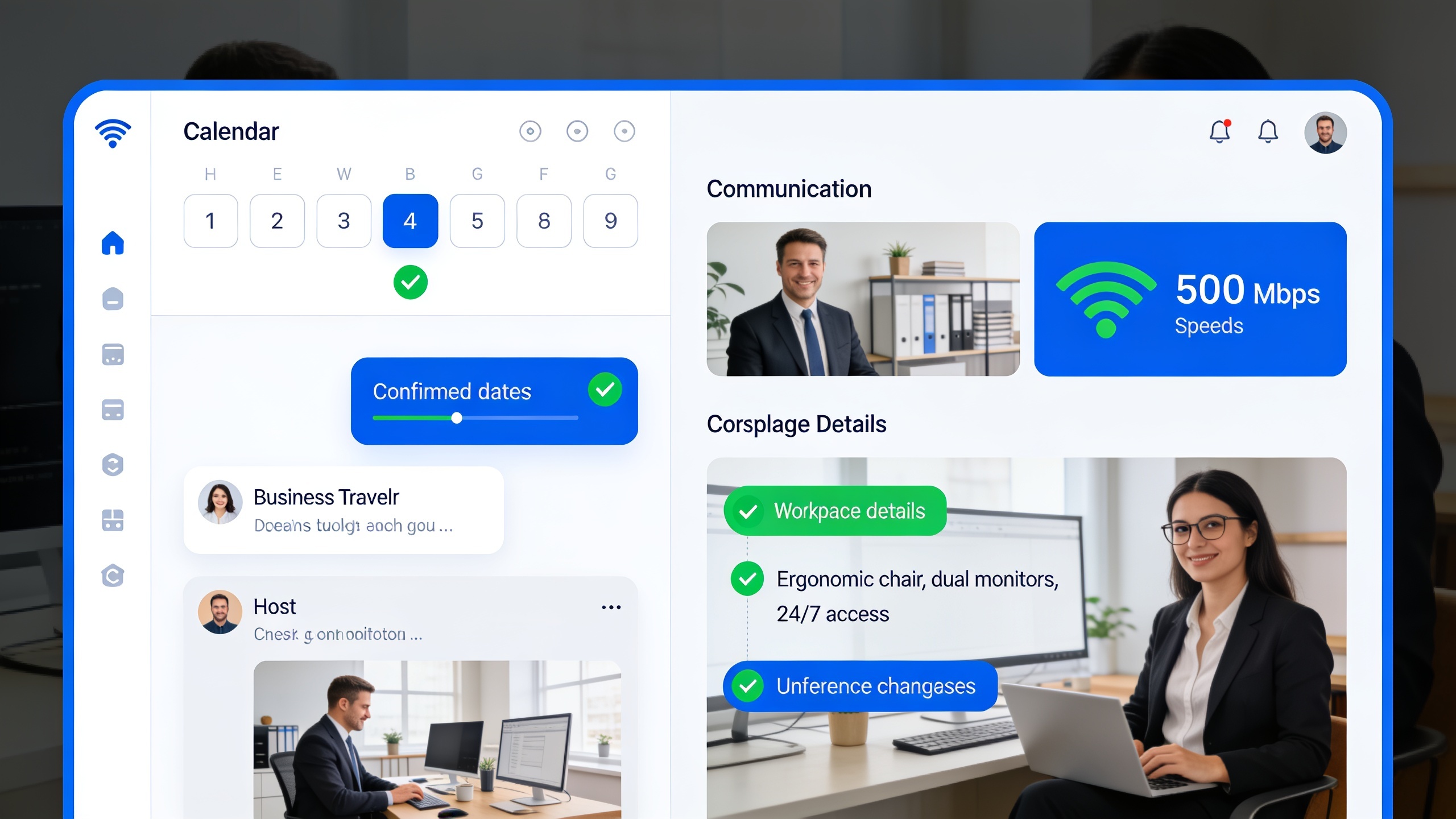 Digital communication interface showing home swap booking confirmation with dates, Wi-Fi speeds, and workspace details
Communication before you arrive matters more for work than it ever does for leisure. Confirm in writing, ideally through the platform's messaging, what the internet speed is, where the workspace lives, whether anyone else is around during your stay, and the house rules (parking, quiet hours, deliveries). This is also the moment to flag if you'll be receiving packages, taking 6 a.m. calls across time zones, or hosting a client video call from the place. Easy to sort in advance. Awkward to discover the morning of.
And give yourself a little breathing room on both ends of the trip. Check-in and check-out on a swap tend to be looser than a hotel's rigid clock, which is usually a nice thing, but it also means don't schedule your first client call for the hour you land. A short settling-in window to test the Wi-Fi, find the workspace, and get your bearings saves you from kicking off something important on a connection you've never actually used.
Staying Productive in a Swapped Home
Staying productive in a swapped home mostly means treating it like an office you're borrowing, not a vacation rental you're lounging in. Set a fixed workspace, protect a consistent schedule, and test your tools before you need them for anything that matters. Yes, you get way more room than a hotel gives you. But you also lose the built-in structure of a business center or a coworking space's shared vibe, so a bit of self-discipline has to fill that hole.
Pick one spot and use it consistently. Don't drift from the couch to the kitchen table to the bed. This is exactly what full-time traveling remote workers already do, as laid out in how digital nomads are using home swaps to travel for free. A stable routine, even in a brand-new city every few weeks, keeps your output steady while everything around you keeps changing.
Test the internet and your video setup the second you arrive, not five minutes before your first meeting. If the listing named a speed (SwappaHome publishes numbers like 100 Mbps or 150 Mbps on individual listings), go confirm the actual speed in the room you'll work from matches, because walls, which floor you're on, and where the router sits all mess with real-world performance.
Be honest with yourself about time zones. A swap several zones away from home base can be a productivity gift (quiet early mornings before anyone else logs on) or a slow-motion disaster (late-night calls chewing up your sleep), and which one it turns into is entirely down to how you schedule. Block out consistent focus hours that don't shift with your location, and get deliberate about which meetings you take live versus which can go async. That's what keeps a multi-week trip from dissolving into a blur of mistimed calls.
Home Swap vs. Hotel for Business Travel: A Side-by-Side Look
The cleanest way to figure out whether a swap makes sense for your next trip is to line it up against a hotel on the things that actually matter: cost, space, experience, and how the whole stay gets arranged. SwappaHome does exactly this on its own site, contrasting the traditional hotel stay with what it calls "the new way" for remote workers.
| Dimension | Traditional Hotel | Home Swap for Business Travel (SwappaHome) |
|---|---|---|
| Cost | $150–400 per night (per SwappaHome's stated range) | 1 credit per night; no cash membership fees |
| Space | Small hotel room | Entire home, including kitchen and often a garden or terrace |
| Experience | Concentrated in tourist areas | Staying in a real residential neighborhood |
| Check-in | Anonymous front-desk check-in | Direct communication with a host who has a LinkedIn-verified profile |
| Booking model | Pay per night at time of stay | Credits earned by listing your own home, usable across destinations |
Now, this doesn't mean a swap wins every single time. One overnight before an early meeting, where you'll barely see the room anyway? A hotel's probably simpler, especially since those trips tend to come together last-minute. But for stays of a week or more, where a full kitchen, a dedicated workspace, and the cost gap from SwappaHome's Paris example (1,707 € on Airbnb versus 0 € through the swap, based on that 14-night comparison) genuinely compound, a work-friendly exchange starts looking like the smarter play on both budget and quality of life.
Frequently Asked Questions
Is this safe if I'm a solo professional traveling alone? Mostly it comes down to how well you vet the listing and the host before you commit, same as any place you'd book from someone you've never met. Platforms that tie member identity to something verifiable help a lot here. SwappaHome, for one, makes you sign up through LinkedIn, so solo travelers can actually see a host's professional background before agreeing to anything. There's more on the practical safety habits (communication norms, what to confirm before you show up) in solo travel home swap tips for the independent explorer.
Do I have to swap at the same time as my host, or can I just stay in their place? Depends on the platform. SwappaHome runs on credits rather than forcing two people to swap simultaneously. You earn credits by listing your own home and spend them staying in others, and the platform says those credits never expire. That gives you a lot more scheduling wiggle room than a strict same-time swap ever would.
How do I know the internet's actually good enough for calls? Check whether the listing states a speed (SwappaHome publishes them, with current examples running from 75 Mbps up to 150 Mbps) and then message the host to confirm that speed reaches the room you'll actually work in. Building layout can make the real number look nothing like the advertised one.
Can families or couples tack a swap onto a work trip? In principle, sure. Swapped homes usually give you more bedrooms and living space than a hotel room, which makes bringing a partner or the kids along a lot easier. Whether it's the right call still comes down to matching the bedroom count, workspace, and location to what the trip actually needs. Same evaluation any business traveler runs, regardless of who's tagging along.
Is it really free to use something like SwappaHome? SwappaHome says listing a home and joining is free, no required membership fees, and that stays run on credits rather than cash changing hands between members. That said, read the current terms on the site directly before you bank on any specific figure, since these things change over time.
Bringing It All Together
Blending work and travel through a home swap isn't some quirky novelty. It's a pretty logical answer to how much business travel has shifted toward longer stays, remote meetings, and laptops that go wherever you go. Two-week consulting gig, a run of client visits across Europe, a remote-work stretch bolted onto conference travel, whatever it is, a work-friendly exchange trades the standard hotel room for a real home, a real workspace, and, on platforms like SwappaHome, a cost structure built on credits instead of nightly bills. The homework (checking Wi-Fi speeds, confirming the workspace, talking clearly with your host ahead of time) is what turns a promising listing into a trip where the work actually gets done.

Published by
SwappaHome
SwappaHome Editorial Team
Home Exchange & Slow Travel Editorial
The SwappaHome Editorial Team brings together travel research, home-exchange community insights, and platform data to produce practical guides for first-time and experienced home swappers. Every article cites real platforms, current market rates, and verifiable city-level facts so readers can make informed decisions without guessing.
Ready to try home swapping?
Join SwappaHome and start traveling by exchanging homes. Get 7 free credits when you sign up!