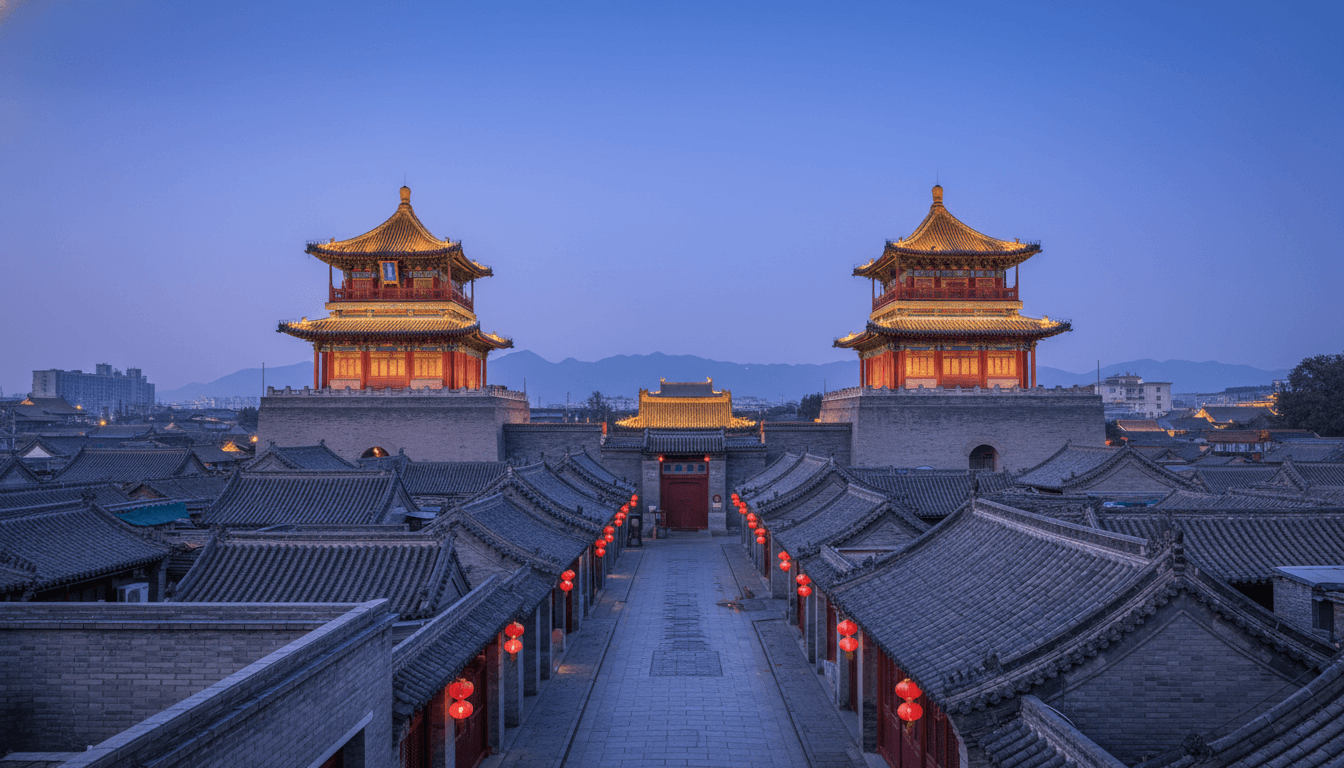
Beijing for Couples: Intimate Home Exchange Experiences That Transform Your Trip

SwappaHome Editorial Team
Home Exchange & Slow Travel Editorial
Discover why Beijing for couples becomes magical through home exchange—from hidden hutong courtyards to locals' secret date spots that no hotel concierge knows.
The morning light hit different in that hutong courtyard.
I was standing in my borrowed kitchen—a renovated traditional Beijing home with exposed wooden beams and a tiny garden where pomegranate trees grew wild—watching my partner attempt to make jianbing from a recipe our host had left us. Flour everywhere. Laughter echoing off 400-year-old walls. This wasn't a hotel breakfast buffet. This was something else entirely.
That trip changed how I think about Beijing for couples. Not because of the Great Wall (though yes, we went). Not because of the Forbidden City (stunning, obviously). But because staying in someone's actual home—their neighborhood, their local haunts, their morning routine—turned what could have been a standard tourist itinerary into something genuinely intimate.
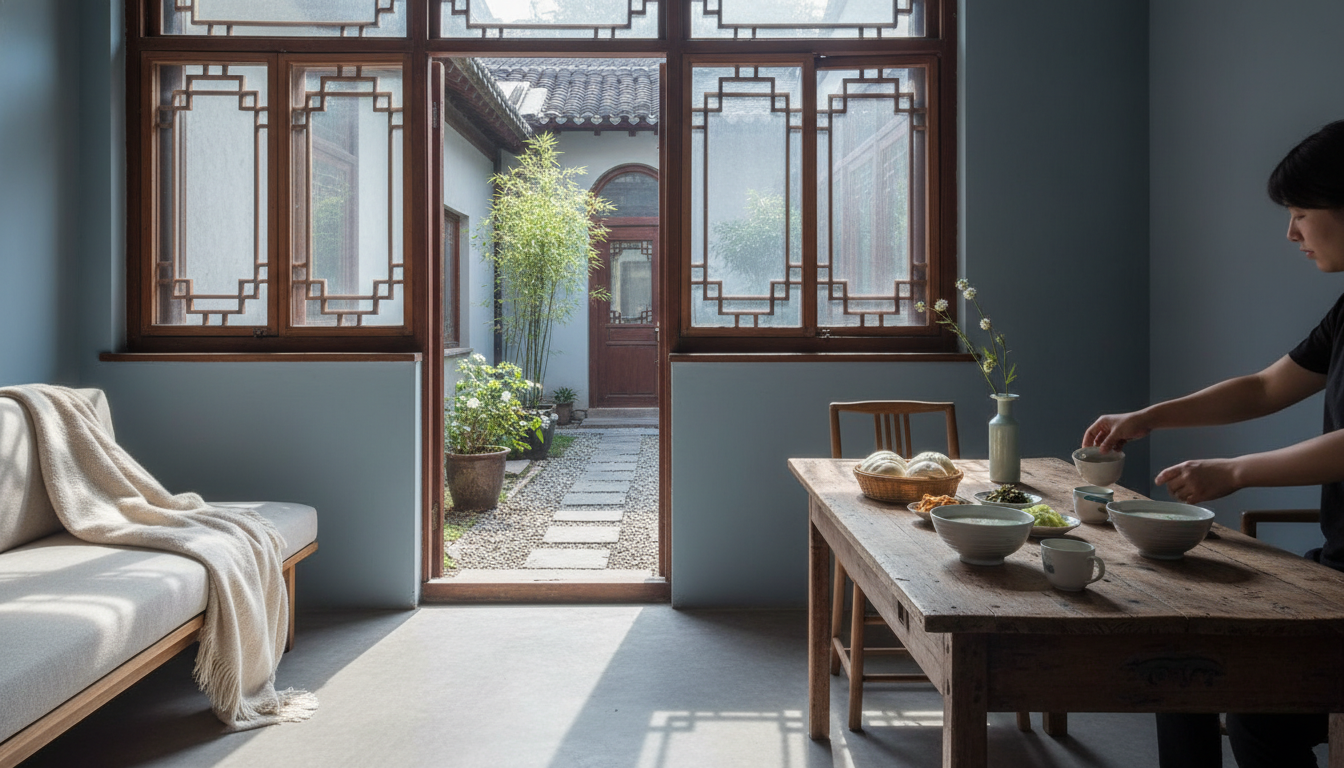 Morning light streaming through traditional wooden lattice windows into a renovated hutong home, wit
Why Home Exchange in Beijing Creates Couple Magic
Here's what I've figured out after seven years of swapping homes: the best couple trips aren't about fancy hotels. They're about shared experiences that feel like yours—not choreographed, not Instagrammable in that generic way, just... real.
Beijing rewards this approach more than almost any city I've visited. The contrast between ancient and ultramodern is jarring in the best way. You can wake up in a 600-year-old courtyard home, grab breakfast from a street vendor who's been there for three generations, then spend your afternoon in the most futuristic shopping mall you've ever seen.
But here's the thing—you only access that contrast if you're actually in a neighborhood. Hotels cluster in business districts or tourist zones. Home exchanges scatter you across the real city.
My partner and I stayed in Dongcheng District, specifically in a narrow alley off Nanluoguxiang. Our host, a graphic designer named Wei, had left us a hand-drawn map of her favorite spots. The dumpling place with no sign (turn left at the red door, look for the grandmother). The rooftop bar her friends owned. The park where couples danced at sunset.
No hotel concierge has that map.
Best Beijing Neighborhoods for Couples Doing Home Exchange
Location matters enormously here. Beijing is massive—like, genuinely hard to comprehend until you're there. The wrong neighborhood means hours on the subway instead of wandering hand-in-hand through lantern-lit alleys.
Dongcheng: The Romantic Hutong Heart
This is where I'd point any couple doing their first Beijing home exchange. The hutongs here have been thoughtfully preserved—not Disneyfied, but genuinely maintained. You get the old Beijing atmosphere without feeling like you're walking through a theme park.
A boutique hotel in this area runs about ¥800-1,200 ($110-165 USD) per night. Or you could use 1 credit per night through SwappaHome. Same neighborhood, fraction of the cost, ten times the character.
The best home exchanges here are the courtyard houses—siheyuan—that have been converted into modern living spaces. They're architectural gems: gray brick walls, wooden doors with brass knockers, interior courtyards that bloom with persimmons in autumn.
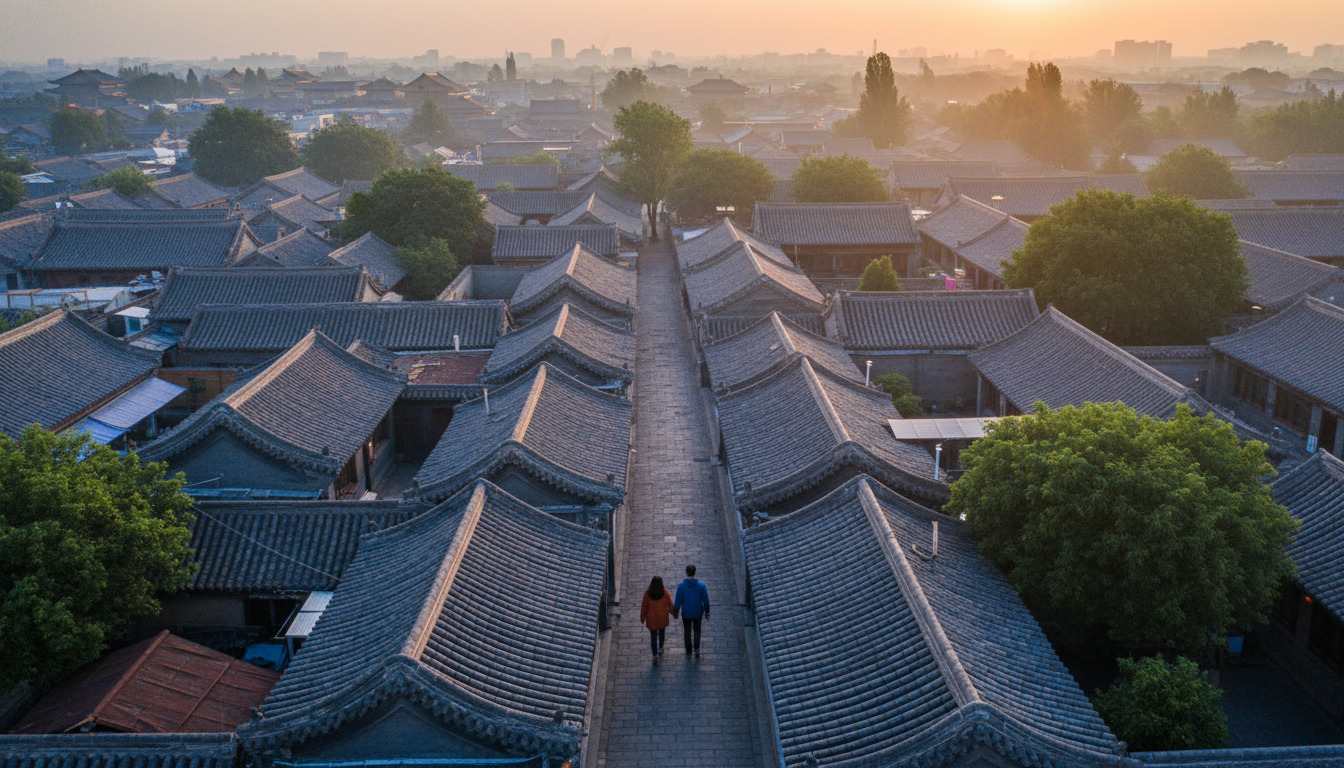 Aerial view of traditional gray-roofed hutong houses in Dongcheng, narrow alleyways weaving between
Xicheng: Lakes and Imperial Vibes
If your couple aesthetic leans more "sunset boat ride" than "hidden alleyway exploration," Xicheng delivers. The Shichahai lake area—Qianhai, Houhai, and Xihai—offers that classic Beijing romance: willow trees trailing into water, traditional boats, bars and cafes lining the shores.
Home exchanges here often come with rooftop terraces. I'm not exaggerating when I say watching the sun set over the Drum Tower from a private rooftop, wine in hand, partner beside you, might be the most romantic thing I've done in Asia.
The neighborhood is walkable in a way that feels rare for Beijing. You can spend an entire day just wandering—morning coffee at a lakeside cafe, afternoon exploring the hutongs around Yandai Xiejie, evening drinks as the lanterns flicker on.
Chaoyang: Modern Romance for City Lovers
I'll be honest—Chaoyang isn't my first choice for couples. It's Beijing's business district, all glass towers and international restaurants. But if you and your partner would rather have a stunning 40th-floor apartment with skyline views than a historic courtyard, this is your spot.
Home exchanges here tend to be sleek modern apartments in complexes like Sanlitun SOHO or Park Avenue. You'll have access to rooftop pools, gyms, the whole luxury apartment experience. And Sanlitun itself is Beijing's nightlife hub—cocktail bars, live music, restaurants from every cuisine you can think of.
Just know you'll be taking taxis or the subway to see the historic sites. Trade-offs, always trade-offs.
How to Find Your Perfect Beijing Couples Home Exchange
I've learned some things the hard way so you don't have to.
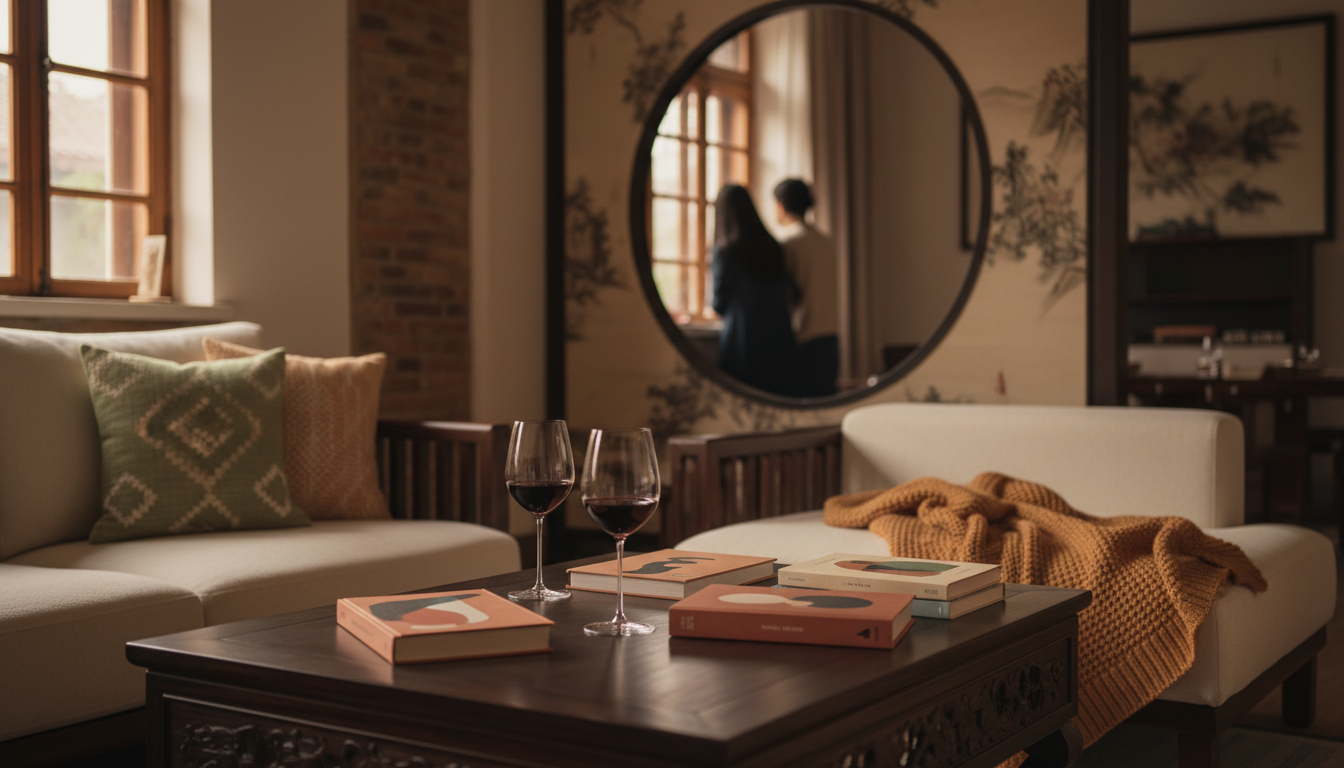 Cozy interior of a renovated Beijing apartment, mix of traditional Chinese furniture and modern touc
Start your search 3-4 months ahead if you're visiting during peak season (April-May for spring, September-October for autumn). Beijing home exchanges get snapped up fast during these windows because—well, the weather is genuinely perfect and everyone knows it.
Read the neighborhood descriptions carefully. "Close to the Forbidden City" can mean a 10-minute walk or a 45-minute subway ride depending on how creative the host is being. Look for specific hutong names or subway station references.
And this is couples-specific—check the bed situation. Traditional Chinese homes sometimes have kang beds (heated brick platforms) which are amazing for the cultural experience but can be, uh, firm. If you need a proper mattress, confirm before booking.
When I browse SwappaHome for Beijing listings, I filter for verified hosts first. The review system helps enormously—look for hosts who mention they've hosted couples before. They'll often leave little touches: restaurant recommendations for date nights, suggestions for less-crowded times at popular spots.
The credit system keeps things simple: 1 credit per night, regardless of whether you're booking a tiny studio or a sprawling courtyard house. Those 7 free credits new members get? That's 7 nights in Beijing. I've done the math on what that would cost in hotels. It's... a lot.
Intimate Experiences Only Home Exchange Unlocks
This is where it gets good.
Cook Together in a Real Beijing Kitchen
Most home exchanges come with kitchens. Revolutionary concept, I know. But hear me out—one of my favorite Beijing memories is wandering through a wet market with my partner, pointing at vegetables we couldn't identify, buying way too many dumplings from a vendor who found our Mandarin attempts hilarious, then going back to "our" apartment and attempting to cook dinner.
Was the food good? Honestly, mediocre. Was the experience incredible? Absolutely.
The Dongzhimen area has fantastic markets. Sanyuanli Market is the famous one—chaotic, colorful, overwhelming in the best way. Go early (before 9 AM) when the produce is freshest and the crowds haven't descended.
Have the Neighborhood to Yourselves
Tourist Beijing empties out by 6 PM. The tour buses leave, the groups head to their hotels, and suddenly the hutongs belong to the people who actually live there.
This is when Beijing becomes romantic.
I remember walking through Wudaoying Hutong at dusk with my partner, the sky turning pink over gray rooftops, elderly couples practicing tai chi in doorways, the smell of someone's dinner drifting out. We found a tiny wine bar—literally four tables—run by a woman who'd lived in Paris for a decade. She told us about the neighborhood's history while we drank natural wine and ate cheese that had no business being that good in Beijing.
You don't find that bar from a hotel in Chaoyang. You find it because you live there, temporarily, and you wander.
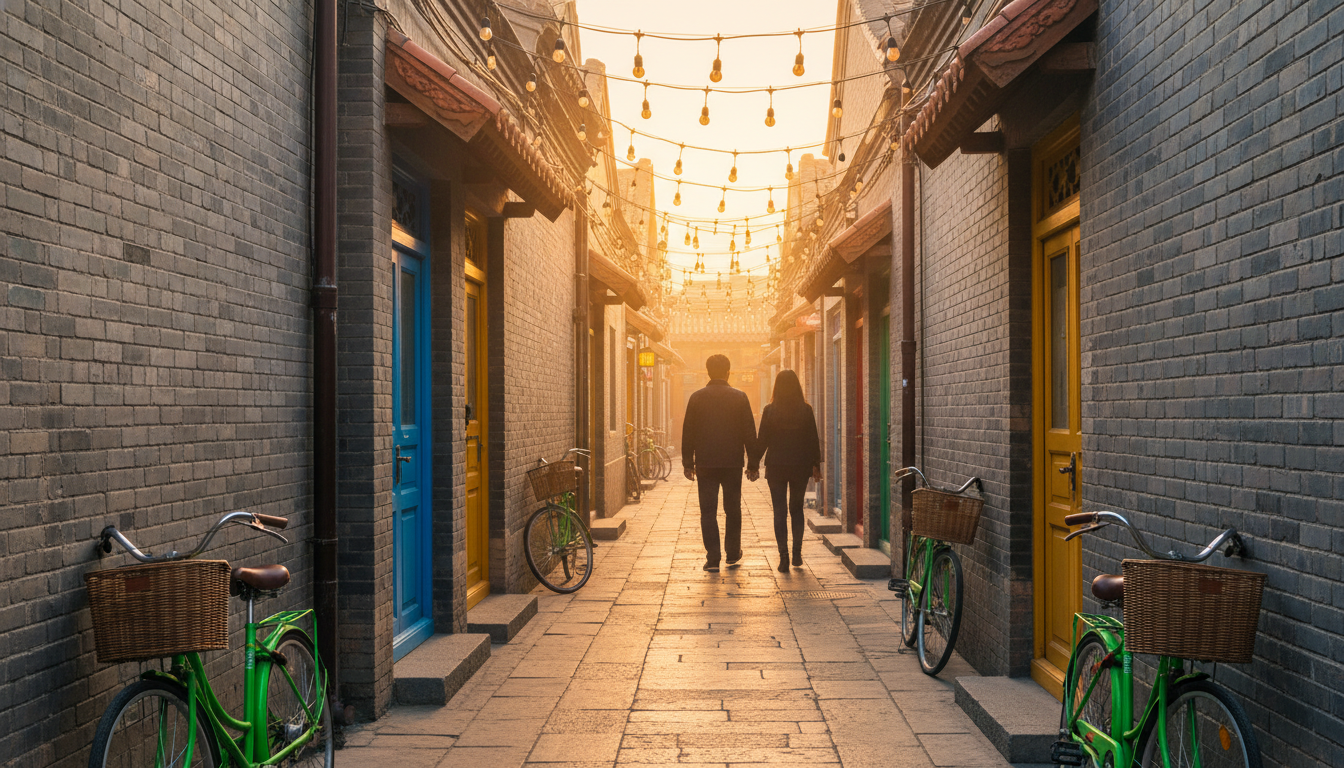 Narrow Beijing hutong at golden hour, string lights beginning to glow, a couple silhouetted walking
Morning Rituals That Feel Local
I'm convinced the best part of home exchange is mornings.
In a hotel, you wake up, go to the breakfast buffet, eat the same scrambled eggs you'd eat anywhere. In a Beijing home, you wake up and you're there. You hear the neighborhood waking up—the clatter of bike bells, the call of the breakfast vendors, someone practicing erhu in a courtyard nearby.
Our host had left us a note: "For breakfast, turn right out the door, walk 30 seconds, look for the blue cart. Order jianbing with extra cilantro and egg. Trust me."
We did. Every single morning.
That jianbing vendor—her name was Auntie Liu, we learned eventually—made the best breakfast crepes I've ever had. ¥8 each (about $1.10 USD). By day four, she'd start making ours when she saw us coming.
You can't buy that. You can only live it.
Planning Your Days: A Couples Home Exchange Itinerary
I'm not going to give you a rigid day-by-day schedule because honestly, the whole point of home exchange is flexibility. But here's how I'd structure a week in Beijing with a partner, based on what actually worked for us.
Slow Mornings, Active Afternoons
Beijing's major sites are exhausting. The Forbidden City alone can take 4-5 hours if you're doing it properly. The Great Wall is a full-day commitment. Summer Palace, Temple of Heaven, the hutong walking tours—they all require energy.
So we'd sleep in. Make coffee in our borrowed kitchen. Eat our jianbing slowly. Then hit one major site in the afternoon when we were actually awake and functional.
This rhythm—lazy morning, one big thing, relaxed evening—kept us from burning out and actually enjoying each other's company instead of just grinding through a checklist.
The Great Wall: Do It Right
Every couple visiting Beijing goes to the Great Wall. The question is which section and how.
Badaling is the most famous, most restored, most crowded. Skip it.
Mutianyu is my recommendation for couples: well-restored enough to be safe, uncrowded enough to actually have moments alone, and there's a cable car so you're not exhausted before you even start walking. The views are staggering. We went on a misty morning and it felt like walking through a Chinese painting.
Jinshanling is for the adventurous—partially ruined, genuinely remote, requires hiking. Incredibly romantic if you're both into that kind of thing. We did a sunrise hike there and had an entire watchtower to ourselves.
Pro tip: pack a picnic from your home exchange kitchen. Finding a quiet spot on the Wall, spreading out some food, watching the mountains roll into the distance—that's a date.
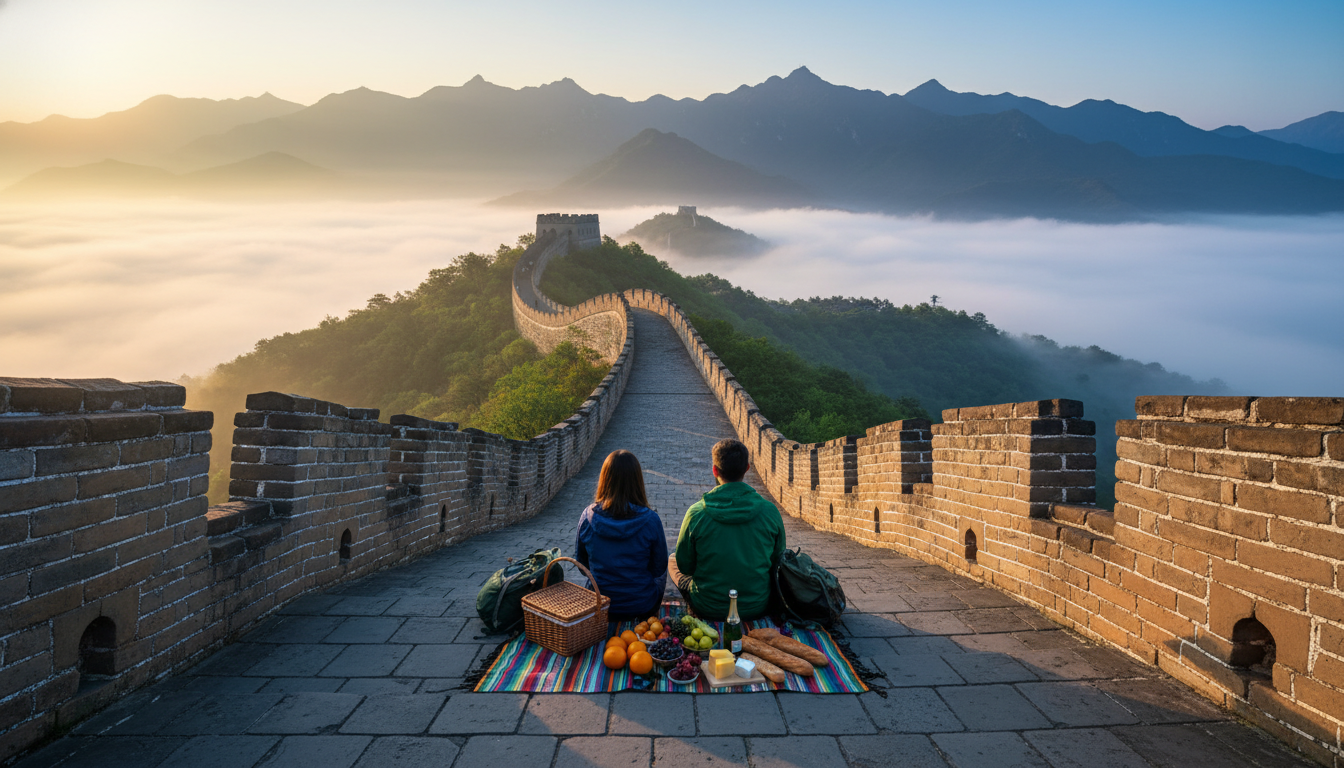 Two people sitting on the Great Wall at Mutianyu, morning mist in the valley below, picnic spread be
Evening Date Spots the Locals Know
Our host's hand-drawn map led us to some genuinely special places.
Dali Courtyard in Gulou is housed in a traditional courtyard home—you eat Yunnan cuisine in what feels like someone's living room. The mushroom hot pot is unreal. Expect to pay around ¥300-400 ($40-55 USD) for two with drinks.
Jing-A Brewing in the 1949 complex does craft beer in a converted factory space. Not traditionally romantic, but we loved it—industrial vibes, excellent IPAs, a crowd that's half expat, half young Beijing creative types.
The Hidden House (you'll need to ask locals for the exact location—it changes) does cocktails in a secret speakeasy setup. When we went, it was behind an unmarked door in a hutong. The bartender made us drinks based on our "mood." Cheesy concept, excellent execution.
None of these are in guidebooks. All of them came from our host or people we met in the neighborhood. That's the home exchange advantage.
What to Know Before Your Beijing Couples Home Exchange
Some practical stuff, because romance doesn't help when you can't figure out the wifi.
Language and Communication
Mandarin is essential for anything beyond tourist zones. Download Pleco (dictionary app) and learn basic phrases. "Zhège" (this one) while pointing will get you through most food situations. "Duōshao qián" (how much?) is crucial for markets.
Your home exchange host will likely speak English—most SwappaHome members do—but their neighbors won't. This is actually wonderful. We had entire conversations through gestures and phone translation apps with Auntie Liu. By the end of the week, she was teaching my partner how to flip the jianbing properly.
The VPN Situation
Google, Instagram, WhatsApp—none of them work in China without a VPN. Download one before you arrive (ExpressVPN and NordVPN both work well). Your host might have recommendations for local alternatives too.
This actually became a bonding thing for us. Without constant social media access, we were more present with each other. Silver linings.
Getting Around as a Couple
The Beijing subway is excellent, cheap (¥3-7 per ride depending on distance), and air-conditioned. Get a Yikatong transit card—you can share one between two people.
But honestly? The best way to see Beijing as a couple is walking and biking. The shared bike systems (Mobike, Ofo) are everywhere. Scanning a bike, riding through hutongs together, stopping whenever something catches your eye—that's the move.
Money Matters
China runs on WeChat Pay and Alipay. As tourists, you can now link international credit cards to these apps (this is new—it used to be impossible). Do this before you arrive. Cash is increasingly useless in Beijing; many places literally won't accept it.
The exchange rate hovers around ¥7.2 to $1 USD as I write this. A nice dinner for two runs ¥200-400 ($28-55 USD). Street food is absurdly cheap—you can eat breakfast for ¥10-15 ($1.40-2 USD) each.
Making Your Home Exchange Work Smoothly
A few things I've learned about being a good guest, specifically in Beijing.
Communicate with your host about arrival logistics. Beijing traffic is legendary—if you're coming from the airport, it can take anywhere from 40 minutes to 2.5 hours to reach the city center depending on time of day. Coordinate key handoff accordingly.
Ask about neighborhood quirks. Our host warned us that the hot water heater needed 20 minutes to warm up, that the courtyard door stuck in humid weather, that the upstairs neighbor practiced violin at 7 AM (actually charming once we expected it). These details make the difference between frustration and "ah, this is just how life works here."
Leave the place better than you found it. This matters everywhere, but especially in Beijing where hosts are often sharing genuinely historic homes. We left Auntie Liu's jianbing recipe (as best we could transcribe it) and a bottle of wine from that hutong wine bar. Our host messaged us months later saying she'd never known about that bar despite living there for years.
That's the home exchange ecosystem working: you become part of the neighborhood, even briefly, and you leave something behind.
The Real Romance of Beijing Home Exchange
I've been thinking about why that Beijing trip stands out among all the places my partner and I have traveled together.
It wasn't the sites—though the Forbidden City at sunset genuinely took my breath away. It wasn't the food—though yes, I still dream about those dumplings.
It was the intimacy of ordinary life.
Waking up together in a space that felt like ours. Developing little routines—the jianbing run, the evening walk, the nightcap on the rooftop. Getting to know a neighborhood well enough that the fruit vendor started saving us the good lychees.
That's what home exchange offers couples that hotels simply can't: the chance to play house in a place that isn't home, to build temporary rituals together, to experience a city not as tourists but as—however briefly—residents.
Beijing rewards this approach more than most cities. Its neighborhoods have such distinct personalities. Its local life is so rich and accessible if you're actually in it. The contrast between ancient and modern creates endless conversation fodder. And the food—god, the food—is best discovered through wandering, not restaurant reservations.
If you're considering Beijing for your next couple's trip, I'd genuinely encourage you to try home exchange. SwappaHome has solid listings in all the neighborhoods I've mentioned—I've browsed them recently, and there are some beautiful hutong properties available. The 7 free credits for new members means you could do a substantial Beijing trip without the accommodation costs that usually make this city expensive.
But more than the savings: it's about the experience. The courtyard mornings. The neighborhood discoveries. The feeling of having a temporary life together in one of the world's most fascinating cities.
That's worth more than any hotel upgrade.
Frequently Asked Questions
Is home exchange in Beijing safe for couples?
Beijing is one of the safest major cities globally, with very low violent crime rates. SwappaHome's verification and review system adds accountability—you can see previous guest experiences before booking. I'd recommend getting your own travel insurance for peace of mind, but we never felt unsafe during our stay.
How much can couples save with Beijing home exchange versus hotels?
The savings are real. Comparable hutong boutique hotels run ¥800-1,500 ($110-210 USD) per night. Through SwappaHome, you're spending 1 credit per night regardless of property type. For a 7-night trip, that's potentially $770-1,470 in accommodation savings—enough to upgrade every dinner or add extra experiences.
What's the best time of year for couples to visit Beijing?
Autumn (September-October) is ideal: clear skies, comfortable temperatures around 15-25°C (59-77°F), and beautiful foliage in the parks. Spring (April-May) is second best. Summer gets hot and humid, winter gets cold—though both have fewer tourists if that's your thing.
Do Beijing home exchange hosts provide couple-friendly amenities?
Most hosts accommodate couples well—queen or king beds, romantic touches like rooftop access or courtyard gardens. Always message hosts beforehand to confirm bed configuration and ask about special features. Many hosts leave date night recommendations and romantic spot suggestions in their welcome guides.
How far in advance should couples book Beijing home exchanges?
Book 3-4 months ahead for peak seasons (April-May, September-October), especially for desirable hutong properties in Dongcheng. Off-season offers more flexibility—4-6 weeks is usually sufficient. Popular listings get multiple requests, so earlier is always better for choice properties.

Published by
SwappaHome
SwappaHome Editorial Team
Home Exchange & Slow Travel Editorial
The SwappaHome Editorial Team brings together travel research, home-exchange community insights, and platform data to produce practical guides for first-time and experienced home swappers. Every article cites real platforms, current market rates, and verifiable city-level facts so readers can make informed decisions without guessing.
Ready to try home swapping?
Join SwappaHome and start traveling by exchanging homes. Get 7 free credits when you sign up!
Related articles
Bachelor and Bachelorette Parties in Singapore: The Complete Home Swap Group Guide for 2026
Planning a bachelor or bachelorette party in Singapore? Discover how home swapping lets groups of 6-12 stay together in luxury condos, saving thousands while partying in Marina Bay.

Cycling in Lisbon: 7 Home Swap Bike Tour Itineraries for Every Rider
Discover the best cycling routes in Lisbon with these home swap bike tour itineraries—from waterfront paths to hilltop adventures, all starting from your borrowed home.

Graduation Trip to Barcelona: How Home Swapping Gives New Graduates the Ultimate Celebration
Planning a graduation trip to Barcelona? Discover how home swapping lets new graduates explore Spain's most vibrant city without the hostel crowds or hotel costs.