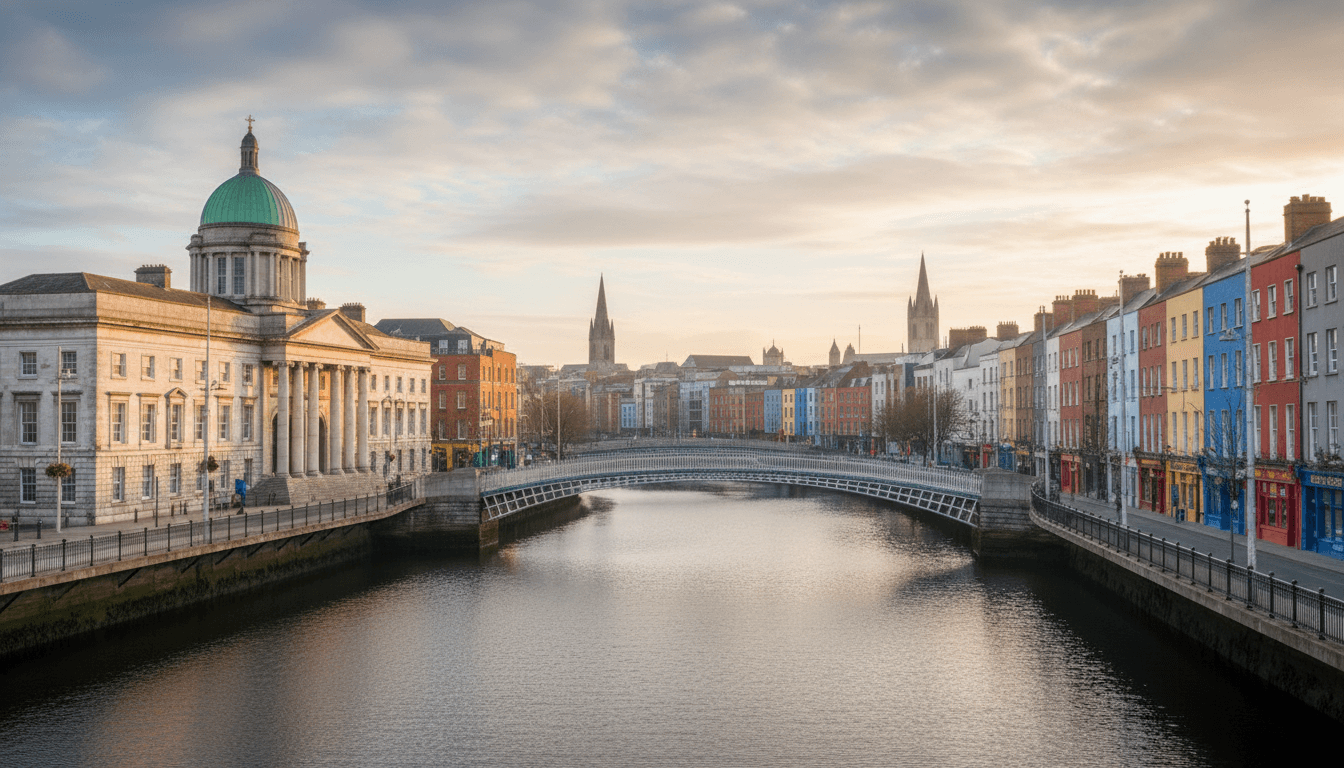
Dublin Architecture Guide: A Home Swap Traveler's Building Tour Through 1,000 Years of History

SwappaHome Editorial Team
Home Exchange & Slow Travel Editorial
Discover Dublin's architectural treasures from Georgian townhouses to Viking ruins. This home swap traveler's guide reveals hidden gems, walking routes, and insider tips for exploring Ireland's capital.
You're standing on Henrietta Street at 7:30 in the morning, fog lifting off the Liffey somewhere behind you, and the Georgian townhouses lining both sides are so perfectly preserved that you half-expect a horse-drawn carriage to clatter past. This is Dublin architecture at its most theatrical—four-story red-brick facades with their distinctive Dublin doors painted in racing green, Prussian blue, and that particular shade of Georgian red that seems to exist nowhere else in the world. Home swap travelers have something hotel guests don't: time to notice how the morning light catches the original fanlight windows, how the wrought-iron balconies still bear the craftsmen's marks from 1748.
This Dublin architecture guide isn't about rushing through a checklist of famous buildings. It's about understanding why Dublin looks the way it does—the Viking foundations beneath your feet, the Georgian ambition that transformed muddy streets into Europe's second-largest city, the Victorian industrial confidence, and the contemporary glass-and-steel statements rising along the Docklands. When you're staying in someone's actual home in Portobello or Stoneybatter, you're not just visiting Dublin's architecture. You're living inside it.
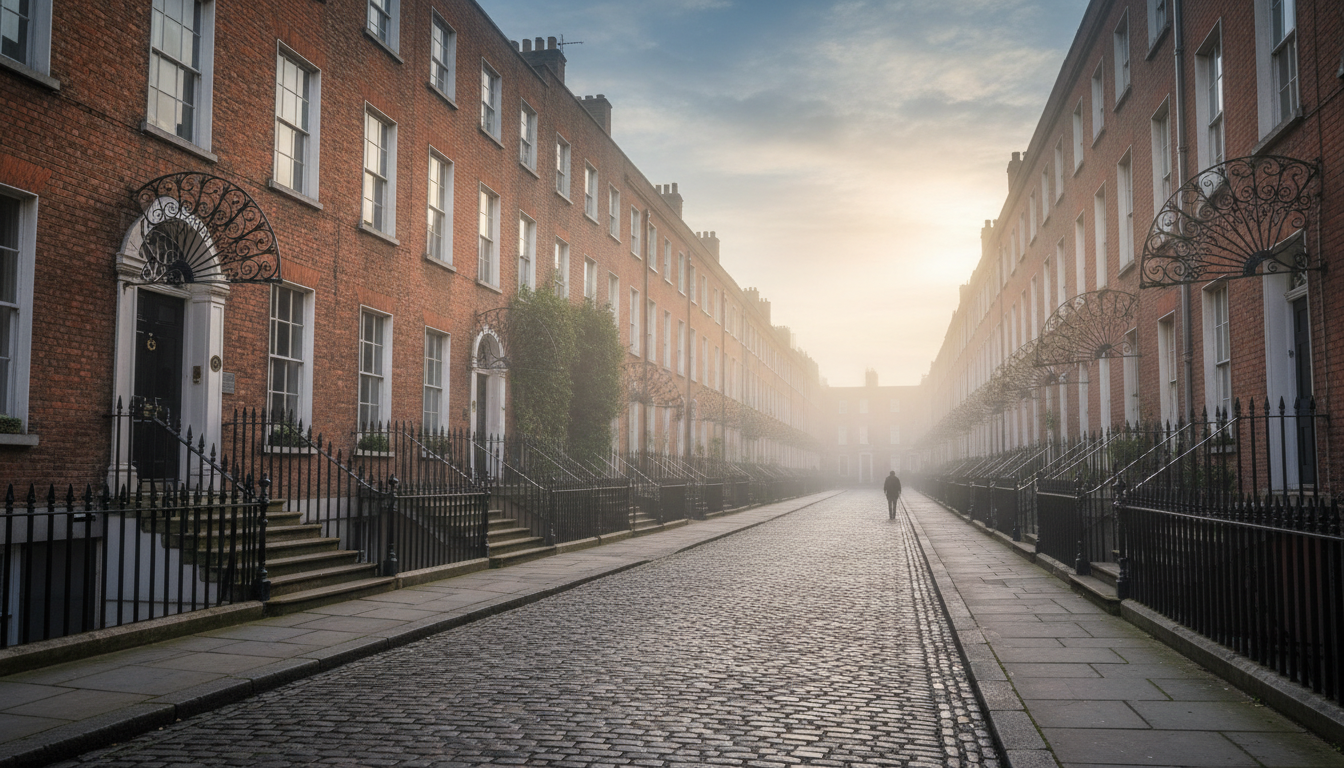 Early morning view of Henrietta Streets Georgian townhouses with original fanlights and iron railing
Why Dublin's Architecture Rewards Slow Travel
Here's what most visitors miss: Dublin is a city of layers, and you need time to peel them back. The typical tourist hits Trinity College, snaps the Ha'penny Bridge, maybe wanders through Temple Bar, and calls it done. But Dublin's architectural story is written in details that reveal themselves over days, not hours.
The city's compact medieval core—roughly the area bounded by Christ Church Cathedral, Dublin Castle, and the River Liffey—sits directly atop Viking Dublin, founded in 841 AD. Walk down Fishamble Street today and you're tracing the exact path that Sitric Silkenbeard's traders walked over a thousand years ago. The street width hasn't changed. The curve follows the original Viking settlement's boundary.
Home swap travelers staying in Dublin typically spend 5-10 nights in the city, compared to the 2.3-night average for hotel guests. That difference transforms how you experience the built environment. You start noticing that the door knockers on Fitzwilliam Square each have slightly different lion's head designs—because Georgian craftsmen competed for commissions. You realize that the red brick on Merrion Square is a deeper, more expensive shade than the brick on the north side of the Liffey, reflecting the historic wealth divide that still echoes through Dublin's property market.
SwappaHome members who've stayed in Dublin's Georgian core often mention waking up in rooms with original ceiling plasterwork—those elaborate Adam-style medallions and cornices that would cost €15,000 to replicate today. You can't get that in a hotel. You can only get it by staying in someone's actual Georgian flat on Baggot Street or their converted coach house in Ranelagh.
The Georgian Quarter: Dublin's Architectural Crown Jewel
Dublin's Georgian architecture represents one of Europe's most intact 18th-century urban landscapes, and understanding it transforms how you see the city. The period roughly spans 1714-1830, named for the four King Georges who ruled Britain and Ireland during this era. But Dublin's Georgian story is really about ambition, speculation, and a property boom that makes modern real estate frenzies look modest.
Merrion Square and Fitzwilliam Square
Start at Merrion Square, laid out between 1762 and 1785. The square's east side features the finest surviving Georgian townhouses in Dublin, with Oscar Wilde's childhood home at Number 1 now marked by a flamboyant statue of the writer lounging on a boulder in the park. The houses here follow strict proportions dictated by the Wide Streets Commission—Ireland's first urban planning authority, established in 1757.
Notice the hierarchy built into each facade: the ground floor (called the "rustic" level) features rougher stonework and smaller windows, originally housing kitchens and servants' quarters. The first floor—the piano nobile—has the tallest windows and most elaborate interior decoration, where the family received guests. Windows shrink progressively on upper floors, following classical rules of proportion that make the buildings appear taller and more elegant than they actually are.
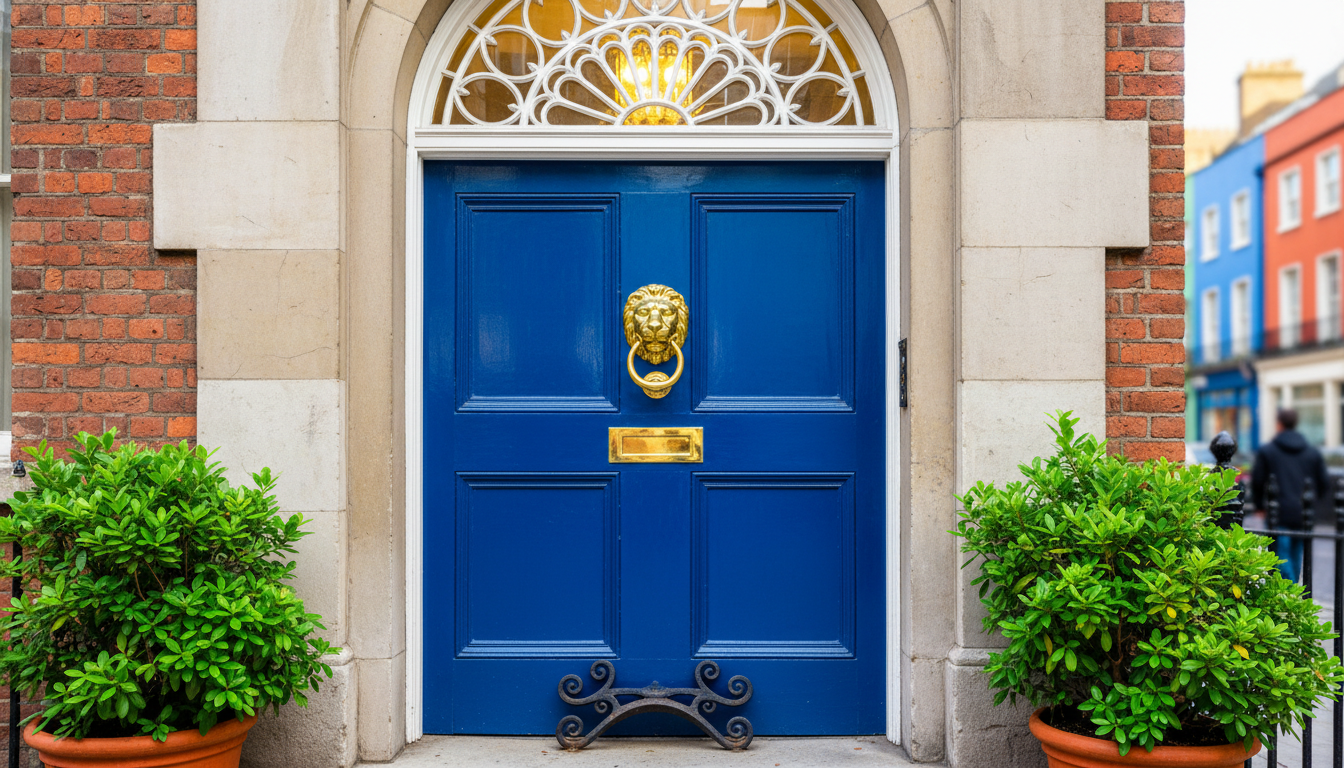 Close-up of a Georgian Dublin door on Merrion Square, showing fanlight transom window, brass door kn
Fitzwilliam Square, completed in 1825, remains Dublin's only Georgian square with a private central garden—residents still get keys. The houses here sold for £2,000-£4,000 in the 1820s (roughly €350,000-€700,000 in today's money). Current market values for these same properties run €2.5-€4.5 million, making them some of Ireland's most expensive residential real estate.
The Dublin Door Phenomenon
Those colorful doors aren't just Instagram fodder—they're a rebellion against uniformity. Georgian building regulations required consistent facade treatments, so residents expressed individuality through door colors and the elaborate fanlights above them. The fan-shaped windows served a practical purpose too: in an era before electricity, they admitted light into deep entrance hallways.
The best fanlight collection in Dublin lines Henrietta Street, where you'll find original 1740s examples with delicate lead tracery that modern craftsmen struggle to replicate. Number 14 Henrietta Street now operates as a museum dedicated to tenement life—a reminder that these grand houses, after Georgian families abandoned the north side for more fashionable addresses, became overcrowded tenements housing up to 100 people per building well into the 20th century.
A Georgian Walking Route
This 90-minute walk covers Dublin's essential Georgian architecture:
Start: Parnell Square (north side) – Dublin's first Georgian square, now housing the Dublin Writers Museum in a restored townhouse
Walk south on: O'Connell Street – largely rebuilt after the 1916 Rising, but the General Post Office (1818) survives with its iconic Ionic portico
Cross: O'Connell Bridge – note the equal width and length, one of Europe's few square bridges
Turn left onto: Westmoreland Street, then right onto College Green
Stop at: Trinity College's Front Square – the Rubrics building (1700) is Dublin's oldest surviving residential building
Continue to: Nassau Street, left onto Merrion Square West
Circle: Merrion Square – allow 20 minutes to appreciate the doorways
End at: Fitzwilliam Street Lower – the longest continuous Georgian streetscape in Europe
Medieval Dublin: Vikings, Normans, and the City's Bones
Before the Georgian developers transformed Dublin, the city was a cramped medieval settlement centered on two cathedrals and a castle. This older Dublin survives in fragments—but knowing where to look reveals a thousand years of continuous occupation.
Christ Church Cathedral and the Viking Foundations
Christ Church Cathedral, founded in 1028 by Sitric Silkenbeard (the Viking King of Dublin), stands on the highest ground in the old city. The current structure dates mostly from a controversial 1870s restoration, but the Romanesque south doorway and the massive crypt—the largest medieval crypt in Britain or Ireland—survive from the 12th century.
The crypt extends the full length of the cathedral and contains some genuinely strange artifacts: a mummified cat and rat found trapped in an organ pipe, stocks and a punishment chair, and the heart shrine of St. Laurence O'Toole, Dublin's patron saint. Entry costs €8 for adults, and the crypt alone justifies the price.
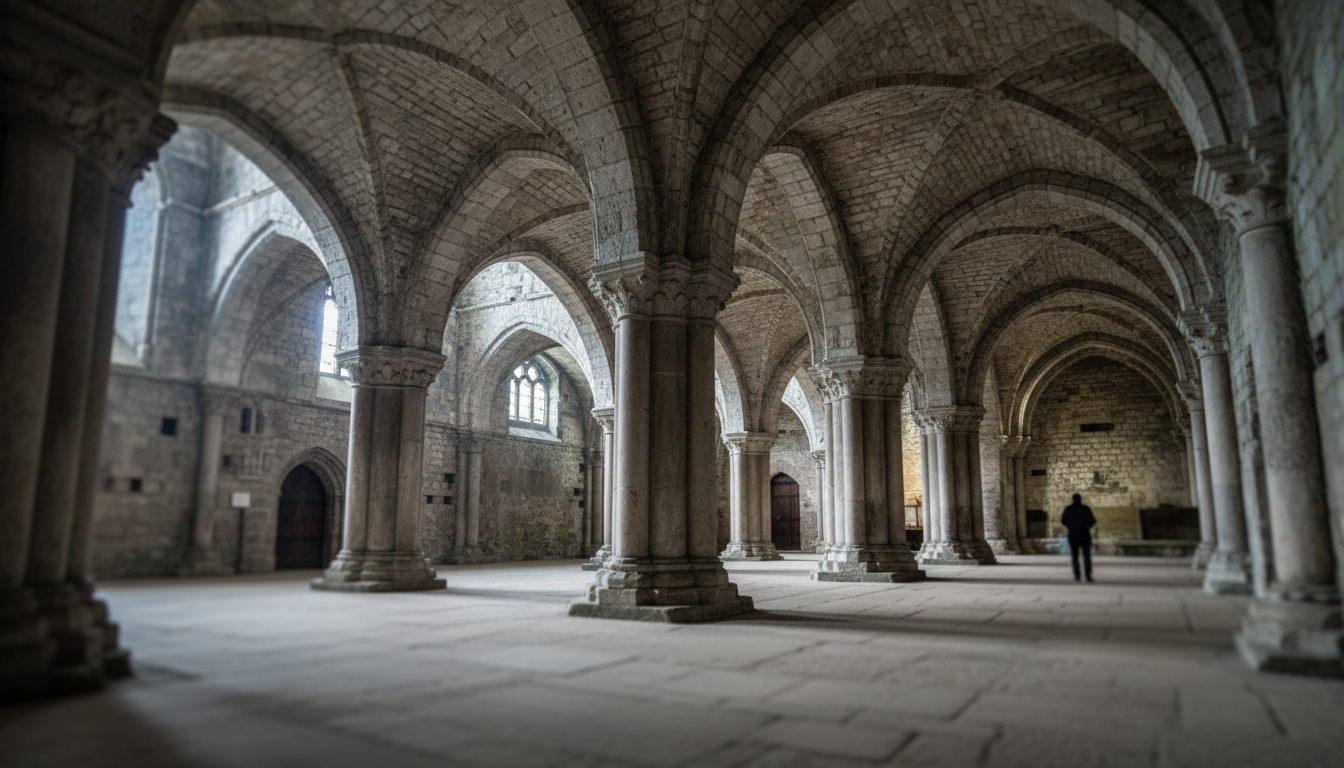 Interior of Christ Church Cathedral crypt showing Romanesque stone arches and medieval columns with
Dublin Castle: 800 Years of Power
Dublin Castle represents the seat of British rule in Ireland for over 700 years, though precious little medieval fabric survives. The Record Tower—a 13th-century Norman fortification—is the only substantial medieval structure remaining. The rest dates from Georgian and Victorian rebuilding after fires.
What makes Dublin Castle architecturally fascinating is the Chester Beatty Library, housed in the castle's clock tower building. The library itself is free to enter and contains one of the world's finest collections of Islamic manuscripts, Chinese jade books, and early biblical papyri. The building's interior renovation by Dublin architects won the European Museum of the Year award in 2002.
St. Patrick's Cathedral and the Liberties
Dublin's other medieval cathedral, St. Patrick's, sits outside the original city walls in an area called the Liberties—so named because it lay beyond the jurisdiction of Dublin's medieval corporation. The cathedral's current form dates largely from a 19th-century restoration funded by Benjamin Guinness (of the brewing family), but the Lady Chapel and the 43-meter spire retain medieval stonework.
The Liberties neighborhood surrounding St. Patrick's offers some of Dublin's most authentic working-class architecture: narrow streets of Victorian terraced houses, former industrial buildings converted to apartments, and the Iveagh Trust housing—philanthropic workers' housing built by the Guinness family in 1904 that remains in use today.
Victorian and Edwardian Dublin: Industrial Confidence
Dublin's Victorian architecture often gets overlooked in favor of Georgian glamour, but the period 1840-1914 produced some of the city's most exuberant buildings. This was the era of railway stations, department stores, and public institutions designed to impress.
Heuston Station and the Railway Age
Heuston Station (originally Kingsbridge Station, renamed after the 1916 Rising leader Seán Heuston) exemplifies Victorian railway architecture at its most confident. Designed by Sancton Wood and completed in 1846, the station's facade features a colonnade of Corinthian columns, elaborate carved stonework, and twin campanile towers that make it look more like a Renaissance palace than a train station.
The interior retains original cast-iron roof trusses and decorative tilework. Trains to Cork, Galway, and Limerick depart from here, so you'll likely pass through if you're exploring beyond Dublin.
The Natural History Museum: A Victorian Time Capsule
Dubliners call it "the Dead Zoo," and the Natural History Museum on Merrion Street hasn't changed significantly since opening in 1857. The building itself—designed by Frederick Clarendon—is a restrained Italianate structure, but the interior represents the finest surviving example of a Victorian-era natural history collection, complete with original wooden display cases, whale skeletons suspended from the ceiling, and taxidermied animals arranged according to 19th-century classification systems.
Entry is free. The building's lack of modernization is both its charm and its challenge—accessibility is limited, and the upper galleries remain closed for structural repairs. But standing in the ground floor gallery, surrounded by glass cases that haven't moved since the 1850s, offers a genuinely rare experience.
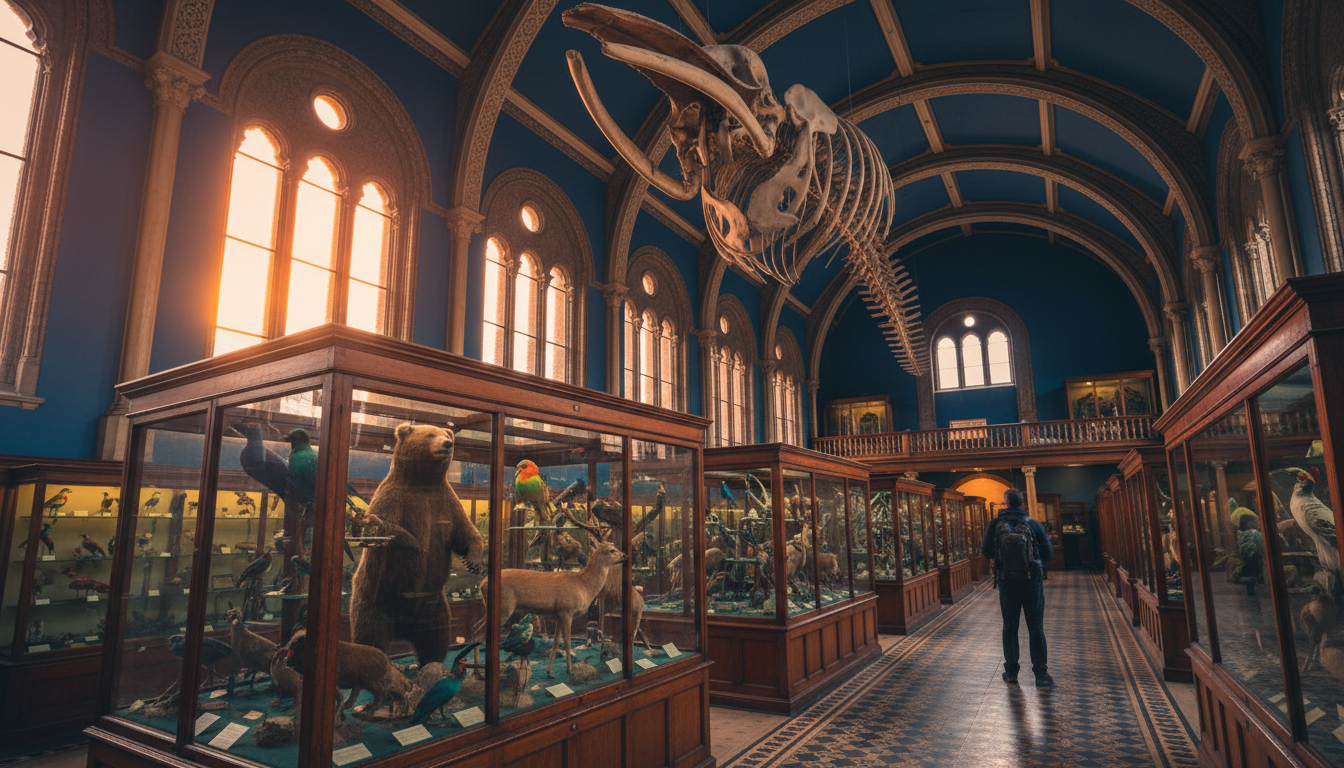 Interior of Dublins Natural History Museum showing Victorian display cases with taxidermied animals
The Powerscourt Townhouse: Georgian Bones, Victorian Commerce
Powerscourt Townhouse on South William Street demonstrates how Dublin's Georgian architecture adapted to Victorian commercial pressures. Built in 1774 as a private mansion for Viscount Powerscourt, the building became a department store in 1981 and now houses shops, cafés, and a design center.
The central courtyard—originally an open carriage yard—was roofed with a glass atrium, creating one of Dublin's most pleasant indoor spaces. The original Georgian staircase survives, as do ceiling plasterworks by Michael Stapleton, one of Dublin's most celebrated 18th-century craftsmen. Coffee at one of the courtyard cafés costs €3.50-€5, and you can spend an hour just studying the architectural details.
Contemporary Dublin: The Docklands and Beyond
Dublin's 21st-century architecture concentrates along the former docklands, where derelict warehouses and shipping infrastructure have given way to tech company headquarters, apartment towers, and cultural institutions. The transformation—ongoing since the late 1990s—represents Ireland's largest urban regeneration project.
The Samuel Beckett Bridge and Docklands Walking Route
Santiago Calatrava's Samuel Beckett Bridge (2009) has become Dublin's contemporary architectural icon. The cable-stayed bridge, designed to evoke a harp lying on its side (Ireland's national symbol), rotates 90 degrees to allow ships to pass—though this rarely happens now that commercial shipping has moved downstream.
A Docklands architecture walk takes about 75 minutes:
Start: Samuel Beckett Bridge – best photographed from the south bank at sunset
Walk east along: Sir John Rogerson's Quay – passing the Marker Hotel (2013), with its distinctive green glass facade
Cross: Sean O'Casey Bridge (2005) – another Calatrava-influenced design
Continue to: Grand Canal Square – designed by Martha Schwartz, featuring red "reeds" that light up at night and the Bord Gáis Energy Theatre (Daniel Libeskind, 2010)
Walk north to: The Convention Centre Dublin (Kevin Roche, 2010) – the tilted glass cylinder visible from much of the city
End at: The 3Arena (originally The Point Depot) – a Victorian railway terminus converted to a concert venue
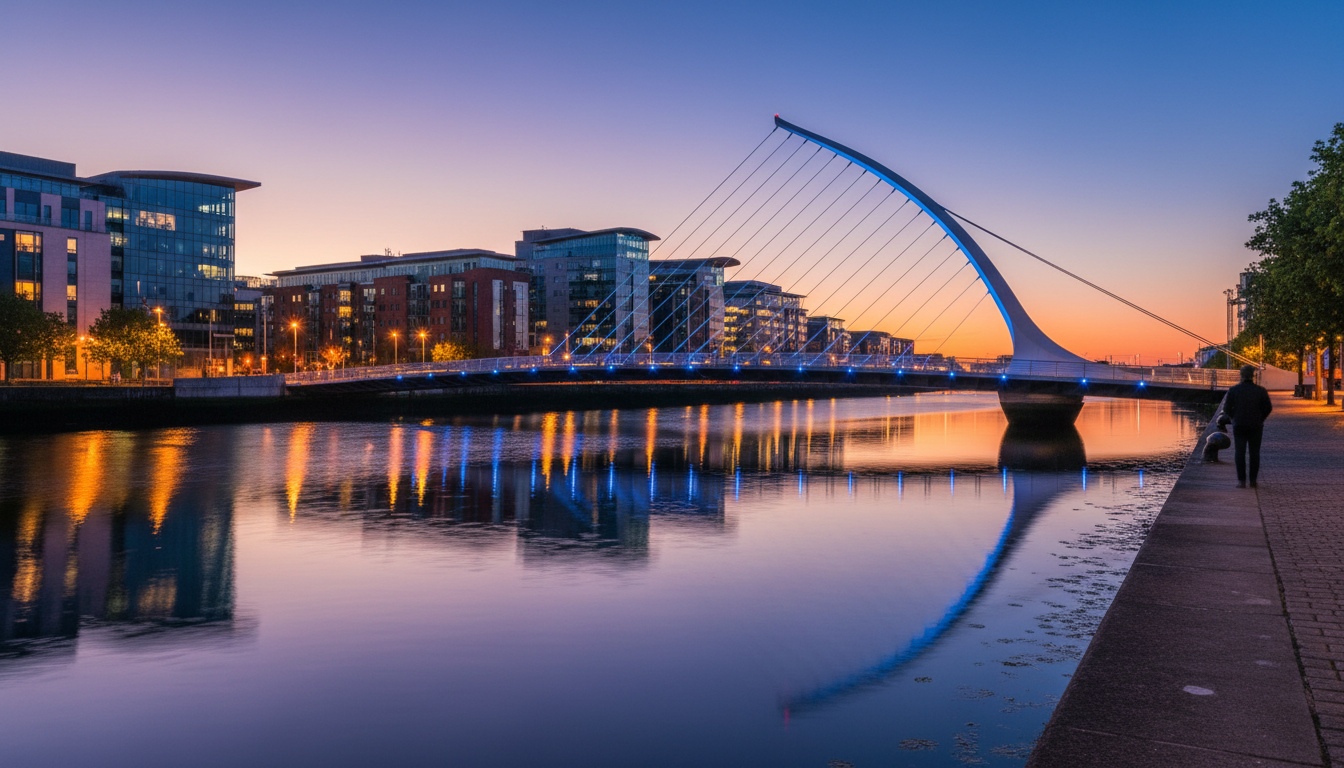 Samuel Beckett Bridge at dusk with cable stays illuminated, reflecting in the River Liffey with mode
Tech Campus Architecture
Dublin's status as European headquarters for Google, Facebook, and other tech giants has produced corporate campuses with public-facing architecture worth seeing. The Google Docks building on Barrow Street features a landscaped public plaza, while the Facebook (Meta) campus on Grand Canal Square incorporates a publicly accessible through-route with commissioned artworks.
These aren't tourist destinations per se, but if you're staying in a home swap in the Docklands or Ringsend area, the corporate architecture becomes part of your daily landscape—a sharp contrast to the Georgian streets a kilometer west.
Neighborhood Architecture: Where Home Swaps Meet History
The joy of home swapping in Dublin is staying in neighborhoods tourists rarely see—places where architectural history isn't preserved behind museum ropes but lived in daily.
Portobello: Victorian Village Atmosphere
Portobello, south of the Grand Canal, developed in the Victorian era as a Jewish neighborhood (Dublin's "Little Jerusalem") and retains its distinctive character. The redbrick terraced houses along South Circular Road and Lennox Street date from the 1880s-1900s and feature bay windows, decorative brickwork, and small front gardens that distinguish them from Georgian uniformity.
The area's architectural highlight is the former Portobello House (now a hotel), a Georgian building that served as the terminus of the Grand Canal passenger service until railways made it obsolete. The canal basin itself—now a pleasant park—offers views of the Victorian lock-keeper's cottage and original stone quays.
Home swaps in Portobello typically occupy these Victorian terraces, meaning you're staying in buildings designed for middle-class families rather than aristocratic display. Ceiling heights are lower than Georgian houses, rooms are more practically sized, and original features—fireplaces, cornices, wooden floors—survive because they were built to last rather than to impress.
Stoneybatter: Working-Class Georgian
Stoneybatter, northwest of the city center, contains Dublin's largest concentration of artisan dwellings—small Georgian houses built for skilled workers rather than the wealthy. The houses on streets like Arbour Hill and Prussia Street follow Georgian proportions but at a compressed scale: two stories instead of four, two windows wide instead of three, and plain facades without the elaborate doorways of Merrion Square.
The neighborhood is gentrifying rapidly—house prices have roughly doubled since 2015—but retains a village atmosphere with independent cafés, vintage shops, and the Cobblestone pub, famous for traditional Irish music sessions.
Ranelagh: Edwardian Suburbia
Ranelagh developed in the Edwardian era (1901-1910) as a middle-class suburb connected to the city center by tram. The architecture reflects this status: semi-detached red-brick houses with front gardens, bay windows, and decorative plasterwork more elaborate than Victorian equivalents.
The village center along Ranelagh Road preserves its Edwardian commercial streetscape—two-story shops with living quarters above, original shopfronts with leaded glass, and the Stella Cinema (1923), one of Dublin's few surviving original picture palaces, now restored and operating as a boutique cinema.
Practical Tips for Architecture-Focused Visits
Best Times for Photography
Dublin's latitude (53°N) means dramatic seasonal variation in light. Summer evenings offer golden hour until 10 PM—perfect for photographing the Georgian squares when they're empty of crowds. Winter brings low-angle light that rakes across facades, revealing textures invisible in summer, but sunset arrives by 4:30 PM.
The Docklands photograph best at dusk when building lights activate and the water reflects the Samuel Beckett Bridge's cables. Merrion Square and Fitzwilliam Square are most photogenic in early morning before parked cars fill the streets.
Architecture Tours and Resources
The Irish Architecture Foundation offers walking tours (€15-€20) led by practicing architects who can explain structural details and historical context that guidebooks miss. Their Open House Dublin event each October opens private buildings normally closed to the public—Georgian townhouses, contemporary offices, and historic institutions.
The Dublin Civic Trust runs occasional tours of Henrietta Street's restored Georgian interiors, focusing on construction techniques and social history. Booking is essential; tours fill weeks in advance.
What Home Swap Stays Offer Architecture Enthusiasts
Staying in a Dublin home swap means experiencing architecture from the inside. SwappaHome members listing properties in Dublin often highlight original features—working fireplaces, Victorian tiling, Georgian plasterwork—that represent the city's architectural heritage in daily use.
The platform's credit system (one credit per night, regardless of property type) means a week in a Georgian flat on Baggot Street costs the same as a week in a Docklands apartment—seven credits either way. New members receive seven free credits to start, enough for a week's stay to explore Dublin's architectural diversity without accommodation costs.
Hidden Architectural Gems Most Visitors Miss
The Iveagh Gardens
This Victorian park, hidden behind the National Concert Hall on Harcourt Street, contains architectural follies including a rustic grotto, a cascade fountain, and a rosarium designed by Ninian Niven in 1865. The gardens are rarely crowded because they're poorly signposted—enter through the gate on Clonmel Street.
Marsh's Library
Ireland's oldest public library (1701) occupies a building designed by Sir William Robinson, who also designed the Royal Hospital Kilmainham. The interior features original dark oak bookcases, wire cages where readers were locked in with rare books to prevent theft, and a collection of 25,000 volumes from the 16th-18th centuries. Entry costs €5.
The Casino at Marino
Despite the name, this isn't a gambling house—"casino" means "little house" in Italian. Built in the 1750s-1770s for Lord Charlemont, the Casino is a neoclassical garden pavilion considered one of the finest 18th-century buildings in Europe. The exterior appears to be a single-room temple, but the interior contains 16 rooms arranged over three floors, with ingenious hidden features: chimneys disguised as urns, drainage through hollow columns, and windows concealed behind stone panels.
The Casino is located 3 km north of the city center in Marino—take the 123 bus from O'Connell Street. Entry costs €5, and tours run hourly.
Frequently Asked Questions
What is the best area to stay for Dublin architecture tours?
The Georgian core—particularly around Merrion Square, Baggot Street, and Fitzwilliam Square—puts you within walking distance of Dublin's finest 18th-century architecture. Home swaps in this area often occupy original Georgian buildings with period features intact. The Portobello and Ranelagh neighborhoods offer Victorian and Edwardian alternatives at slightly lower price points while remaining within 15 minutes' walk of the city center.
How long do you need to explore Dublin's architecture properly?
A thorough exploration of Dublin's architectural highlights requires 4-5 days minimum. Day one covers the Georgian squares and Trinity College; day two focuses on medieval Dublin including both cathedrals and Dublin Castle; day three explores the Docklands contemporary architecture; and days four and five allow for neighborhood walks in Stoneybatter, Portobello, and excursions to outlying sites like the Casino at Marino. Home swap stays averaging 5-10 nights provide ideal pacing.
Are Dublin's Georgian houses open to the public?
Most Georgian townhouses remain private residences or offices, but several offer public access. Number 29 Fitzwilliam Street Lower operates as a Georgian house museum (€8 entry). The Henrietta Street museum documents tenement life in a restored Georgian building (€9 entry). During Open House Dublin each October, dozens of private Georgian interiors open for free tours—check the Irish Architecture Foundation website for dates and booking.
Is Dublin good for architectural photography?
Dublin offers excellent architectural photography opportunities, particularly during shoulder seasons (April-May, September-October) when light quality is optimal and tourist crowds are manageable. The Georgian squares photograph best in early morning before cars fill the streets. The Docklands are most photogenic at dusk. Winter's low-angle light reveals facade textures invisible in summer, though shorter days limit shooting time. No permits are required for street photography.
Can you do a self-guided Dublin architecture walking tour?
Absolutely. The Georgian walking route outlined in this guide covers essential 18th-century architecture in 90 minutes. The Docklands contemporary route takes 75 minutes. Both routes are flat and accessible, following public streets without entry fees. For deeper understanding, the Irish Architecture Foundation's guidebook "Dublin: A Guide to Recent Architecture" (€15, available at Hodges Figgis bookshop on Dawson Street) provides detailed commentary on post-1990 buildings.

Published by
SwappaHome
SwappaHome Editorial Team
Home Exchange & Slow Travel Editorial
The SwappaHome Editorial Team brings together travel research, home-exchange community insights, and platform data to produce practical guides for first-time and experienced home swappers. Every article cites real platforms, current market rates, and verifiable city-level facts so readers can make informed decisions without guessing.
Ready to try home swapping?
Join SwappaHome and start traveling by exchanging homes. Get 7 free credits when you sign up!
Related articles
Bachelor and Bachelorette Parties in Singapore: The Complete Home Swap Group Guide for 2026
Planning a bachelor or bachelorette party in Singapore? Discover how home swapping lets groups of 6-12 stay together in luxury condos, saving thousands while partying in Marina Bay.
Cycling in Lisbon: 7 Home Swap Bike Tour Itineraries for Every Rider
Discover the best cycling routes in Lisbon with these home swap bike tour itineraries—from waterfront paths to hilltop adventures, all starting from your borrowed home.
Graduation Trip to Barcelona: How Home Swapping Gives New Graduates the Ultimate Celebration
Planning a graduation trip to Barcelona? Discover how home swapping lets new graduates explore Spain's most vibrant city without the hostel crowds or hotel costs.