
Family-Friendly Home Swapping in Paris: The Complete Planning Guide for 2026

SwappaHome Editorial Team
Home Exchange & Slow Travel Editorial
Plan the perfect family home swap in Paris with neighborhood picks, kid-friendly tips, and real cost savings. Your complete 2026 guide to Parisian family travel.
Your four-year-old stands in front of the Eiffel Tower, clutching a pain au chocolat that's leaving flaky evidence all over her jacket—and you're not stressed about checkout times or cramped hotel rooms. Behind you is a three-bedroom apartment in the 11th arrondissement with a washing machine, a full kitchen stocked with French butter, and enough space for everyone to nap at different times. This is what family-friendly home swapping in Paris actually looks like. It's why more families are ditching the €400-per-night hotel suites for something that feels less like tourism and more like temporarily living in one of the world's greatest cities.
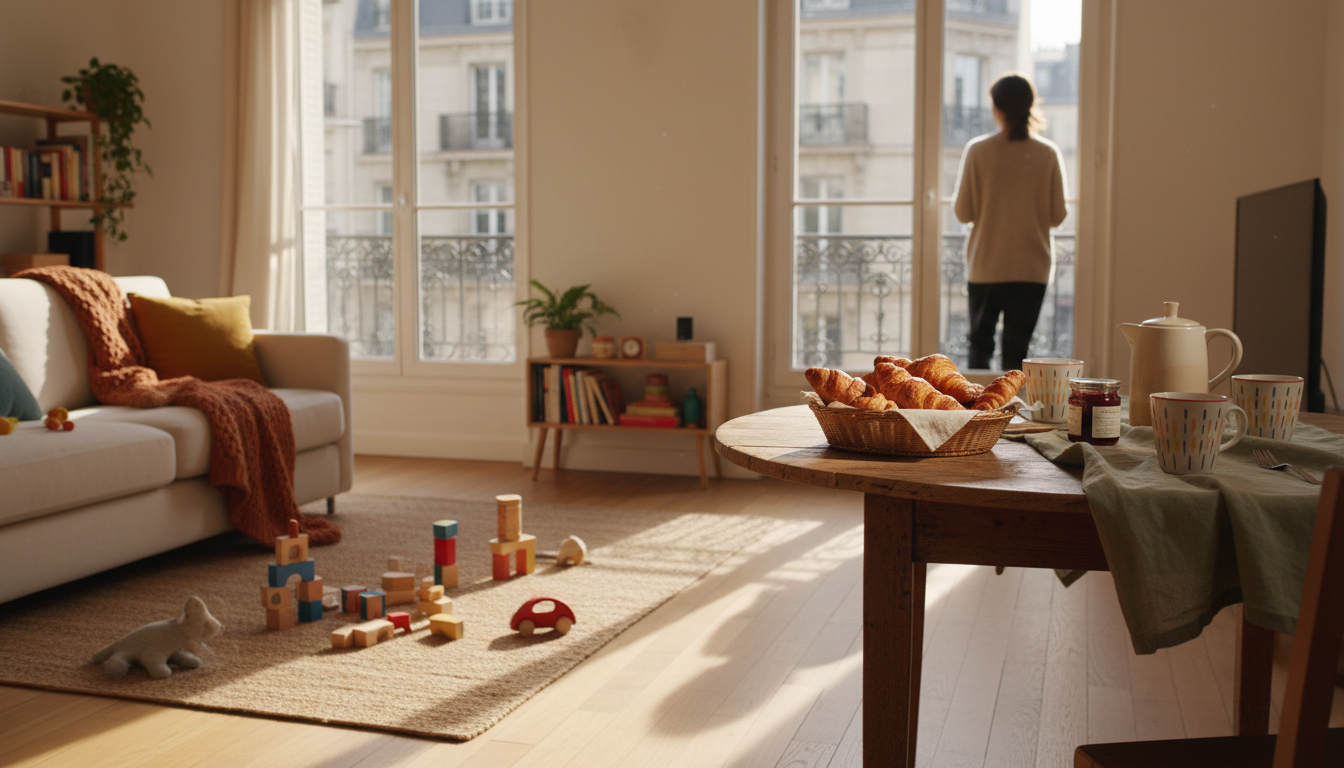 A sun-filled Parisian apartment living room with kids toys visible, large windows overlooking Haussm
Paris with children can be magical or miserable, and the difference often comes down to where you stay. A home swap gives your family something hotels fundamentally can't: space, normalcy, and the kind of local immersion that turns a trip into a story your kids will actually remember. The SwappaHome community reports that Paris consistently ranks among the top five most-requested destinations for family exchanges—and once you understand why, you'll probably want to add your home to the mix.
Why Paris Works Exceptionally Well for Family Home Swaps
Here's something most Paris travel guides won't tell you: the city is quietly one of the most family-friendly capitals in Europe, but only if you know how to access it. The public parks have free puppet shows. The boulangeries hand out broken cookie pieces to small children. The Métro is stroller-accessible on most lines (with some notorious exceptions we'll cover). But experiencing any of this requires not being exhausted from sharing a 25-square-meter hotel room with your entire family.
Home swapping solves the space problem immediately. The typical Paris home swap listing on SwappaHome offers 60-90 square meters—roughly three times what you'd get in a mid-range hotel room. More importantly, you get separate sleeping areas. Any parent of young children knows this is the difference between a vacation and an endurance test.
The financial math is equally compelling. A family-suitable hotel in central Paris runs €250-400 per night for anything with connecting rooms or a suite. Over a ten-day trip, that's €2,500-4,000 just for accommodation. Through SwappaHome's credit system, that same stay costs you nothing beyond your membership—you've already earned the credits by hosting others at your home. The savings aren't marginal; they're transformative. Families frequently redirect that budget toward experiences: a private Seine river cruise, a day trip to Giverny, or simply more croissants.
Choosing the Right Paris Neighborhood for Your Family
Paris is 20 arrondissements arranged in a clockwise spiral, and not all of them make sense for families. The neighborhood you choose will shape your entire trip—from morning routines to bedtime logistics.
The Marais (3rd and 4th Arrondissements): Best for Walkability with Older Kids
The Marais delivers the Paris of postcards: cobblestone streets, centuries-old architecture, and some of the city's best falafel on Rue des Rosiers. For families with children over six, this neighborhood offers exceptional walkability. The Place des Vosges—Paris's oldest planned square—has a central garden where kids can run while you sit on a bench and feel unreasonably sophisticated.
Home swap properties in the Marais tend toward character: exposed beams, spiral staircases, and the kind of quirky layouts that come from buildings constructed before elevators existed. Check listings carefully for floor level and stair access if you're traveling with a stroller. The SwappaHome community notes that Marais apartments often lack outdoor space, so factor in daily park visits to the Square du Temple or the gardens along the Canal Saint-Martin.
Worth noting: grocery shopping in the Marais means smaller specialty shops rather than large supermarkets. You'll find excellent produce at the Marché des Enfants Rouges (Paris's oldest covered market), but don't expect a one-stop shopping experience.
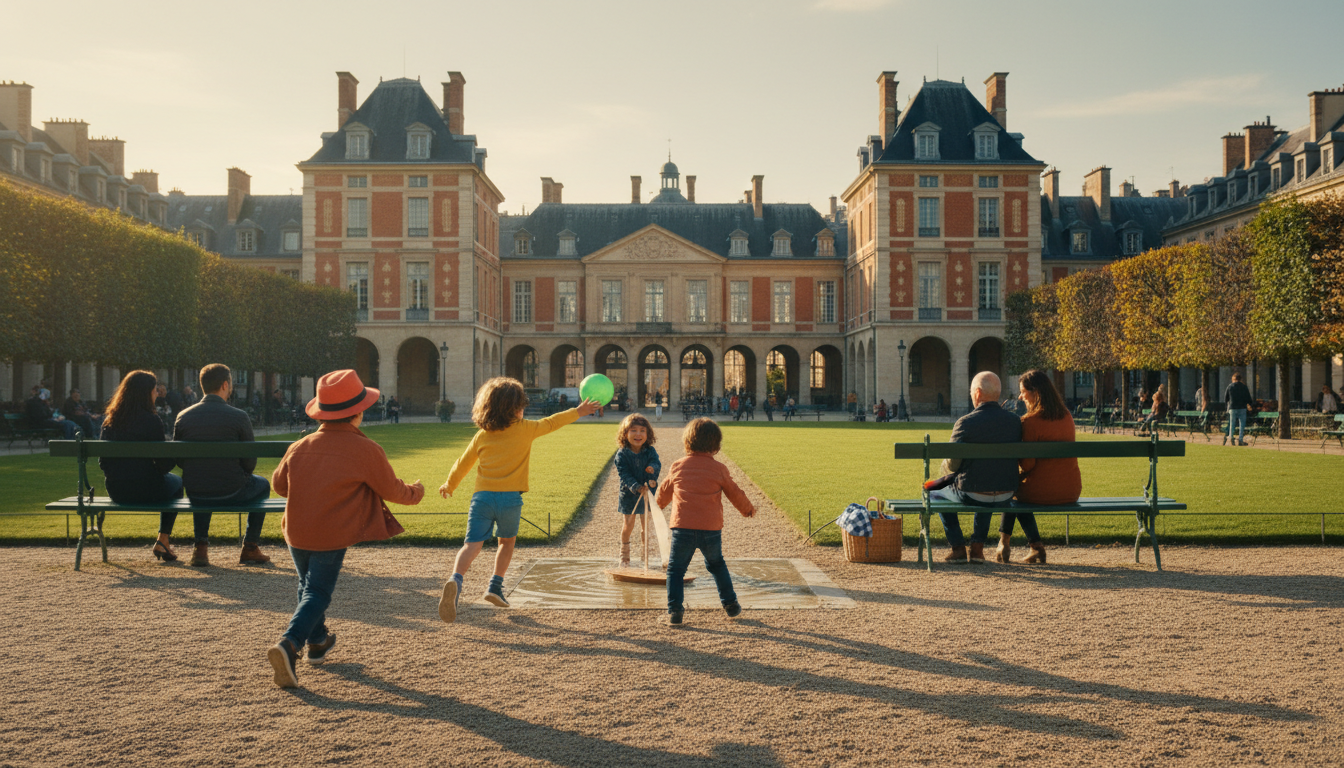 Children playing in the Place des Vosges garden with the iconic red-brick arcaded buildings in the b
Montmartre (18th Arrondissement): Best for Artistic Families Who Don't Mind Hills
Montmartre offers something rare in Paris: a village atmosphere. The winding streets around Sacré-Cœur feel removed from the urban intensity of central Paris, and the neighborhood's artistic heritage—Picasso, Van Gogh, and Renoir all lived here—gives you built-in storytelling material for curious kids.
The trade-off is topography. Montmartre is hilly, and "hilly" in Parisian terms means genuinely steep. If you're traveling with a stroller, you'll become intimately familiar with the Montmartre funicular (free with a Métro ticket). Home swaps in this area often include outdoor space—small terraces or gardens—which is unusual for Paris and valuable for families needing contained outdoor time.
The Abbesses Métro station has the deepest platform in Paris (36 meters), served only by stairs and two small elevators that are frequently out of service. Plan your routes accordingly.
The 11th Arrondissement: Best for Families Who Want to Live Like Locals
If your goal is experiencing Paris as Parisians actually live it, the 11th arrondissement delivers. This neighborhood—stretching from Bastille to Oberkampf—has become the de facto home base for young Parisian families. You'll find excellent playgrounds, family-friendly restaurants that don't require reservations two weeks in advance, and a genuine neighborhood feel.
Home swap listings in the 11th tend to be larger and more modern than in historic central areas. Many buildings have elevators, and you're more likely to find apartments with dedicated children's rooms. The Marché d'Aligre operates every morning except Monday, offering one of Paris's best and most affordable food markets.
The trade-off: you're not walking distance to the Louvre or the Eiffel Tower. But you're a 15-minute Métro ride from everything, and you gain the ability to establish genuine routines—the same boulangerie every morning, the same playground every afternoon.
The 15th Arrondissement: Best for Families with Very Young Children
The 15th is Paris's largest arrondissement and its most residential. This isn't where tourists typically stay, which is precisely why it works for families with babies or toddlers. The neighborhood has abundant green space (Parc André Citroën, Parc Georges-Brassens), wide sidewalks suitable for strollers, and the kind of infrastructure—pediatric pharmacies, family restaurants with high chairs that don't require asking—that makes daily life with small children manageable.
Home swaps here often offer significantly more space per euro than central neighborhoods. The SwappaHome community reports that 15th arrondissement listings frequently include amenities like washing machines, dishwashers, and even parking—luxuries in central Paris.
You'll need to accept that your Paris experience will be less "iconic views" and more "actually enjoyable daily life." For families with children under four, that trade-off usually makes sense.
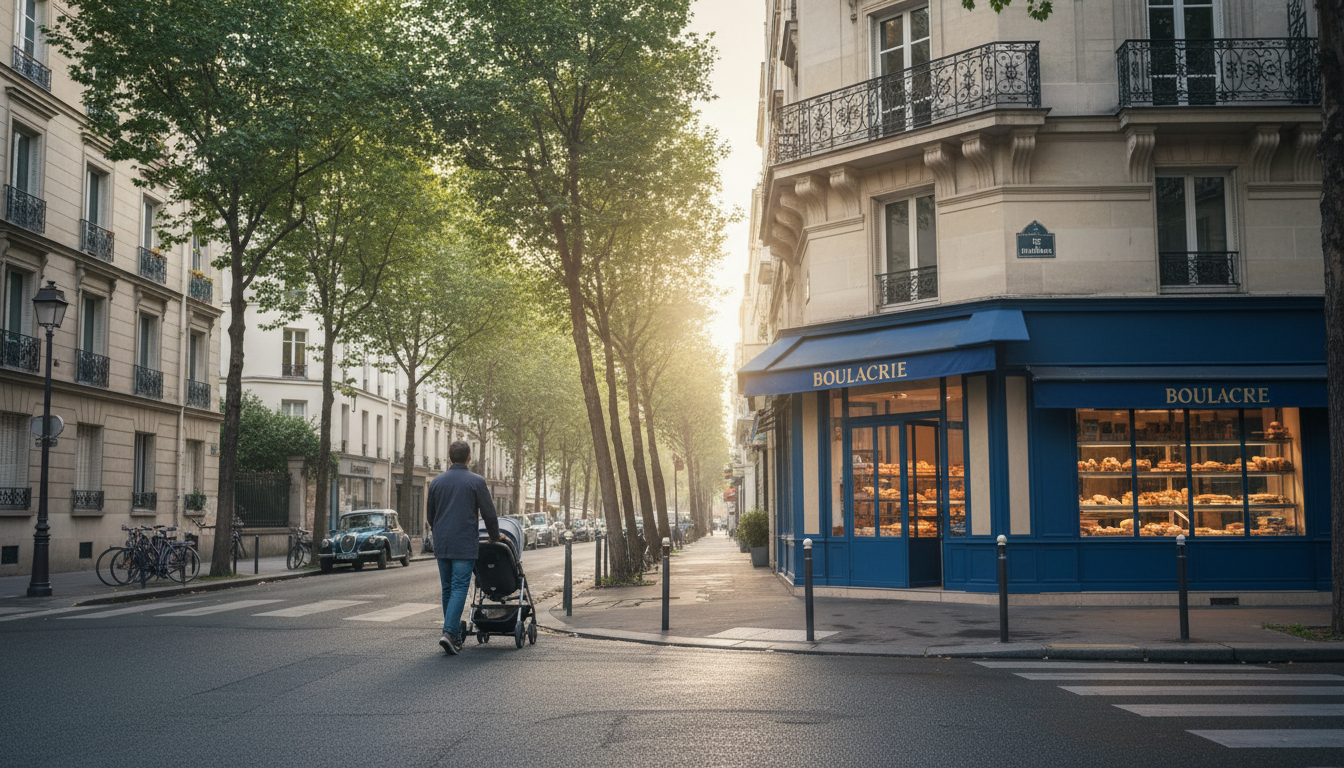 A quiet tree-lined street in the 15th arrondissement with a parent pushing a stroller past a corner
Preparing Your Home Swap Listing to Attract Paris Families
Home swapping works on reciprocity. To secure a great Paris apartment for your family, you need to offer something compelling in return. Paris-based families—like families everywhere—are looking for specific things when they browse SwappaHome listings.
What Paris Families Actually Want
Based on common patterns in the SwappaHome community, Paris families searching for swaps prioritize space and nature access above almost everything else. Parisian apartments are notoriously compact. If you have a backyard, a pool, proximity to hiking trails, or simply more than 100 square meters of living space, lead with that. A suburban American home with a yard is genuinely exotic to a family living in a 70-square-meter Paris apartment.
Car access matters too. Many Paris families don't own vehicles. If your location requires driving, offering your car as part of the swap dramatically increases your appeal. Mention if you have car seats available.
A kid-friendly setup goes a long way. Document everything that makes your home work for children: the crib in the closet, the high chair, the baby gate, the basket of toys. Paris parents know that traveling with children means traveling with equipment, and a home that's already set up saves them from packing half a nursery.
And don't underestimate proximity to experiences. What can a family do near your home that they can't do in Paris? Beach access, national parks, theme parks, ski slopes—these aren't generic amenities, they're reasons to choose your listing over hundreds of others.
Timing Your Request
Paris families follow predictable patterns. French school holidays (Toussaint in late October, Christmas, February ski break, spring break in April, and the long summer vacation from early July through August) are when Paris families want to travel. These are also when Paris apartments are most available for incoming swappers.
Conversely, Paris is most desirable for visitors during shoulder seasons (April-May, September-October) when weather is pleasant and crowds are manageable. The SwappaHome community recommends planning 3-6 months ahead for popular periods, though last-minute matches happen regularly.
Navigating Paris with Children: Practical Logistics
The difference between a good Paris family trip and a great one often comes down to logistics.
Transportation That Actually Works
The Paris Métro is extensive, affordable, and—contrary to reputation—increasingly accessible. Lines 1 and 14 are fully automated with platform doors and reliable elevator access. Other lines vary. The RATP app shows real-time elevator status, which becomes essential information when you're carrying a stroller.
Children under four ride free on all Paris public transit. Children 4-9 pay reduced fares. A family carnet (book of ten tickets) costs €16.90 and can be shared among family members—significantly cheaper than buying individual tickets.
For families with strollers, buses are often easier than the Métro. Every Paris bus has a designated stroller area, and drivers are generally patient with the boarding process. The Bus 69 route is particularly family-friendly, running from the Eiffel Tower through Saint-Germain-des-Prés to the Marais.
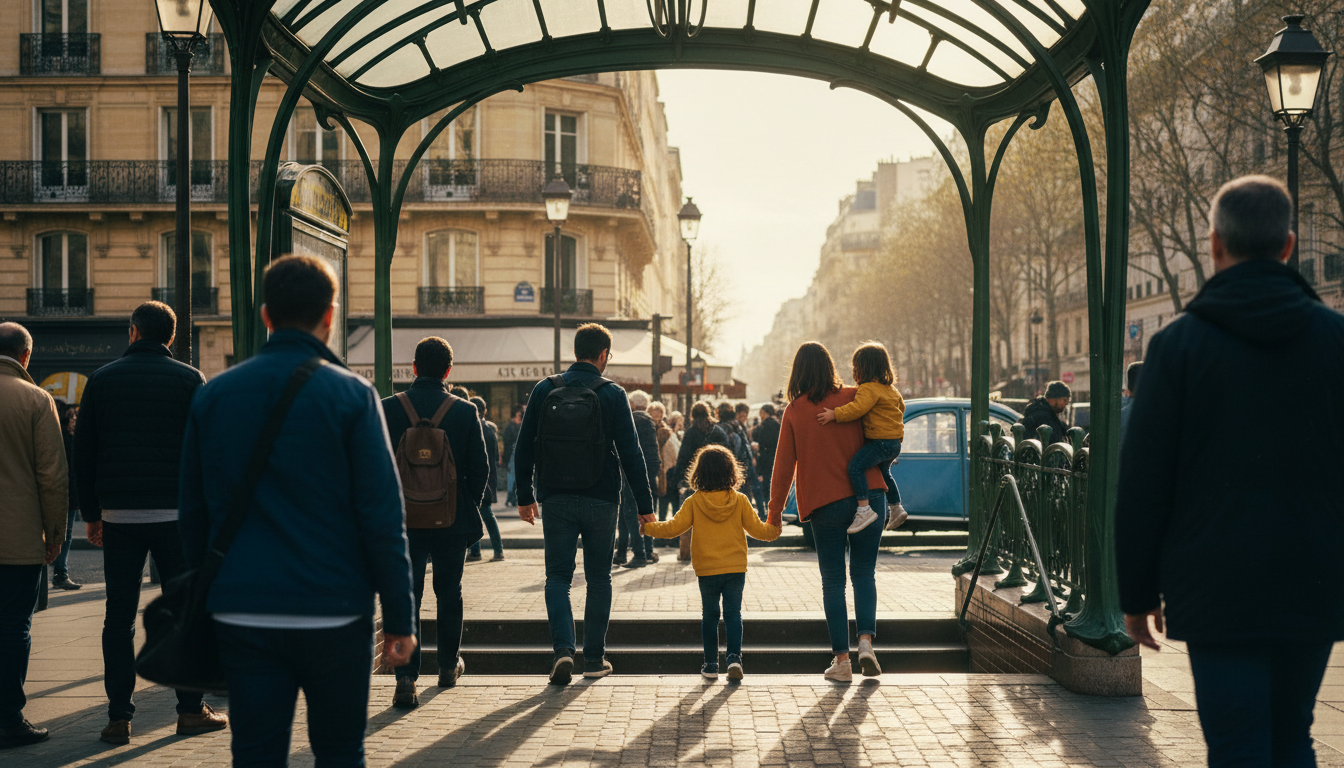 A family with two children exiting a Paris Mtro station Line 1, the iconic Art Nouveau entrance visi
Grocery Shopping and Meal Planning
One of home swapping's greatest advantages is kitchen access, but you need to understand how Parisian grocery shopping works. Large supermarkets (Carrefour, Monoprix, Franprix) exist but are smaller than American equivalents. Most Parisians shop at multiple stores: the boulangerie for bread, the fromagerie for cheese, the primeur for produce.
For families, Picard (a frozen food chain) is a lifesaver. The quality is genuinely good—this isn't American frozen food—and having a freezer stocked with kid-friendly options means you're never scrambling for dinner after an exhausting museum day.
Expect to spend €80-120 per week on groceries for a family of four, depending on how often you eat out. That's roughly what you'd spend on two restaurant dinners.
Managing Jet Lag with Children
Paris is 6-9 hours ahead of most North American time zones, which means your children will want to sleep at noon and party at 3 AM. The standard advice—get outside in natural light, push through the first day—works for adults but rarely for kids.
Here's the honest truth: lean into the chaos for the first 48 hours. Let kids sleep when they're tired, even if that means a 4 PM nap. Use the strange hours for experiences that benefit from empty streets—an early morning walk to a boulangerie, a late evening stroll along the Seine. By day three, most children naturally adjust.
Having a home swap apartment makes this infinitely easier than a hotel. You have space to be awake at weird hours without waking everyone. You have a kitchen for 2 AM snacks. You have the flexibility to structure days around your children's actual needs rather than hotel breakfast schedules.
Kid-Friendly Paris Experiences Worth Prioritizing
Paris offers more family activities than any single trip can accommodate.
The Jardin du Luxembourg: Non-Negotiable
Every Paris family trip should include multiple visits to the Jardin du Luxembourg. This isn't just a park—it's a complete children's entertainment ecosystem. The playground (€4.50 entry, cash only) is among Europe's best. The pond has toy sailboats for rent (€5 for 30 minutes). Puppet shows at the Théâtre du Luxembourg run Wednesday, Saturday, and Sunday afternoons (€7, French language only, but kids don't seem to mind).
The gardens are in the 6th arrondissement, accessible via the RER B to Luxembourg or Métro Line 4 to Saint-Sulpice. Plan for at least two hours per visit; most families end up staying longer.
The Cité des Sciences et de l'Industrie: For Rainy Days
Located in the Parc de la Villette in the 19th arrondissement, the Cité des Sciences is Europe's largest science museum and genuinely impressive. The Cité des Enfants section has separate areas for ages 2-7 and 5-12, with timed entry sessions (€13 per person, book online). Children can play with water, light, construction materials, and interactive exhibits designed specifically for their developmental stages.
The surrounding park includes a decommissioned submarine (the Argonaute, €3 entry), multiple playgrounds, and the Géode IMAX theater. You can easily spend an entire day here.
 Children interacting with a water play exhibit at the Cit des Enfants, colorful equipment, engaged e
The Eiffel Tower: Manage Expectations
Yes, you should see the Eiffel Tower. No, you probably shouldn't wait in line for two hours to go up it with young children. The view from the top is genuinely spectacular, but the experience of getting there—long queues, crowded elevators, limited mobility once you're up—is challenging with kids under eight.
The smart move: visit the Champ de Mars (the park beneath the tower) for a picnic, let kids run on the grass, take photos, and call it a win. If you want elevation, the Arc de Triomphe rooftop (€13 adults, free under 18) offers comparable views with shorter lines and more manageable logistics.
The Eiffel Tower sparkles for five minutes every hour after sunset. Watching this from the Trocadéro plaza across the river is magical for children and involves zero queuing.
Day Trips That Work with Kids
Versailles is doable with children but requires strategy. Skip the palace interior (crowded, fragile, "don't touch anything" repeated 400 times) and focus on the gardens. The Petit Trianon and Marie Antoinette's hamlet feel like a fairy tale. Rent a rowboat on the Grand Canal. Pack a picnic—food inside the grounds is overpriced and mediocre.
Giverny (Monet's garden) works best with children old enough to appreciate flowers and art, roughly age seven and up. The train from Paris Saint-Lazare to Vernon takes 45 minutes, followed by a shuttle bus to the gardens. Go early to avoid crowds.
Disneyland Paris is 40 minutes by RER A from central Paris. It's expensive (€62-124 per person depending on season), crowded, and exactly what you'd expect. Some families swear by it; others find it an odd choice when Paris itself offers so much. Know your kids.
Safety, Health, and Practical Concerns
Is Paris Safe for Families?
Paris is statistically safer than most major American cities. Violent crime is rare in tourist areas. The primary concerns are pickpocketing (especially on the Métro and at major attractions) and scams targeting tourists.
With children, the biggest practical safety issue is traffic. Parisian drivers are aggressive, and crosswalks don't guarantee cars will stop. Teach children to wait for the green pedestrian signal and to look both ways regardless.
The SwappaHome community reports that family home swaps in Paris have an excellent safety record. You're staying in residential neighborhoods, often in buildings with door codes and concierges, which provides a level of security that ground-floor hotel rooms don't.
Healthcare Access
French pharmacies (marked by green crosses) are everywhere and staffed by trained pharmacists who can recommend treatments for minor ailments. Many common medications that require prescriptions in the US are available over-the-counter in France.
For emergencies, dial 15 (SAMU medical emergency) or 112 (European emergency number). The American Hospital of Paris in Neuilly-sur-Seine has English-speaking staff and is accustomed to treating international patients. Travel insurance that covers medical care in France is strongly recommended—French healthcare is excellent but not free for tourists.
What to Pack (and What to Buy There)
Paris has everything you might need for children, often at lower prices than in the US. Don't overpack diapers, formula, or baby food—French pharmacies and supermarkets stock excellent options. Brands like Mustela (skincare) and Blédina (baby food) are high quality and widely available.
Do pack comfortable walking shoes for everyone (cobblestones are unforgiving), layers (Paris weather shifts quickly), a compact umbrella, any specific medications your children need, and adapters for European outlets (Type C and E).
Making the Most of Your Home Swap Experience
Communication with Your Swap Partners
The families whose Paris apartment you're using are trusting you with their home. Clear, warm communication before, during, and after your swap makes the experience better for everyone—and builds the kind of reputation that leads to future swap opportunities.
Before arrival, ask about building entry codes and any security procedures, WiFi network and password, quirks of the apartment ("jiggle the bathroom door handle," "the hot water takes 30 seconds"), local recommendations for families, and emergency contacts (building manager, nearby family or friends).
During your stay, send a brief message confirming you've arrived safely. If anything breaks or malfunctions, communicate immediately—most issues are easily resolved, but silence creates anxiety.
Before departure, leave the apartment as clean as you found it. Strip the beds, run the dishwasher, take out the trash. A small gift—something from your home region—is a lovely touch but not required.
Building Your SwappaHome Reputation
Every successful swap builds your profile. Detailed, honest reviews from your hosts make future swaps easier to secure. The SwappaHome credit system means that hosting guests at your home earns you credits for future stays—one credit per night hosted, one credit per night booked, regardless of property size or location.
For families, this creates a virtuous cycle: host a family from Paris at your home, earn credits, use those credits for your Paris adventure, repeat with a new destination. Many SwappaHome families report that home swapping has fundamentally changed how they travel, making extended trips financially possible in ways hotels never could.
Common Mistakes to Avoid
Overscheduling. Paris has too much to see, and the temptation to cram everything into a week leads to exhausted, miserable children. Plan one major activity per day maximum. Leave room for spontaneous discoveries, long lunches, and the kind of unstructured time that lets kids actually enjoy where they are.
Ignoring nap logistics. If your children still nap, build your days around that reality. A home swap apartment makes midday returns easy; a packed sightseeing schedule does not.
Underestimating walking distances. Paris looks compact on maps but covers substantial ground on foot. The walk from the Louvre to the Eiffel Tower is 3.5 kilometers—manageable for adults, potentially brutal for small children. Use the Métro liberally.
Eating only at restaurants. French restaurant meals are long, formal, and not always welcoming to young children. Balance restaurant dinners with picnics in parks, casual café lunches, and home-cooked meals in your swap apartment.
Forgetting that you're guests. The apartment you're staying in is someone's home. Treat it with the care you'd want for your own space.
The Bigger Picture
Family-friendly home swapping in Paris isn't just about saving money or having more space—though those benefits are real and significant. It's about giving your children a different kind of travel experience. They're not tourists passing through; they're temporary residents of a neighborhood, with a local boulangerie and a favorite playground and a sense of what daily life looks like somewhere very different from home.
That's the kind of travel that shapes how children see the world. And it's available to any family willing to open their own home in return.
Frequently Asked Questions
Is home swapping in Paris safe for families with young children?
Paris home swapping has an excellent safety record within the SwappaHome community. You're staying in residential neighborhoods, often in buildings with secure entry codes and concierges. The city itself is statistically safer than most major American cities. Standard precautions—securing valuables, being aware of pickpockets on public transit—apply as they would anywhere.
How much can a family save with home swapping versus hotels in Paris?
A family-suitable Paris hotel runs €250-400 per night for connecting rooms or suites. Over a ten-day trip, that's €2,500-4,000. Through SwappaHome's credit system, accommodation costs nothing beyond your annual membership (€190). Most families report saving €2,000-3,500 per trip, which they redirect toward experiences, meals, and day trips.
What's the best Paris neighborhood for a family home swap with toddlers?
The 15th arrondissement offers the best combination of space, green areas, and family infrastructure for families with very young children. It's residential rather than touristy, with wide sidewalks, abundant parks, and practical amenities like pediatric pharmacies. Home swaps here tend to be larger and more affordable than central locations.
How far in advance should we plan a Paris family home swap?
For popular periods (French school holidays, April-May, September-October), plan 3-6 months ahead. The SwappaHome community is active, and desirable Paris listings get booked quickly. Last-minute matches do happen, but families with specific needs—multiple bedrooms, ground-floor access, particular neighborhoods—benefit from early planning.
Can we use public transportation in Paris with a stroller?
Yes, though with caveats. Métro Lines 1 and 14 are fully accessible with reliable elevators. Other lines vary—the RATP app shows real-time elevator status. Buses are often easier than the Métro for strollers, with designated spaces and patient drivers. Children under four ride free on all Paris public transit.

Published by
SwappaHome
SwappaHome Editorial Team
Home Exchange & Slow Travel Editorial
The SwappaHome Editorial Team brings together travel research, home-exchange community insights, and platform data to produce practical guides for first-time and experienced home swappers. Every article cites real platforms, current market rates, and verifiable city-level facts so readers can make informed decisions without guessing.
Ready to try home swapping?
Join SwappaHome and start traveling by exchanging homes. Get 7 free credits when you sign up!
Related articles

Bachelor and Bachelorette Parties in Singapore: The Complete Home Swap Group Guide for 2026
Planning a bachelor or bachelorette party in Singapore? Discover how home swapping lets groups of 6-12 stay together in luxury condos, saving thousands while partying in Marina Bay.

Cycling in Lisbon: 7 Home Swap Bike Tour Itineraries for Every Rider
Discover the best cycling routes in Lisbon with these home swap bike tour itineraries—from waterfront paths to hilltop adventures, all starting from your borrowed home.

Graduation Trip to Barcelona: How Home Swapping Gives New Graduates the Ultimate Celebration
Planning a graduation trip to Barcelona? Discover how home swapping lets new graduates explore Spain's most vibrant city without the hostel crowds or hotel costs.