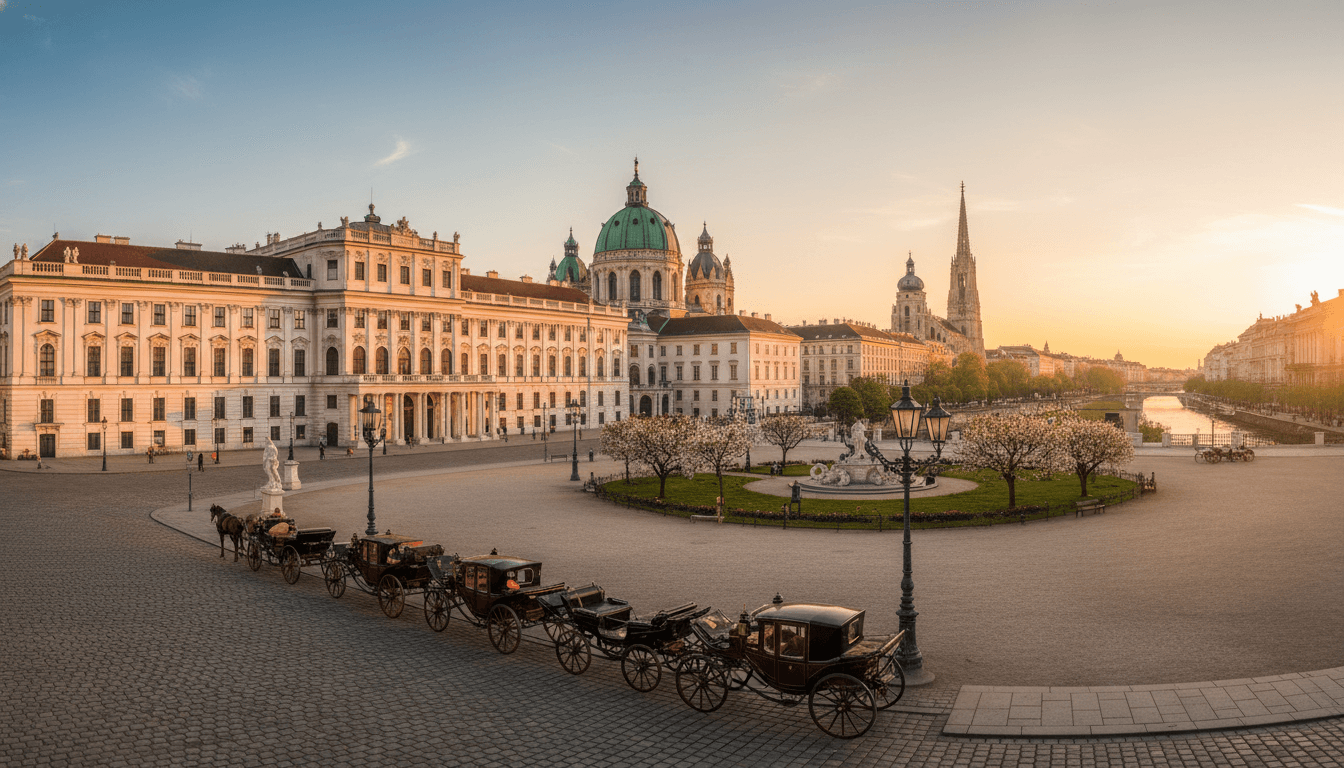
Family Home Exchanges in Vienna: The Complete Guide to Space, Safety, and Kid-Friendly Adventures

SwappaHome Editorial Team
Home Exchange & Slow Travel Editorial
Discover why Vienna ranks as Europe's best city for family home exchanges. Real tips on neighborhoods, safety, and keeping kids entertained—from a mom who's done it.
My daughter was four the first time she fed swans along the Danube Canal. We'd been in Vienna for three days, staying in a family home exchange in the 2nd district, and she'd already decided this was her favorite city in the world. Not because of the palaces—though she did love pretending to be a princess at Schönbrunn—but because the apartment had a toy kitchen, a balcony where she could watch the trams go by, and a family cat named Mozart who tolerated her enthusiastic affection.
That trip changed how I think about traveling with kids. Hotels are fine. But family home exchanges in Vienna? They're something else entirely.
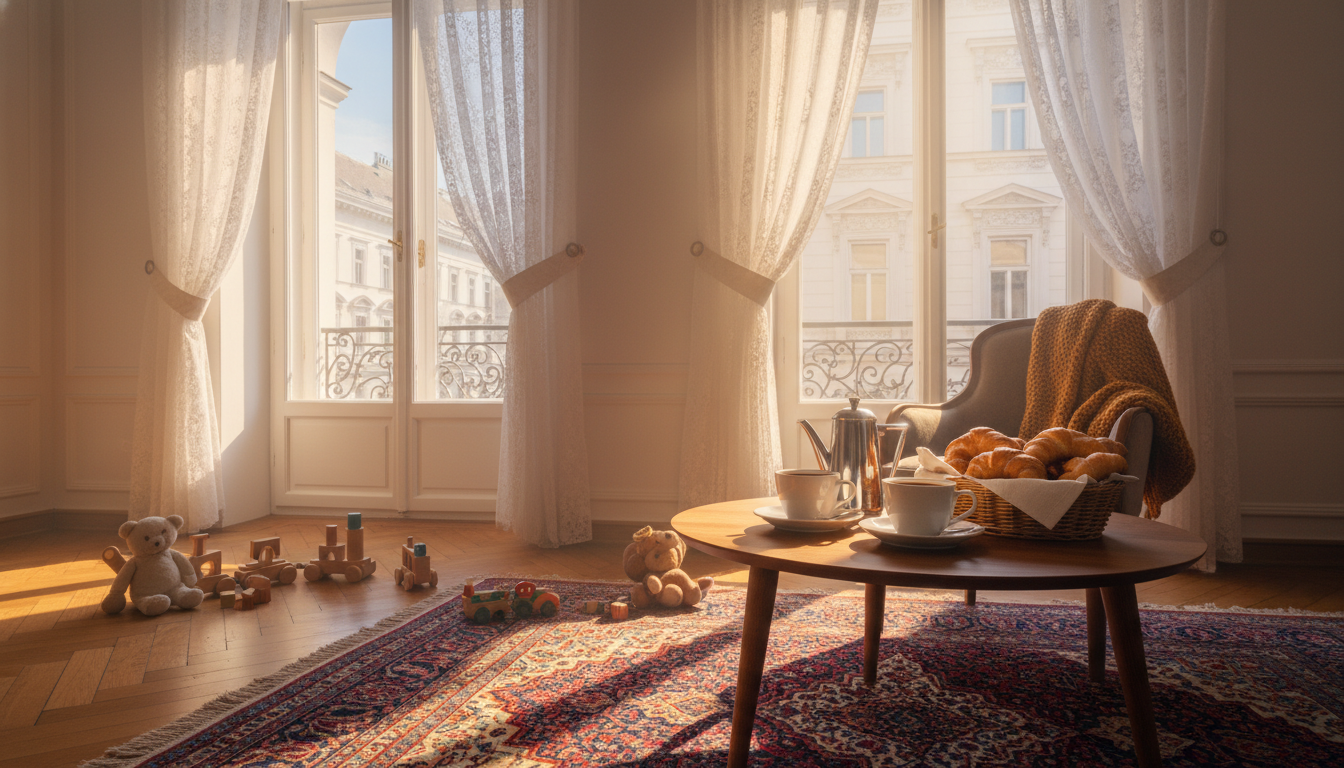 Golden morning light streaming through a Viennese apartment window, childs toys scattered on a Persi
Why Vienna Is Perfect for Family Home Exchanges
Here's something that surprised me when I first started researching Vienna with kids: it's been ranked the world's most livable city for over a decade. And honestly? After swapping homes there three times now, I get it.
The city operates with a kind of quiet efficiency that makes traveling with children dramatically less stressful. Trams arrive on time. Playgrounds are everywhere—and I mean everywhere, like tucked behind every other building. The tap water is Alpine spring water that tastes better than anything you'd buy bottled. And Viennese culture has this wonderful tradition of Kaffeehauskultur—lingering over coffee and cake—which means nobody rushes you when your toddler is taking forty-five minutes to eat a single Sachertorte.
But the real magic for families? Space.
Vienna's apartments are big. Like, shockingly big compared to other European capitals. The city's housing stock includes tons of pre-war buildings with high ceilings, multiple bedrooms, and those deep windowsills kids love to sit in. When you do a family home exchange in Vienna, you're often getting a proper home—not a cramped tourist rental.
The family we swapped with last summer had a three-bedroom apartment in Josefstadt with a dedicated playroom. A playroom! In the middle of one of Europe's most expensive cities. Try finding that in Paris.
Best Vienna Neighborhoods for Family Home Exchanges
Not all Viennese districts are created equal when you're traveling with kids. After three swaps and countless hours of research (and one regrettable booking in a party neighborhood—learn from my mistakes), here's my honest breakdown.
The 2nd District (Leopoldstadt): Best for Young Families
This is where I always look first. Leopoldstadt sits between the Danube Canal and the Danube proper, which means water access, bike paths, and the Prater—Vienna's massive park with the famous Ferris wheel.
The neighborhood has gentrified significantly but still feels genuinely lived-in. You'll find Augarten park with its porcelain factory and massive lawns for running, plus the Prater, which isn't just the amusement park (though that's there too)—it's 6 square kilometers of forest, playgrounds, and bike trails. There's Karmelitermarkt, a farmer's market where my daughter became obsessed with fresh pretzels. And the tram access to the city center is easy—about 10 minutes to Stephansplatz.
Family home exchanges in the 2nd district typically run larger because it's traditionally been a family neighborhood. Expect apartments with separate kids' rooms, often with toys and books already there.
Pricing context: If you were paying for hotels here, you'd spend $180-280 USD per night for a family room. A comparable Airbnb runs $150-220. With SwappaHome's credit system, it's one credit per night regardless of size—which, when you're getting a three-bedroom apartment, feels almost absurd.
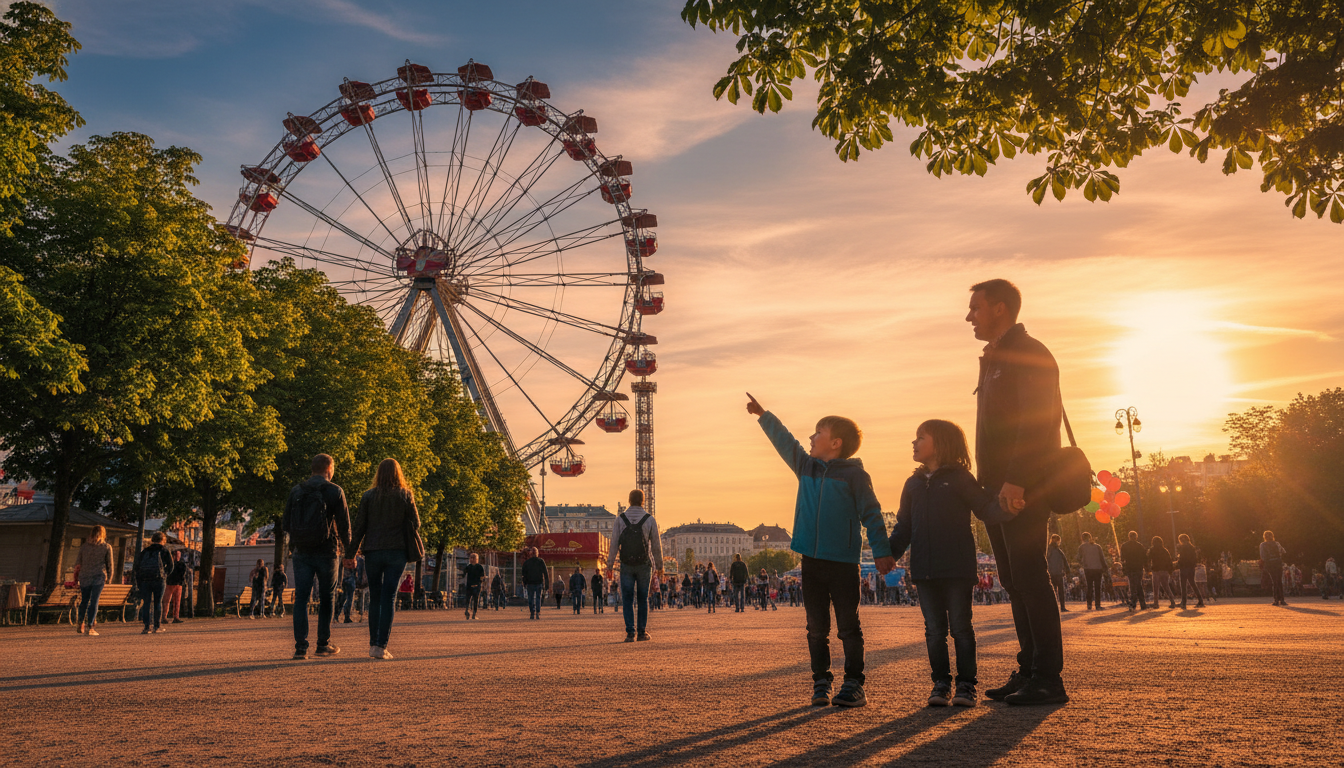 The Praters iconic Riesenrad Ferris wheel at golden hour, families walking below among chestnut tree
The 18th District (Währing): Best for Older Kids and Teens
Währing is Vienna's leafy, hilly district on the edge of the Vienna Woods. It's quieter than the central areas but has excellent transport links and something crucial for traveling with tweens and teens: space to roam independently.
The streets here feel safe in that specifically Viennese way—well-lit, well-maintained, with enough foot traffic that kids can walk to the bakery alone without you panicking. My friend's 12-year-old navigated the tram to the Natural History Museum by himself during their swap here, and she said the freedom transformed the trip for both of them.
Währing highlights for families include Türkenschanzpark—a gorgeous park with a pond, playground, and paths perfect for scooters—along with direct tram lines to the city center on the 40 and 41. The Cottage district has villa-lined streets that are great for evening walks, and you've got easy access to hiking in the Vienna Woods (Wienerwald).
Homes here tend to be either spacious apartments in Gründerzeit buildings or actual houses with gardens. Yes, houses. With gardens. In Vienna.
The 7th District (Neubau): Best for Culture-Loving Families
Neubau is Vienna's creative heart—think independent boutiques, excellent coffee, street art, and the MuseumsQuartier just at its edge. It's more urban than the other neighborhoods I've mentioned, but it works brilliantly for families who want to walk everywhere and whose kids are old enough to handle city energy.
The apartments here are typically smaller than in the 2nd or 18th, but you're trading space for location. You can walk to the MuseumsQuartier (the ZOOM children's museum is there—more on that later), the Naschmarkt for lunch wandering, Mariahilfer Straße for shopping, and multiple excellent playgrounds tucked into courtyards.
I'd recommend Neubau for families with kids 6 and up who don't need nap schedules and can handle more stimulation.
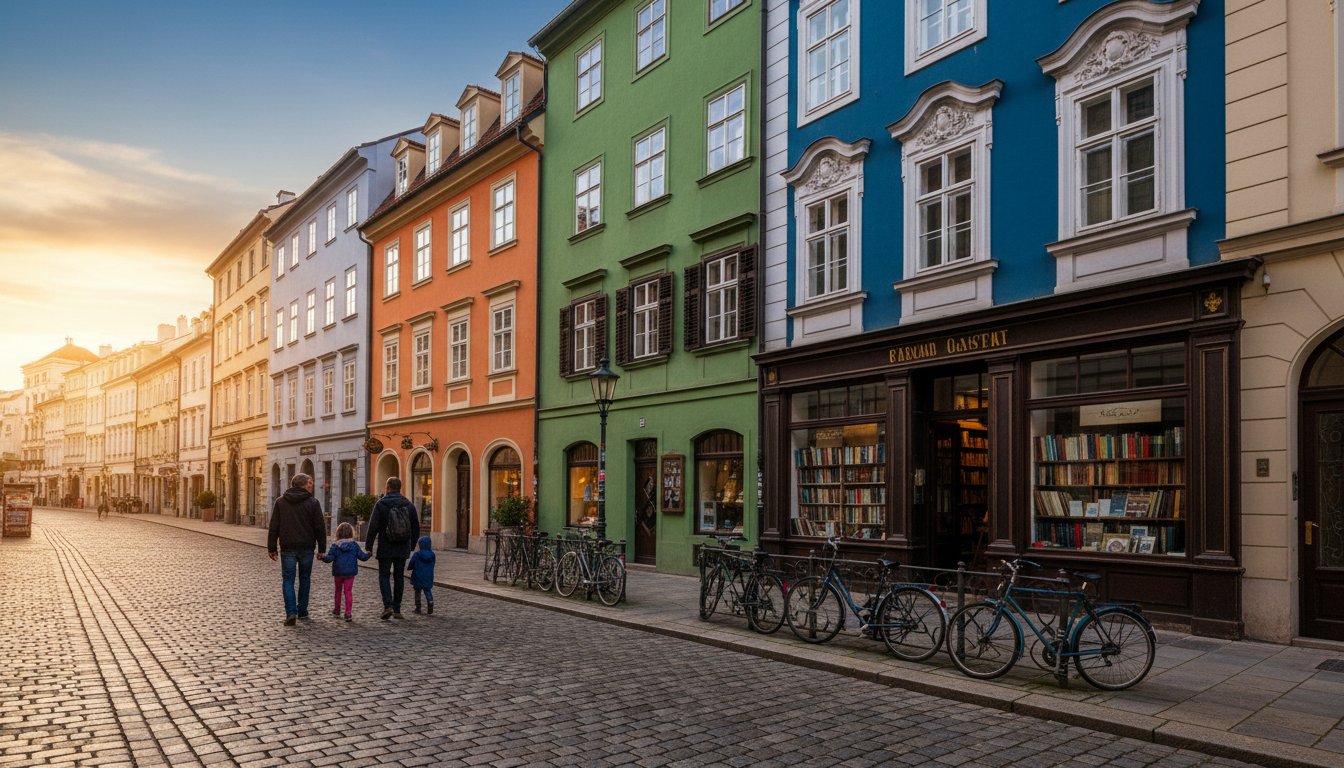 Cobblestone street in Viennas 7th district with colorful building facades, a family walking past a v
The 13th District (Hietzing): Best for Schönbrunn Access
If your kids are palace-obsessed (or if you want to be close to Schönbrunn's incredible zoo and gardens), Hietzing is your answer. This is Vienna's embassy district—quiet, elegant, and extremely safe.
The trade-off is that it feels more suburban and requires more transit time to reach the city center. But if you're planning multiple Schönbrunn visits (and with kids, you probably will—the maze alone is worth three trips), staying nearby saves enormous amounts of energy.
Family home exchanges in Hietzing often come with gardens or terraces, which can be game-changing for early risers who need somewhere to play at 6 AM while parents drink coffee in peace.
Safety in Vienna: What Families Actually Need to Know
I'm going to be direct here because I know this is what parents really want to understand.
Vienna is extremely safe. Like, remarkably so. It consistently ranks in the top 10 safest cities globally, and that matches my experience completely. During our swaps, I've let my daughter (now 7) play in building courtyards while I watched from the window. I've walked home at midnight through the city center without a second thought. I've left strollers unlocked outside shops.
Public transport is clean, well-monitored, and feels safe at all hours. Kids under 6 ride free, and kids 6-15 can travel alone on school days—locals do this routinely.
Playgrounds are taken seriously here. Equipment is modern and well-maintained, surfaces are impact-absorbing, and I've never seen broken glass or sketchy situations at any of the dozens we've visited.
Healthcare is excellent. EU citizens can use their EHIC cards, and non-EU visitors should have travel insurance—but even private care is reasonably priced compared to the US. There's a children's hospital (St. Anna Kinderspital) with English-speaking staff.
The one caveat: Like any city, watch for pickpockets in tourist-heavy areas like Stephansplatz and the Naschmarkt. Keep valuables secure, teach kids not to leave bags unattended. But honestly, this is standard travel advice, not Vienna-specific concern.
When doing a family home exchange, you also get the safety benefit of local knowledge. The families we've swapped with have always left detailed notes about their neighborhood—which parks are best at which times, where the nearest pharmacy is, how to navigate the local grocery store. That insider information is invaluable.
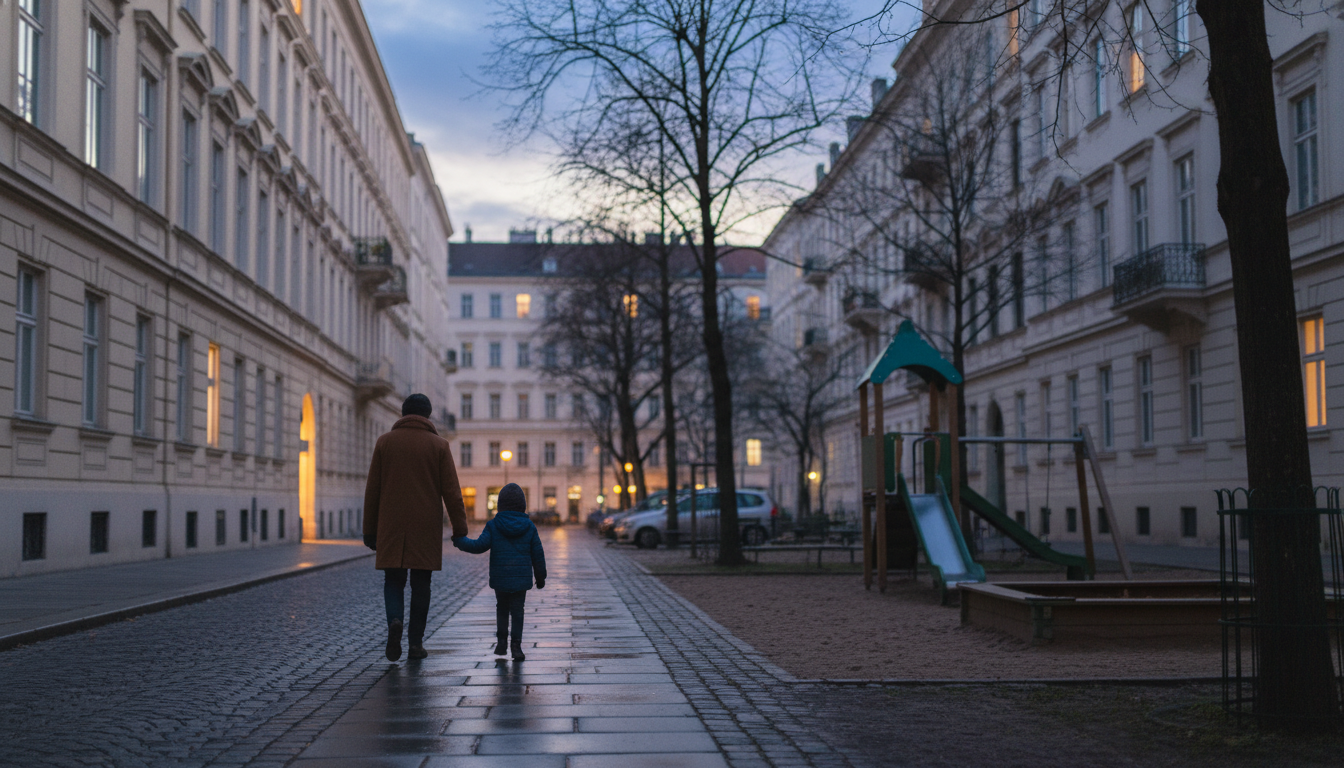 A quiet Viennese residential street at dusk, warm light glowing from apartment windows, a parent and
Keeping Kids Entertained: Vienna's Best Family Activities
Okay, let's talk about the fun stuff. Vienna has this reputation as a formal, classical music, fancy coffee house kind of city—and it is that. But it's also secretly incredible for kids.
Museums That Don't Bore Children
ZOOM Kindermuseum in the MuseumsQuartier is the one must-do. It's a hands-on children's museum with rotating exhibits designed for different age groups. You need to book time slots in advance (seriously, do this before your trip), but it's worth the planning. Admission runs around €6-7 per person ($6.50-7.50 USD).
Haus der Musik is an interactive sound museum where kids can conduct the Vienna Philharmonic (virtually), create their own music, and learn about acoustics through play. My daughter spent two hours here and cried when we left. It's €15 for adults, €6 for kids ($16 and $6.50 USD).
Natural History Museum—the dinosaur hall alone is worth the visit. There's also a digital planetarium and tons of hands-on exhibits. Pro tip: go on the first Sunday of the month when admission is free.
Technisches Museum, Vienna's science and technology museum, has a dedicated kids' area and exhibits on everything from trains to mining to musical instruments. It's €15 for adults, free for under 19 on Sundays ($16 USD).
Outdoor Adventures
The Prater goes way beyond the famous amusement park (Wurstelprater). There's a miniature railway, a planetarium, miles of bike paths, and playgrounds scattered throughout. The amusement park itself is free to enter—you just pay per ride, which means you can let kids choose a few favorites without committing to an expensive day.
Schönbrunn Zoo is the world's oldest zoo, and it shows—in a good way. The grounds are gorgeous, the animals have spacious enclosures, and there's a dedicated children's area with a playground and petting zoo. Plan for a full day. It's €26 for adults, €15 for kids ($28 and $16 USD).
Donauinsel, the Danube Island, is a 21-kilometer recreational area with beaches (yes, beaches!), bike paths, and playgrounds. In summer, families swim in designated areas. It's completely free and feels like an escape from the city while still being accessible by U-Bahn.
Lainzer Tiergarten is a former imperial hunting ground that's now a nature reserve. You can hike, spot wild boar and deer, and visit the Hermesvilla (a palace in the woods). Free entry, and it feels like actual wilderness.
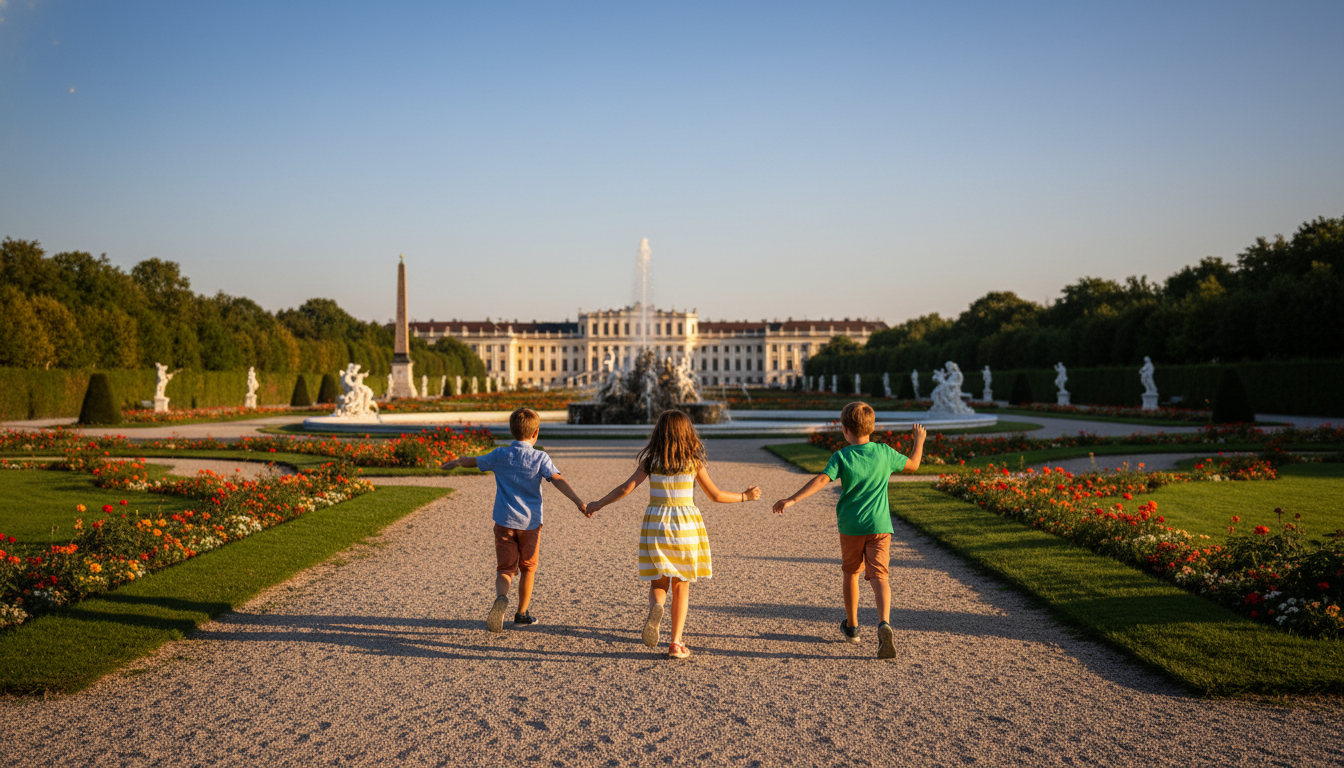 Children running through the formal gardens at Schnbrunn Palace, the Neptune Fountain in the backgro
Rainy Day Options
Vienna weather can be unpredictable, especially in spring and fall. Having a home base through a family home exchange means you can ride out bad weather more easily, but here are backup plans:
Dschungel Wien is a theater for young audiences in the MuseumsQuartier. Performances are often visual and physical enough that language isn't a barrier.
Indoor playgrounds like Family Fun, Monki Park, and BOGI Park are large indoor play centers. Not culturally enriching, but sometimes kids just need to climb and slide.
Cooking together can fill a rainy afternoon beautifully—if your home exchange has a good kitchen, hit up a local market and make Wiener Schnitzel together. Austrian grocery stores also have excellent baking supplies for rainy afternoon projects.
Café culture works surprisingly well with kids. Viennese cafés are more kid-tolerant than you'd expect. Order hot chocolate with whipped cream (mit Schlag), a slice of cake, and some coloring supplies. Café Sperl and Café Prückel both have that old-world atmosphere without being stuffy about children.
Practical Tips for Family Home Exchanges in Vienna
After three swaps, I've learned some things the hard way so you don't have to.
What to Look for in a Listing
When browsing family home exchanges in Vienna on SwappaHome, pay attention to floor level—Viennese buildings often don't have elevators, or the elevator is tiny. If you have a stroller or heavy luggage, ground floor or elevator access matters.
Outdoor space is gold with kids. A balcony or courtyard access changes the dynamic of early mornings and late evenings.
Washing machine: You will do laundry. Trust me. Look for in-unit machines rather than shared basement facilities.
Toy situation: Many Vienna families include notes about what toys and books are available. Don't be shy about asking in your initial message—most families with kids are happy to leave out age-appropriate entertainment.
Neighborhood playground proximity: Ask specifically about the nearest playground and how long it takes to walk there. Viennese families know their local spots.
Getting Around with Kids
Vienna's public transport is genuinely excellent for families. The U-Bahn is fast, frequent, and mostly accessible. Trams are scenic and fun for kids, though boarding with strollers can be tricky on older models. Buses fill in the gaps, and the S-Bahn regional trains are useful for day trips.
A weekly pass (Wochenkarte) costs €17.10 ($18.50 USD) and covers unlimited travel on everything. Kids under 6 are free. Kids 6-15 travel free on Sundays, public holidays, and during Vienna school holidays (which you can look up online).
Renting bikes is also viable—Vienna has excellent bike infrastructure and family-friendly routes along the Danube Canal. Citybike stations are everywhere, though you'll need your own child seats or rent family bikes from shops like Pedal Power.
Food and Groceries
One of the best parts of a home exchange is cooking some meals. Billa and Spar are the main supermarket chains—well-stocked, reasonable prices, found everywhere. Hofer is Austria's Aldi equivalent, great for basics and surprising quality on many items.
Markets are wonderful for groceries. The Naschmarkt is famous but touristy. For actual grocery shopping, neighborhood markets like Karmelitermarkt, Brunnenmarkt, or Kutschkermarkt are better—cheaper, less crowded, and more authentic.
Bakeries (Bäckerei) are in every neighborhood, with fresh bread and pastries daily. My daughter's breakfast routine in Vienna: Semmel (bread roll), butter, jam, and a tiny cup of cocoa.
Restaurant dining with kids is straightforward. Austrians eat dinner early by European standards (6-7 PM is normal), and most traditional restaurants (Gasthäuser and Beisln) welcome families. Expect to pay €12-20 ($13-22 USD) for main courses, with kids' portions usually available.
Making the Exchange Work: Communication Tips
Family-to-family home exchanges have a different dynamic than swapping with child-free adults. Here's what I've learned:
Be upfront about ages and needs. In your initial message, mention your kids' ages and any specific requirements (crib, high chair, baby gates). Families understand and appreciate the honesty.
Ask about their kids' stuff. It's totally normal to ask if you can use their toys, books, games, and outdoor equipment. Most families are happy to share—it means their things get used instead of sitting idle.
Discuss house rules. Every family has different rules about screen time, eating in bedrooms, shoes indoors, etc. Clarify expectations both ways so there are no surprises.
Leave the home better than you found it. This is standard home exchange etiquette, but with kids it takes extra effort. Do a thorough check before leaving—toys back in bins, no crumbs in couch cushions, any accidents cleaned up properly.
Write a thoughtful review. Mention specific things that made the swap family-friendly. This helps other traveling parents find good matches.
The SwappaHome platform makes this communication easy with secure messaging, but I always suggest moving to email or WhatsApp once you've confirmed the exchange. Real-time communication is helpful when you're navigating kid logistics.
Day Trips from Vienna with Kids
One advantage of a longer home exchange stay is the ability to do day trips without the hassle of packing up and moving hotels. From Vienna, several destinations work brilliantly for families.
Bratislava, Slovakia is just an hour by train—a different country for the day! The old town is compact and walkable, there's a castle with views, and kids love saying they visited two countries. Train tickets run about €15-20 round trip ($16-22 USD).
Wachau Valley is about 1.5 hours by train to Krems. It's wine country along the Danube, but also castles, apricot orchards, and a boat ride option. The Melk Abbey is spectacular if your kids can handle religious architecture.
Baden bei Wien is just 30 minutes by train—a spa town with a beautiful park, outdoor pools in summer, and a casino garden that's lovely for wandering. Very manageable with young kids.
Semmering is an hour by train, offering mountain scenery and the famous Semmering Railway (a UNESCO site). Good hiking options for families, and the train ride itself is the attraction.
What I Wish I'd Known Before Our First Vienna Family Home Exchange
Let me save you some learning curve.
Sundays are quiet. Almost everything closes on Sundays in Austria. Grocery shop on Saturday. Plan for museums, parks, or cooking at home.
The coffee house thing is real. Don't rush. Viennese cafés expect you to linger. Order one coffee and stay two hours—nobody will judge you, and kids can sprawl with coloring books.
Schönbrunn needs a full day. Don't try to squeeze it in with other activities. The palace, gardens, zoo, and maze could honestly fill two days. We made the mistake of planning afternoon activities after Schönbrunn and the kids were destroyed.
Playgrounds close at dusk. Unlike some cities where parks stay open, Vienna playgrounds have posted hours and actually close. Plan afternoon play accordingly.
The tap water is incredible. Seriously, fill water bottles from the tap and skip buying bottled water entirely. It comes directly from Alpine springs.
Heuriger are family-friendly. These traditional wine taverns might seem adult-focused, but they're actually great for families. Kids can run around the gardens while parents enjoy wine and cold cuts. Grinzing and Nussdorf have clusters of good ones.
The Real Value of Family Home Exchanges
I want to be honest about why I keep choosing home exchanges over hotels when traveling with my daughter.
It's not just the money—though saving $200+ per night adds up fast, especially on longer trips. It's not just the space—though having a separate bedroom for her means we all sleep better.
It's the way she experiences a place.
In a hotel, she's a guest. Everything is temporary, sanitized, impersonal. In a home exchange, she's living someone's life for a week. She sleeps in another kid's bed, plays with their toys, eats breakfast at their kitchen table. She notices things—the family photos on the wall, the books on the shelves, the way Viennese families organize their homes.
Last time we were in Vienna, she asked why Austrian kids have so many board games. (They do, by the way—game culture is huge there.) That led to a conversation about screen time differences, about how families in different countries spend their evenings, about what it might be like to grow up somewhere else.
You don't get that in a Marriott.
SwappaHome's credit system makes this accessible in a way that traditional home swapping didn't. You don't need to find a Vienna family who wants to visit your city at the exact same time. You host someone—anyone—earn a credit, and use it when you're ready. For families whose schedules are dictated by school calendars and work constraints, that flexibility is everything.
Getting Started with Your Vienna Family Home Exchange
If you're ready to try this, here's my suggested approach:
Create a family-focused profile. Mention your kids' ages, your home's kid-friendliness, and what you're looking for in exchanges. Families seek out other families.
Start browsing Vienna listings. Filter for the neighborhoods I mentioned. Look for mentions of kids, toys, family-friendly features.
Send thoughtful inquiries. Introduce your family, explain why Vienna appeals to you, ask specific questions about their home and neighborhood.
Plan for shoulder season. Vienna in May-June or September-October has the best weather and fewer crowds. School holiday timing varies by country, so check your options.
Book early for summer. If you're targeting July-August, start looking 4-6 months ahead. Family homes in good neighborhoods go fast.
Vienna isn't the obvious choice for a family trip. It doesn't have beaches or theme parks or the immediate kid appeal of some destinations. But it has something better: the chance to live like a local in one of the world's most livable cities, in a home that actually fits your family, surrounded by culture and nature and really excellent pastries.
My daughter still talks about Mozart the cat. She still asks when we're going back to "our Vienna apartment." She doesn't remember hotel rooms from other trips. She remembers homes.
That's the difference a family home exchange makes.
Frequently Asked Questions
Is Vienna safe for family home exchanges with young children?
Vienna consistently ranks among the world's safest cities, making it ideal for family home exchanges with children of all ages. The city has low crime rates, clean and reliable public transport, well-maintained playgrounds, and a culture that genuinely welcomes families. Standard travel precautions apply, but parents can feel confident letting older children explore neighborhoods independently.
How much can families save with home exchanges in Vienna compared to hotels?
Families typically save €150-250 ($165-275 USD) per night compared to family-sized hotel rooms in central Vienna. For a two-week trip, that's €2,100-3,500 ($2,300-3,850 USD) in savings. With SwappaHome's credit system, you spend one credit per night regardless of apartment size—meaning a three-bedroom family home costs the same as a studio.
What Vienna neighborhoods are best for families with toddlers?
The 2nd district (Leopoldstadt) is ideal for toddlers, offering flat terrain for strollers, the Prater park with age-appropriate playgrounds, and family-oriented apartment buildings with larger units. The 13th district (Hietzing) near Schönbrunn is another excellent choice, with quieter streets, garden access, and proximity to the zoo and palace grounds.
Do Vienna home exchange families provide cribs and high chairs?
Many Vienna families with young children include baby equipment in their home exchange listings. Always ask specifically in your initial message—most families are happy to leave out cribs, high chairs, strollers, and baby gates. If equipment isn't available, rental services like Baby Equipment Vienna can deliver items to your exchange home.
What's the best time of year for a family home exchange in Vienna?
May through early June and September through October offer the best combination of pleasant weather, manageable crowds, and outdoor activity options for families. Summer (July-August) is popular but hot and crowded at major attractions. December brings magical Christmas markets but cold weather and shorter days. Book family home exchanges 4-6 months ahead for peak seasons.

Published by
SwappaHome
SwappaHome Editorial Team
Home Exchange & Slow Travel Editorial
The SwappaHome Editorial Team brings together travel research, home-exchange community insights, and platform data to produce practical guides for first-time and experienced home swappers. Every article cites real platforms, current market rates, and verifiable city-level facts so readers can make informed decisions without guessing.
Ready to try home swapping?
Join SwappaHome and start traveling by exchanging homes. Get 7 free credits when you sign up!
Related articles
Home Swap in Rome: Where to Find the Best Properties for Your Italian Exchange
Discover where to find the best home swap properties in Rome—from Trastevere's cobblestone charm to Testaccio's local authenticity. Real neighborhoods, real advice.

Home Swap in Bangkok: Where to Find the Best Properties for Free Stays
Discover where to find the best home swap properties in Bangkok—from riverside condos in Charoen Krung to family homes in Ari. Real neighborhoods, real savings.
Home Swap for Beach Lovers: 12 Coastal Destinations Ranked for 2026
Discover the best coastal destinations for home swapping in 2026. From Portugal's Algarve to Australia's Gold Coast, find your perfect beach exchange.