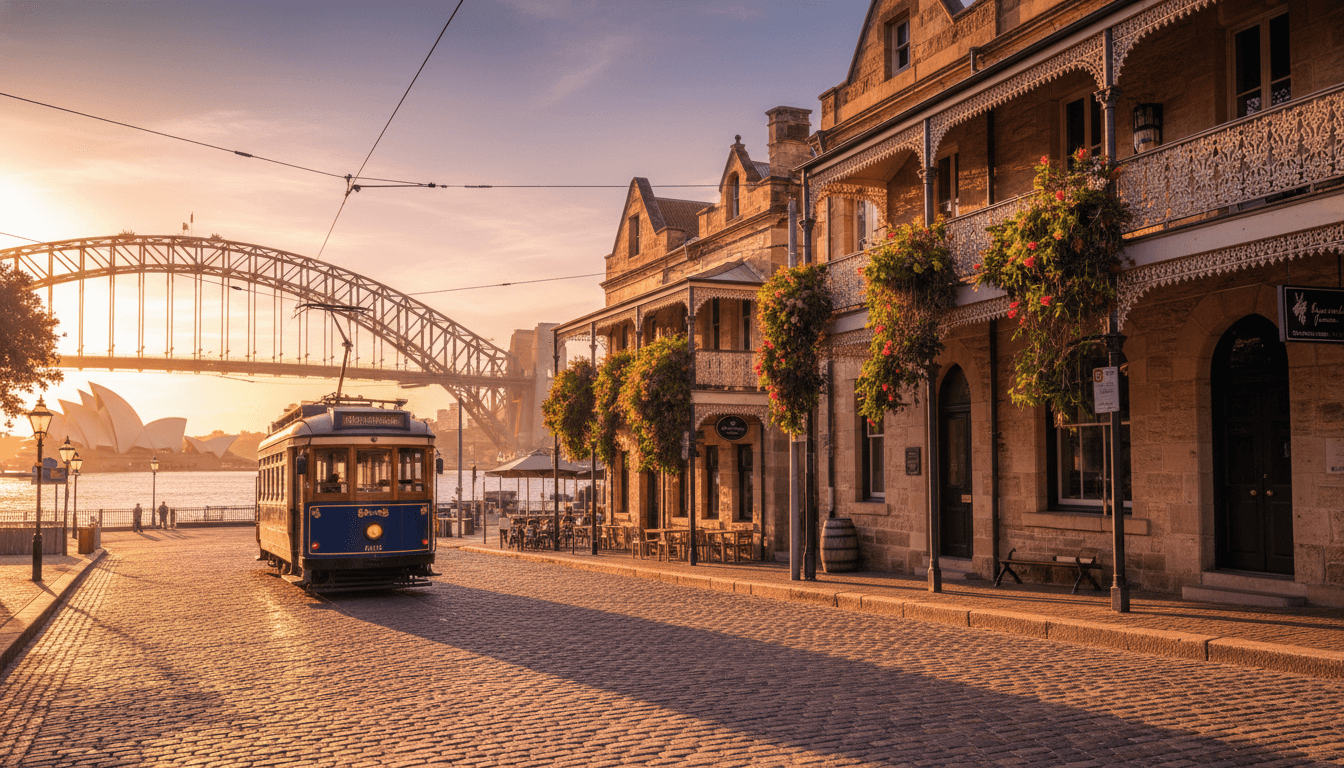
Home Exchange in Sydney: Your Complete Guide to Living Like a Local in Australia's Harbor City

SwappaHome Editorial Team
Home Exchange & Slow Travel Editorial
Discover how home exchange in Sydney lets you skip tourist traps, save thousands, and wake up to harbor views in neighborhoods most visitors never find.
The first time I woke up in Balmain, I genuinely forgot I wasn't home. Sunlight streaming through plantation shutters, a kookaburra doing its ridiculous laugh somewhere in the garden, the smell of coffee drifting up from the café downstairs. This wasn't a hotel. This was someone's life—and for three weeks, it was mine.
Here's the thing about home exchange in Sydney that nobody tells you: it doesn't just save you money (though it absolutely does—we'll get to that). It completely rewires how you experience this city. Instead of shuffling between Circular Quay and Bondi with every other tourist, you find yourself arguing with the barista at your local about flat white temperatures, learning which ferry wharf has the shortest lines, developing strong opinions about which beach is actually the best.
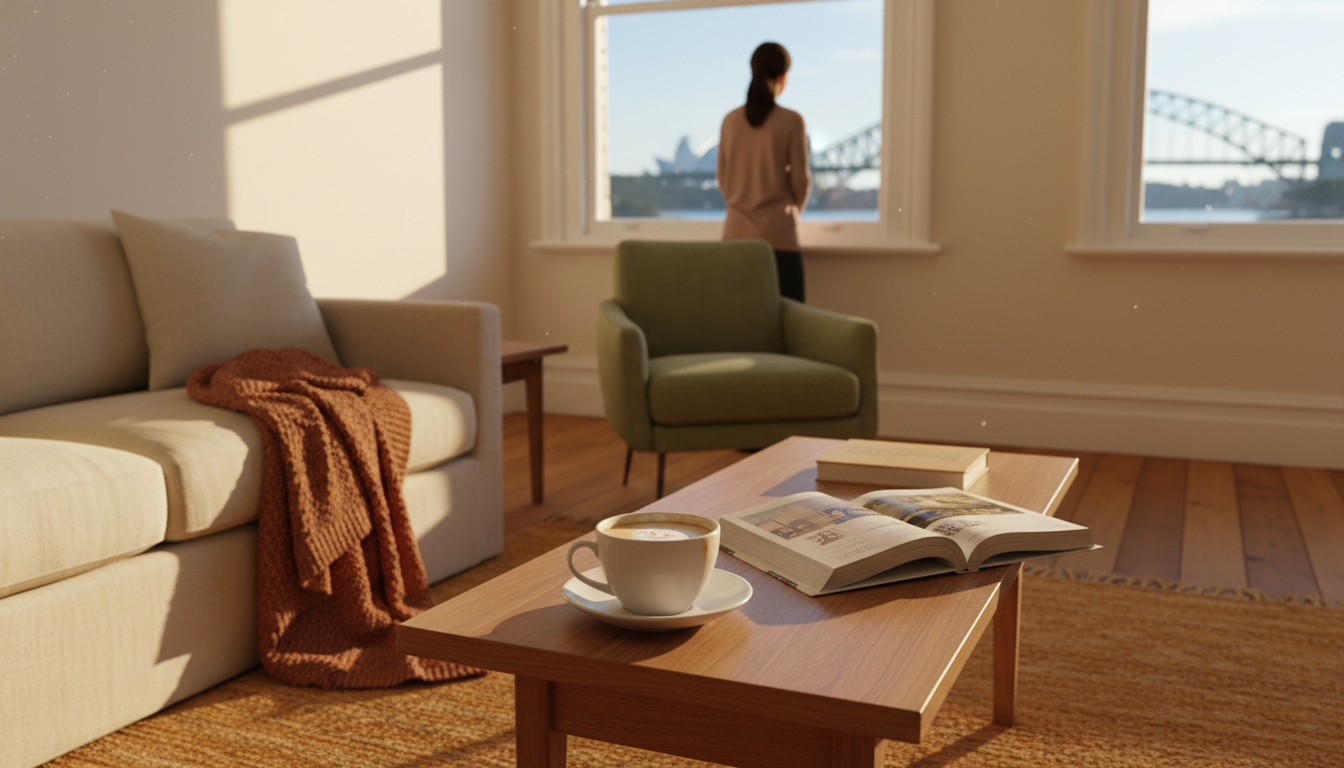 Morning light flooding through a Balmain terrace house living room, harbor glimpses through the wind
I've done home swaps on six continents now, but Sydney holds a special place. Maybe it's because Australians are genuinely enthusiastic about showing off their city—the welcome notes I've received here rival small novels. Or maybe it's because Sydney is secretly a collection of villages pretending to be a metropolis, and you can only discover that when you're actually living in one.
Why Home Exchange in Sydney Makes More Sense Than Anywhere Else
Here's a number that might make you choke on your morning coffee: the average hotel room in Sydney costs around $280 AUD ($185 USD) per night. And that's for something mid-range—nothing fancy, probably in a soulless tower near Darling Harbour where your "city view" is another hotel's air conditioning units.
A decent Airbnb? You're looking at $200-350 AUD ($130-230 USD) per night for a one-bedroom, plus cleaning fees that seem to increase every time I check. Over a two-week trip, that's easily $3,000-5,000 USD just on accommodation.
With home exchange through a platform like SwappaHome, you're spending exactly zero dollars on accommodation. The credit system is beautifully simple—you earn one credit for every night you host someone at your place, spend one credit for every night you stay somewhere else. New members start with 7 free credits, which means you could have a full week in Sydney before you've even hosted anyone.
But honestly? The money is almost beside the point.
What home exchange gives you in Sydney is access. Access to neighborhoods that don't have hotels. Access to kitchens where you can actually cook the incredible produce from Carriageworks Farmers Market. Access to backyards with lemon trees. Access to the kind of local knowledge that takes years to accumulate—handed to you in a welcome folder.
My Balmain host left me a hand-drawn map of her favorite walking route, including which houses had the best gardens to peek at and where to find the hidden staircase down to the water. You cannot buy that experience.
Best Sydney Neighborhoods for Home Exchange
Sydney sprawls. Like, really sprawls. Choosing where to stay matters enormously, and this is where home exchange shines—you're not limited to the hotel districts.
The Inner West: For the Culturally Curious
If I had to pick one area for a first-time Sydney home swap, it would be somewhere in the Inner West. Newtown, Marrickville, Enmore, Erskineville—these neighborhoods have the energy that made me fall in love with Sydney.
Newtown's King Street is a chaotic jumble of Thai restaurants, vintage shops, vegan cafés, and pubs that have been serving schooners since before your grandparents were born. The Victorian terrace houses here are stunning—many SwappaHome listings feature those classic iron lacework balconies and tiny courtyards bursting with frangipani.
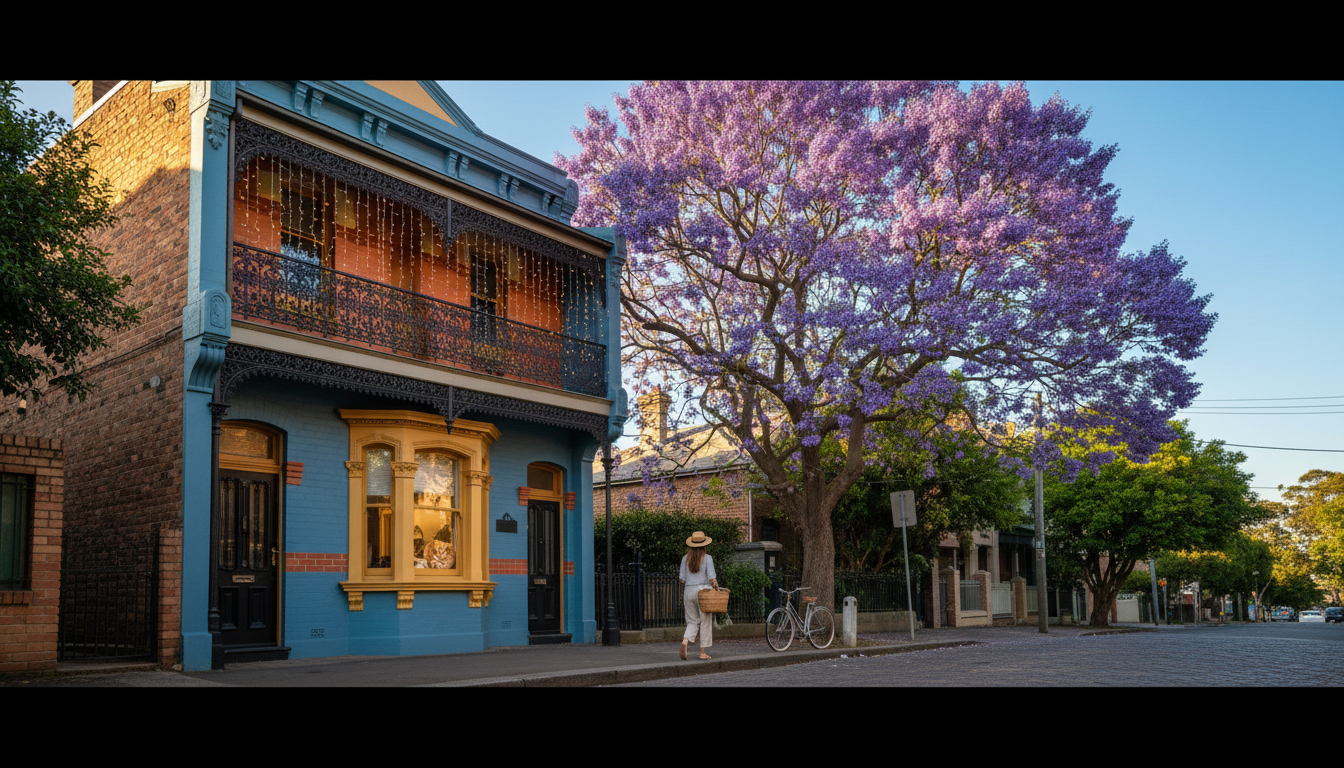 A colorful Victorian terrace house on a Newtown side street, iron lacework balcony draped with fairy
Marrickville has quietly become Sydney's food capital. The Marrickville Pork Roll from Marrickville Pork Roll (yes, that's actually the name—$8 AUD / $5.30 USD) is a religious experience. Greek bakeries, Vietnamese restaurants, Portuguese chicken shops—all within walking distance of wherever you're staying.
Public transport from the Inner West is excellent. The train from Newtown to Central takes 8 minutes, and from there you can get anywhere.
The Northern Beaches: For Beach Lovers Who Want Space
Manly gets all the attention, but the Northern Beaches stretch for 30 kilometers of coastline, and the further north you go, the more local it feels.
I did a home exchange in Avalon once—a weatherboard cottage three blocks from the beach—and it genuinely felt like a different country from the Sydney CBD. People surf before work. The café owners know everyone's name. The pace is slower, the air is saltier, and the beaches are significantly less crowded than Bondi.
The catch? You're 45-60 minutes from the city center by bus (the B-Line is your friend), and there's no train. But if you're planning a beach-focused trip and don't need to be in the CBD daily, the Northern Beaches offer some of the best home exchange value in Sydney—larger properties, often with gardens or pools, at the same one-credit-per-night rate as a studio apartment in Surry Hills.
The Eastern Suburbs: Classic Sydney
Bondi, Bronte, Coogee, Clovelly—these are the beaches you've seen in every Sydney tourism campaign. They're popular for a reason. The Bondi to Coogee coastal walk is genuinely spectacular, especially at sunrise before the crowds.
Home exchange listings in the Eastern Suburbs tend to be apartments rather than houses, often in Art Deco buildings with ocean glimpses. Expect smaller spaces but unbeatable locations. I stayed in a tiny Bronte flat once where I could hear the waves from bed. Worth every square meter I didn't have.
The Eastern Suburbs are well-connected by bus to the CBD (20-30 minutes to Circular Quay), and the new light rail makes getting to Central and beyond much easier than it used to be.
The Inner City: For Urban Explorers
Surry Hills, Darlinghurst, Paddington, Redfern—if you want walkability to restaurants, bars, galleries, and that buzzy inner-city energy, this is your zone.
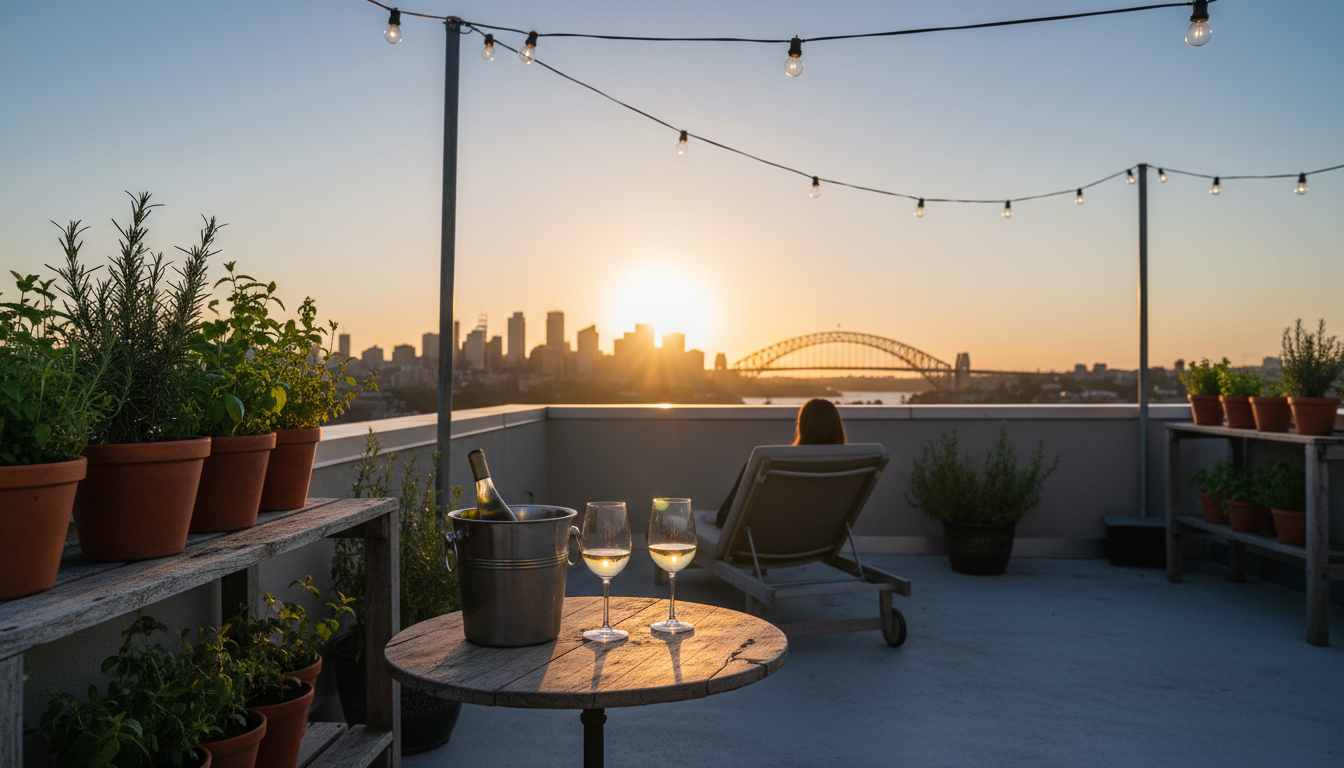 A rooftop terrace in Surry Hills at golden hour, Sydney skyline in the background, string lights, po
Surry Hills in particular has transformed over the past decade into Sydney's culinary heart. Crown Street is lined with restaurants that would be destination-worthy in any city—Firedoor, Poly, Nomad. The terrace houses here are beautiful but compact; expect steep stairs and narrow hallways in exchange for location.
Redfern has a more emerging, artsy feel—slightly grittier, significantly cheaper for dining out, and home to some excellent Indigenous-owned businesses and galleries. It's a 10-minute walk to Central Station.
The North Shore: For Families and Harbor Access
Kirribilli, Neutral Bay, Mosman—the Lower North Shore offers a quieter, more residential feel while still being incredibly close to the city. The ferry from Kirribilli to Circular Quay takes 5 minutes and delivers you right under the Harbour Bridge.
These neighborhoods have excellent home exchange options for families—more houses with yards, quieter streets, good playgrounds. Taronga Zoo is right there if you're traveling with kids.
How to Find the Perfect Sydney Home Exchange
Alright, let's get practical.
Start Your Search Early
Sydney is a popular home exchange destination, especially during the Australian summer (December-February) and around major events like Vivid Sydney (May-June) or the Sydney Festival (January). I'd recommend starting your search 3-4 months in advance for peak times, 6-8 weeks for shoulder seasons.
On SwappaHome, you can filter by location, dates, and property type. I always start by browsing what's available in my target neighborhoods before sending any requests.
Write a Compelling Request
Your initial message matters. A lot. Sydney hosts receive plenty of requests, and a generic "Hi, I'd like to stay at your place" won't cut it.
Mention something specific about their listing—their book collection, their neighborhood, their cat. Explain why you're visiting Sydney and what kind of traveler you are. Share a bit about your own home and what makes it special. Ask questions that show you've actually read their description.
Australians particularly appreciate directness and a bit of humor. Don't be stiff.
Be Flexible on Dates and Neighborhoods
If your heart is set on a specific two-week window in Bondi, you might be disappointed. But if you're open to "sometime in March" and "somewhere in the Eastern Suburbs," your options multiply dramatically.
I've discovered some of my favorite Sydney neighborhoods through home exchanges that weren't my first choice. That Balmain swap? I'd originally been looking at Surry Hills. The Balmain host reached out to me after seeing my listing, and I'm so glad I said yes.
Check Reviews and Verification
SwappaHome has a review system for a reason—use it. Look for hosts with multiple positive reviews, and pay attention to what previous guests say about communication, cleanliness, and accuracy of the listing.
Verified members have completed identity verification, which adds an extra layer of trust. I always feel more comfortable swapping with verified hosts, and I keep my own verification current.
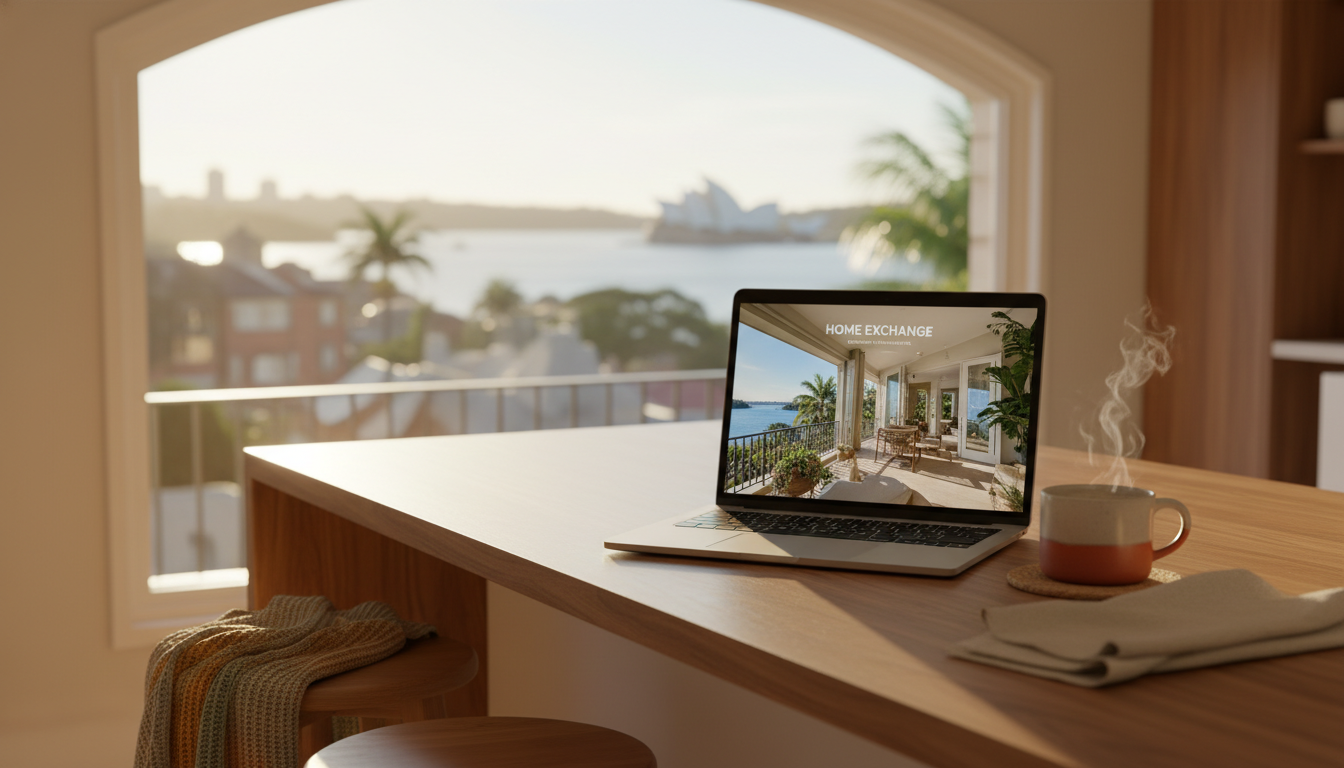 A laptop open on a kitchen counter showing a home exchange listing, morning light, coffee cup beside
What to Expect from Your Sydney Home Exchange Host
Australian home exchange hosts are, in my experience, exceptionally generous with information. I've received welcome documents that were basically short novels—restaurant recommendations organized by neighborhood, public transport tips, emergency contacts, detailed plant-watering instructions, and once, a hand-drawn map of the best sunset spots within walking distance.
Expect clear instructions about keys and access (many Sydney apartments have complex fob systems), wifi passwords and streaming service logins, garbage and recycling schedules (Australians are serious about recycling), any quirks of the property, pet care if applicable, and local recommendations.
What you shouldn't expect? Hotel-style service. You're staying in someone's home, not a serviced property. You'll need to do your own cleaning, change your own sheets, and generally treat the place like you'd want someone to treat yours.
This is actually one of my favorite things about home exchange—it keeps you grounded. You're not a guest floating above the city in a hotel bubble. You're a temporary local, with all the small responsibilities that entails.
Living Like a Local: Sydney Edition
Okay, you've secured your home exchange. Now what?
Master the Coffee Culture
Sydney takes coffee extremely seriously. The flat white was arguably invented here (Melbourne will fight me on this), and ordering a "regular coffee" will get you confused looks.
The vocabulary: flat white is espresso with steamed milk, less foam than a latte. Long black is espresso with hot water—what Americans call an Americano, but stronger. Short black is straight espresso. Piccolo is a small latte, basically.
Find your local café within the first day. Go back. Become a regular. The barista will start making your drink when they see you walk in, and this is when you know you've made it.
Some of my favorites: Single O in Surry Hills, Edition Coffee Roasters in Darlinghurst, Campos in Newtown, The Boathouse in Palm Beach.
Shop Like a Local
Forget the big supermarkets for produce. Sydney's farmers markets are where the magic happens.
Carriageworks Farmers Market (Saturdays, Eveleigh) is the flagship—over 80 stalls of seasonal produce, artisan bread, incredible cheese, and ready-to-eat food. Get there early; it gets crowded by 10am.
Orange Grove Markets (Saturdays, Lilyfield) is smaller and more neighborhood-focused. Bondi Farmers Markets (Saturdays) is perfect if you're staying in the East.
 A colorful spread of produce at Carriageworks Farmers Marketheirloom tomatoes, purple carrots, fresh
For everyday groceries, Harris Farm Markets has excellent produce at reasonable prices. Asian groceries in Haymarket (Chinatown) are unbeatable for value and variety.
Use Public Transport (Mostly)
Sydney's public transport is actually pretty good, despite what locals will tell you. Get an Opal card (or use a contactless credit card) and you're set for trains, buses, ferries, and light rail.
The ferries are the secret weapon. The commuter ferry from Circular Quay to Manly ($7.65 AUD / $5 USD) is basically a harbor cruise that locals take for granted. The Parramatta River ferry goes all the way to Parramatta, passing under the Harbour Bridge and through Sydney Olympic Park.
That said, some neighborhoods—Northern Beaches, parts of the Inner West—are much easier with a car. If your home exchange host offers use of their car, that's gold. If not, GoGet car-share has vehicles scattered throughout the city.
Embrace the Beach Life (Properly)
Yes, you should go to Bondi. Once. To say you did.
Then explore the beaches that don't have their own Instagram hashtag. Clovelly is a narrow inlet with calm water and excellent snorkeling. Balmoral has a shark net and calm harbor water—perfect for nervous swimmers. Freshwater, just south of Manly, has a fraction of the crowds. Milk Beach in Vaucluse feels like a secret.
Always swim between the flags. This isn't a suggestion—Australian beaches have rips that can be genuinely dangerous, and the volunteer lifesavers know where it's safe. Slip, slop, slap (slip on a shirt, slop on sunscreen, slap on a hat) isn't just a cute slogan; the Australian sun will destroy you.
Eat Where Locals Eat
Skip the Darling Harbour chain restaurants. Please.
For cheap eats: the food courts in Chinatown (especially Eating World and Dixon House), laksa at Malay Chinese Takeaway in Haymarket ($14 AUD / $9 USD), pork rolls in Marrickville, fish and chips at any actual fish market—not the tourist-trap restaurants at Sydney Fish Market, but the takeaway windows.
For a proper meal: Ester in Chippendale for modern Australian, Mr. Wong in the CBD for Cantonese (go for yum cha on weekends), Cho Cho San in Potts Point for Japanese, Sixpenny in Stanmore if you want to splurge.
Pub meals are underrated. The Courthouse Hotel in Newtown, the Woollahra Hotel in Paddington, the Riverview Hotel in Balmain—all do excellent, affordable food in beautiful heritage buildings.
Practical Tips for Your Sydney Home Exchange
Timing Your Visit
Sydney is genuinely pleasant year-round, but each season has its character.
Summer (December-February): Hot, humid, crowded. Beach weather, but also bushfire season and occasional smoke haze. New Year's Eve is spectacular but chaotic. Expect temperatures of 25-35°C (77-95°F).
Autumn (March-May): My favorite. Warm days, cool nights, smaller crowds, beautiful light. The ocean is still warm enough to swim. Temperatures around 15-25°C (59-77°F).
Winter (June-August): Mild by Northern Hemisphere standards—rarely below 8°C (46°F)—but Sydney houses are notoriously poorly insulated. Bring layers. Vivid Sydney lights up the city in May-June.
Spring (September-November): Gorgeous, but unpredictable. Jacarandas bloom purple across the city in October-November. Temperatures climbing from 15-25°C (59-77°F).
What to Bring
Sydney is casual. Very casual. You will be overdressed in anything more formal than nice jeans and a decent top for 95% of situations.
Essentials: reef-safe sunscreen (SPF 50+), a good hat, comfortable walking shoes, a light jacket even in summer (air conditioning is aggressive), swimmers/bathers/togs (whatever you call swimwear), and a reusable water bottle.
Getting Around the Costs
Sydney is expensive—one of the most expensive cities in the world, actually. But home exchange immediately eliminates your biggest cost. Here's how to manage the rest:
Eat breakfast at home (your home exchange kitchen!). Make lunch your main meal out—many restaurants offer cheaper lunch specials. Take advantage of happy hours from 4-6pm at most bars. Use the free attractions: coastal walks, beaches, Barangaroo Reserve, The Rocks markets, Art Gallery of NSW (free general admission). Buy an Opal card and travel on Sundays, when fares are capped at $8.05 AUD for unlimited travel.
Being a Great Home Exchange Guest in Sydney
This part matters. The home exchange community runs on trust and reciprocity. Be the guest you'd want in your own home.
Before you arrive, confirm all details with your host at least a week before, share your arrival time and any delays, ask about parking if you're renting a car, and clarify any questions about the property.
During your stay, follow the house rules (they exist for a reason), take care of any plants or pets as agreed, keep the place reasonably tidy, and report any issues immediately—don't wait until checkout. Don't rearrange furniture or personal items. Be mindful of neighbors; Sydney terraces share walls.
Before you leave, clean thoroughly—leave it as clean as you found it, ideally cleaner. Run the dishwasher, take out trash, strip the beds unless told otherwise. Replace anything you've used up (toilet paper, basic pantry items). Return keys exactly as instructed. Leave a small thank-you gift if you can—local treats from your hometown, a nice card.
After your stay, write a thoughtful review on SwappaHome, send a personal thank-you message, and respond if your host has any questions.
I've maintained friendships with several of my Sydney hosts. One couple has visited me in San Francisco twice. That's the magic of home exchange—it creates connections that outlast the trip.
A Note on Safety and Trust
I get asked about this a lot: "Isn't it weird staying in a stranger's home?"
Honestly? It felt weird the first time. By the third swap, it felt completely natural.
The SwappaHome community is built on mutual trust. Everyone has skin in the game—if you trash someone's house, they can review you, and your home exchange days are effectively over. The review system creates accountability that hotels simply don't have.
That said, I always recommend getting your own travel insurance that covers accommodation issues, and checking whether your home insurance covers guests if you're hosting. SwappaHome connects members but doesn't provide insurance coverage—that's on you to arrange if you want it.
Use the messaging system to get to know your host before committing. Video chat if it helps. Trust your instincts.
In seven years and 40+ swaps, I've never had a serious issue. The worst was a miscommunication about laundry detergent. The home exchange community self-selects for trustworthy people—you have to be a certain kind of person to open your home to strangers, and that kind of person tends to be pretty great.
Making It Happen
I could write another 5,000 words about Sydney. I haven't even mentioned the Blue Mountains day trips, or the Hunter Valley wine region, or the fact that you can see whales migrating past the coast from May to November.
But here's what I really want you to take away: home exchange in Sydney isn't just a budget hack. It's a completely different way of experiencing one of the world's great cities. You stop being a tourist and start being, however temporarily, a local.
You learn that Sydney isn't really about the Opera House or the Harbour Bridge—those are just the postcards. Sydney is about the morning swim at your local beach, the flat white from your local café, the sunset from your local park. And you can only access that "local" when you're actually living somewhere.
SwappaHome makes it surprisingly easy to find your Sydney home. Browse the listings, send some messages, be genuine about who you are and what you're looking for. Somewhere in this sprawling, sun-drenched city, there's a terrace house or a beach apartment or a harbor-view flat waiting for you.
I'll probably see you at the farmers market. I'll be the one arguing with the cheese vendor about aged cheddar.
Frequently Asked Questions
Is home exchange in Sydney safe for first-time swappers?
Absolutely. Sydney's home exchange community is well-established and welcoming to newcomers. Use SwappaHome's verification features, read reviews carefully, and communicate thoroughly with your host before booking. The review system creates accountability, and most Sydney hosts are experienced and helpful. I'd recommend starting with a verified host who has multiple positive reviews for your first swap.
How much money can I save with home exchange in Sydney compared to hotels?
Substantially. Average Sydney hotel rooms cost $185 USD per night, while decent Airbnbs run $130-230 USD nightly. Over a two-week trip, home exchange saves you $2,600-4,200 USD on accommodation alone. With SwappaHome's credit system (one credit per night, 7 free credits for new members), your accommodation cost is effectively zero—just the annual membership fee.
What's the best neighborhood in Sydney for home exchange?
It depends on your priorities. The Inner West (Newtown, Marrickville) offers the best food scene and cultural vibe. The Eastern Suburbs (Bondi, Bronte) provide classic beach access. The Northern Beaches (Manly, Avalon) suit families and surf enthusiasts. The Inner City (Surry Hills, Paddington) delivers walkable urban energy. I recommend the Inner West for first-timers—excellent transport links and authentic local atmosphere.
When is the best time to do a home exchange in Sydney?
Autumn (March-May) offers ideal conditions: warm weather, swimmable ocean temperatures, fewer crowds, and beautiful light. Spring (September-November) is equally pleasant with jacaranda blooms. Summer (December-February) is peak season with higher demand and heat. Winter (June-August) is mild but Sydney homes can feel cold. Book 3-4 months ahead for summer, 6-8 weeks for other seasons.
Do I need a car for a Sydney home exchange?
Not necessarily. Sydney's public transport—trains, buses, ferries, and light rail—covers most areas well. The Inner West, Inner City, and Eastern Suburbs are highly walkable with excellent connections. However, the Northern Beaches and some outer suburbs are easier with a car. Check if your home exchange host offers car access; otherwise, GoGet car-share operates throughout the city for occasional trips.

Published by
SwappaHome
SwappaHome Editorial Team
Home Exchange & Slow Travel Editorial
The SwappaHome Editorial Team brings together travel research, home-exchange community insights, and platform data to produce practical guides for first-time and experienced home swappers. Every article cites real platforms, current market rates, and verifiable city-level facts so readers can make informed decisions without guessing.
Ready to try home swapping?
Join SwappaHome and start traveling by exchanging homes. Get 7 free credits when you sign up!
Related articles
Bachelor and Bachelorette Parties in Singapore: The Complete Home Swap Group Guide for 2026
Planning a bachelor or bachelorette party in Singapore? Discover how home swapping lets groups of 6-12 stay together in luxury condos, saving thousands while partying in Marina Bay.

Cycling in Lisbon: 7 Home Swap Bike Tour Itineraries for Every Rider
Discover the best cycling routes in Lisbon with these home swap bike tour itineraries—from waterfront paths to hilltop adventures, all starting from your borrowed home.

Graduation Trip to Barcelona: How Home Swapping Gives New Graduates the Ultimate Celebration
Planning a graduation trip to Barcelona? Discover how home swapping lets new graduates explore Spain's most vibrant city without the hostel crowds or hotel costs.