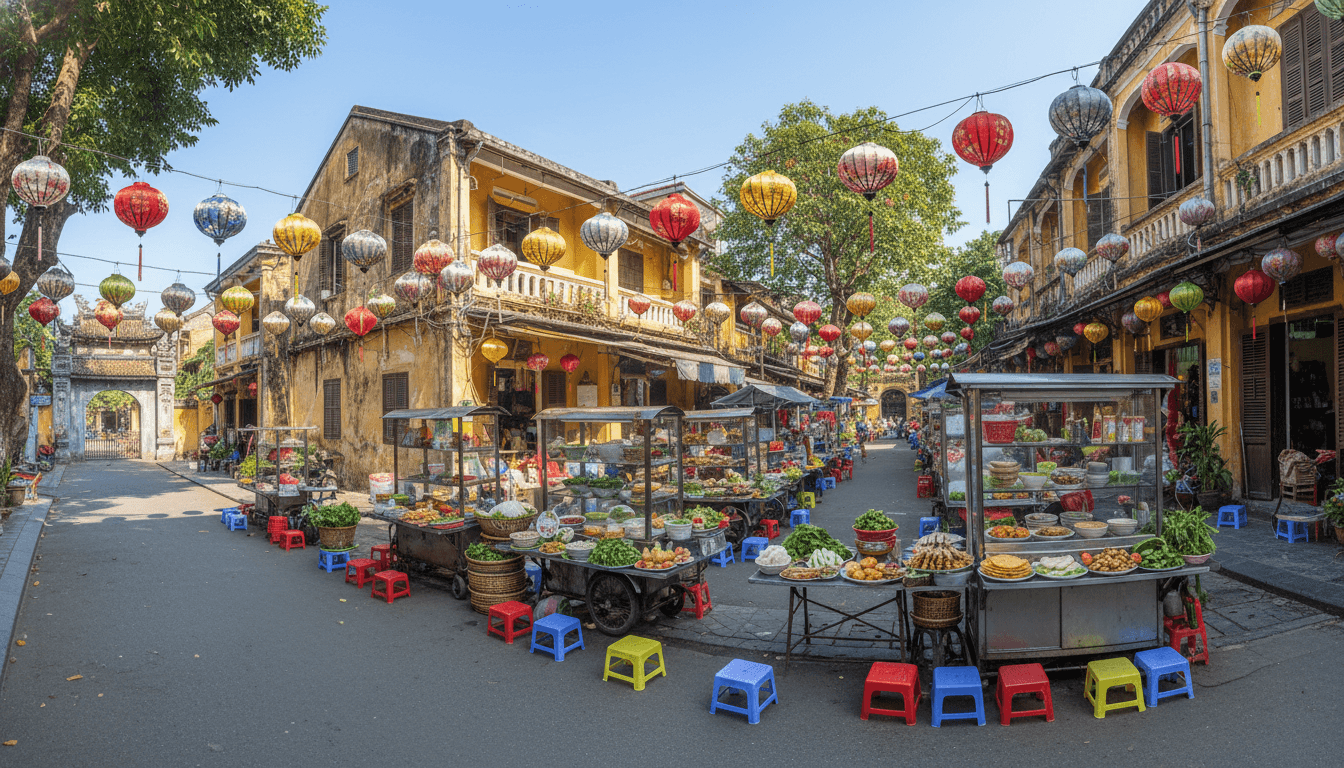
Hanoi Markets and Food Tours: A Home Swapper's Complete Guide to Vietnamese Street Food

SwappaHome Editorial Team
Home Exchange & Slow Travel Editorial
Discover Hanoi's best markets and food tours through a local lens. From dawn phở runs to midnight bánh mì hunts, this guide covers every delicious corner.
The first time I woke up in a Hanoi home swap, I made a rookie mistake. I'd planned to ease into the day, maybe grab breakfast around 9am. By the time I shuffled onto the balcony of my host's apartment in Ba Đình District, the street below was already in full chaos—motorbikes weaving between women carrying bamboo poles laden with produce, the air thick with charcoal smoke and the unmistakable funk of fish sauce hitting hot oil.
My host had left a note: "Breakfast at the corner. Look for the blue plastic stools. Tell them Linh sent you."
That bowl of bún chả changed everything I thought I knew about Hanoi markets and food tours. Here's what no guidebook tells you: the best food in this city isn't found on organized tours or in restaurants with English menus. It's found through connections—through neighbors, through hosts, through the kind of local knowledge you only get when you're actually living in someone's home.
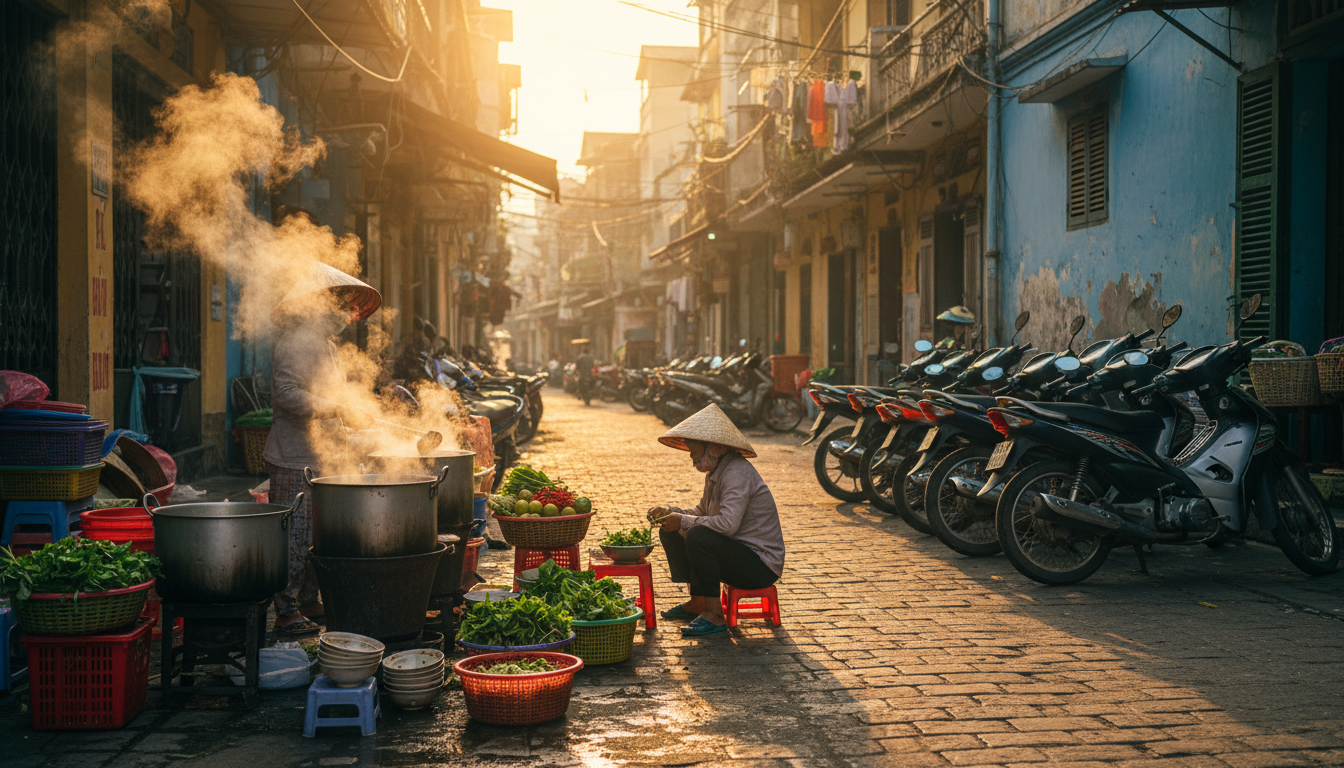 Early morning street scene in Hanois Old Quarter with vendors setting up food stalls, steam rising f
I've done home swaps in 25 countries now. But Vietnam—specifically Hanoi—remains the destination where the home exchange model delivers the most dramatic advantage over traditional travel. When you're staying in a local's apartment instead of a hotel in the tourist district, you're not just saving money. You're gaining access to an entirely different city.
Why Hanoi Markets Demand Local Knowledge
Let me be direct: you can absolutely explore Hanoi's markets on your own. Thousands of tourists do it every day. They walk through Đồng Xuân Market, take photos of the hanging ducks, buy some knockoff North Face gear, and leave thinking they've "done" the market scene.
They've missed about 90% of it.
Hanoi's market culture operates on layers. The tourist layer is obvious—it's the ground floor of the big markets, the English signs, the vendors who quote prices in dollars. But beneath that exists a parallel universe of wholesale floors that open at 3am, specialty sections where locals buy ingredients you won't find in any restaurant, and neighborhood markets so hyperlocal that outsiders literally don't know they exist.
During my three-week home swap last March, my host Minh drew me a map on the back of a receipt. Seven markets within walking distance of his apartment—none of which appeared in my Lonely Planet guide. One sold only tofu and soy products. Another specialized in herbs and traditional medicine. A third was exclusively for breakfast foods and shut down by 8am.
"The big markets are for tourists and wholesale buyers," Minh explained. "Real Hanoians shop at the small ones."
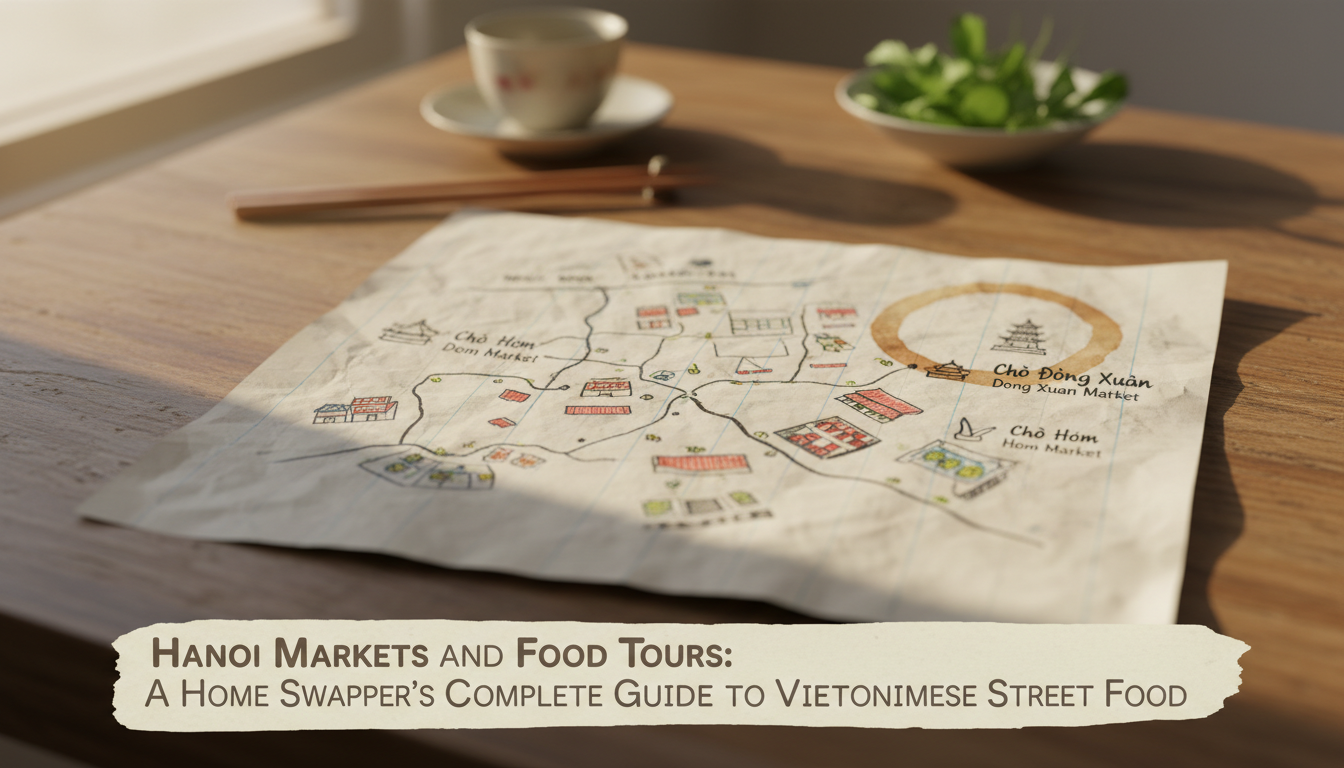 Hand-drawn map on Vietnamese receipt paper showing neighborhood market locations with annotations in
The Essential Hanoi Markets You Actually Need to Visit
I'm going to give you the honest breakdown—which markets are worth your time, which are tourist traps, and which hidden gems require a local connection to properly experience.
Đồng Xuân Market: The Necessary Evil
Yes, it's touristy. Yes, you'll get hassled. But Đồng Xuân Market remains Hanoi's largest covered market, and skipping it entirely means missing genuine cultural context.
The trick is timing and location. The ground floor during daylight hours? Skip it unless you need cheap luggage or want to practice saying "không, cảm ơn" (no, thank you) four hundred times. But the upper floors—specifically the fabric and clothing wholesale sections—operate in a completely different register. Vendors there deal primarily with Vietnamese buyers and largely ignore tourists.
The real magic happens between 2am and 6am when the night market takes over the surrounding streets. This is when Hanoi's restaurant owners come to buy ingredients, when the flower sellers unload trucks from the countryside, when you can eat phở gà (chicken phở) at 4am surrounded by market workers on their break.
I went three times during my swap. Once during the day (regretted it), once at 4am (life-changing), and once at sunset when the transition between day market and night market creates this liminal chaos that felt like watching a city breathe.
Chợ Hôm: Where Hanoians Actually Shop
If Đồng Xuân is the market tourists visit, Chợ Hôm is the market they should visit. Located in Hai Bà Trưng District, about a 15-minute walk from Hoàn Kiếm Lake, this three-story market serves actual Hanoi residents buying actual daily necessities.
The ground floor food section is staggering. I counted seventeen different types of tofu alone. The bánh cuốn (steamed rice rolls) vendor near the east entrance makes them fresh every morning—she starts at 5:30am and sells out by 9am. A serving costs 25,000 VND (about $1 USD), and watching her work is like watching someone perform surgery with rice batter.
The upper floors sell fabric, clothing, and household goods at prices roughly 40% lower than Đồng Xuân. My host's mother apparently buys all her áo dài fabric here—has for thirty years.
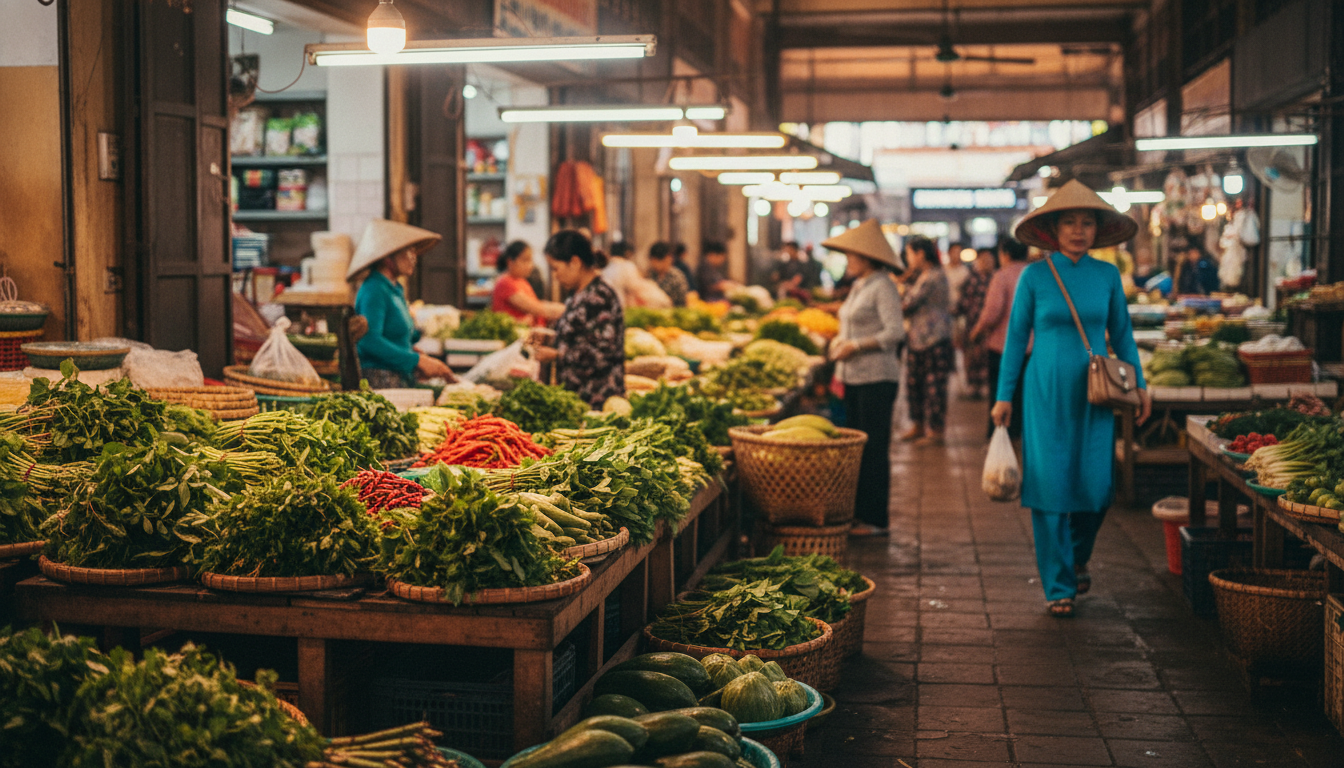 Interior of Ch Hm market showing Vietnamese women shopping at produce stalls, piles of fresh herbs a
Long Biên Market: The 3am Experience
This one requires commitment. Long Biên Market operates from roughly midnight to 6am under the Long Biên Bridge, and it's the wholesale hub that supplies much of Hanoi's produce.
I'm not going to pretend this is comfortable. You'll be exhausted, possibly confused, definitely in the way. But if you want to understand how Hanoi actually feeds itself, there's no substitute.
The scale is overwhelming—trucks arriving from farms across northern Vietnam, porters carrying impossible loads on bamboo poles, buyers negotiating prices for quantities measured in hundreds of kilograms. The smell is intense: ripe fruit, diesel exhaust, river water, and something green and alive that I can only describe as "agriculture."
My advice: go with someone who knows the market. My host's nephew worked as a porter there during university, and he took me through at 3am. Without him, I would have wandered aimlessly and probably gotten run over by a motorbike carrying 200 pineapples.
Neighborhood Markets: The Real Secret
Every Hanoi neighborhood has its own small market, usually operating from around 6am to noon. These don't have names that appear on Google Maps. They're just... there. A cluster of vendors on a particular street corner, a converted alley, a courtyard behind an apartment building.
When you're doing a home swap in Hanoi, ask your host about their neighborhood market. Not the nearest famous market—their actual daily shopping spot. This is where you'll find the best prices, the freshest ingredients, and the complete absence of English.
In Ba Đình, my host's market was a narrow alley off Đội Cấn Street. The phở vendor there had been serving the same recipe for forty years. A bowl cost 35,000 VND ($1.40 USD) and came with a plate of herbs so fresh they were still wet from washing. No menu. No English. Just point at what others are eating and trust the process.
Hanoi Food Tours: An Honest Assessment
Let's talk about the organized food tour situation, because I know some of you are thinking "this sounds great but I don't have a local host to guide me."
Hanoi food tours range from excellent to actively harmful to your wallet and taste buds. I've done four of them across different trips—two before I discovered home swapping, two during swaps when I wanted to compare experiences.
The Good: Small Group Walking Tours
The best Hanoi food tours share certain characteristics: small groups (under 8 people), local guides who actually grew up in the city, and itineraries that include at least one stop the guide personally frequents when not working.
I had a genuinely great experience with a tour that started at 5pm in the Old Quarter and wound through back alleys for four hours. The guide, a woman named Hương who'd grown up in Hanoi, took us to her aunt's bánh mì cart—a spot with no signage that I never would have found alone. The tour cost $45 USD and included about eight food stops plus beer.
What made it work: Hương clearly loved the food. She wasn't reciting facts; she was sharing her city. When we asked about her favorite dish, she got genuinely animated talking about her grandmother's bún riêu recipe.
The Bad: Large Group Bus Tours
Avoid any food tour that involves a bus, a microphone, or more than 10 participants. These tours hit the same five restaurants that pay commissions, serve tourist-adjusted versions of dishes, and cost twice as much as walking tours.
I made this mistake on my first Hanoi trip. Forty dollars for lukewarm phở at a restaurant with laminated English menus. Never again.
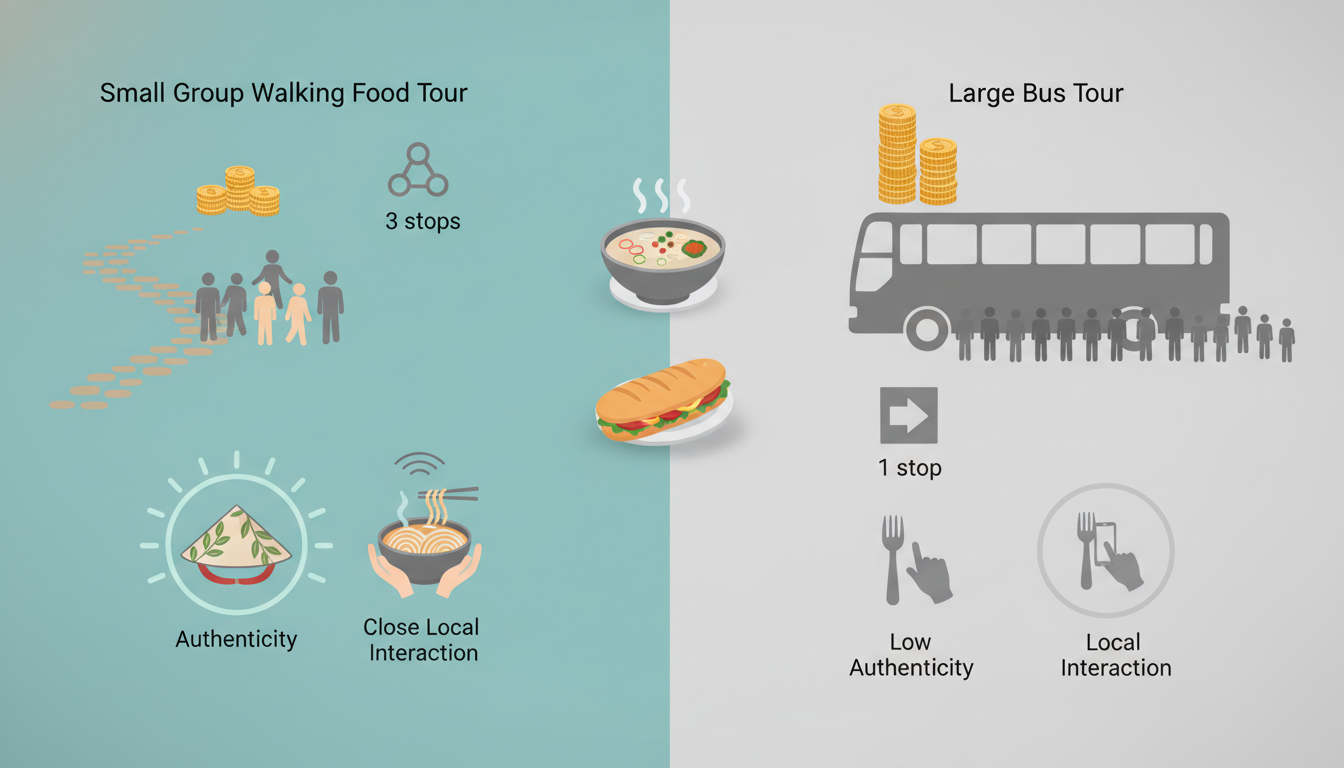 Comparison infographic showing small group walking food tour vs large bus tour - price per person, n
The Alternative: DIY Food Tours with Local Intel
Here's where the home swap advantage becomes undeniable. When you're staying in a Hanoian's home, you have access to something no tour company can provide: genuine local recommendations with context.
My host Minh didn't just tell me where to eat—he told me what to order, when to go, and how to navigate the social dynamics. "The phở place on Bát Đàn is good, but only before 8am. After that, the broth gets weak. Order the tái (rare beef), not the chín (well-done). Sit at the back table—the front ones are for takeaway customers."
This kind of granular knowledge transforms eating from tourism into participation. You're not observing Hanoi food culture; you're joining it.
Building Your Own Hanoi Food Itinerary
After multiple trips and one extended home swap, I've developed what I consider the optimal approach to experiencing Hanoi's food scene. It combines market visits, strategic food tour participation, and the kind of wandering that only works when you have a local base.
Day One: Orientation and Breakfast Culture
Start early—like, 6am early. Hanoi's breakfast culture is its own universe, and missing it means missing the city's most vibrant food hours.
Walk to your nearest neighborhood market (ask your host). Don't try to buy anything yet—just observe. Notice how transactions happen, how locals select produce, how vendors arrange their stalls. Get a feel for the rhythm.
Then find a phở stall. Not a restaurant—a stall. Look for plastic stools, a massive steaming pot, and a crowd of Vietnamese people eating quickly before work. Point at what someone else is having. Eat. Pay (probably 40,000-50,000 VND, around $1.60-2 USD). Leave.
Spend the rest of the morning walking the Old Quarter, but skip the markets until you've gotten your bearings. The sensory overload of Đồng Xuân on your first day will just exhaust you.
Day Two: Market Deep Dive
Now you're ready. Start at Chợ Hôm around 7am. Spend two hours exploring methodically—ground floor food section first, then upper floors for context on non-food commerce. Buy something small: a bag of fresh herbs, some fruit, maybe a bánh cuốn from the vendor near the east entrance.
In the afternoon, consider booking a small-group food tour for the evening. Yes, I know I just spent paragraphs explaining how home swaps provide better access than tours. But a good guided tour on your second day gives you vocabulary, context, and confidence for independent exploration later.
Day Three and Beyond: The Real Work
This is where the home swap model pays dividends. By day three, you should be asking your host questions: Where do you buy your coffee beans? Which bánh mì cart do you actually use? What's your favorite dish that tourists never try?
Follow their recommendations religiously. If they say go to a specific intersection at 7pm for the best bún chả, do exactly that. If they warn you away from a popular restaurant, trust them.
My host Minh's sleeper recommendation: a tiny shop in Cầu Giấy District that sold only chả cá (turmeric fish with dill). No English menu, no tourist reviews, just incredible fish at prices roughly 60% lower than the famous Chả Cá Lã Vọng restaurant that appears in every guidebook.
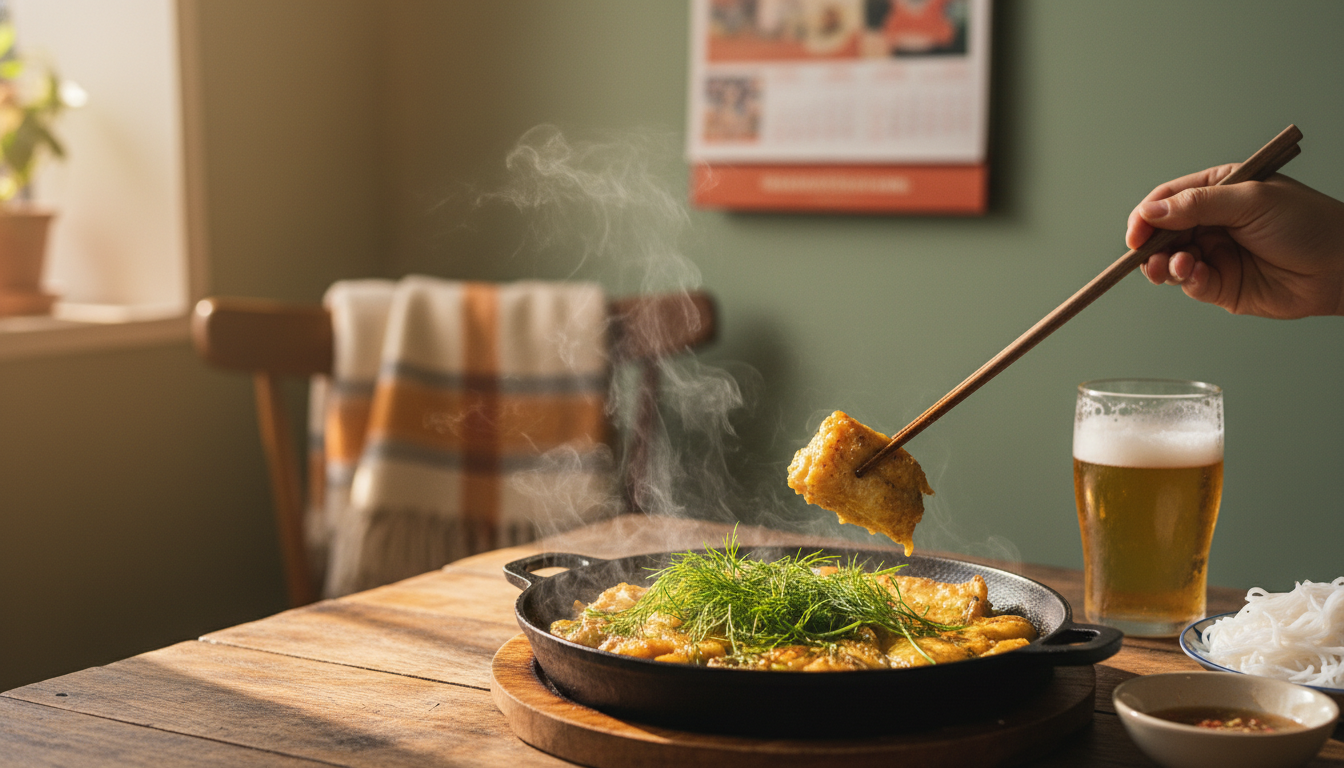 Sizzling ch c in cast iron pan with fresh dill and turmeric, chopsticks hovering, beer in background
The Night Market Scene: Beyond Food
Hanoi's night markets deserve separate attention because they're not primarily about food—though food is everywhere.
The weekend night market on Hàng Đào Street (Friday-Sunday evenings) is the most famous, stretching through the Old Quarter with hundreds of vendors selling everything from handicrafts to bootleg sneakers. It's crowded, loud, and honestly kind of exhausting. But the side streets feeding into the main market contain some of the city's best casual eating.
Look for the vendors selling ốc (snails) cooked in various styles. This is quintessential Hanoi street food that tourists often overlook because, well, snails. But the garlic butter preparation at the corner of Hàng Buồm and Tạ Hiện is legitimately one of the best things I've eaten anywhere. A plate costs about 60,000 VND ($2.40 USD) and comes with cold Hanoi beer.
The night market around Đồng Xuân (the one I mentioned earlier, operating 2am-6am) is different—it's a working market, not a tourist attraction. Come here for the experience of seeing Hanoi's food supply chain in action, not for shopping.
Practical Logistics: Money, Timing, and Stomach Prep
A few things I wish someone had told me before my first Hanoi market and food tour experience:
Cash is king. Most market vendors and street food stalls don't accept cards. ATMs are everywhere, but withdraw in larger amounts to minimize fees. Budget roughly 200,000-300,000 VND ($8-12 USD) per day for food if you're eating street food and market stalls. Double that if you want restaurant meals.
Timing matters more than location. The same stall can be transcendent at 7am and mediocre at 11am. Ask locals about optimal timing for specific dishes—phở is a morning food, bún chả is lunch, and certain dishes only appear at specific hours.
Your stomach will need adjustment. I'm not trying to scare you, but Hanoi street food involves unfamiliar bacteria, different oil types, and aggressive spice levels. Start slowly. Don't eat at five different stalls on your first day. Build up tolerance gradually.
Learn basic Vietnamese food vocabulary. Even a few words—phở, bún, bánh, chả, nước (water), cay (spicy), không cay (not spicy)—dramatically improve your experience. Vendors appreciate the effort, and you'll order more accurately.
Why Home Swapping Transforms the Hanoi Food Experience
I've been circling this point throughout, but let me make it explicit: the difference between experiencing Hanoi markets and food tours as a hotel tourist versus a home swapper isn't incremental. It's categorical.
When you stay in a hotel—even a nice boutique hotel in the Old Quarter—you exist in a tourist bubble. Your interactions are transactional. Your recommendations come from concierges who've been trained to send guests to commission-paying restaurants. Your market visits are performances.
When you're home swapping, you're living in someone's actual neighborhood. You shop at their market because it's the closest market. You eat at their breakfast spot because it's on your way to the Metro. You receive recommendations from someone who has no financial incentive to steer you anywhere—just genuine pride in sharing their city.
My host Minh spent an entire evening teaching me how to properly eat bún chả—the correct ratio of meat to noodles to herbs, the right amount of nước chấm (dipping sauce), the technique for adding chili without overwhelming the dish. This wasn't a tour. It wasn't a service. It was a neighbor teaching a guest.
That's what SwappaHome enables. The platform's credit system means you can host travelers in your own city, earn credits, and use them to stay in homes across Vietnam—or anywhere else. The community aspect creates accountability through reviews, so hosts are genuinely invested in making your experience great.
I've used my credits for stays in Hội An, Đà Nẵng, and Hồ Chí Minh City, each time receiving the same kind of local knowledge that transformed my Hanoi experience. The 7 free credits new members receive would cover a full week of accommodation—enough time to properly explore any Vietnamese city's food scene.
The Markets and Food Tours I'd Skip
Honesty requires mentioning what's not worth your time:
Bát Tràng Ceramic Village: Often packaged with market tours, this "traditional pottery village" is now essentially a tourist shopping complex. The ceramics are nice but overpriced, and the "traditional" demonstrations are staged.
Cooking classes that start with market tours: These sound great in theory—visit a market, buy ingredients, cook a meal. In practice, the market visit is rushed and performative, and the cooking class teaches simplified tourist versions of dishes. If you want to learn Vietnamese cooking, do a dedicated cooking class and explore markets separately.
Any food tour over $60 USD: Hanoi street food is cheap. A tour that costs more than $60 is either including unnecessary extras (air-conditioned transport, "premium" restaurants) or simply overcharging. The best tours I've done cost $35-45 USD.
Sunset boat tours with dinner: The Red River is not scenic. The dinner is mediocre. You're paying for an Instagram moment that won't look as good as you imagine.
Eating Like You Live There
I've written 3,000 words about Hanoi markets and food tours, and I realize I've mostly written about something else entirely: the difference between visiting a place and temporarily living there.
The markets don't change based on how you're traveling. The phở tastes the same whether you're staying at the Sofitel or in a local's spare bedroom. But your relationship to the experience changes everything.
When you're home swapping, you have time. You can return to the same breakfast stall three days in a row until the vendor starts preparing your order when she sees you coming. You can explore the same market at different hours, noticing how the light changes, how the crowd shifts, how the vendors' energy evolves through the day.
You can fail—order something you hate, get lost in an unfamiliar neighborhood, show up at a stall after it's closed—and try again tomorrow. Tourism doesn't allow for failure. Home swapping does.
My last morning in Hanoi, I walked to the corner phở stall at 6:30am. The owner—a woman named Lan who'd served me breakfast every day for three weeks—had my bowl ready before I sat down. She'd added extra herbs because she'd noticed I always asked for more. She charged me the local price, not the tourist price.
That moment cost me nothing except the willingness to live somewhere instead of just visiting.
The markets will be there whenever you arrive. The food tours will keep running. But the experience of being known, of belonging even temporarily, of eating like you live there—that requires a different kind of travel.
SwappaHome makes that kind of travel possible. And honestly? The food tastes better when you're home.
Frequently Asked Questions
What are the best Hanoi markets for food and local products?
The best Hanoi markets for authentic food shopping are Chợ Hôm for daily produce and local ingredients, Đồng Xuân's night market (2am-6am) for wholesale produce and restaurant-quality ingredients, and neighborhood markets specific to your district. Long Biên Market offers the most dramatic wholesale experience but requires 3am commitment and ideally a local guide.
How much do Hanoi food tours cost and are they worth it?
Quality Hanoi food tours cost $35-50 USD for small-group walking tours lasting 3-4 hours with 6-8 food stops included. These are worth it for first-time visitors seeking context and confidence. Avoid tours over $60 USD or those involving buses—they typically visit commission-paying restaurants serving tourist-adjusted dishes.
Is Hanoi street food safe for tourists to eat?
Hanoi street food is generally safe when you follow local patterns: eat at busy stalls with high turnover, choose places where locals eat, start slowly to let your stomach adjust, and avoid pre-made dishes sitting at room temperature. Most stomach issues come from eating too much variety too quickly rather than food safety problems.
What time do Hanoi markets open and close?
Hanoi market hours vary dramatically by type. Neighborhood markets operate roughly 6am-noon. Đồng Xuân Market's tourist areas run 6am-6pm, while its night wholesale market operates midnight-6am. Long Biên wholesale market peaks between 2am-5am. The weekend night market on Hàng Đào runs Friday-Sunday evenings from 7pm-midnight.
What Vietnamese phrases should I know for Hanoi markets and food stalls?
Essential Vietnamese for markets: "bao nhiêu" (how much), "không cay" (not spicy), "cay" (spicy), "nước" (water), "một" (one), "cảm ơn" (thank you). For food: know dish names like phở, bún chả, bánh mì, bánh cuốn. Pointing and smiling works remarkably well—vendors appreciate any attempt at Vietnamese, however imperfect.

Published by
SwappaHome
SwappaHome Editorial Team
Home Exchange & Slow Travel Editorial
The SwappaHome Editorial Team brings together travel research, home-exchange community insights, and platform data to produce practical guides for first-time and experienced home swappers. Every article cites real platforms, current market rates, and verifiable city-level facts so readers can make informed decisions without guessing.
Ready to try home swapping?
Join SwappaHome and start traveling by exchanging homes. Get 7 free credits when you sign up!
Related articles
Bachelor and Bachelorette Parties in Singapore: The Complete Home Swap Group Guide for 2026
Planning a bachelor or bachelorette party in Singapore? Discover how home swapping lets groups of 6-12 stay together in luxury condos, saving thousands while partying in Marina Bay.
Cycling in Lisbon: 7 Home Swap Bike Tour Itineraries for Every Rider
Discover the best cycling routes in Lisbon with these home swap bike tour itineraries—from waterfront paths to hilltop adventures, all starting from your borrowed home.

Graduation Trip to Barcelona: How Home Swapping Gives New Graduates the Ultimate Celebration
Planning a graduation trip to Barcelona? Discover how home swapping lets new graduates explore Spain's most vibrant city without the hostel crowds or hotel costs.