
Nairobi for Retirees: Your Complete Guide to Relaxed Home Exchange Experiences in Kenya

SwappaHome Editorial Team
Home Exchange & Slow Travel Editorial
Discover why Nairobi is becoming a top destination for retired home exchangers seeking adventure, comfort, and authentic African experiences at a fraction of hotel costs.
I wasn't expecting to cry at a giraffe sanctuary.
But there I was, 7,000 feet above sea level in the Karen suburb of Nairobi, hand-feeding a Rothschild giraffe named Daisy while she wrapped her 18-inch purple tongue around my palm. The retired couple whose home I was staying in had left me a handwritten note: "Don't miss the giraffes. Trust us." They were right.
Nairobi for retirees isn't the destination most people imagine when they think about their golden years abroad. But after spending three weeks in a home exchange in Kenya's capital last year—and interviewing dozens of retired SwappaHome members who've done the same—I'm convinced it should be on every adventurous retiree's radar.
 Morning light streaming through floor-to-ceiling windows of a modern Karen home, with a giraffe visi
Here's the thing about Nairobi that surprised me most: it's genuinely comfortable. Not "comfortable for Africa" comfortable—actually, properly comfortable. The kind of place where you can have world-class healthcare, reliable wifi, excellent restaurants, and still be 45 minutes from wild elephants. For retirees considering home exchange in Nairobi, this combination of adventure and accessibility is the whole point.
Why Nairobi Home Exchange Appeals to Retired Travelers
I'll be honest—I was skeptical at first too. When my friend Patricia, a 67-year-old retired teacher from Oregon, told me she'd done three separate home swaps in Nairobi over two years, I thought she was either incredibly brave or slightly unhinged.
"It's the most underrated retirement travel destination on the planet," she told me over Zoom, a Kenyan kikoi blanket draped over her shoulders. "Where else can you live in a gorgeous home with a garden, have someone help with cooking and cleaning for $15 a day, and go on safari every weekend if you want?"
She had a point.
The economics alone make Nairobi home exchange for retirees remarkably attractive. A mid-range hotel runs $150-200 per night. A safari lodge? $400-800. But through home exchange, you're paying nothing for accommodation—just your SwappaHome credits, which you've earned by hosting travelers in your own home back in Portland or Perth or wherever you're from.
The math gets even better when you factor in the cost of living. A full-time housekeeper in Nairobi costs around $200-300 per month. A private driver (and many retirees hire one for safety and convenience) runs about $30-40 per day. Restaurant meals at excellent establishments average $15-25 per person. Your morning cappuccino at Artcaffe, one of Nairobi's beloved café chains? About $3.50.
But it's not just about money. The retired home exchangers I've spoken with cite three consistent reasons for choosing Nairobi.
The weather sits at a perpetual 70-77°F year-round thanks to the altitude. No humidity. No extreme heat. No freezing winters. For retirees escaping harsh climates back home, this alone is transformative.
English is everywhere. Kenya was a British colony until 1963, and English remains one of two official languages. Every sign, every menu, every conversation can happen in English. For retirees who don't want the stress of language barriers, this matters enormously.
And the pace? It suits slower travel beautifully. Unlike frenetic cities that demand constant movement, Nairobi rewards those who linger. The culture here embraces what Kenyans call "pole pole"—slowly, slowly. Morning coffee stretches into two hours. Dinners start at 8pm. Nobody rushes you.
Best Nairobi Neighborhoods for Retired Home Exchangers
Not all of Nairobi works equally well for retirees. After extensive research and personal experience, I've identified the neighborhoods that consistently deliver the best home exchange experiences for older travelers.
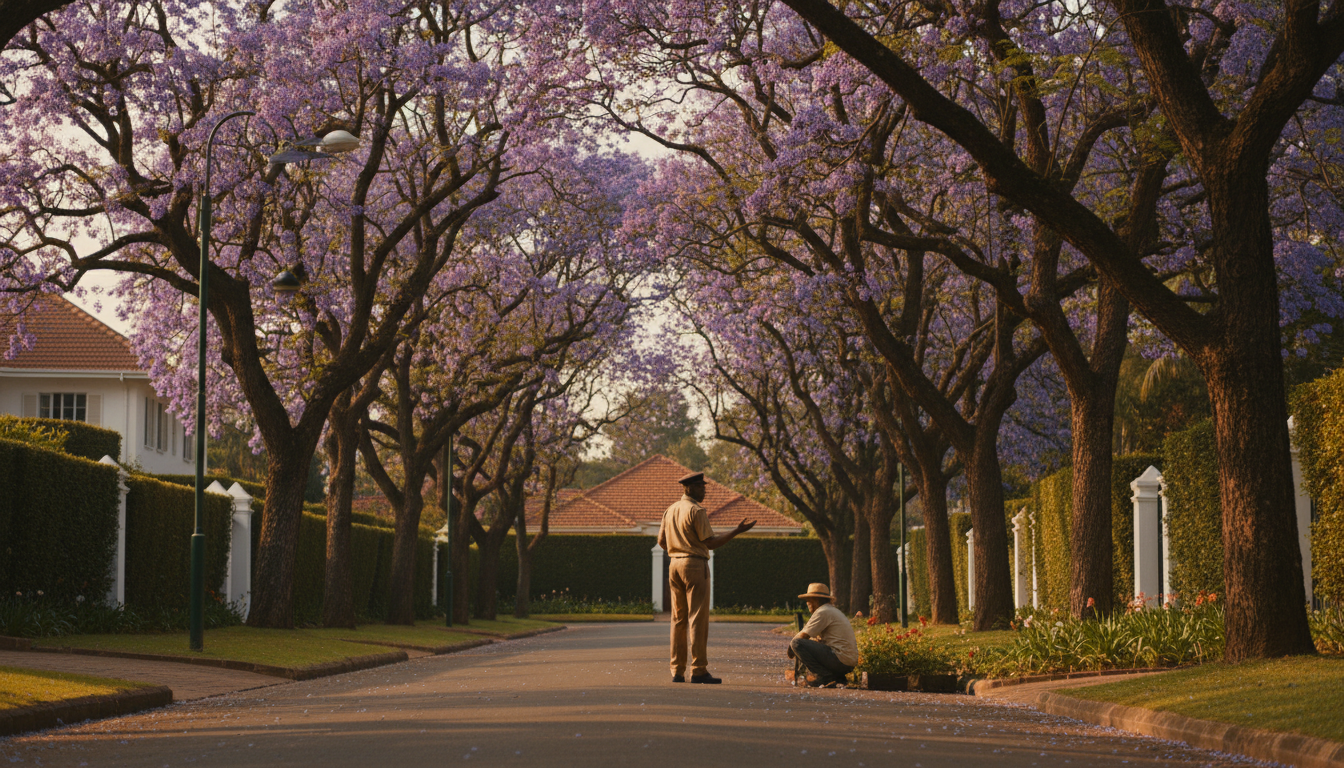 Tree-lined street in Karen with jacaranda trees in purple bloom, colonial-era homes with manicured g
Karen: The Gold Standard for Retiree Home Swaps
Named after Karen Blixen (yes, the "Out of Africa" Karen), this suburb sits about 25 kilometers from downtown Nairobi. It's where I stayed, and it's where I'd recommend any first-time retiree start their Nairobi home exchange journey.
Karen feels like a different world. Properties here average 1-2 acres, with gardens that would make English country estates jealous. The homes range from renovated colonial bungalows to modern architect-designed villas. Most have staff quarters, meaning your hosts' housekeeper or gardener often stays on the property during your exchange—available to help if you need them.
The Giraffe Centre is here. The Karen Blixen Museum is here. The Kazuri Bead Factory, where you can watch women hand-roll ceramic beads, is a 10-minute drive. The Karen Country Club offers golf, tennis, and a pool for day visitors (about $30).
Medical care access is excellent—Karen Hospital sits right in the neighborhood, and Nairobi Hospital (the best in East Africa) is a 20-minute drive.
What I loved most: the quiet. Birds wake you up here, not traffic. You can hear yourself think.
Muthaiga: Old-Money Elegance
If Karen is country estates, Muthaiga is diplomatic mansions. This is where ambassadors live, where old Kenyan money has established roots, where the legendary Muthaiga Country Club (founded 1913) still serves gin and tonics on the veranda.
Home exchanges in Muthaiga are rarer but spectacular when they appear. The architecture tends toward colonial grandeur—think sweeping staircases, formal gardens, libraries with actual books. Security is exceptional; most properties have 24-hour guards and alarm systems.
The neighborhood sits closer to downtown (about 10 kilometers), making it convenient for retirees who want easier access to museums, restaurants, and cultural events. The Village Market shopping center, with its excellent supermarket, cinema, and restaurants, is nearby.
Muthaiga works best for retirees who appreciate formality and don't mind a more structured environment. It's less bohemian than Karen, more polished.
Lavington: The Practical Middle Ground
Lavington offers something Karen and Muthaiga don't: walkability. This residential neighborhood has enough density that you can actually stroll to cafés, small shops, and restaurants without getting in a car.
The Lavington Green shopping center anchors the neighborhood with a good supermarket, pharmacy, and several restaurants. The homes are smaller than Karen's estates but still spacious by most standards—typically 3-4 bedrooms with gardens.
I'd recommend Lavington for retirees who value independence. If you want to pop out for bread without coordinating with a driver, if you prefer self-sufficiency over staff assistance, Lavington delivers.
The vibe is younger and more cosmopolitan here. You'll find more international families, more modern construction, more of a neighborhood feel versus estate isolation.
Gigiri: Near the UN and Embassies
Gigiri is practical rather than charming. It's where the United Nations complex sits, along with numerous embassies and international organizations. The housing stock reflects this—lots of modern compounds built for diplomatic families.
For retirees, Gigiri's main advantage is the Village Market (a massive shopping and entertainment complex) and proximity to excellent healthcare at Aga Khan Hospital. The neighborhood is extremely secure due to the diplomatic presence.
I'd suggest Gigiri for retirees doing shorter stays or those who prioritize convenience and security over character. The homes are comfortable but rarely have the gardens or architectural interest of Karen or Muthaiga.
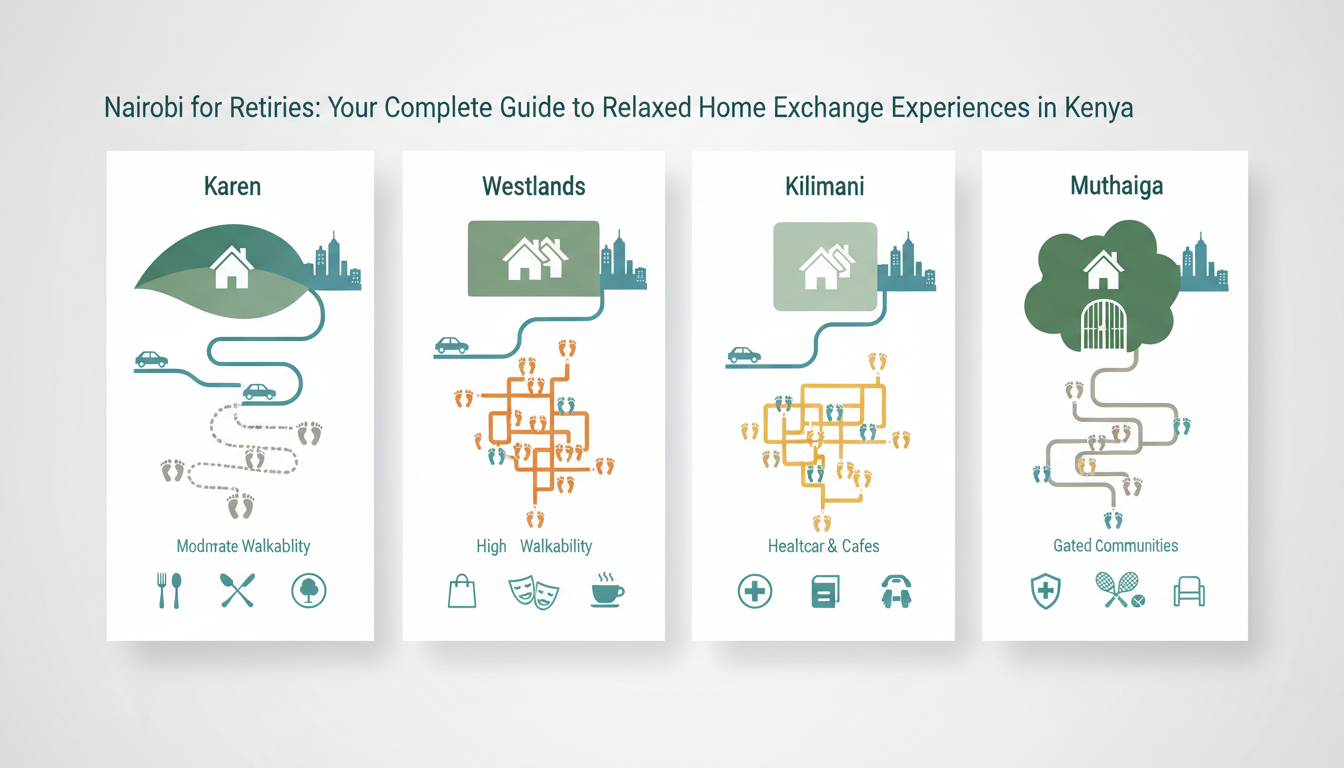 Infographic comparing four Nairobi neighborhoods for retirees, showing distance to center, average p
What to Expect from Your Nairobi Home Exchange Host
Kenyan hospitality is legendary, and it extends to home exchange. The hosts I've encountered—and the ones retired members consistently rave about—go far beyond leaving keys under the mat.
Expect detailed welcome guides. My Karen hosts left me a 15-page document covering everything from how to work the water heater (solar, with electric backup) to their favorite nyama choma (grilled meat) spot. They'd included phone numbers for their driver, their housekeeper, their gardener, their "fix-it guy," and three different doctors.
Staff arrangements vary. Some hosts include their household staff in the exchange—you'd have their housekeeper come daily, their gardener maintain the grounds, their cook prepare meals if you want. Others give staff paid leave during exchanges. This should be discussed clearly before your stay.
Most retired exchangers I interviewed prefer having staff available. Margaret, a 71-year-old from Melbourne who's done four Nairobi swaps, put it bluntly: "I'm not going to Africa to do laundry. Having Mary come in to cook and clean three days a week cost me $60 total and made the whole experience luxurious."
Security briefings are standard. Your hosts will explain their security setup—alarm codes, guard schedules, what to do if something seems wrong. This isn't alarmist; it's just how Nairobi works. Every home has security measures, and understanding them is part of settling in.
Vehicle access varies too. Some hosts leave their car for you to use (you'd need an international driving permit). Others connect you with their regular driver. A few leave you to arrange your own transport. For retirees, I strongly recommend arranging a driver rather than self-driving—Nairobi traffic is chaotic, and having someone who knows the roads eliminates enormous stress.
Practical Considerations for Retired Home Exchangers in Nairobi
Let me address the questions I know you're asking.
Healthcare Access
Nairobi has genuinely excellent private healthcare. Nairobi Hospital, Aga Khan Hospital, and Karen Hospital all provide Western-standard care with English-speaking doctors, many of whom trained in the UK or US.
A doctor's consultation runs about $50-80. Basic blood work costs $30-50. Prescription medications are available and affordable—often a fraction of US prices.
However—and this is crucial—you need comprehensive travel insurance with medical evacuation coverage. While Nairobi can handle most situations, complex procedures might require evacuation to South Africa or Europe. I recommend policies from World Nomads, Allianz, or IMG Global for retirees.
Many retired exchangers also establish a relationship with a local doctor early in their stay. A quick introductory appointment ($50) gives you someone to call if issues arise.
Safety Realities
I won't sugarcoat this: Nairobi requires awareness. Petty crime exists. Carjacking happens, though rarely in the upscale neighborhoods I've recommended. The US Embassy issues regular security alerts.
But here's what I've observed: retired home exchangers who follow basic precautions have overwhelmingly positive experiences. Those precautions include staying in secure neighborhoods (Karen, Muthaiga, Lavington, Gigiri), using trusted drivers rather than random taxis, not walking alone after dark, and not displaying expensive jewelry or electronics.
The retired exchangers I interviewed unanimously said they felt safer than expected. "I was nervous before I arrived," admitted Thomas, 69, from Connecticut. "But once I settled into Karen, with the guards and the community and everyone looking out for each other, I felt completely at ease."
 A retired couple having sundowners on a veranda overlooking the Ngong Hills at golden hour, comforta
Getting Around
Forget public transportation—it's not practical for visitors. Your options are:
Private driver: The gold standard for retirees. Costs $30-50 per day, includes fuel, and gives you a local expert who handles traffic, knows shortcuts, and waits while you explore. Many hosts can connect you with their regular driver.
Uber/Bolt: Both operate in Nairobi and work well. Rides across the city cost $5-15. The apps add a layer of safety since trips are tracked. This works for retirees comfortable with smartphone apps.
Hosted vehicle: Some exchangers leave their car. Driving yourself is possible but stressful. Nairobi traffic is aggressive, roads aren't always well-marked, and the liability concerns aren't worth the savings for most retirees.
Internet and Communication
Nairobi has excellent internet infrastructure. Most homes in the neighborhoods I've recommended have fiber connections with speeds of 20-50 Mbps—plenty for video calls with grandchildren.
Get a local SIM card immediately upon arrival. Safaricom is the dominant carrier, and a tourist SIM with data costs about $10 at the airport. This gives you local calling capability and data backup if home wifi fails.
WhatsApp is the communication standard in Kenya. Everyone uses it—your hosts, drivers, housekeepers, restaurants for reservations. Download it before you arrive if you haven't already.
Sample Three-Week Itinerary for Retired Home Exchangers
Based on what's worked for retirees I've interviewed, here's a realistic pace for a three-week Nairobi home exchange:
Week One: Settle and Explore Locally
Don't rush. Jet lag is real, altitude adjustment takes a day or two, and you have time. Spend the first week getting comfortable with your home, meeting any staff, establishing routines.
Visit the Giraffe Centre (about $15 entry). Explore the Karen Blixen Museum ($10). Find your favorite local café. Take a cooking class in Kenyan cuisine (about $50-80 through various providers). Wander the Kazuri Bead Factory.
This is also when you should arrange your driver situation, locate the nearest quality supermarket (Karen's Chandarana Foodplus is excellent), and identify any medical resources you might need.
Week Two: Day Trips and Cultural Immersion
Now you're ready to venture further.
Nairobi National Park is the only national park inside a major city. Lions, rhinos, giraffes, buffalo—all with Nairobi's skyline in the background. Half-day safari costs about $80-100 including park fees.
The David Sheldrick Elephant Trust lets you visit orphaned baby elephants during the 11am feeding. Deeply moving. $50 donation gets you entry.
The Nairobi National Museum offers a comprehensive overview of Kenyan history, culture, and nature. $10 entry, easily worth half a day.
Kitengela Glass is an art studio in the southern suburbs where recycled glass becomes stunning sculptures. Free to visit, and the surrounding area feels like an art installation itself.
Week Three: Safari Extension
Most retired exchangers use Nairobi as a base for at least one proper safari. Options within reasonable driving distance:
Masai Mara: The most famous, about 5-6 hours by road. Three-night stays at mid-range lodges run $300-500 per person per night, all-inclusive. The wildebeest migration (July-October) is bucket-list material.
Amboseli: Closer (4 hours), with stunning elephant populations and Mount Kilimanjaro views. Slightly more affordable than the Mara.
Lake Nakuru: Just 2-3 hours north, famous for flamingos and rhinos. Good for a two-night trip.
Many retirees book through their hosts' recommended operators—this personal connection often yields better prices and service than random online bookings.
 Elephants crossing in front of safari vehicle at golden hour in Amboseli, Mount Kilimanjaro snow-cap
The Home Exchange Advantage for Retirees in Nairobi
I want to circle back to why home exchange specifically makes sense for retirees visiting Nairobi—beyond just the cost savings.
Hotels in Nairobi cluster in two areas: downtown (busy, not particularly pleasant for extended stays) and the upscale suburbs (expensive and somewhat sterile). Neither gives you what a home exchange provides: genuine immersion in residential Nairobi.
When you stay in someone's Karen home, you shop where they shop. You meet their neighbors. You understand the rhythm of daily life—the askari (guard) who greets you by name, the vegetable vendor who comes to the gate on Tuesdays, the sound of the mosque's call to prayer mixing with church bells on Sunday.
You also get space. Hotel rooms, even nice ones, feel confining after a few days. A home with a garden, a reading nook, a proper kitchen—these things matter enormously for longer stays. Retirees consistently tell me that having room to spread out, to establish routines, to live rather than just visit, transforms the experience.
And then there's the community aspect. Through SwappaHome, you're not just finding accommodation—you're connecting with people who share your love of travel, who understand the home exchange ethos of mutual trust and respect. Your Nairobi hosts become friends. You correspond after the trip. Some retired exchangers have returned to the same homes three or four times, deepening relationships with each visit.
Making Your Nairobi Home Exchange Happen
If you're a retiree considering Nairobi for your next home exchange adventure, here's my practical advice:
Start your search early. Quality homes in Karen and Muthaiga get booked months in advance, especially during high season (June-October, December-February). List your own home on SwappaHome now and begin building credits through hosting.
Be specific in your communications. When reaching out to potential hosts, mention that you're retired, explain your travel style (relaxed, extended stay), and ask detailed questions about staff arrangements, security, and vehicle access. Good hosts appreciate thorough communication.
Consider shoulder season. March-May brings the "long rains," but they're not constant—typically afternoon showers that clear quickly. Prices drop, crowds thin, and the landscape turns impossibly green. Many retired exchangers prefer this period.
Plan for at least three weeks. Nairobi reveals itself slowly. A week isn't enough to settle in, adjust, and truly experience the place. Three weeks feels right; a month is even better. The beauty of home exchange is that longer stays don't cost more—just more credits.
The Unexpected Gift of Nairobi
I'll leave you with something Margaret from Melbourne told me, which has stuck with me since.
"I thought I was going to Nairobi for the wildlife," she said. "And yes, the elephants and lions were incredible. But what I didn't expect was how the place would slow me down. How sitting in that garden every morning, watching the sunbirds, having nowhere I had to be—how that would feel like the real luxury."
She paused.
"I've traveled a lot since I retired. Nairobi is the only place that made me feel like I was actually living somewhere, not just visiting."
That's the gift of home exchange in Nairobi for retirees. Not just the safaris or the savings, though those matter. It's the chance to belong somewhere new, even if just for a few weeks. To have a garden that feels like yours. To know the guard's name and have him know yours.
If that sounds like your kind of adventure, start browsing SwappaHome's Nairobi listings. Your Karen cottage—or Muthaiga mansion, or Lavington townhouse—might be waiting.
And don't skip the giraffes. Trust me.
Frequently Asked Questions
Is Nairobi safe for retired travelers doing home exchange?
Nairobi is safe for retirees who stay in secure neighborhoods like Karen, Muthaiga, Lavington, or Gigiri. These areas have 24-hour security, gated properties, and established expat communities. Following basic precautions—using trusted drivers, avoiding walking alone after dark, and staying in recommended areas—retired home exchangers consistently report feeling secure and comfortable during their stays.
How much can retirees save with home exchange versus hotels in Nairobi?
Retirees can save $3,000-6,000 on a three-week Nairobi trip through home exchange. Mid-range hotels cost $150-200 per night ($3,150-4,200 for three weeks), while upscale options run $300-400+ nightly. With home exchange, accommodation costs only your SwappaHome credits—earned by hosting travelers in your own home. Additional savings come from having a kitchen to prepare some meals.
What healthcare is available for retirees in Nairobi?
Nairobi offers excellent private healthcare at facilities like Nairobi Hospital, Aga Khan Hospital, and Karen Hospital. English-speaking doctors, many Western-trained, provide consultations for $50-80. However, retirees should purchase comprehensive travel insurance with medical evacuation coverage before traveling. Prescription medications are readily available and often more affordable than in the US or Europe.
How long should retirees stay for a Nairobi home exchange?
Three weeks is the minimum recommended stay for retired home exchangers in Nairobi. This allows time to adjust to the altitude (7,000 feet), settle into your home, explore the city at a relaxed pace, and take at least one safari excursion. Many retirees prefer month-long stays, which the home exchange model supports perfectly since longer stays don't increase accommodation costs.
What's the best time of year for retirees to visit Nairobi?
The dry seasons—June through October and December through February—offer the best weather and wildlife viewing for retirees. However, the shoulder season (March-May) brings lower crowds, greener landscapes, and more available home exchange options. Nairobi's altitude keeps temperatures comfortable year-round at 70-77°F, making it suitable for retirees escaping extreme weather back home.

Published by
SwappaHome
SwappaHome Editorial Team
Home Exchange & Slow Travel Editorial
The SwappaHome Editorial Team brings together travel research, home-exchange community insights, and platform data to produce practical guides for first-time and experienced home swappers. Every article cites real platforms, current market rates, and verifiable city-level facts so readers can make informed decisions without guessing.
Ready to try home swapping?
Join SwappaHome and start traveling by exchanging homes. Get 7 free credits when you sign up!
Related articles

Bachelor and Bachelorette Parties in Singapore: The Complete Home Swap Group Guide for 2026
Planning a bachelor or bachelorette party in Singapore? Discover how home swapping lets groups of 6-12 stay together in luxury condos, saving thousands while partying in Marina Bay.

Cycling in Lisbon: 7 Home Swap Bike Tour Itineraries for Every Rider
Discover the best cycling routes in Lisbon with these home swap bike tour itineraries—from waterfront paths to hilltop adventures, all starting from your borrowed home.

Graduation Trip to Barcelona: How Home Swapping Gives New Graduates the Ultimate Celebration
Planning a graduation trip to Barcelona? Discover how home swapping lets new graduates explore Spain's most vibrant city without the hostel crowds or hotel costs.