
Senior-Friendly Home Swap in Washington DC: Your Complete Guide to Accessible, Comfortable Stays

SwappaHome Editorial Team
Home Exchange & Slow Travel Editorial
Discover how to find the perfect senior-friendly home swap in Washington DC with elevator access, step-free entries, and neighborhoods perfect for mature travelers.
My mom called me last February with a request that stopped me mid-sip of my morning coffee. "Maya, I want to try one of your home swap things. But I need it to work for my knees."
She's 71, fiercely independent, and has been eyeing my travel photos for years. The catch? She needs step-free access, a real bed (not some lofted situation requiring a ladder), and ideally a neighborhood where she won't be hiking up Capitol Hill's steeper sections just to grab breakfast.
Finding a senior-friendly home swap in Washington DC turned into a three-week project that taught me more about accessible travel than seven years of swapping ever had. And honestly? DC surprised me. This city—with its wide sidewalks, excellent Metro accessibility, and neighborhoods designed for walking at any pace—might be one of the best destinations in America for mature home exchangers.
 Morning light streaming through a ground-floor apartment window in DCs Dupont Circle, showing a comf
Why Washington DC Works for Senior-Friendly Home Swaps
So here's something most travel guides won't tell you: DC was literally designed to be walkable. L'Enfant's original 1791 plan created those famous wide avenues and gentle grades specifically so people could navigate the city comfortably. Two centuries later? That planning translates into one of the most accessible major cities in the country.
The Metro system has elevators at every single station—not most, every one. The Smithsonian museums are free and fully accessible. The National Mall, while long, is completely flat. And unlike cities built on hills (I'm looking at you, San Francisco), most DC neighborhoods offer level walking routes.
For home swappers specifically, DC has another advantage: the housing stock. Many buildings from the 1920s-1950s were constructed with elevators as standard. The newer developments are required by law to meet ADA accessibility standards. This means your pool of potential swaps with elevator access, wide doorways, and accessible bathrooms is genuinely large.
My mom ended up in a one-bedroom condo in Woodley Park. Elevator building, walk-in shower, two blocks from the Metro, and a Safeway grocery store she could reach without crossing any major intersections. She stayed two weeks and is already planning her return trip.
Best DC Neighborhoods for Senior-Friendly Home Exchanges
Not all DC neighborhoods are created equal when you're prioritizing accessibility and comfort. After researching dozens of options for my mom—and now having helped three other family friends plan similar trips—here's my honest breakdown.
Dupont Circle: The Sweet Spot
If I had to pick one neighborhood for a senior home swapper, it's Dupont Circle. The area has the highest concentration of elevator buildings in the city, thanks to its early-20th-century development as a wealthy residential enclave. Wide sidewalks, benches scattered throughout the circle itself, and an almost European café culture that encourages lingering.
The Dupont Circle Metro station has one of the longest escalators in the Western Hemisphere—but don't let that scare you. There's a perfectly good elevator. Once you're street-level, you're surrounded by restaurants, bookshops, and the famous Sunday farmers market (held year-round).
What to expect in Dupont Circle listings: one-bedroom condos in pre-war buildings, typically 600-900 square feet, with original hardwood floors and updated bathrooms. Many have been renovated with grab bars and walk-in showers.
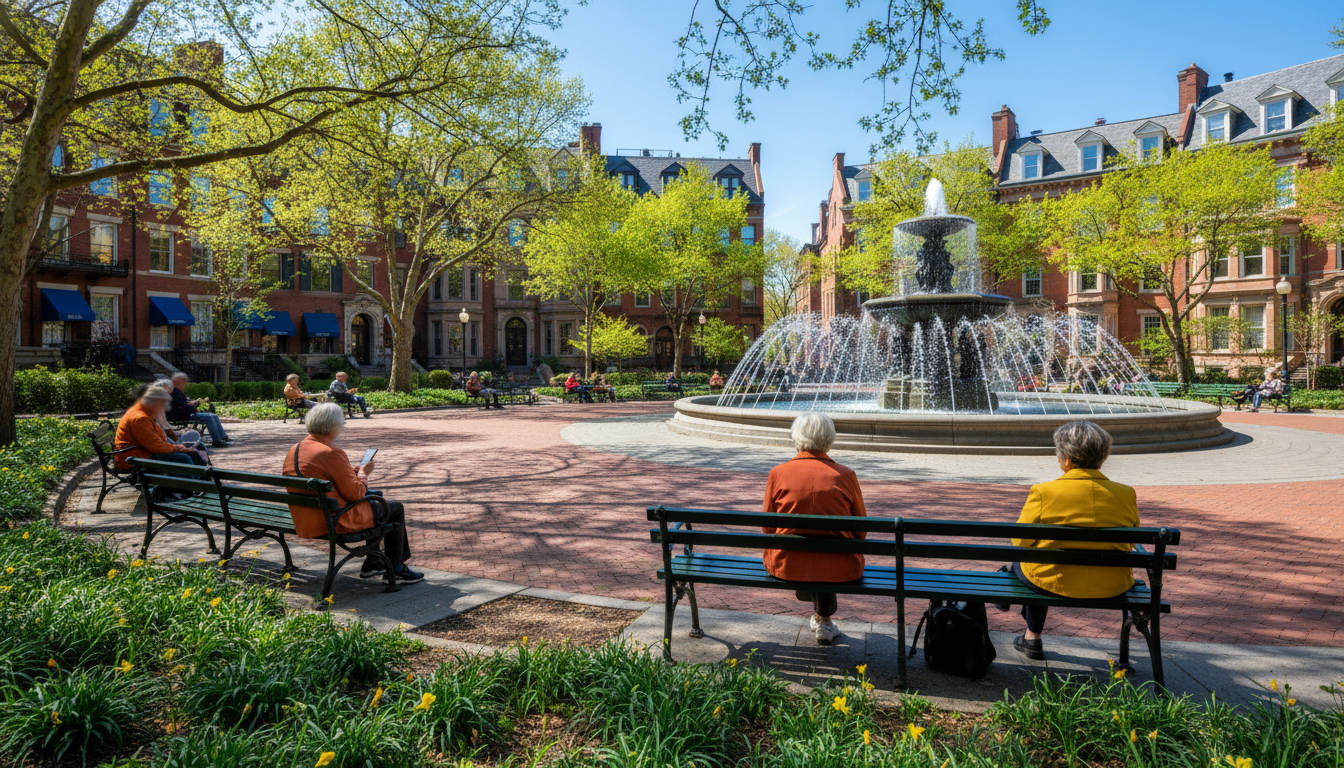 Dupont Circle fountain on a spring afternoon, showing seniors sitting on benches, tree-lined paths,
Woodley Park and Cleveland Park: Quiet Residential Charm
These neighboring areas along Connecticut Avenue offer something Dupont doesn't: quiet. The pace here is slower, the streets are tree-lined, and you'll find yourself nodding hello to the same dog walkers each morning.
Woodley Park sits right next to the National Zoo (free admission, fully accessible), and Cleveland Park has one of DC's best independent movie theaters, the historic Uptown. Both neighborhoods have excellent restaurant rows along Connecticut Avenue, all at street level.
The housing here tends toward larger apartments and condos—lots of two-bedrooms, which is ideal if you're traveling with a companion or want a dedicated guest room. Many buildings from the 1940s and 1950s have been retrofitted with modern elevators.
One note: there's a moderate hill between the two neighborhoods. If mobility is a significant concern, pick one and stick to it rather than walking between them. The Metro connects them in two minutes anyway.
Capitol Hill (Southeast): Surprisingly Accessible
I know, I know—it's called Capitol Hill. But hear me out.
The neighborhood around Eastern Market, particularly the blocks south of Pennsylvania Avenue, is remarkably flat. And the community here is multigenerational in a way that few DC neighborhoods manage.
Eastern Market itself is a weekend institution—local vendors, fresh produce, and a flea market that's been running since 1873. The market building is fully accessible, and the surrounding streets have some of the best people-watching in the city.
Housing on Capitol Hill tends toward historic rowhouses, which can be tricky for accessibility. But many have been converted to condos with added elevators, and some of the newer developments along the waterfront offer modern accessible units with stunning views of the Anacostia River.
Foggy Bottom: Proximity to Everything
If your priority is minimizing walking distance to major attractions, Foggy Bottom puts you within a 10-minute stroll of the Kennedy Center, the State Department, and the western end of the National Mall. George Washington University's campus runs through the neighborhood, giving it a lively but not overwhelming energy.
The housing here is primarily high-rise apartments from the 1960s-1980s—not architecturally exciting, but reliably accessible. Elevators, wide hallways, and often on-site amenities like pharmacies and dry cleaners in the building lobbies.
How to Find Accessible Home Swaps on SwappaHome
Here's where I need to get practical. SwappaHome's search filters are helpful, but finding truly senior-friendly accommodations requires some detective work. I've developed a system that works.
 Screenshot-style illustration showing a laptop with a home listing page, highlighting accessibility
What to Search For (and What to Ask)
Start with location filters for the neighborhoods I mentioned above. Then scan listings for these specific phrases: "elevator building," "ground floor," "walk-in shower," "step-free entry," and "accessible bathroom." Not every host will use these exact terms, but many do.
When you find a promising listing, message the host directly before requesting a booking. I always suggest asking these specific questions:
"Could you describe the path from the building entrance to your front door? Are there any steps involved?"
"What's the bathroom setup—is it a tub/shower combo or a walk-in shower? Are there grab bars?"
"How far is the nearest Metro elevator entrance? And is there grocery shopping within a flat, five-minute walk?"
Most hosts are genuinely happy to provide this information. If someone seems annoyed by accessibility questions, that's actually useful data—you probably don't want to stay with them anyway.
Creating Your Own Listing to Attract DC Hosts
Remember, home swapping works both ways. If you want DC hosts to accept your booking request, your own listing needs to shine.
Here's a tip specifically for senior travelers: explicitly mention your home's accessibility features, even if they seem obvious to you. Does your home have a ground-floor bedroom? Say so. A walk-in shower? Highlight it. A quiet neighborhood with flat sidewalks? That's a selling point for hosts of all ages.
On SwappaHome, you earn credits by hosting guests—one credit per night, regardless of your home's size or location. Those credits then let you book stays anywhere in the network. So even if your home is in a small town that DC residents might not typically visit, you can host other SwappaHome members, bank credits, and use them for your Washington adventure.
Planning Your Accessible DC Itinerary
Once you've secured your home swap, the real fun begins. DC is genuinely one of the most accessible tourist destinations I've encountered, but some advance planning makes everything smoother.
The Smithsonian Museums: Free and Fully Accessible
All 19 Smithsonian museums are free, and all are fully accessible. But here's insider knowledge: some are more senior-friendly than others in terms of pacing and seating.
The National Portrait Gallery and American Art Museum (they share a building) have benches in nearly every room and a stunning enclosed courtyard with comfortable seating where you can rest mid-visit. The café there is also excellent—try the mushroom flatbread.
The Air and Space Museum, while incredible, involves a lot of standing and walking through large open halls. If this is on your list, go early (doors open at 10 AM) and plan for a shorter visit with breaks.
The Hirshhorn Museum, DC's modern art collection, is compact and circular—you can see the entire collection in 90 minutes at a leisurely pace, and there's a wonderful sculpture garden outside with plenty of seating.
 Interior of the National Portrait Gallerys Kogod Courtyard, showing the stunning glass ceiling, indo
The National Mall: Strategies for Comfortable Exploration
The Mall stretches about two miles from the Capitol to the Lincoln Memorial. That's a lot of ground to cover, especially on hot summer days or if walking long distances is challenging.
Here's what I tell everyone: don't try to do it all in one day. Pick one end and explore thoroughly. The eastern end (Capitol, Botanic Garden, Native American Museum) can easily fill a morning. The western end (Lincoln Memorial, Vietnam Veterans Memorial, Korean War Veterans Memorial) deserves its own afternoon.
The DC Circulator bus runs along the Mall and costs just $1 per ride. It's not the fastest option, but it's fully accessible and lets you hop between sections without exhausting yourself.
For a splurge, consider a pedicab tour. Yes, they're touristy. But the drivers know the Mall intimately, you're sitting comfortably, and you can cover ground that would take hours on foot. Expect to pay around $40-60 for an hour-long tour—negotiate before you hop on.
Dining Recommendations for Comfort-Seekers
DC's restaurant scene has exploded in the past decade, but not every hot spot is comfortable for a leisurely meal. Here are my picks for senior-friendly dining—places with comfortable seating, manageable noise levels, and excellent food.
Old Ebbitt Grill (Downtown, near the White House): Yes, it's a tourist spot. It's also been operating since 1856, has plush booth seating, and serves a genuinely good oyster happy hour. The noise level is moderate, and the staff is experienced with guests of all ages. Expect $25-40 per person for dinner.
Le Diplomate (14th Street): This French brasserie has become a DC institution. The sidewalk seating is wonderful in good weather, and the interior booths are comfortable and private. It's pricier ($40-60 per person) but worth it for a special dinner.
Unconventional Diner (Shaw): Don't let the name fool you—this is upscale comfort food in a bright, spacious room with excellent acoustics. The chicken and waffles are legendary. Around $20-30 per person.
Teaism (Multiple locations including Dupont Circle): Perfect for a light lunch or afternoon tea. The Penn Quarter location has a serene vibe, comfortable seating, and a menu of Asian-influenced dishes alongside an extensive tea selection. $15-25 per person.
Practical Considerations for Senior Home Swappers
Let's talk about the logistics that guidebooks often skip.
 A well-organized travel bag open on a bed, showing compression socks, a small first-aid kit, a porta
Weather and Timing
DC has four distinct seasons, and your choice of when to visit matters enormously for comfort.
Spring (late March through May) is peak season for a reason—cherry blossoms, mild temperatures, and the city at its most beautiful. But it's also crowded. If mobility is a concern, the crowds around the Tidal Basin during cherry blossom peak (usually early April) can be genuinely difficult to navigate.
Fall (September through November) is my pick for senior travelers. The summer humidity has broken, the crowds have thinned, and the foliage along the Mall is gorgeous. October is particularly lovely—warm enough for comfortable walking, cool enough that you won't overheat.
Summer (June through August) is brutally hot and humid. If this is your only option, plan outdoor activities for early morning, retreat to air-conditioned museums midday, and venture out again in the evening.
Winter (December through February) is cold but manageable, and you'll have the museums almost to yourself. The holiday decorations are beautiful, and many restaurants offer special seasonal menus.
Healthcare Access
DC has world-class medical facilities, including MedStar Georgetown University Hospital and George Washington University Hospital. Both have emergency rooms and are accessible by Metro.
For non-emergency needs, CVS MinuteClinics are scattered throughout the city and can handle minor issues like prescription refills or sudden colds. There's one in Dupont Circle, one in Foggy Bottom, and several downtown.
If you take regular medications, bring more than you think you'll need. Keep a list of your prescriptions, dosages, and your doctor's contact information in your phone and on paper.
Getting Around Beyond the Metro
The Metro is excellent, but it's not your only option.
Uber and Lyft both operate in DC, and both offer wheelchair-accessible vehicle options (though availability varies). For guaranteed accessible transportation, consider scheduling rides through MetroAccess, DC's paratransit service—though this requires advance registration.
Many DC neighborhoods are also served by the DC Circulator, a bus system with $1 fares and fully accessible vehicles. Routes connect Georgetown to Union Station, run along the Mall, and serve the U Street corridor.
For a more leisurely option, the Capital Bikeshare system now includes adaptive bikes at certain stations, including hand cycles and bikes with step-through frames. Check their website for locations.
What to Communicate With Your Host
Transparency makes home swaps work. When you're booking a senior-friendly home swap in Washington DC—or anywhere—clear communication prevents problems.
Before confirming your swap, share any specific needs with your host. Will you need extra towels for daily use? Is there a particular bed height that works best for you? Do you prefer a firmer mattress? Most hosts are happy to accommodate requests, but they need to know about them.
Also discuss emergency procedures. Where's the nearest hospital? Is there a building superintendent who can help with issues? What's the protocol if something breaks?
On SwappaHome, you can message hosts directly through the platform's secure messaging system. I always recommend having at least 3-4 message exchanges before finalizing any swap—it helps you gauge whether you'll communicate well if issues arise.
Insurance and Peace of Mind
I want to be direct about something: SwappaHome connects members but doesn't provide insurance coverage for stays. This is standard for home exchange platforms, and it means you should think about your own coverage.
Many travelers' existing homeowners or renters insurance policies extend some coverage to home exchanges—check with your provider. Travel insurance policies often cover trip interruption, medical emergencies abroad, and sometimes even damage to temporary accommodations.
For senior travelers especially, I recommend a travel insurance policy that includes medical evacuation coverage. Companies like Allianz, World Nomads, and IMG Global offer policies specifically designed for older travelers. Expect to pay $50-150 for a two-week policy, depending on your age and coverage level.
Making the Most of Your DC Home Swap
Here's what I've learned from my mom's trip and the subsequent swaps I've helped plan: the best part of home swapping isn't the free accommodation. It's the feeling of actually living somewhere.
My mom's favorite memory from her DC trip wasn't the Lincoln Memorial or the Smithsonian. It was the morning routine she developed—walking two blocks to the local coffee shop, ordering "the usual" by day four, and reading the Washington Post in a sunny corner booth while the neighborhood woke up around her.
That's what a home swap offers that no hotel can match. You're not a tourist; you're a temporary local. You learn which grocery store has the best produce, which park bench catches the afternoon sun, which restaurant the neighbors actually eat at.
For senior travelers especially, this matters. You're not rushing through a checklist of attractions. You're settling into a place, moving at your own pace, and experiencing a city the way it's actually lived.
Your Next Step
If you're considering a senior-friendly home swap in Washington DC, start browsing SwappaHome listings in the neighborhoods I mentioned. Filter for the features that matter most to you—elevator access, ground-floor units, walk-in showers. Message hosts with specific questions about accessibility.
Not quite ready to commit? Create your own listing first. Describe your home's accessibility features, upload clear photos, and start earning credits by hosting other travelers. By the time you're ready for DC, you'll have the credits banked and a profile that shows you're a trustworthy member of the community.
My mom is already planning her second DC swap—this time in Capitol Hill, near Eastern Market. She wants to be closer to the weekend vendors and the neighborhood cats that apparently roam the area. She's 71, her knees still complain, and she's never been more excited about travel.
That's the thing about home swapping. It doesn't have age limits. It just requires a little extra planning and the willingness to ask for what you need.
Frequently Asked Questions
Is home swapping in Washington DC safe for seniors?
Yes, home swapping in DC is safe for seniors when you use established platforms like SwappaHome with verified members and review systems. The city itself is well-patrolled, especially in tourist areas and residential neighborhoods like Dupont Circle and Woodley Park. Always communicate thoroughly with hosts, verify building security features, and trust your instincts about potential swap partners.
How much can seniors save with home exchange versus hotels in DC?
Significant savings are possible. A mid-range DC hotel averages $200-350 per night, meaning a two-week stay costs $2,800-4,900. With SwappaHome's credit system (one credit per night), you can stay for free after earning credits by hosting guests at your own home. Even accounting for membership fees, most members save $2,000+ on a two-week DC trip.
What accessibility features should I look for in a DC home swap?
Prioritize elevator buildings or ground-floor units, step-free entries, walk-in showers with grab bars, and proximity to Metro elevator entrances. Also consider bed height, lighting quality, and distance to grocery stores. Message hosts directly to ask about specific accessibility features before booking—most are happy to provide detailed information.
Which DC neighborhood is best for seniors with mobility concerns?
Dupont Circle offers the best combination of accessibility and amenities for seniors. The neighborhood has numerous elevator buildings, flat sidewalks, abundant seating in the circle park, and excellent public transit access. Woodley Park is a close second, offering quieter streets and proximity to the National Zoo.
Do I need special insurance for a senior-friendly home swap?
SwappaHome doesn't provide insurance coverage, so arranging your own protection is wise. Check if your homeowners or renters insurance extends to home exchanges, and consider travel insurance with medical coverage and trip interruption protection. For seniors, policies including medical evacuation coverage (from companies like Allianz or IMG Global) provide additional peace of mind, typically costing $50-150 for two weeks.

Published by
SwappaHome
SwappaHome Editorial Team
Home Exchange & Slow Travel Editorial
The SwappaHome Editorial Team brings together travel research, home-exchange community insights, and platform data to produce practical guides for first-time and experienced home swappers. Every article cites real platforms, current market rates, and verifiable city-level facts so readers can make informed decisions without guessing.
Ready to try home swapping?
Join SwappaHome and start traveling by exchanging homes. Get 7 free credits when you sign up!
Related articles

Bachelor and Bachelorette Parties in Singapore: The Complete Home Swap Group Guide for 2026
Planning a bachelor or bachelorette party in Singapore? Discover how home swapping lets groups of 6-12 stay together in luxury condos, saving thousands while partying in Marina Bay.

Cycling in Lisbon: 7 Home Swap Bike Tour Itineraries for Every Rider
Discover the best cycling routes in Lisbon with these home swap bike tour itineraries—from waterfront paths to hilltop adventures, all starting from your borrowed home.

Graduation Trip to Barcelona: How Home Swapping Gives New Graduates the Ultimate Celebration
Planning a graduation trip to Barcelona? Discover how home swapping lets new graduates explore Spain's most vibrant city without the hostel crowds or hotel costs.