
Simultaneous vs Non-Simultaneous Home Swaps: What's the Difference?

SwappaHome Editorial Team
Home Exchange & Slow Travel Editorial
So you've started looking into home swaps, and almost immediately you hit a fork in the road. There are two basic ways to do this. Either both households swap homes at the exact same time...
So you've started looking into home swaps, and almost immediately you hit a fork in the road. There are two basic ways to do this. Either both households swap homes at the exact same time (simultaneous), or each person takes their trip whenever it suits them, on totally separate schedules (non-simultaneous). Sounds like a small distinction. It isn't. This one choice ripples out into how you plan your dates, how much wiggle room you have, and honestly, how relaxed you feel about the whole thing.
And it matters no matter who you are. Family trying to skip the sterile hotel routine? Retiree with a calendar that's basically wide open? Remote worker bouncing between time zones? The swap style you land on will shape your whole experience.
I'm going to lay both models out in plain English, weigh the good against the annoying, and help you figure out which one actually fits your life. I'll also get into credit-based platforms, because they've quietly changed this whole conversation.
Table of Contents
- What Are the Main Types of Home Swaps?
- What Is a Simultaneous Home Exchange?
- What Is a Non-Simultaneous Home Swap?
- Simultaneous vs Non-Simultaneous: Side-by-Side Comparison
- Which Type of Home Swap Is Right for You?
- How Credit-Based Swapping Changes the Equation
- Common Mistakes to Avoid When Choosing a Swap Type
- Frequently Asked Questions
What Are the Main Types of Home Swaps?
There are two main types of home swaps: simultaneous exchanges and non-simultaneous exchanges, and the whole thing hinges on timing. Do both households travel at once, or does each trip happen on its own? That's really the crux of it. There are some variations tucked inside each category too, like direct swaps between two specific homes, or credit-based systems where you don't need a matching partner at all.
The old-school version of home exchange is the reciprocal kind: two families trade homes for a set stretch, usually lining up during school breaks or overlapping vacation time. That's the picture most people have in their head when someone says "home swap." But travel has gotten a lot more flexible and remote-friendly over the years, and non-simultaneous and credit-based setups have caught on precisely because they ditch the whole "we both have to leave at the same moment" requirement.
And this isn't just a scheduling technicality. Your choice affects your negotiating power, your flexibility, and even whether you'll sleep soundly knowing your place is empty back home. Before you commit to a model, it's genuinely worth reading up on how to choose the right home swap partner for your trip. Because who you swap with often matters as much as how you swap.
What Is a Simultaneous Home Exchange?
A simultaneous home exchange is when two households swap homes at the same time. Family A crashes at Family B's place while Family B settles into Family A's, usually over the same or overlapping dates. This is the original flavor of home swapping, and it's still the one that clicks fastest for first-timers.
How It Actually Plays Out
Both sides agree on a date range, hand over keys or access codes, and (if they're nice) leave behind notes, restaurant recommendations, maybe a stocked fridge. Because both homes are lived-in at once, there's this built-in sense of fairness and trust. Nobody's sitting around waiting for the other person to hold up their end months down the line. You're both in it, at the same time.
Why People Love It
The best part is the mutual accountability. Since you're both away during the same window, everything just balances out. You're never left wondering if your swap partner is going to flake on you weeks later. It also suits people with locked-in schedules, teachers working around the academic year, parents wrangling kids' vacation dates, that kind of thing.
Oh, and it neatly solves the empty-house problem. Neither place sits vacant, because someone's there to water the plants, grab the mail, and generally keep an eye on things.
 Swap partner caring for a home during simultaneous exchange, watering plants and managing household tasks
The Annoying Parts
Scheduling. It's always scheduling. Both households need overlapping availability, similar trip lengths, and destinations you actually want to visit. That's a lot of stars to align. One family wants two weeks in July, the other's only free for a long weekend in April, and suddenly you're stuck. This rigidity is a big reason people eventually go looking for something more flexible, and it's also why coordination goes sideways so often. There's a solid rundown of that in this piece on home swap mistakes to avoid for a smooth, stress-free exchange.
What Is a Non-Simultaneous Home Swap?
A non-simultaneous home swap is when each household's stay happens on its own timeline instead of at the same moment. You might host someone in March and take your own trip somewhere completely different in September. It splits the "giving" from the "receiving," and that little separation unlocks way more freedom than the traditional format.
How It Usually Works
Rather than trying to nail down one overlapping date range with one specific partner, non-simultaneous swaps usually run on credits, points, or informal IOUs. You host someone at your place now, and later on, maybe with a totally different household, you cash that in toward your own stay elsewhere. It's a lifesaver for people whose free time never seems to line up neatly with anyone else's.
Why It's Great
Flexibility, hands down. You're no longer hunting for that one magical household that wants your exact dates in your exact location. Host whenever it works for you. Travel whenever it works for you. The two don't have to talk to each other. This is catnip for digital nomads and remote workers who aren't tied to a school-year rhythm, and for retirees whose calendars are wide open and who want maximum say over where they go and when.
The Trade-Offs
Since the exchange isn't happening in real time, there's less accountability baked in. You're leaning on a system, usually a platform's verification and credit setup, rather than a direct handshake with one person. And your home might sit empty while you're off using your credits somewhere, unless you've sorted out house-sitting or someone to check in. This is exactly where stuff like ID verification and two-way reviews earns its keep. It fills the trust gap that simultaneous swaps handle automatically.
Simultaneous vs Non-Simultaneous: Side-by-Side Comparison
Here's a direct comparison of how these two types of home swaps stack up across the factors that matter most to travelers.
| Factor | Simultaneous Home Exchange | Non-Simultaneous Home Swap |
|---|---|---|
| Timing | Both households travel at the same time | Each stay happens independently, on its own schedule |
| Scheduling flexibility | Lower — requires overlapping dates with one partner | Higher — hosting and traveling can happen at different times |
| Accountability structure | Built-in mutual trust since both sides travel together | Relies on platform verification, reviews, or a credit system |
| Best suited for | Families with fixed school-holiday windows, couples with matching vacation time | Digital nomads, remote workers, retirees with open schedules |
| Home security while away | Naturally covered since your swap partner is also away | May require added planning if your home sits empty |
| Finding a match | Harder — needs a partner with matching dates and location interest | Easier — you don't need one specific reciprocal partner |
| Typical cost | Free between members, though platform fees vary by service | Often free or credit-based, depending on the platform's model |
Which Type of Home Swap Is Right for You?
The right type of home swap mostly depends on two things: how flexible your travel dates are, and whether you value that built-in reciprocity more than pure scheduling freedom. There's no winner here. It's about matching the model to how you actually live.
If Your Travel Dates Are Locked In
Families working around school calendars, or couples with a fixed two-week allowance from work, usually do best with simultaneous exchanges. Your dates are already set, so the only real job is finding a partner whose availability overlaps with yours. And once you find them, the whole "you're in my house while I'm in yours" symmetry just feels safer, especially if you're new to this.
If You're Flexible or Always on the Move
Digital nomads, remote workers, retirees. This crowd tends to get way more out of non-simultaneous setups. You host on your own timeline and travel whenever an opportunity pops up, no need to sync your life to one household's calendar. If your work or lifestyle lets you be spontaneous, a credit-based system yanks out the biggest planning roadblock.
If You've Never Done This Before
A lot of first-timers gravitate toward simultaneous swaps because the fairness of it is so obvious. You're in my place, I'm in yours, we're even. Makes sense. But honestly? Credit-based platforms with solid verification can give you that same peace of mind minus the scheduling migraine. It really comes down to whether you trust a platform's vetting more than a one-on-one arrangement with a specific stranger.
How Credit-Based Swapping Changes the Equation
Credit-based home swapping is a modern spin on the non-simultaneous idea where you earn credits by hosting guests, then spend those credits (not cash) to book stays in other members' homes anywhere in the network. It basically deletes the need to find a single reciprocal partner, because you're not swapping with one household anymore. You're swapping with the whole community.
Take SwappaHome as an example. It runs in three simple steps: you list your home and set your availability, you earn one credit for every night a guest stays with you, and then you spend those credits on stays worldwide, with one credit buying one night anywhere in the network. Credits don't expire either, so you can host now and travel much, much later. That's non-simultaneous flexibility in a nutshell. New members even get seven free credits when they sign up, which is up to a week of free stays before you've hosted a single person.
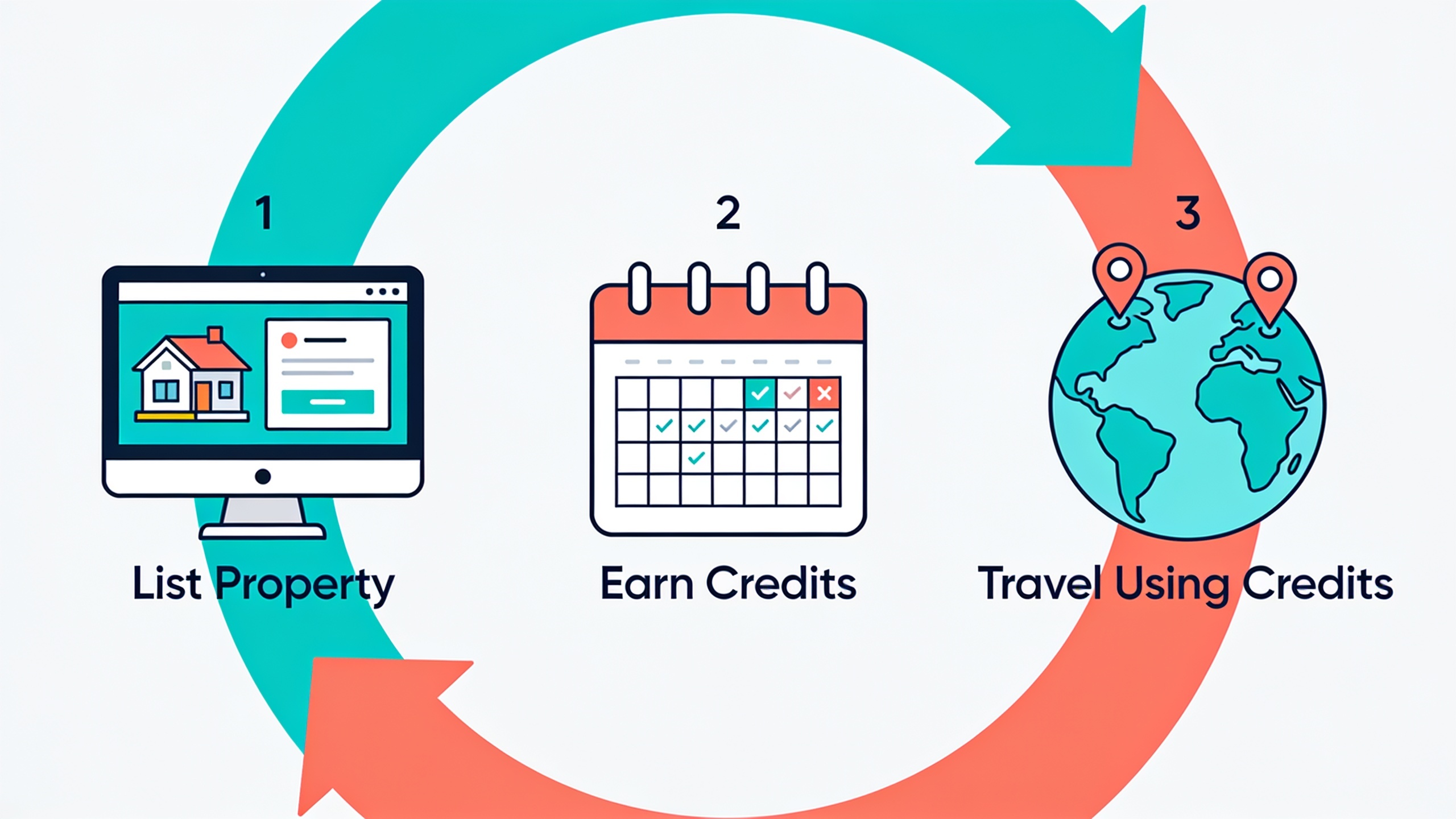 Three-step cycle of credit-based home swapping: list home, earn credits from guests, travel using credits
This also dodges one of traditional swapping's biggest headaches: the "perfect match" problem. Instead of needing your dates, your destination, and your home type to line up with one other family, you can host a guest in Berlin this spring and put your credits toward Lisbon or Melbourne in the fall. Two completely separate transactions, tied together only by the credits, not some date-locked handshake. Worth flagging, though, that platforms handle fees, verification, and credit rules differently, so always read the fine print before you commit to a listing.
Now, if you want to see why this appeals to budget travelers, look at the numbers. Using average nightly prices tracked across 947 cities by AirROI public data (2026 snapshot), a hypothetical 7-night stay in Paris came out to roughly 1,707 euros through a typical short-term rental platform. Through a credit-based exchange, where one credit covers one night? Zero. That gap is the whole story, really, and it's why home swapping in either form has become such an attractive alternative for families, retirees, and anyone trying to make a travel budget go further.
Common Mistakes to Avoid When Choosing a Swap Type
The single most common mistake people make is assuming one model is just flat-out better, instead of asking which one fits how they actually travel. A family boxed in by school holidays who forces themselves into a flexible, non-simultaneous system will probably find the missing fixed date maddening. Meanwhile a retiree with an open calendar who insists on simultaneous swaps might burn through months hunting for someone whose schedule matches theirs. Neither is doing themselves any favors.
Another one that trips people up: ignoring home security in a non-simultaneous setup. If your place is empty while you're off spending credits, you need a plan for the mail, the plants, the cat, whatever. There's no swap partner sitting in your living room this time. And regardless of which model you pick, don't skimp on the basics, check-in instructions, house rules, local tips. These tiny details make a shockingly big difference in how smooth the whole thing feels, which is exactly why it's worth running through a checklist on avoiding common home swap mistakes before you finalize anything.
There's also the stuff around the trip itself that's easy to forget. Airport transport in a city you don't know, for instance. If you're landing at some giant international hub, booking ahead with a service like The VIP Transfer for private airport transfers or chauffeur-driven rides in places like Antalya or Istanbul takes one more unknown off your plate the second you touch down.
And honestly, there's a bigger principle lurking under all of this. The way travelers do best by matching their swap type to their real habits instead of some one-size-fits-all default? Businesses run into the same thing when they're hiring outside expertise. Platforms like Advisorynavigator exist to connect people with the right advisor for a specific problem rather than a generic one. Same idea. And for anyone running a home-swap-adjacent business or blog who wants their content actually reaching the right people, tools like RobinRank that automate SEO content and backlink building can help get useful travel info in front of more readers. Even outfits well outside travel, like SamaiSolutions, which handles operational efficiency and systems integration for businesses, prove the same point: matching the right tool to your actual situation beats grabbing whatever's most popular.
Frequently Asked Questions
Is a simultaneous swap actually safer than a non-simultaneous one? Not really. Safety in either model comes down to verification and communication way more than timing. Simultaneous swaps have that natural reciprocity going for them since both parties are traveling at once, but non-simultaneous systems can get you to the same comfort level through ID verification, member reviews, and clear house rules. The trick is picking a platform or partner with transparent trust-building measures, not assuming one setup is automatically safer.
Can I do a simultaneous swap with someone in a different time zone or season? Yep, as long as you both agree on overlapping travel dates that work for each of you. The time zone itself isn't the problem, it's coordinating logistics like check-in timing and talking to each other across the gap. A bit of clear planning sorts out most of it.
What happens to my home if I go the non-simultaneous or credit-based route? It might sit empty during your own trip unless you line up a house sitter, a neighbor, or family to check in, because there's no simultaneous guest holding down the fort in return. That's one of the real trade-offs for all that flexibility.
Do I need to find a matching partner for a credit-based swap? Nope, and that's the whole appeal. You earn credits by hosting, then spend them on stays anywhere in the network. No single household needs to reciprocate on matching dates.
Which type works best for a two-week family vacation? Families with fixed vacation weeks, especially anyone tied to a school calendar, usually find simultaneous exchanges easier to plan since both households lock in the same dates up front. That said, a credit-based non-simultaneous system works just as well if you're okay earning credits ahead of time and cashing them in later for your window.
At the end of it, choosing between simultaneous and non-simultaneous home swaps comes down to what your travel calendar looks like and how much flexibility you want built in. Both give you the same core payoff anyway: a home-like stay, a real neighborhood instead of a tourist strip, and genuine savings over paying nightly rates. So it's less about finding the "right" answer and more about picking the structure that fits how you actually like to travel.

Published by
SwappaHome
SwappaHome Editorial Team
Home Exchange & Slow Travel Editorial
The SwappaHome Editorial Team brings together travel research, home-exchange community insights, and platform data to produce practical guides for first-time and experienced home swappers. Every article cites real platforms, current market rates, and verifiable city-level facts so readers can make informed decisions without guessing.
Ready to try home swapping?
Join SwappaHome and start traveling by exchanging homes. Get 7 free credits when you sign up!