Split for Retirees: Your Complete Guide to Relaxed Home Exchange Experiences in Croatia

SwappaHome Editorial Team
Home Exchange & Slow Travel Editorial
Discover why Split is perfect for retired home exchangers seeking slow travel, mild winters, affordable living, and authentic Croatian experiences.
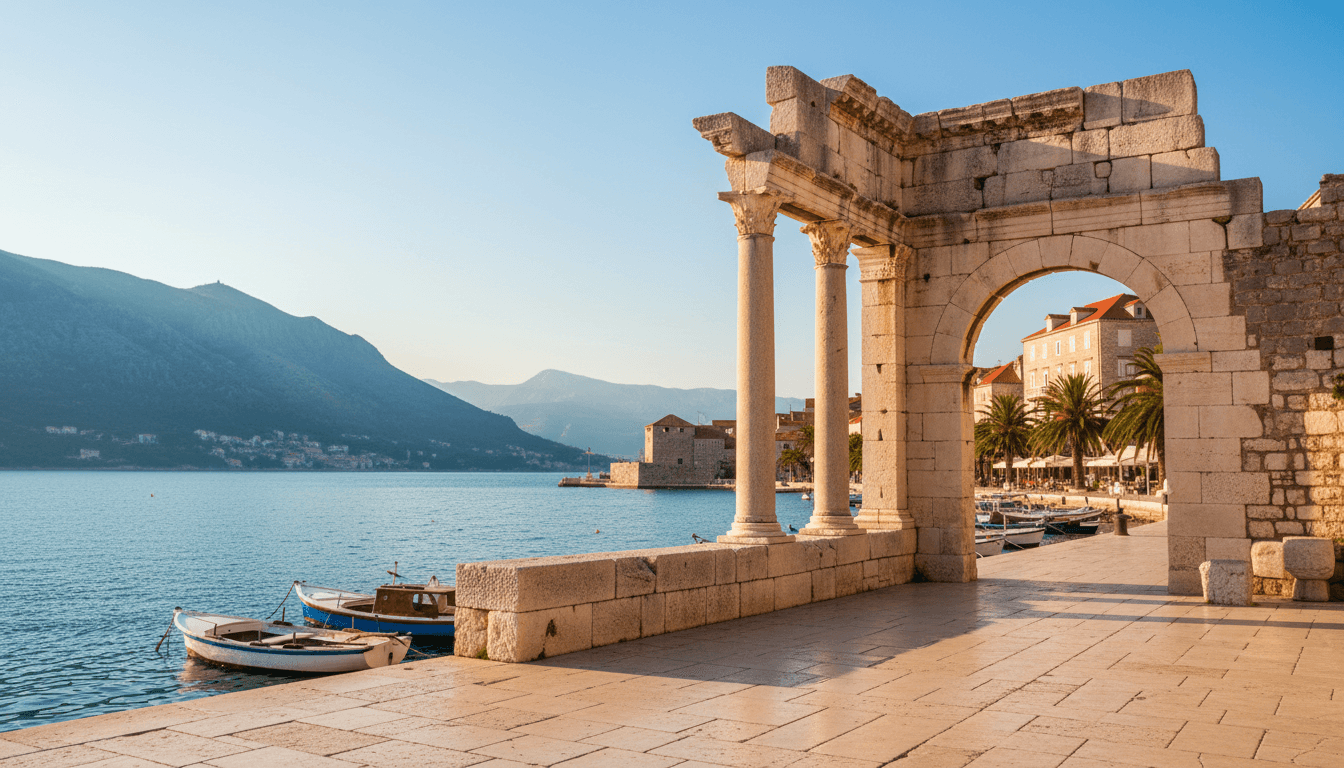
I was sitting on a stone bench in Split's Diocletian's Palace last October, watching the afternoon light turn the ancient walls honey-gold, when I realized something. The couple next to me—both in their late sixties—weren't rushing to check off sights. They were just... being. Sipping coffee. Watching locals argue affectionately in Croatian. Living.
Turns out, they'd been home swapping in Split for six weeks. Six weeks. And suddenly, everything I thought I knew about retirement travel shifted.
Split for retirees isn't just a destination—it's a revelation. This 1,700-year-old city on Croatia's Dalmatian Coast has quietly become one of Europe's most compelling spots for retired travelers seeking meaningful, unhurried experiences through home exchange. After spending time there myself and interviewing dozens of retirees who've made Split their temporary home, I'm convinced it deserves a spot on every retired traveler's radar.
 Morning light filtering through the peristyle of Diocletians Palace, elderly couple sharing coffee a
Why Split Is Perfect for Retired Home Exchangers
Here's what nobody tells you about Split: it's designed for slow living. Not because anyone planned it that way, but because the city's bones—those Roman walls, the narrow medieval streets, the rhythm of life that still revolves around morning markets and afternoon espresso—simply don't accommodate rushing.
For retirees? Magic.
The city sits in a sweet spot that's genuinely hard to find elsewhere in Europe. You get real Mediterranean culture without Barcelona's chaos or the French Riviera's eye-watering prices. World-class history without Rome's tourist crush. And a healthcare system that consistently ranks among Europe's best—something that matters more as we get older, whether we like admitting it or not.
I met Richard and Diane, both 71, during my last visit. They'd done home exchanges in twelve countries but kept returning to Split. "It's the only place," Diane told me, stirring her macchiato, "where I don't feel like a tourist, even on day one."
That's the thing about home exchange here—you're not staying in some sterile vacation rental. You're living in someone's actual apartment, usually in a building where neighbors nod hello, where the bakery owner starts recognizing your face, where you develop a routine that feels remarkably like home.
The Best Split Neighborhoods for Retired Home Exchangers
Location matters more when you're planning an extended stay. Split's neighborhoods each offer something different, and after talking to dozens of retired exchangers, here's where they actually stay—and why.
Manuš and Veli Varoš: The Sweet Spot
These neighboring areas just west of the Old Town are where I'd point any retiree first. Manuš sits slightly uphill, which means better views and a bit more walking—but we're talking gentle slopes, not San Francisco hills. Veli Varoš is Split's oldest residential neighborhood, a tangle of stone houses and narrow lanes that feels like stepping back fifty years.
What makes these areas ideal? You're a 5-10 minute flat walk to the palace and waterfront, but you're sleeping in genuine quiet. Apartments here tend to be in older stone buildings with thick walls (natural air conditioning, honestly) and often have terraces with sea views. Grocery stores, pharmacies, and the excellent neighborhood bakery Bajamonti are all within a few blocks.
Expect home exchange listings here to feature 1-2 bedroom apartments, many with updated interiors behind those ancient stone facades. Monthly costs if you were renting would run $1,200-1,800 USD—but through home exchange, you're paying nothing for accommodation.
Bačvice: Beach Life Made Easy
If daily beach access matters to you, Bačvice is your neighborhood. This area wraps around Split's most famous beach—a shallow, sandy bay where locals have been swimming for generations. The water stays shallow for a long way out, which makes it perfect for anyone with mobility concerns or who just prefers a gentle entry.
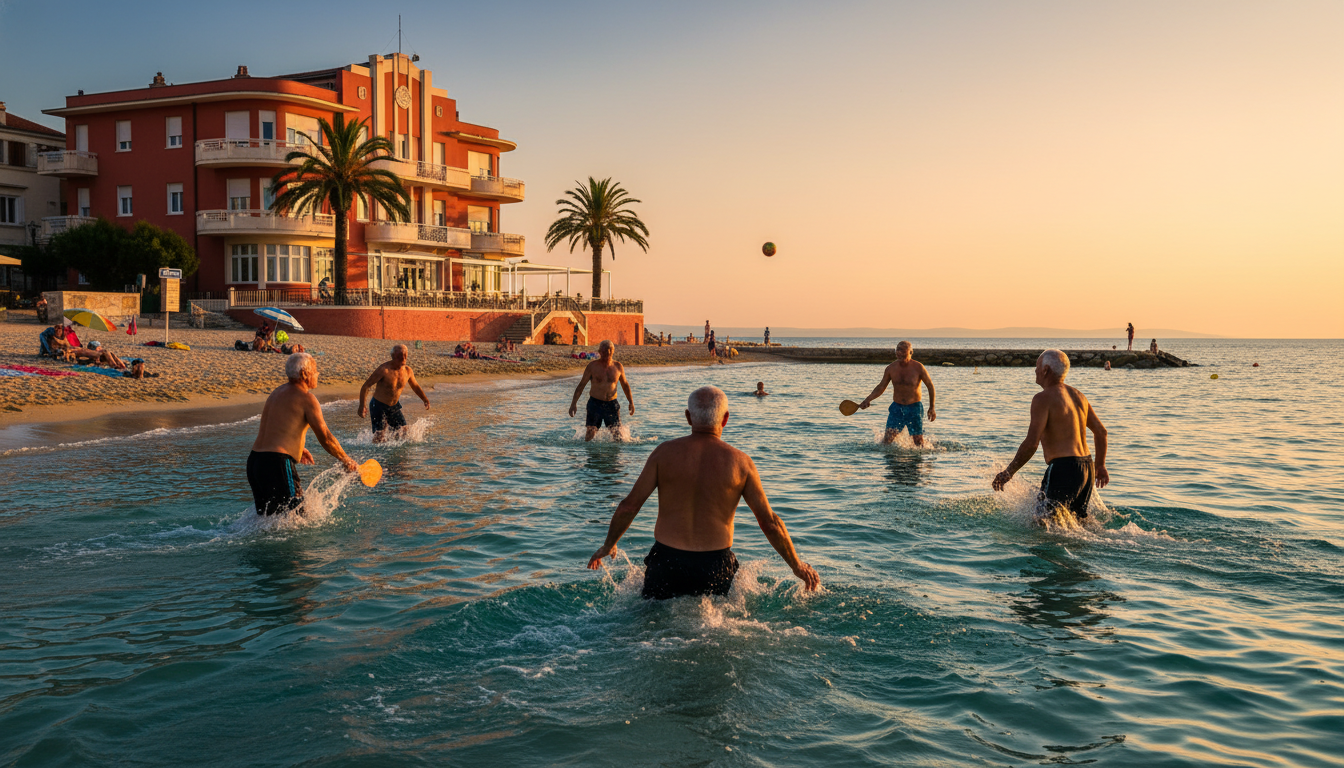 Bavice Beach in late afternoon, retirees playing picigin traditional paddle ball game in shallow tur
The neighborhood itself is more modern than the Old Town areas—you'll find apartment buildings from the 1960s-80s alongside newer construction. It's flatter, which matters. And you're still only a 15-minute waterfront stroll from Diocletian's Palace.
I'll be honest: Bačvice gets livelier in summer, with beach bars and younger crowds. But from September through June? Wonderfully calm. Several retired exchangers I spoke with specifically time their stays for shoulder seasons here.
Spinut: The Local's Choice
North of the center, Spinut is where Split residents actually live. It's not picturesque in a postcard way—you'll find mid-century apartment blocks, local markets, and the kind of everyday infrastructure (dentists, hardware stores, the excellent Studenac grocery chain) that makes extended stays practical.
The Marjan Forest Park borders Spinut, giving you immediate access to shaded walking trails, pine-scented air, and some of the best sunset viewpoints in the city. Several retirees mentioned this as their daily exercise route—flat paths along the water, gentle climbs if you want them, always with that Adriatic blue visible through the trees.
Home exchange options in Spinut tend to be larger—you might find a 3-bedroom apartment where a family lives, perfect if you're traveling with grandchildren or want space to spread out.
What Makes Home Exchange Ideal for Retirees in Split
I've written about home swapping for years, but talking to retired exchangers specifically opened my eyes to benefits I'd undervalued.
The Kitchen Factor
This came up in every single conversation. Having a full kitchen isn't just about saving money (though you will—restaurant meals in Split run $15-25 USD per person, while cooking at home costs a fraction of that). It's about dietary control, medication schedules, and the simple pleasure of morning coffee made exactly how you like it.
Split's markets make cooking a joy rather than a chore. The Pazar green market, steps from the palace, operates every morning with local produce, cheese, and olive oil. Fish market? Right next door, with catches that were swimming hours ago. Several exchangers mentioned that their morning market routine became the highlight of their day.
The Pace Problem Disappears
Hotels create pressure. That $250/night rate whispers "you should be out doing something." Home exchange eliminates this entirely. When your accommodation costs nothing, you're free to have slow days. To read on your terrace all afternoon. To skip the famous museum because you'd rather sit in the same café as yesterday.
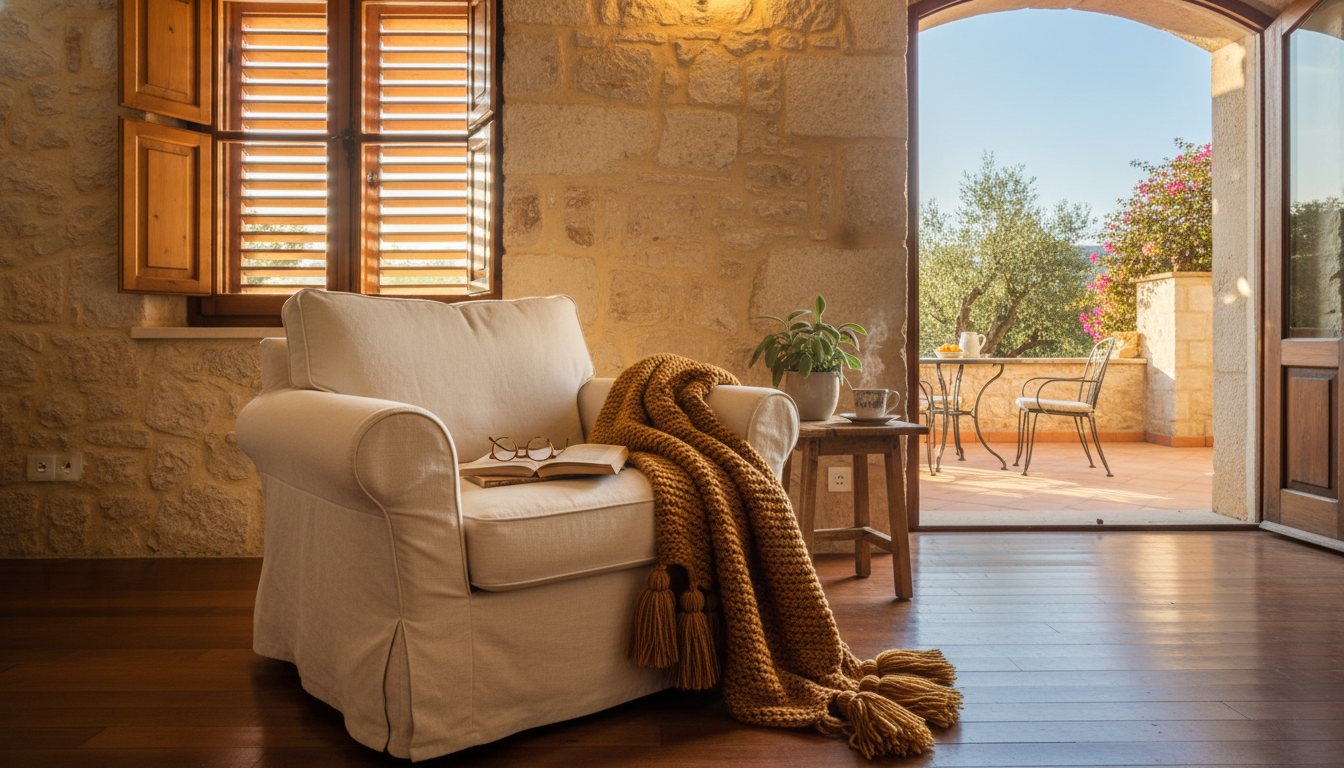 Cozy living room interior in a Split stone house, afternoon light through wooden shutters, comfortab
Richard put it perfectly: "We stopped counting days. We stopped making lists. We just lived there."
The Community Connection
Here's something beautiful about home exchange that doesn't get discussed enough: you inherit a neighborhood. Your host's neighbors become your neighbors. The café where they're regulars treats you like a regular. You're slotted into an existing social fabric rather than floating anonymously through tourist infrastructure.
For retirees—especially those traveling solo—this matters enormously. Loneliness is a real risk in extended travel. Home exchange builds in human connection from day one.
Practical Considerations for Retired Exchangers in Split
Let me get specific, because vague advice helps no one.
Healthcare Access
Croatia has excellent healthcare, and Split is home to the KBC Split hospital—one of the country's largest medical centers. EU citizens with a European Health Insurance Card (EHIC) can access public healthcare. For everyone else, travel insurance is essential.
I always recommend retirees get comprehensive travel insurance that covers pre-existing conditions—companies like World Nomads, Allianz, or IMG Global offer plans specifically designed for longer stays. Expect to pay $150-300 USD monthly depending on your age and coverage level.
Pharmacies (ljekarna) are everywhere in Split, and pharmacists are knowledgeable. Many medications available only by prescription in the US or UK are over-the-counter here. Bring documentation for any controlled medications.
Mobility and Accessibility
I won't sugarcoat this: Split's Old Town is challenging for anyone with significant mobility issues. Uneven stone streets, steps everywhere, no elevators in historic buildings. If you use a wheelchair or walker, focus your home exchange search on Bačvice, Spinut, or the newer eastern neighborhoods like Split 3.
That said, the waterfront Riva promenade is completely flat and stretches for over a kilometer—perfect for morning walks or evening strolls. And many retired exchangers told me the gentle daily walking actually improved their mobility over their stay.
Getting Around
Split is walkable for most needs, but the bus system is excellent for longer distances. A single ticket costs about $1.50 USD, and seniors often qualify for discounted monthly passes. Buses run frequently and connect all neighborhoods to the center.
Taxis are affordable—expect $5-10 USD for trips within the city. Uber operates here too. For day trips, the bus station and ferry terminal are both downtown, making excursions to islands or nearby towns easy.
Cost of Living
With home exchange covering your accommodation, here's what a comfortable retired life in Split actually costs monthly: groceries run $200-300 USD for quality ingredients, dining out is $15-25 USD per meal at mid-range restaurants, coffee costs $2-4 USD for espresso (wine is $4-6 USD), transportation is $30-50 USD if using buses regularly, and entertainment is often discounted—many museums offer senior rates, and concerts at the Croatian National Theatre run $15-30 USD.
Total monthly budget (excluding flights): $400-600 USD is comfortable. Compare that to what you'd spend at home.
 Overhead view of Pazar market in morning light, colorful produce displays, elderly shoppers with can
The Best Times for Retired Home Exchangers to Visit Split
Timing transforms the Split experience, and retirees have an advantage here: flexibility.
September-October: The Golden Window
This is my top recommendation. Summer crowds have thinned, but the Adriatic is still warm enough for swimming (around 72-75°F/22-24°C). Daytime temperatures hover in the comfortable 70s°F. Restaurants have availability. Locals have exhaled after the tourist rush and are genuinely happy to chat.
Home exchange availability peaks during this period too—many Split residents travel in autumn, creating opportunities for longer stays.
April-May: Spring Awakening
Split bursts into bloom in spring. Jacaranda trees purple the streets, outdoor cafés reopen, and the city shakes off winter quiet. Water's still too cold for most swimmers, but the weather is perfect for walking and exploring.
Easter in Split is special if you're interested in cultural experiences—the cathedral services, the traditional foods, the processions through ancient streets.
November-March: The Quiet Season
Here's a secret: Split doesn't really have winter the way northern Europe does. January averages 45°F/7°C—chilly but rarely freezing. Rain is more common, but so are dramatic skies and moody Mediterranean light.
The real advantage? You'll have the city almost to yourself. Diocletian's Palace without crowds is a different experience entirely. Prices at restaurants drop. Locals have time to talk. Several retirees I interviewed specifically seek winter exchanges in Split for this reason.
The downside: some tourist-oriented businesses close, and ferry schedules to islands reduce significantly. But for a city-focused stay, winter Split has a melancholy beauty that rewards slow exploration.
Day Trips and Excursions from Split
One of Split's greatest advantages is its position as a hub. You can easily fill weeks with day trips, returning each evening to your home exchange base.
The Islands
Brač is closest—a 50-minute ferry ride brings you to Supetar, a charming port town with excellent beaches. Zlatni Rat, Croatia's most photographed beach, is on Brač's southern shore (add a bus ride from Supetar).
Hvar is more dramatic—steep, lavender-scented, with a Venetian-era old town that rivals any in the Mediterranean. The fast catamaran takes about an hour. Hvar Town is lively (some would say too lively in summer), but the island's interior villages offer profound quiet.
Vis is the farthest inhabited island, which kept it off-limits during Yugoslav times and preserved something authentic. The seafood here is arguably Croatia's best. It's a longer day trip—plan for an early ferry and late return.
Inland Adventures
Krka National Park offers waterfalls you can swim beneath, wooden boardwalks through wetlands, and a fraction of Plitvice's crowds. Buses run directly from Split; expect a 90-minute journey each way.
Trogir, a UNESCO World Heritage town, is just 30 minutes by bus. Its medieval center sits on a tiny island, perfectly preserved, with excellent restaurants and none of Split's summer intensity.
Omiš, where the Cetina River meets the sea, offers dramatic canyon scenery and Croatia's best adventure sports if you're feeling spry—zip-lining, rafting, and canyoning are all available with professional guides.
 View from Marjan Hill at sunset, Splits terracotta rooftops below, islands visible on the horizon, e
How to Find the Perfect Split Home Exchange
Let me share what actually works for finding great exchanges in Split, based on what successful retired exchangers told me.
Start Early, Be Flexible
The best Split listings get snapped up months in advance, especially for peak shoulder seasons. If you're targeting September-October, start your search in March or April. For spring stays, begin looking after New Year.
Flexibility on exact dates helps enormously. Being able to say "anytime in October" rather than "October 15-30" opens more possibilities.
Write Compelling Requests
Your initial message matters more than you might think. Croatian hosts told me they receive dozens of generic requests. The ones that stand out mention specific things: why Split appeals, what you hope to experience, genuine questions about the neighborhood.
Mention your home exchange experience if you have it. Include that you're retired and seeking a longer, slower stay—many hosts prefer this to quick tourist turnovers.
Use SwappaHome's Credit System Strategically
SwappaHome's model works beautifully for retirees. You earn credits by hosting guests in your home—one credit per night, regardless of your home's size or location. You spend credits the same way: one credit per night anywhere in the world.
This means you could host guests for two weeks in your home, earn 14 credits, then spend those credits on a two-week stay in Split. New members start with 7 free credits, which already covers a substantial trip.
The system rewards active community members. Build your profile thoroughly, respond promptly to messages, and collect positive reviews—hosts in desirable locations like Split can afford to be selective.
What to Look for in Listings
Beyond the obvious (location, amenities), pay attention to floor level—ground floor or elevator access matters if stairs are a concern. Check heating and cooling, since Split summers are hot and air conditioning is essential June-August, while winters require heating. Look for outdoor space, because a terrace or balcony transforms extended stays. Confirm laundry options—in-unit washing machines are common, but dryers are rare since everyone line-dries. And check WiFi speed if you need to stay connected with family or handle any remote work.
Read reviews carefully. Look for mentions of the neighborhood, the host's communication style, and any quirks about the space.
Making the Most of Your Split Home Exchange
A few final thoughts from someone who's watched retirees thrive in Split—and a few who struggled.
Embrace the Rhythm
Split operates on Mediterranean time. Shops close for afternoon breaks. Dinner starts at 8pm or later. Sunday is genuinely quiet. Fighting this rhythm leads to frustration; embracing it leads to relaxation.
Plan your active time for mornings. Use afternoons for rest, reading, or that second coffee. Save energy for evening passeggiata along the Riva.
Learn a Few Words
Croatians appreciate any attempt at their language. "Dobar dan" (good day), "hvala" (thank you), and "molim" (please/you're welcome) will get you far. The effort matters more than the pronunciation.
Stay Connected, But Not Too Connected
The retirees who seemed happiest had found a balance: regular video calls with family, but not constant phone-checking. Split's beauty reveals itself to those paying attention. Put the phone down sometimes.
Build Rituals
The most content long-stay exchangers all had daily rituals. Morning market visits. Afternoon walks on Marjan. Evening aperitivo at the same waterfront bar. These rhythms create belonging faster than any sightseeing checklist.
Why Split Keeps Calling Retirees Back
I asked every retired exchanger I interviewed the same question: would you return?
Every single one said yes. Most had already booked their next stay.
There's something about Split that gets under your skin. Maybe it's the way ancient history and daily life coexist so naturally—you're buying vegetables in a market built into Roman walls. Maybe it's the Adriatic light, that particular Mediterranean blue that makes everything feel slightly unreal. Maybe it's simply that the city moves at a pace that feels human again.
Home exchange makes this accessible in a way that hotels never could. You're not visiting Split; you're living there, temporarily, in someone's actual life. You're part of the neighborhood, the rhythm, the story.
That couple I saw in Diocletian's Palace, the ones who'd been there six weeks? I ran into them again on my last day. They were heading to the market, canvas bags in hand, greeting the cheese vendor by name.
They looked completely at home.
Ready to explore home exchange in Split? SwappaHome connects travelers worldwide through a simple credit system—host guests, earn credits, stay anywhere. New members start with 7 free credits, enough for a meaningful first exchange. Your Croatian adventure might be closer than you think.
Frequently Asked Questions
Is Split safe for retired travelers?
Split is exceptionally safe for retirees. Croatia has low crime rates, and Split's well-lit streets and strong community culture mean you can walk comfortably day or night. The main concerns are typical travel issues—watch for pickpockets in crowded summer areas and mind uneven cobblestones in the Old Town. Healthcare is excellent and accessible.
How much does a month-long stay in Split cost for retirees?
With home exchange covering accommodation, expect monthly costs of $400-600 USD for a comfortable lifestyle. This includes groceries ($200-300), occasional dining out, transportation, and entertainment. Compare this to hotel stays averaging $100-150/night, and the savings become dramatic—potentially $3,000-4,000 monthly.
What's the best time of year for retired home exchangers to visit Split?
September and October offer the ideal combination: warm weather (70s°F), swimmable seas, thinned crowds, and excellent home exchange availability. Spring (April-May) is lovely for walking and cultural experiences. Even winter appeals to some retirees seeking solitude and dramatic Mediterranean atmosphere at the lowest costs.
Do I need to speak Croatian for an extended stay in Split?
No, but learning basics helps. English is widely spoken in Split, especially in restaurants, shops, and healthcare settings. Younger Croatians are often fluent. However, learning "dobar dan" (hello), "hvala" (thank you), and a few other phrases earns genuine appreciation and warmer interactions with locals.
How does home exchange work for longer retirement stays?
Platforms like SwappaHome use a credit system: host guests in your home (earning 1 credit per night), then use those credits to stay elsewhere (spending 1 credit per night). New members receive 7 free credits. This makes extended stays financially accessible—a month in Split costs 30 credits but zero accommodation fees, regardless of the property's location or size.

Published by
SwappaHome
SwappaHome Editorial Team
Home Exchange & Slow Travel Editorial
The SwappaHome Editorial Team brings together travel research, home-exchange community insights, and platform data to produce practical guides for first-time and experienced home swappers. Every article cites real platforms, current market rates, and verifiable city-level facts so readers can make informed decisions without guessing.
Ready to try home swapping?
Join SwappaHome and start traveling by exchanging homes. Get 7 free credits when you sign up!
Related articles
Bachelor and Bachelorette Parties in Singapore: The Complete Home Swap Group Guide for 2026
Planning a bachelor or bachelorette party in Singapore? Discover how home swapping lets groups of 6-12 stay together in luxury condos, saving thousands while partying in Marina Bay.
Cycling in Lisbon: 7 Home Swap Bike Tour Itineraries for Every Rider
Discover the best cycling routes in Lisbon with these home swap bike tour itineraries—from waterfront paths to hilltop adventures, all starting from your borrowed home.
Graduation Trip to Barcelona: How Home Swapping Gives New Graduates the Ultimate Celebration
Planning a graduation trip to Barcelona? Discover how home swapping lets new graduates explore Spain's most vibrant city without the hostel crowds or hotel costs.