SwappaHome Credit Strategy: How Frequent Travelers Maximize Free Stays

SwappaHome Editorial Team
Home Exchange & Slow Travel Editorial
Master the SwappaHome credit system to unlock unlimited free accommodation. Real strategies from power users who've turned hosting into year-round travel.
SwappaHome Credit Strategy: How Frequent Travelers Maximize Free Stays
You've just returned from hosting your third guest this month. Your inbox pings: 3 credits added. That's three free nights anywhere in the world—Tokyo, Lisbon, Cape Town, Buenos Aires. No cash exchanged. No booking fees. Just pure travel currency sitting in your account, waiting to be spent.
This is the SwappaHome credit strategy that frequent travelers have quietly optimized into an art form. While most members treat home exchange as an occasional vacation hack, a growing segment of the community has figured out how to turn strategic hosting into a self-sustaining travel lifestyle. The math is elegantly simple: one night hosted equals one night anywhere. But the strategy behind maximizing that equation? That's where things get interesting.
 Digital dashboard showing SwappaHome credit balance with world map pins marking potential destinatio
The SwappaHome credit system operates on radical equality. Whether you're hosting someone in a Manhattan penthouse or a cozy studio in Kraków, you earn exactly one credit per night. Whether you're booking a beachfront villa in Bali or a compact apartment in Berlin, you spend exactly one credit per night. This levels the playing field in ways traditional home exchange never could—and opens up strategic possibilities that savvy travelers have learned to exploit.
How the SwappaHome Credit System Actually Works
Before diving into advanced strategy, the fundamentals matter. The SwappaHome credit system eliminates the logistical nightmare of finding simultaneous swaps. Traditional home exchange required finding someone who wanted your home exactly when you wanted theirs—a coordination puzzle that left most listings gathering dust.
Credits changed everything.
Here's the core mechanic: Host a guest for any number of nights, earn that same number of credits. Use those credits to book stays with any other member, anywhere, anytime availability exists. New members start with 7 free credits—essentially a free week of accommodation anywhere in the network to test the waters.
The implications for frequent travelers are significant. You're no longer limited to destinations where someone happens to want your specific home. You're no longer locked into rigid date-matching. You've entered an economy where hospitality itself becomes currency.
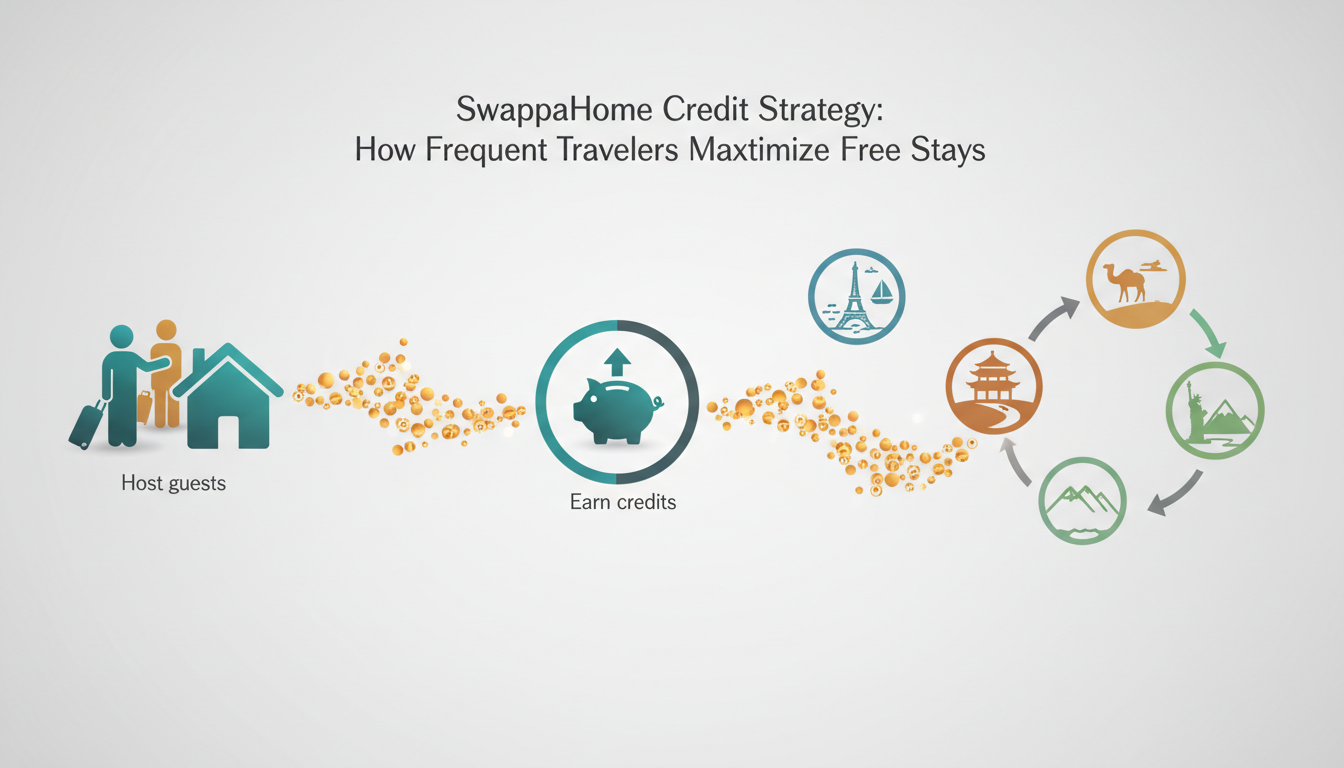 Infographic showing the credit flow Host guests Earn credits Book stays anywhere, with icons repre
A pattern emerges in the SwappaHome community: members who initially join for one specific trip end up restructuring their entire travel approach around the credit system. The shift from "occasional user" to "strategic credit builder" typically happens after the first successful hosting experience—when the realization hits that free accommodation isn't a one-time perk but a renewable resource.
Building Your Credit Reserve: The Foundation Strategy
The most successful frequent travelers on SwappaHome share one trait: they think in credit surplus, not credit balance. The goal isn't to earn exactly what you need for your next trip. The goal is building a reserve that gives you flexibility, spontaneity, and negotiating power.
The 3:1 Hosting Ratio
Power users in the community often target hosting three nights for every one night they plan to travel. This creates a perpetual surplus that covers unexpected opportunities—a last-minute invitation to a friend's wedding in Barcelona, a work conference in Singapore where you want to extend your stay, a spontaneous weekend getaway when burnout hits.
The math works like this: If you travel 30 nights per year, aim to host 90-100 nights annually. That's roughly 8-9 nights of hosting per month—achievable for anyone with a spare room or flexible living situation.
Strategic Availability Windows
Not all hosting periods are equal. Experienced members have identified high-demand windows that fill quickly:
Peak demand periods to keep available:
- Major city events (fashion weeks, film festivals, marathons)
- Holiday weekends when hotels triple their rates
- University graduation and move-in periods
- Conference seasons in business hubs
- Summer months in tourist destinations
Consider Edinburgh during the August Fringe Festival. Hotel rates regularly exceed £300 per night—making the credit value proposition extraordinary for travelers, which means booking requests flood in. Hosts who block out the entire festival period exclusively for SwappaHome guests report their calendars filling within days.
 Calendar view with strategic hosting periods highlighted, showing peak seasons marked in different c
The Spare Room Advantage
Here's where the credit strategy diverges sharply from traditional home exchange. You don't need to vacate your entire home to host. Members with spare bedrooms or separate guest quarters can host while living in their home—dramatically increasing hosting capacity.
This changes the economics entirely. Instead of hosting only when you're traveling (maybe 4-6 weeks per year), you can host year-round. A spare room available 20 nights per month generates 240 credits annually. That's eight months of free accommodation anywhere in the world.
The SwappaHome community includes teachers who host during summer break, remote workers who offer their second bedroom continuously, and retirees who've turned hosting into a social activity as much as a travel strategy.
Spending Credits Strategically: Where One Night Equals More
Earning credits is half the equation. Spending them wisely multiplies their value.
The credit system's flat rate—one credit per night regardless of location—creates arbitrage opportunities that frequent travelers have learned to exploit. Your credit earned hosting in a mid-tier city buys a night in the world's most expensive destinations at face value.
High-Value Credit Destinations
Consider the real-world math. Average nightly hotel rates in these cities regularly exceed $200-400:
Cities where credits punch above their weight:
- Tokyo: Budget hotels start around $150/night; mid-range easily hits $300
- Zurich: Among Europe's most expensive cities, $250+ is standard
- Sydney: Peak season rates of $200-350 for central locations
- New York: Manhattan averages $300+ for anything decent
- London: Central zones command $200-400 depending on season
- Singapore: $180-350 for well-located accommodation
One credit spent in Zurich delivers roughly 3-4x the monetary value of one credit spent in, say, Lisbon or Mexico City (where excellent accommodation runs $50-80/night). Strategic credit spenders prioritize high-cost destinations and use traditional booking methods for budget-friendly locations.
The Long-Stay Multiplier
Credit value compounds on extended stays. A two-week trip to Tokyo using 14 credits saves $2,800-4,200 versus hotels. A month in Sydney saves $6,000-10,500. These aren't theoretical numbers—they're the calculations members run before committing to credit-funded trips.
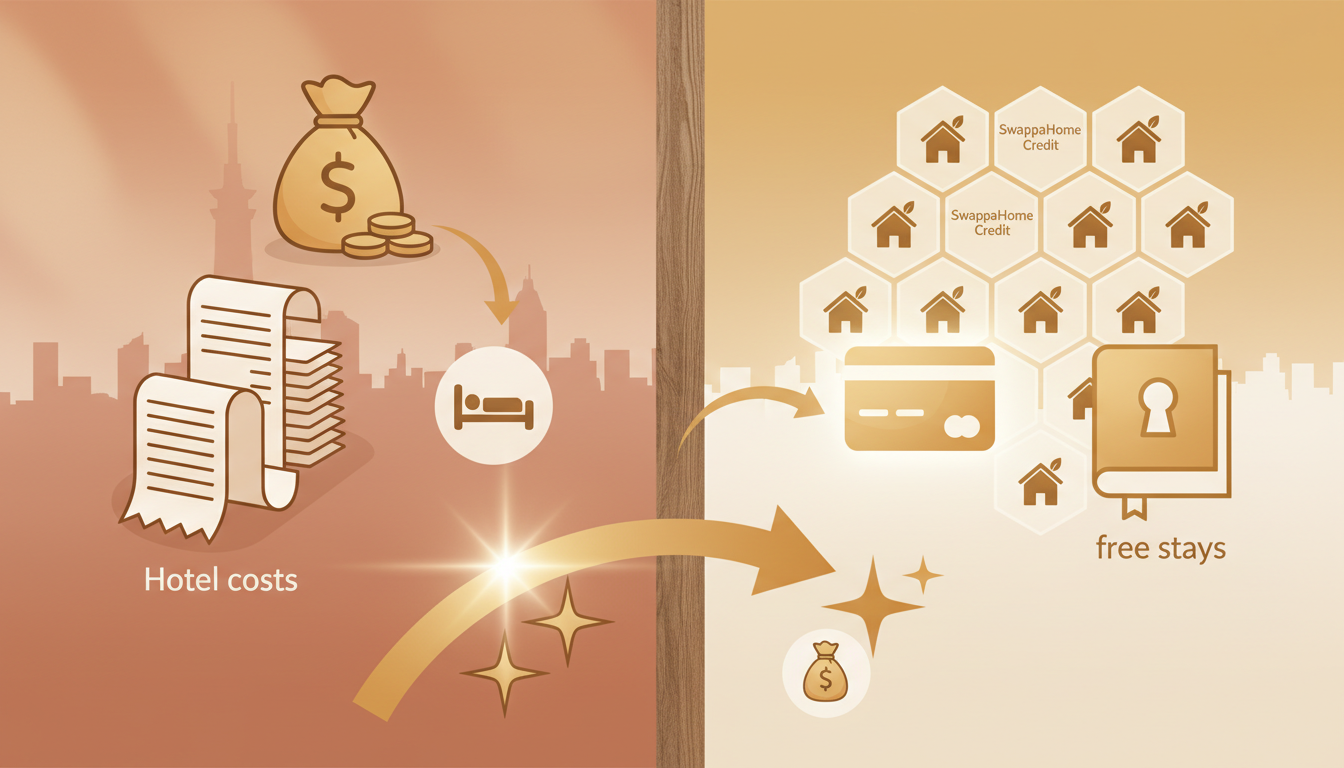 Split-screen comparison showing hotel receipt totals versus SwappaHome credit cost for a two-week To
Frequent travelers often structure their year around one or two long credit-funded trips to expensive destinations, supplemented by shorter budget-destination trips booked conventionally. The credit system becomes a strategic tool rather than a universal solution.
Shoulder Season Arbitrage
Credit availability follows predictable patterns. Popular destinations in peak season get booked months in advance. The same destinations in shoulder season? Often available with just weeks' notice.
Smart credit strategy means booking peak-season stays 3-6 months ahead, staying flexible on shoulder-season trips, and having a "credit dump" destination list for last-minute availability.
Paris in April requires early planning. Paris in November? You might find availability next week. The credit cost is identical—but your flexibility determines whether you can actually use them.
Advanced Credit Tactics for Power Users
Once the fundamentals click, experienced members layer on sophisticated strategies that maximize both earning and spending efficiency.
The Hub Strategy
Some frequent travelers maintain listings in multiple cities—a primary residence plus a pied-à-terre, a family property they manage, or a home they've kept after relocating. Multiple listings multiply hosting capacity without additional physical space.
A member might list their Brooklyn apartment and their parents' empty nest in suburban Chicago. Different markets, different demand patterns, combined credit earnings. The Brooklyn listing attracts international visitors year-round; the Chicago listing fills during Bears games, conventions, and family reunion season.
Reciprocal Relationship Building
While the credit system eliminates the need for direct swaps, building relationships with members in your target destinations creates advantages: guaranteed availability during peak periods, insider tips that transform tourist trips into local experiences, and potential for future direct exchanges (credits still work, but you've got a trusted contact).
The SwappaHome messaging system facilitates these connections. Members who host someone from Barcelona often reach out months later when planning their own Spanish trip—not because they need to, but because they've built trust.
 Cozy living room scene with two travelers looking at a physical map together, local guidebooks and h
The Review Flywheel
Credits open doors. Reviews keep them open.
Members with 20+ positive reviews report significantly higher booking acceptance rates and faster responses. The review flywheel works like this: good hosting generates good reviews, which attracts more booking requests, which generates more credits, which funds more travel, which generates more reviews as a guest.
Frequent travelers protect their review profile obsessively. They communicate proactively, leave detailed house guides, stock welcome snacks, and follow up after stays. Each five-star review compounds their future options.
Credit Timing and Expiration Awareness
Credits on SwappaHome don't expire—but your ability to use them depends on maintaining an active membership. Power users stay aware of their membership status and plan credit usage accordingly.
Some members deliberately "spend down" large credit balances before any planned membership changes. Others maintain modest surpluses to avoid the psychological pressure of unused credits. The right balance depends on your travel patterns and hosting capacity.
Common Credit Strategy Mistakes (And How to Avoid Them)
Even experienced members stumble. These patterns emerge repeatedly in community discussions:
Mistake #1: Hoarding Credits Without Plans
Credits have no interest rate. A credit earned today has the same value as a credit earned three years from now. Yet some members accumulate hundreds of credits without concrete travel plans—essentially providing free hosting to the network without reciprocal benefit.
The fix: Set credit targets tied to specific trips. "I need 21 credits for my Japan trip in October" creates purpose. "I'll just keep hosting and see what happens" leads to imbalanced exchanges.
Mistake #2: Ignoring Listing Optimization
Credits come from bookings. Bookings come from attractive listings. Members who treat their listing as an afterthought—blurry photos, sparse descriptions, no local tips—struggle to earn credits regardless of their home's actual quality.
The SwappaHome community consistently reports that listing quality matters more than location or amenities. A well-photographed, thoughtfully described studio apartment in a secondary city outperforms a luxury home with three sentences of description and dark photos.
Mistake #3: Peak-Season-Only Availability
Limiting availability to dates when you're traveling anyway minimizes credit-earning potential. The members who accumulate significant credit reserves are those who host beyond their own travel dates—keeping spare rooms available continuously or accepting guests during periods they're home but not traveling.
Mistake #4: Underestimating Response Time
Booking requests have windows. Members who take days to respond often lose guests to faster hosts. The SwappaHome algorithm also factors response time into listing visibility—slow responders get buried.
Frequent travelers enable mobile notifications and aim to respond within hours, not days. Even a "let me check my calendar and get back to you tomorrow" maintains engagement better than silence.
Building a Sustainable Credit Lifestyle
The most successful credit strategists don't view SwappaHome as a hack or a trick. They've integrated it into a broader philosophy about travel, community, and resource sharing.
The Mindset Shift
Transactional thinking—"I hosted three nights so I deserve three nights"—misses the point. The members who thrive long-term approach hosting as genuine hospitality that happens to generate travel currency. They enjoy meeting travelers, sharing their neighborhoods, and participating in a global community of like-minded people.
This isn't just philosophical. Guests sense transactional energy. Reviews reflect it. And the credit system, while mechanically neutral, rewards members who bring authentic hospitality to their hosting.
Balancing Hosting and Living
Burnout is real. Members who maximize hosting at the expense of their own peace eventually step back or leave the platform entirely. Sustainable credit strategy includes blocking dates for personal recovery, setting clear boundaries in listings (quiet hours, shared space expectations), taking breaks between guests when needed, and being honest about hosting capacity rather than overcommitting.
The Long Game
Frequent travelers who've used SwappaHome for years describe a compounding effect. Early effort building reviews and relationships pays dividends indefinitely. A member with 50+ reviews and established connections in multiple cities operates in a different tier than a newcomer—not because the platform treats them differently, but because they've built social capital within the community.
The credit strategy isn't about gaming a system. It's about investing in a network that returns value proportional to what you contribute.
Real-World Credit Math: A Year in the Life
To make this concrete, here's how credit strategy might play out over twelve months for a frequent traveler based in a mid-sized U.S. city:
Hosting (Credit Earning):
- Spare bedroom available 15 nights/month = 180 potential nights
- Average occupancy: 60% = 108 nights hosted
- Credits earned: 108
Traveling (Credit Spending):
- Two-week trip to Japan: 14 credits
- Ten days in London: 10 credits
- Long weekend in NYC (3 nights): 3 credits
- Week in Portugal: 7 credits
- Spontaneous trips and extended stays: 20 credits
- Total credits spent: 54
Net Position: +54 credits carried into next year
Equivalent Savings:
- Japan (14 nights × $250 avg): $3,500
- London (10 nights × $275 avg): $2,750
- NYC (3 nights × $350 avg): $1,050
- Portugal (7 nights × $80 avg): $560
- Other trips (20 nights × $150 avg): $3,000
- Total accommodation savings: $10,860
This math assumes moderate hosting effort and strategic destination selection. Members in high-demand locations or with multiple listings report significantly higher numbers.
Getting Started: Your First 90 Days of Credit Strategy
New members often feel overwhelmed by optimization possibilities. Here's a grounded 90-day plan:
Days 1-30: Foundation
- Use your 7 free credits on a test trip (validates the system works for you)
- Create a compelling listing with 15+ quality photos
- Write a detailed description including neighborhood highlights
- Set availability for the next 3 months
- Respond to any inquiries within 12 hours
Days 31-60: First Hosting Experiences
- Accept your first 2-3 booking requests
- Focus on earning positive reviews over maximizing nights
- Refine your house guide based on guest questions
- Identify your hosting rhythm (consecutive nights vs. gaps between guests)
Days 61-90: Strategy Development
- Analyze which dates attracted the most interest
- Plan your next credit-funded trip 3-6 months out
- Calculate your target credit reserve
- Identify high-value destinations for future credit spending
The first 90 days establish patterns that compound over years. Members who rush past this foundation often struggle to build momentum later.
The Future of Credit-Based Travel
The SwappaHome credit system represents a broader shift in how people think about travel accommodation. As hotel prices continue climbing and short-term rental regulations tighten in major cities, community-based alternatives gain appeal.
Frequent travelers who master credit strategy now position themselves for a future where these skills matter more, not less. The network effects—more members means more options means more value—suggest the system's utility will only grow.
For those willing to approach travel as a two-way exchange rather than a one-way purchase, the credit system offers something hotels never can: a global community of people who've opened their homes to you, and to whom you've done the same.
That's worth more than any discount code.
Frequently Asked Questions
How many SwappaHome credits do I need for a two-week trip?
You need exactly 14 credits for a two-week trip—one credit per night, regardless of destination. Whether you're staying in an expensive city like Tokyo or a budget-friendly location like Lisbon, the credit cost remains the same. New members start with 7 free credits, so hosting just 7 nights before your trip covers the remaining balance.
Can I earn SwappaHome credits without leaving my home?
Yes—members with spare bedrooms or separate guest spaces can host while living in their home. This dramatically increases credit-earning potential since you're not limited to hosting only when traveling. Many frequent travelers earn 100+ credits annually using a spare room available 15-20 nights per month.
Do SwappaHome credits expire?
Credits don't expire as long as you maintain an active membership. However, your ability to use accumulated credits depends on continued membership status. Power users recommend maintaining a reasonable credit balance tied to concrete travel plans rather than hoarding large surpluses indefinitely.
What's the best strategy for using credits in expensive cities?
Prioritize spending credits in high-cost destinations like Tokyo, Zurich, Sydney, New York, and London where hotel rates regularly exceed $200-400 per night. One credit in these cities delivers 3-4x the monetary value compared to budget destinations. Use conventional booking methods for affordable locations and save credits for maximum impact.
How do I get more SwappaHome booking requests to earn credits faster?
Listing quality drives booking requests more than location or amenities. Invest in 15+ high-quality photos with natural lighting, write detailed descriptions including neighborhood highlights, respond to inquiries within hours, and maintain availability during high-demand periods like local events and holiday weekends. Members with strong review histories also report significantly higher booking rates.

Published by
SwappaHome
SwappaHome Editorial Team
Home Exchange & Slow Travel Editorial
The SwappaHome Editorial Team brings together travel research, home-exchange community insights, and platform data to produce practical guides for first-time and experienced home swappers. Every article cites real platforms, current market rates, and verifiable city-level facts so readers can make informed decisions without guessing.
Ready to try home swapping?
Join SwappaHome and start traveling by exchanging homes. Get 7 free credits when you sign up!
Related articles

Bachelor and Bachelorette Parties in Singapore: The Complete Home Swap Group Guide for 2026
Planning a bachelor or bachelorette party in Singapore? Discover how home swapping lets groups of 6-12 stay together in luxury condos, saving thousands while partying in Marina Bay.

Cycling in Lisbon: 7 Home Swap Bike Tour Itineraries for Every Rider
Discover the best cycling routes in Lisbon with these home swap bike tour itineraries—from waterfront paths to hilltop adventures, all starting from your borrowed home.

Graduation Trip to Barcelona: How Home Swapping Gives New Graduates the Ultimate Celebration
Planning a graduation trip to Barcelona? Discover how home swapping lets new graduates explore Spain's most vibrant city without the hostel crowds or hotel costs.