Japanese Phrases for Home Swap Travelers: Your Tokyo Language Survival Guide

SwappaHome Editorial Team
Home Exchange & Slow Travel Editorial
Master essential Japanese phrases for your Tokyo home swap. From greeting neighbors to navigating konbini, this guide covers the language basics that transform awkward tourists into welcomed guests.
You're standing outside a residential building in Nakano, Tokyo, fumbling with a set of unfamiliar keys while an elderly neighbor watches from across the narrow street. She approaches. Your heart rate spikes. This is the moment that separates a forgettable trip from a genuine cultural exchange—and the only thing standing between awkward silence and warm connection is about forty words of Japanese.
Here's the honest truth about Japanese phrases for home swap travelers: you don't need fluency. You don't even need conversational ability. What you need is a strategic toolkit of expressions that signal respect, facilitate daily life, and turn potential friction points into moments of human connection. The SwappaHome community has identified exactly which phrases matter—and which textbook Japanese you can safely forget.
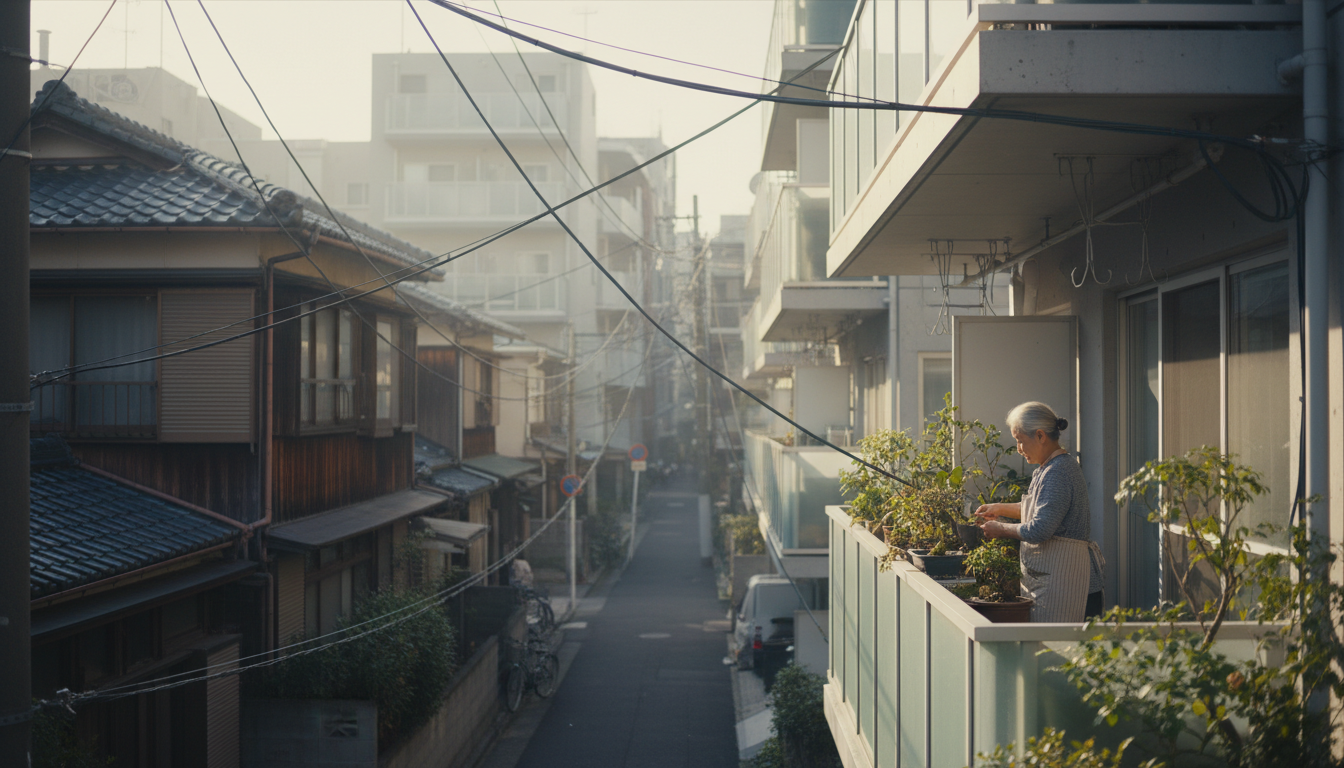 Warm morning scene in a Tokyo residential neighborhood, showing traditional wooden houses mixed with
Why Language Matters More for Home Swaps Than Hotel Stays
When you book a hotel in Shinjuku, staff speak English. Signs are bilingual. You exist in a tourist bubble designed to minimize linguistic friction. A home swap in Tokyo drops you into actual Japanese life—residential neighborhoods where English is rare, local konbini where staff speak rapid-fire Japanese, and neighbors who've never interacted with a foreign guest.
This isn't a problem. It's the entire point.
But it does mean the stakes are different. Your home swap host's reputation in their building depends partly on how their guests behave. The neighbor who sees you struggling with garbage sorting will form opinions. The building manager who encounters you in the elevator will decide whether future exchanges are welcome.
Japanese phrases for home swap travelers aren't about impressing anyone with your language skills. They're about demonstrating cultural awareness—showing that you understand you're a guest in someone's community, not a tourist passing through a commercial space.
Travelers consistently report that even broken, heavily-accented Japanese transforms interactions. A simple "sumimasen" (excuse me/sorry) before asking for help in English generates completely different responses than launching directly into English. It's not about the words themselves—it's about the respect they signal.
The First 24 Hours: Arrival Phrases That Set the Tone
Your first interactions establish everything. Here's what you'll actually need:
Meeting Your Host or Their Representative
Many Tokyo home swaps involve a brief handoff—your host shows you the apartment, explains the quirks, hands over keys. Even if they speak English, opening in Japanese creates immediate warmth.
Hajimemashite (ha-jee-meh-mash-teh) — "Nice to meet you" (first meeting only)
Yoroshiku onegaishimasu (yoh-roh-shee-koo oh-neh-guy-shee-mahss) — This phrase has no direct English translation. It roughly means "please treat me well" or "I'm in your care." Use it after introductions. It's the single most relationship-building phrase in Japanese.
Osewa ni narimasu (oh-seh-wah nee nah-ree-mahss) — "Thank you for taking care of me" — Use this when your host has gone out of their way to prepare things for you.
Subarashii (soo-bah-rah-shee) — "Wonderful/amazing" — When they show you the apartment, this genuine appreciation lands better than English superlatives.
The Neighbor Encounter
This is where home swaps diverge most sharply from hotels. You will encounter neighbors. In the elevator, at the mailboxes, taking out trash. How you handle these moments ripples through your entire stay.
Konnichiwa (kohn-nee-chee-wah) — "Hello/Good afternoon" — The safe default for daytime encounters.
Ohayou gozaimasu (oh-hah-yoh goh-zah-ee-mahss) — "Good morning" — Use before about 10 AM. The formal version matters in residential buildings.
Konbanwa (kohn-bahn-wah) — "Good evening" — After sunset.
[Your host's name]-san no tomodachi desu — "I'm [host's name]'s friend" — This single phrase explains your presence and connects you to someone they know. It transforms you from "random foreigner" to "guest of a neighbor."
Shibaraku otama shimasu (shee-bah-rah-koo oh-tah-mah shee-mahss) — "I'll be staying for a while" — A polite acknowledgment that you're temporary.
 Interior of a Tokyo apartment entryway genkan, showing the step up to the main floor, a shoe cabinet
Daily Survival: The Konbini, Supermarket, and Beyond
Tokyo's convenience stores—konbini—will become your second home. 7-Eleven, Lawson, and FamilyMart are open 24/7, sell everything from onigiri to concert tickets, and operate with a specific verbal rhythm you'll want to understand.
Konbini Transactions
When you approach the register, staff will rapid-fire several questions. Don't panic—here's what they're asking:
"Pointo kaado wa arimasu ka?" — "Do you have a point card?" Your response: "Nai desu" (nye dess) — "I don't have one" or simply shake your head.
"Fukuro wa irimasu ka?" — "Do you need a bag?" Your response: "Hai, onegaishimasu" (hi, oh-neh-guy-shee-mahss) — "Yes, please" or "Iie, kekkou desu" (ee-eh, kehk-koh dess) — "No, I'm fine"
"Otemoto wa irimasu ka?" — "Do you need chopsticks?" Same yes/no responses work.
"Atatamemasu ka?" — "Should I heat this up?" (for bento boxes, onigiri) "Hai, onegaishimasu" — Yes, please
When paying: "Suica de" (swee-kah deh) — "With Suica" (or Pasmo, your transit card) "Genkin de" (gehn-keen deh) — "With cash" "Kaado de" (kah-doh deh) — "With card"
Supermarket Essentials
Local supermarkets in residential Tokyo neighborhoods—places like Life, Maruetsu, or OK Store—offer better prices than konbini and a glimpse into actual Japanese daily life. The checkout process is similar but often faster.
"Kore wa nan desu ka?" (koh-reh wah nahn dess kah) — "What is this?" — Useful when you can't identify a food item. Point while asking.
"[Food item] wa doko desu ka?" — "Where is [food item]?" — Staff will usually walk you there rather than explain.
Common items you might need to ask about:
- Tamago (tah-mah-goh) — Eggs
- Gyuunyuu (gyoo-nyoo) — Milk
- Pan (pahn) — Bread
- Niku (nee-koo) — Meat
- Yasai (yah-sai) — Vegetables
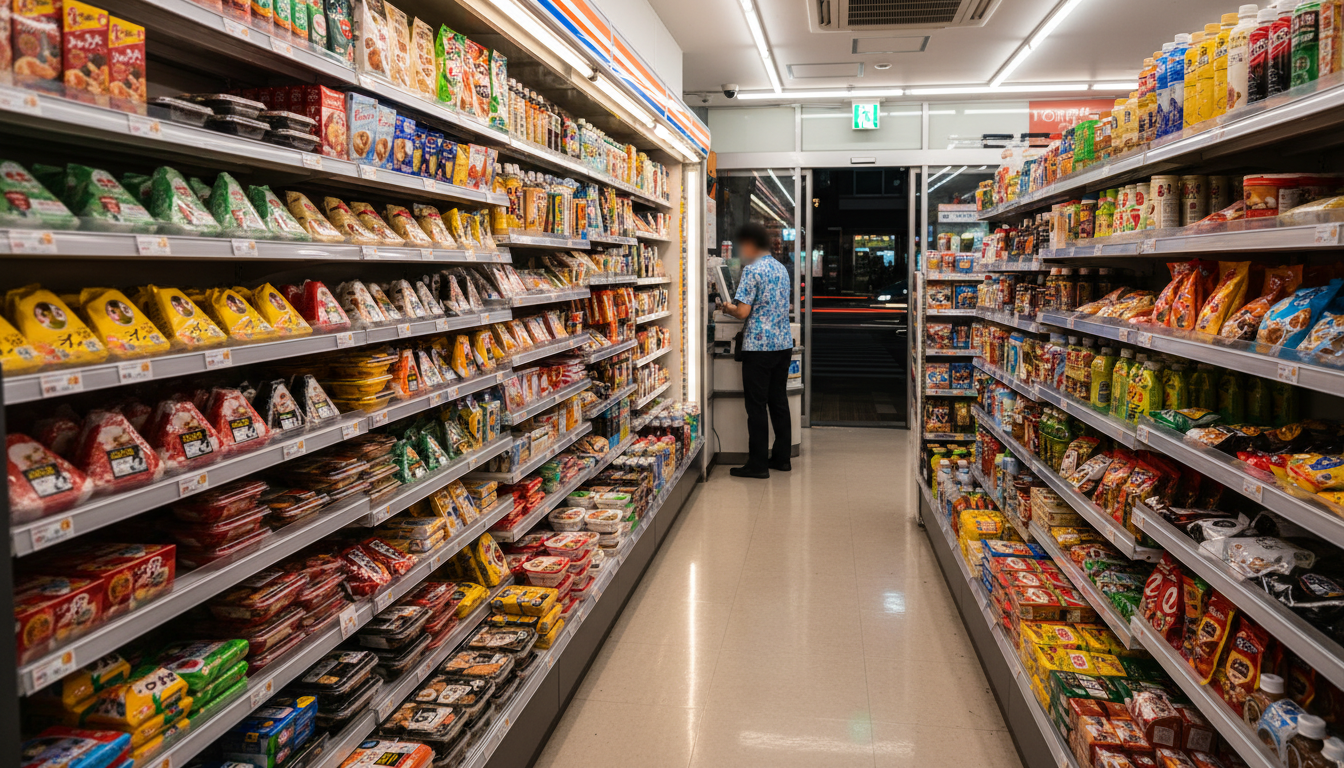 Interior of a Tokyo konbini at night, showing brightly lit aisles with bento boxes, onigiri triangle
Navigating Tokyo's Transit System
Tokyo's train system is legendarily complex—13 subway lines, multiple JR lines, private railways, all interconnected. The good news: it's designed for non-Japanese speakers. Station names are romanized, announcements often include English, and Google Maps works flawlessly.
But phrases still help, especially when things go wrong.
At the Station
"[Station name] made ikura desu ka?" — "How much to [station name]?" — Useful at ticket machines if you're not using a Suica/Pasmo.
"[Station name] wa dono densha desu ka?" — "Which train goes to [station name]?" — Staff at the ticket gates can point you to the right platform.
"Tsugi no densha wa nanji desu ka?" — "What time is the next train?"
"Shinjuku eki wa doko desu ka?" — "Where is Shinjuku Station?" — Replace with any station name.
When Things Go Wrong
"Sumimasen, michi ni mayoimashita" (soo-mee-mah-sehn, mee-chee nee mah-yoh-ee-mah-shee-tah) — "Excuse me, I'm lost" — Japanese people will go extraordinarily far out of their way to help lost foreigners. This phrase, combined with showing your destination on Google Maps, typically results in someone walking you there.
"Eigo o hanasemasu ka?" — "Do you speak English?" — Worth asking, but don't expect yes. Younger people in commercial areas are more likely to have some English.
"Koko wa doko desu ka?" — "Where is this place?" — When you're genuinely disoriented.
Home Swap Specific Situations
These phrases address scenarios unique to staying in someone's home rather than a hotel.
Garbage and Recycling
Tokyo's garbage system is notoriously complex. Different days for different types, specific bags required, penalties for mistakes. Your host should explain their building's system, but these phrases help:
"Gomi no hi wa itsu desu ka?" — "When is garbage day?"
"Moeru gomi" (moh-eh-roo goh-mee) — Burnable garbage "Moenai gomi" (moh-eh-nai goh-mee) — Non-burnable garbage "Shigen gomi" (shee-gehn goh-mee) — Recyclables "Pet botoru" — PET bottles (plastic bottles) "Kan" (kahn) — Cans "Bin" (been) — Glass bottles
"Kono gomi wa doko ni sutemasu ka?" — "Where do I throw away this garbage?" — Useful if you're unsure about a specific item.
Household Issues
"[Item] ga kowaremashita" — "The [item] is broken" — Hopefully you won't need this, but:
- Eakon (eh-ah-kohn) — Air conditioner
- Reizouko (reh-zoh-koh) — Refrigerator
- Sentakuki (sehn-tah-koo-kee) — Washing machine
- Toire (toh-ee-reh) — Toilet
"Oyu ga demasen" — "Hot water isn't coming out" — A common issue with Japanese water heaters that have specific operating procedures.
"Kagi o nakushimashita" — "I lost the key" — The phrase you hope never to use.
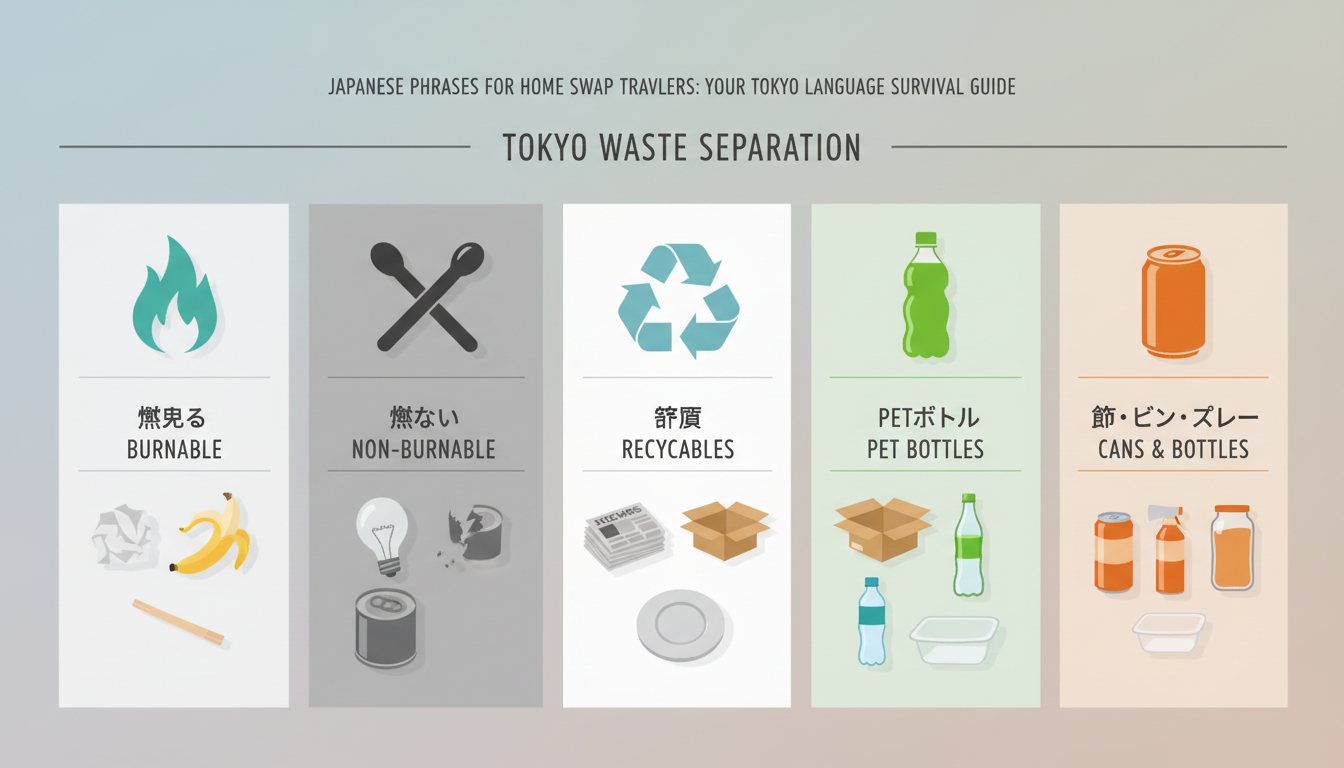 A detailed infographic showing Tokyos garbage separation system with icons for burnable, non-burnabl
Restaurant and Café Phrases
Eating out in Tokyo—even in residential neighborhoods—is often cheaper than cooking. A bowl of ramen in Koenji runs ¥800-1,200 (roughly $5-8 USD), and local izakaya offer filling set meals for ¥1,000-1,500. These phrases smooth the experience:
Entering and Seating
"Hitori desu" (hee-toh-ree dess) — "One person" — Or "Futari desu" for two people.
"Yoyaku wa shite imasen" — "I don't have a reservation"
"Kinen seki onegaishimasu" — "Non-smoking section, please" — Less necessary now that most Tokyo restaurants are non-smoking indoors, but still useful.
Ordering
"Osusume wa nan desu ka?" — "What do you recommend?" — Japanese servers take this question seriously and will give genuine recommendations.
"Kore o kudasai" (koh-reh oh koo-dah-sai) — "This one, please" — Point at the menu or plastic food display.
"[Dish name] o hitotsu kudasai" — "One [dish name], please"
"Mizu o kudasai" — "Water, please" — Free water is standard in Japanese restaurants.
"Okaikei onegaishimasu" (oh-kai-keh oh-neh-guy-shee-mahss) — "Check, please" — Or make an X with your fingers, the universal Japanese gesture for "bill."
Dietary Needs
"Niku nashi de onegaishimasu" — "Without meat, please" — Vegetarianism is poorly understood in Japan; be specific.
"[Allergen] arerugi ga arimasu" — "I have a [allergen] allergy"
- Komugi (koh-moo-gee) — Wheat
- Tamago — Eggs
- Nyuuseihin (nyoo-seh-heen) — Dairy
- Ebi (eh-bee) — Shrimp
- Piinattsu — Peanuts
"Bejitarian ryouri wa arimasu ka?" — "Do you have vegetarian dishes?" — The answer is often no, but asking shows respect.
Emergency and Medical Phrases
You probably won't need these. But if you do, you'll need them urgently.
"Tasukete kudasai!" (tah-soo-keh-teh koo-dah-sai) — "Help me, please!" — For genuine emergencies.
"Kyuukyuusha o yonde kudasai" — "Please call an ambulance" — Emergency number is 119 in Japan.
"Keisatsu o yonde kudasai" — "Please call the police" — Also 110.
"Byouin wa doko desu ka?" — "Where is the hospital?"
"Kusuri ga hitsuyou desu" — "I need medicine"
"[Body part] ga itai desu" — "My [body part] hurts"
- Atama (ah-tah-mah) — Head
- Onaka (oh-nah-kah) — Stomach
- Nodo (noh-doh) — Throat
- Senaka (seh-nah-kah) — Back
"Yakkyoku wa doko desu ka?" — "Where is the pharmacy?" — Look for the green cross sign.
 A quiet Tokyo residential street at dusk, showing a small local pharmacy yakkyoku with its green cro
Cultural Phrases That Build Connection
These aren't strictly necessary for survival, but they transform transactions into interactions.
Expressing Gratitude
"Arigatou gozaimasu" (ah-ree-gah-toh goh-zah-ee-mahss) — "Thank you" (formal) — Use this with strangers, service workers, anyone older than you.
"Arigatou" — "Thanks" (casual) — Only with people your age or younger in informal settings.
"Osore irimasu" (oh-soh-reh ee-ree-mahss) — "I'm sorry to trouble you" — Use when someone goes out of their way for you. Deeply appreciated.
"Gochisousama deshita" (goh-chee-soh-sah-mah deh-shee-tah) — "Thank you for the meal" — Say this when leaving a restaurant or after someone treats you. Non-negotiable politeness.
Compliments That Land
"Oishii desu" (oh-ee-shee dess) — "It's delicious" — The single most useful food compliment.
"Kirei desu ne" (kee-reh dess neh) — "It's beautiful, isn't it?" — For views, gardens, arrangements.
"Sugoi desu ne" (soo-goh-ee dess neh) — "That's amazing, isn't it?" — General-purpose impressed reaction.
Departure Phrases
When leaving your home swap, these phrases leave a lasting positive impression:
"Osewa ni narimashita" (oh-seh-wah nee nah-ree-mah-shee-tah) — "Thank you for taking care of me" — Past tense version, perfect for departure.
"Totemo tanoshikatta desu" — "I had a great time"
"Mata aimashou" — "Let's meet again" — If you genuinely hope to.
"Ogenki de" (oh-gehn-kee deh) — "Take care" — A warm farewell.
Pronunciation Tips That Actually Matter
Japanese pronunciation is more forgiving than you'd expect. Unlike Chinese, there are no tones. Unlike French, there are no nasal vowels. But a few patterns will dramatically improve comprehension:
Vowels are consistent:
- A = "ah" (as in "father")
- I = "ee" (as in "feet")
- U = "oo" (as in "food")
- E = "eh" (as in "bed")
- O = "oh" (as in "go")
Double consonants matter: "Kite" (come) vs. "Kitte" (stamp) are different words. Hold the consonant slightly longer.
The "R" sound: Japanese "R" is between an English "R" and "L"—tap your tongue against the roof of your mouth once, like a soft "D."
Pitch matters more than stress: Japanese doesn't have stressed syllables like English. Keep pitch relatively flat, with slight rises at the end of questions.
"U" often disappears: "Desu" is pronounced closer to "dess." "Masu" sounds like "mahss." This is normal.
Technology Aids Worth Using
Language learning apps and translation tools have transformed travel in Japan. Here's what actually works:
Google Translate's camera function: Point your phone at Japanese text—menus, signs, instructions—and get instant translation. Not perfect, but usually good enough.
Google Translate's conversation mode: Speak English, it speaks Japanese. Speak Japanese, it translates to English. Useful for complex explanations with your host.
Papago: Often more accurate than Google for Japanese-English translation. Worth downloading as a backup.
Voice input: Most Japanese people under 40 can understand Google Translate's voice output. Show them your phone, play the translation. It works.
But here's the thing: using technology without attempting human phrases first signals something different than trying Japanese first and falling back on technology. The attempt matters. Start with "sumimasen," try your phrase, then pull out the phone if needed. The interaction quality transforms.
The Phrases Your Host Will Appreciate Most
Hosts who've welcomed guests in Tokyo consistently report that certain phrases create disproportionate goodwill:
"Ie o taisetsu ni shimasu" — "I will take good care of your home" — Said at arrival, this phrase acknowledges the trust your host is placing in you.
"Nanika mondai ga attara renraku shimasu" — "I'll contact you if there are any problems" — Reassurance that you'll communicate rather than ignore issues.
"Subarashii ie desu ne" — "What a wonderful home" — Genuine appreciation for their space.
"Gomi no bunbetsu o oshiete kudasai" — "Please teach me the garbage separation" — Shows you care about doing things correctly.
These phrases signal that you understand home exchange as a relationship, not a transaction. That understanding—more than perfect grammar—is what makes guests welcome.
Common Mistakes to Avoid
Some lessons come up again and again in the community:
Don't use casual forms with strangers: "Arigatou" is fine with friends; "Arigatou gozaimasu" is required with service workers, neighbors, and anyone you don't know well.
Don't skip the "sumimasen": Before asking anything of anyone, say "sumimasen" first. It's not optional politeness—it's expected.
Don't speak loudly: Japanese public spaces are quiet. Match the volume around you, especially on trains.
Don't assume English: Even in Tokyo, English proficiency is lower than most Western travelers expect. Attempt Japanese first.
Don't ignore bowing: A slight head nod accompanies most greetings and thank-yous. Match what you receive—don't over-bow, but don't stand stiffly either.
Building Your Personal Phrase Card
Before your Tokyo home swap, create a physical card (or phone note) with your essential phrases. Include:
- Your host's name and address in Japanese characters (ask them to write it)
- "I'm staying at [host's name]-san's home"
- The nearest station name
- Any dietary restrictions in Japanese
- Your emergency contact information
This card becomes your safety net. When language fails completely, showing this card to a taxi driver, police officer, or helpful stranger communicates everything essential.
The Honest Reality
Will you become fluent in Japanese during your Tokyo home swap? No. Will you understand rapid-fire conversations between locals? Almost certainly not. Will you occasionally misunderstand, mispronounce, and muddle through? Absolutely.
But here's what experienced home swappers know: the effort matters more than the execution. A badly pronounced "sumimasen" opens more doors than perfect English delivered with expectation. A fumbled "arigatou gozaimasu" creates more connection than a smooth credit card tap.
Japanese culture values effort, sincerity, and humility. Your attempts at their language—however imperfect—demonstrate all three. That's not just nice sentiment; it's practical strategy for better interactions, warmer welcomes, and the kind of local experiences that make home swapping in Tokyo fundamentally different from hotel tourism.
Start with five phrases. Master the pronunciation. Use them constantly. Add five more. By the end of your stay, you'll have a functional toolkit that serves you not just in Tokyo, but across Japan—and a deeper appreciation for a culture that rewards genuine effort over performative confidence.
Your neighbors in Nakano, Koenji, Shimokitazawa, or wherever your home swap lands you—they're not expecting fluency. They're hoping for respect. These phrases deliver exactly that.
Frequently Asked Questions
Do I need to speak Japanese for a Tokyo home swap?
No, you don't need Japanese fluency for a successful Tokyo home swap. Most SwappaHome hosts communicate in English, and Tokyo's transit system includes English signage. However, learning 20-30 basic phrases dramatically improves daily interactions with neighbors, shop staff, and in residential neighborhoods where English is rare. The effort signals cultural respect and typically results in warmer welcomes.
What's the most important Japanese phrase for home swap travelers?
"Yoroshiku onegaishimasu" (please treat me well/I'm in your care) is arguably the most valuable phrase. Use it after meeting your host, neighbors, or anyone helping you. It acknowledges relationship and mutual obligation—core Japanese cultural values. Combined with "sumimasen" (excuse me) before any request, these two phrases cover most social situations.
How do I explain I'm staying at someone's home in Japanese?
Say "[Host's name]-san no tomodachi desu" (I'm [host's name]'s friend) followed by "shibaraku otama shimasu" (I'll be staying for a while). This connects you to a known neighbor and explains your temporary presence. For building managers or curious neighbors, this phrase transforms you from "unknown foreigner" to "guest of a resident."
Is it better to attempt Japanese or use a translation app in Tokyo?
Attempt Japanese first, then fall back on translation apps. Starting with "sumimasen" and trying a phrase—even imperfectly—before pulling out your phone signals respect and effort. Google Translate's camera and conversation modes work well as backup. Most Japanese people under 40 are comfortable with translation app interactions, but the human attempt first creates noticeably warmer responses.
What Japanese phrases help with Tokyo's garbage system?
Learn "moeru gomi" (burnable), "moenai gomi" (non-burnable), "shigen gomi" (recyclables), "pet botoru" (PET bottles), and "gomi no hi wa itsu desu ka?" (when is garbage day?). Tokyo's garbage separation is strict, and mistakes can reflect poorly on your host. Ask your host to explain their building's specific system—rules vary by ward and building.
When is the best time for a Tokyo home swap—cherry blossom or autumn?
Both seasons offer distinct advantages for Tokyo home swaps. Cherry blossom season (late March to early April) brings magical hanami culture but also peak crowds and prices. Autumn (mid-November to early December) offers stunning kouyou (autumn colors) at temples and gardens with fewer tourists. Many travelers prefer autumn for the combination of pleasant weather, beautiful scenery, and easier booking availability.

Published by
SwappaHome
SwappaHome Editorial Team
Home Exchange & Slow Travel Editorial
The SwappaHome Editorial Team brings together travel research, home-exchange community insights, and platform data to produce practical guides for first-time and experienced home swappers. Every article cites real platforms, current market rates, and verifiable city-level facts so readers can make informed decisions without guessing.
Ready to try home swapping?
Join SwappaHome and start traveling by exchanging homes. Get 7 free credits when you sign up!
Related articles

Bachelor and Bachelorette Parties in Singapore: The Complete Home Swap Group Guide for 2026
Planning a bachelor or bachelorette party in Singapore? Discover how home swapping lets groups of 6-12 stay together in luxury condos, saving thousands while partying in Marina Bay.

Cycling in Lisbon: 7 Home Swap Bike Tour Itineraries for Every Rider
Discover the best cycling routes in Lisbon with these home swap bike tour itineraries—from waterfront paths to hilltop adventures, all starting from your borrowed home.

Graduation Trip to Barcelona: How Home Swapping Gives New Graduates the Ultimate Celebration
Planning a graduation trip to Barcelona? Discover how home swapping lets new graduates explore Spain's most vibrant city without the hostel crowds or hotel costs.