
Budget Travel to Chicago: Why Home Swapping Beats Every Other Option

SwappaHome Editorial Team
Home Exchange & Slow Travel Editorial
Discover why home swapping is the smartest budget travel hack for Chicago—save 70-90% on accommodation while living like a local in Wicker Park or Lincoln Park.
The L train rattles overhead on Wells Street, and you're walking into a brownstone apartment in Lincoln Park that costs exactly zero dollars per night. The kitchen has a French press, there's a balcony overlooking a tree-lined street, and the host left a note recommending their favorite pierogi spot in Ukrainian Village. This is budget travel to Chicago done right—and it's why home swapping has become the smartest move for travelers who refuse to overpay for soulless hotel rooms.
Chicago isn't cheap. The average hotel rate downtown hovers around $189 per night, climbing to $250+ during peak seasons like Lollapalooza weekend or the Chicago Auto Show. Airbnb hasn't helped—median nightly rates in desirable neighborhoods like Wicker Park, Logan Square, and Lincoln Park now sit between $150-$220. For a week-long trip, you're looking at $1,000-$1,500 just for a place to sleep.
That's money that could go toward a Michelin-starred meal at Alinea, an architecture river cruise, or simply extending your trip by another week.
Home swapping flips this math entirely. Instead of hemorrhaging cash on accommodation, you exchange stays with another traveler—earning credits when you host, spending them when you travel. The result? A full apartment in Chicago for the cost of... nothing. Well, almost nothing. Here's exactly why this works and how to make it work for you.
 Morning light streaming through a Lincoln Park brownstone window, coffee cup on a wooden table, Chic
How Home Swapping Actually Works for Budget Travel to Chicago
Forget what you think you know about home exchange from that 2006 Cameron Diaz movie. Modern home swapping doesn't require finding someone who wants your exact home at your exact dates—that simultaneous-swap model was always a logistical nightmare.
Platforms like SwappaHome use a credit system instead. Here's the mechanics: when you host a guest in your home, you earn credits (one credit per night, regardless of whether you have a studio in Cleveland or a villa in Malibu). When you want to travel, you spend those credits to book stays in other members' homes. One credit equals one night, everywhere, always.
New members typically start with a handful of free credits—SwappaHome gives you seven—which means you can book your first Chicago trip before you've even hosted anyone. That's a free week in the Windy City just for signing up.
The beauty of this system for budget travel to Chicago specifically? Chicago has a robust home-swap community. The city consistently ranks among the top 15 U.S. destinations on major exchange platforms, with 100+ active listings at any given time. You'll find everything from studio apartments in River North to three-bedroom homes in Beverly, family houses in Evanston, and converted lofts in the West Loop.
The Real Numbers: Chicago Hotel Costs vs. Home Swap Savings
Let's get specific, because vague promises of "savings" don't help anyone plan a trip.
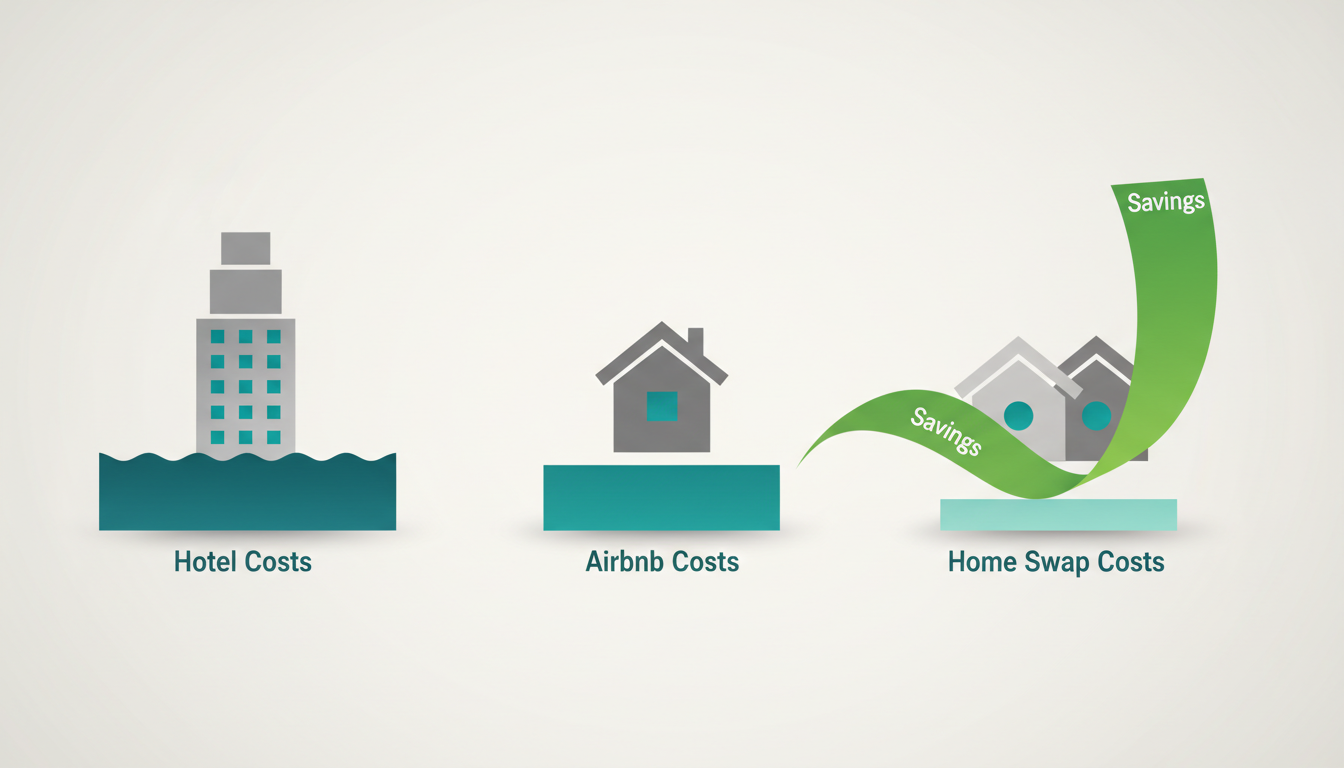
Downtown Chicago hotel (mid-range): $189/night average, $1,323/week Boutique hotel in Lincoln Park: $220/night average, $1,540/week Airbnb in Wicker Park (1BR): $165/night average, $1,155/week Home swap anywhere in Chicago: 7 credits (free with SwappaHome signup)
That's $1,155-$1,540 back in your pocket for a single week. Over a two-week trip—common for international visitors exploring the Midwest—the savings hit $2,300-$3,000. Enough to cover round-trip flights from most European cities.
But the financial advantage goes deeper than nightly rates. Home swaps include full kitchens, which transforms your food budget. The average traveler spends $75-$100 per day on restaurant meals in Chicago. Cook half your meals at home—grabbing groceries from the Mariano's on Ashland or the Whole Foods in Lincoln Park—and you'll cut that to $30-$40 daily. Over a week, that's another $250-$400 saved.
 Side-by-side cost comparison infographic showing hotel costs, Airbnb costs, and home swap costs for
Best Chicago Neighborhoods for Home Swapping
Where you stay shapes your entire Chicago experience. Hotels cluster downtown around the Magnificent Mile and River North—fine for business travelers, but these areas feel like any American city's commercial core. Home swapping opens up neighborhoods that actually have character.
Wicker Park and Bucktown
This is where Chicago's creative class lives, works, and plays. The intersection of Milwaukee, North, and Damen—known locally as the "six corners"—anchors a neighborhood packed with independent boutiques, vintage shops, and some of the city's best coffee (try Ipsento on Western Avenue or Big Shoulders at the Wicker Park Fieldhouse).
Home swap listings here tend toward vintage two-flats with exposed brick, original woodwork, and that particular Chicago aesthetic of cozy-meets-urban. You're a 15-minute Blue Line ride from the Loop, but you're also walking distance to dinner at Giant, drinks at The Violet Hour, and late-night tacos at Big Star.
Typical Airbnb rate: $160-$200/night Home swap cost: 1 credit/night
Lincoln Park
Chicago's most traditionally "nice" neighborhood—tree-lined streets, well-maintained brownstones, young professionals pushing strollers past farm-to-table restaurants. Lincoln Park Zoo (free admission, always) sits at its heart, and the lakefront trail is a five-minute walk from most addresses.
Home swap properties here skew toward family-friendly: larger apartments, actual bedrooms with doors, often with parking included. If you're traveling with kids or simply want more space than a hotel room offers, this is your neighborhood.
Typical Airbnb rate: $175-$225/night Home swap cost: 1 credit/night
Logan Square
A decade ago, Logan Square was Chicago's best-kept secret. Now it's firmly arrived, but it still feels more neighborhood than destination. The boulevards here—Palmer Square, Logan Boulevard—feature some of the city's most impressive residential architecture, and the dining scene rivals anywhere in the city (Lula Café has been a farm-to-table pioneer since 2000).
Swap listings in Logan Square often include outdoor space—a rarity in Chicago—whether that's a back deck, a shared courtyard, or a rooftop with skyline views. The Blue Line stops at Logan Square and California, putting you 20 minutes from downtown.
Typical Airbnb rate: $140-$180/night Home swap cost: 1 credit/night
Pilsen
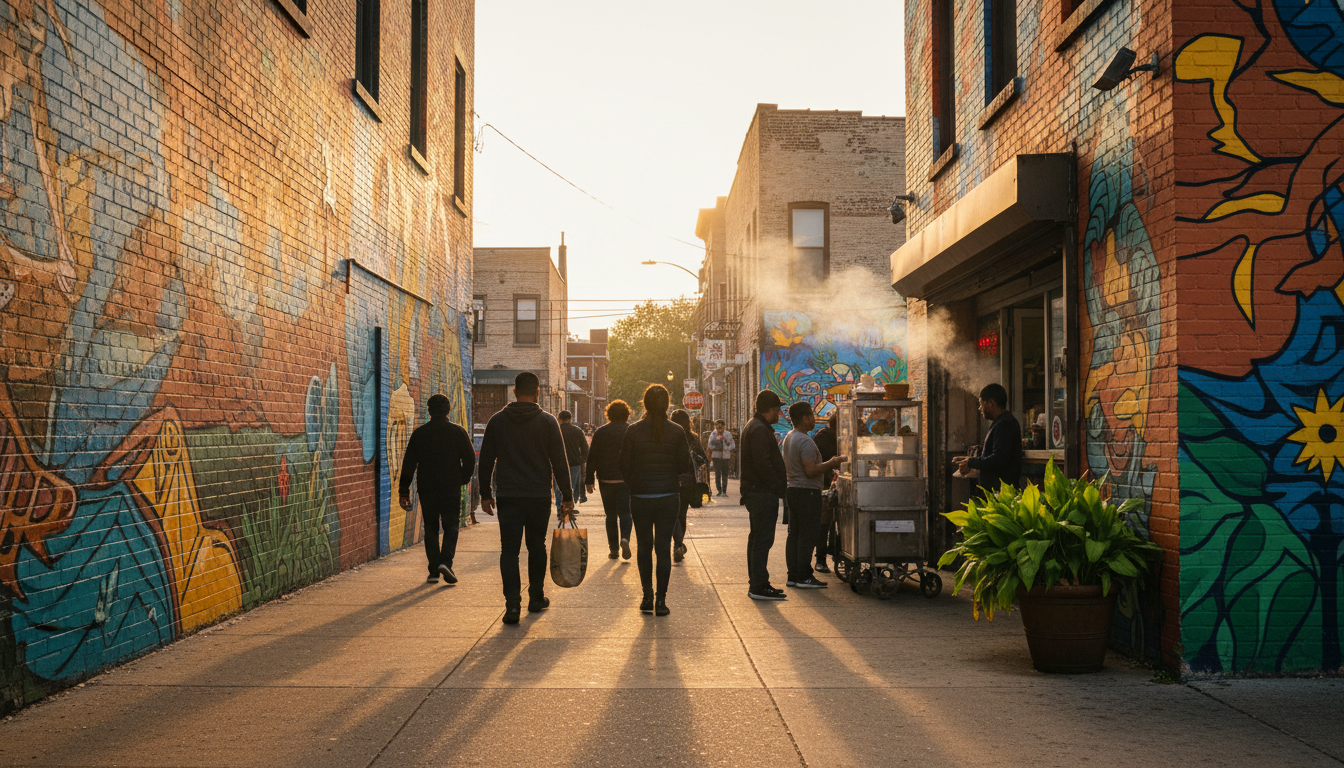
Chicago's historically Mexican neighborhood has become one of the city's most vibrant arts districts without losing its cultural identity. Murals cover seemingly every available wall, the National Museum of Mexican Art (free admission) anchors 18th Street, and taquerias that have been here for decades sit alongside newer galleries and coffee shops.
Home swap options in Pilsen tend toward smaller apartments in converted industrial buildings—think high ceilings, large windows, neighborhood character. The Pink Line connects you to the Loop in 15 minutes.
Typical Airbnb rate: $120-$160/night Home swap cost: 1 credit/night
 Street scene in Pilsen showing colorful murals on building walls, people walking past a taqueria, la
What You Actually Get in a Chicago Home Swap
Hotel rooms are standardized by design—that's their selling point and their limitation. Home swaps are personal, which means they vary wildly. Here's what to realistically expect when booking a home exchange in Chicago.
Space: The average Chicago home swap offers 2-3 times the square footage of a comparable hotel room. Most listings include a living room, full kitchen, and at least one dedicated bedroom. Many include outdoor space—balconies, decks, or shared yards—which Chicago residents treasure during the brief months when outdoor living is possible.
Kitchen: This is the game-changer for budget travel. A real kitchen with a full-size refrigerator, stovetop, oven, and actual cookware. You can buy a rotisserie chicken from Jewel-Osco for $7, make pasta, store leftovers, and eat breakfast at home instead of paying $18 for hotel eggs.
Laundry: Most Chicago apartments—especially in multi-unit buildings—have in-unit or in-building laundry. Pack lighter, wash as you go. Hotels charge $3-5 per item for laundry service; home swaps include it free.
Local knowledge: This is the intangible advantage. Home swap hosts typically leave recommendations—their favorite coffee shop, the best route to the lake, which L line to avoid during rush hour, where to find the best jibarito sandwich. This insider perspective is worth more than any guidebook.
What you won't get: Daily housekeeping, a concierge desk, room service, or someone to call when the WiFi acts up. Home swapping requires a bit more self-sufficiency. For most budget travelers, that's a trade-off worth making.
Planning Your Chicago Home Swap: A Practical Timeline
Home swapping requires more advance planning than booking a hotel. You can't just show up and expect availability. Here's how to approach it:
3-4 months before your trip: Create your profile on SwappaHome (or your platform of choice). Upload quality photos of your home, write an honest description, and set your availability calendar. If you're a new member, your free credits are already waiting.
2-3 months before: Start browsing Chicago listings. Use filters for your specific needs—neighborhood, number of bedrooms, pet-friendliness, parking. Send requests to 5-8 properties that interest you. Home swap isn't like hotel booking; hosts need to accept your request, so having backups matters.
1-2 months before: Confirm your booking, exchange details with your host, and ask any specific questions (parking logistics, building access codes, L train tips). Most hosts are happy to help you plan—they've been travelers too.
1 week before: Finalize arrival details, get emergency contact information, and prepare your own home for potential guests (if you're hosting simultaneously).
The day of: Arrive, settle in, and start exploring. Many hosts leave welcome baskets, local snacks, or at minimum a bottle of wine. Reciprocate this hospitality when you host.
 Cozy Chicago apartment living room with exposed brick, comfortable couch, local art on walls, window
Budget Travel to Chicago: Beyond Accommodation Savings
Home swapping anchors your budget travel strategy, but Chicago offers plenty of other ways to stretch your dollars.
Free and Nearly-Free Attractions
Chicago has more free world-class attractions than almost any American city. Lincoln Park Zoo is always free, always excellent—the Farm-in-the-Zoo area is particularly charming. Millennium Park and Cloud Gate cost nothing to visit, and the park hosts free concerts throughout summer. The Chicago Cultural Center houses the world's largest Tiffany glass dome, with free exhibitions and building tours. The National Museum of Mexican Art offers free admission with a permanent collection plus rotating exhibitions. Navy Pier is free to walk (skip the expensive rides), and the Chicago Riverwalk stretches 1.25 miles—grab a drink at City Winery and watch the boats.
The Art Institute of Chicago—one of the world's great museums—offers free admission for Illinois residents on certain days and for Chicago Public Library cardholders. If you're staying long enough to get a library card (free with proof of Chicago address, which your home swap provides), you unlock free museum access across the city.
Getting Around Cheaply
Chicago's L train system covers most neighborhoods you'd want to visit. A single ride costs $2.50 with a Ventra card; a 1-day pass is $5, and a 7-day pass is $20. That 7-day pass is almost always the right choice for visitors.
The 606 Trail—a converted elevated rail line now used as a walking and biking path—runs 2.7 miles through Bucktown, Wicker Park, Humboldt Park, and Logan Square. It's free, it's beautiful, and it connects several of the best home swap neighborhoods. Divvy bike-share stations are everywhere, with day passes costing $16.50 for unlimited 3-hour rides—useful for covering more ground than walking allows.
Eating Well on a Budget
Chicago's food scene includes plenty of affordable excellence. Portillo's serves Chicago-style hot dogs and Italian beef for under $10. Jim's Original at 1250 S. Union is the original Maxwell Street Polish sausage stand—cash only, under $8. Taqueria El Milagro has authentic tacos for $2-3 each. Sultan's Market at 2521 N. Clark offers falafel sandwiches for $7, perfect for a Lincoln Park lunch. And Margie's Candies at 1960 N. Western is a historic ice cream parlor with massive sundaes for $8-12.
With a home swap kitchen, you can splurge on one memorable dinner—maybe Girl & the Goat or Avec—while eating affordably the rest of the trip.
 Chicago deep-dish pizza being pulled from oven at a classic neighborhood pizzeria, cheese stretching
When to Visit Chicago for Budget Travelers
Chicago's seasonal extremes create distinct budget opportunities.
Best value: September-October and April-May. Shoulder seasons offer the sweet spot. Weather is manageable (50s-70s°F), summer crowds have dispersed, and home swap availability peaks as locals travel elsewhere. Hotel rates drop 20-30% from summer highs, which makes the home swap savings differential slightly less dramatic—but you're still paying nothing versus something.
Summer (June-August): Highest demand, but worth it. Chicago summers are glorious—festivals every weekend, beaches packed, rooftop bars thriving. Hotel rates peak, Airbnb prices surge, and home swap competition increases. Book 3-4 months ahead for summer dates. The city's energy during these months justifies the extra planning effort.
Winter (December-February): Cheapest, but challenging. Chicago winters are brutal—temperatures regularly drop below 0°F, wind off Lake Michigan cuts through any coat, and gray skies dominate. Hotel rates plummet, home swap availability is excellent, but you'll spend more time indoors. The upside: world-class museums with no crowds, cozy neighborhood bars, and the genuine Chicago experience of complaining about weather with locals.
Avoid if budget-conscious: Lollapalooza weekend (late July/early August) when hotel rates triple, Chicago Marathon weekend (October) when accommodation is scarce citywide, and St. Patrick's Day weekend (March) when the city dyes the river green and prices red.
The Trust Factor: Is Home Swapping in Chicago Safe?
This question comes up constantly, and it deserves a direct answer. Home swapping requires trust—you're staying in someone's personal space, and potentially letting strangers into yours. So how does this actually work?
The community model works. Home exchange platforms function because members have skin in the game. Everyone's home is their most valuable asset. The mutual vulnerability creates mutual respect. SwappaHome members report overwhelmingly positive experiences—the community self-selects for responsible, trustworthy travelers.
Verification helps. Modern platforms offer identity verification, connecting profiles to government IDs and real-world identities. Reviews from previous exchanges build track records. A member with 15 positive reviews over three years is a known quantity.
You control access. You decide who stays in your home. You can decline requests, ask questions, video chat before accepting, and set house rules. If something feels off, trust your instincts and say no.
Practical precautions matter. Lock away valuables, remove anything irreplaceable, document your home's condition before guests arrive. This is common sense, not paranoia.
Here's the honest truth: home swap communities have remarkably low incident rates. The vast majority of exchanges go smoothly—guests respect homes because they want their own homes respected. It's reciprocity in action.
That said, SwappaHome is a platform connecting members, not an insurance provider. If you want coverage for potential issues, arrange your own travel or home insurance. Many homeowner's policies cover short-term guests; check with your provider.
Making Your Home Swap-Ready: Earning Credits for Chicago
Home swapping is a two-way street. To travel to Chicago, you need credits. To get credits, you host travelers in your own space. Here's how to make your home attractive to potential guests.
Photography matters more than square footage. Bright, clean photos taken during daylight hours. Show the bed made nicely, the kitchen organized, the bathroom spotless. Wide-angle shots that capture room flow. Detail shots of appealing features—a reading nook, a balcony view, interesting art.
Write like a human, not a hotel. "Our 1920s apartment has creaky floors and a radiator that clanks, but the morning light through the bay windows is worth it" beats "charming vintage apartment in desirable location." Honesty builds trust.
Highlight what travelers actually want: Proximity to transit, walkability, coffee within stumbling distance, parking if available, workspace if you have one. Practical details matter more than flowery descriptions.
Be responsive. When requests come in, respond within 24 hours. Quick communication signals reliability.
The SwappaHome community includes travelers from everywhere—European families planning American road trips, Australians exploring the Midwest, domestic travelers from other U.S. cities. Your home in Tucson or Tampa or Toledo might be exactly what someone needs as a base for their own adventure.
The Bottom Line on Budget Travel to Chicago
Chicago is one of America's great cities—world-class architecture, a food scene that rivals any coastal metropolis, lakefront beaches, legendary music venues, and neighborhoods with genuine character. It's also expensive, with accommodation costs that can consume half a trip budget before you've eaten a single deep-dish pizza.
Home swapping changes that equation entirely. Instead of paying $1,200+ for a week in a generic hotel room, you stay in a real Chicago apartment—with a kitchen, with space, with local recommendations—for nothing but the credits you've earned by hosting others.
The math is simple. The experience is better. The only cost is the willingness to try something different.
SwappaHome members have been doing this for years, building a community of travelers who'd rather live like locals than tourists. If you're planning budget travel to Chicago, joining that community might be the smartest financial decision you make.
Frequently Asked Questions
Is home swapping in Chicago safe for first-time exchangers?
Home swapping in Chicago is generally very safe, especially through established platforms with verification systems. The SwappaHome community uses identity verification, member reviews, and a credit-based reputation system that encourages responsible behavior. Most experienced home-swappers recommend starting with highly-reviewed hosts and communicating thoroughly before your exchange. For added peace of mind, consider arranging your own travel insurance.
How much can I save with home swapping vs. hotels in Chicago?
Budget travelers typically save $1,000-$1,500 per week by home swapping instead of booking Chicago hotels. The average downtown hotel costs $189/night ($1,323/week), while Airbnbs in popular neighborhoods run $150-$200/night. Home swapping costs only credits—and new SwappaHome members receive 7 free credits, enough for a full week. Add kitchen savings on food costs, and total savings can exceed $1,500 weekly.
What's the best Chicago neighborhood for home swapping?
Wicker Park, Lincoln Park, and Logan Square consistently offer the best home swap options for visitors. Wicker Park provides walkable access to restaurants, nightlife, and the Blue Line. Lincoln Park suits families with its zoo, green space, and larger apartments. Logan Square offers excellent value with strong dining options. All three neighborhoods have active home swap communities with 20+ listings typically available.
When should I book a Chicago home swap for best availability?
Book your Chicago home swap 2-3 months in advance for best selection, or 3-4 months ahead for peak summer dates (June-August). Shoulder seasons—April-May and September-October—offer easier booking with excellent weather. Avoid Lollapalooza weekend (late July), Chicago Marathon weekend (October), and St. Patrick's Day, when accommodation demand spikes citywide.
Do I need a car for budget travel to Chicago?
No—Chicago's L train system makes car-free travel easy and affordable. A 7-day Ventra pass costs $20 and covers unlimited rides across all train lines and buses. The Blue, Brown, and Red lines connect most visitor-friendly neighborhoods to downtown attractions. Divvy bike-share ($16.50/day) supplements transit for neighborhood exploration. Parking costs $30-50/day downtown, making car-free travel the clear budget choice.

Published by
SwappaHome
SwappaHome Editorial Team
Home Exchange & Slow Travel Editorial
The SwappaHome Editorial Team brings together travel research, home-exchange community insights, and platform data to produce practical guides for first-time and experienced home swappers. Every article cites real platforms, current market rates, and verifiable city-level facts so readers can make informed decisions without guessing.
Ready to try home swapping?
Join SwappaHome and start traveling by exchanging homes. Get 7 free credits when you sign up!
Related articles

Bachelor and Bachelorette Parties in Singapore: The Complete Home Swap Group Guide for 2026
Planning a bachelor or bachelorette party in Singapore? Discover how home swapping lets groups of 6-12 stay together in luxury condos, saving thousands while partying in Marina Bay.

Cycling in Lisbon: 7 Home Swap Bike Tour Itineraries for Every Rider
Discover the best cycling routes in Lisbon with these home swap bike tour itineraries—from waterfront paths to hilltop adventures, all starting from your borrowed home.

Graduation Trip to Barcelona: How Home Swapping Gives New Graduates the Ultimate Celebration
Planning a graduation trip to Barcelona? Discover how home swapping lets new graduates explore Spain's most vibrant city without the hostel crowds or hotel costs.