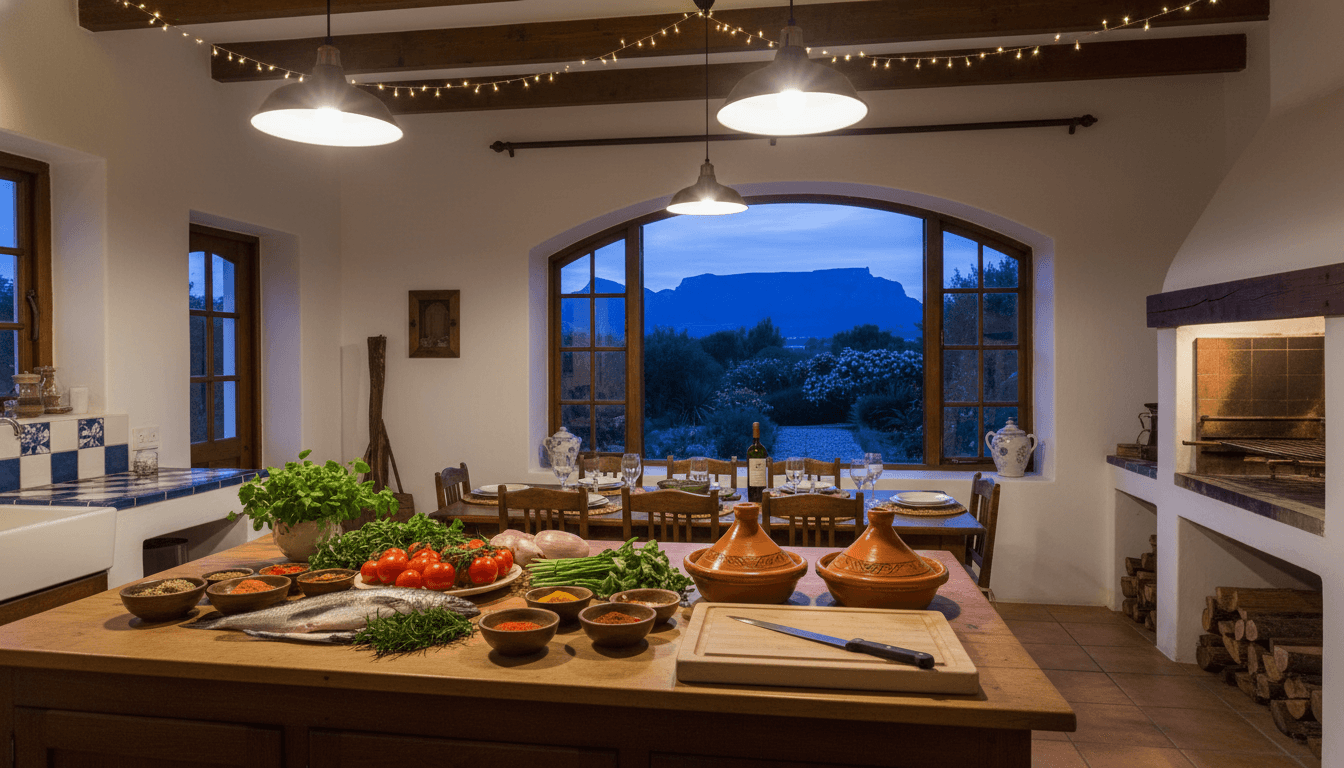
Cape Town Local Cuisine: Your Complete Guide to Cooking and Dining During a Home Swap

SwappaHome Editorial Team
Home Exchange & Slow Travel Editorial
Discover Cape Town's incredible food scene during your home swap—from braai basics to Bo-Kaap cooking classes. A local's guide to eating like a Capetonian.
The smoke hit me before I even cracked the kitchen window. Braai from next door, drifting across the garden and mixing with something sweet—koeksisters, I was pretty sure—wafting from the house behind. Four hours into my Cape Town home swap, and the city was already feeding me through pure osmosis.
Cape Town local cuisine is unlike anything I've encountered in seven years of trading homes. It's not just food. It's Malay spices crashing into Dutch comfort, African fire meeting Indian heat, all of it simmered together over centuries until you can't separate the strands anymore. And here's what nobody mentions: experiencing it from a local kitchen, through a home exchange, transforms you from tourist to temporary Capetonian in ways no hotel restaurant ever could.
Why Cape Town Food Culture Hits Different During a Home Swap
I've eaten my way through this city twice now. Once from a boutique hotel in the V&A Waterfront. Once from a converted fisherman's cottage in Kalk Bay. Same city. Completely different experience.
From the hotel, I ate well. Really well, actually. But I ate at Cape Town, not with it.
The second time—staying in a local's home through SwappaHome—I found myself at a neighbor's Sunday braai within 48 hours. I learned that you don't just grill boerewors. You coil it. You watch it. You argue about whether it's done. I discovered that the corner café (they call them "cafés" but they're more like bodegas) sold vetkoek stuffed with curried mince for 25 rand. That's $1.35 USD. I accidentally became a regular.
The difference? Access. When you're home swapping in Cape Town, you inherit a kitchen stocked with local staples, a neighborhood that actually functions, and often—if your host is generous with their notes—a list of places that don't appear on any "Top 10 Cape Town Restaurants" listicle.
Understanding Cape Town's Culinary Neighborhoods
Cape Town sprawls. Like, really sprawls. Each neighborhood has its own food personality, and choosing where to base your home swap will fundamentally shape what you eat.
Bo-Kaap: The Heart of Cape Malay Cooking
Those Instagram-famous colorful houses? They're in Bo-Kaap. Behind their bright facades, families have been cooking Cape Malay food for generations. If spice is your love language, this is where you want to be.
Cape Malay cuisine is the soul of Cape Town local cuisine—a fusion born from Indonesian slaves brought by Dutch colonizers, blended with local ingredients and African techniques. Think bobotie (curried meat with an egg custard top), bredie (slow-cooked stews), and samoosas that put anything I've had in London to shame.
During my stay, I booked a cooking class with a local family through Cooking with Zainie—about $65 USD per person. We made denningvleis, this sweet-and-sour lamb dish that takes hours and fills the house with tamarind and cinnamon. The grandmother running the class kept adjusting my spice ratios. "More, more," she'd say, adding another pinch of something I couldn't identify. "You're cooking scared."
She wasn't wrong.
Kalk Bay: Seafood and Artistic Soul
If I could only recommend one neighborhood for a Cape Town home swap focused on food? It might be Kalk Bay. This former fishing village on the False Bay coast is gloriously uncommercial. Or at least, it still feels that way.
The harbor here is working. Like, actually working. Fishermen bring in their catch daily, and you can buy directly from the boats. Snoek (a local fish that's practically a religion here), yellowtail, crayfish when the season's right. Prices vary wildly—anywhere from 80-200 rand ($4.30-$10.80 USD) depending on the catch and your negotiation skills.
Kalky's is the spot everyone mentions. Honestly? It deserves the hype. Tiny fish-and-chips counter right on the harbor. Nothing fancy. Plastic chairs. Paper-wrapped fish. Seagulls that will absolutely steal your food if you're not vigilant. The hake and chips runs about 95 rand ($5.15 USD), and you eat it watching the boats come in.
But here's my actual tip: walk past Kalky's to the harbor wall, find the guys selling fresh snoek, and ask them to smoke it for you. They'll do it right there. Take it back to your home swap kitchen, flake it into pasta with cream and lemon, and you've got a meal that costs maybe $8 total and tastes like the ocean itself.
Woodstock: Where Old Cape Town Meets New
Woodstock is having a moment. Victorian houses sit next to craft breweries. Old Malay families live alongside artists and young professionals. For food, this means range.
The Old Biscuit Mill market on Saturdays is mandatory. I know, I know—markets can feel touristy. But this one genuinely delivers. Arrive before 9 AM to beat the crowds. The Ethiopian stall does injera with doro wat that made me emotional. There's a woman selling koeksisters—braided, syrup-soaked doughnuts—so sticky-sweet you'll need three napkins. Budget about 200-300 rand ($10.80-$16.20 USD) for a proper graze.
For sit-down meals, The Test Kitchen was legendary before it closed, but The Pot Luck Club (same chef, same building) still delivers incredible sharing plates with views over the city. Expect to spend around 800-1200 rand ($43-$65 USD) per person for the full experience.
Stocking Your Cape Town Home Swap Kitchen
One of the genuine joys of home swapping is cooking. In Cape Town, the ingredients available will make you want to cook constantly.
Where to Shop Like a Local
Forget Woolworths—though their food section is admittedly excellent for emergencies. For the real experience, you need the local spots.
Pick n Pay and Checkers are the everyday supermarkets. Perfectly fine, well-stocked, but not exciting. Use them for basics: milk, bread, that rooibos tea you'll become addicted to.
The Golden Acre in the city center has a basement food market that locals actually use. It's chaotic. It's loud. The produce is half the price of anywhere else. The spice stalls here are where Bo-Kaap families shop—ask for "braai spice" and "Cape Malay curry powder." These are your building blocks.
Neighbourgoods Market (Saturdays, Woodstock) and Oranjezicht City Farm Market (Saturdays and Sundays, V&A Waterfront) are where you'll find artisan producers, organic vegetables, and specialty items. More expensive, but worth it for specific ingredients.
For meat—and you'll want meat, because braai culture is inescapable—find your nearest butcher. Not a supermarket counter. An actual butcher. Ask for boerewors (the coiled sausage), sosaties (marinated kebabs), and if you're feeling adventurous, some biltong for snacking. A good butcher will cost maybe 15-20% more than supermarket meat and taste 200% better.
Essential Cape Town Ingredients to Buy
Here's what I always grab in the first 24 hours of a Cape Town home swap:
Mrs. Ball's Chutney — A sweet-spicy condiment that goes on everything. Seriously, everything. About 35 rand ($1.90 USD). Braai spice — Every family has their favorite brand. Ask your host or the butcher. Chakalaka — A spicy vegetable relish, usually served with pap (maize porridge). Buy it jarred or make it fresh. Rooibos tea — You'll drink it constantly. Caffeine-free, slightly sweet, weirdly comforting. Biltong — Dried, cured meat. Like jerky's sophisticated older cousin. Get it from a dedicated biltong shop, not a supermarket. Malva pudding mix — For when you want dessert but don't want to work too hard. Add cream, bake, feel happy.
Mastering the Braai: Cape Town's Sacred Ritual
I need to be honest with you. I didn't understand braai before Cape Town. I thought it was just barbecue with a different name.
So wrong.
Braai is a social institution. It's how South Africans gather, argue about politics, celebrate, mourn, and mark every occasion worth marking. If your Cape Town home swap has a braai (many do—it's standard equipment here), you're holding a key to local life.
The Basics of Braai
First, the fuel. South Africans are particular about this. You want hardwood—specifically, something like sekelbos or kameeldoring. You can buy bags at any petrol station or supermarket for about 60-80 rand ($3.25-$4.30 USD). Charcoal is acceptable but will earn you side-eye from purists.
The fire needs to burn down to coals. This takes 45 minutes to an hour. You cannot rush it. The waiting is part of the ritual—this is when you drink, snack on biltong, and solve the world's problems.
Boerewors goes on first. Coiled. Never pricked. (Pricking releases the juices—apparently a crime.) Cook it slow, turn it once. Then your sosaties, then your steaks or chops. Everything gets that smoky char.
The sides matter: pap (maize porridge, stiffer than polenta), chakalaka, braaibroodjies (grilled cheese sandwiches with tomato and onion, made right on the grill), and potato salad. Always potato salad.
Where to Braai If Your Swap Doesn't Have One
Some Cape Town neighborhoods have public braai spots. Clifton 4th Beach has facilities, as does Camps Bay. But honestly, the best move is to befriend your neighbors. Tell them you're visiting from abroad, that you want to learn proper braai technique, and I guarantee someone will invite you over. South Africans are almost aggressively hospitable when it comes to braai.
Cape Town Dining: Where to Eat Out
Not every meal needs to be homemade. Cape Town's restaurant scene is genuinely world-class, and prices are remarkably reasonable compared to European or American cities.
High-End Experiences Worth the Splurge
La Colombe in Constantia consistently ranks among Africa's best restaurants. The tasting menu runs about 1,800 rand ($97 USD) per person—steep for Cape Town, but comparable restaurants in London would charge double. The setting, in the Constantia winelands, is absurdly beautiful.
FYN in the city center does contemporary African cuisine with Japanese influences. A bit conceptual, but the flavors are extraordinary. Tasting menu around 2,200 rand ($119 USD).
Salsify at the Roundhouse in Camps Bay has views that make you forget about the food. Except the food is also incredible. Main courses 250-400 rand ($13.50-$21.60 USD).
Mid-Range Gems
Kloof Street House in Gardens is set in a Victorian house with a garden that feels like a secret. Modern South African menu. You'll spend about 350-500 rand ($19-$27 USD) per person with wine.
The Shortmarket Club in the city center does excellent cocktails and sharing plates in a beautiful old building. Great for a date night. Budget 400-600 rand ($21.60-$32.40 USD) per person.
Mzansi in Khayelitsha requires a bit more effort—it's in a township, and you'll want to go with a tour or a local guide—but the traditional Xhosa food is unlike anything else in the city. This is where you'll try umngqusho (samp and beans), umleqwa (free-range chicken), and maybe some homemade umqombothi (traditional beer). Meals run about 150-250 rand ($8.10-$13.50 USD).
Cheap Eats That Locals Love
Gatsby sandwiches are Cape Town's ultimate budget food. These are massive—forearm-length—submarine sandwiches stuffed with chips, polony (a type of bologna), steak, or masala. Messy. Ridiculous. About 60-90 rand ($3.25-$4.85 USD). Super Fisheries in Athlone is legendary.
Bunny chow isn't originally from Cape Town (it's a Durban thing), but you can find good versions here. Hollowed-out loaf of bread filled with curry. Look for it in the Indian-influenced areas around Salt River. About 50-80 rand ($2.70-$4.30 USD).
Vetkoek (fat cakes) are fried dough balls, usually stuffed with curried mince. Find them at markets or from street vendors. Maybe 25-40 rand ($1.35-$2.15 USD) each.
Wine Country: An Easy Day Trip from Your Home Swap
You cannot visit Cape Town and skip the winelands. I don't care if you don't drink—the scenery alone is worth the trip.
Stellenbosch is closest, about 50 kilometers from the city center. Franschhoek is prettier and more food-focused. Constantia is actually within Cape Town proper and has some of the oldest wine estates in the southern hemisphere.
Most estates offer tastings for 50-150 rand ($2.70-$8.10 USD). Many have restaurants attached. Babylonstoren in Franschhoek has gardens that look like something from a fairy tale and a restaurant, Babel, that serves produce grown on-site.
If you're driving back to your home swap, designate a driver or book a tour. The police here don't mess around with drink driving.
Cooking Classes and Food Experiences
If you want to take Cape Town's flavors home with you—back to your own kitchen, wherever that is—consider a cooking class.
Cape Malay Cooking Classes
Cooking with Zainie in Bo-Kaap is intimate, family-run, and deeply authentic. You'll cook in a home kitchen, eat what you make, and leave with recipes that actually work. About 900 rand ($48.60 USD) per person.
Andulela Experience offers a Bo-Kaap walking tour combined with cooking. More structured, good for those who want context with their cuisine. Around 1,200 rand ($64.80 USD).
Other Food Experiences
Cape Town Food Tours runs walking tours through the city center and Bo-Kaap. About 850 rand ($45.90 USD) for three hours of eating and walking.
Coffeebeans Routes does township food experiences—you'll visit Langa or Khayelitsha, eat with local families, and learn about food traditions that most tourists never encounter. Around 1,500 rand ($81 USD) including transport.
Practical Tips for Food-Focused Home Swapping in Cape Town
After two extended stays and countless meals, here's what I wish I'd known from the start.
Timing matters. Cape Town's food scene is seasonal. Winter (June-August) means hearty stews and comfort food. Summer (December-February) is braai season, fresh seafood, outdoor dining. The shoulder seasons often have the best weather and fewer crowds.
Tipping is expected. 10-15% at restaurants is standard. Round up for casual spots.
Load shedding affects restaurants. South Africa has scheduled power outages. Check the schedule (there are apps for this) and know that some restaurants close during blackouts while others have generators. Your home swap host should have info on how it affects the neighborhood.
Water is precious. Cape Town nearly ran out of water in 2018. The situation has improved, but conservation is still important. Be mindful when cooking and washing up.
Ask your host for recommendations. The best thing about home swapping is the local knowledge. Most SwappaHome hosts leave detailed notes about their neighborhoods—use them. That random café they mention might become your favorite spot.
The Last Bite
I left Cape Town the second time with a suitcase full of Mrs. Ball's Chutney (it doesn't exist outside South Africa, I've checked), a recipe for bobotie I've since made probably thirty times, and the phone number of my Kalk Bay neighbor who promised to text me next time the snoek are running.
That's what Cape Town local cuisine does to you. It doesn't just feed you—it adopts you, temporarily, into a food culture that's been blending and evolving for centuries.
If you're considering a home swap in Cape Town, go. Find a place with a braai and a view of the mountain if you can. Stock the kitchen with spices and chutney. Learn to cook something new. And when the neighbor's smoke drifts over the garden wall, take it as the invitation it is.
SwappaHome has listings across Cape Town's best food neighborhoods—from Bo-Kaap apartments to Kalk Bay cottages to Constantia estates near the winelands. The 7 free credits you get when you sign up could cover a full week in someone's home, with a kitchen full of possibilities.
Some cities you visit. Cape Town, you taste.
Frequently Asked Questions
What is the best area to stay in Cape Town for food lovers?
Bo-Kaap and Kalk Bay are the best areas for Cape Town local cuisine experiences. Bo-Kaap offers authentic Cape Malay cooking classes and spice-filled markets, while Kalk Bay provides fresh-off-the-boat seafood and charming harbor-side dining. Woodstock is ideal for foodies who want access to artisan markets and trendy restaurants.
How much does food cost in Cape Town compared to other cities?
Cape Town is remarkably affordable for food. A local meal costs $3-8 USD, mid-range restaurants run $20-35 USD per person, and fine dining is $50-120 USD—roughly 40-60% cheaper than comparable restaurants in London or New York. Groceries are similarly affordable, making home cooking during a home swap very economical.
Can I take a cooking class in Cape Town during my visit?
Yes, Cape Town offers excellent cooking classes, especially for Cape Malay cuisine. Classes in Bo-Kaap with local families cost $45-65 USD and teach traditional dishes like bobotie, bredie, and samoosas. Book at least a week in advance during peak season (December-February) as popular classes fill quickly.
What traditional Cape Town foods should I try?
Must-try Cape Town local cuisine includes bobotie (curried meat with egg custard), boerewors (spiced sausage), Cape Malay curry, bunny chow (curry in bread), vetkoek (fried dough with mince), and malva pudding for dessert. Don't miss a traditional braai experience and fresh snoek from Kalk Bay harbor.
Is it safe to eat street food in Cape Town?
Street food in Cape Town is generally safe, especially from established vendors and markets like Old Biscuit Mill and Neighbourgoods Market. Stick to busy stalls with high turnover, and use common sense about food that's been sitting out. The gatsby sandwiches and vetkoek from local vendors are beloved by Capetonians and visitors alike.

Published by
SwappaHome
SwappaHome Editorial Team
Home Exchange & Slow Travel Editorial
The SwappaHome Editorial Team brings together travel research, home-exchange community insights, and platform data to produce practical guides for first-time and experienced home swappers. Every article cites real platforms, current market rates, and verifiable city-level facts so readers can make informed decisions without guessing.
Ready to try home swapping?
Join SwappaHome and start traveling by exchanging homes. Get 7 free credits when you sign up!
Related articles

Bachelor and Bachelorette Parties in Singapore: The Complete Home Swap Group Guide for 2026
Planning a bachelor or bachelorette party in Singapore? Discover how home swapping lets groups of 6-12 stay together in luxury condos, saving thousands while partying in Marina Bay.

Cycling in Lisbon: 7 Home Swap Bike Tour Itineraries for Every Rider
Discover the best cycling routes in Lisbon with these home swap bike tour itineraries—from waterfront paths to hilltop adventures, all starting from your borrowed home.

Graduation Trip to Barcelona: How Home Swapping Gives New Graduates the Ultimate Celebration
Planning a graduation trip to Barcelona? Discover how home swapping lets new graduates explore Spain's most vibrant city without the hostel crowds or hotel costs.