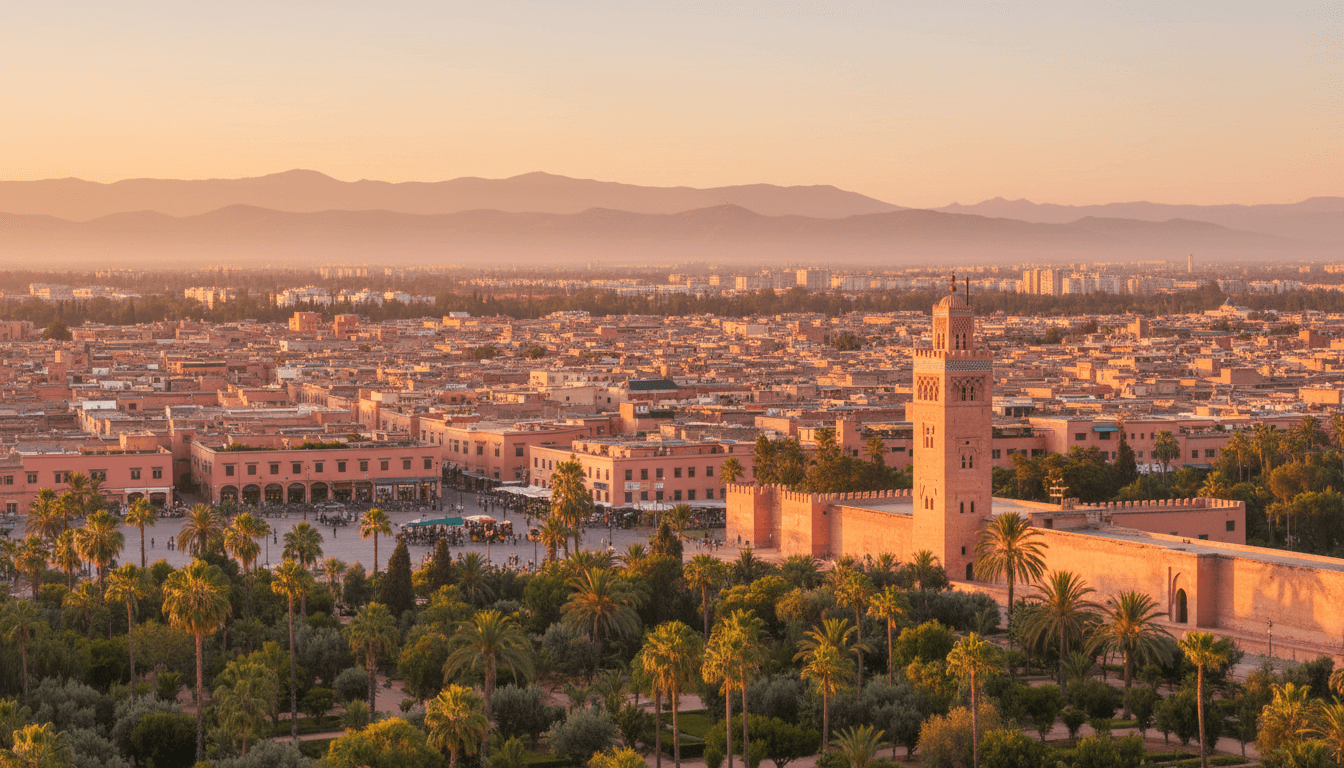
Home Exchange in Marrakech for Retirees: Your Complete Guide to Relaxed Moroccan Living

SwappaHome Editorial Team
Home Exchange & Slow Travel Editorial
Discover why home exchange in Marrakech is perfect for retirees seeking authentic Moroccan experiences, slower travel, and incredible value.
I was standing on a rooftop terrace in the Mellah district, watching the sun paint the Atlas Mountains pink and gold, when it hit me. The retired couple whose riad I was staying in had cracked something most travelers never figure out: Marrakech isn't just a destination—it's a lifestyle. And home exchange in Marrakech for retirees might be the best-kept secret in slow travel.
My hosts, a British couple in their late sixties named David and Patricia, had been doing home exchanges for three years. They'd traded their Cotswolds cottage for this restored riad with its courtyard fountain and orange trees, spending three months each winter escaping the English grey. "We couldn't afford to stay in hotels for this long," Patricia told me over mint tea. "And honestly? Hotels never felt like living somewhere."
That conversation rewired how I think about retirement travel. So if you're a retiree eyeing Morocco—or anywhere, really—here's everything I've picked up about making home exchange work for the over-60 crowd.
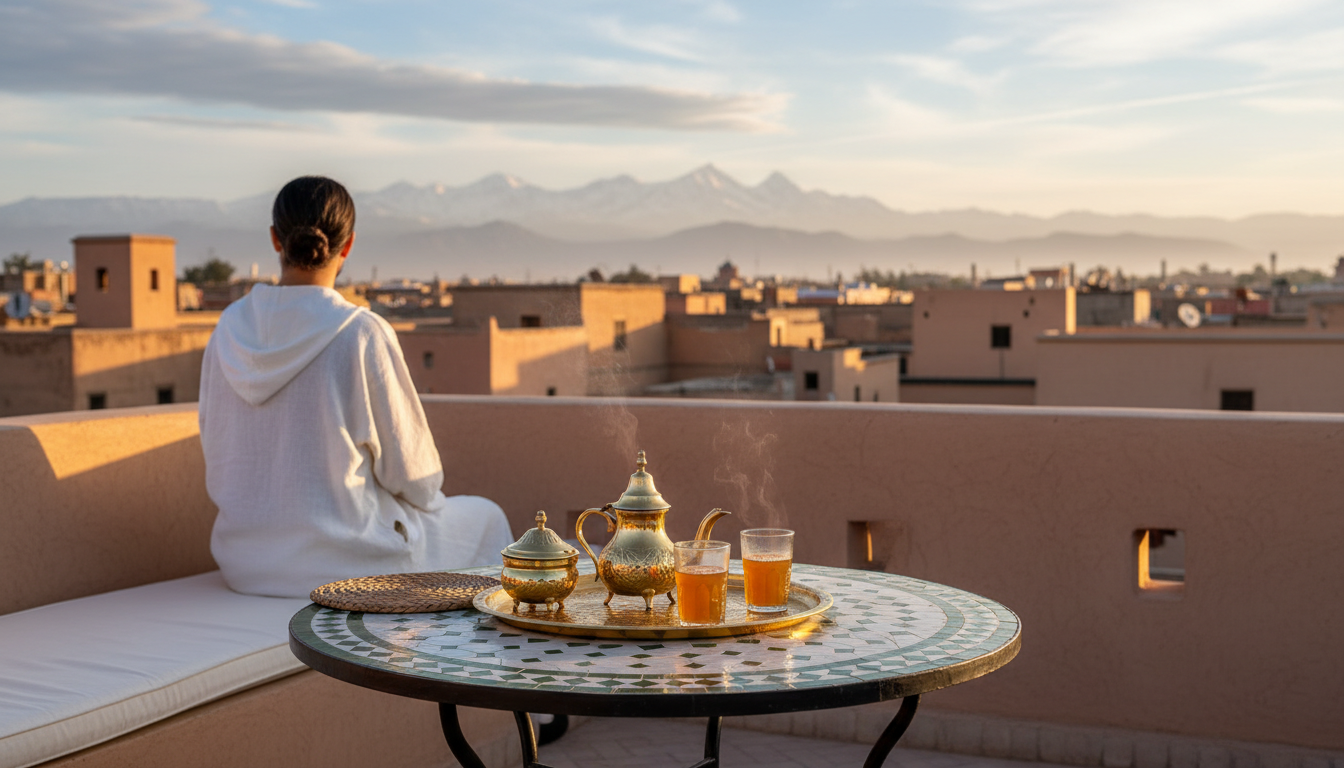 sunrise view from a traditional Marrakech riad rooftop terrace, Atlas Mountains visible in the dista
Why Marrakech Is Ideal for Retired Home Exchangers
Real talk: Marrakech isn't for everyone. The medina can overwhelm you, the souks are a full sensory assault, and yes—you'll get lost. Repeatedly.
But here's what makes it extraordinary for retirees specifically.
The pace of life, once you're past the tourist frenzy, is genuinely slow. Moroccans take their time. Tea is a ceremony, not a caffeine delivery system. Meals stretch for hours. Nobody rushes you. The cost of living? Remarkably low. I'm talking $3 tagines, $1 fresh orange juice, and $15 hammam experiences that would run you $150 at a spa back home. Your retirement budget stretches further here than almost anywhere in Europe.
The weather from October through April is essentially perfect—warm days, cool nights, minimal rain. Exactly when most retirees want to escape northern winters. And those riads—traditional Moroccan houses built around interior courtyards—were designed for precisely this kind of living. Quiet sanctuaries behind unassuming doors, with thick walls that block both heat and noise.
Understanding Home Exchange in Marrakech: How It Actually Works
I get tons of questions from retirees who love the idea of home exchange but feel intimidated by the logistics. So let me break this down.
With a platform like SwappaHome, you list your home—wherever it is—and earn credits when you host travelers. Then you use those credits to book stays in other members' homes. One credit equals one night, whether you're staying in a studio apartment in Marrakech or a villa in the Palmeraie.
The beauty for retirees? You don't need to coordinate simultaneous swaps. Host a young couple from Paris in your Arizona condo in March, then use those credits for a month in Morocco in November. The flexibility is the whole point.
New members start with 7 free credits—meaning you could book a 10-night stay in Marrakech before you've even hosted anyone. That's essentially a free trial of the retirement travel lifestyle you've been dreaming about.
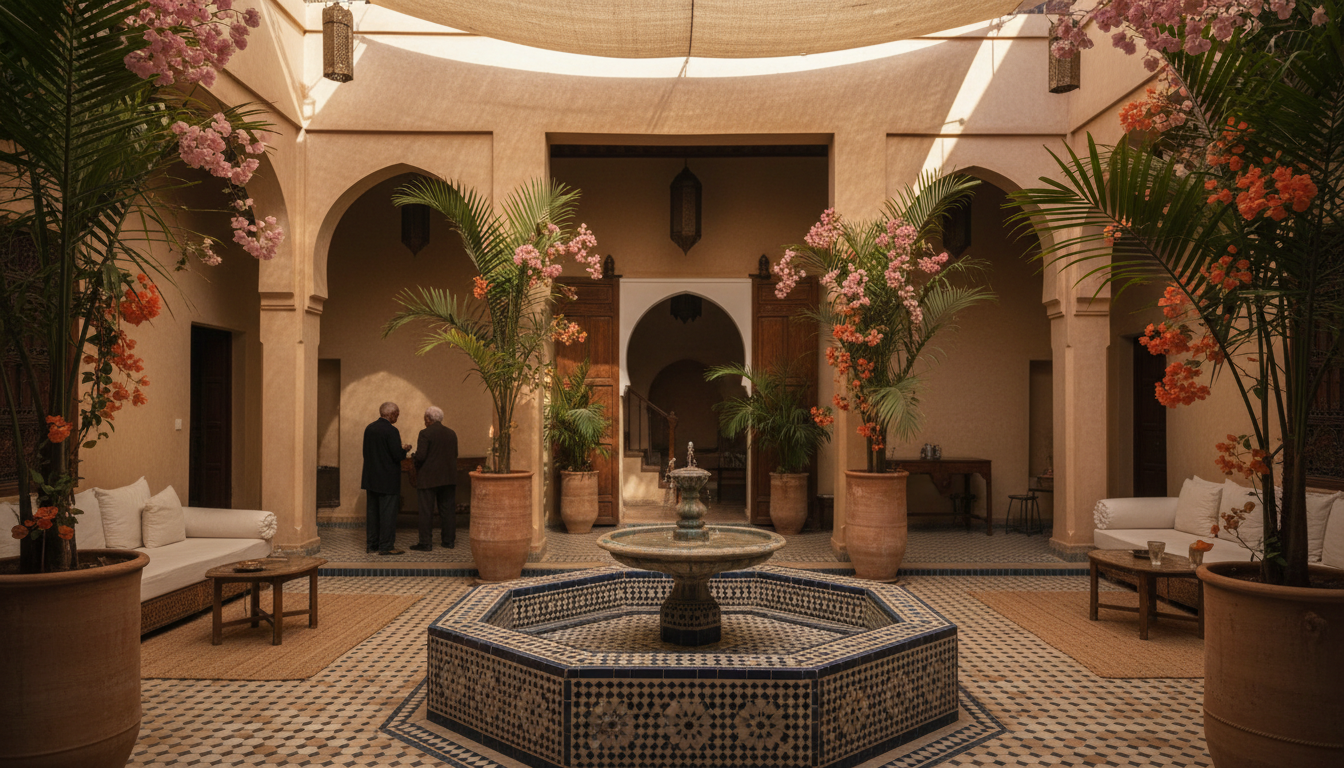 interior courtyard of a traditional Marrakech riad with central fountain, zellige tilework in geomet
Best Neighborhoods in Marrakech for Retired Home Exchangers
Not all parts of Marrakech are created equal—especially if you're prioritizing comfort, safety, and walkability over nightlife and Instagram spots.
Kasbah: Quiet Elegance Near the Palace
This is my top recommendation for retirees, hands down. The Kasbah district sits just south of the main medina, near the Royal Palace and the Saadian Tombs. It's significantly calmer than the central medina—fewer motorbikes, less aggressive shopkeepers, more residential feel.
The riads here tend to be larger, with more generous courtyards and rooftop terraces. You're a 15-minute walk from Jemaa el-Fnaa (the famous main square) but far enough that you won't hear the drums at night. I stayed in a Kasbah riad last February that had a small plunge pool, a rooftop with mountain views, and a housekeeper who came twice weekly. The owner, a retired French architect, had spent years restoring it. That's the kind of home you find on exchange platforms—places with stories.
Mellah: The Historic Jewish Quarter
The Mellah has seen serious restoration in recent years, becoming a favorite among longer-term visitors. The streets are slightly wider than in the central medina, there's a lovely spice market, and you're walking distance to the Bahia Palace.
What I appreciate about the Mellah for retirees: it's authentic without being chaotic. You'll see more locals going about their daily lives and fewer tour groups.
Gueliz: The Modern Alternative
If the medina feels like too much, Gueliz might be your answer. This is the "new town" built during the French protectorate—wide boulevards, sidewalks, familiar-looking cafés, and actual traffic lights.
You'll find apartments here rather than riads, often with elevators, modern kitchens, and reliable wifi. It's a 20-minute walk or a $2 taxi to the medina. Some retirees I've met prefer this as a base: they get their medina fix during the day, then retreat to air-conditioned comfort at night. Honestly? I'd suggest trying a medina stay first. But it's good to know Gueliz exists as a backup.
Palmeraie: For Those Who Want Space
About 15 minutes outside the city center, the Palmeraie is a palm grove dotted with villas and boutique hotels. If you're exchanging a larger property—say, a house with a garden—you might find a match here.
The trade-off: you'll need taxis to get anywhere, and you'll miss the walking-out-your-door-into-another-world magic of the medina. But for couples who want a pool, a garden, and genuine quiet, it's worth considering.
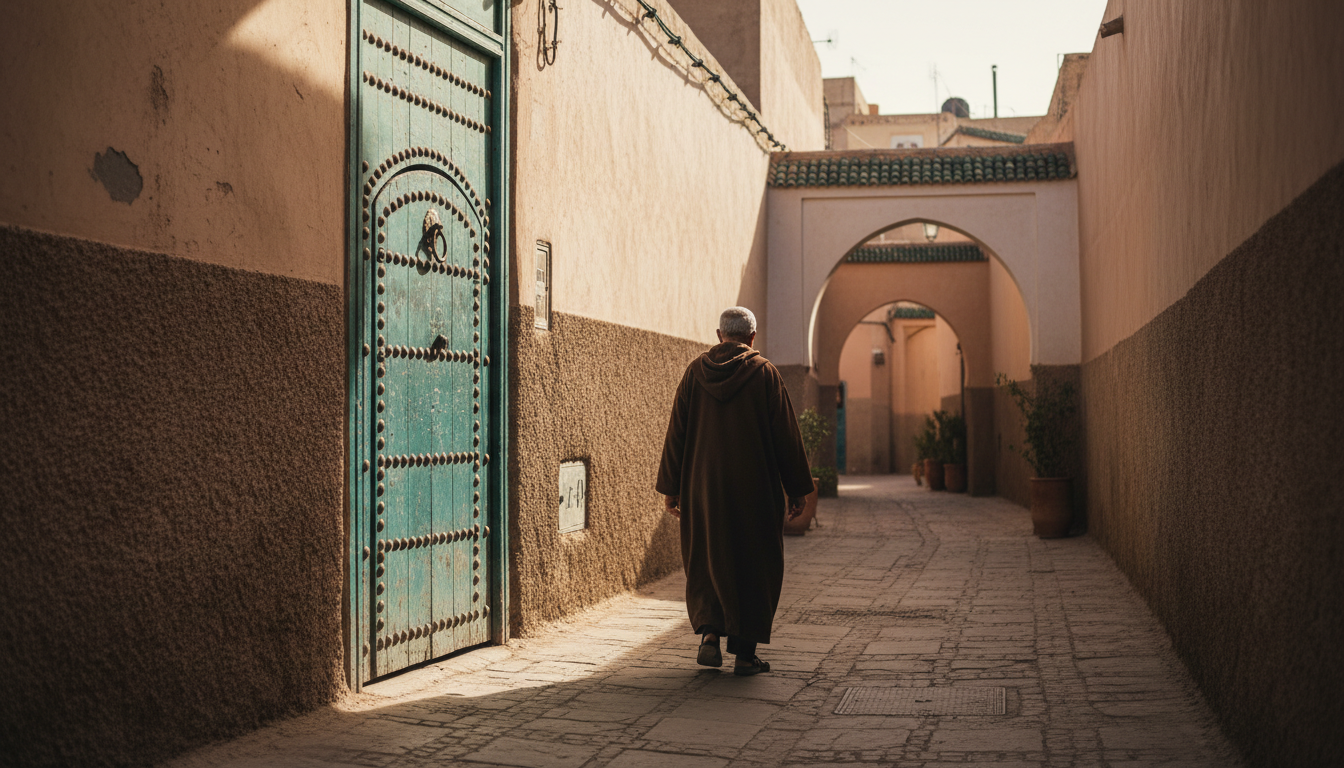 narrow street in Marrakechs Kasbah district, elderly Moroccan man in traditional djellaba walking pa
What to Look for in a Marrakech Home Exchange Listing
Not all riads work well for retirees, and I've learned to read between the lines of listings. Here's what to check:
Stairs. Traditional riads are vertical—ground floor courtyard, bedrooms on upper floors, rooftop terrace on top. That can mean 40+ stairs daily. Look for listings mentioning ground-floor bedrooms or ask directly before booking.
Heating and cooling. Marrakech gets cold in winter (40°F nights in January) and brutal in summer (110°F+ in July). Many older riads have neither central heating nor AC. Look for mentions of fireplaces, space heaters, or individual room units.
Kitchen facilities. Some riads have minimal kitchens because the original owners had household staff. If you want to cook—and I recommend it, given the incredible produce at the souks—make sure there's more than a hot plate.
Wifi reliability. This matters if you're staying connected with family or managing finances remotely. Ask about speed and consistency.
Accessibility from the street. Medina streets are pedestrian-only, which means luggage-hauling. Some riads are 2 minutes from a taxi drop-off; others are a 15-minute maze walk. This matters when you're arriving with suitcases.
The Practical Side: Costs, Visas, and Health Considerations
Let's talk logistics—I know retirees tend to be planners (in the best way).
How Much You'll Actually Spend
With accommodation covered through home exchange, your daily costs in Marrakech can be remarkably low. Meals run $15-25/day eating well, including one restaurant meal. Transportation is $3-5/day for occasional taxis. Activities like museum entries and hammam visits cost $5-15. Coffee and tea? $1-2 per café visit.
I've met retirees living comfortably on $50/day including everything. Compare that to what you'd spend in Portugal or Spain.
Visa Situation for Americans and Europeans
US, UK, Canadian, and EU citizens get 90 days visa-free in Morocco. That's three months—a proper winter escape. If you want to stay longer, you'll need to do a visa run (most people pop to Spain for a few days) or apply for an extension, which is possible but bureaucratic.
Healthcare Access
Marrakech has several private clinics with English-speaking doctors. Clinique Internationale is the go-to for expats and long-term visitors. A doctor's visit runs $30-50; prescriptions are cheap.
That said, I strongly recommend travel insurance that includes medical evacuation. Morocco's healthcare handles routine issues fine, but for anything serious, you'd want the option to get to Europe. SwappaHome doesn't provide insurance coverage—that's on you to arrange. Most retirees I know use annual travel insurance policies, which work out cheaper than buying coverage trip by trip.
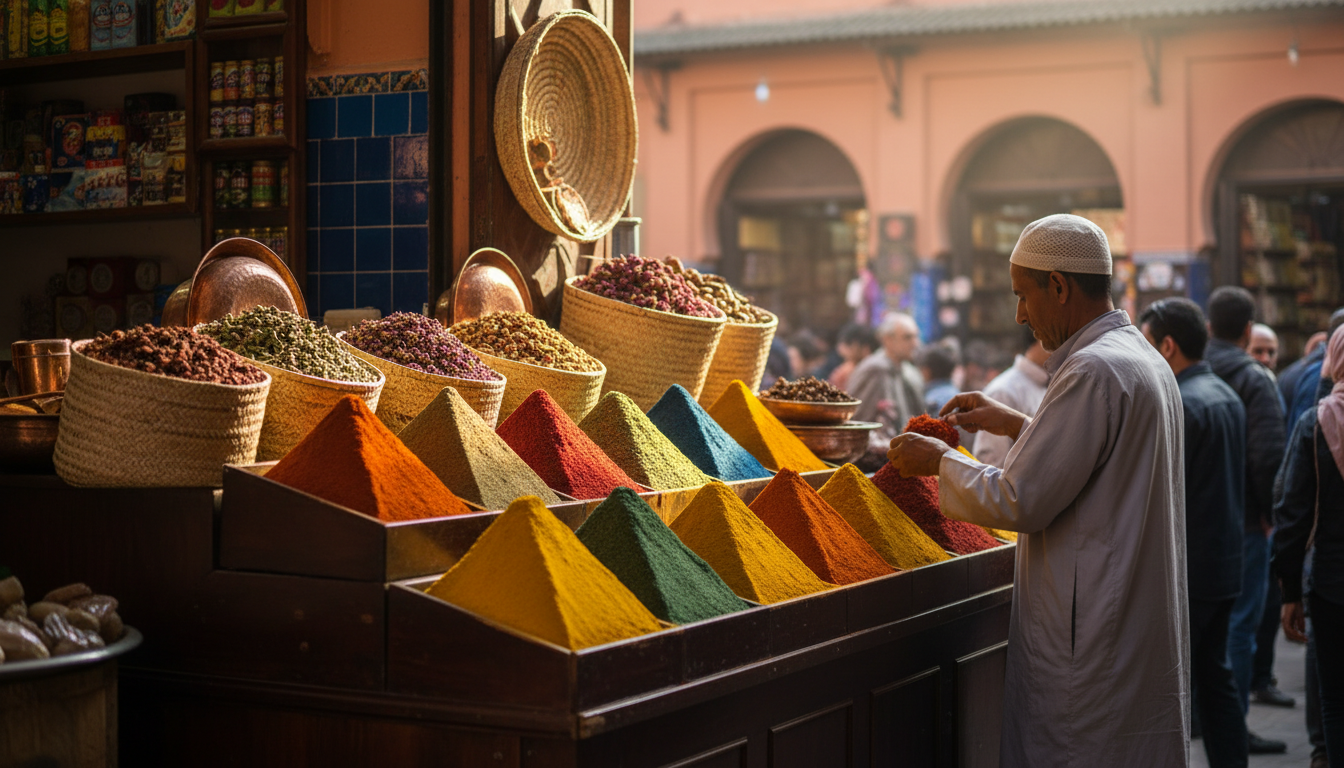 colorful spice pyramids at a Marrakech souk, copper containers and woven baskets, vendor in white ca
Making Your Home Exchange Listing Attractive to Marrakech Hosts
Here's something retirees have going for them: you're often the ideal guest.
Marrakech homeowners—especially those with carefully restored riads—tend to be protective of their properties. They're not looking for party groups or careless backpackers. They want mature travelers who'll respect the space, water the plants, and maybe even appreciate the craftsmanship.
When creating your listing, emphasize your experience as homeowners (you understand property care), your travel style (relaxed, respectful, interested in local culture), what makes your home special (the garden, the neighborhood, the proximity to hiking), and your flexibility on dates (retirees can often travel off-peak).
Include photos that show your home at its best, but also photos of you. Hosts want to know who's staying in their space. A friendly photo of you and your partner makes a huge difference.
A Typical Day: What Relaxed Marrakech Living Actually Looks Like
I want to paint a picture here, because I think it helps to visualize this.
You wake up around 8, sunlight filtering through the carved wooden screens. The riad is quiet—those thick walls again. You make coffee in the kitchen, then carry it up to the rooftop terrace. The call to prayer echoes across the medina. The air is still cool.
Around 10, you walk to a nearby café for a second coffee and maybe some msemen (Moroccan flatbread) with honey. You chat with the owner, who's starting to recognize you. Your French is improving. Late morning, you wander toward the souks. Not to buy anything specific—just to look. The leather tanneries, the copper workers, the endless textiles. You stop for fresh orange juice (8 dirhams, about 80 cents) at your favorite stall.
Lunch is a tagine at a hole-in-the-wall near the Bahia Palace. Lamb with prunes and almonds, bread for scooping, mint tea after. The whole thing costs $4.
Afternoon: you read on the terrace, maybe nap, perhaps walk to Jardin Majorelle (the famous blue garden, $8 entry). The light turns golden. Evening: you cook dinner from souk ingredients—fresh vegetables, spices, maybe some fish from the market. Or you walk to a neighborhood restaurant where locals eat. Either way, you're in bed by 10, pleasantly tired.
This is the rhythm. It's not about checking off sights. It's about being somewhere.
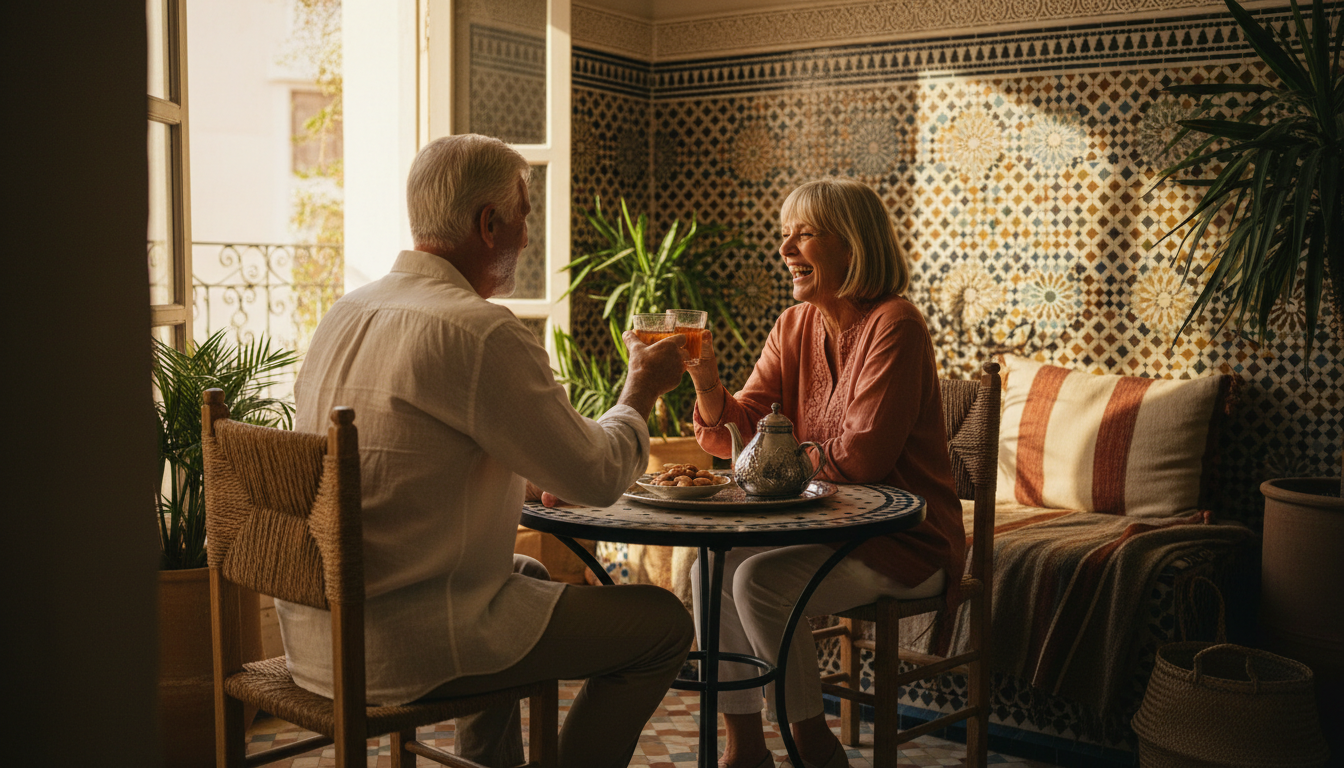 elderly Western couple sitting at a small Moroccan caf table, laughing over glasses of mint tea, zel
Connecting with Other Expats and Long-Term Visitors
One concern I hear from retirees: "Won't I be isolated?"
Marrakech has a substantial community of expats and long-term visitors, especially in winter. The American Language Center hosts events and conversation groups—even if your French is fine, it's a good social hub. Café du Livre in Gueliz is a bookshop-café that's basically expat central. English books, good wifi, and you'll inevitably strike up conversations.
Facebook groups like "Marrakech Expats" and "Marrakech Long-Termers" are active and helpful. People share recommendations, organize dinners, and offer practical advice. Hash House Harriers runs a weekly walking/running group—it's more social than athletic, and the post-walk drinks are the real point.
I've also found that home exchange naturally builds connections. The hosts I've stayed with often introduce me to their local friends, recommend their favorite hammam, or connect me with other exchangers in the area.
Safety and Common Concerns for Retirees
I won't pretend Marrakech is Zurich. It's a developing country with developing-country realities. But I've never felt unsafe there, and neither have the retirees I've talked to.
The medina can be disorienting, but it's not dangerous. You might get lost; you won't get mugged. The biggest annoyances are persistent touts and the occasional scam attempt—neither threatening, just tiresome.
Some practical tips: download offline maps (Maps.me or Google Maps offline) before you arrive. Carry small bills for tips and small purchases; avoid flashing large notes. Women may get more attention; modest dress helps but doesn't eliminate it. Trust your instincts about people, same as anywhere. Keep your host's phone number handy in case you get truly lost.
For health, the main risks are stomach issues (common but usually minor) and sun exposure. Drink bottled water, ease into street food, and wear a hat.
When to Visit: Timing Your Marrakech Home Exchange
The sweet spot for retirees is October through April.
October-November brings warm temperatures (70s-80s°F) with crowds thinning after summer—excellent time. December-February runs cool to cold, especially at night (40s-60s°F). Pack layers. This is peak season for European escapees, so book early. March-April warms up nicely, with spring flowers in the countryside. Lovely for day trips to the Atlas. May-September? Increasingly brutal heat. June through August regularly tops 100°F. I'd avoid it unless you're very heat-tolerant.
For home exchange, start reaching out to potential hosts 2-3 months before your desired dates. Marrakech riads are popular, and the best ones book up.
Day Trips and Excursions Worth Taking
Once you've settled into Marrakech life, you'll want to explore beyond the city. All of these work as day trips:
Ourika Valley is 45 minutes into the Atlas foothills. Berber villages, a waterfall hike (gentle, not strenuous), and lunch by the river. $30-40 for a shared taxi or $80 for a private driver.
Essaouira is a coastal town 2.5 hours west—completely different vibe. Portuguese fortifications, fishing boats, wind-swept beaches. Great for a 2-3 day side trip if you want variety.
Ouzoud Waterfalls are Morocco's most impressive, about 2.5 hours northeast. The hike down is moderate; there are Barbary macaques. Bring a swimsuit if you want to dip in the pools.
Atlas Mountain villages like Imlil are the most accessible, about 90 minutes from Marrakech. From there, you can do easy walks with mountain views, or just have lunch and enjoy the scenery.
Many Marrakech homeowners can arrange drivers or recommend guides. This is one of those times when local knowledge proves invaluable.
Getting Started: Your First Home Exchange in Marrakech
If this is resonating with you, here's how I'd approach it:
Step one: Create a thorough listing of your own home on SwappaHome. Good photos, honest description, emphasis on what makes it special. You start with 7 free credits—already enough for a solid Marrakech trial.
Step two: Search Marrakech listings. Filter by neighborhood (Kasbah and Mellah for medina experience, Gueliz for modern comfort). Read descriptions carefully for accessibility and amenities.
Step three: Send thoughtful messages to potential hosts. Introduce yourselves, explain why you're interested in their specific home, mention your dates and flexibility. Personal connection matters in home exchange.
Step four: Once you've confirmed a stay, ask your host for their recommendations. Best cafés, reliable taxi drivers, their favorite hammam. This insider knowledge is half the value of home exchange.
Step five: Book your flights and get travel insurance. Consider arriving a day early and staying in a hotel to recover from jet lag before settling into the riad.
Then? Just go. Be open. Get lost in the souks. Drink too much mint tea. Let Marrakech work its strange magic on you.
I think about David and Patricia often—that couple with the Cotswolds-to-Marrakech exchange. They told me their three months in Morocco each year had become the highlight of their retirement. "We're not tourists anymore," David said. "We have a neighborhood. We have routines. We have friends here."
That's what home exchange offers that hotels never can: the chance to actually live somewhere, not just visit it. And Marrakech, with its slow rhythms and affordable living and sensory richness, might be the perfect place to try it.
Your riad is waiting. The terrace. The mint tea. The mountains turning pink at sunset.
Frequently Asked Questions
Is home exchange in Marrakech safe for retirees?
Yes, home exchange in Marrakech is generally safe for retirees. The medina can feel chaotic initially, but it's not dangerous—just unfamiliar. Choose accommodations in calmer neighborhoods like Kasbah or Mellah, use SwappaHome's review system to vet hosts, and arrange your own travel insurance for peace of mind. Most retirees find Moroccans welcoming and helpful.
How much does a month in Marrakech cost with home exchange?
With accommodation covered through home exchange, expect to spend $1,200-1,500 per month for a comfortable retirement lifestyle in Marrakech. This includes meals ($15-25/day), transportation ($3-5/day), activities, and occasional splurges. Compare this to $3,000-5,000 monthly in European cities—your retirement savings stretch significantly further.
What's the best time of year for retirees to visit Marrakech?
October through April offers ideal conditions for retired home exchangers in Marrakech. Temperatures range from 50-80°F, perfect for walking and exploring. December through February is peak season for winter escapees, so book early. Avoid June through September when temperatures regularly exceed 100°F.
Do I need to speak French or Arabic for home exchange in Marrakech?
French is widely spoken in Marrakech and extremely helpful for daily life—basic phrases go a long way. Arabic is appreciated but not expected from visitors. Many younger Moroccans speak English, especially in tourist areas. Your home exchange hosts can help bridge language gaps and provide essential phrases for shopping and transportation.
Can I do a long-term home exchange in Marrakech (1-3 months)?
Absolutely—long-term stays are where home exchange truly shines for retirees. US, UK, Canadian, and EU citizens receive 90-day visa-free entry to Morocco. SwappaHome's credit system (1 credit = 1 night) makes extended stays affordable. Many Marrakech homeowners specifically seek responsible long-term guests who'll care for their riads.

Published by
SwappaHome
SwappaHome Editorial Team
Home Exchange & Slow Travel Editorial
The SwappaHome Editorial Team brings together travel research, home-exchange community insights, and platform data to produce practical guides for first-time and experienced home swappers. Every article cites real platforms, current market rates, and verifiable city-level facts so readers can make informed decisions without guessing.
Ready to try home swapping?
Join SwappaHome and start traveling by exchanging homes. Get 7 free credits when you sign up!
Related articles
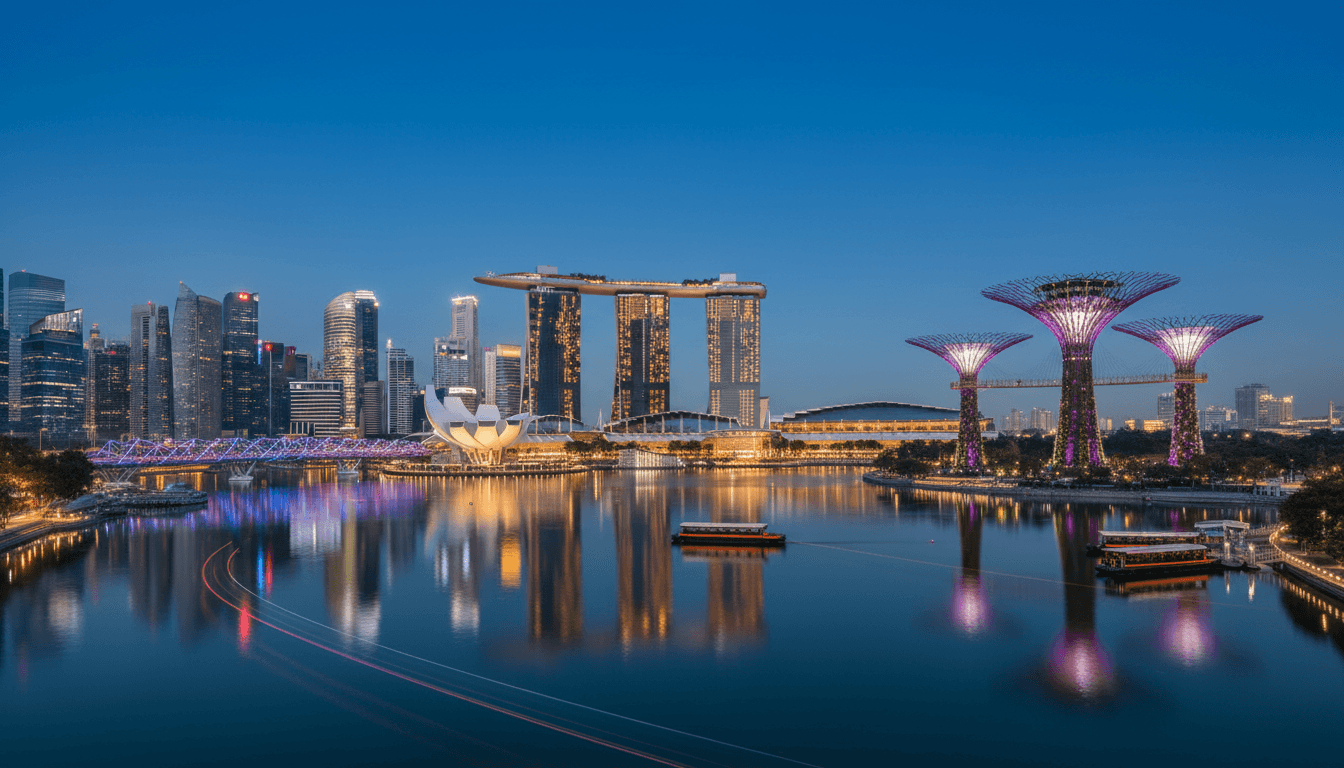
Bachelor and Bachelorette Parties in Singapore: The Complete Home Swap Group Guide for 2026
Planning a bachelor or bachelorette party in Singapore? Discover how home swapping lets groups of 6-12 stay together in luxury condos, saving thousands while partying in Marina Bay.
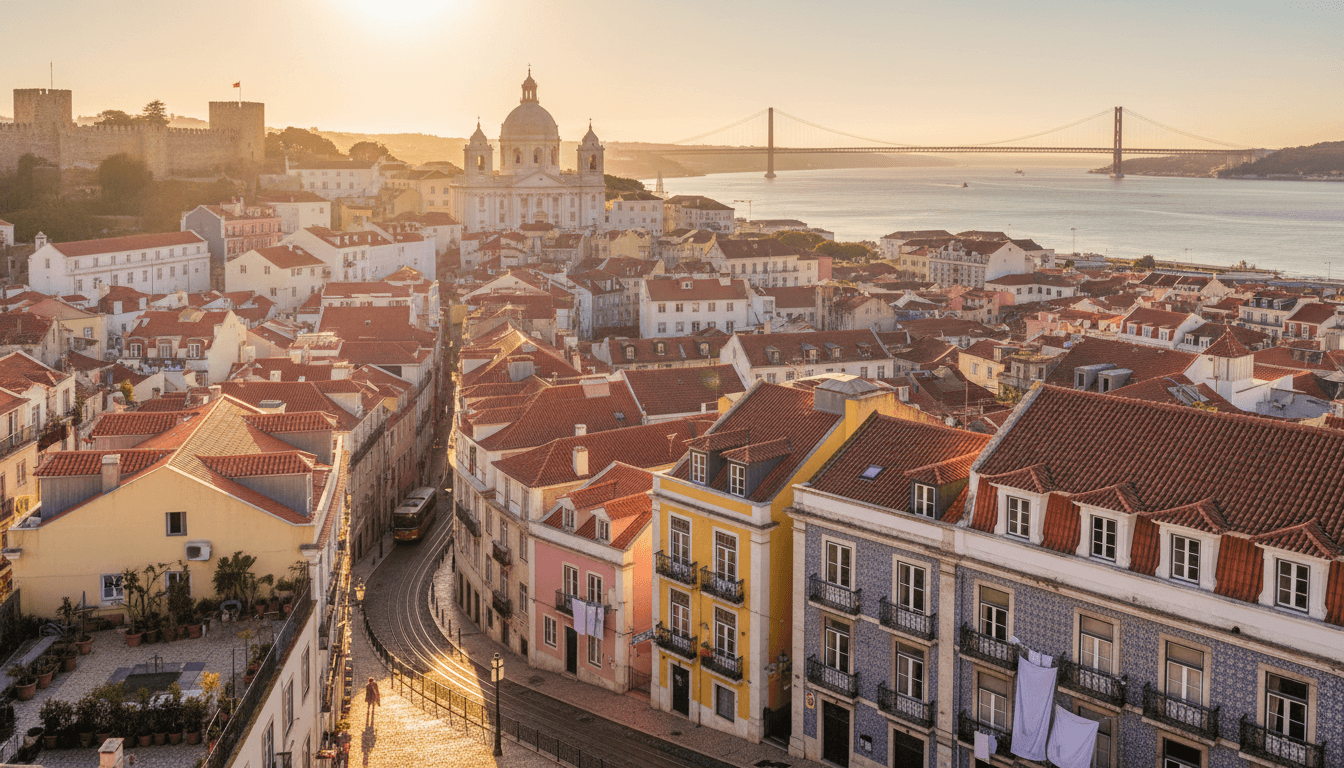
Cycling in Lisbon: 7 Home Swap Bike Tour Itineraries for Every Rider
Discover the best cycling routes in Lisbon with these home swap bike tour itineraries—from waterfront paths to hilltop adventures, all starting from your borrowed home.
Graduation Trip to Barcelona: How Home Swapping Gives New Graduates the Ultimate Celebration
Planning a graduation trip to Barcelona? Discover how home swapping lets new graduates explore Spain's most vibrant city without the hostel crowds or hotel costs.