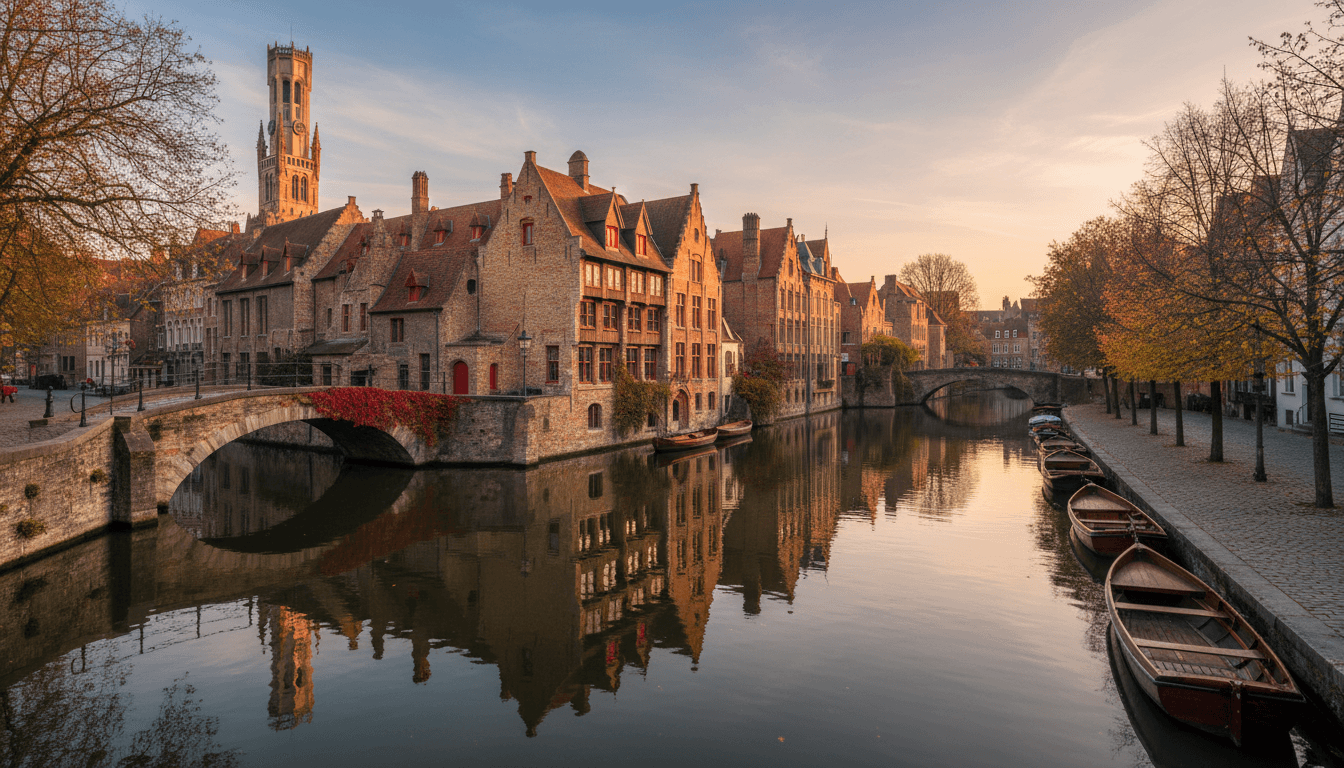
Retirement Travel to Bruges: Why Home Exchange is Perfect for Slow Travel

SwappaHome Editorial Team
Home Exchange & Slow Travel Editorial
Discover why retirement travel to Bruges through home exchange offers the ideal slow travel experience—affordable, authentic, and perfectly paced for savoring Belgium's medieval gem.
The first time I walked across Bruges' Rozenhoedkaai at dawn, I had the entire canal to myself. No tour groups. No selfie sticks. Just me, the swans gliding past centuries-old guild houses, and the smell of fresh waffles drifting from a bakery that wouldn't open for another hour.
I was staying in a retired professor's apartment overlooking the Minnewater—the "Lake of Love"—and I'd been there long enough to know exactly which cobblestones to avoid (the ones near the fish market get slippery), which café served the best hot chocolate (De Proeverie, no contest), and that the carillon concert at the Belfry sounds completely different from inside the city walls than from the tourist crowds below.
Retirement travel to Bruges through home exchange gave me something no hotel stay ever could: time. Time to actually live in one of Europe's most enchanting medieval cities rather than just photograph it.
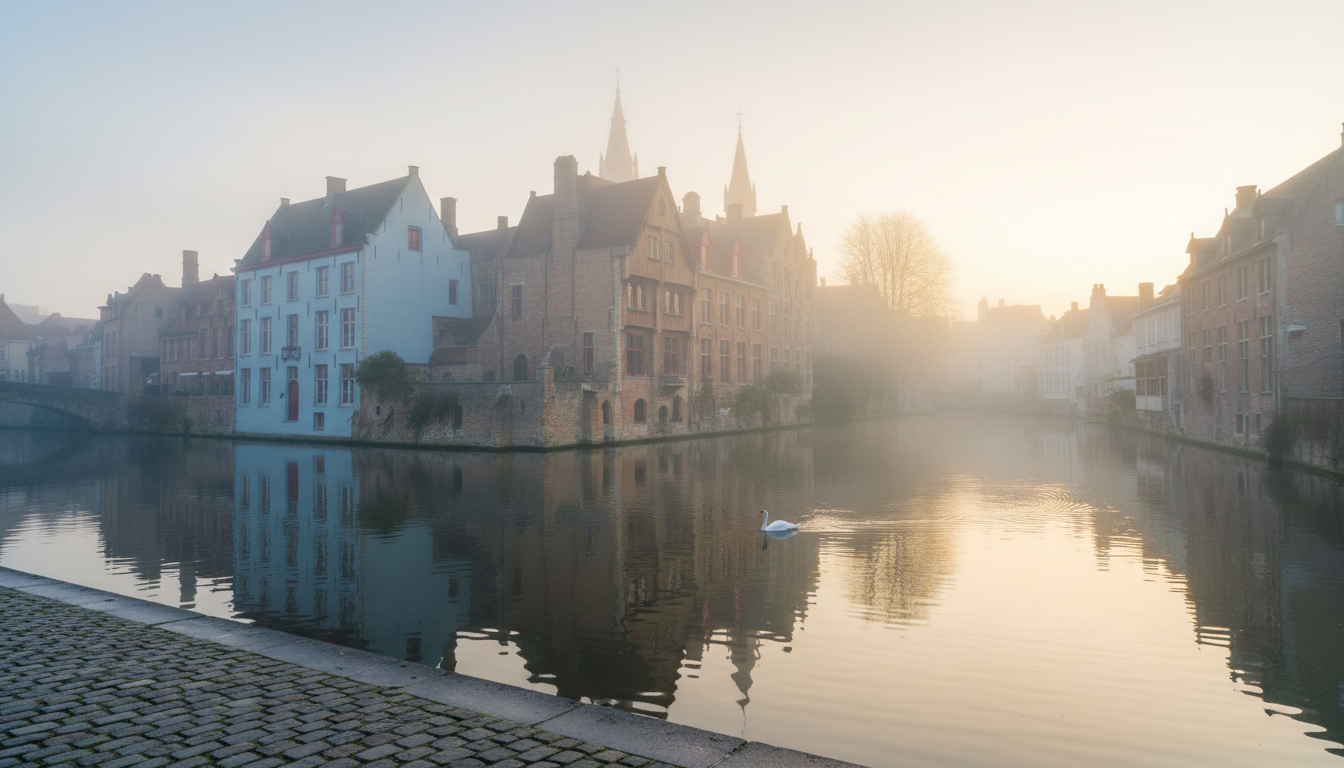 Misty morning view of Bruges Rozenhoedkaai canal with medieval brick buildings reflected in still wa
Why Bruges is Made for Retirement Travel
Here's something tour guides won't tell you: Bruges is exhausting if you try to do it in two days. The cobblestones are uneven. The museums are dense with Flemish masterpieces that deserve more than a passing glance. And the beer culture alone—with over 170 varieties brewed in the region—could occupy a month of careful research.
But give yourself two or three weeks? Everything shifts.
The city was literally designed for walking. It's compact enough that you can cross the entire historic center in twenty minutes, but packed with so many hidden courtyards, almshouses, and canal-side benches that you could spend a lifetime discovering new corners. The pace here is slower than Brussels or Antwerp. Locals actually stop to chat. Shop owners remember your name after the second visit.
For retirees, this matters. You're not racing against a vacation clock anymore. You can spend an entire afternoon in the Groeningemuseum studying Jan van Eyck's impossible detail work, then come back the next day to see what you missed. You can take the scenic route to the grocery store because—honestly?—the scenic route is the only route.
And the practical stuff? Bruges handles it beautifully. The city center is largely car-free, so you're not dodging traffic. There's excellent healthcare nearby (AZ Sint-Jan hospital is a ten-minute taxi ride). English is spoken everywhere. The trains to Brussels Airport run like clockwork—about 90 minutes door-to-door.
Home Exchange for Retirement Travel: The Perfect Match
I'll be honest with you: I didn't start home swapping because I was trying to be trendy. I started because I was tired of spending $200 a night on hotel rooms that felt identical whether I was in Portland or Prague.
But for retirement travel specifically? Home exchange isn't just economical—it changes everything.
Think about what you actually need when you're staying somewhere for two weeks or more. A real kitchen where you can cook breakfast without paying $25 for hotel eggs. A washing machine (because nobody wants to pack three weeks of clothes). A comfortable chair for reading. A neighborhood where you can establish a routine.
Hotels in Bruges' historic center run $180-280 per night for anything decent. That's $2,520-$3,920 for a two-week stay—before you've eaten a single meal or visited a single museum. Vacation rentals aren't much better, averaging $150-200 nightly for a centrally located apartment.
With SwappaHome's credit system, you're spending zero dollars on accommodation. You earn credits by hosting travelers at your home, then use those credits to book stays anywhere in the network. One credit equals one night, regardless of whether you're staying in a Manhattan penthouse or a Bruges canal house. New members start with 7 free credits—that's a full week of accommodation right there.
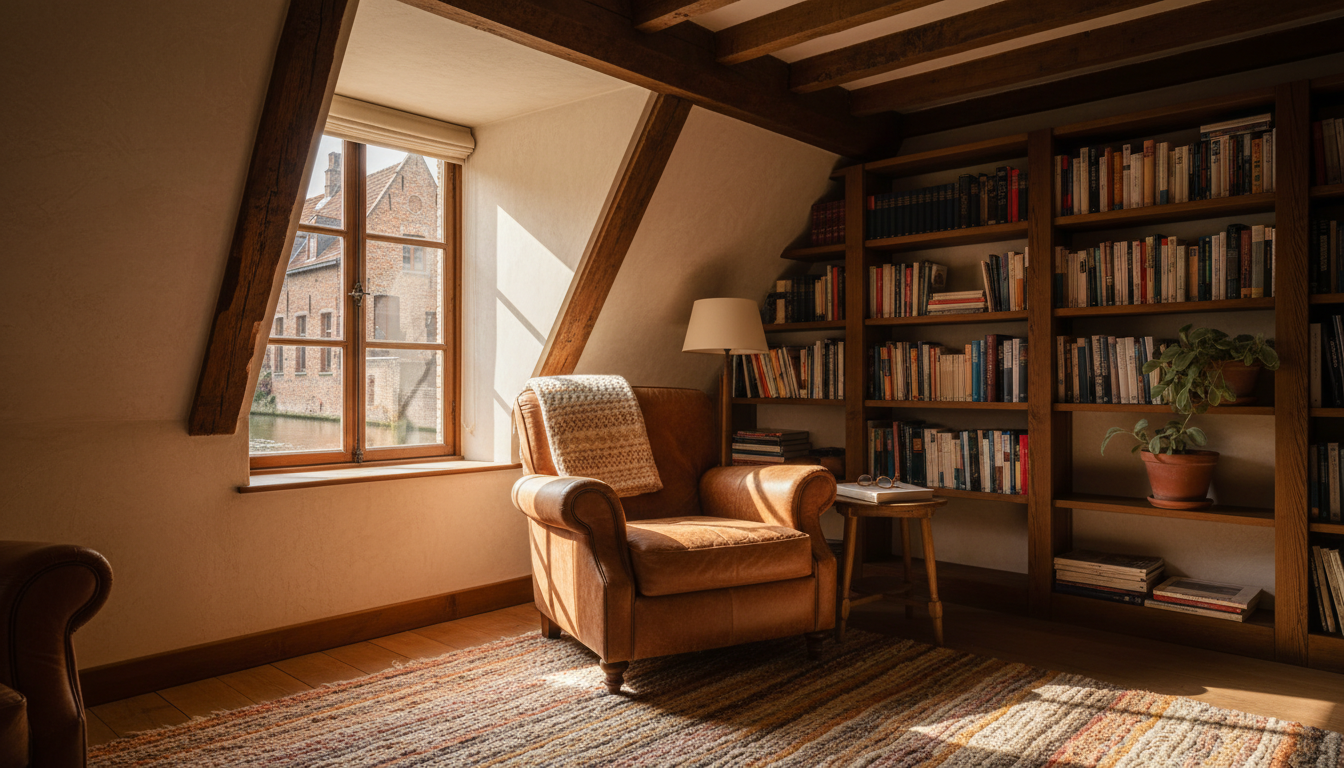 Cozy living room in a traditional Bruges townhouse with exposed wooden beams, a worn leather armchai
The Best Bruges Neighborhoods for Home Exchange
Not all of Bruges is created equal for longer stays. The Markt square is spectacular, but you probably don't want to sleep above a waffle shop with tour groups streaming past at 8 AM.
Sint-Anna: The Quiet Side of the Canals
This is my favorite neighborhood for extended stays, and I don't think I'm alone. Sint-Anna sits just east of the main tourist circuit—close enough to walk everywhere, far enough that you'll actually hear birds instead of guided tour microphones.
The area around the Jerusalem Church (a genuine 15th-century replica of the Holy Sepulchre, built by a wealthy merchant family after their pilgrimage) has some of the most authentic residential streets in the city. You'll find locals walking their dogs, small bakeries that don't appear in guidebooks, and a genuine sense of neighborhood. Housing here tends toward traditional Bruges townhouses—narrow, tall, with steep stairs that are worth mentioning if mobility is a concern. But the trade-off is living in a real home, often with small gardens or terraces overlooking quiet canals.
The Minnewater Area: Romantic and Residential
South of the city center, around the Minnewater park and the Begijnhof (a UNESCO-protected 13th-century community of religious women), you'll find a more residential atmosphere. It's about a 15-minute walk to the Markt, but you're rewarded with green space, waterfowl, and streets that feel genuinely lived-in.
This area works particularly well if you're traveling as a couple. The Minnewater itself—the "Lake of Love"—is genuinely beautiful, and having it as your backyard never gets old. I watched the sunset from a bench there probably twenty times during my stay. Each time felt like a small gift.
Around the Train Station: Practical, Not Romantic
I know, I know—nobody dreams of staying near a train station. But hear me out: if you're planning day trips to Ghent (30 minutes), Brussels (1 hour), or the Belgian coast (15 minutes to Ostend), being a five-minute walk from the station changes your entire experience.
The 't Zand area, between the station and the old city, has more modern apartments with elevators—something to consider if stairs are an issue. It's less picturesque but more practical, and you're still only a ten-minute walk from the Markt.
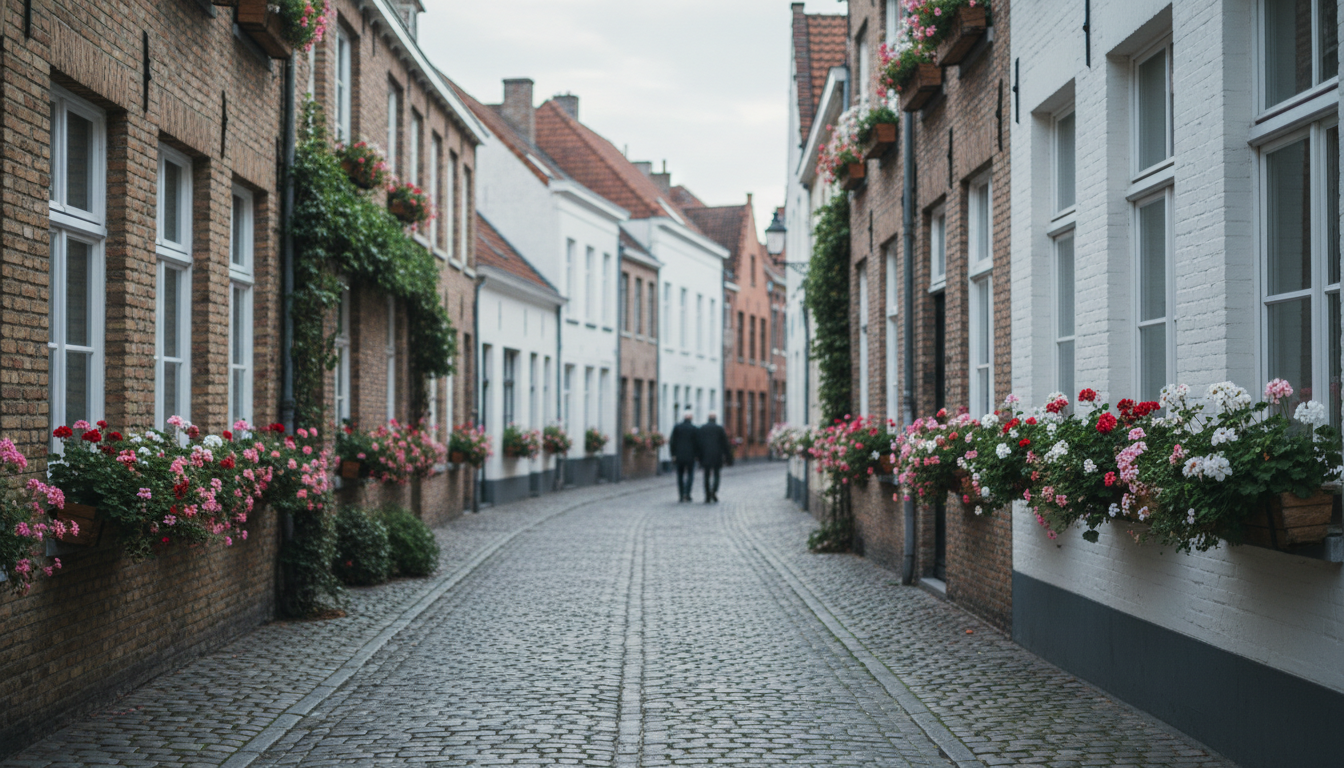 Narrow cobblestone street in Bruges Sint-Anna neighborhood, traditional brick houses with white-trim
What a Week of Retirement Travel in Bruges Actually Looks Like
Let me paint you a picture.
You wake up around 8 AM—no alarm, because why would you set one? The light coming through the lace curtains is that particular Flemish gray-gold that painters have been chasing for five hundred years. You make coffee in the kitchen (you figured out the European stovetop espresso maker on day two) and eat breakfast at the small table by the window, watching the canal boats begin their first tours of the day.
By 9:30, you're walking to the bakery. You've learned the owner's name is Katrien, and she's started setting aside a koekebrood—a sweet bread with raisins—because she knows you'll be in. The transaction happens in a mix of English and your terrible Dutch, and you both find this hilarious.
Maybe today you visit the Memling Museum, housed in the medieval St. John's Hospital. It's small enough to absorb in two hours without feeling rushed. Hans Memling's portraits are extraordinary—faces that feel like they could speak to you—and you find yourself returning to the same painting three times, noticing something new each visit.
Lunch is a croque monsieur at a café where you've become a regular. The owner's daughter is studying for university exams, and you've started asking about her progress. She practices her English on you. You tell her about your grandkids.
The afternoon might be a canal boat tour (yes, even locals do them sometimes—the perspective from the water is genuinely different), or a walk through the Begijnhof when the tour groups have moved on, or simply reading in the park. You've stopped feeling guilty about "wasting" time. This is the point.
Dinner is something you cook yourself—Belgian endives braised in butter, a crusty bread from the bakery, a local cheese you discovered at the Saturday market. You open a Trappist beer (Westmalle Dubbel, because you've developed opinions about these things) and eat at the kitchen table while the church bells mark the hour.
This is retirement travel. This is what you worked for.
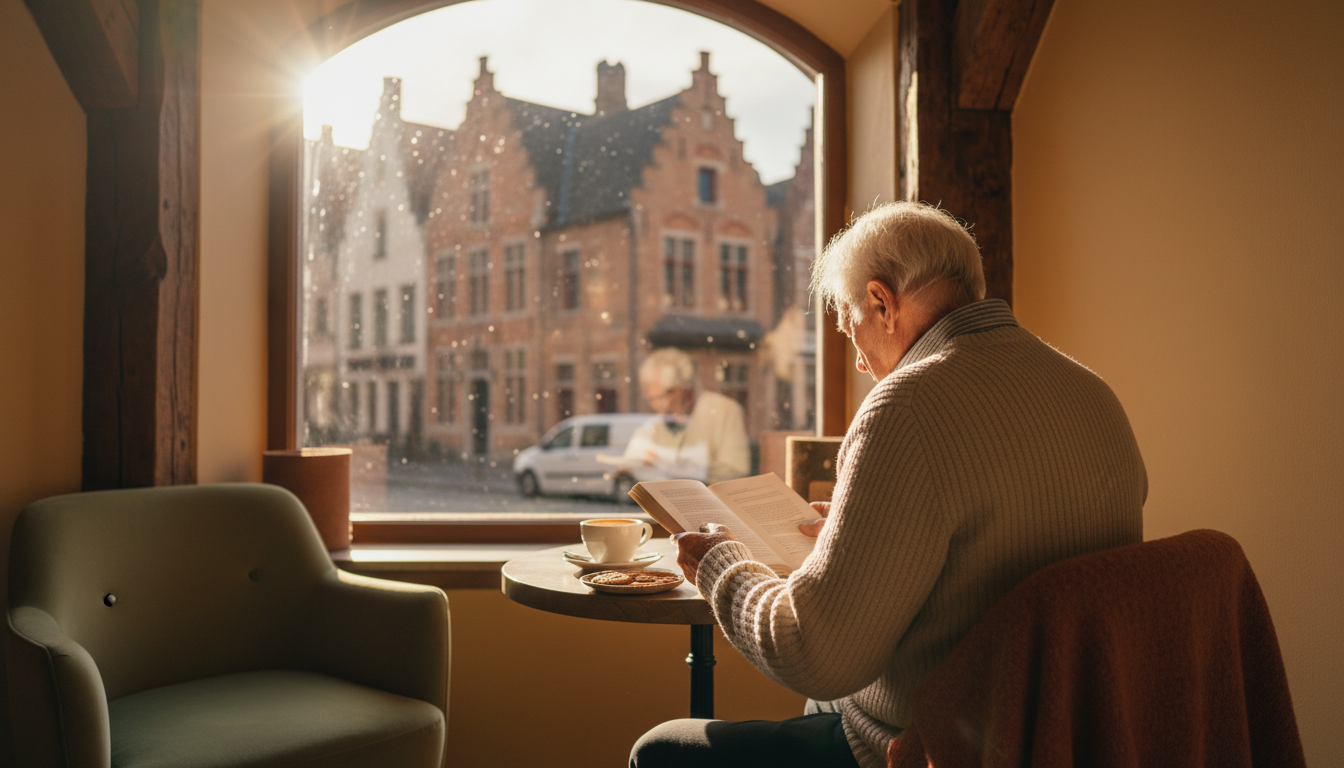 Golden afternoon light in a Bruges caf, elderly traveler reading a book at a window table, half-fini
Practical Tips for Home Exchange in Bruges
Alright, let's get into the specifics.
Timing Your Visit
Bruges has distinct seasons, and they matter more than you might think.
April through early June is my favorite window. The weather is mild (50-65°F), the gardens are exploding with color, and the summer crowds haven't descended yet. You'll have the museums nearly to yourself on weekday mornings.
September and October offer similar advantages, plus the bonus of Belgian beer festival season. The Bruges Beer Festival in early September is surprisingly accessible—not a rowdy college scene, but a genuine celebration of brewing heritage.
Winter (December through February) is magical but cold. The Christmas markets transform the Markt into something from a storybook, but temperatures hover around freezing, and many canal boats stop running. If you don't mind bundling up, though, winter Bruges has an intimacy that summer can't match.
July and August? I'd skip them unless you have no other option. The crowds are intense, prices spike, and the city loses some of its magic when you're shuffling through the streets in a tourist conga line.
What to Look for in a Bruges Home Exchange
Mobility considerations come first. Many Bruges homes are centuries-old townhouses with steep, narrow stairs—charming, but potentially challenging. When browsing listings on SwappaHome, look for ground-floor bedrooms or apartments with elevators, mentions of step-free access, photos that show staircase width and steepness, and proximity to flat walking routes (the area around the Markt is mostly level).
Kitchen setup matters for longer stays. Look for listings that mention a full kitchen versus a kitchenette. You'll want at least a stovetop, refrigerator, and basic cookware. Belgian grocery stores are excellent—Delhaize and Carrefour are the main chains—but you need somewhere to actually prepare what you buy.
Washing machine access is non-negotiable for stays over a week. Most Belgian homes have them, but confirm before booking.
Communication with Your Exchange Host
This is where home exchange really shines for retirement travel. Unlike Airbnb, where you might never interact with your host, home exchange creates a genuine connection.
Before your trip, ask your host about their favorite neighborhood restaurant (not the tourist one, the real one), the best day to visit the fish market, which pharmacy they use and whether it requires a prescription for common medications, and the quirks of their home (does the hot water take a minute to warm up? Which key opens the garden gate?).
Many hosts leave detailed welcome guides, but the personal recommendations are gold. My Bruges host told me about a tiny chocolate shop on Katelijnestraat where the owner still makes pralines by hand—no sign, no website, just a doorbell and a display case. I never would have found it otherwise.
 Belgian chocolate pralines arranged on a marble counter in a small artisan shop, warm lighting, hand
Day Trips from Your Bruges Home Base
One of the underrated advantages of staying in Bruges for an extended period: it's perfectly positioned for exploring Flanders without the hassle of changing hotels every few days.
Ghent: The Underrated Gem
Thirty minutes by train (about $8 round trip), and you're in a city that rivals Bruges for medieval atmosphere but with half the tourists. The Ghent Altarpiece at St. Bavo's Cathedral is worth the trip alone—Van Eyck's masterpiece, recently restored, is genuinely breathtaking.
I'd suggest at least two day trips to Ghent. The first to see the major sights (the castle, the cathedral, the Graslei waterfront), the second to wander without an agenda.
The Belgian Coast
Ostend is 15 minutes by train, and the coastal tram runs the entire length of the Belgian shoreline—about 40 miles of beaches, dunes, and small resort towns. It's not the Mediterranean, but there's something bracing about the North Sea, and the seafood in Ostend is spectacular.
De Haan, a few stops up the coast, is a perfectly preserved Belle Époque beach town that feels like stepping into a 1920s postcard.
Brussels: When You Need a City Fix
An hour by train, and you're in a proper capital city with world-class museums, diverse restaurants, and the kind of energy that Bruges intentionally lacks. The Royal Museums of Fine Arts could occupy several visits. The Magritte Museum is surrealism heaven.
But here's the thing: after a few weeks in Bruges, you might find Brussels feels overwhelming. You'll be grateful to return to your quiet canal-side apartment, to the familiar walk to the bakery, to the slower rhythm you've built. That's the gift of extended travel. You develop a sense of home.
The Real Cost Comparison: Home Exchange vs. Traditional Accommodation
Let's do the math on a two-week retirement trip to Bruges.
Traditional Hotel (mid-range, central location): Accommodation runs $220/night × 14 nights = $3,080. Add hotel breakfasts at $25/day × 14 days = $350. Total: $3,430.
Vacation Rental: Accommodation at $175/night × 14 nights = $2,450, plus groceries for breakfasts around $100. Total: $2,550.
Home Exchange via SwappaHome: Accommodation costs 14 credits (free if you've hosted guests), plus groceries for breakfasts around $100. Total: $100.
That's a savings of $2,450-$3,330—enough for business class flights, or an extra week in Belgium, or a serious dent in your next adventure fund.
And the savings compound over time. If you're doing three or four extended trips per year in retirement, home exchange can save you $10,000-15,000 annually. That's not theoretical money. That's real trips you can take, experiences you can have, grandchildren you can visit.
Building Trust in the Home Exchange Community
I get it—the idea of strangers staying in your home (and staying in theirs) can feel uncomfortable at first. But here's what I've learned after seven years and forty-plus exchanges: the home swap community is remarkably trustworthy.
SwappaHome's verification system helps establish baseline trust. Members can verify their identity, and the review system means everyone has a reputation to protect. I've never had a negative experience, and the retired travelers I've met through the platform have become genuine friends.
That said, I always recommend getting your own travel insurance that covers personal belongings, and some members choose to get additional home insurance for peace of mind. SwappaHome connects you with other members, but the relationship—and any arrangements around security deposits or house rules—is between you and your exchange partner.
Most exchanges involve detailed communication beforehand. You'll know who's staying in your home, they'll know what to expect from yours, and there's a mutual investment in treating each other's spaces with respect. It's not a transaction; it's a relationship.
Why Home Exchange is Particularly Suited to Retirement Travel
I've been thinking about this a lot lately, as more of my friends enter retirement and start asking about how I travel so much on a fixed income.
Home exchange works for retirees in ways it doesn't for younger travelers. You have time flexibility—you can travel during shoulder seasons when home exchange inventory is highest and tourist crowds are lowest. You're not constrained to school holidays or limited vacation days.
You have a home worth exchanging. After decades of building a life, you likely have a comfortable, well-equipped home that other travelers would love to stay in. That empty nest? It's an asset.
You value comfort over novelty. Hostels and budget hotels lose their appeal. You want a real bed, a real kitchen, a real neighborhood. Home exchange delivers exactly that.
You appreciate connection. The relationships formed through home exchange—the local recommendations, the ongoing correspondence, the sense of being welcomed rather than just accommodated—align with what many retirees are seeking from travel.
And you're experienced enough to be good guests. You know how to treat someone else's home because you know how you'd want yours treated. This matters in a community built on mutual respect.
Getting Started with Your Bruges Home Exchange
If you're ready to try this, here's what I'd suggest.
First, create your SwappaHome profile and list your home with honest, detailed descriptions and plenty of photos. Mention what makes your place special—the garden, the proximity to hiking trails, the well-stocked kitchen. Other retirees will be looking for the same things you are.
Second, start browsing Bruges listings to get a sense of what's available. Look at the neighborhoods I mentioned, read the reviews, and save properties that appeal to you.
Third, consider hosting a few guests at your home first. This builds your credit balance and your reputation, and it gives you a feel for how the community works. Many of my best exchange relationships started when I hosted someone from a city I wanted to visit.
Fourth, reach out to Bruges hosts directly. Explain that you're a retiree looking for an extended stay, mention what appeals to you about their home, and ask any questions you have about the neighborhood or accessibility. The best exchanges start with genuine conversation.
And finally, book your trip. Two weeks minimum—three if you can swing it. Bruges rewards patience. It reveals itself slowly, one cobblestone at a time.
I'm writing this from my home office in San Francisco, but part of me is still sitting on that bench by the Minnewater, watching the swans and thinking about absolutely nothing. That's what Bruges gave me. That's what retirement travel through home exchange can give you.
The medieval city will still be there. The canals will still reflect those impossible guild houses. The chocolate shops will still smell like heaven.
All you have to do is give yourself the time to experience it properly.
Frequently Asked Questions
Is home exchange safe for retirement travel to Bruges?
Home exchange through platforms like SwappaHome is generally very safe for retirees. The community is built on mutual trust and accountability—members review each other, creating strong incentives for respectful behavior. Bruges itself is one of Europe's safest cities, with low crime rates and excellent healthcare access. For additional peace of mind, consider getting personal travel insurance that covers your belongings.
How much can I save with home exchange versus hotels in Bruges?
For a two-week stay in Bruges, home exchange can save you $2,450-$3,330 compared to hotels or vacation rentals. Mid-range hotels in central Bruges cost $180-280 per night, while home exchange costs zero dollars for accommodation—you simply use credits earned by hosting guests at your own home. Over a year of retirement travel, these savings can exceed $10,000.
What's the best time of year for retirement travel to Bruges?
April through early June and September through October offer the ideal conditions for retirement travel to Bruges. You'll enjoy mild weather (50-65°F), fewer crowds than summer, and full access to museums and attractions. Winter offers magical Christmas markets but cold temperatures, while July-August brings intense crowds that diminish the slow-travel experience.
Are Bruges homes suitable for travelers with mobility concerns?
Many traditional Bruges townhouses have steep, narrow stairs, but accessible options exist. When searching on SwappaHome, filter for ground-floor apartments or properties with elevators. The 't Zand area near the train station has more modern buildings with better accessibility. Always communicate mobility needs directly with hosts before booking.
How does the SwappaHome credit system work for extended stays?
SwappaHome uses a simple credit system: you earn 1 credit for each night you host guests, and you spend 1 credit for each night you stay elsewhere. New members receive 7 free credits to start. For a two-week Bruges stay, you'd use 14 credits. There's no money exchanged between members—just credits that let you travel affordably to any destination in the network.

Published by
SwappaHome
SwappaHome Editorial Team
Home Exchange & Slow Travel Editorial
The SwappaHome Editorial Team brings together travel research, home-exchange community insights, and platform data to produce practical guides for first-time and experienced home swappers. Every article cites real platforms, current market rates, and verifiable city-level facts so readers can make informed decisions without guessing.
Ready to try home swapping?
Join SwappaHome and start traveling by exchanging homes. Get 7 free credits when you sign up!
Related articles

Bachelor and Bachelorette Parties in Singapore: The Complete Home Swap Group Guide for 2026
Planning a bachelor or bachelorette party in Singapore? Discover how home swapping lets groups of 6-12 stay together in luxury condos, saving thousands while partying in Marina Bay.

Cycling in Lisbon: 7 Home Swap Bike Tour Itineraries for Every Rider
Discover the best cycling routes in Lisbon with these home swap bike tour itineraries—from waterfront paths to hilltop adventures, all starting from your borrowed home.

Graduation Trip to Barcelona: How Home Swapping Gives New Graduates the Ultimate Celebration
Planning a graduation trip to Barcelona? Discover how home swapping lets new graduates explore Spain's most vibrant city without the hostel crowds or hotel costs.